Chapter 01 – An Introduction to Money and the Financial System
Chapter 1
An Introduction to Money and the Financial System
Problems
1. List the financial transactions you have engaged in over the past week. How might
each one have been carried out 50 years ago? (LO1)
Answer: Commercial purchases that you made likely used credit cards and debit
2. How were you, your family or your friends affected by the recent failure of the
financial system to function normally during the financial crisis of 2007-2009? (LO1)
Answer: It is likely that you or someone you know had an account with one of the
3. List three items you used to buy with cash but you now purchase with a debit card.
(LO1)
Answer: Among the possibilities: purchases of cappuccino at the local coffee shop,
4. Various financial instruments usually serve one of two distinct purposes: to store
value or to transfer risk. Name a financial instrument used for each purpose. (LO1)
Answer: Financial instruments used to store value include bank accounts, stocks and
5. Financial innovation has reduced individuals’ need to carry cash. Explain how. (LO1)
Answer: Everyone has a number of alternative methods of payment. Electronic
6. * Many people believe that, despite ongoing financial innovations, cash will always
be with us to some degree as a form of money. What Core Principle could justify this
view? (LO2)
Answer: Core Principle 3 – information is the basis for decisions. When cash is used
to settle a transaction, it is a final payment, not some form of a promise to pay. No
1-1
Copyright © 2015 McGraw-Hill Education. All rights reserved. No reproduction or distribution without the prior written consent of
McGraw-Hill Education.
Chapter 01 – An Introduction to Money and the Financial System
7. When you apply for a loan, you are required to answer lots of questions. Why? Why
is the set of questions you must answer standardized? (LO2)
Answer: The questions are aimed at figuring out how likely you are to repay the loan.
8. Name two distinct financial markets and describe the kind of asset traded in each.
(LO1)
Answer: Among the best-known financial markets are those for stocks and for bonds.
9. * Why do you think the financial system has become more globally integrated over
time? Can you think of any downside to this increased integration? (LO1)
Answer: Technological progress is one obvious reason. According to Core Principle
3, information is the basis for decisions. Improvements in technology have allowed
10. The government is heavily involved in the financial system. Explain why. (LO1)
Answer: For markets to work there have to be rules. And the rules need to be
11. If offered the choice of receiving $1,000 today or $1,000 in one year’s time, which
option would you choose, and why? (LO2)
Answer: Core Principle 1 states that time has value, so you should choose option 1.
By receiving the $1000 today, you can immediately put the money to use. Perhaps
1-2
Copyright © 2015 McGraw-Hill Education. All rights reserved. No reproduction or distribution without the prior written consent of
McGraw-Hill Education.
Chapter 01 – An Introduction to Money and the Financial System
12. If time has value, why are financial institutions often willing to extend you a 30-year
mortgage at a lower annual interest rate than they would charge for a one-year loan?
(LO2)
Answer: With a mortgage, the house you purchase acts as collateral for the loan. In
13. Using Core Principle 2, under what circumstances would you expect a job applicant
to accept an offer of a low base salary and an opportunity to earn commission over
one with a higher base salary and no commission potential? (LO2)
Answer: The applicant would have to expect to earn a higher total salary working for
14. Suppose medical research confirms earlier speculation that red wine is good for you.
Why would banks be willing to lend to vineyards that produce red wine at a lower
interest rate than before? (LO2)
Answer: The future prospects for the vineyards have improved, reducing the risk
15. * If the U.S. Securities and Exchange Commission eliminated its requirement for
public companies to disclose information about their finances, what would you expect
to happen to the stock prices for these companies? (LO2)
Answer: You should expect the stock prices to fall. Gathering sufficient information
16. If 2 percent growth is your break-even point for an investment project, under which
outlook for the economy would you be more inclined to go ahead with the
investment: (1) A forecast for economic growth that ranges from 0 to 4 percent, or (2)
a forecast of 2 percent growth for sure, assuming the forecasts are equally reliable?
What Core Principle does this illustrate? (LO2)
Answer: You would be more inclined to invest in the project if you knew for sure that
17. * Why are large, publicly listed companies much more likely than small businesses to
sell financial instruments such as bonds directly to the market, while small businesses
get their financing from financial institutions such as banks? (LO2)
1-3
Copyright © 2015 McGraw-Hill Education. All rights reserved. No reproduction or distribution without the prior written consent of
McGraw-Hill Education.
Chapter 01 – An Introduction to Money and the Financial System
Answer: Information costs associated with small businesses are higher than those for
large, publicly listed companies—costs that bond market investors are unlikely to be
18. * During the financial crisis of 2007-2009, some financial instruments that received
high ratings in terms of their safety turned out to be much riskier than those ratings
indicated. Explain why markets for other financial instruments might have been
adversely affected by that development. (LO2)
Answer: Core Principle 3 states that information is the basis for decisions. Ratings
19. Suppose financial institutions didn’t exist but you urgently needed a loan. Where
would you most likely get this loan? Using Core Principles, identify an advantage and
a disadvantage this arrangement might have over borrowing from a financial
institution. (LO2)
Answer: In the absence of financial institutions, you are most likely to borrow from a
family member or a friend. An advantage of this arrangement, under Core Principle
Data Exploration
1. Go to the FRED database at the Federal Reserve Bank of St. Louis Web site
(research.stlouisfed.org/fred2/). Register to set up your own account. Doing so will
allow you to save and update graphs, alter them for submitting assignments and
making presentations, and receive a notice whenever the data is updated.
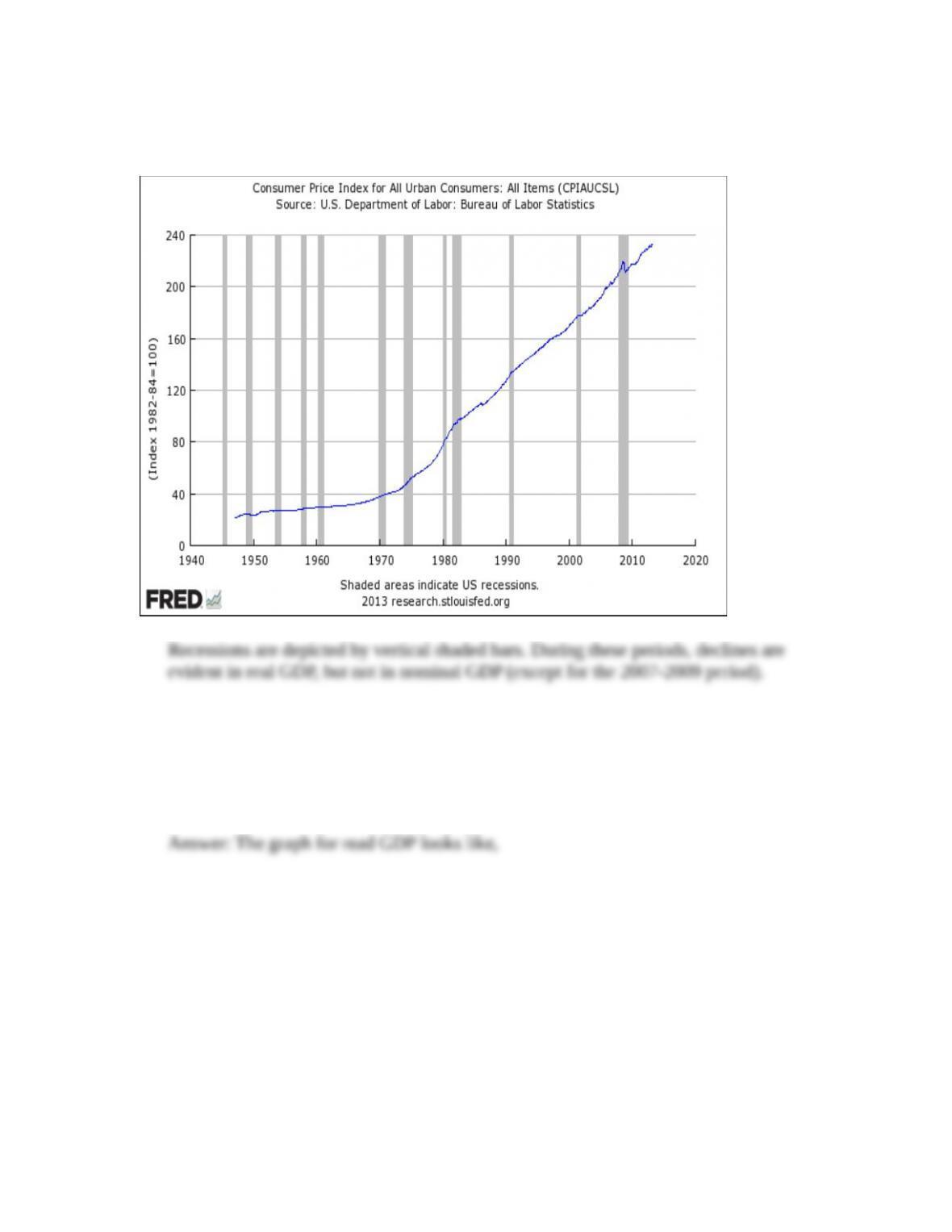
2. To begin using FRED, plot the consumer price index (FRED code:
CPIAUCSL) and find the date and level of the latest observation. Then plot the
inflation rate measured as the percent change from a year ago of this index.
1-4
Copyright © 2015 McGraw-Hill Education. All rights reserved. No reproduction or distribution without the prior written consent of
McGraw-Hill Education.
Chapter 01 – An Introduction to Money and the Financial System
Answer: After following the indicated directions, the plots for CPI (adjusting for any
data revisions) look like:
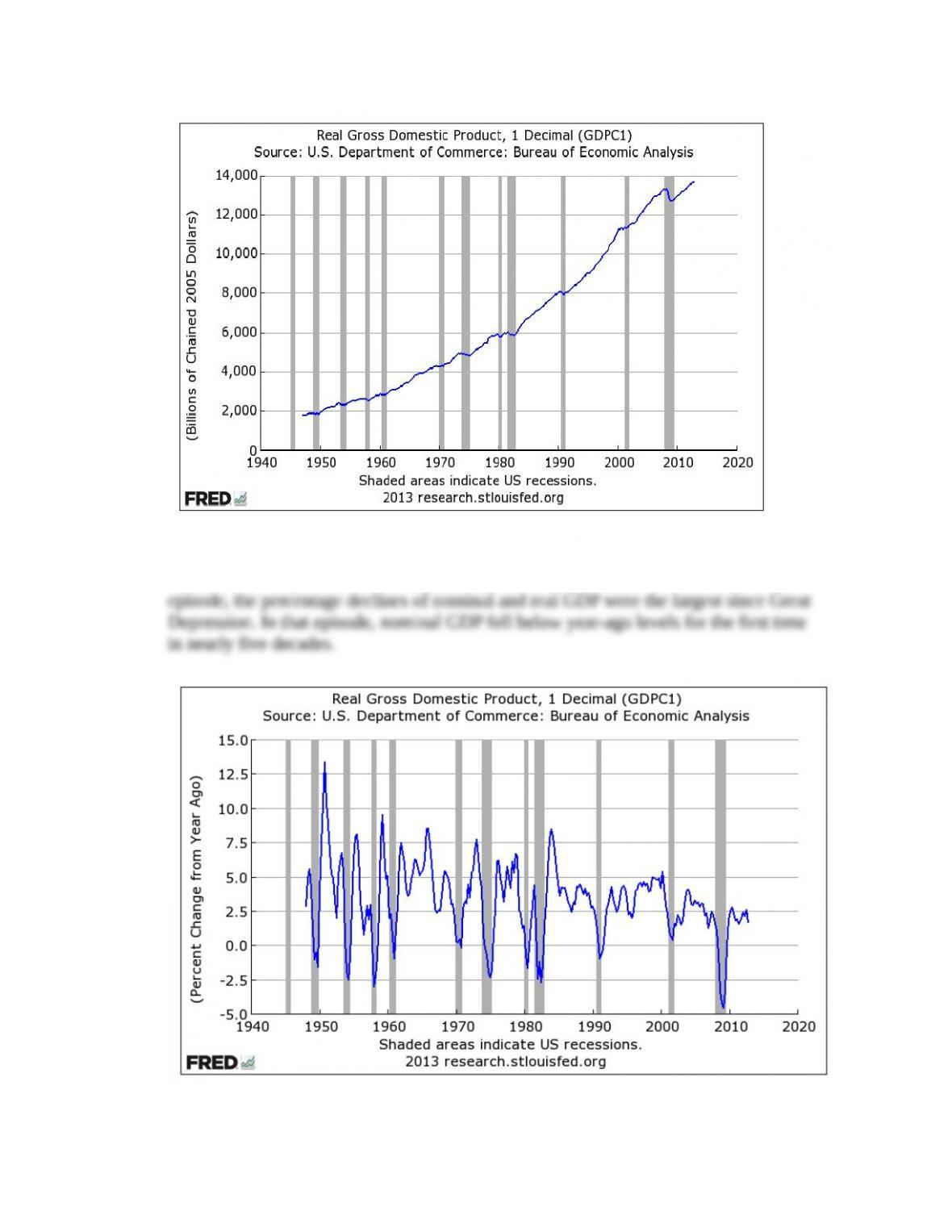
3. Plot the level of real GDP (FRED code: GDPC1). Then plot the rate of economic
growth as the percent change from a year ago of this index. Describe how real GDP
behaves in recessions, which are denoted in the FRED graph by vertical shaded bars.
If you registered on FRED (as in Data Exploration Problem 1), save the graph so that
you can recall and update the graph easily when new observations become available.
1-5
Copyright © 2015 McGraw-Hill Education. All rights reserved. No reproduction or distribution without the prior written consent of
McGraw-Hill Education.
Chapter 01 – An Introduction to Money and the Financial System
Real GDP usually declines in recessions and rebounds afterwards. In the 2007-2009
1-6
Copyright © 2015 McGraw-Hill Education. All rights reserved. No reproduction or distribution without the prior written consent of
McGraw-Hill Education.
Chapter 01 – An Introduction to Money and the Financial System
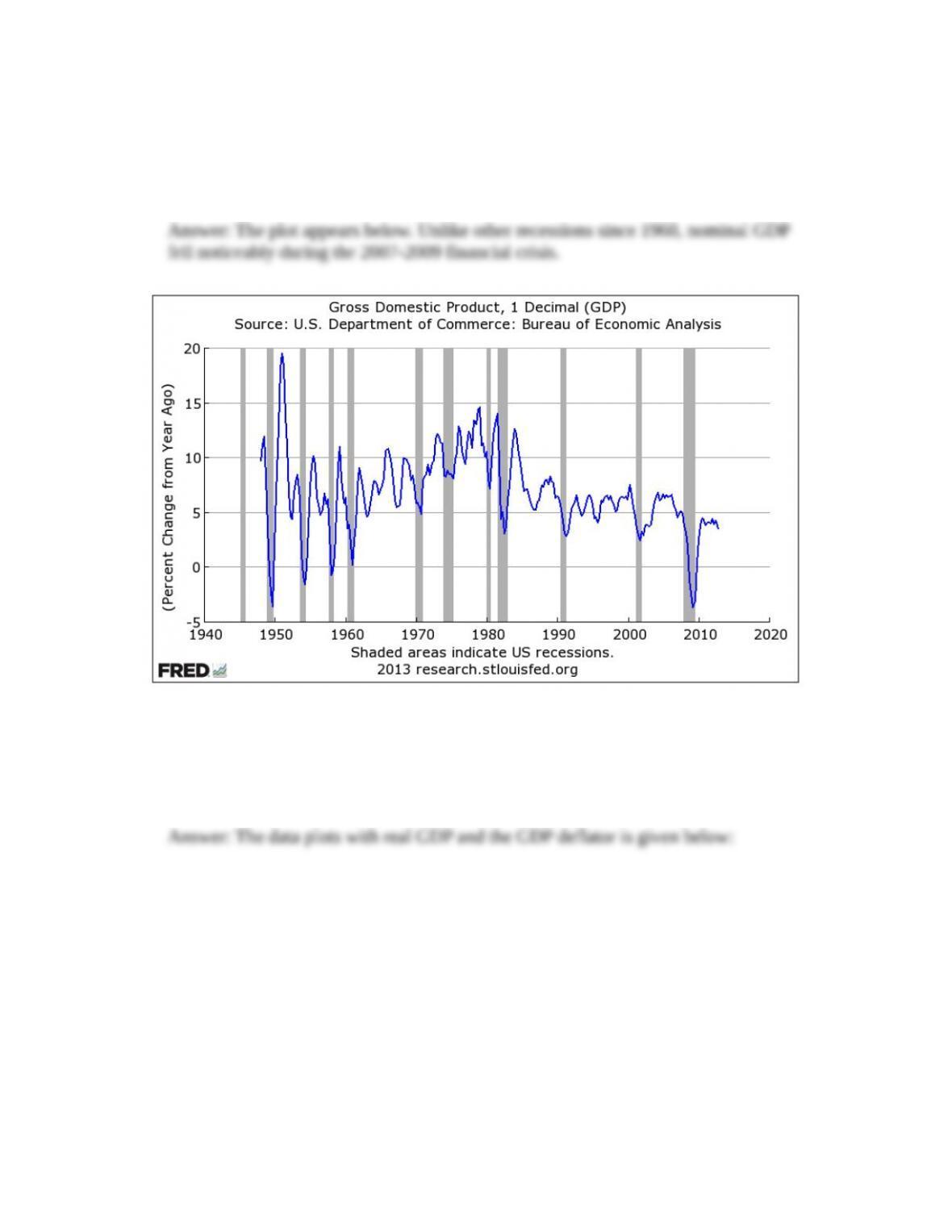
4. Examine nominal GDP (FRED code: GDP) by repeating the steps in Data
Exploration Problem 3. Based on the figure showing percent change from a year ago,
what was special about the behavior of nominal GDP during the financial crisis of
2007-2009 compared to previous decades?
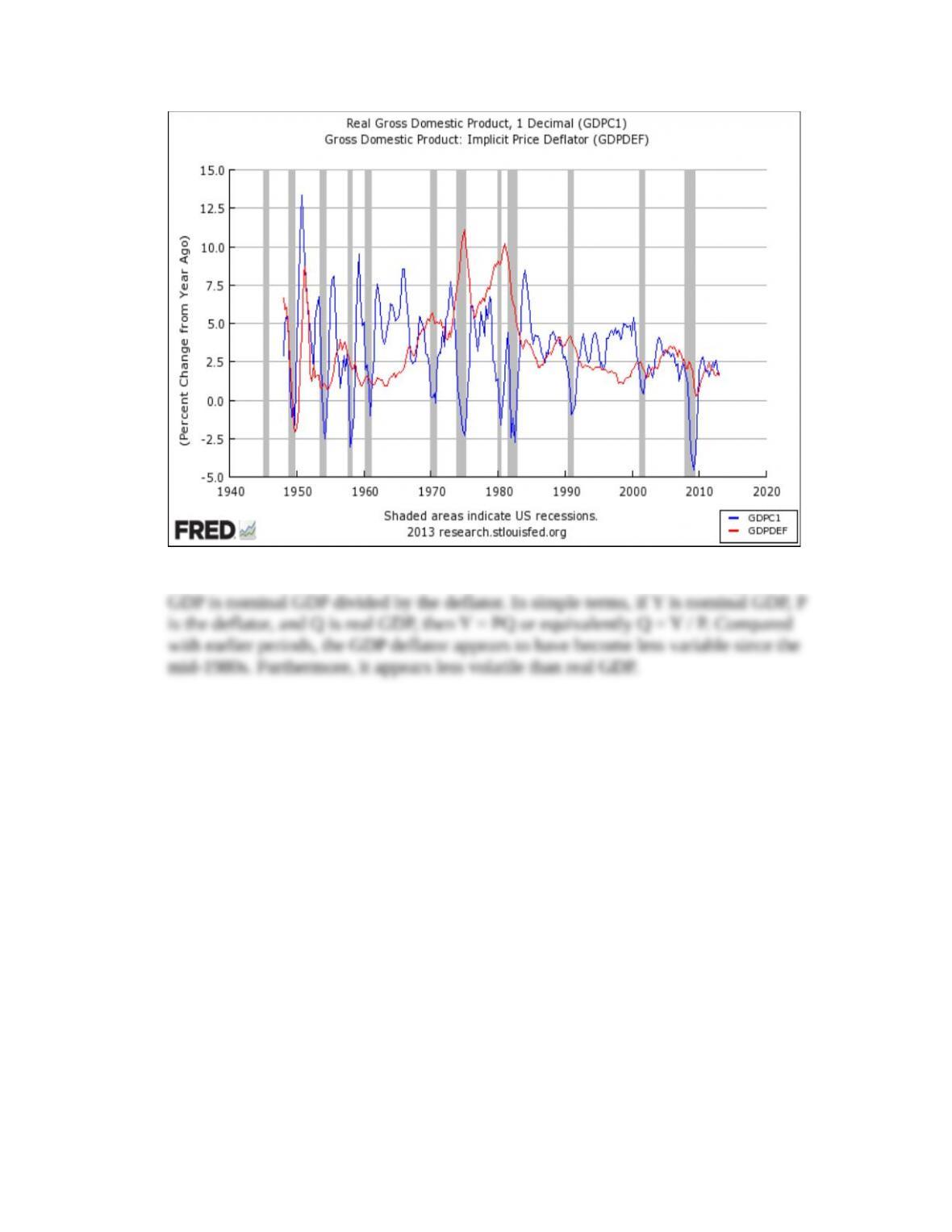
5. Plot on one figure the percent change from a year ago of both the GDP deflator
(FRED code: GDPDEF) and real GDP (FRED code: GDPC1). How does the GDP
deflator link nominal and real GDP? Since the mid-1980s, does it fluctuate more or
less than real GDP?
1-7
Copyright © 2015 McGraw-Hill Education. All rights reserved. No reproduction or distribution without the prior written consent of
McGraw-Hill Education.
Chapter 01 – An Introduction to Money and the Financial System
Nominal GDP is the product of real GDP and the GDP deflator. Alternatively, real
* indicates more difficult problems
1-8
Copyright © 2015 McGraw-Hill Education. All rights reserved. No reproduction or distribution without the prior written consent of
McGraw-Hill Education.