Chapter 22 – Understanding Business Cycle Fluctuations
Chapter 22
Understanding Business Cycle Fluctuations
Conceptual and Analytical Problems
1. Define the term stabilization policy and describe how it can be used to reduce the
volatility of economic growth and inflation. Do stabilization policies improve
everyone’s welfare? (LO2)
Answer: Stabilization policies are monetary or fiscal policies designed to stabilize
inflation and output. Both monetary and fiscal policies can be used to shift the
2. Explain why stabilization policies are usually pursued using monetary rather than
fiscal policy. (LO3)
Answer: While fiscal policies can reduce a recessionary output gap by increasing
government spending and or cutting taxes, it takes a long time for these policies to
be enacted and the effect of tax cuts is not immediate. Fiscal policymakers are
3. Explain why fiscal policy played a greater role than usual in the response to the
2007-2009 recession. (LO3)
Answer: The fact that monetary policymakers had cut interest rates almost to zero
4. Explain why monetary policy makers cannot restore the original long-run
equilibrium of the economy if, in the short run, the economy has moved to a point
where inflation is above target inflation and output is below potential output.
(LO2)
Answer: If inflation is above target inflation and output is below potential output,
22-1
© 2015 by McGraw-Hill Education. This is proprietary material solely for authorized instructor use. Not authorized for sale or distribution in
any manner. This document may not be copied, scanned, duplicated, forwarded, distributed, or posted on a website, in whole or part.
Chapter 22 – Understanding Business Cycle Fluctuations
5. Explain why the rise in oil prices in 2008 created a particularly difficult situation
for Federal Reserve policymakers. (LO2)
Answer: The rise in oil prices and consequent upward pressure on inflation came
at a time when the US economy was weak. Uncertainty surrounding the extent of
6. Will changes in technology affect the rate at which the short-run aggregate supply
curve shifts in response to an output gap? Why or why not? Provide some
specific examples of how technology will change the rate of adjustment. (LO1)
Answer: Technological advancements will make it easier to change prices in
response to an output gap. For example, instead of placing price stickers on items
7. After examining Figure 22.6, explain the potential link between innovations in
financial markets and output volatility since the 1980s. You should consider both
the “Great Moderation” and the recession of 2007-2009 in your answer. (LO1)
Answer: From the early 1980’s until the onset of the recession in 2007, there was
a marked moderation in the volatility of output growth that became known as the
“Great Moderation”. From the early 1980’s many new financial products
8. *According to real business cycle theory, can monetary policy affect equilibrium
output in either the short run or the long run? (LO1)
Answer: According to real business cycle theory, business cycle fluctuations arise
due to changes in potential output and the short-run aggregate supply curve shifts
22-2
© 2015 by McGraw-Hill Education. This is proprietary material solely for authorized instructor use. Not authorized for sale or distribution in
any manner. This document may not be copied, scanned, duplicated, forwarded, distributed, or posted on a website, in whole or part.
Chapter 22 – Understanding Business Cycle Fluctuations
9. The economy has been sluggish, so in an effort to increase output in the short run,
government officials have decided to cut taxes. They are considering two
possible tax cuts of equal size in terms of lost revenue. The first would reduce for
one year the taxes on people with income above the median. The second would
cut for one year the taxes on people with income below the median. Which
change would shift the aggregate demand curve further to the right? Why? (LO2)
Answer: Temporary tax cuts usually have little impact on the spending of
taxpayers who are not liquidity or credit constrained. Put differently,
10. Starting with the economy in long-run equilibrium, use the aggregate
demand-aggregate supply framework to illustrate what would happen to inflation
and output in the short run if there were a rise in consumer confidence in the
economy. Assuming the central bank takes no action to offset this rise in
confidence, what would happen to inflation and output in the long run? What
policy adjustment is the central bank undertaking? (LO2)
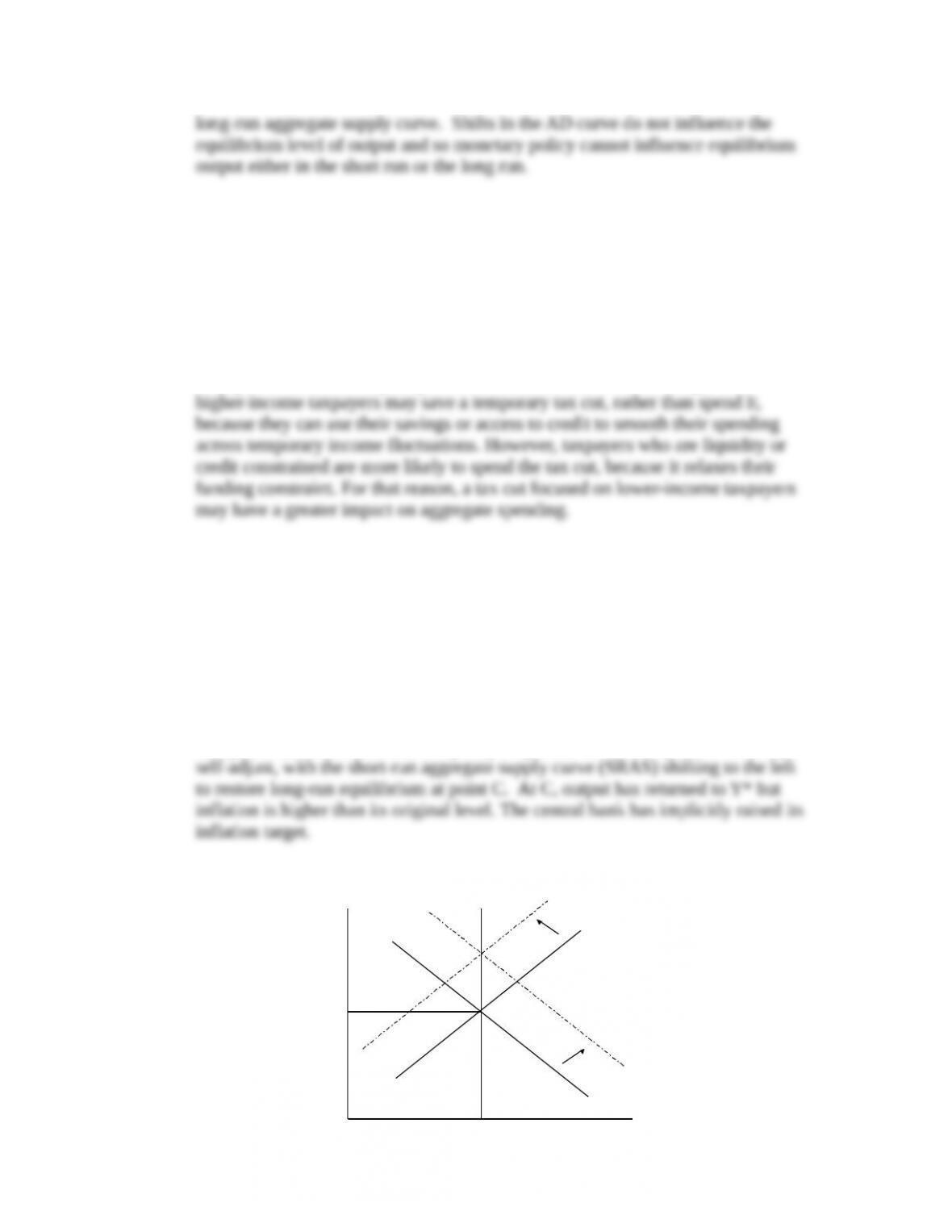
Answer: A rise in consumer confidence would shift the dynamic aggregate
demand curve (AD) to the right, increasing both inflation and output in the short
run (point B). In the absence of a policy response, the economy will eventually
22-3
© 2015 by McGraw-Hill Education. This is proprietary material solely for authorized instructor use. Not authorized for sale or distribution in
any manner. This document may not be copied, scanned, duplicated, forwarded, distributed, or posted on a website, in whole or part.
Inflation
Output
LRAS
SRAS
AD
Y*
πT
AD’
B
C
A
SRAS’
Chapter 22 – Understanding Business Cycle Fluctuations
11. Consider again the rise in consumer confidence described in Problem 10. What
would happen to inflation and output in the long run if the central bank remained
committed to it original inflation target and responded with an immediate policy
tightening? Compare the outcome to that in Problem 10 using the aggregate
demand-aggregate supply framework. (LO2)
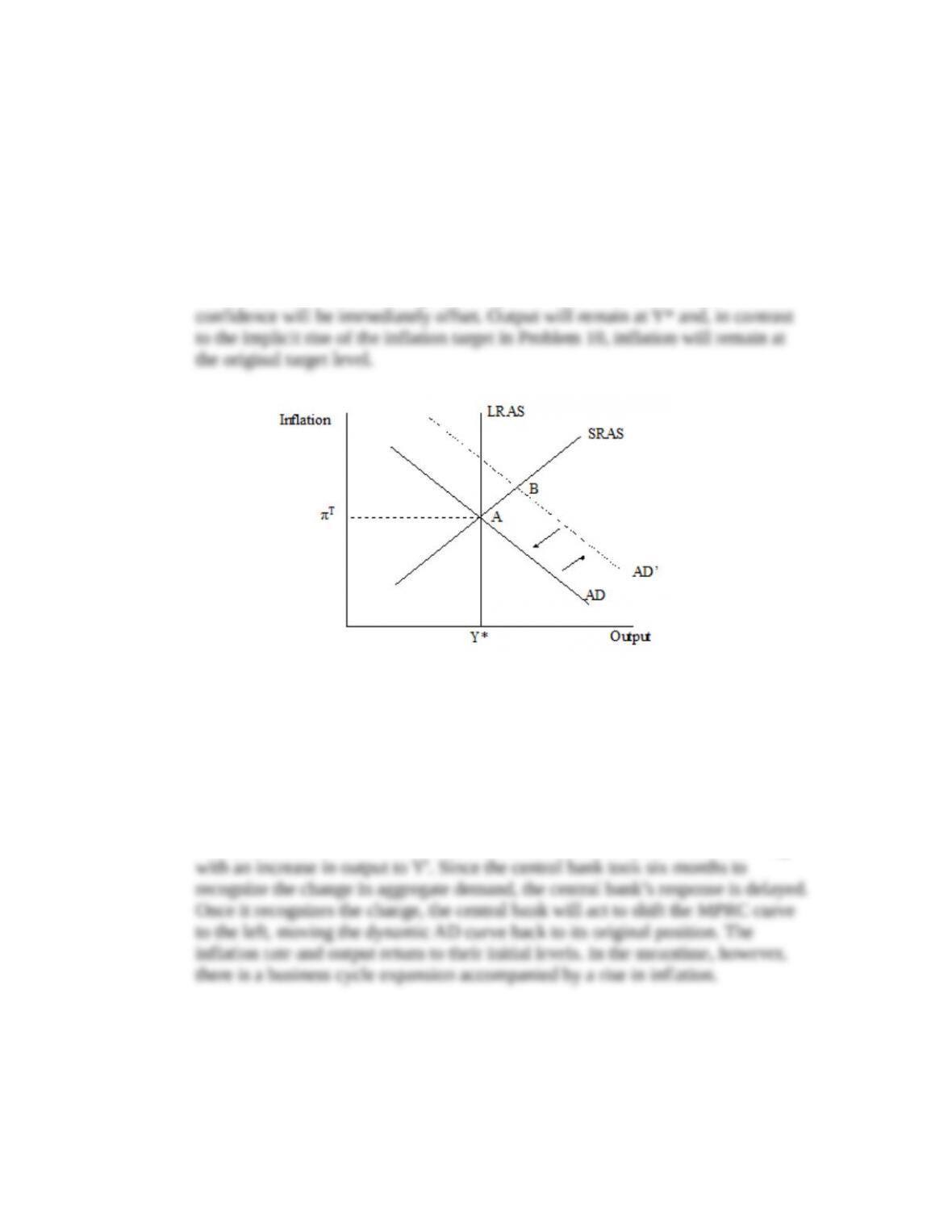
Answer: If the central bank tightens policy immediately in response to the upward
movement in inflation and output, the rightward AD curve shift due to the rise in
12. Suppose that consumer confidence unexpectedly rises six months before the
central bank detects the change or its magnitude. Compared to your answer to
Problem 11, what happens to inflation and output in that six-month interval?
How does monetary policy return the economy to long-run equilibrium at the
initial inflation target? (LO2)
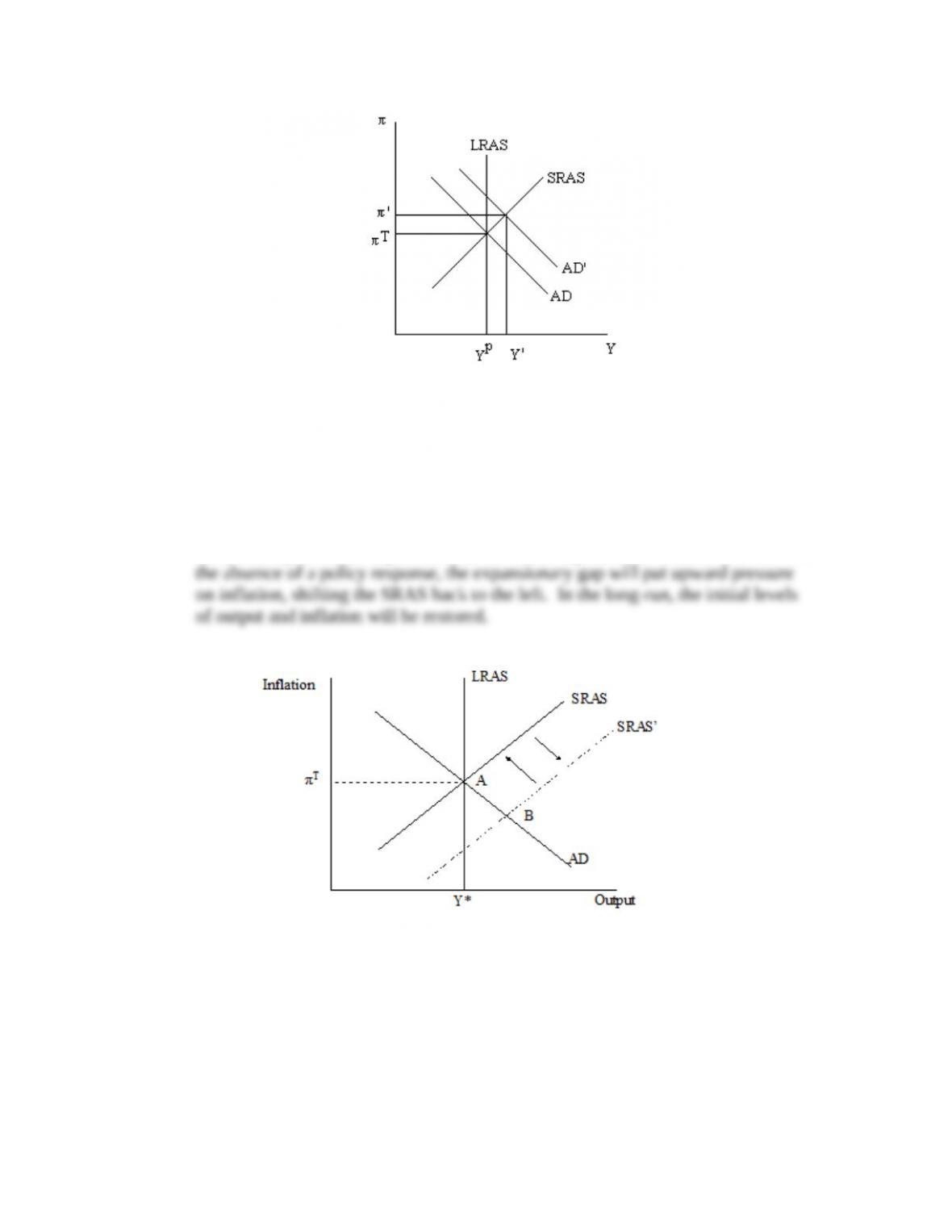
Answer: The rise in consumer confidence implies a right shift in the dynamic AD
curve, from AD to AD′. This shift leads to a rise in the inflation rate to π′, along
22-4
© 2015 by McGraw-Hill Education. This is proprietary material solely for authorized instructor use. Not authorized for sale or distribution in
any manner. This document may not be copied, scanned, duplicated, forwarded, distributed, or posted on a website, in whole or part.
Chapter 22 – Understanding Business Cycle Fluctuations
13. How would a shock that reduces production costs in the economy (a positive
supply shock) affect equilibrium output and inflation in the both short run and the
long run? Illustrate your answer using the aggregate demand-aggregate supply
framework. You should assume that the shock does not affect the potential output
of the economy. (LO2)
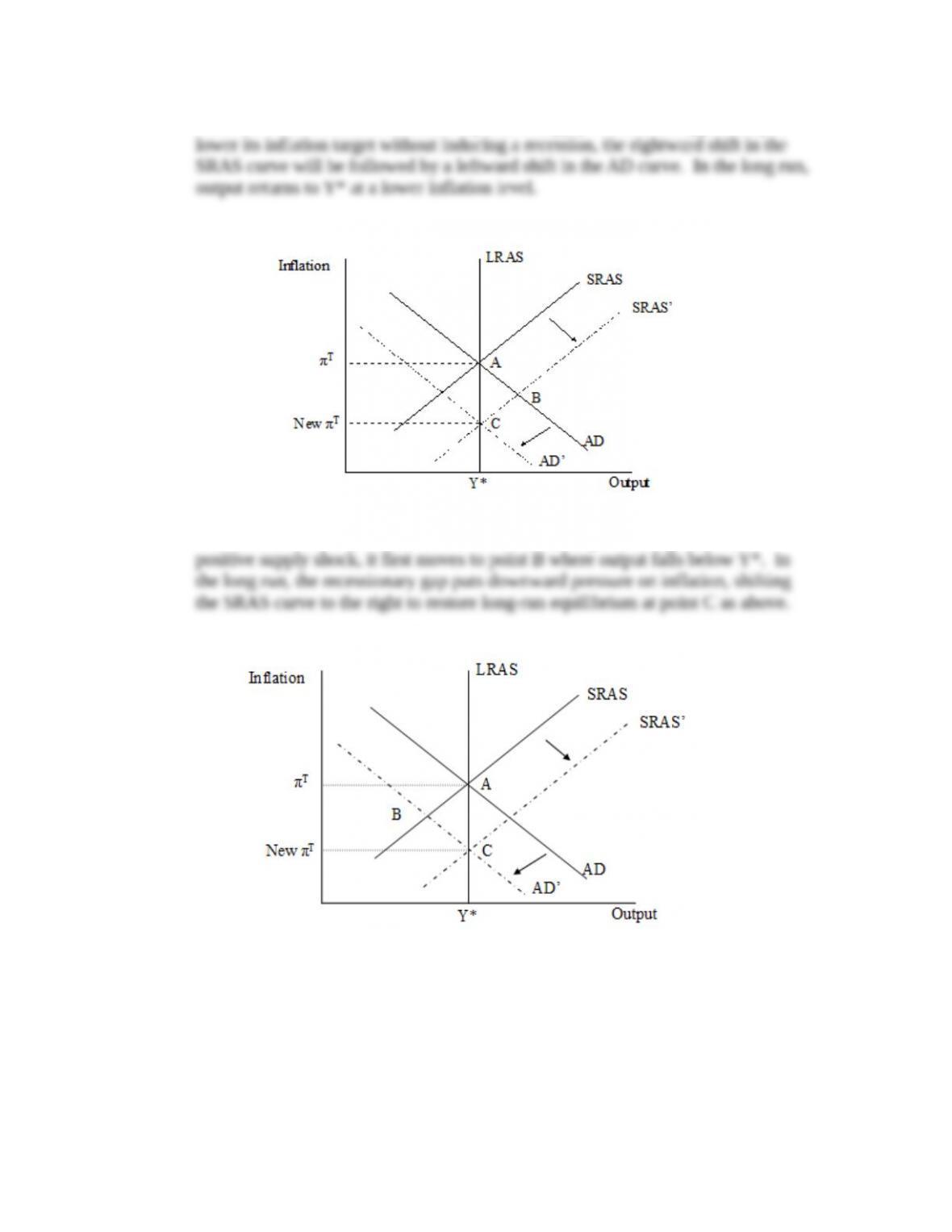
Answer: A positive supply shock will shift the SRAS curve to the right. In the
short run, equilibrium output will increase while equilibrium inflation will fall. In
14. Suppose, instead of waiting for the economy described in question 13 to return to
long-run equilibrium, the central bank opted to use the positive supply shock as an
opportunity to move to a lower inflation target. Illustrate the impact of this
change in the inflation target using an aggregate demand-aggregate supply
diagram. Compare this with a graph of a situation where the central bank lowers
its inflation target in the absence of a positive supply shock. (LO3)
22-5
© 2015 by McGraw-Hill Education. This is proprietary material solely for authorized instructor use. Not authorized for sale or distribution in
any manner. This document may not be copied, scanned, duplicated, forwarded, distributed, or posted on a website, in whole or part.
Chapter 22 – Understanding Business Cycle Fluctuations
Answer: If the central bank uses the positive supply shock as an opportunity to
In contrast, if the central bank lowers its inflation target in the absence of a
15. *Suppose a natural disaster reduces the productive capacity of the economy. How
would the equilibrium long-run real interest rate be affected? Assuming the
central bank maintains its existing inflation target, illustrate the impact on the
monetary policy reaction function and on equilibrium inflation and output both in
the short run and the long run. (LO1)
22-6
© 2015 by McGraw-Hill Education. This is proprietary material solely for authorized instructor use. Not authorized for sale or distribution in
any manner. This document may not be copied, scanned, duplicated, forwarded, distributed, or posted on a website, in whole or part.
Chapter 22 – Understanding Business Cycle Fluctuations
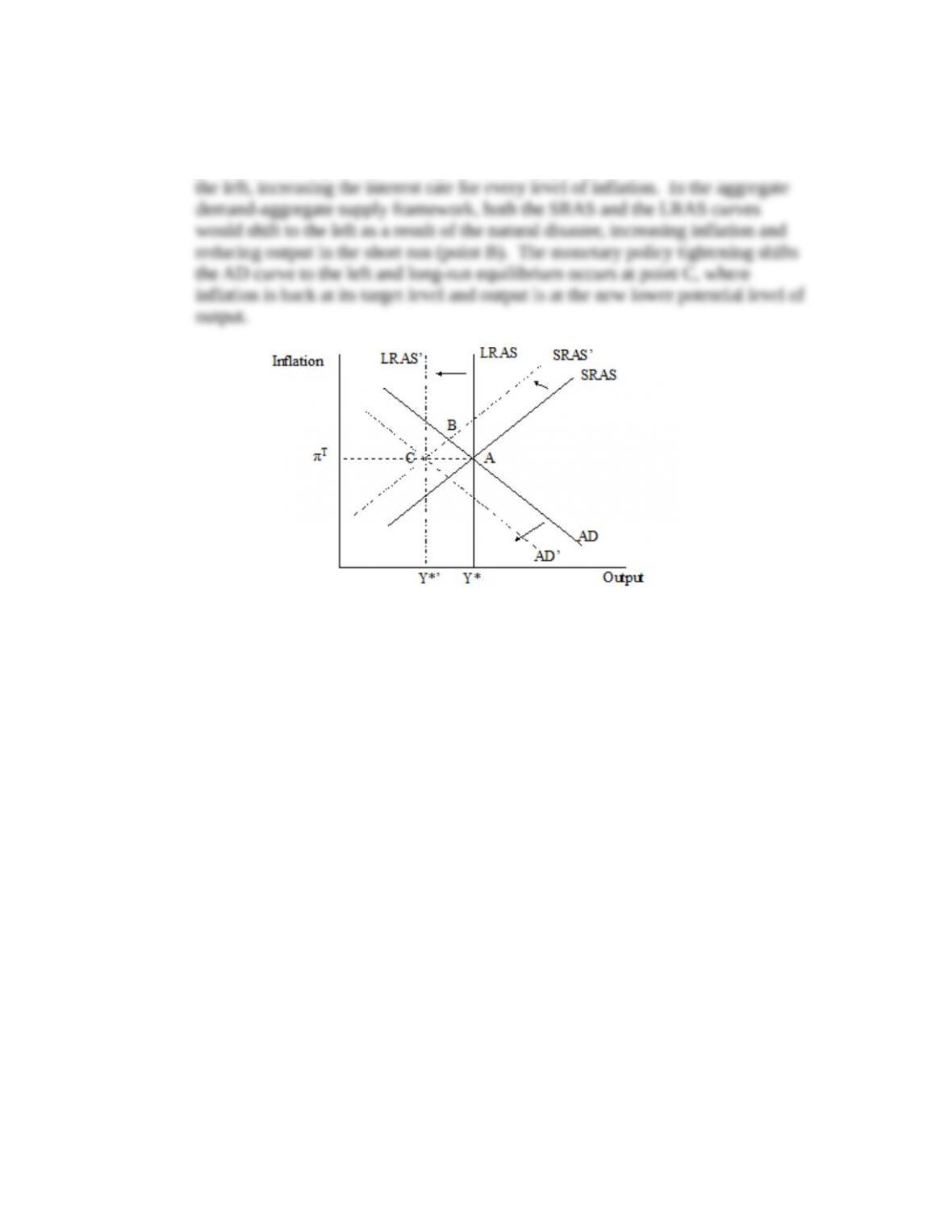
Answer: As a result of a natural disaster that reduces the productive capacity of
the economy, the long-run real interest rate would increase. Monetary
policymakers respond by shifting the monetary policy reaction curve (MPRC) to
22-7
© 2015 by McGraw-Hill Education. This is proprietary material solely for authorized instructor use. Not authorized for sale or distribution in
any manner. This document may not be copied, scanned, duplicated, forwarded, distributed, or posted on a website, in whole or part.