Chapter 16 – The Structure of Central Banks: The Federal Reserve and the European Central Bank
Chapter 16
The Structure of Central Banks:
The Federal Reserve and the European Central Bank
Conceptual and Analytical Problems
1. What are the Federal Reserve’s goals and who established them? How are Fed
officials held accountable for meeting them? Explain why the Chair is most
influential Fed official. (LO1)
Answer: Congress mandates the Federal Reserve to “maintain long run growth of
the monetary and credit aggregates commensurate with the economy’s long run
potential to increase production, so as to promote effectively the goals of
maximum employment, stable prices, and moderate long-term interest rates.” The
2. Go to the Federal Reserve Board’s Web site and locate the FOMC’s most recent
statement. What did the committee members say at their last meeting regarding
the Federal funds target and the two goals of price stability and sustainable
economic growth? (LO2)
Answer: In the statement released May 1, 2013, the FOMC kept the target federal
funds rate at 0-1/4 percent, and stated that this “exceptionally low range … will
3. Some people have argued that the high inflation of the late 1970s was a
consequence of the fact that Federal Reserve Board Chairman Arthur Burns did
what President Richard Nixon wanted him to do. What policy do you think
Nixon might have wanted? (LO2)
16-1
Copyright © 2015 McGraw-Hill Education. All rights reserved. No reproduction or distribution without the prior written consent of
McGraw-Hill Education.
Chapter 16 – The Structure of Central Banks: The Federal Reserve and the European Central Bank
Answer: Because politicians are elected for relatively short terms, they often favor
expansionary monetary policy that will boost economic growth in the short run.
4. How might the ECB’s pursuit of price stability as its primary objective restrict its
response to the sovereign debt crisis in the euro zone? (LO4)
Answer: A short-term solution to the sovereign debt crisis would be for the ECB
to buy all the bonds of the highly indebted countries that they are unable to sell to
5. Evaluate the following statement: “The Treaty of Maastricht helped solve the time
consistency problem in monetary policy but not fiscal policy.” (LO4)
Answer: The time consistency problem for monetary policy was addressed by
establishing a highly independent central bank. Independence resulted from
features such as long terms (without reappointment) for Executive Board
6. How did the financial crisis of 2007-2009 alter the appointment process of
presidents of the regional Federal Reserve banks? (LO1)
Answer: The bailouts of financial institutions during the crisis fueled a public
perception that the regional reserve banks are too sympathetic to the private
banks, in part because presidents of regional Feds often are selected from the
7. What are the goals of the ECB? How are its officials held accountable for meeting
them? (LO3)
16-2
Copyright © 2015 McGraw-Hill Education. All rights reserved. No reproduction or distribution without the prior written consent of
McGraw-Hill Education.
Chapter 16 – The Structure of Central Banks: The Federal Reserve and the European Central Bank
Answer: The primary goal of the ECB is to maintain price stability, which the
ECB defines as an annual inflation rate of less than, but close to, two percent
8. Why did the sovereign debt problem of Greece – which accounts for less than 2
percent of euro-area GDP – threaten the banking system throughout the euro area?
(LO4)
Answer: Banks throughout the euro area held Greek government debt. When its
value fell, bank capital at these banks declined, making banks throughout the
region riskier than before. More important, concerns about sovereign default and
about a possible exit of Greece from the euro area proved contagious, leading the
9. Go to the ECB’s web site and locate the most recent introductory statement made
by the president of the ECB at the press conference following a Governing
Council meeting. What was the Governing Council’s policy decision? How was
it justified? Is there any reference to financial stability measures? (LO4)
Answer: On June 6, 2013 the Governing Council left key interest rates
unchanged, with the main refinancing rate at 0.5 percent. The president reported
10. Do you think the FOMC has an easier or a harder time agreeing on monetary
policy than the Governing Council of the ECB? Why? (LO3)
Answer: The FOMC and ECB have similar numerical inflation objectives.
However, the presence of national biases may make agreement among members
16-3
Copyright © 2015 McGraw-Hill Education. All rights reserved. No reproduction or distribution without the prior written consent of
McGraw-Hill Education.
Chapter 16 – The Structure of Central Banks: The Federal Reserve and the European Central Bank
11. Why did the “no-bailout” clause of the Maastricht Treaty come under stress
during the financial crisis of 2007-2009? (LO4)
Answer: Large fiscal deficits in some euro-area countries threatened the ability of
those governments to borrow. A disruption to sovereign borrowing in one country
12. Do you think the current procedures for appointing members to the Board of
Governors are consistent with the principles of good central bank design?
Explain your answer. (LO1)
Answer: The length of the terms and the fact they are staggered reduces the
opportunity for political influence on the selection of the governors and so these
13. *Currently, all the national central banks in the Eurosystem are involved with the
day-to-day implementation of monetary policy. What do you think the advantage
would be of centralizing the conduct of these day-to-day interactions with
financial markets at the ECB in Frankfurt? Are there any disadvantages you can
think of? (LO3)
Answer: The main advantage would be in terms of efficiency. Conducting these
interactions at 17 different national central banks is more cumbersome than
14. If you were charged with re-drawing the boundaries of the Federal Reserve
districts, what criteria would you use to complete the task? (LO1)
Answer: Ideally, the districts should reflect a diverse range of economic interests.
16-4
Copyright © 2015 McGraw-Hill Education. All rights reserved. No reproduction or distribution without the prior written consent of
McGraw-Hill Education.
Chapter 16 – The Structure of Central Banks: The Federal Reserve and the European Central Bank
15. In 2012, the FOMC stated for the first time that it aims at an inflation rate of 2
percent (based on the price index of personal consumption expenditures). How
might this announcement help secure price stability? (LO2)
Answer: An announced inflation target can help to anchor the public’s
expectations of inflation, thereby limiting inflation swings. The transparency of
16. Do you think the members of the ECB’s Governing Council should take formal
votes? Why or why not? If they do vote, how do you think the votes should be
allocated? (LO3)
Answer: Taking formal votes would be a more practical approach to making
decisions, especially as the number of member countries increases. One country,
17. Why do you think the statement released after each Federal Open Market
Committee meeting retains the same basic structure? (LO2)
Answer: Maintaining the same structure for the statement promotes transparency
and is thought to be a good communication strategy. The market knows what
18. Do you think, in the interest of transparency, the Chair of the Federal Reserve
Board should explain in detail the subtleties surrounding policy decisions? Why
or why not? (LO2)
Answer: Since 2012, the Fed Chair has conducted quarterly press conferences
following those FOMC meetings where members’ quantitative economic and
16-5
Copyright © 2015 McGraw-Hill Education. All rights reserved. No reproduction or distribution without the prior written consent of
McGraw-Hill Education.
Chapter 16 – The Structure of Central Banks: The Federal Reserve and the European Central Bank
19. *If you were asked to design a new central bank, what two institutional design
features of (a) the Federal Reserve System and (b) the ECB would you adopt?
Explain your choices. (LO1)
Answer: Features of the design of the Federal Reserve System to adopt might
include the centralization of the conduct of monetary policy and the publication of
Data Exploration
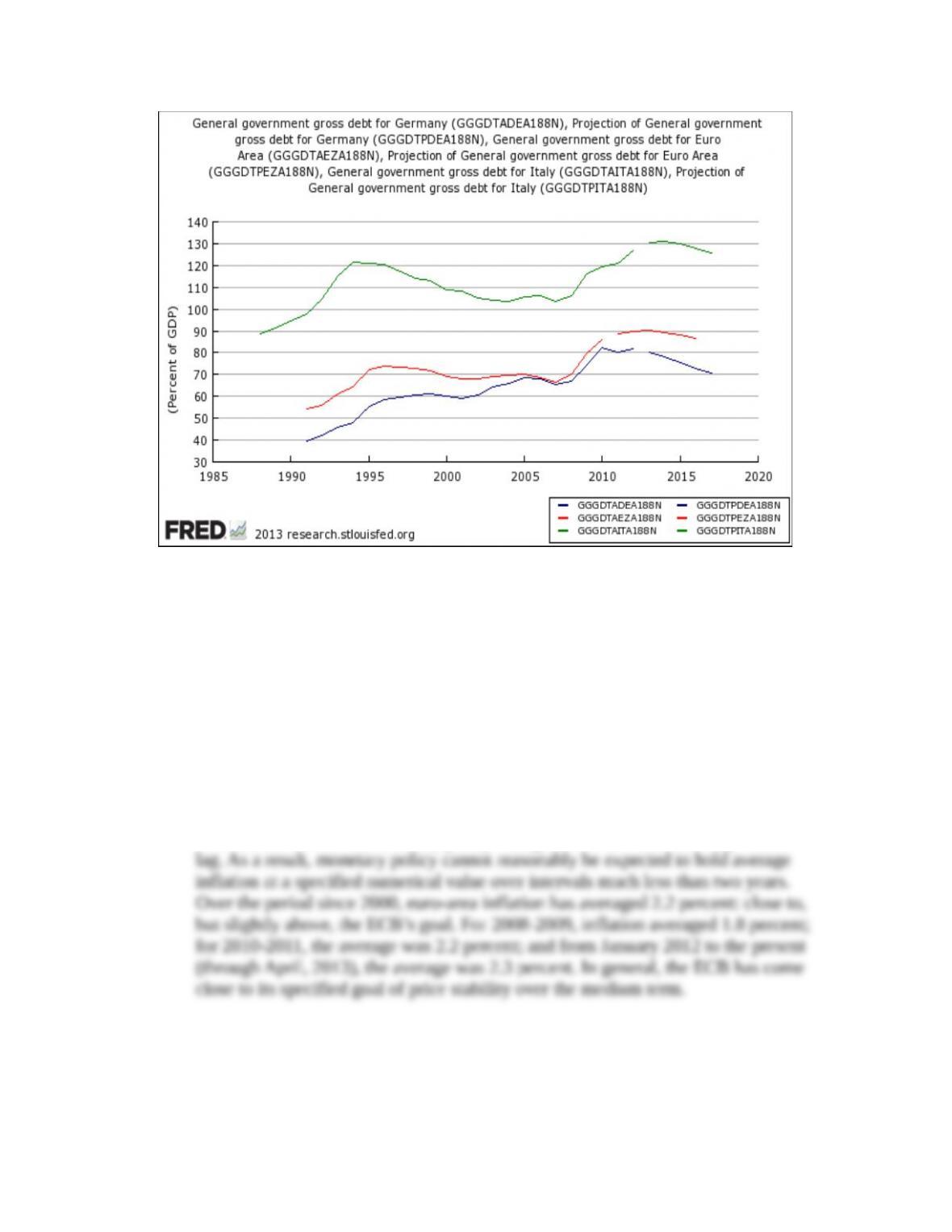
1. How large are the public debt burdens of key euro-area economies? Are they
rising or falling? Plot without recession bars the debt-to-GDP ratios of Germany
(FRED code: GGGDTADEA188N), Italy (FRED code: GGGDTAITA188N) and
the euro area as a whole (FRED code: GGGDTAEZA188N). Extend each line
using the projections of the International Monetary Fund (FRED codes:
GGGDTPDEA188N, GGGDTPITA188N, and GGGDTPEZA188N,
respectively). Are these ratios consistent with the Maastricht Treaty’s public
debt-to-GDP guideline of 60 percent? (LO4) (Hints: Turn off the recession bars
and select the same color for the debt ratio and the projected debt ratio of each
country or region.)
Answer: As of 2013, even Germany, the largest and perhaps the healthiest of the
big euro-area economies, has a debt-to-GDP ratio above the 60% guideline for the
16-6
Copyright © 2015 McGraw-Hill Education. All rights reserved. No reproduction or distribution without the prior written consent of
McGraw-Hill Education.
Chapter 16 – The Structure of Central Banks: The Federal Reserve and the European Central Bank
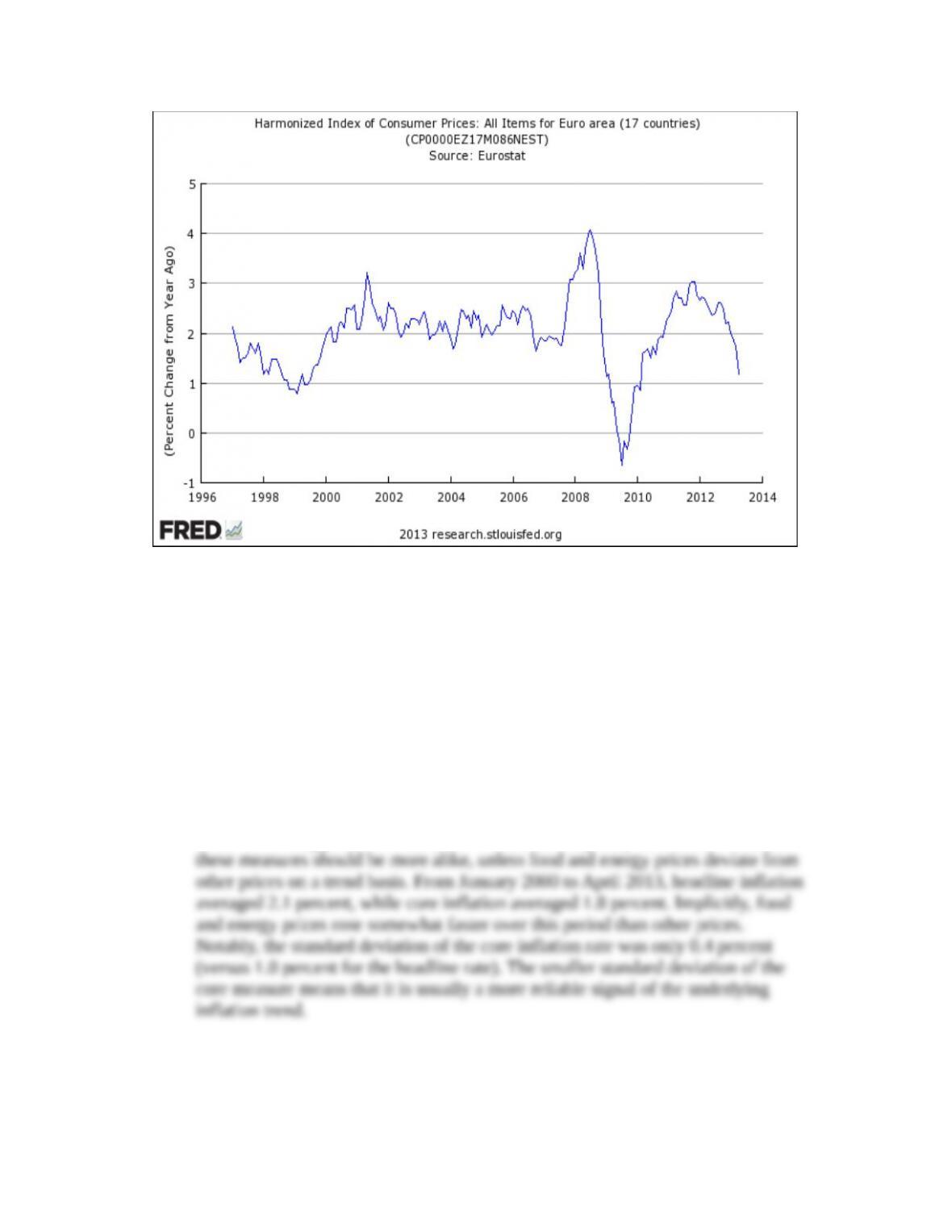
2. The European Central Bank (ECB) has translated its primary objective of price
stability into an explicit, quantitative goal of keeping euro-area annual inflation
close to, but below, 2 percent over the medium term. Plot the percent change from
a year ago of the euro-area price level (FRED code: CP0000EZ17M086NEST).
Evaluate the performance of the ECB on average since 2000 and over shorter
intervals. Download the data and compute the average inflation rate for the full
period and for the periods 2008-2009, 2010-2011, and 2012-present. (LO4)
Answer: The plot is shown below. Over short periods, measured inflation varies
significantly as a result of temporary price disturbances that do not affect the trend
of inflation. Moreover, monetary policy changes influence inflation only with a
16-7
Copyright © 2015 McGraw-Hill Education. All rights reserved. No reproduction or distribution without the prior written consent of
McGraw-Hill Education.
Chapter 16 – The Structure of Central Banks: The Federal Reserve and the European Central Bank
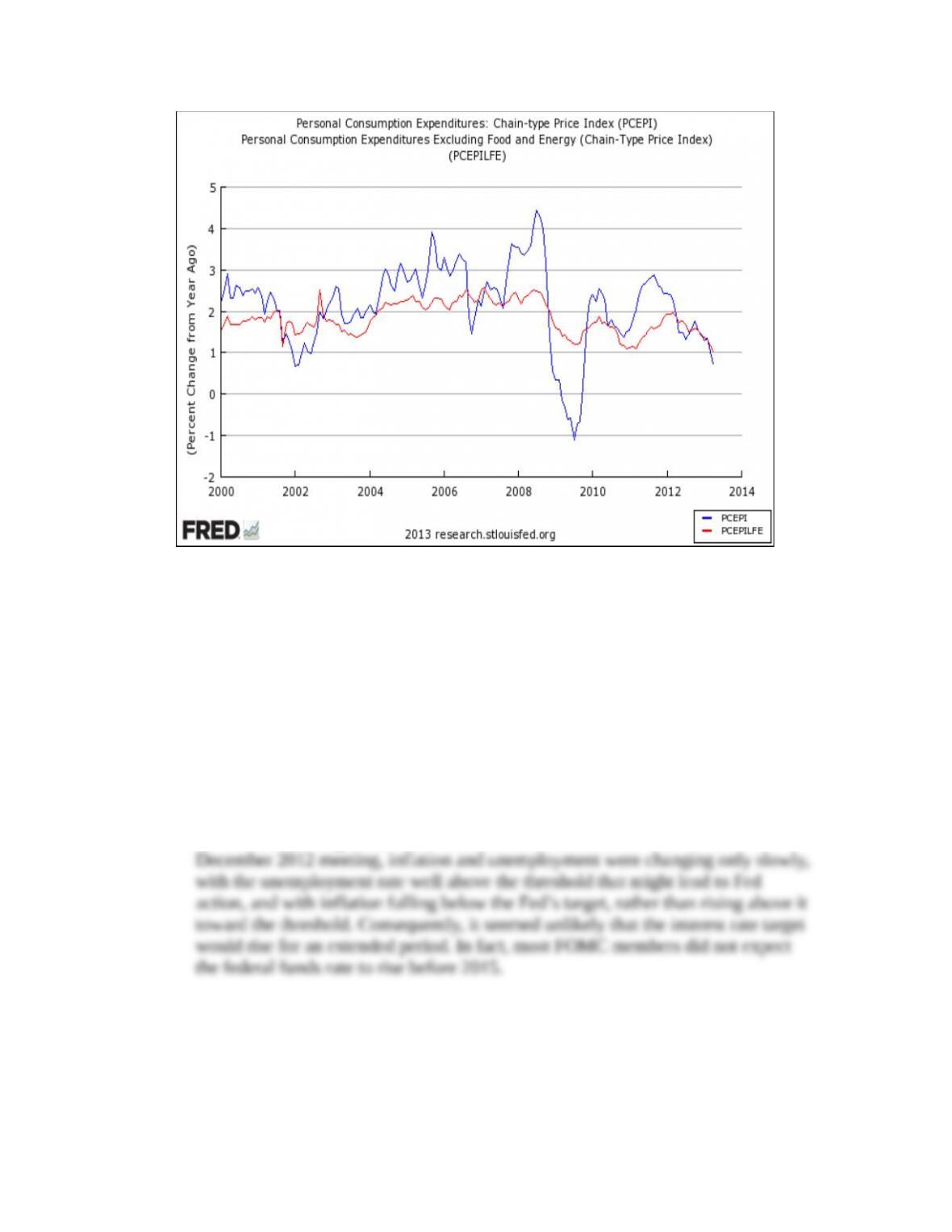
3. In 2012, the Federal Reserve announced an inflation objective of 2 percent “over
the longer run” for the price index of personal consumption expenditures (FRED
code: PCEPI). However, many analysts focus on the “core” price index (FRED
code: PCEPILFE), which omits the volatile food and energy components. For the
Fed’s horizon, does this difference matter? Plot the percent change from a year
ago for both inflation measures since 2000. Download the data and compute the
averages and standard deviations over that period. What do you conclude? (LO2)
Answer: The core index is relatively useful for anticipating the trend of inflation,
because volatile components of the headline price index can mask its underlying
trend. Over long periods of time, however, such temporary disturbances fade, so
16-8
Copyright © 2015 McGraw-Hill Education. All rights reserved. No reproduction or distribution without the prior written consent of
McGraw-Hill Education.
Chapter 16 – The Structure of Central Banks: The Federal Reserve and the European Central Bank
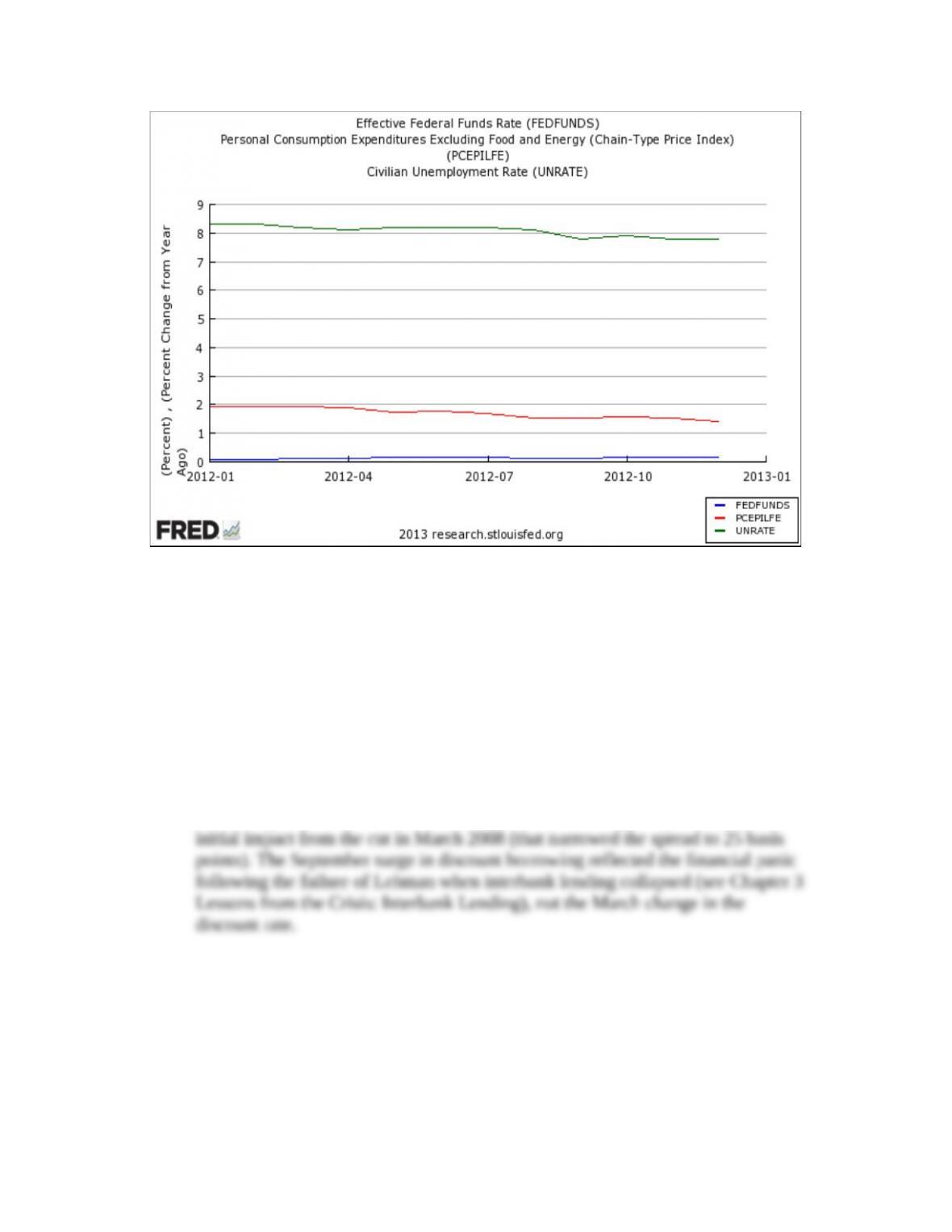
4. The FOMC statement of December 12, 2012, indicated that the target range for
the federal funds rate would continue at least until the rate of unemployment falls
below 6½ percent or the projected rate of inflation one to two years ahead exceeds
the FOMC’s two-percent objective by one-half percentage point. From January
until December 2012, plot the effective federal funds (FRED code: FEDFUNDS),
the unemployment rate (FRED code: UNRATE) and the inflation rate based on
the percent change from a year ago of the core price index for personal
consumption expenditures (FRED code: PCEPILFE). Judging by the data, would
you expect FOMC interest-rate policy to change soon? (LO2)
Answer: The FOMC’s statement set thresholds, rather than triggers, for changing
the interest rate target. Based on information available at the time of the
16-9
Copyright © 2015 McGraw-Hill Education. All rights reserved. No reproduction or distribution without the prior written consent of
McGraw-Hill Education.
Chapter 16 – The Structure of Central Banks: The Federal Reserve and the European Central Bank
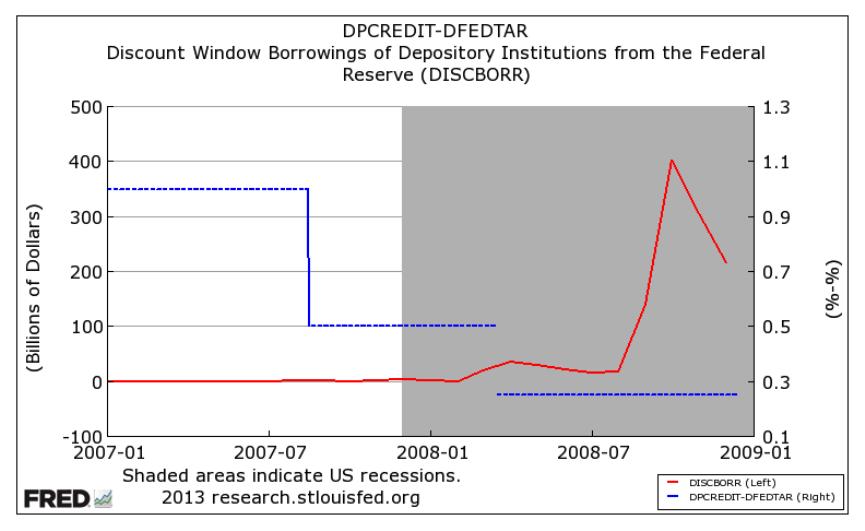
5. In August 2007 and in March 2008, the Federal Reserve Board reduced the
discount rate to ease liquidity conditions for banks. Plot discount window
borrowing (FRED code: DISCBORR) between January 2007 and December
2008. As a second line, plot on the right axis the difference between the discount
rate (FRED code: DPCREDIT) and the fed funds rate target (FRED code:
DFEDTAR). Did narrowing the spread between the discount rate and the federal
funds target rate trigger the borrowing surge in September-October 2008? (LO2)
Answer: The data plot is below. The data show no effect from the discount rate
cut in August 2007 (that narrowed the spread to 50 basis points) and a modest
16-10
Copyright © 2015 McGraw-Hill Education. All rights reserved. No reproduction or distribution without the prior written consent of
McGraw-Hill Education.
Chapter 16 – The Structure of Central Banks: The Federal Reserve and the European Central Bank
* indicates more difficult problems
16-11
Copyright © 2015 McGraw-Hill Education. All rights reserved. No reproduction or distribution without the prior written consent of
McGraw-Hill Education.