
Using the equation of exchange, if inflation is 1%, the velocity of money grows by
1.0% and the growth rate of money is 3.0%; what is real growth?
A. +3.0%
B. 1%
C. 4.0%
D. -1.0%
Answer:
Bonds issued by the U.S. Treasury would:
A. not be held by the Fed.
B. be held by the Fed as part of its securities.
C. be held by the Fed as part of its foreign exchange reserves.
D. be held by the Fed as part of its loans.
Answer:

When stock prices reflect fundamental values:
A. all investors will have positive returns.
B. the allocation of resources will be more efficient.
C. all companies will have an easier task of obtaining financing for investment
projects.
D. the overall level of the stock market should move higher.
Answer:
The real and nominal exchange rates differ in the sense that:
A. the real exchange rate does not express differences in the purchasing power of a
currency.
B. the nominal exchange rate is adjusted for price differences between countries and
the real is not.
C. the nominal exchange rate does not reflect differences in purchasing power between
currencies.
D. nominal exchange rates are fixed but real rates are flexible.
Answer:

A reduction in the central bank’s inflation target shifts the dynamic aggregate demand
curve to the left resulting in:
A. lower current output and higher inflation.
B. higher current output and higher inflation.
C. lower current output and lower inflation.
D. higher current output and lower inflation.
Answer:
In the United Kingdom, regulation of the financial system is concentrated in two
agencies. They are:
A. The Federal Deposit Insurance Conglomerate and the Bank of England.
B. The Financial Conduct Authority and the Bank of England.
C. The Financial Conduct Authority and English Banking Authority.
D. The Bank of England and the U.K. Treasury.
Answer:

Assume we have a stock currently worth $50. We also assume the interest rate is zero,
and we can buy options for this stock with a strike price of $50. If the stock can rise or
fall by $10 with equal probability over the option period, and the option cannot be
exercised until the expiration date, what is the time value of the option?
A. $5
B. $10
C. $50
D. $40
Answer:
Financial intermediaries reduce the problems in lending associated with information
asymmetries by all of the following except:
A. collecting and processing standardized information.
B. screening applicants to be sure they are creditworthy.
C. monitoring loan recipients to be sure the funds are used properly.
D. charging interest rates high enough to discourage undesirable borrowers.
Answer:

The measure of risk that focuses on the worst possible outcome is called:
A. expected rate of return.
B. risk-free rate of return.
C. standard deviation of return.
D. value at risk.
Answer:
In 2003, ratings agencies downgraded bonds issued by the State of California several
times. How will this affect the market for these bonds?
A. Yields on these bonds will decrease and the yield on Treasury bonds will increase.
B. The yield on these bonds will not change, nor will the yield on Treasury bonds.
C. The yield on these bonds and on Treasury bonds will both decrease.
D. Yields on these bonds will increase.
Answer:

If the probability of an outcome is zero, you know the outcome is:
A. more likely to occur.
B. certain to occur.
C. less likely to occur.
D. certain not to occur.
Answer:
If the target federal funds rate reaches zero the FOMC:
A. must stop purchasing securities since they cannot lower nominal rates below zero.
B. would likely shift their focus to purchasing longer-term securities.
C. would likely raise the required reserve rate.
D. would likely raise the discount rate.
Answer:
An increase in European wealth, all other factors held constant should:

A. have no impact at all on the demand for dollars.
B. cause the demand for dollars to decrease.
C. cause the demand for dollars to increase.
D. cause the supply of dollars to increase while the demand stays constant.
Answer:
If the government did not offer the too-big-to-fail safety net:
A. large banks would be more disciplined by the potential loss of large corporate
accounts.
B. the moral hazard problem of insuring large banks would increase.
C. the moral hazard problem of insuring large banks would not be affected.
D. the FDIC deposit insurance limits would have to be raised.
Answer:
One characteristic that distinguishes holding period return from the coupon rate, the

current yield, and the yield to maturity is:
A. all of the other returns can be calculated at the time the bond is purchased, but
holding period return cannot.
B. holding period return will always be the highest return.
C. holding period return will usually be less than the other returns.
D. only the holding period return includes the capital gain/loss.
Answer:
Using the rule of 72, determine the approximate time it will take $1000 to double given
the following interest rates.
a) 5.5%
b) 10.0%
c) 30.0%
d) 2.0%
e) 4.5%
Answer:

U.S. Treasury securities are considered to carry no risk spread because:
A. they are the closest thing to default-risk free that an investor can obtain.
B. the prices of U.S. Treasury bonds never change.
C. the yields on U.S. Treasury bonds never change.
D. the yields on U.S. Treasury bonds are always low.
Answer:
When the current yield and the coupon rate are equal, the bond is:
A. purchased at a discount.
B. purchased at a price that equals the face value.
C. a zero-coupon bond.
D. purchased at a price that exceeds its face value.

Answer:
Often a bank will require a loan officer to make personal visits on customers with loans
outstanding. This is encouraged because:
A. the bank worries about another bank trying to steal their customers.
B. the bank wants to make sure the business is busy.
C. this is an effective monitoring technique and should reduce moral hazard.
D. the bank has excess funds available and hopes to make another loan to the business.
Answer:
A liability of the central bank in functioning as the bankers’ bank is:
A. accounts of commercial banks.
B. securities.
C. loans.
D. currency.

Answer:
The credit risk a bank faces is the risk resulting specifically from:
A. the economy entering a recession.
B. interest rates falling.
C. some of the bank’s loans not being repaid.
D. the bank experiencing a decrease in deposits.
Answer:
Stock prices rise:
A. usually six to twelve months after interest rates are reduced.
B. immediately after interest rates are increased.
C. in anticipation of an interest rate reduction.
D. only after people are convinced the central bank interest rate cut is permanent.
Answer:

An inflation rate below the target rate will result in:
A. a movement up along the monetary policy reaction curve and a movement down the
dynamic aggregate demand curve.
B. a movement down along the monetary policy reaction curve and a movement down
the dynamic aggregate demand curve.
C. a movement up along the monetary policy reaction curve and a rightward shift of
the dynamic aggregate demand curve.
D. a movement up along the monetary policy reaction curve and a leftward shift of the
dynamic aggregate demand curve.
Answer:
Brokerage commissions:
A. are set by government regulators so they cannot vary across firms for the same
services.
B. can vary but typically don’t because firms tend to set them at the same levels.
C. can differ reflecting the different services being offered.
D. are always a percentage of the amount of the trade.

Answer:
Savings banks and savings and loans are regulated by a combination of agencies which
includes the:
A. Federal Reserve System.
B. Office of the Comptroller of the Currency.
C. Securities and Exchange Commission.
D. Internal Revenue Service.
Answer:
The key difference between a forward and a futures contract is:
A. a forward contract is customized where a futures contract is not.
B. a forward contract is bought and sold on organized exchanges.
C. only the forward contracts have settlement dates.
D. the amount of time involved.
Answer:

Nondepository institutions:
A. do not serve as intermediaries.
B. only serve as brokers.
C. only transform assets.
D. do not accept deposits.
Answer:
Government-sponsored enterprises like Fannie Mae and Freddie Mac usually borrow at
interest rates:
A. below what private lenders pay.
B. exceeding what private lenders pay.
C. that are the same as private lenders since they are really a private lender.
D. that are slightly below the federal funds rate.
Answer:

Which of the following bank assets would be categorized as secondary reserves?
A. U.S. Treasury bills
B. Cash
C. Mortgage loans
D. Deposits at the Federal Reserve
Answer:
The economy enters a period of robust economic growth that is expected to last for
several years. How would this be reflected in the risk structure of interest rates?
A. An inverted yield curve
B. A decrease in the term spread
C. A decrease in the interest rate spread
D. An increase in yields on tax-exempt bonds
Answer:

Crises that occasionally hit financial markets will increase the demand for money
since:
A. the return on money increases.
B. the return on financial assets increases.
C. there is no risk with holding money.
D. the risk of holding money relative to other financial assets decreases.
Answer:
When a business purchases a $25,000 computer system by writing a check, the
business’s balance sheet will:
A. show an increase in assets and liabilities of $25,000.
B. only show an increase in assets of $25,000.
C. only show an increase in liabilities of $25,000.
D. still show the same total amount of assets as before the purchase.
Answer:

Which of the following statements is true?
A. The ECB’s marginal lending facility was the model for the Fed’s redesign of its
procedures for lending to banks.
B. The ECB’s success in controlling reserves by paying interest on them has led the
Fed to do the same.
C. The ECB’s weekly auctions include only a few of the largest banks in Europe.
D. The Fed’s redesign of its procedures for lending to banks was the model for the
ECB’s marginal lending facility.
Answer:
The most common form of zero-coupon bonds found in the United States is:
A. A rated corporate bonds.
B. U.S. Treasury bills.
C. 30-year U.S. Treasury bonds.
D. municipal bonds.
Answer:
If the Fed wanted to target price stability, meaning zero inflation, why should it set a
target rate of inflation of around one percent?
Answer:
Answer:

Discuss what happens to the monetary policy reaction curve if the Fed were to lower
their inflation target and why?
Answer:
Why do people hold money? Explain the reasons.
Answer:

Assuming the free flow of capital across borders, explain why a country that has a fixed
exchange rate cannot have an independent monetary policy reaction curve.
Answer:
A friend who is taking her first class in investments asks you why the regulatory bodies
place so much emphasis on minimizing insider information if many of the potential
problems associated with financial transactions stem from information asymmetry or a
lack of information. How would you respond?
Answer:
Which investment plan will provide the highest future value: $500 invested at 5 percent
annually for four years and then that balance invested at 7 percent annually for an
additional three years, or $500 invested at 6 percent annually for seven years?
Answer:
Information asymmetry that exists in lending creates what type of risk for banks?
Discuss the ways for a bank to handle or minimize this risk.
Answer:

Why is it more correct to say that the Fed (the central bank) controls the monetary base
than to say it controls the amount of reserves?
Answer:
Explain the rapid rise in popularity of mutual funds.
Answer:
A high school basketball player decides to bypass college and go right into the NBA,
(the National Basketball Association). Describe the risk the individual is taking and a
contract that might transfer the risk.
Answer:
If you understood the discussion of the characteristics of common stocks, you should be
able to explain the following statement: One of the benefits from stock ownership is the
unlimited upside potential and the limited downside. What does this statement mean?
Answer:
Discuss the case for a ‘super-regulator” in the context of what you have learned about
“regulatory competition.”
Answer:
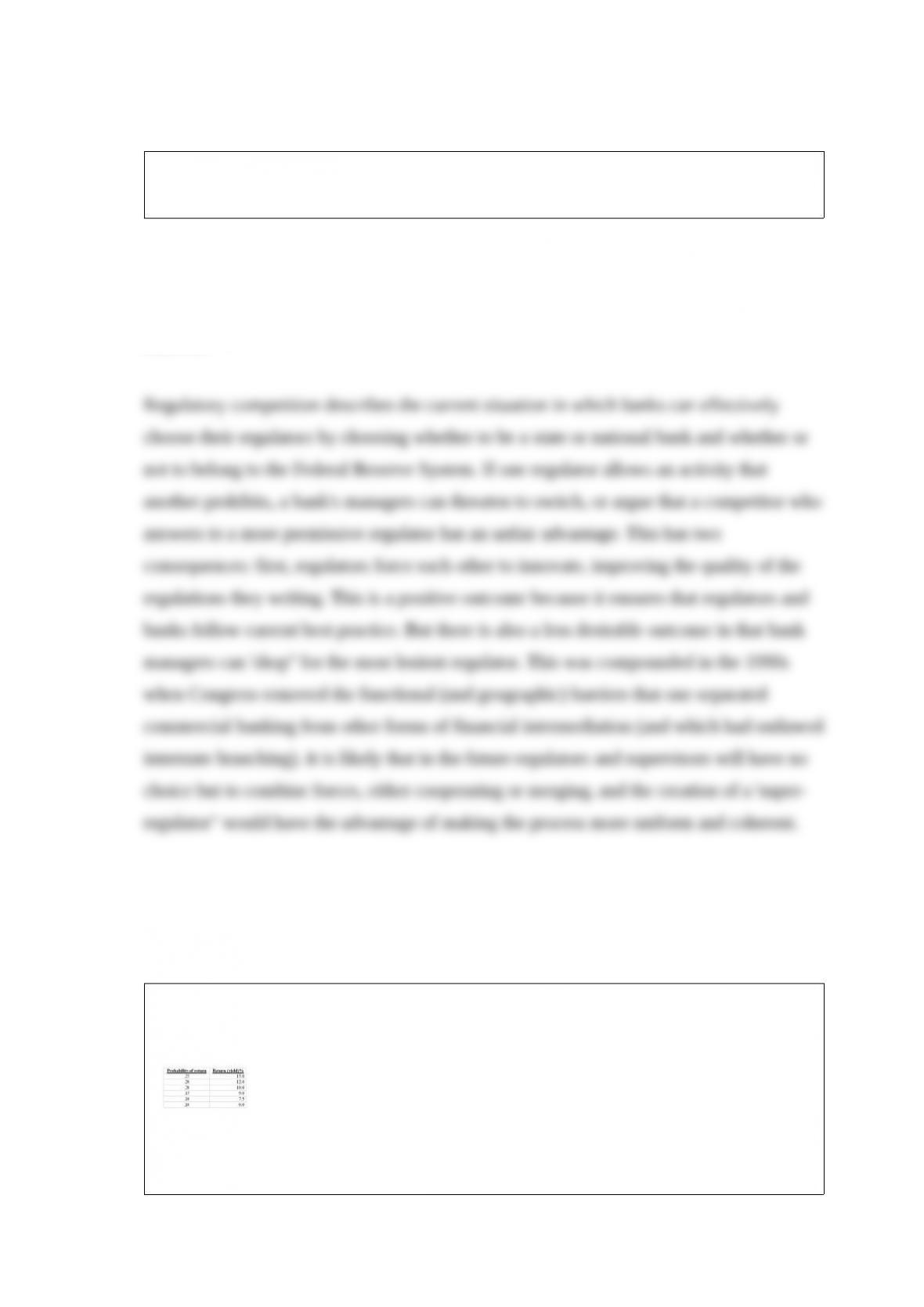
An individual faces two alternatives for an investment. Asset ‘A’ has the following
probability of return schedule:
Asset ‘B’ has a certain return of 10.25%. If this individual selects asset ‘A’ does it imply
she is risk averse? Explain.

Answer:
Explain why, if real interest rates are so important, we see most interest rates quoted in
nominal terms.
Answer:
If the correlation between the rate of inflation and the rate of money growth were closer
to -1 rather than +1 would the Fed care any more or less about the growth rate of
money? Explain your answer.
Answer: