
The law of one price:
A. is based on arbitrage.
B. applies only to real goods and not financial assets.
C. can explain short-run exchange rates but not long-run exchange rates.
D. is a mathematical concept that is not useful in explaining exchange rates.
Answer:
A saver knows that if she put $95 in the bank today she will receive $100 from the bank
one year from now, including the interest she will earn. What is the interest rate she is
earning?
A. 5.10%
B. 6.00%
C. 5.52%
D. 5.26%
Answer:

Since the 1920’s, the ratio of assets to capital has almost tripled for commercial banks.
Many economists believe this is the direct result of:
A. lower quality management in banks.
B. the increase in branch banking.
C. allowing banks to offer non-bank services.
D. government provided deposit insurance.
Answer:
If a bond has a face value of $1,000 and the bondholder receives coupon payments of
$27.50 semi-annually, the bond’s coupon rate is:
A. 2.75%
B. 5.50%
C. 27.5%
D. a value that cannot be determined from the information provided.
Answer:

A foreign exchange intervention that does not alter the domestic monetary base is:
A. sterilized.
B. unsterilized.
C. likely to change domestic interest rates.
D. impossible.
Answer:
The European Central Bank’s equivalent of the Fed’s open market operations (OMO)
is:
A. very similar to the Fed’s OMO in that they are highly centralized.
B. dissimilar to the Fed’s OMO in that the operations are conducted at all 18 of the
National Central Banks simultaneously.
C. similar to the Fed’s OMO in that they accept only U.S. Treasury securities in their
refinancing operations.
D. dissimilar to the Fed’s OMO because fewer banks participate in the auctions of the
securities.
Answer:

Which of the following is an example of a financial market?
A. A local coffeehouse where people regularly buy and sell financial instruments.
B. A bank that only accepts deposits and issues loans.
C. An electronic network used for buying and selling textbooks.
D. A central bank used for raising taxes and borrowing on behalf of the government.
Answer:
Considering the value of a financial instrument, the sooner the promised payment is
made:
A. the less valuable is the promise to make it since time is valuable.
B. the greater the risk, therefore the promise has greater value.
C. the more valuable is the promise to make it.
D. the less relevant is the likelihood that the payment will be made.
Answer:

If interest rates in the U.S. increases relative to interest rates in Europe:
A. the demand for dollars on the foreign exchange market would increase.
B. the supply of euros on the foreign exchange market would increase.
C. the price of U.S. assets should increase.
D. all of the answers given are correct.
Answer:
In the bond market, the assigning of a risk premium is a tool designed to address the
problem of:
A. adverse selection.
B. information asymmetry.
C. the free-rider.
D. moral hazard.
Answer:

If consumer and business sentiment were to increase dramatically, causing an
expansionary gap:
A. monetary policymakers could stabilize the economy by shifting their monetary
policy reaction curve to the right.
B. fiscal policymakers could stabilize aggregate demand by cutting income and
business taxes.
C. monetary policymakers would likely shift the monetary policy reaction curve to the
left to shift the dynamic aggregate demand left.
D. fiscal policymakers could stabilize aggregate demand by increasing government
purchases.
Answer:
The interest rates charged on most credit cards is:
A. high due to the problem of adverse selection.
B. high because Visa and MasterCard have a virtual monopoly on this business.
C. high due to diseconomies of scale that exist in this market.
D. lower than they should be given the problem of adverse selection.
Answer:

Because most insurance companies insure many people, they do not have to worry
about the problem of:
A. moral hazard.
B. adverse selection.
C. spreading of risk.
D. information asymmetry.
Answer:
The purchasing power of money:
A. rises when inflation rises.
B. decreases as the price level decreases.
C. decreases with inflation.
D. is not impacted by inflation, only by monetary policy.
Answer:

The New York Stock Exchange is an example of a:
A. financial instrument.
B. financial institution.
C. financial market.
D. bank.
Answer:
All of the following are true about electronic funds transfers except:
A. sometimes involve the Federal Reserve sending electronic images of checks to
banks.
B. occur when banks or individuals deposit/withdraw from one bank account to
another electronically.
C. include automated clearinghouse transactions (ACH).
D. include credit card payments made online.
Answer:

The Volcker rule in the Dodd-Frank Act does which of the following?
A. Creates a host of new agencies to streamline the regulatory process
B. Increases oversight of specific institutions regarded as a systemic risk
C. Introduces significant regulation of hedge funds
D. Forbids insured depositories from proprietary trading
Answer:
Every one percent increase in the rate of inflation will:
A. increase the real federal funds rate by 1.5%.
B. increase the target federal funds rate by 1.5%.
C. increase the real federal funds rate by 0.5%.
D. increase the target federal funds rate by 1.5% and increase the real federal funds rate
by 0.5%.
Answer:

The intersection of the aggregate demand curve and the short-run aggregate supply
curve determines:
A. current inflation, but not current output.
B. potential output.
C. current output, but not current inflation.
D. current output and current inflation.
Answer:
In the ten years after the FDIC limit was increased to $100,000:
A. more than four times the number of banks and savings and loans failed than did
during the first 46 years of FDIC’s existence.
B. less than one-fourth the number of banks and savings and loans failed than during
the first 46 years of FDIC’s existence.
C. the cost to taxpayers of failed institutions in that period was negligible because
FDIC was in place.
D. increasing the deposit insurance limit to $250,000 provided complete coverage for
all deposits except those of large corporations.
Answer:

A country with a fixed exchange rate policy and free cross-border capital flows that is
experiencing an economic slowdown will find:
A. their central bank will reduce the domestic interest rate in order to fend off the
slowdown.
B. their currency will depreciate to stimulate exports.
C. their corporate equities will become more attractive to foreign investors.
D. monetary policy in not available as an economic stabilization tool.
Answer:
In the chapter you read that it costs the U.S. Treasury’s Bureau of Engraving and
Printing around nine cents to print a note (currency), whether that bill is a one-dollar or
one-hundred dollar bill. It seems the Treasury could generate a nice profit for the
government by simply printing currency and using this currency to purchase the goods
and services the government needs. In fact, this seems to be a way to eliminate the
problem of budget deficits for the U.S. government. Comment on this idea.
Answer:

If inflation in country A exceeds inflation in country B, we can express the percentage
change in the units of currency of country A per unit of currency of country B as:
A. the inflation rate in country B – the inflation rate in country A.
B. the inflation rate in country A – the inflation rate in country B.
C. the inflation rate in country A times the inflation rate in country B.
D. the inflation rate in country A divided by the inflation rate in country B.
Answer:
Mutual funds have:
A. been created for very wealthy individuals with a lot of money to invest.
B. increased the risks associated with constructing a portfolio.
C. reduced the costs associated with gathering information on stocks and bonds.
D. increased the transactions costs associated with participating in financial markets.
Answer:

Debt instruments that have maturities less than one year are traded in the:
A. primary market exclusively.
B. bond markets exclusively.
C. bond market if they are already in existence.
D. money market.
Answer:
In which situation would policymakers be unable to neutralize the effect on the
economy?
A. The federal government runs a deficit
B. An increase in the price of oil
C. Imports exceed exports
D. Consumer confidence declines
Answer:

Considering the S&P 500 Index, if each company’s stock price increased by 10%:
A. the weights in the index would remain the same.
B. the companies with the most shares outstanding would have even greater weight
after the increase.
C. the companies with fewer shares would gain more weight at the expense of the
companies with greater shares.
D. the weights in the index would change to reflect the percentage changes in the
prices of the various stocks.
Answer:
Each of the following items would appear as assets on the central bank’s balance sheet,
except:
A. loans.
B. securities.
C. currency.
D. foreign exchange reserves.
Answer:

Implicit government support for “too big to fail” banks:
A. increases the scrutiny of the bank’s risk by large corporate depositors.
B. reduces the risk faced by depositors with accounts less than $250,000.
C. reduces the risk faced by depositors with accounts exceeding $250,000.
D. reduces the moral hazard problem of insuring large banks.
Answer:
The number of central banks that exist in the world today is:
A. less than 10.
B. about 250.
C. over 170.
D. over 50 but less than 100.
Answer:

Congress chartered Sallie Mae to make loans to:
A. homeowners.
B. customers of securities brokers.
C. small business owners.
D. students.
Answer:
If a country has a flexible exchange rate, will high rates of inflation, though generally
harmful, price this country’s goods off world markets? Explain.
Answer:
We saw in the text that regulations, specifically deposit insurance and the Basel Accord
(of 1988), can create moral hazard. Explain.
Answer:
Have the growth rates of the two measures of money moved together over time?
Explain.
Answer:
Explain what is likely to happen to the rate of mortgage loan default given the
following: “For years home values across the country have increased on average 3 to
4% percent each year. Mortgage lenders have come to expect this to always be the case
and so begin to offer mortgages with little to nothing down and not requiring PMI
insurance. An economic slowdown occurs hitting a few areas of the country harder than
others. Home values across the country begin to decrease with some areas seeing
decreases of as much as 10%.”
Answer:
The CPI is a commonly used and closely watched measure of inflation. However, it has
limitations. What are they?
Answer:
Answer:
Explain why many industrialized countries do not often intervene in the foreign
exchange market.
Answer:
There are three goods produced in an economy by three individuals:
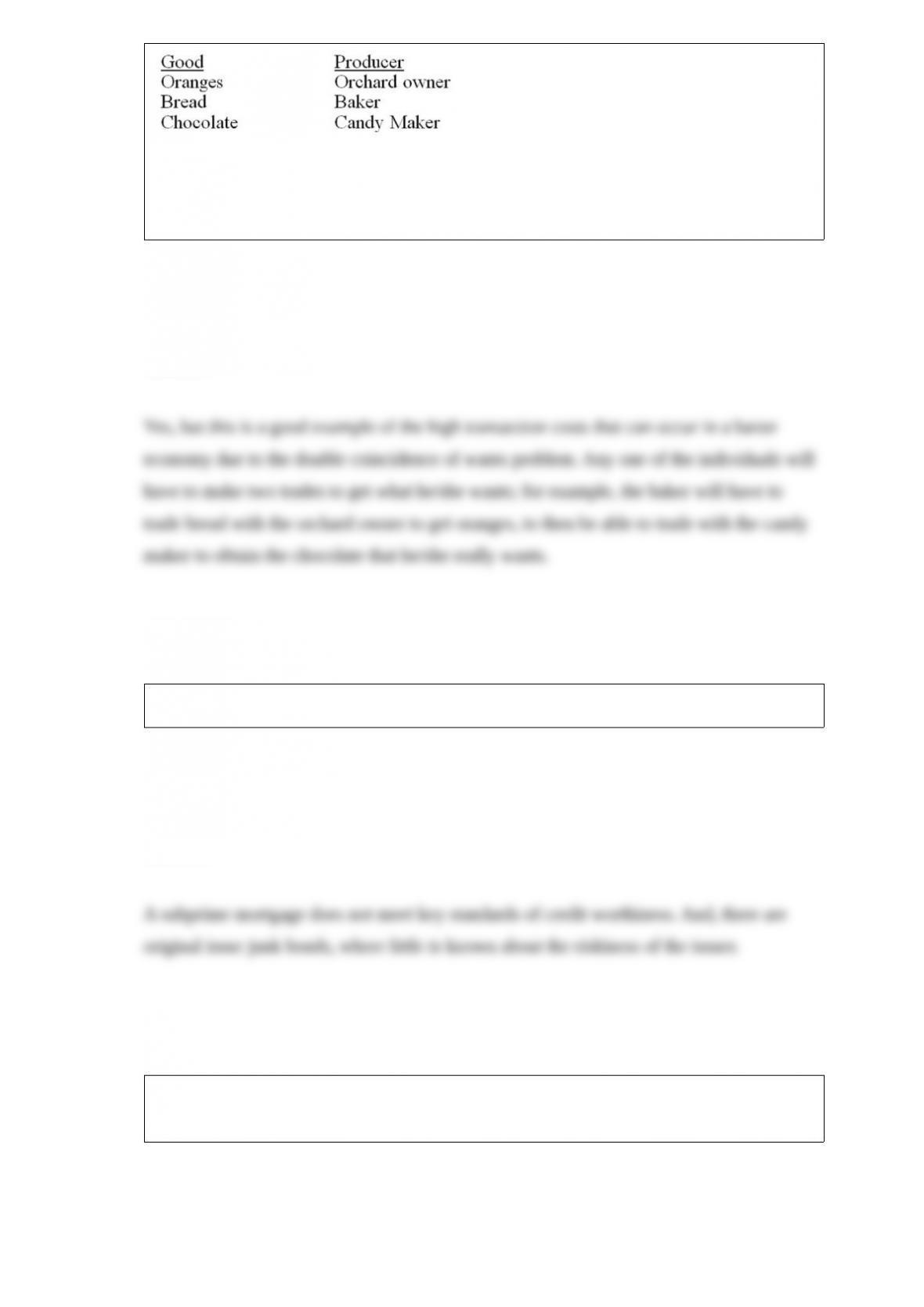
If the orchard owner likes only bread, the baker likes only chocolate, and the candy
maker likes only oranges, will any trade between these three persons take place in a
barter economy? Explain.
Answer:
What is meant by a subprime mortgage?
Answer:
Discuss how the goals of central bankers can be linked to risk and the ability or
inability of individuals to eliminate this risk.

Answer:
Consider the following two assets with probability of return = Pi and return = Ri.
Calculate the expected return for each and the standard deviation. Which one carries the
greatest risk? Why?
Answer:
Today there is a clear consensus about the best way to design a central bank. What are
the criteria for a successful central bank?
Answer:
What are the risks to a country of fixing its exchange rate to that of another country?
Answer:
Using demand and supply analysis, explain why the euro/dollar exchange rate rises (the
dollar appreciates) if the Fed intervenes in the foreign exchange market and sells euros.
Answer:
Explain why countries with high and volatile inflation rates are likely to have volatile
nominal interest rates.
Answer:
Discuss the role that companies like Standard & Poor’s, Dun & Bradstreet, and Moody’s
play in solving the problem of adverse selection.
Answer:
Consider an individual who plans to buy a new home. He has two options: (i) pay for
mortgage insurance (that insures the lender in case the borrower defaults), or (ii) pay
the lender a higher interest rate for the mortgage. Describe how these two options are
related to the concept of risk premium and the lender’s aversion to risk. Why does the
interest rate on the mortgage differ in these two options?
Answer:
When faced with inflation above desirable levels, is there anything that policymakers
can do about concern that a deep recession will lower inflationary expectations sharply
and thereby raise real interest rates in a destabilizing manner?
Answer:
What is the probability of tossing a pair of dice once and getting a 1? How about a 7?
Answer: