
The financial crisis in the United States in 2007-2009 brought about all but which of the
following changes:
A. a rise in the number of unit banks.
B. an increase in the deposit share of the top four U.S. commercial banks.
C. the placement of the two government-sponsored enterprises for housing finance into
conservatorship.
D. a run on money-market mutual funds.
Answer:
An investment carrying a current cost of $120,000 is going to generate $50,000 of
revenue for each of the next three years. To calculate the internal rate of return we need
to:
A. calculate the present value of each of the $50,000 payments and multiply these and
set this equal to $120,000.
B. find the interest rate at which the present value of $150,000 for three years from
now equals $120,000.
C. find the interest rate at which the sum of the present values of $50,000 for each of
the next three years equals $120,000.
D. subtract $120,000 from $150,000 and set this difference equal to the interest rate.
Answer:

Which of the following are depository institutions?
A. Credit unions
B. Mutual funds
C. Pension funds
D. Insurance companies
Answer:
All other factors equal, as nominal interest rates increase, checking account balances
should:
A. increase.
B. decrease.
C. remain constant.
D. be converted to cash.
Answer:
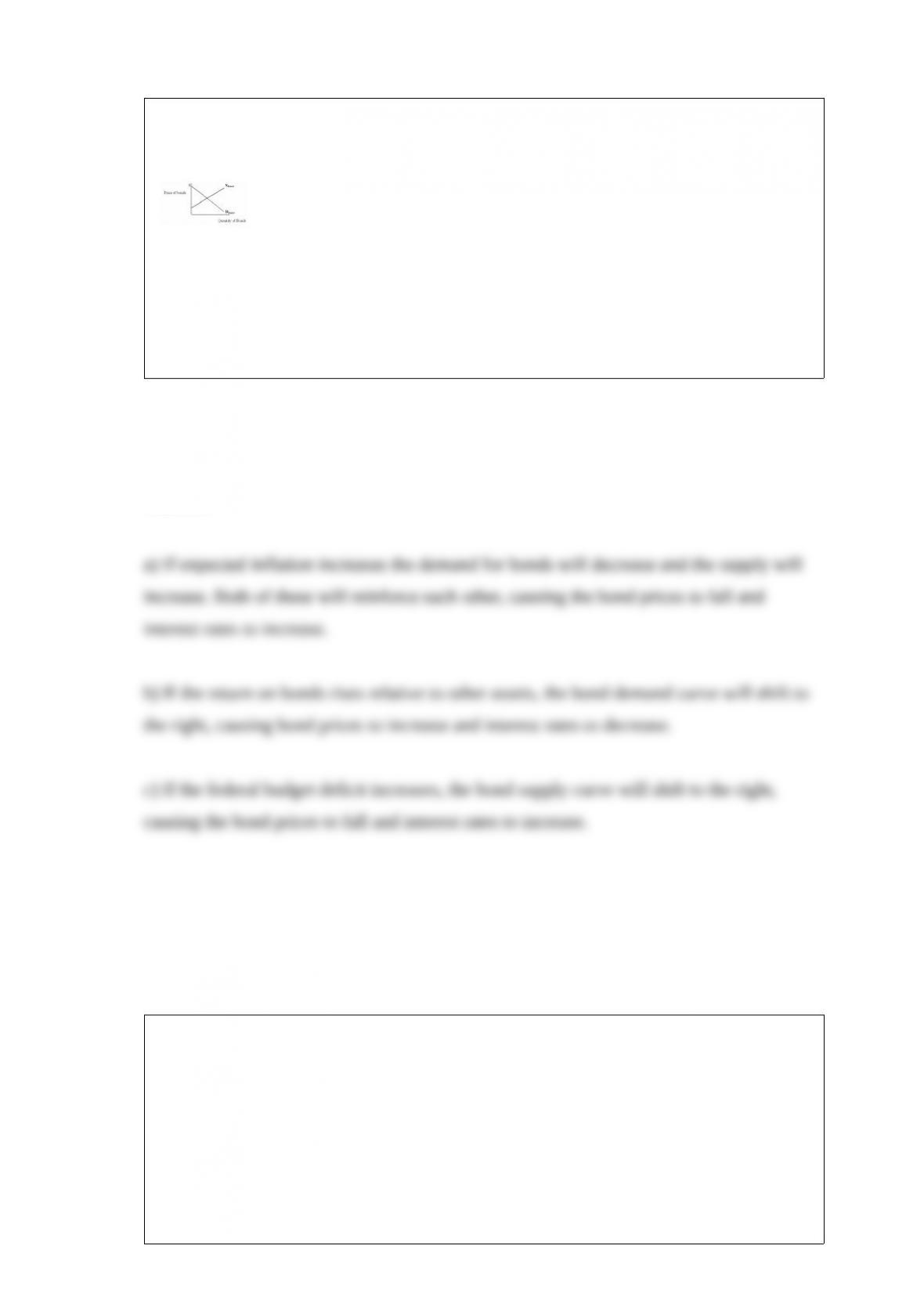
Notice the following model of a bond market. In each situation given, explain what
happens to the bond price and yield and why.
a) Expected inflation increases
b) The return on bonds rises relative to other assets
c) The federal government deficit increases
Answer:
An Edge Act Corporation is:
A. a company created so a U.S. bank can operate in more than one state.
B. a subsidiary of a bank created to provide insurance and securities services.
C. a company created by a non-bank corporation used to purchase and operate banks.
D. a subsidiary of a domestic bank that is established specifically to engage in

international banking transactions.
Answer:
A share of common stock represents a(n):
A. claim from a lender against a borrower.
B. share in the company’s debts.
C. share of ownership of the company.
D. unlimited liability to the owner of the stock.
Answer:
If each company that made up the Dow Jones Industrial Average increased the number
of their shares outstanding by 10%, but the share prices did not change, the value of the
index would:
A. not change.
B. increase by 10%.
C. increase, but by less than 10%.

D. decrease since there are more shares outstanding.
Answer:
A bagel cost $1 in New York and 0.5 euros in Paris. If the real exchange rate is one-half
of a New York bagel for a Parisian bagel, how many euros should you receive in
exchange for one dollar?
A. 0.1
B. 2
C. 0.25
D. 1.5
Answer:
Business cycles vary in:
A. the length of recessions only.
B. the time between recessions only.

C. both the length of recessions and the time between recessions.
D. none of the answers given is correct; business cycles are by definition recurring
waves that rise and fall in a periodic pattern.
Answer:
Which of the following statements is correct?
A. The long-run real interest rate varies directly with changes in non-interest sensitive
components of aggregate demand and inversely with potential output.
B. The long-run real interest rate varies inversely with changes in non-interest sensitive
components of aggregate demand and inversely with potential output.
C. The long-run real interest rate varies directly with changes in non-interest sensitive
components of aggregate demand and directly with potential output.
D. The long-run real interest rate varies directly with changes in non-interest sensitive
components of aggregate demand and does not vary with potential output.
Answer:
The relationship between the price and the interest rate for a zero coupon bond is best
described as:

A. volatile.
B. fluctuating.
C. inverse.
D. non-existent.
Answer:
If a Japanese Toyota sells for 2,500,000 yen and the nominal exchange rate is 110 yen/
$U.S., then the dollar price of the Japanese automobile is:
A. 22,727 yen.
B. $20,000.
C. $25,000.
D. $22,727.
Answer:
If we let P = the domestic price of a basket of goods and Pf the foreign price of the same

basket of goods measured in domestic currency:
A. If > 1 foreign products will seem inexpensive.
B. If > 1 foreign products will seem expensive.
C. If = 1 the nominal exchange rate is also = 1.
D. You cannot determine the relative prices of foreign goods from the equation
.
Answer:
The tools of monetary policy include:
A. the target federal funds rate.
B. the excess reserve rate.
C. the currency-to-deposit ratio.
D. both the excess reserve rate and the target federal funds rate.
Answer:

Everything else equal, if the growth rate of a country exceeds its sustainable rate, the
central bank:
A. will keep interest rates low to keep the momentum.
B. will now identify this new rate as the sustainable rate and try to maintain it.
C. is likely to raise interest rates to slow the rate of growth.
D. is likely to lower the interest rate thinking a slowdown is coming to offset this
boom.
Answer:
All other factors equal, as nominal interest rates decrease, checking account balances
should:
A. increase.
B. decrease.
C. remain constant.
D. be converted to cash.
Answer:

The fact that, for most of its history, the Fed was reluctant to make discount loans
actually:
A. at times was a destabilizing force for financial markets.
B. proved to be a very stabilizing force for financial markets.
C. pushed the discount rate above the target federal funds rate.
D. resulted in banks in very strong financial shape as being the only ones borrowing
from the Fed.
Answer:
A promise of a $100 payment to be received one year from today is:
A. more valuable than receiving the payment today.
B. less valuable than receiving the payment two years from now.
C. equally valuable as a payment received today if the interest rate is zero.
D. not enough information is provided to answer the question.
Answer:

The focus for most central banks today is:
A. the quantity of M1.
B. interest rates.
C. the quantity of M2.
D. controlling the size of the money multiplier.
Answer:
When a country’s current account balance is added to its capital account balance, the
sum should be:
A. twice the current account.
B. zero.
C. positive.
D. negative.
Answer:

A foreign exchange intervention that alters the domestic monetary base is:
A. sterilized.
B. unsterilized.
C. not likely to change domestic interest rates.
D. impossible.
Answer:
An increase in the real interest rate on U.S. bonds, everything else equal, will have the
following impact on the foreign exchange market:
A. the demand for dollars will decrease.
B. the supply of dollars will increase.
C. the dollar will depreciate relative to foreign currencies.
D. the demand for dollars will increase.
Answer:

The risk spread on bonds fluctuates mainly because:
A. taxes tend to increase over time.
B. bond rating agencies are often inconsistent.
C. new information about a borrower’s financial condition becomes available.
D. people do not change their attitudes towards risk quickly.
Answer:
There’s a call option written for 100 shares of GM stock for $85.00 a share, prior to the
third Friday of October 2017: The option writer:
A. has the requirement to sell 100 shares of GM for $85 a share on or before the third
Friday of October 2017 if the option holder wants to exercise the option.
B. has the option to sell 100 shares of GM for $85 a share on or before the third Friday
of October 2017.
C. can cancel the option before the third Friday of October 2017.
D. does not have to post margin while the option holder does.
Answer:

An increase in the real interest rate on U.S. bonds, everything else equal, will have the
following impact on the foreign exchange market:
A. the demand for dollars will increase.
B. the supply of dollars will increase.
C. the dollar will depreciate relative to foreign currencies.
D. there will be a movement up the existing demand for dollars curve.
Answer:
Increases in productivity result in:
A. higher inflation as output increases.
B. lower inflation as output decreases.
C. opportunities for policymakers to reduce their inflation target without inducing a
recession.
D. none of the answers provided is correct.
Answer:

An insurance company provides liability insurance to a restaurant protecting the owner
against claims from customers. One area of coverage is protections against food
poisoning claims. The insurance company may periodically send an employee into the
restaurant to observe food preparation and food storage processes. The insurance
company is trying to avoid:
A. free riding.
B. moral hazard.
C. adverse selection.
D. transaction costs.
Answer:
Investing in a mutual fund made up of hundreds of stocks of different companies is an
example of all of the following except:
A. spreading risk.
B. diversifying.
C. risk reduction.
D. increasing the variance of a portfolio.
Answer:

Inflation presents risk because:
A. inflation is always present.
B. inflation cannot be measured.
C. there are different ways to measure it.
D. there is no certainty regarding what inflation will be in the future.
Answer:
In which situation will inflation fall the fastest?
A. A negative supply shock occurs, the dynamic aggregate demand curve is steep and
so is the monetary policy reaction curve
B. A negative supply shock occurs, the dynamic aggregate demand curve is flat and so
is the monetary policy reaction curve
C. A negative supply shock occurs, the dynamic aggregate demand curve is flat, and
the monetary policy reaction curve is steep
D. A negative supply shock occurs, the dynamic aggregate demand curve is steep, and
the monetary policy reaction curve is flat
Answer:
What should be the impact on the U.S. interest rates if the Fed undertakes a sterilized
foreign exchange intervention? Be sure to explain your answer.
Answer:
Describe what is likely to happen to the average price of a share of stock if the stock
markets decide to close every Friday and Monday to provide workers at the exchanges
with longer weekends.
Answer:
How are the locations of the twelve regional Federal Reserve Banks and the
corresponding districts explained?
Answer:
Besides regulating banks, the government also regulates nondepository financial
institutions, such as insurance companies. Consider a property casualty insurance
company; why would the government need to regulate them?
Answer:
Economists usually maintain that policy designed to increase aggregate demand cannot
have any long-run real effects. What lies behind this argument?
Answer:
Explain the various ways that financial intermediaries increase the efficiency of an
economy.
Answer:
Why does the United States have more banks than most other highly industrialized
countries?
Answer:
After the Revolutionary War, the U.S. monetary system was based on gold. Historically,
why did the U.S. adopt the use of gold as a currency? How does this compare with the
currency used today?
Answer:
In the mid 1930s, the Federal Reserve became more independent from political
pressure. What significant changes occurred then to increase the Fed’s independence?
Answer:
The Riegle-Neal Interstate Banking and Branching Efficiency Act has allowed banks to
diversify themselves geographically. Has this geographical expansion resulted in the
harm to consumers that early supporters of anti-branching laws feared? Explain.
Answer:
The Federal Reserve didn’t always communicate its actions to the public like it does
today. As recently as the mid 1990s, secrecy ruled. Why do you think the Fed and most
central banks now are more public about their actions and the reasons for them?
Answer:

What was the main reason the Fed stopped announcing growth targets for money
aggregates in the early 2000s?
Answer:
For many years now the United States has been running large current account deficits.
What do you know about the capital account for the United States and what you predict
for the exchange rate in the future? Explain.
Answer:

The chairman of the Fed gives a speech and hints that, at the next meeting of the Open
Market Committee, the issues of a rapidly growing economy and preliminary
indications of rising prices will have to be addressed. You are in the market for a new
house and your mortgage broker calls to tell you that the interest rate on the $100,000,
30-year mortgage you applied for has just increased by a quarter of a percent. Why did
the rate increase even though the Fed has not announced any rate change?
Answer:
If we assume the required reserve rate is ten percent (0.1), and that the public does not
change their currency holdings and that banks do not hold any excess reserves, what
will be the change in deposits resulting from a $150 million open market purchase by
the Fed?
Answer: