
The value of $100 left in a certificate of deposit for four years that earns 4.5% annually
will be:
A. $120.00
B. $119.25
C. $117.00
D. $145.00
Answer:
The stability of the financial system is enhanced by the ability of central banks to:
A. be a lender of last resort.
B. provide loans to insolvent banks.
C. provide deposit insurance.
D. convert poorly run banks into branches of the central bank.
Answer:
Which of the following is necessarily true of coupon bonds?
A. The price exceeds the face value.
B. The coupon rate exceeds the interest rate.
C. The price is equal to the coupon payments.
D. The price is the sum of the present value of coupon payments and the face value.
Answer:
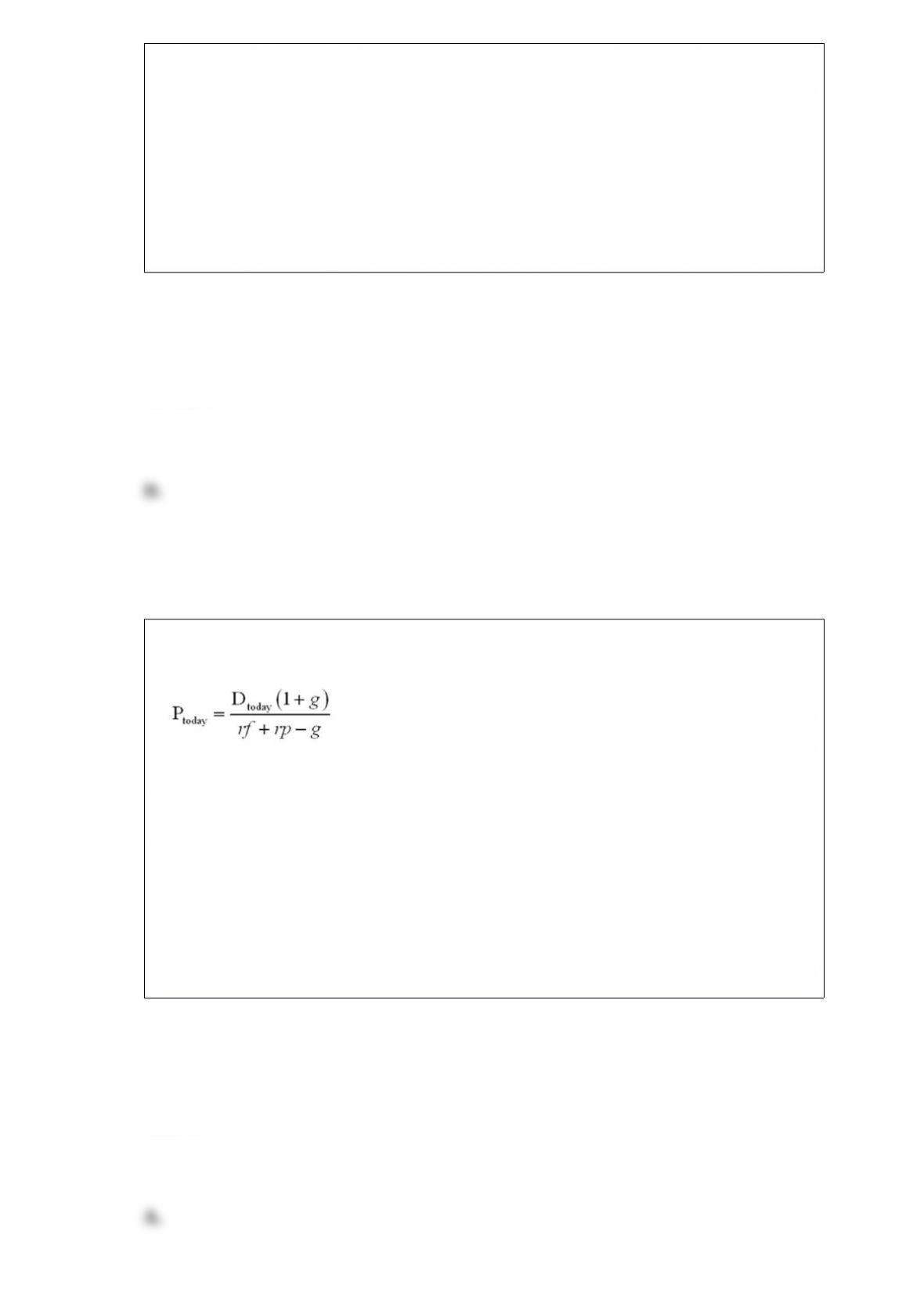
Which of the following will cause an increase in the current price of a stock?
A. A decrease in the risk-free return
B. A decrease in the current dividend
C. A decrease in the dividend growth rate
D. Both an increase in the risk-free return or an increase in the current dividend
Answer:

The term structure of interest rates:
A. always results in an upward sloping yield curve.
B. represents the variation in yields for securities differing in maturities.
C. usually results in a flat yield curve.
D. usually results in a downward sloping yield curve.
Answer:
In recent years the U.S. banking structure has changed in such a way that there are
now:
A. more banks.
B. fewer branches.
C. fewer banks but more branches.
D. fewer banks and fewer banks with branches.
Answer:

One way inflation reduces aggregate demand is by:
A. increasing nominal GDP.
B. increasing velocity.
C. reducing real balances.
D. increasing wealth.
Answer:
The efficient allocation of resources requires: A. that prices reflect the relative value of
goods and services.
B. that inflation not exceed three percent a year.
C. deflation.
D. prices to remain constant.
Answer:
All but which of the following could be adjusted as a means of deflating asset price
bubbles:

A. Tariffs
B. Capital requirements
C. Capital surcharges
D. Fees for insuring the capital of banks
Answer:
The interest rate the Fed charges for secondary credit is:
A. above the primary discount rate.
B. below the market federal funds rate.
C. below the primary discount rate.
D. equal to the primary discount rate.
Answer:
The federal funds market:

A. is the term used for bank borrowing from the Federal Reserve System.
B. is the lending to banks by the U.S. treasury when banks face liquidity emergencies.
C. is the inter-bank market where excess reserves from one bank can be loaned to
another bank.
D. is the borrowing by American banks from foreign lenders.
Answer:
If we look at the value of money in terms of how many units of a good it takes to buy
one dollar, then inflation means:
A. it would take more goods to buy the same dollar.
B. it would take fewer goods to buy the same dollar.
C. the same number of goods would buy fewer dollars.
D. it would take fewer dollars to buy the same goods.
Answer:
Mary deposits funds into a CD at her bank. The CD has an annual interest of 4.0%. If

Mary leaves the funds in the CD for two years she will have $540.80. Assuming no
penalties for withdrawing the funds early, what amount would Mary have at the end of
one year?
A. $521.60
B. $490.00
C. $500.00
D. $520.00
Answer:
A primary financial market is:
A. a market just for corporate stocks.
B. a market only for AAA rated Securities.
C. the New York Stock Exchange.
D. one in which newly issued securities are sold.
Answer:

If we assume a ten percent required reserve rate, and banks not holding any excess
reserves and no change in currency holdings, an open market sale of $5 million of U.S.
Treasury securities by the Fed, will result in deposits:
A. decreasing by $50 million.
B. increasing by $5 million.
C. increasing by $50 million.
D. not changing.
Answer:
The risk structure of interest rates refers to the:
A. relationship among the interest rates of bonds with different maturities.
B. relationship among the interest rates of bonds from different issuers with the same
maturities.
C. relationship among the interest rates of bonds from the same issuer but different
maturities.
D. additional interest required to compensate the buyer for the longer maturity of the
bond.
Answer:

Suppose Mary receives an $8,000 loan from First National Bank. Mary repays $8,480
to First National Bank at the end of one year. Assuming the simple calculation of
interest, the interest rate on Mary’s loan was:
A. 8.00%
B. $480
C. 6.00%
D. 5.66%
Answer:
The central bank in the United States is:
A. the Bank of America.
B. the Federal Reserve.
C. the U.S. Treasury.
D. the Bank of the United States.
Answer:

If the Japanese yen appreciates against the U.S. dollar:
A. Americans should find Japanese goods are now less expensive.
B. Japanese residents would find Japanese goods are relatively less expensive than
American goods.
C. U.S. goods should have an easier time competing against Japanese goods in both
countries.
D. Japanese goods should have an easier time competing against U.S. goods in both
countries.
Answer:
The bond demand curve slopes downward because:
A. at lower prices the reward for holding the bond increases.
B. as bond prices fall so do yields.
C. as bond prices fall bonds are less attractive.
D. as bond prices rise yields increase.
Answer:

The introduction of money market substitutes for basic checking accounts was fueled
partially by the:
A. relatively high rates of inflation that existed in the late 1970s and early 1980s.
B. reluctance of many retailers to accept checks.
C. high number of bank failures that were occurring in the 1970s.
D. higher interest rates banks had to pay on checking accounts.
Answer:
Without the use of money, workers in an economy would:
A. become more specialized
B. have to spend a lot less time trading
C. probably specialize less
D. be far more productive
Answer:

Non-depository institutions would include all of the following except:
A. finance companies.
B. pension funds.
C. insurance companies.
D. credit unions.
Answer:
A bank that meets deposit withdrawal by borrowing additional funds will alter:
A. the asset side of their balance sheet.
B. the liabilities side of the balance sheet.
C. the amount of bank capital.
D. the asset and liabilities side of the balance sheet.
Answer:
If a bank has more interest-rate sensitive liabilities than interest-rate sensitive assets, an

increase in the interest rate will cause profits to:
A. increase.
B. decrease.
C. remain constant.
D. be negative, meaning there will not be profits, only losses.
Answer:
Permanent declines in inflation such as those seen in Chile and Sweden must have been
a result of:
A. an increase in the central bank’s inflation target.
B. a decrease in the central bank’s inflation target.
C. less independence for their central banks.
D. a change to targeting interest rates instead of inflation rates.
Answer:

How many members belong to the board of directors for each of the Reserve Banks of
the Fed?
A. Seven
B. Nine
C. Twelve
D. Fourteen
Answer:
The members of the Board of Governors in recent years have been all of the following,
except:
A. former academic economists.
B. former economic forecasters.
C. a current Secretary of the Treasury.
D. former bankers.
Answer:

When the Russian government defaulted on its bonds in August 1998:
A. risk spreads decreased significantly.
B. yields on U.S. Treasury securities fell while yields on corporate bonds rose.
C. yields on U.S. Treasury securities rose while prices of corporate bonds rose.
D. risk spreads did not change.
Answer:
Over the past twenty-five years, bank loans as a percentage of total credit:
A. increased from less than sixty percent to over 90 percent.
B. stayed fairly constant at around eighty percent.
C. decreased from accounting for virtually all of the credit to less than sixty percent.
D. dropped from seventy five percent to less than thirty percent.
Answer:
The bond supply curve slopes upward because:

A. as bond prices rise people holding bonds are more tempted to hold them.
B. as bond prices rise yields increase.
C. for companies seeking financing, the higher the price of bonds the more attractive it
is to sell bonds.
D. as bond prices rise yields decrease.
Answer:
The primary difference in certificates of deposit (CDs) that are equal to or less than
$100,000 and those over $100,000 (other than the amount) is:
A. a bank does not have to include CDs equal to or less than $100,000 in its liabilities.
B. CDs greater than $100,000 are negotiable and therefore can be bought and sold.
C. CDs equal to or less than $100,000 are issued for only six months or less.
D. CDs greater than $100,000 are issued for only six months or less.
Answer:

Empirical research has shown that:
A. in the 1990s and 2000s, velocity was more sensitive to an increase in the
opportunity cost of holding money than in the 1980s.
B. in the 1990s and 2000s, velocity was less sensitive to an increase in the opportunity
cost of holding money than in the 1980s.
C. during the 1980s and 1990s, the velocity of money was not sensitive to changes in
the opportunity cost of holding money.
D. during the 1980s and 1990s, the velocity of money actually decreased as the
opportunity cost of holding money increased.
Answer:
The central banks of Australia, Canada and New Zealand have eliminated reserve
requirements and conduct monetary policy through a “channel” or “corridor” system.
The “channel” or “corridor” refers to the spread between the central bank’s:
A. target interest rate and its deposit rate.
B. target interest rate and its lending rate.
C. lending rate and its deposit rate.
D. target interest rate and the current interest rate.
Answer:

In the first calendar quarter a company issues a surprising report saying that it expects
profits to rise in the fourth quarter. The theory of efficient markets says we should
expect the price of the company’s stock to:
A. rise in the fourth quarter when the higher profits are actually seen.
B. fall immediately as stockholders will be disappointed about having to wait until the
fourth quarter for higher profits.
C. rise immediately on the expectation of higher profits in the future.
D. rise around the third quarter since this information will take time to disseminate.
Answer: