
If the lender of last resort function of the government is to be effective in working to
minimize a crisis, it must be:
A. reserved only for those banks that are most deserving.
B. used on a limited basis.
C. credible, with banks knowing they can get loans quickly.
D. only available during economic downturns.
Answer:
If monetary policymakers respond aggressively to current inflation above the target
inflation rate, the:
A. monetary policy reaction curve would be flat.
B. dynamic aggregate demand curve would have a steep slope.
C. monetary policy reaction curve would have a positive and steep slope.
D. dynamic aggregate demand curve would shift rightward.
Answer:

A rate of inflation that exceeds the growth rate of money for a country could be
explained by:
A. a growing real economy.
B. a constant velocity of money.
C. an increasing velocity of money.
D. a decreasing velocity of money.
Answer:
Which of the following statements is most correct?
A. High real interest rates cause recessions.
B. Central bankers raise real interest rates to cause recessions.
C. There is no evidence that high real interest rates are followed by lower levels of
growth.
D. There is evidence that high real interest rates are followed by lower levels of
growth.
Answer:

Which of the following statements is most accurate?
A. Yield to maturity is equal to the coupon rate if the bond is held to maturity.
B. Yield to maturity is the same as the coupon rate.
C. Yield to maturity will exceed the coupon rate if the bond is purchased for face value.
D. Yield to maturity is the same as the coupon rate if the bond is purchased for face
value and held to maturity.
Answer:
Insurance companies offer two basic type of insurance; these are:
A. life insurance and property and casualty insurance.
B. life insurance and mutual funds.
C. property and casualty companies.
D. whole life and term life insurance companies.
Answer:

The key to the success of forward guidance as a monetary policy tool is:
A. timing.
B. a favorable exchange rate.
C. transparency.
D. credibility.
Answer:
Citigroup is an example of:
A. an Edge Act corporation.
B. a foreign bank.
C. a financial holding company.
D. a unit bank.
Answer:
In its role as the bankers’ bank, a central bank performs each of the following, except:

A. providing loans during times of financial distress.
B. providing deposit insurance.
C. overseeing commercial banks and the financial system.
D. managing the payments system.
Answer:
In a barter economy with “n” number of goods there will always be:
A. exactly “n” relative prices.
B. fewer than “n” relative prices.
C. more than “n” relative prices.
D. “n/2” relative prices.
Answer:
In the short run, the aggregate supply curve is:

A. vertical.
B. horizontal.
C. upward sloping.
D. downward sloping.
Answer:
For several years before the crisis of 2007-2009, people in U.S. business and
government called for China to move away from its fixed-exchange rate regime
because:
A. hindering its own growth.
B. building up inflation risks.
C. adding to its current account deficit.
D. exporting its inflation to the United States.
Answer:
The direct impact on spending of short-term interest rate changes by central banks is:

A. definitely the strongest of all transmission mechanisms.
B. not that powerful.
C. only effective for consumption but not investment.
D. only effective for net exports but not for investment and consumption.
Answer:
Identify which of the following is not one of the five core principles of money and
banking.
A. Risk requires compensation
B. Time has value
C. Information is the basis for decisions
D. Stability creates risk
Answer:
The greater the standard deviation of an investment the:

A. lower the return.
B. greater the risk.
C. lower the risk.
D. lower the risk and return.
Answer:
In May of 2003, the European Central Bank (ECB) decided to:
A. focus almost exclusively on money growth as their target.
B. downgrade the role of money growth in their policymaking strategy.
C. limit the role of interest rate targeting to be second in importance to money growth
targeting.
D. switch from an inflation target to a money growth target.
Answer:
As a result of “Check 21The Check Clearing for the 21st Century Act”:

A. banks no longer have to ship paper checks to complete the process of check
clearing.
B. people can write checks and plan on having a couple of days to make a deposit to
cover the check amount.
C. canceled checks can no longer be used as proof of payment.
D. the Federal Reserve is no longer involved in the check-clearing process.
Answer:
According to Robert Shiller, a dark-horse candidate for the next speculative bubble is:
A. stock market.
B. farmland.
C. housing market.
D. student loans.
Answer:

An increased risk of a financial crisis in the euro area should cause the:
A. demand for all government securities including U.S. Treasury securities to decrease.
B. risk spread between U.S. Treasury bonds and other bonds to decrease.
C. price of U.S. Treasury bonds to increase and the yield on other bonds to increase.
D. price of U.S. Treasury bonds to increase and the yield on other bonds to decrease.
Answer:
In the short run, a country’s exchange rate is determined by:
A. monetary policy.
B. purchasing power parity.
C. the domestic inflation rate.
D. supply and demand.
Answer:
Seasonal credit provided by the Fed is not as common as it used to be because:

A. there are fewer banks in seasonal areas.
B. other sources for long-term loans have developed for banks in seasonal areas.
C. seasonal credit has been replaced by secondary credit.
D. seasonal credit is being replaced by primary credit.
Answer:
We would expect the relationship between the risk spread on Baa bonds and U.S.
Treasury securities of similar maturities to:
A. vary directly with economic growth.
B. show no variation over the business cycle.
C. vary inversely with economic growth.
D. be uncorrelated with economic growth.
Answer:
Over the long run if central banks want to avoid high rates of inflation, they need to be

concerned with the:
A. unemployment rate.
B. money growth rate.
C. real economic growth rate.
D. productivity of labor.
Answer:
You graduate from law school and can now begin charging clients fees for your time.
What impact will this have on your demand for money?
A. Your increased income will likely cause your demand for money to decrease
B. Your opportunity cost of making trips to the bank will decrease
C. Your increased income will likely cause your demand for money to increase
D. Your demand for money will not be affected
Answer:

In dollar amounts:
A. the monetary base is larger than M2 and M1 is less than M2.
B. M1 is smaller than the monetary base and M2 is larger than both.
C. the monetary base is larger than M1 and M2.
D. the monetary base is smaller than M1 and M2 is larger than M1.
Answer:
A major contributing factor to the instability of money demand over the past 25 years is
the:
A. introduction of financial instruments that pay higher returns than money but can be
used as a means of payment.
B. Fed has changed the way the money aggregates are defined.
C. failure of many savings and loans.
D. introduction of credit cards.
Answer:

The yield on a 30-year U.S. Treasury security is 6.5%; the yield on a 2-year U.S.
Treasury bond is 4.0%. This data indicate:
A. the yield curve is downward sloping.
B. the yield curve is flat since the risk premium needs to be added for longer
maturities.
C. the yield curve is upward sloping.
D. that people expect inflation to decrease in the future.
Answer:
Which of the following is not a goal of the Dodd-Frank Act of 2010?
A. To anticipate and prevent financial crises by limiting systemic risk
B. To end “too big to fail”
C. To promote competition
D. To reduce moral hazard
Answer:

Which of the following assigns widely followed bond ratings?
A. The Federal Reserve
B. The U.S. Treasury
C. The New York Stock Exchange
D. Standard & Poor’s
Answer:
Which of the following is responsible for invoking the Fed’s emergency powers?
A. FOMC
B. Board of Governors
C. Fed Chairman
D. a majority of the Federal Reserve Bank presidents
Answer:
In an economy like the United States, the impact of a decrease in import prices on

overall inflation can be best described as:
A. nonexistent.
B. a modest increase.
C. a modest decrease.
D. a significant decrease, particularly as globalization and trade increase.
Answer:
It is difficult for depositors to know the true health of banks because:
A. regulations prohibit banks making their financial statements publicly available.
B. the financial statements of banks are too difficult for most people to understand.
C. most of the information on bank loans is private and based on sophisticated models.
D. banking is competitive and financial records of banks are not divulged to prevent
competitor banks from having an advantage.
Answer:

Financial intermediaries pool funds of:
A. many small savers and provide it to a few large borrowers.
B. few large savers and provide it to many small borrowers.
C. few large savers a few large borrowers.
D. many small savers and provide it to many borrowers.
Answer:
Over the years most monetary policy experts would agree with each of the following
statements, except:
A. the reserve requirement is not useful as an operational instrument.
B. central bank lending is necessary to ensure financial stability.
C. short-term interest rates are the best tool to use to stabilize short-term fluctuations in
prices and output.
D. transparency in policy making hinders accountability.
Answer:

If changes in the nominal federal funds rate result in equal changes to the expected rate
of inflation, how effective would it be for the FOMC to target the nominal federal funds
rate?
Answer:
Is the characteristic that distinguishes money from other assets its ability to be a store of
value?
Answer:
Predict how monetary policymaking would change, if at all, if members of the Board of
Governors of the Federal Reserve were popularly elected to two-year terms and could
run for re-election.

Answer:
Why do increases in potential output allow monetary policymakers to think
“opportunistically” about disinflation?
Answer:
It has been argued that the laws that prohibited branch banking were needed to protect
consumers from large monopoly banks. Does that argument hold up to close scrutiny?
Explain.

Answer:
An argument that comes up from time to time is that credit unions have an advantage
over other financial depository institutions in the sense that they are non-profit
institutions and, therefore, are exempt from taxes on income that other private
depository institutions pay. As a result, credit unions may be able to charge lower rates
of interest to borrowers and pay a higher rate to depositors than these other institutions.
What do you think of this argument?
Answer:
A lender expects to earn a real interest rate of 4.5% over the next 12 months. She
charges a 9.25% (annual) nominal rate for a 12-month loan. What inflation rate is she
expecting? If the lender is in a 30% marginal tax bracket, the borrower in a 25%
marginal tax bracket, and they both have the same inflation expectations, what are the
real after-tax rates each expects?

Answer:
Explain the view called real business cycle theory.
Answer:
When we compare the graphs of GDP growth over time to the corresponding risk
spread on Baa bonds compared to 10-year U.S. Treasury bonds, what relationship can
be inferred?
Answer:
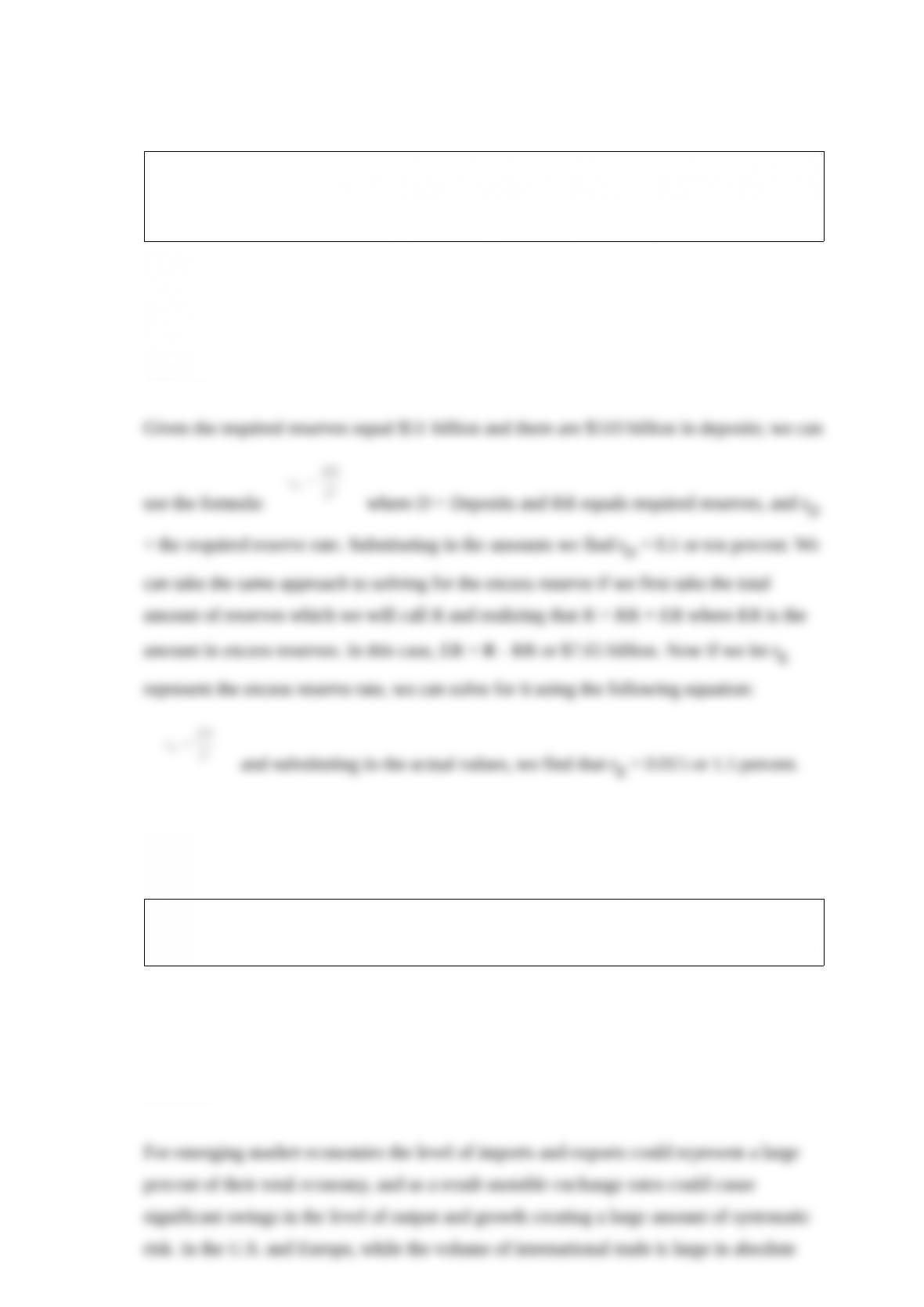
Total banking system reserves equal $58.65 billion. The total banking system checkable
deposits subject to reserve requirements are $510 billion. The required reserves are $51
billion. What is the required reserve rate, and what is the excess reserve rate?
Answer:
Why might the central bankers in emerging market economies focus more attention on
a stable exchange rate than say the Federal Reserve or the European Central Bank?
Answer:

What were the positive effects of the 1988 Basel Accord? What were its shortcomings?
Answer:
Discuss why many economists maintain that continued deficit spending by government
is likely to “crowd out” (decrease) investment spending in the long run.
Answer:
Answer:
If the U.S. Supreme Court ruled that states could no longer require people to have auto
insurance, do you think most people would cancel their policies? Explain.
Answer:
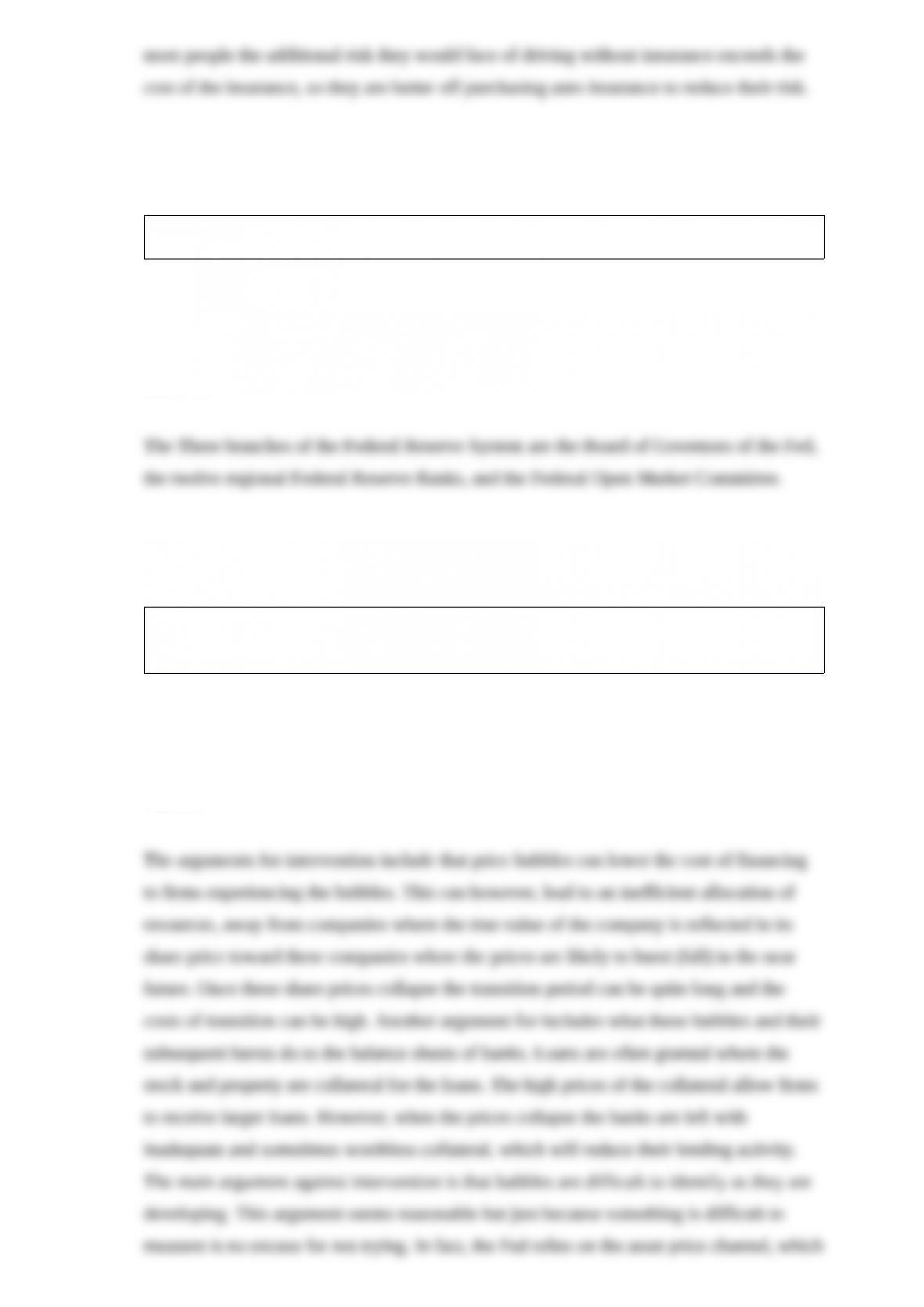
What are the three branches that make up the Federal Reserve System?
Answer:
What are the arguments for and against monetary policymakers intervening to address
equity and property price bubbles?
Answer:

What separates a sterilized foreign exchange market intervention from an unsterilized
intervention?
Answer:
What factors can cause the portfolio demand for money to increase?
Answer:
If the Fed wanted to keep inflation in check given the growth rate of the economy, how
should they have responded to the financial innovations of the mid to late 1970s and
early 1980s in terms of money growth?
Answer: