Chapter 23 – Modern Monetary Policy and the Challenges Facing Central Bankers
Chapter 23
Modern Monetary Policy and the Challenges Facing Central
Bankers
Conceptual and Analytical Problems
1. Explain in detail how monetary policy influences banks’ lending behavior. Show
how an open market purchase affects the banking system’s balance sheet, and dis-
cuss the impact on the supply of bank loans. (You may wish to refer to Chapter
17 in answering this question.) (LO1)
Answer: The traditional tool of monetary policy in the U.S. is the federal funds
rate. To achieve the target rate, the Fed buys or sells Treasury securities. When
2. Explain why you might expect the recovery from the 2007-2009 recession to be
weaker than normal? (LO1)
Answer: Recoveries from recessions precipitated from financial crises tend gen-
erally to be weaker. Banks tend to tighten credit standards in the wake of financial
3. *Explain why the traditional interest-rate channel of monetary policy transmission
from monetary policy actions to changes in investment and consumption deci-
sions may be relatively weak. (LO1)
Answer: External financing by firms is made difficult by problems associated
with asymmetric information, weakening the impact of changes in the cost of
4. Explain why monetary policymakers’ actions in cutting the Federal Funds rate to
almost zero were not sufficient to boost economic activity during the recession of
2007-2009. (LO2)
23-1
© 2015 by McGraw-Hill Education. This is proprietary material solely for authorized instructor use. Not authorized for sale or distribution in
any manner. This document may not be copied, scanned, duplicated, forwarded, distributed, or posted on a website, in whole or part.
Chapter 23 – Modern Monetary Policy and the Challenges Facing Central Bankers
Answer: The financial system is the key link between monetary policy and eco-
nomic activity. When the financial system is disrupted, so too is the mechanism
that transmits monetary policy actions to the real economy. The financial crisis
5. When monetary policymakers hit the zero nominal-interest-rate bound with their
policy rate, they have the option to turn to unconventional tools of monetary poli-
cy. How do these unconventional tools work, and why are policymakers reluctant
to use them except in very difficult circumstances? (LO2)
Answer: Forward guidance, quantitative easing and targeted asset purchases are
examples of unconventional tools. Forward guidance, where the central bank ex-
presses the intent to keep interest rates low in the future; influencing long-term in-
Policymakers usually are reluctant to use these tools as they have limited experi-
ence with them, making the impact of their use less predictable. In addition, exit-
6. The government decides to place limits on the interest rates banks can pay their
depositors. Seeing that alternative investments pay higher interest rates, deposi-
tors withdraw their funds from banks and place them in bonds. Will their action
have an impact on the economy? If so, how? (LO1)
Answer: If depositors withdraw their funds, banks will be forced to shrink the size
of their balance sheets so the supply of loans will fall, with a special effect on
23-2
© 2015 by McGraw-Hill Education. This is proprietary material solely for authorized instructor use. Not authorized for sale or distribution in
any manner. This document may not be copied, scanned, duplicated, forwarded, distributed, or posted on a website, in whole or part.
Chapter 23 – Modern Monetary Policy and the Challenges Facing Central Bankers
7. New developments in information technology have simplified the assessment of
individual borrowers’ creditworthiness. What are the likely consequences for the
structure of the financial system? For monetary policy? (LO2)
Answer: Individuals can now obtain loans and mortgages from many different
8. * Describe the theory of the exchange-rate channel of the monetary transmission
mechanism. How, through the exchange rate, does an interest rate increase influ-
ence output? Why is this link difficult to find in practice? (LO1)
Answer: A rise in nominal interest rates will lead to a rise in real interest rates in
the face of price stickiness. This makes domestic investments more attractive to
In practice, there are many factors that affect the demand and supply for domestic
9. Many economists have argued that Japan’s economic problems during the 1990s
were caused largely by bank failures and the failure of the Japanese government
to clean up the banking system. Explain how a collapse of the banking system
could cause a fall in real output. Can monetary policymakers do anything to re-
vive the economy under such circumstances? (LO2)
Answer: Decreases in asset prices caused borrowers to default on loans, reducing
bank capital. Banks that should have been closed were allowed to stay open, but
10. Why might the zero nominal-interest-rate bound lead policymakers to raise their
inflation objective? (LO2)
Answer: Nominal interest rates cannot fall significantly below zero. If an
economy experiences a deflationary shock when the nominal interest rate is zero,
23-3
© 2015 by McGraw-Hill Education. This is proprietary material solely for authorized instructor use. Not authorized for sale or distribution in
any manner. This document may not be copied, scanned, duplicated, forwarded, distributed, or posted on a website, in whole or part.
Chapter 23 – Modern Monetary Policy and the Challenges Facing Central Bankers
11. Considering the role of the U.S. house price bubble in the financial crisis of
2007-2009, how do you think monetary policymakers should respond to bubbles
in asset markets? (LO2)
Answer: Sharp changes in asset prices can be very damaging to the economy,
creating large swings in consumption through wealth effects, facilitating booms
and busts in investment and damaging the balance sheets of financial institutions.
While monetary policymakers may wish to act to avoid or contain such bubbles,
12. For each of the following, explain whether the response is theoretically consistent
with a tightening of monetary policy and identify which traditional channel of
monetary policy is at work: (LO1)
a. Firms become more likely to undertake investment projects.
b. Households become less likely to purchase refrigerators and washing ma-
chines.
c. Net exports fall.
Answer:
a. This is not consistent with a tightening of monetary policy, which would
b. This is consistent with a tightening of monetary policy. In the face of
c. This is consistent with a tightening of monetary policy. When interest
rates rise, there is an increase in investor demand for U.S. assets, leading
13. In Country A suppose that changes in short-term interest rates translate quickly
into changes in long-term interest rates, while in Country B long-term interest
23-4
© 2015 by McGraw-Hill Education. This is proprietary material solely for authorized instructor use. Not authorized for sale or distribution in
any manner. This document may not be copied, scanned, duplicated, forwarded, distributed, or posted on a website, in whole or part.
Chapter 23 – Modern Monetary Policy and the Challenges Facing Central Bankers
rates do not respond much to changes in short-term rates. In which country would
you expect the interest-rate channel of monetary policy to be stronger? Explain
your answer. (LO1)
Answer: Households’ decisions to buy cars and houses and firms’ decisions to
14. Consider a situation where central bank officials repeatedly express concern that
output exceeds potential output, implying that the economy is overheating. Al-
though they haven’t implemented any policy moves as yet, the data show that
consumption of luxury goods has begun to slow. Explain how this behavior could
reflect the asset-price channel of monetary policy at work. (LO1)
Answer: Policymakers expressing concern about the economy overheating may
15. Do you think the balance-sheet channel of monetary policy would be stronger or
weaker if: (LO1)
a. Firms’ balance sheets in general are very healthy?
b. Firms have a lot of existing variable-rate debt?
Answer:
a. The balance-sheet channel is likely to be weaker if firms generally have
b. The balance-sheet channel is likely to be stronger if firms have high levels
16. In the wake of the financial crisis of 2007-2009, would you anticipate the bank
lending channel becoming more or less important in the U.S. in the near future?
Explain your answer. (LO2)
Answer: The financial crisis interrupted the trend towards securities market fi-
nance, which could increase the importance of bank lending and strengthen the
17. *Suppose there is an unexpected slowdown in the rate of productivity growth in
the economy so that forecasters consistently overestimate the growth rate of GDP.
If the central bank bases its policy decisions on the consensus forecast, what
23-5
© 2015 by McGraw-Hill Education. This is proprietary material solely for authorized instructor use. Not authorized for sale or distribution in
any manner. This document may not be copied, scanned, duplicated, forwarded, distributed, or posted on a website, in whole or part.
Chapter 23 – Modern Monetary Policy and the Challenges Facing Central Bankers
would be the likely consequences for inflation assuming it maintains its existing
inflation target? (LO2)
Answer: Suppose, for example, the consensus forecast was for positive
productivity growth while actual productivity growth was zero, resulting in no
18. Suppose the policy interest rate controlled by the central bank and the inflation
rate were both zero. Explain in terms of the aggregate demand-aggregate supply
framework how the economy could fall into a deflationary spiral if it were hit by a
negative aggregate demand shock. (LO2)
Answer: A negative aggregate demand shock shifts the aggregate demand curve to
the left, leading in the short run to output falling below potential output. In the
absence of a policy response, this will eventually put downward pressure on
19. *Use the aggregate demand-aggregate supply framework to show how a boom in
equity prices might affect inflation and output in the short run. Describe the
long-run impact on inflation and output: (a) if the central bank implicitly allows
its inflation target to rise; (b) if it retains its original inflation target. (LO2)
Answer: The boom in equity prices would increase consumer wealth, boosting
consumption. It would make financing cheaper for firms, boosting investment.
If the central bank does not take offsetting action to counter the demand curve
23-6
© 2015 by McGraw-Hill Education. This is proprietary material solely for authorized instructor use. Not authorized for sale or distribution in
any manner. This document may not be copied, scanned, duplicated, forwarded, distributed, or posted on a website, in whole or part.

Chapter 23 – Modern Monetary Policy and the Challenges Facing Central Bankers
If the central bank maintained its original inflation target, monetary policy would
20. Compare the impact of a given change in monetary policy in two economies that
are similar in every way except that, in Economy A, the financial system has a
large shadow banking system providing many alternatives to bank financing,
while in Economy B, bank loans account for almost all of the financing in the
economy. (LO1)
Answer: Given the reliance on bank loans in economy B, the bank lending
channel would be stronger than in Economy A, leading to a larger shift in the
dynamic aggregate demand curve in Economy B for a given change in monetary
policy.
Data Exploration
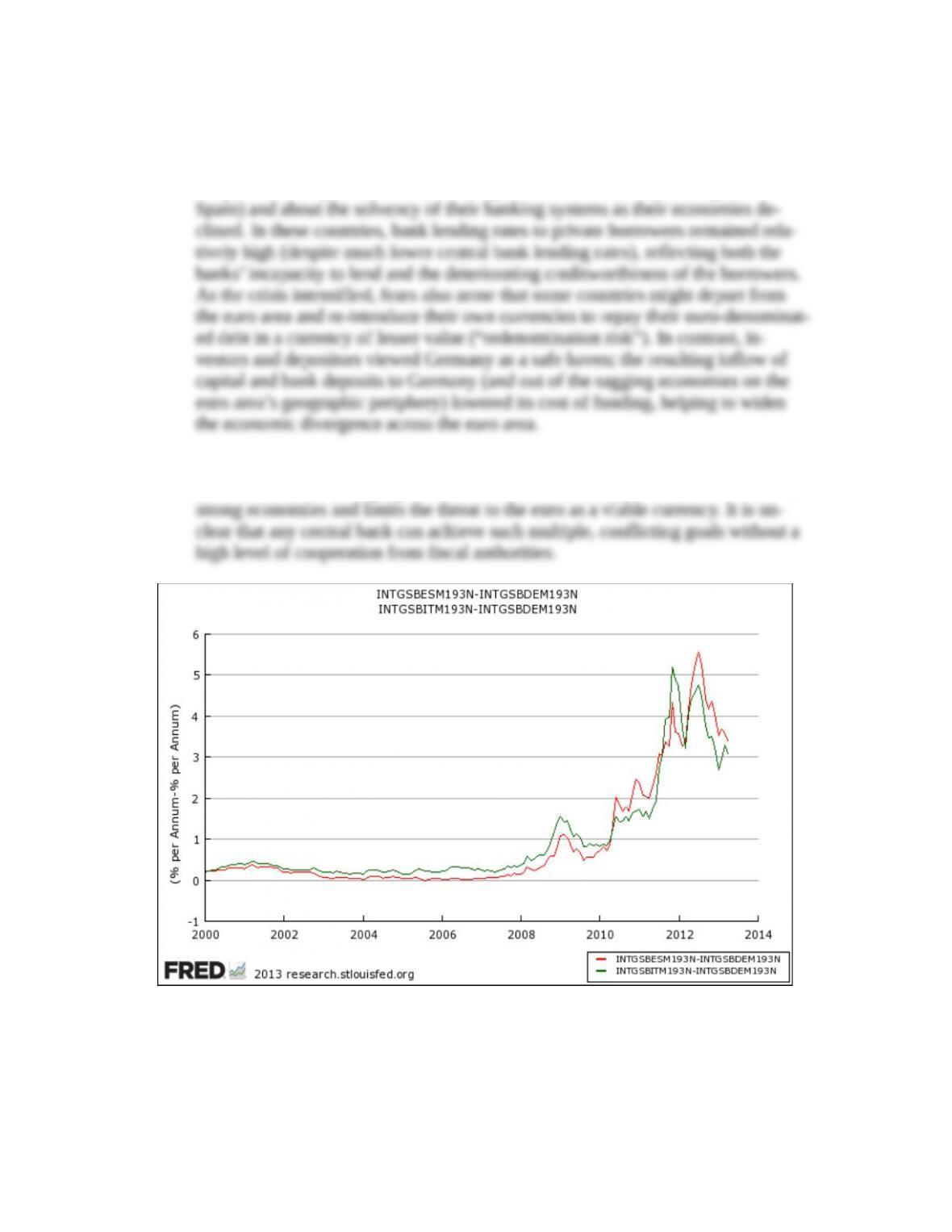
1. In conducting monetary policy, the European Central Bank (ECB) must balance
the needs of euro-area countries with differing economic conditions. Plot since
1990 the yield spread between government bonds in Italy (FRED code: INTGS-
BITM193N) and Germany (FRED code: INTGSBDEM193N), along with the
yield spread between government bonds in Spain (FRED code: INTGSBES193N)
and Germany. Discuss the yield spreads after 2008 and explain how they reflect
policy challenges for the ECB. (LO2)
23-7
© 2015 by McGraw-Hill Education. This is proprietary material solely for authorized instructor use. Not authorized for sale or distribution in
any manner. This document may not be copied, scanned, duplicated, forwarded, distributed, or posted on a website, in whole or part.
Inflation
Output
LRAS
SRAS
AD
Y*
πT
AD’
B
C
A
SRAS’
Chapter 23 – Modern Monetary Policy and the Challenges Facing Central Bankers
Answer: The data is plotted below. Prior to the euro-area financial crisis, the
yields on government bonds were nearly identical across the countries of the euro
area. During the crisis, however, concerns emerged about the risks of default on
the part of some governments (including Greece, Ireland, Italy, Portugal, and
The challenge for the ECB is to maintain price stability while designing a policy
that addresses the diverging economic and financial conditions in both weak and
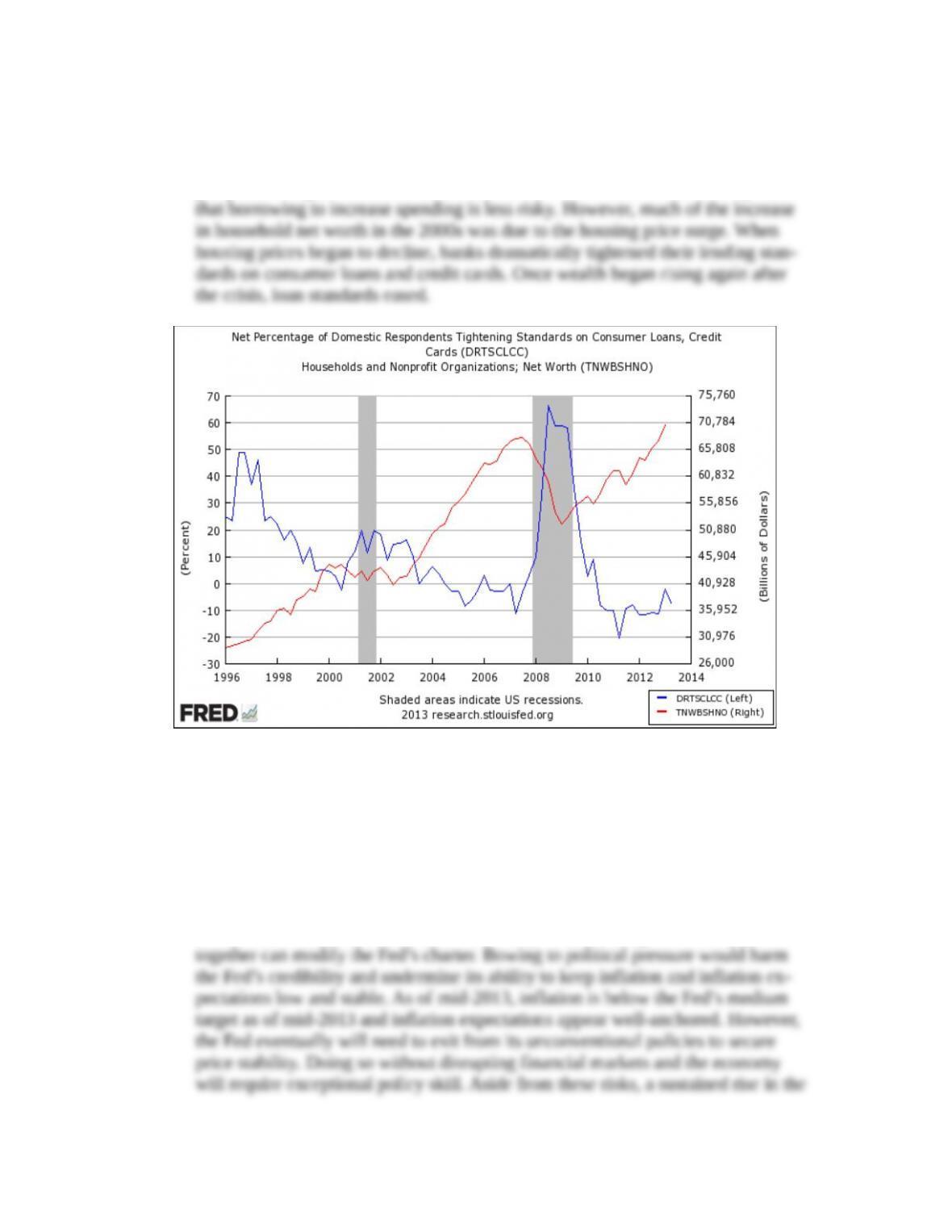
2. How important is the balance sheet channel of monetary policy? Plot since 1996
the net tightening of credit standards for consumer and credit card loans (FRED
code: DRTSCLC) and (on the right scale) household net worth (FRED code:
TNWBSHNO). Do banks adjust lending conditions when household balance
sheets improve or deteriorate? (LO1)
23-8
© 2015 by McGraw-Hill Education. This is proprietary material solely for authorized instructor use. Not authorized for sale or distribution in
any manner. This document may not be copied, scanned, duplicated, forwarded, distributed, or posted on a website, in whole or part.
Chapter 23 – Modern Monetary Policy and the Challenges Facing Central Bankers
Answer: Prior to the onset of the financial crisis of 2007-2009, rising net worth
generally was associated with a loosening of lending standards. From the lender’s
perspective, higher net worth means that a borrower is more credithworthy and
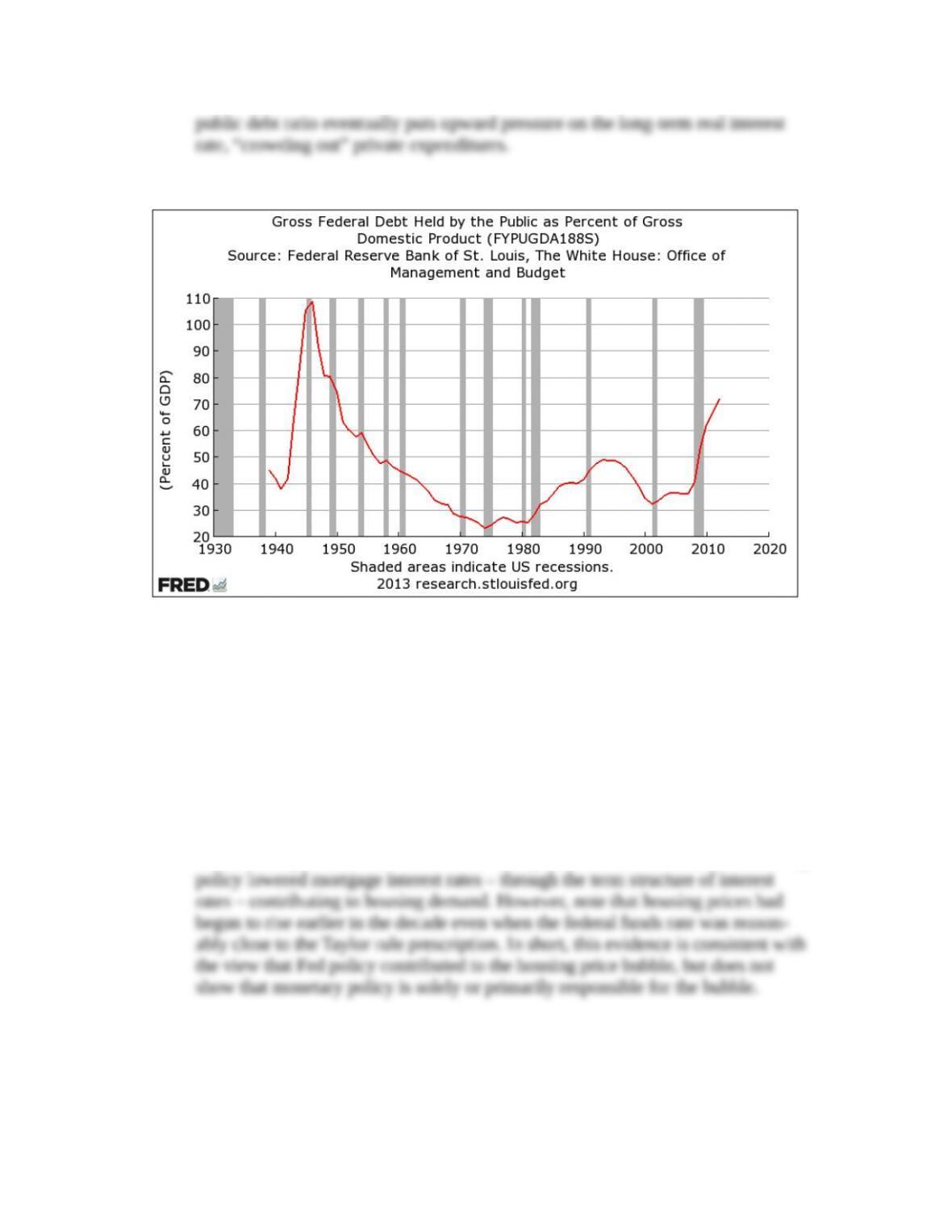
3. Among the challenges facing central banks around the world is the elevated level
of public debt. Plot U.S. federal debt held by the public as a percent of gross do-
mestic product (FRED code: FYPUGDA188S) and discuss the problems that gov-
ernment debt could pose for the Federal Reserve in the future. (LO2)
Answer: The data is plotted below. The key issue is whether the Federal Reserve
will come under political pressure to monetize the debt. As an independent central
bank, the Fed can resist this pressure up to a point, but Congress and the President
23-9
© 2015 by McGraw-Hill Education. This is proprietary material solely for authorized instructor use. Not authorized for sale or distribution in
any manner. This document may not be copied, scanned, duplicated, forwarded, distributed, or posted on a website, in whole or part.
Chapter 23 – Modern Monetary Policy and the Challenges Facing Central Bankers
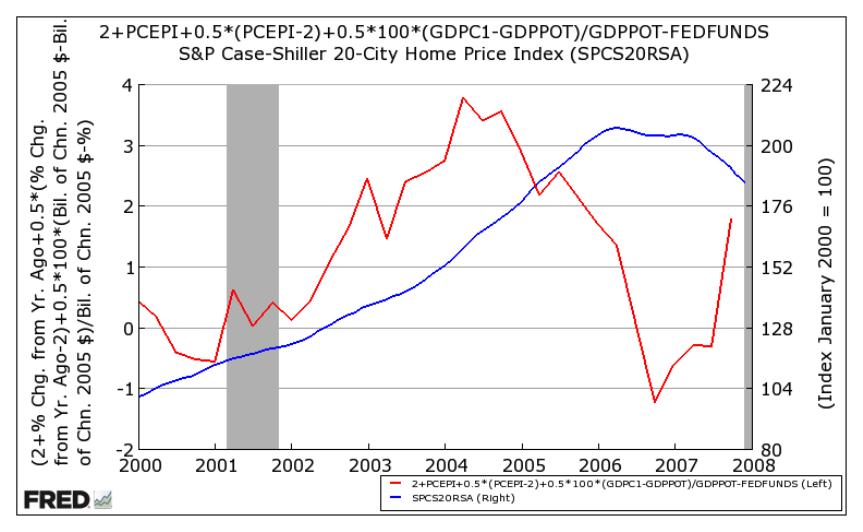
4. *Some critics argue that the Federal Reserve stoked the housing price bubble after
2000 by keeping monetary policy too stimulative. To investigate, first plot from
2000 to 2007 on a quarterly basis the Taylor rule gap – the difference between the
Taylor rule and the federal funds rate – as described in Chapter 18 Data Explo-
ration Problems 1 and 2. Add to this plot on the right scale an index of U.S. hous-
ing prices (FRED code: SPCS20RSA). Does the evidence support the critics’
claim? What other evidence might be sought? (LO1)
Answer: The data, plotted below, shows that U.S. urban housing prices more than
doubled in this period. It also shows that the FOMC set the federal funds rate well
below the Taylor Rule after 2002 for several years. This accommodative monetary
23-10
© 2015 by McGraw-Hill Education. This is proprietary material solely for authorized instructor use. Not authorized for sale or distribution in
any manner. This document may not be copied, scanned, duplicated, forwarded, distributed, or posted on a website, in whole or part.
Chapter 23 – Modern Monetary Policy and the Challenges Facing Central Bankers
*Indicates more difficult problems
23-11
© 2015 by McGraw-Hill Education. This is proprietary material solely for authorized instructor use. Not authorized for sale or distribution in
any manner. This document may not be copied, scanned, duplicated, forwarded, distributed, or posted on a website, in whole or part.