Chapter 17 – The Central Bank Balance Sheet and the Money Supply Process
Chapter 17
The Central Bank Balance Sheet
and the Money Supply Process
Conceptual and Analytical Problems
1. Follow the impact of a $100 cash withdrawal through the entire banking system,
assuming that the reserve requirement is 10 percent and that banks have no desire
to hold excess reserves. (LO3)
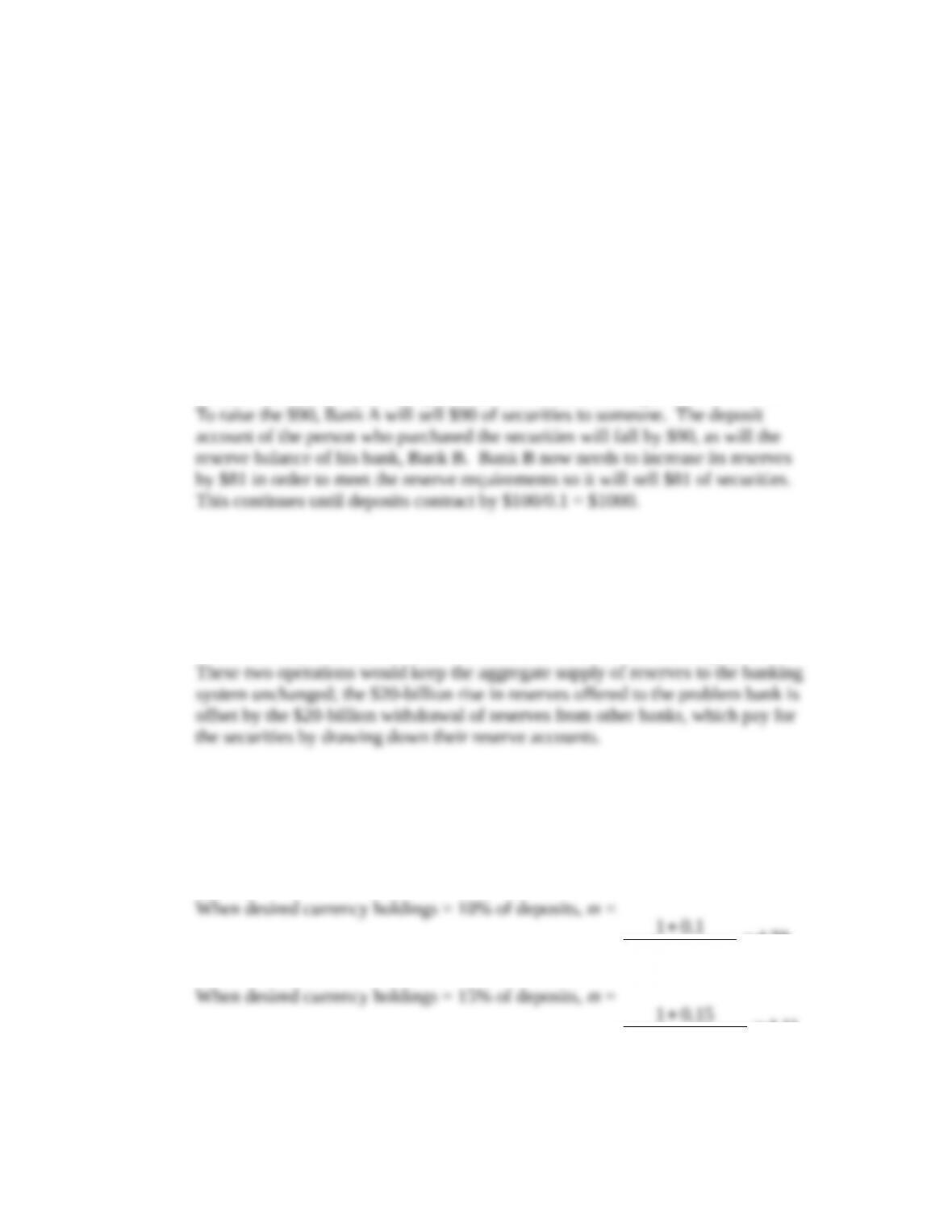
Answer: Deposits fall by $100 and reserves fall by $100. The bank (Bank A)
needs to increase its reserves by $90 in order to meet the required reserve ratio.
2. Suppose a major bank needs to borrow $20 billion overnight that it cannot obtain
from private creditors. The Fed is willing to make a discount loan of $20 billion
provided that it will not alter interbank lending rates. How can it do so? (LO1)
Answer: The Fed can make the $20 billion loan to the problem bank if it
simultaneously sells $20 billion of securities to the rest of the banking system.
3. Compute the impact on the money multiplier of an increase in the
currency-to-deposit ratio from 10 percent to 15 percent when the reserve
requirement is 10 percent of deposits, and banks’ desired excess reserves are 3
percent of deposits. (LO3)
Answer:
11.4
03.01.015.0
15.01
4. Does the Federal Reserve frequently purchase or sell gold or foreign exchange as
part of its efforts to change the money supply? (LO1)
17-1
© 2015 by McGraw-Hill Education. This is proprietary material solely for authorized instructor use. Not authorized for sale or distribution in
any manner. This document may not be copied, scanned, duplicated, forwarded, distributed, or posted on a website, in whole or part.
Chapter 17 – The Central Bank Balance Sheet and the Money Supply Process
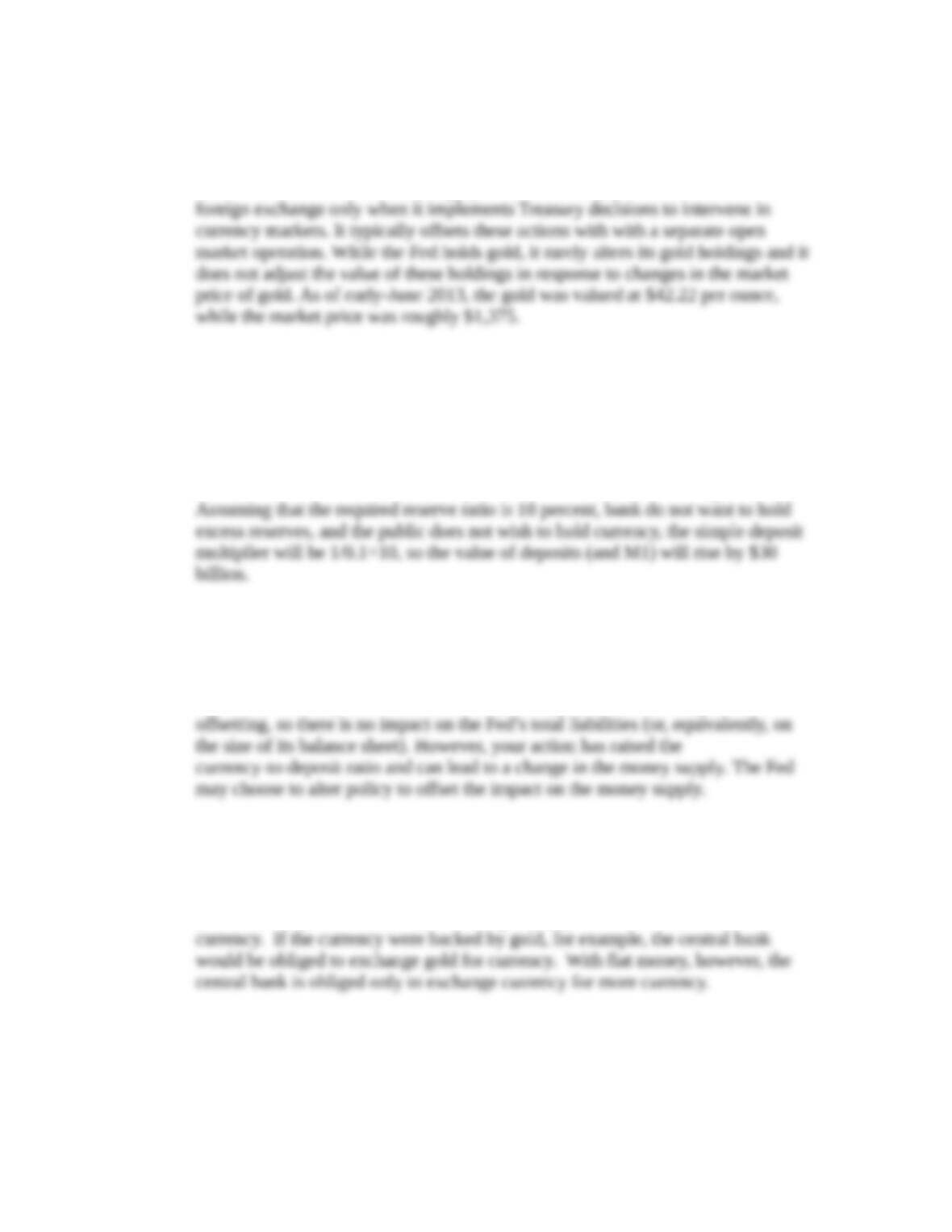
Answer: No. Fed transactions in foreign exchange and gold are infrequent, and
are not used to alter the money supply. The Fed usually purchases and sells
5. Consider an open market purchase by the Fed of $3 billion of Treasury bonds.
What is the impact of the purchase on the bank from which the Fed bought the
securities? Compute the impact on M1 assuming that: (1) the required reserve
ratio is 10 percent; (2) the bank does not wish to hold excess reserves; and (3) the
public does not wish to hold currency. (LO3)
Answer: The bank’s securities fall by $3 billion and its reserves rise by $3 billion.
6. When you withdraw cash from your bank’s ATM, what happens to the size of the
Fed’s balance sheet? Is there any reason for the Fed to react to your action?
Answer: The reserves held by your bank at the Fed decline, but there is a larger
volume of currency in the hands of the nonbank public. These changes are
7. *Why is currency circulating in the hands of the nonbank public considered a
liability of the central bank? (LO1)
Answer: Currency issued by the central bank is effectively an IOU to the holder
of the currency. The central bank is obliged to pay back the holder of the
8. How did the financial crisis of 2007-2009 affect the size and composition of the
balance sheet of the Federal Reserve? (LO1)
17-2
© 2015 by McGraw-Hill Education. This is proprietary material solely for authorized instructor use. Not authorized for sale or distribution in
any manner. This document may not be copied, scanned, duplicated, forwarded, distributed, or posted on a website, in whole or part.
Chapter 17 – The Central Bank Balance Sheet and the Money Supply Process
Answer: Between December 2007 and December 2009, the assets on the Federal
Reserve’s balance sheet increased by 2.5 times, mostly in the form of securities.
9. Suppose the currency-to-deposit ratio is 0.25, the excess reserve-to-deposit ratio is
0.05, and the required reserve ratio is 0.10. Which will have a larger impact on the
money multiplier: a rise of 0.05 in the currency ratio or in the excess reserves
ratio? (LO4)
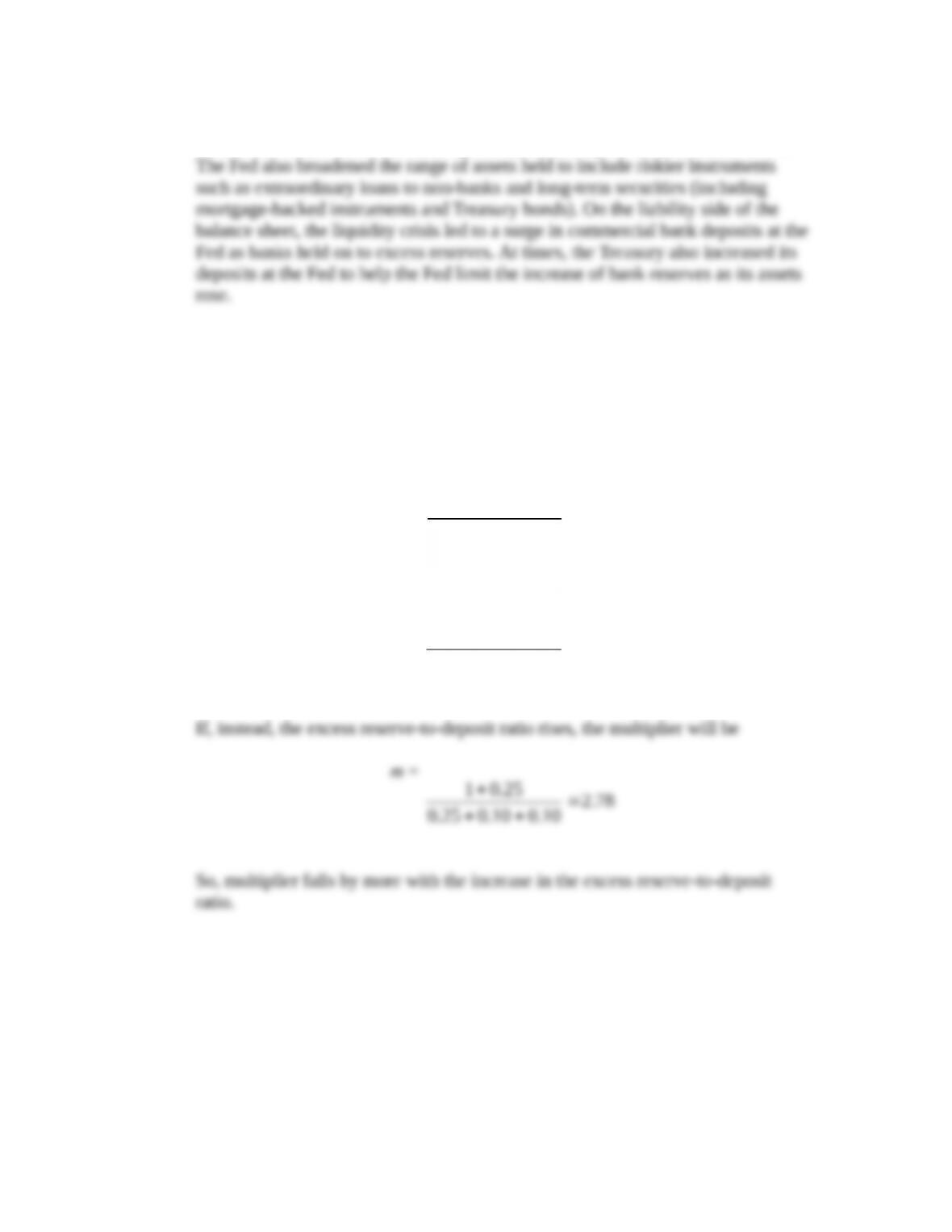
Answer: Initially, the money multiplier is
m =
13.3
05.010.025.0
25.01
If the currency-to-deposit ratio rises to 0.30, the multiplier falls to
m =
89.2
05.010.030.0
30.01
10.010.025.0
Chapter 17 – The Central Bank Balance Sheet and the Money Supply Process
11. Based on Figure 17.11, explain why the multipliers fell sharply with the onset of
the financial crisis of 2007-2009. Why did they remain at this lower level after the
crisis ended? (LO3)
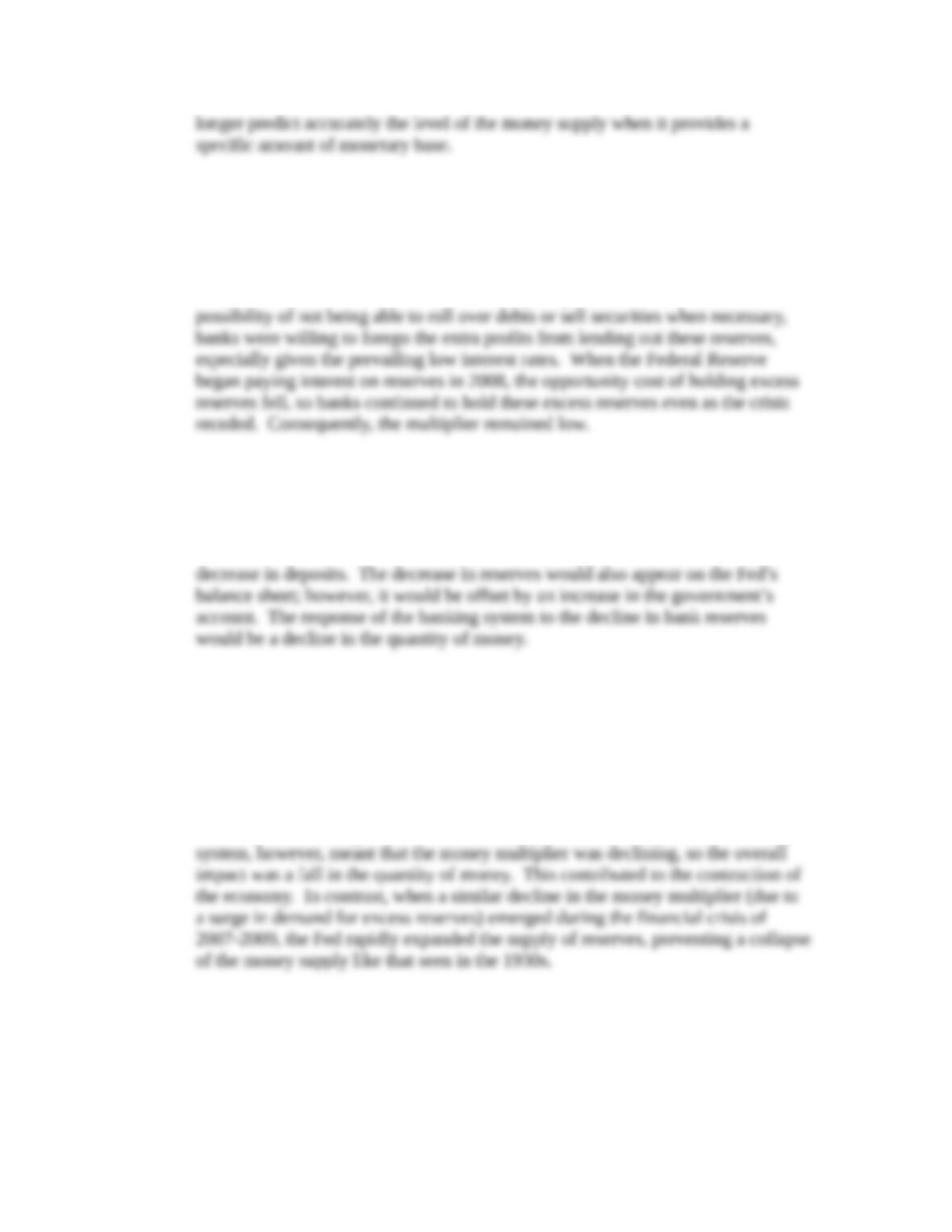
Answer: The money multipliers plummeted during the financial crisis as banks
hoarded excess reserves in the face of the liquidity crisis. Confronted with the
12. The U.S. Treasury maintains accounts at commercial banks. What would be the
consequences for the money supply if the Treasury shifted funds from one of
those banks to the Fed? (LO3)
Answer: The balance sheet for the bank would reflect a decrease in reserves and a
13. *Explain how an incomplete understanding at the Federal Reserve of the
relationship between the central bank’s balance sheet and the money supply
contributed to the Great Depression. How did the Fed’s behavior during the
financial crisis of 2007-2009 illustrate that it had learned a valuable lesson from
the Great Depression? (LO4)
Answer: During the Great Depression, the central bank was increasing the
monetary base at a significant rate. Conditions in the economy and the banking
14. Suppose you examine the central bank’s balance sheet and observe that since the
previous day, reserves had fallen by $100 million. In addition, on the asset side of
the central bank’s balance sheet, securities had fallen by $100 million. What
activity might the central bank have carried out earlier in the day to lead to these
changes in the balance sheet? (LO3)
17-4
© 2015 by McGraw-Hill Education. This is proprietary material solely for authorized instructor use. Not authorized for sale or distribution in
any manner. This document may not be copied, scanned, duplicated, forwarded, distributed, or posted on a website, in whole or part.
Chapter 17 – The Central Bank Balance Sheet and the Money Supply Process
Answer: The central bank conducted an open market sale of $100 million with a
commercial bank. The sale of the securities would involve $100 of securities
15. Do you think the central bank was aiming to increase, decrease, or maintain the
size of the money supply by carrying out the changes described to its balance
sheet in Problem 14? Explain your answer. (LO4)
Answer: It is most likely that the central bank was aiming to decrease the money
16. Looking again at the situation described in Problem 14, do you think the size of
the banking system’s balance sheet would be affected immediately by these
changes to the central bank’s balance sheet? Explain your answer. (LO2)
Answer: No. Reserves and securities both appear on the asset side of the balance
17. Do you think the Federal Reserve successfully carried out its role as lender of last
resort in the wake of the terrorist attacks on September 11, 2001? Why or why
not? (LO2)
Answer: Yes – the Fed successfully acted as lender of last resort and prevented
the financial system from collapsing in the wake of the attacks. The system was
18. *In carrying out open market operations, the Federal Reserve buys and sells U.S.
Treasury securities. Suppose the U.S. government paid off all its debt. Could the
Federal Reserve continue to carry out open market operations? (LO2)
Answer: In theory, yes. In the absence of Treasury securities, the Federal Reserve
19. In which of the following cases will the size of the central bank’s balance sheet
change? (LO2)
17-5
© 2015 by McGraw-Hill Education. This is proprietary material solely for authorized instructor use. Not authorized for sale or distribution in
any manner. This document may not be copied, scanned, duplicated, forwarded, distributed, or posted on a website, in whole or part.
Chapter 17 – The Central Bank Balance Sheet and the Money Supply Process
a. The Federal Reserve conducts an open market purchase of $100 million
U.S. Treasury securities.
b. A commercial bank borrows $100 million from the Federal Reserve.
c. The amount of cash in the vaults of commercial banks falls by $100
million due to withdrawals by the public.
Answer: The size of the central bank’s balance sheet will rise in cases (a) and (b).
20. *You pick up the morning newspaper and note a headline reporting a major
scandal about the Federal Deposit Insurance Corporation that is likely to
undermine the public’s confidence in the banking system. What impact, if any, do
you think this scandal might have on the relationship between the monetary base
and the money supply? (LO4)
Answer: The scandal is likely to increase the public’s desire to hold currency as
the safety of their deposits comes into question; the currency-to-deposit ratio is
Data Exploration
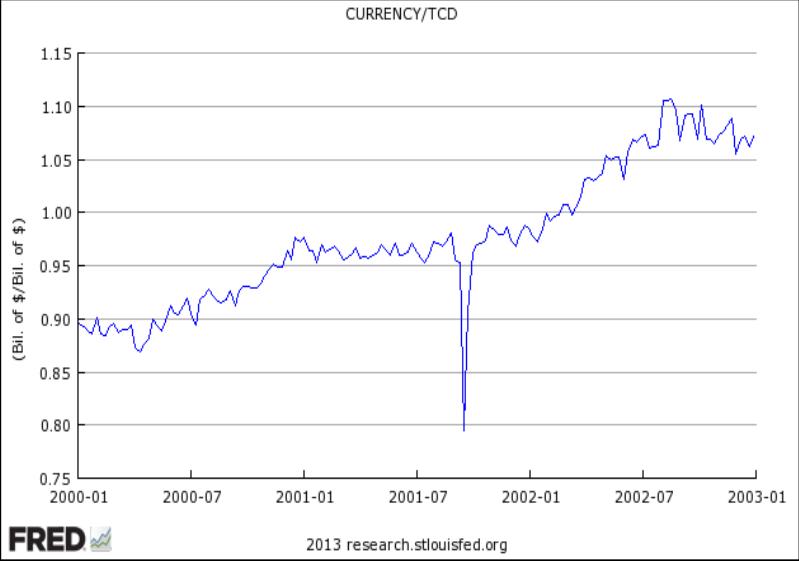
1. Plot on a weekly basis the ratio of currency (FRED code: CURRENCY) to
checkable deposits (FRED code: TCD) from the start of 2000 through 2002.
Download the data and identify the week of the downward spike in the graph. Do
you think the spike reflects the currency term in the numerator or the deposits
term in the denominator? Explain your reasoning. (LO2)
Answer: In the plot below, the downward spike occurred during the week of
September 11. If you plot the data separately, you will see it is due to a sharp,
17-6
© 2015 by McGraw-Hill Education. This is proprietary material solely for authorized instructor use. Not authorized for sale or distribution in
any manner. This document may not be copied, scanned, duplicated, forwarded, distributed, or posted on a website, in whole or part.
Chapter 17 – The Central Bank Balance Sheet and the Money Supply Process
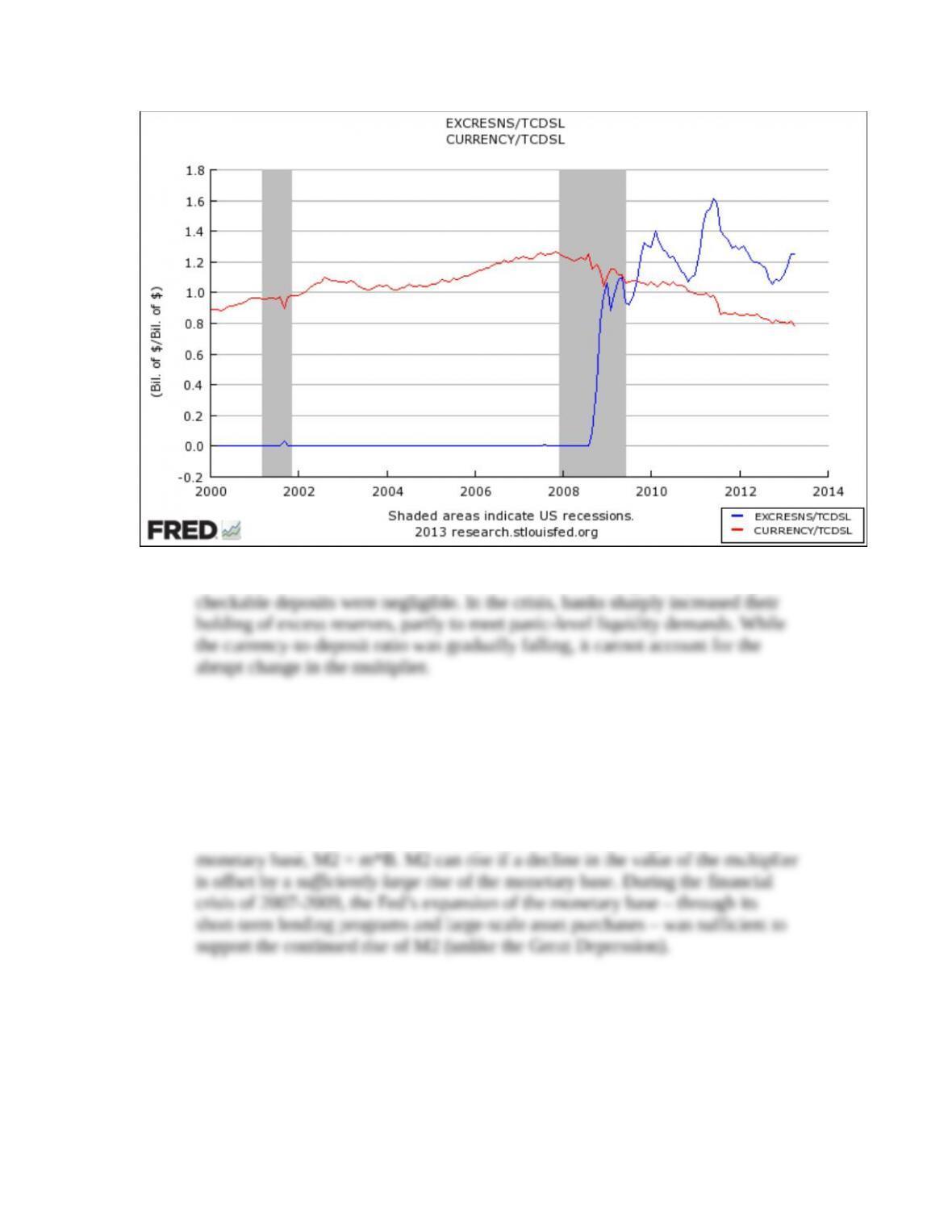
2. Figure 17.11 shows a sharp decline of the M1 money multiplier in 2008. What
caused the drop? Using the indicators for currency (FRED code: CURRENCY),
total reserve balances maintained (FRED code: RESBALNS), reserve balances
required (FRED code: RESBALREQ), and checkable deposits (FRED code:
TCDSL), plot since 2000 the currency-to-deposit ratio and the excess
reserve-to-deposit-ratio. Which one caused the M1 money multiplier to plunge?
(LO3) (Hint: To estimate excess reserves, see footnote 8. Divide RESBALREQ by
1000 to convert the units to billions of dollars.)
17-7
© 2015 by McGraw-Hill Education. This is proprietary material solely for authorized instructor use. Not authorized for sale or distribution in
any manner. This document may not be copied, scanned, duplicated, forwarded, distributed, or posted on a website, in whole or part.
Chapter 17 – The Central Bank Balance Sheet and the Money Supply Process
Answer: Prior to the financial crisis, excess reserve holdings as a percentage of
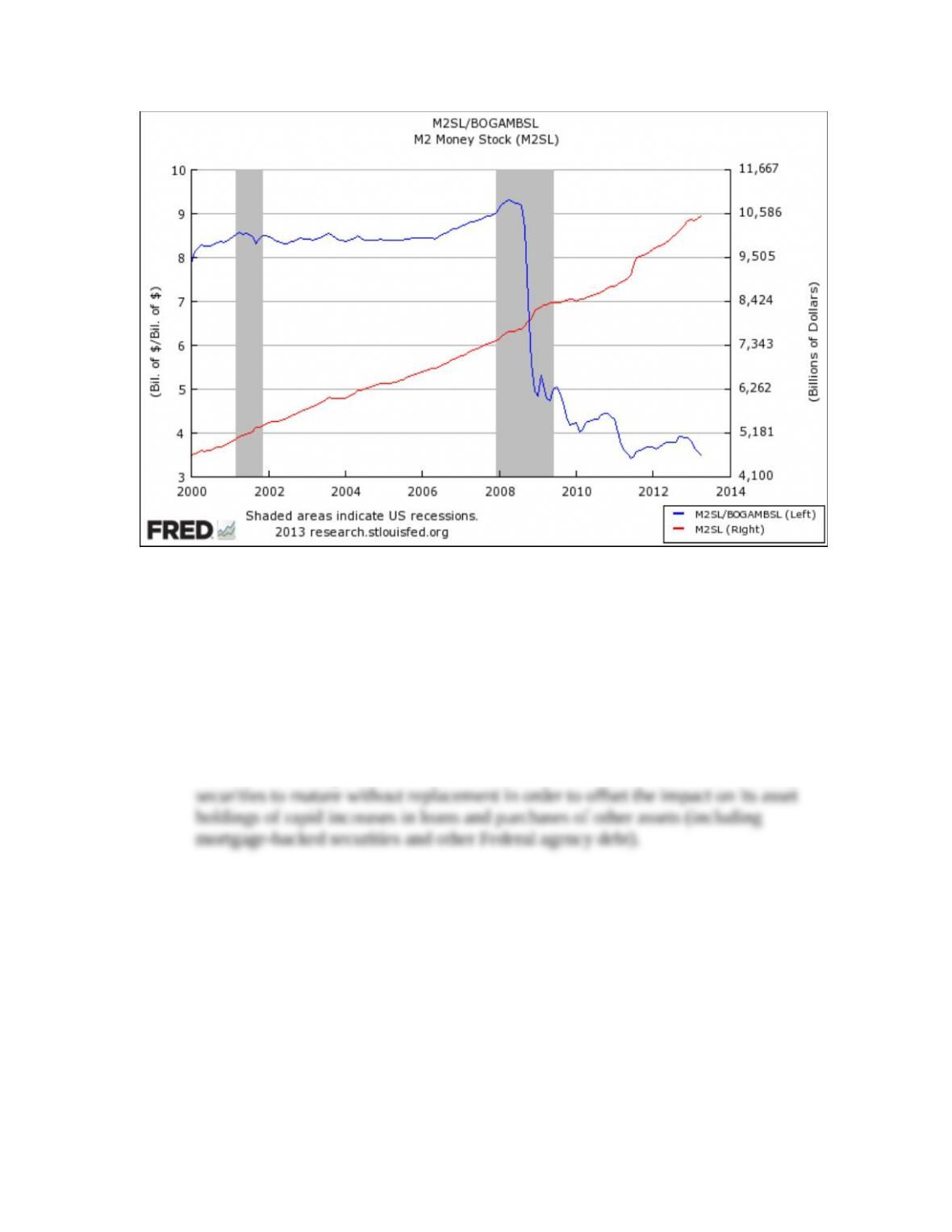
3. In the Great Depression, the Fed allowed the money supply to decline. To confirm
that the Federal Reserve learned from this lesson, plot since 2000 the M2
multiplier – the ratio of M2 (FRED code: M2SL) to the monetary base (FRED
code: AMBSL) – and, on the right axis, the level of M2. Explain how the Fed was
conducting policy in order to sustain the expansion of M2. (LO4)
Answer: The plot is below. M2 is the product of the M2 multiplier and the
17-8
© 2015 by McGraw-Hill Education. This is proprietary material solely for authorized instructor use. Not authorized for sale or distribution in
any manner. This document may not be copied, scanned, duplicated, forwarded, distributed, or posted on a website, in whole or part.
Chapter 17 – The Central Bank Balance Sheet and the Money Supply Process
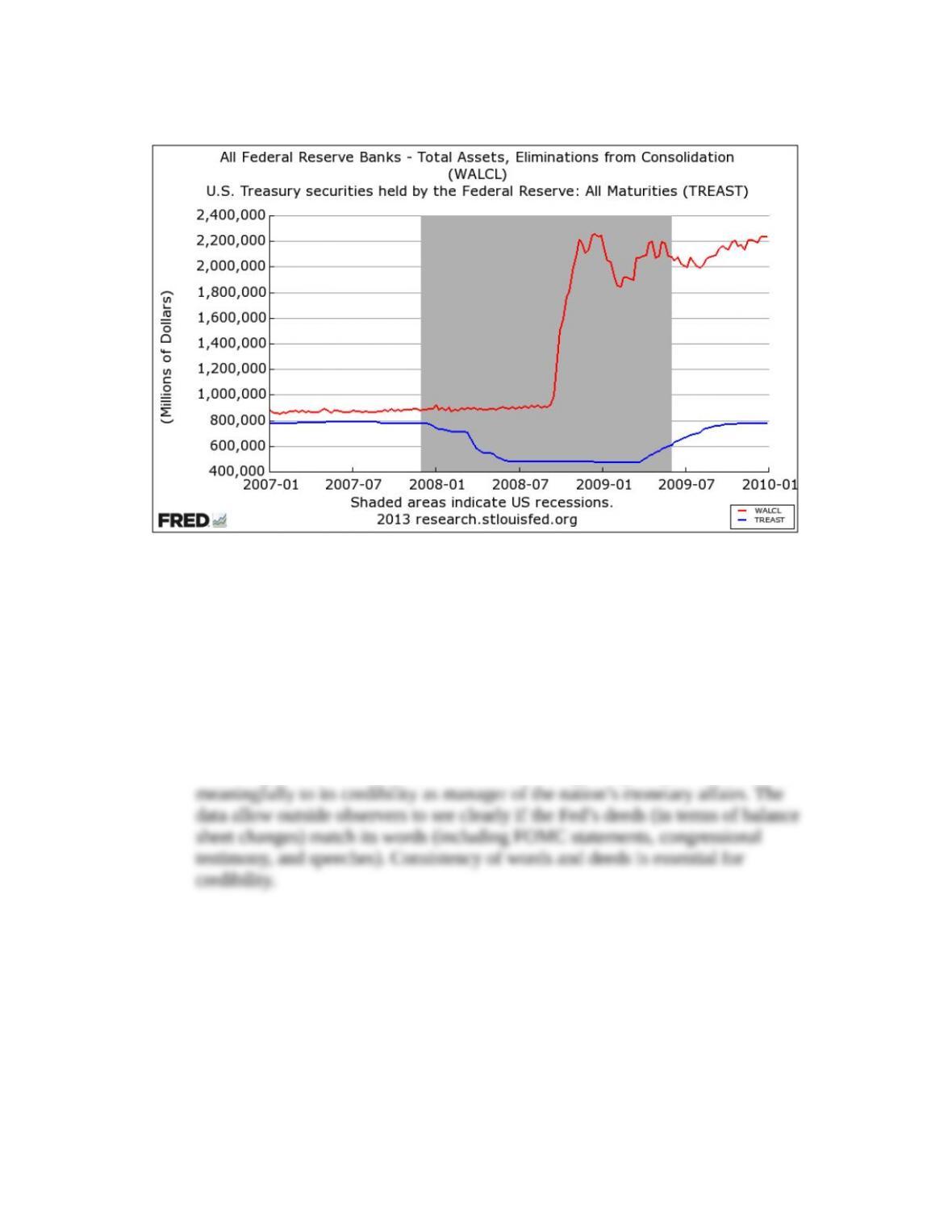
4. Prior to the financial crisis of 2007-2009, the Fed seldom reduced its holdings of
Treasury securities. Plot for the 2007-2009 period the Fed’s Treasury holdings
(FRED code: TREAST) and its total assets (FRED code: WALCL) on a weekly
basis. Did the Fed’s practices change during the crisis? If so, how? (LO2) (Hint:
Examination of Table 17.1 will help with your response.)
Answer: The data plot is below. In 2008, the Fed allowed its short-term Treasury
17-9
© 2015 by McGraw-Hill Education. This is proprietary material solely for authorized instructor use. Not authorized for sale or distribution in
any manner. This document may not be copied, scanned, duplicated, forwarded, distributed, or posted on a website, in whole or part.
Chapter 17 – The Central Bank Balance Sheet and the Money Supply Process
5. Thousands of the data series on FRED are provided directly by the Board of
Governors of the Federal Reserve System, including hundreds of indicators from
the Fed’s weekly balance sheet report (H.4.1 Factors Affecting Reserve Balances).
How does this balance sheet transparency affect the conduct of monetary policy?
(LO1)
Answer: Public disclosure of information about the balance sheet is crucial for the
credibility of a central bank. The Fed’s detailed, high-frequency disclosures add
* indicates more difficult problems
17-10
© 2015 by McGraw-Hill Education. This is proprietary material solely for authorized instructor use. Not authorized for sale or distribution in
any manner. This document may not be copied, scanned, duplicated, forwarded, distributed, or posted on a website, in whole or part.