
Chapter 13 – Financial Industry Structure
Chapter 13
Financial Industry Structure
Conceptual and Analytical Problems
1 For many years you have been using your local, small-town bank. One day you hear
that the bank is about to be purchased by Bank of America. From your vantage point
as a retail bank customer, what are the costs and benefits of such a merger? (LO1)
Answer: The benefits are that you will have access to a larger network of ATMs and
you will be able to use your bank for a larger scope of financial services. However,
you will likely receive less personal service. Economies of scale mean that larger
2 Why have technological advances hindered the enforcement of legal restrictions on
bank branching? (LO1)
Answer: Most people don’t go into a physical bank building to withdraw cash from
their accounts or make a deposit; instead they go to an ATM. ATMs do not qualify as
3 How did the financial crisis of 2007-2009 affect the degree of concentration in the
U.S. banking industry? (LO1)
Answer: The spate of bank failures along with mergers between large banks and
4 Banks have been losing their advantage over other financial intermediaries in
attracting customers’ funds. Why? (LO2)
Answer: Other financial firms now exist that provide individuals with services
typically performed by banks. Money market mutual funds offer customers access to
13-1
Copyright © 2015 McGraw-Hill Education. All rights reserved. No reproduction or distribution without the prior written consent of
McGraw-Hill Education.

Chapter 13 – Financial Industry Structure
5 An industry with a large number of small firms is usually thought to be highly
competitive. Is that supposition true of the banking industry? What are the costs and
benefits to consumers of the current structure of the U.S. banking industry? (LO1)
Answer: When the banking industry consisted of a large number of small firms, the
industry was less competitive than it is today. A bank in a small town or rural area
may have had a monopoly within its geographic area. As large banks branch across
6 *What was the main rationale behind the separation of commercial and investment
banking activities in the Glass-Steagall Act of 1933? Why was the Act repealed?
(LO1)
Answer: The Glass-Steagall Act was enacted in the wake of widespread bank failures
during the Great Depression. It was widely believed that many commercial banks
While the Act sought to protect depositors, it also limited the ability of financial
7 Explain what the phrase “too-big-to-fail” means in reference to financial institutions.
How did the policy responses to the financial crisis of 2007-2009 affect the
“too-big-to-fail” problem? (LO1)
Answer: The phrase “too-big-to-fail” refers to firms that are so big relative to the
The bailouts of systemically important financial institutions in the financial crisis
13-2
Copyright © 2015 McGraw-Hill Education. All rights reserved. No reproduction or distribution without the prior written consent of
McGraw-Hill Education.

Chapter 13 – Financial Industry Structure
8 Discuss the problems life insurance companies will face as genetic information
becomes more widely available. (LO2)
Answer: Insurance companies can’t predict when a particular person will die, but
when they pool together a group of individuals with uncorrelated risks, they can
9 When the values of stocks and bonds fluctuate, they have an impact on the balance
sheets of insurance companies. Why is that impact more likely to be a problem for
life insurance companies than for property and casualty companies? (LO2)
Answer: Property and casualty insurance companies have a different investment
horizon compared to life insurance companies. Because property and casualty
insurance companies are likely to have to make a large number of payments in the
10 Compare and contrast the structures of bank holding companies, financial holding
companies and universal banks. (LO1)
Answer: Bank holding companies typically own several banks, while financial
holding companies own banks and other financial intermediaries (such as investment
11 What are the benefits of collaboration between a large appliance retailer and a finance
company? (LO2)
Answer: The appliance retailer has customers walk in the door who will need
13-3
Copyright © 2015 McGraw-Hill Education. All rights reserved. No reproduction or distribution without the prior written consent of
McGraw-Hill Education.
Chapter 13 – Financial Industry Structure
12 Why did government-sponsored enterprises (GSEs) such as Freddie Mac and Fannie
Mae have substantially higher leverage ratios than the average U.S. bank in the years
preceding the financial crisis of 2007-2009? Explain how this made the enterprises
more vulnerable to the house-price declines that precipitated the crisis. (LO2)
Answer: High leverage ratios resulted from the implicit guarantee behind these
enterprises. Although their debt was not guaranteed by the government, there was
The fall in house prices increased the rate of mortgage defaults, reducing the value of
13 Consider two countries with the following characteristics. Country A has no
restrictions on bank branching and banks in Country A are permitted to offer
investment and insurance products along with traditional banking services. In
Country B, there are strict limits on branch banking and on the geographical spread of
a bank’s business. In addition, banks in Country B are not permitted to offer
investment or insurance services. (LO1)
a. In which country do you think the banking system is more concentrated?
b. In which country do you think the banking system is more competitive?
c. In which country do you think, everything else being equal, banking products are
cheaper?
Explain each of your choices.
Answer:
a. Country A is likely to have a more concentrated banking system, as fewer banks
b. The experience in the United States with the McFadden Act would suggest that
the banking system would be more competitive in Country A. Although banking
13-4
Copyright © 2015 McGraw-Hill Education. All rights reserved. No reproduction or distribution without the prior written consent of
McGraw-Hill Education.

Chapter 13 – Financial Industry Structure
14 You examine the balance sheet of an insurance company and note that its assets are
made up mainly of U.S. Treasury bills and commercial paper. Is this more likely to
be the balance sheet of a property and casualty insurance company or a life insurance
company? Explain your answer. (LO2)
Answer: This is more likely to be a property and casualty insurance company. This
15 *Statistically, teenage drivers are more likely to have an automobile accident than
adult drivers. As a result, insurance companies charge higher insurance premiums for
teenager drivers. Suppose one insurance company decided to charge teenagers and
adults the same premium based on the average risk of an accident for all drivers.
Using your knowledge of the problems associated with asymmetric information,
explain whether you think this insurance company will be profitable. (LO2)
Answer: This insurance company is unlikely to be profitable because of the problem
of adverse selection. The insurance premium based on the average risk of an accident
16 Use your knowledge of the problems associated with asymmetric information to
explain why insurance companies often include deductibles as part of their policies.
(LO2)
Answer: The presence of deductibles helps to reduce moral hazard. In the case of car
17 Suppose you have a defined-contribution pension plan. As you go through your
working life, in what order would you choose to have the following portfolio
allocations: (a) 100 percent bonds and money-market instruments, (b) 100 percent
stocks, (c) 50 percent bonds and 50 percent stocks? (LO2)
Answer: You should choose (b), (c) and (a). Early in your working life, investing in
stocks makes sense as they generally earn a relatively high rate of return and are
13-5
Copyright © 2015 McGraw-Hill Education. All rights reserved. No reproduction or distribution without the prior written consent of
McGraw-Hill Education.
Chapter 13 – Financial Industry Structure
18 As an employee, would you prefer to participate in a defined-benefit pension plan or
a defined-contribution pension plan? Explain your answer. (LO2)
Answer: If you are a risk-averse person and plan to stay in the same job for a
significant portion of your working life, you may prefer a defined benefit plan. The
19 In the aftermath of the financial crisis of 2007-2009, there have been calls to
re-instate the separation of commercial and investment banking activities that were
removed with the repeal of the Glass-Steagall Act. Do you think this is a good way to
reduce systemic risk? (LO1)
Answer: Separating commercial and investment banking activities into different
institutions may remove some conflicts of interest for banks across their different
20 Suppose a well-known financial holding company agreed to be the underwriter for a
new stock issue. After guaranteeing the price to the issuing company but before
selling the stocks, a scandal surrounding the business practices of the holding
company is revealed. How would you expect this scandal to affect (a) the financial
holding company and (b) the issuing company? (LO1)
Answer: Because the financial holding company relies on its reputation to place the
stock issue with investors, it is likely to find it much more difficult to sell the stock at
Data Exploration
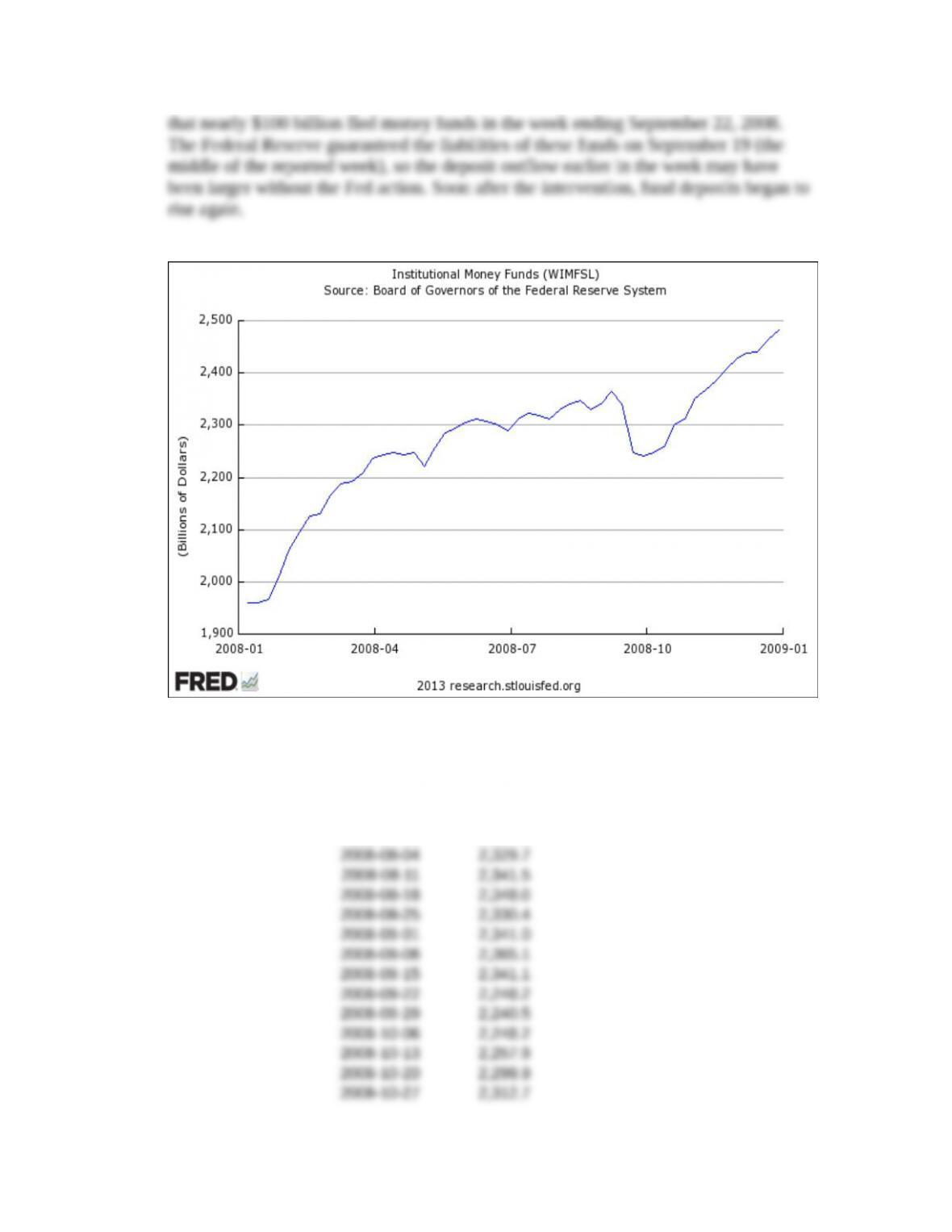
1. One aspect of the 2007-2009 financial panic was a run on some money market mutual
funds (MMMFs). Plot weekly data for 2008 on institutional MMMF deposits (FRED
code: WIMFSL) and identify the timing of the run visually. Next, download the data,
and report the size of the deposit outflow in the week that the run peaked. Why did
this run end? (LO1) (Hint: Turn of the recession bars
Answer: The run on MMMFs occurred in September, 2008; the data plot is below.
Data for several weeks before and after the run are listed below the graph, showing
13-6
Copyright © 2015 McGraw-Hill Education. All rights reserved. No reproduction or distribution without the prior written consent of
McGraw-Hill Education.
Chapter 13 – Financial Industry Structure
Institutional Money Funds (WIMFSL), Billions of Dollars, Weekly, Seasonally
Adjusted
2008-07-14 2,322.3
2008-07-21 2,317.5
2008-07-28 2,311.9
13-7
Copyright © 2015 McGraw-Hill Education. All rights reserved. No reproduction or distribution without the prior written consent of
McGraw-Hill Education.
Chapter 13 – Financial Industry Structure
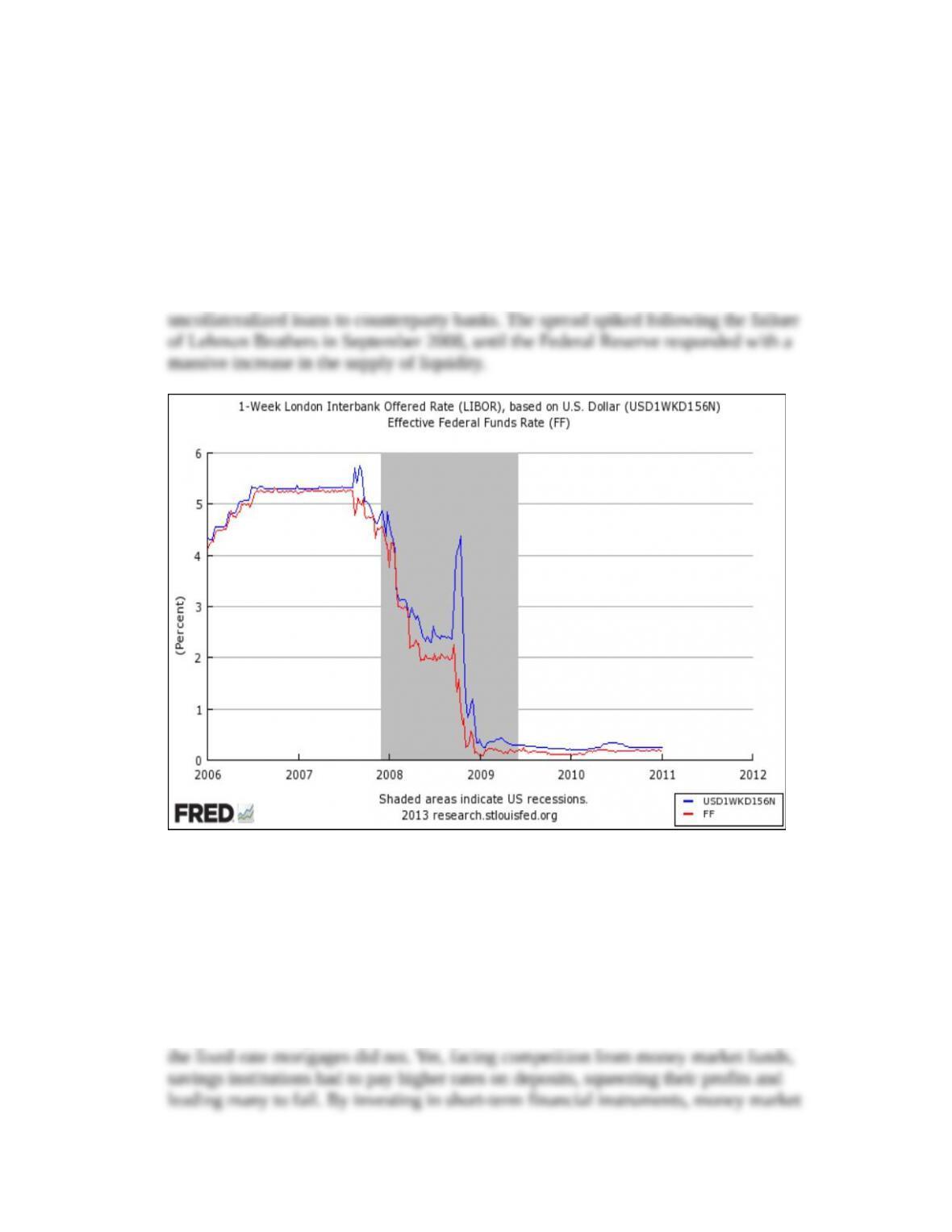
2. When did the financial crisis of 2007-2009 peak and why? Plot weekly data for
2006–2010 for the one-week LIBOR rate (FRED code: USD1WKD156N) and the
effective federal funds rate (FRED code: FF). Explain the pattern. (LO1) (Hint: For
consistency, plot both series on the same basis by specifying “Weekly, ending
Wednesday” in the “Frequency” dropdown box.)
Answer: The data plot is below. The gap between the one-week LIBOR rate and the
federal funds rate primarily reflects liquidity concerns, because both involve
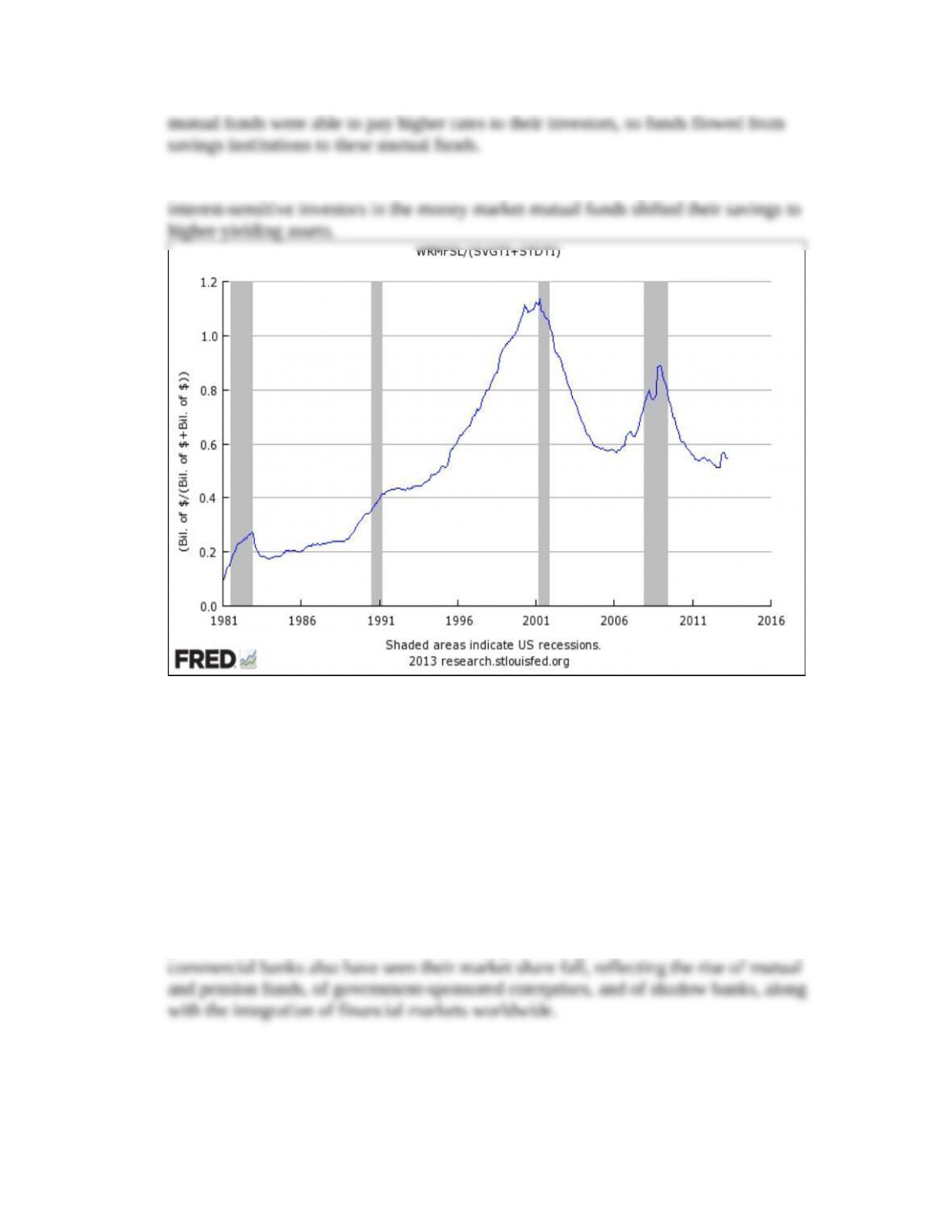
3. How did competition from money market mutual funds affect traditional savings
institutions that provided mortgages at fixed interest rates? Beginning in 1981, plot
the ratio of retail money market mutual funds (FRED code: WRMFSL) to the sum of
savings and time deposits at savings institutions (FRED codes: SVGTI and STDTI).
What favored money funds in the 1980s and 1990s? Why did the ratio shrink in the
first half of the 2000s? (LO1)
Answer: The data plot is below. When interest rates rose in the 1980s, revenues from
13-8
Copyright © 2015 McGraw-Hill Education. All rights reserved. No reproduction or distribution without the prior written consent of
McGraw-Hill Education.
Chapter 13 – Financial Industry Structure
In the first half of the 2000s, short-term interest rates fell to very low levels, so
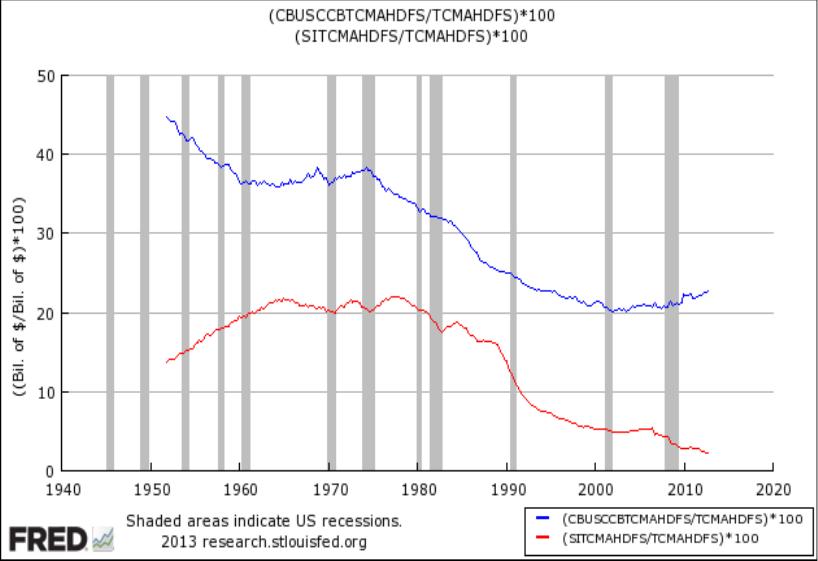
4. How have the market shares of banks and traditional savings institutions evolved over
time? Plot the fraction (in percent) of credit market assets held by the entire domestic
financial sector (TCMAHDFS) that is held by banks (FRED code:
CBUSCCBTCMAHDFS). Plot a similar market share for the assets held by savings
institutions (FRED code: SITCMAHDFS). Explain the long-term trends that you
observe. (LO2)
Answer: The data plot is below. The savings institutions have been subjected to the
pressures described in the answer to Data Exploration question 3 above. The
13-9
Copyright © 2015 McGraw-Hill Education. All rights reserved. No reproduction or distribution without the prior written consent of
McGraw-Hill Education.
Chapter 13 – Financial Industry Structure
* indicates more difficult problems
13-10
Copyright © 2015 McGraw-Hill Education. All rights reserved. No reproduction or distribution without the prior written consent of
McGraw-Hill Education.