Chapter 19 – Exchange-Rate Policy and the Central Bank
Chapter 19
Exchange-Rate Policy and the Central Bank
Conceptual and Analytical Problems
1. Explain the mechanics of a speculative attack on the currency of a country with a
fixed exchange-rate regime. (LO4)
Answer: Assume that country A has a fixed exchange rate, and that its central
bank holds a specific volume of foreign currency reserves. Investors come to
believe that country A will have to let its currency depreciate. To benefit from the
2. Country A frequently experiences large business cycle swings. Under what
conditions might it be appropriate for country A to dollarize? (LO1)
Answer: If country A’s business cycle is synchronized with the U.S. cycle, then
U.S. monetary policy also would suit country A because it would be stimulative
3. In the first half of 1997, the Bank of Thailand maintained a fixed exchange rate of
26 Thai baht to the U.S. dollar, but Thai interest rates were substantially higher
than those in the United States and Japan. Thai bankers were borrowing money in
Japan and lending it in Thailand. (LO3)
a. Why was this transaction profitable?
b. What risks were associated with this method of financing?
c. Describe the impact of a depreciation of the baht on the balance sheets of Thai
banks involved in these transactions.
Answer:
a. Bankers could borrow money in Japan at a low rate, and lend in Thailand at a
19-1
© 2015 by McGraw-Hill Education. This is proprietary material solely for authorized instructor use. Not authorized for sale or distribution in
any manner. This document may not be copied, scanned, duplicated, forwarded, distributed, or posted on a website, in whole or part.
Chapter 19 – Exchange-Rate Policy and the Central Bank
b. There was the risk that the baht could depreciate, making it more costly to
4. During the time of the currency board, Argentinean banks offered accounts in
both dollars and pesos, but loans were made largely in pesos. Describe the impact
on banks of the collapse of the currency board. (LO4)
Answer: The Argentinean banks had to pay interest payments in dollars on the
5. Investors became nervous just before the 2002 Brazilian presidential election. As
a result, the risk premium on Brazilian government debt increased dramatically
and Brazil’s currency depreciated significantly. (LO1)
a. How could concern over an election drive up the risk premium?
b. How was the risk premium connected to the value of the currency?
Answer:
a. Investors were concerned that one of the candidates could cause Brazil to
b. When Brazilian bonds became more risky relative to alternatives, demand for
6. Explain why a well-capitalized domestic banking system might be important for
the successful maintenance of a fixed exchange-rate regime. (LO4)
Answer: In order for a fixed exchange rate regime to be successful, investors
7. *Explain why a central bank is usually more effective at holding the value of its
domestic currency at an artificially low level for a sustained period than at an
artificially high level. (LO3)
Answer: To boost the value of its domestic currency, the central bank would have
to sell foreign currency in exchange for domestic currency. The central bank can
19-2
© 2015 by McGraw-Hill Education. This is proprietary material solely for authorized instructor use. Not authorized for sale or distribution in
any manner. This document may not be copied, scanned, duplicated, forwarded, distributed, or posted on a website, in whole or part.
Chapter 19 – Exchange-Rate Policy and the Central Bank
8. Why might sterilized foreign-exchange market intervention have a greater impact
on the exchange rate in times of financial stress than in times of normal market
conditions? (LO2)
Answer: When markets are functioning normally, the shift in central bank assets
associated with a sterilized intervention are extremely small in relation to the
9. When asked about the value of the dollar, the Chair of the Federal Reserve Board
answers, “The foreign exchange policy of the United States is the responsibility of
the Secretary of the Treasury; I have no comment.” Discuss this answer. (LO1)
Answer: Since the U.S. Treasury is technically responsible for exchange rate
policy or decisions about exchange rate intervention, the Federal Reserve does not
10. *Explain why a consensus has developed that countries should either allow their
exchange rates to float freely or adopt a hard peg as an exchange-rate regime?
(LO3)
Answer: The widespread removal of capital controls and advances in technology
have facilitated the integration of international markets while the development of
11. Explain the costs and benefits of dollarization. Could a dollarized regime
collapse? (LO4)
Answer:
19-3
© 2015 by McGraw-Hill Education. This is proprietary material solely for authorized instructor use. Not authorized for sale or distribution in
any manner. This document may not be copied, scanned, duplicated, forwarded, distributed, or posted on a website, in whole or part.
Chapter 19 – Exchange-Rate Policy and the Central Bank
Costs of dollarization:
Benefits
Dollarization is reversible and so it can collapse. It does not preclude the fiscal
12. You observe that two countries with a fixed exchange rate have current inflation
rates that differ from each other. You check the recent historical data and find that
inflation differentials have been present for several months and that they have not
remained constant. How would you explain these observations in light of the
theory of purchasing power parity? (LO2)
Answer: Purchasing power parity (PPP) tells us about the relationship between
inflation rate differentials and exchange rate movements over long periods such as
13. Assuming the country is open to international capital flows, which of the
following combinations of monetary and exchange-rate policies are viable?
Explain your reasoning. (LO1)
a. A domestic interest rate as a policy instrument and a floating exchange
rate.
b. A domestic interest rate as a policy instrument and a fixed exchange rate.
c. The monetary base as a policy instrument and a floating exchange rate.
Answer: Combinations a. and c. are both viable as they both represent
19-4
© 2015 by McGraw-Hill Education. This is proprietary material solely for authorized instructor use. Not authorized for sale or distribution in
any manner. This document may not be copied, scanned, duplicated, forwarded, distributed, or posted on a website, in whole or part.
Chapter 19 – Exchange-Rate Policy and the Central Bank
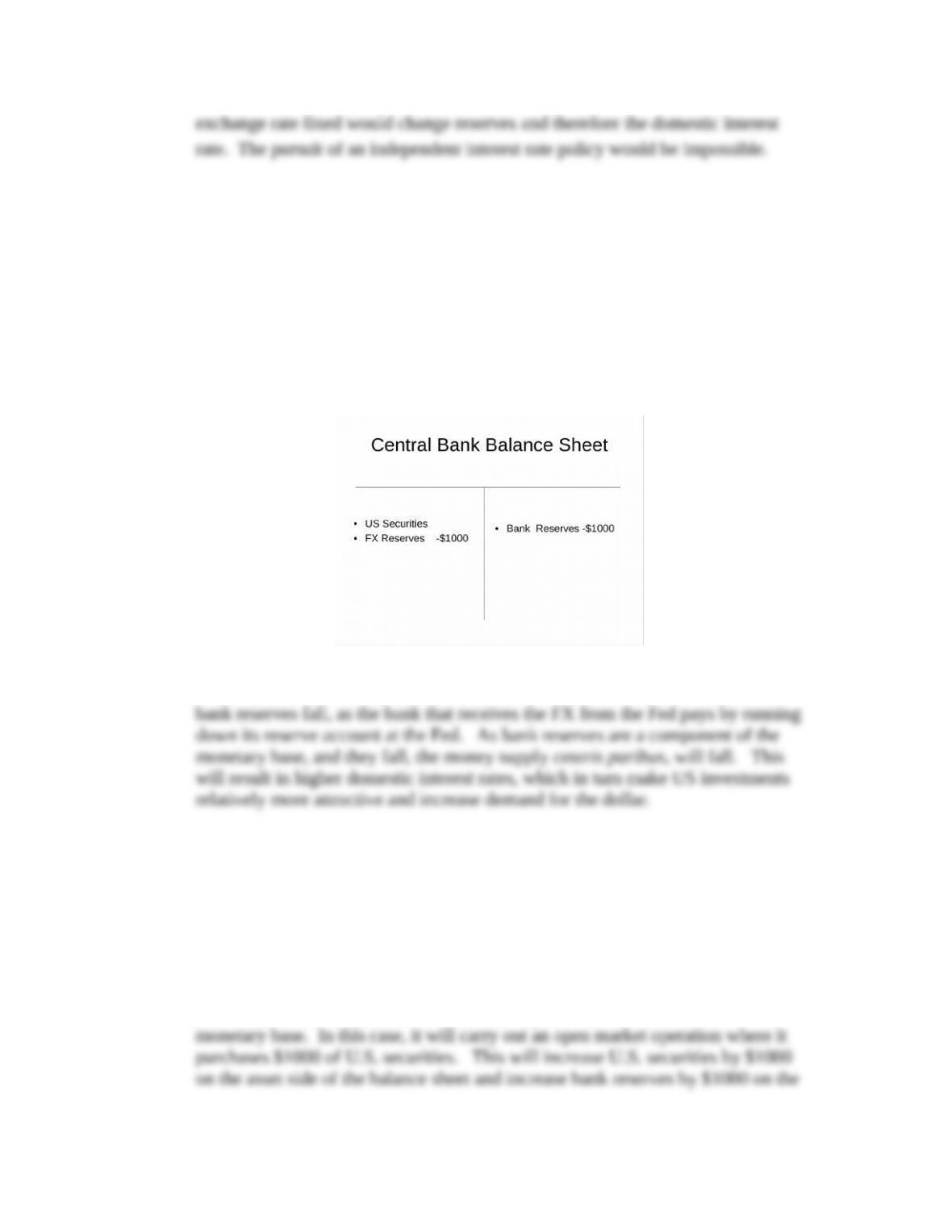
14. Show the impact on the Federal Reserve’s balance sheet of a foreign-exchange
market intervention where the Fed sells $1,000 worth of foreign exchange
reserves. Explain what impact, if any, the intervention will have on the domestic
money supply. (LO2)
Answer:
Selling foreign exchange reserves in exchange for dollars will reduce foreign
currency reserves on the asset side of the balance sheet. On the liability side,
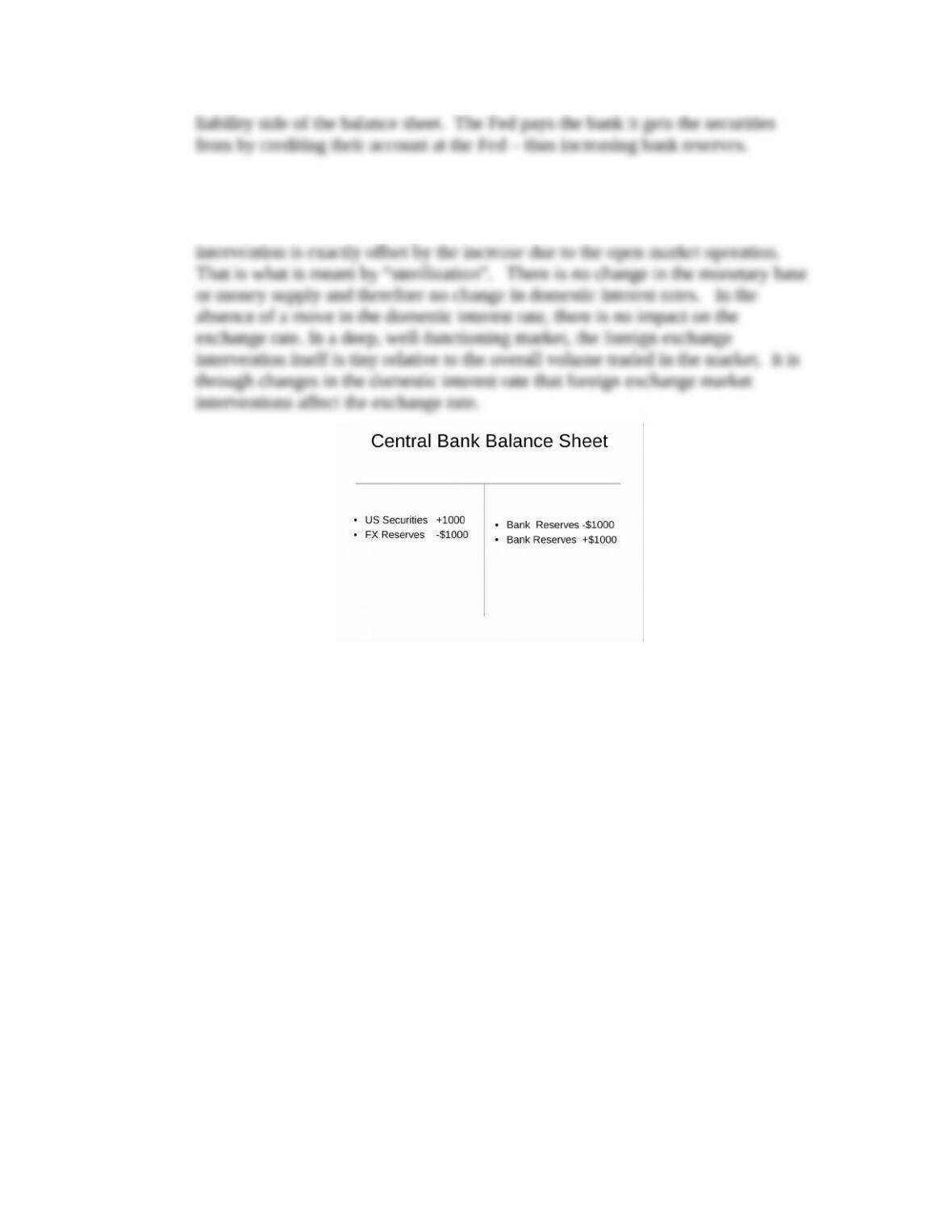
15. If the Federal Reserve decides to sterilize the foreign-exchange market
intervention described in Problem 14, show the impact on the Fed’s balance sheet.
What would the overall impact be on the monetary base? What would be the
impact, if any, on the exchange rate? You should assume that the intervention
took place in a deep, well-functioning foreign-exchange market. (LO2)
Answer: If the Fed decides to sterilize the FX market intervention, it will carry
out an open market operation to offset the impact of the FX intervention on the
19-5
© 2015 by McGraw-Hill Education. This is proprietary material solely for authorized instructor use. Not authorized for sale or distribution in
any manner. This document may not be copied, scanned, duplicated, forwarded, distributed, or posted on a website, in whole or part.
Chapter 19 – Exchange-Rate Policy and the Central Bank
The overall impact on the balance sheet is shown below. On the asset side, there
is a compositional change between FX and domestic securities while on the
liability side there is no change. The fall in bank reserves as a result of the FX
19-6
© 2015 by McGraw-Hill Education. This is proprietary material solely for authorized instructor use. Not authorized for sale or distribution in
any manner. This document may not be copied, scanned, duplicated, forwarded, distributed, or posted on a website, in whole or part.