Archives: Solution Manual
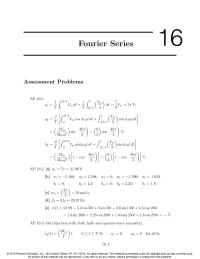
Electrical Engineering Chapter 16 Homework The 5th harmonic because the circuit is a passive bandpass
ak=2 T“Z2T/3 0Vmcos kω0t dt +ZT 2T/3✓Vm 3◆cos kω0t dt# =✓4Vm 3kω0T◆sin 4kπ 3!=✓6 k◆sin 4kπ 3!V; bk=2 T“Z2T/3 0Vmsin kω0t dt +ZT 2T/3✓Vm 3◆sin kω0t dt# =✓4Vm 3kω0T◆“1cos 4kπ 3!#=✓6 k◆“1cos 4kπ 3!# V. b1= 9; b2=4.5; b3= 0; […]
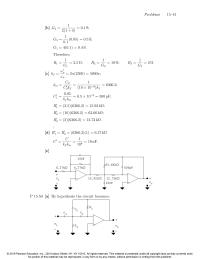
Electrical Engineering Chapter 15 Homework At high frequencies the capacitor branches are short circuits and the
C0 1=0.05 kfkm =0.5⇥109= 500 pF; R0 1= (2.5)(6366.2) = 15.92 kΩ; R0 2= (10)(6366.2) = 63.66 kΩ; R0 3= (2)(6366.2) = 12.73 kΩ. C0=C kfkm =1 108= 10 nF. Problems 15–41 [b] G2=1 2(1 + 4) =0.1 S; [c] […]
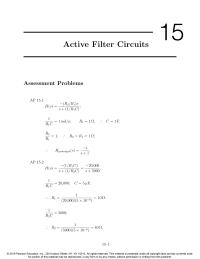
Electrical Engineering Chapter 15 Homework Active Filter Circuits Assessment Problems 151 Hs
1 R1C= 20,000; C=5µF; · .. R 1=1 (20,000)(5 ⇥106)= 10 Ω. 1 R2C= 5000; · .. R 2=1 (5000)(5 ⇥106)= 40 Ω. Active Filter Circuits Assessment Problems AP 15.1 H(s)= (R2/R1)s s+ (1/R1C); AP 15.2 H(s)= (1/R1C) s+ (1/R2C)=20,000 […]
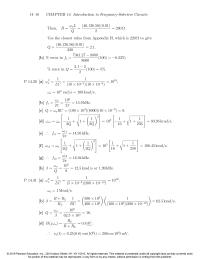
Electrical Engineering Chapter 14 Homework Introduction Frequency selective Circuits Then
ωo= 105rad/s = 100 krad/s. [b] fo=ωo 2π=105 2π= 15.9 kHz. [c] Q=ωoRC = (100 ⇥103)(8000)(10 ⇥109)=8. [d] ωc1=ωo2 6 41 2Q+v u u t1+ 1 2Q!23 7 5= 1052 41 16 +s1+ 1 256 3 5= 93.95 krad/s. [e] […]
Electrical Engineering Chapter 14 Homework Let Z represent the parallel combination of
L=R ωc =5000 4000π=0.40 H. When ω=2πf=2π(50,000) = 100,000πrad/s, H(j100,000π)= 4000π 4000π+j100,000π=1 1+j25 =0.04/87.71; · .. |H(j100,000π)|=0.04. [c] · .. θ(100,000π)=87.71. AP 14.3 ωc=R L=5000 3.5⇥103=1.43 Mrad/s. Introduction to Frequency-Selective Circuits Assessment Problems AP 14.1 fc= 8 kHz,ω c=2πfc= 16πkrad/s; […]
Electrical Engineering Chapter 13 Homework The s-domain equivalent circuit for t > 0 is
I1=0.006 0.01s+20,000 =0.6 s+2×10⁶; i1(t)=0.6e2⇥106tu(t)A. [f] i2(t)=−i1(t)=−0.6e2⇥106tu(t)A. [g] V=−0.0064 + (0.008s+ 4000)I1=−0.0016(s+6.5×10⁶) s+2×106 =−1.6×10³−7200 s+2×10⁶; v(t)=[−1.6×10³δ(t)] −[7200e2⇥106tu(t)] V. Z2=1/C2 s+1/R2C2 =6.25 ×10¹⁰ s+12,500 Ω; V0 Z2 +V0−10/s Z1 = 0; V0(s+12,500) 6.25 ×10¹⁰ +V0(s+20×104) 25 ×1010 =10 s (s+20×104) 25 […]
Electrical Engineering Chapter 13 Homework After The Impulsive Current Vanishes The Capacitors
0Z1 0esth(λ)x(tλ)dλdt =Z1 0h(λ)Z1 0estx(tλ)dt dλ. But x(tλ) = 0 when t < λ. Therefore Y(s)=Z1 0h(λ)Z1 λ estx(tλ)dt dλ. Let u=tλ;du =dt;u= 0 when t=λ;u=1when t=1. Y(s)=Z1 0h(λ)Z1 0es(u+λ)x(u)du dλ =Z1 0h(λ)esλZ1 0esux(u)du dλ =Z1 0h(λ)esλX(s)dλ=H(s)X(s). Note on x(tλ)=0, […]
Electrical Engineering Chapter 13 Homework The Laplace Transform in Circuit Analysis
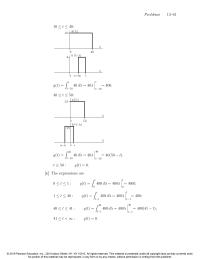
1≤t≤40 : y(t)=Zt t−1400 dλ= 400λ t t−1 = 400; 40 ≤t≤41 : y(t)=Z40 t−1400 dλ= 400λ 40 t−1 = 400(41 −t); 41 ≤t<∞:y(t)=0. Problems 13–61 10 ≤t≤40: [c] The expressions are 0≤t≤1: y(t)=Zt 0400 dλ= 400λ t 0 = […]
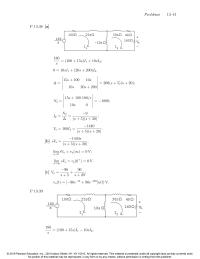
Electrical Engineering Chapter 13 Homework With the dot reversed the s-domain equations are
0=10sI1+ (20s+ 200)I2. ∆= 15s+ 100 10s 10s20s+ 200 = 200(s+ 5)(s+ 20); N2= 15s+ 100 180/s 10s0 =1800; I2=N2 ∆=9 (s+ 5)(s+ 20); Vo= 160I2=1440 (s+ 5)(s+ 20). lim s!0sVo=vo(1) = 0 V; lim s!1 sVo=vo(0+)=0V. [c] Vo=96 […]
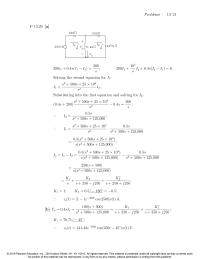
Electrical Engineering Chapter 13 Homework Substituting into the first equation and solving for I2
I1=s2+ 500s+25⇥104 s2I2. (0.4s+ 200)s2+ 500s+25⇥104 s20.4s=200 s; · .. I 2=0.5s s2+ 500s+ 125,000; · .. I 1=s2+ 500s+25⇥104 s2 · 0.5s s2+ 500s+ 125,000 =0.5(s2+ 500s+25⇥104) s(s2+ 500s+ 125,000) ; Io=I1I2=0.5(s2+ 500s+25⇥104) s(s2+ 500s+ 125,000) 0.5s s2+ 500s+ […]
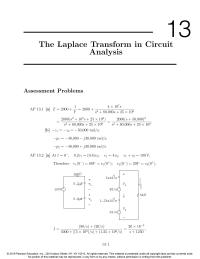
Electrical Engineering Chapter 13 Homework The Laplace Transform Circuit Analysis Assessment Problems
Therefore v1(0)=80V=v1(0+); v2(0)=20V=v2(0+). I=(80/s) + (20/s) 5000 + [(5 ⇥106)/s] + (1.25 ⇥106/s)=20 ⇥103 s+ 1250 ; The Laplace Transform in Circuit Analysis Assessment Problems AP 13.1 [a] Z= 2000 + 1 Y= 2000 + 4⇥107s s2+80,000s+25⇥108 AP 13.2 [a] […]
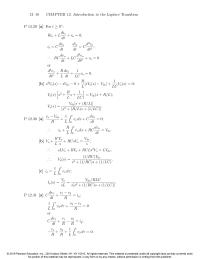
Electrical Engineering Chapter 12 Homework The initial inductor current is zero by hypothesis
Vo(s)s2+R Ls+1 LC =Vdc(s+R/L); Vo(s)= Vdc[s+(R/L)] [s2+(R/L)s+ (1/LC)]. · .. v o+R LZt 0vodx +RC dvo dt =Vdc. · . . sLVo+RVo+RCLs2Vo=LVdc; · .. V o(s)= (1/RC)Vdc s2+ (1/RC)s+ (1/LC). Io(s)= Vo sL =Vdc/RLC s[s2+ (1/RC)s+ (1/LC)]. 1 LZt 0v2dτ+v2−v1 […]
Electrical Engineering Chapter 12 Homework Introduction The Laplace Transform Assessment Problems Et
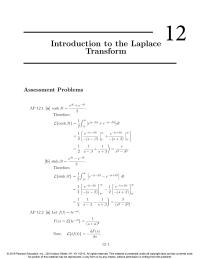
(s+a)2. Now, L{tf(t)}=−dF (s) ds . L{cosh βt}=1 2Z1 0− [e(sβ)t+e(sβ)t]dt =1 2“e(sβ)t −(s−β) 1 0− +e(s+β)t −(s+β) 1 0−# =1 2 1 s−β+1 s+β!=s s2−β2. Introduction to the Laplace Transform Assessment Problems AP 12.1 [a] cosh βt=eβt+eβt 2. Therefore, […]
Electrical Engineering Chapter 11 Homework Then assuming a positive phase sequence, we have
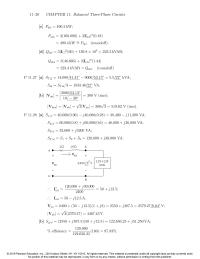
Qabs = 3(46,666) + 3|IaA|2(1.44) = 223.3 kVAR = Qdel.(roundoff) S∆=ST∆/3 = 1833.46/22VA. [b] |Van|= 3000/53.13 10/−30 = 300 V (rms); |Vline|=|Vab|=√3|Van|= 300√3 = 519.62 V (rms). S2/= 60,000(0.8) + j60,000(0.6) = […]
Electrical Engineering Chapter 11 Homework Balanced Three phase Circuits 1111 Make
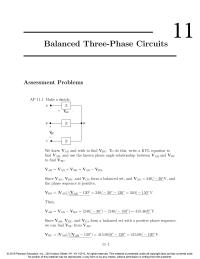
11–1 Balanced Three-Phase Circuits Assessment Problems AP 11.1 Make a sketch: We know VAN and wish to find VBC. To do this, write a KVL equation to find VAB, and use the known phase angle relationship between VAB and VBC […]
Electrical Engineering Chapter 10 Homework Begin by choosing the capacitor value from Appendix H
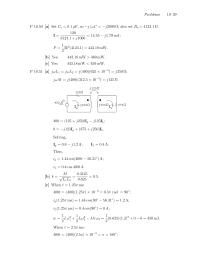
Problems 10–39 P 10.50 [a] Set Co= 0.1µF, so −j/ωC =−j2000 Ω; also set Ro= 4123.1 Ω. I=120 8123.1 + j1000 = 14.55 −j1.79 mA; P 10.51 [a] jωL1=jωL2=j(400)(625 ×10−3) = j250 Ω; jωM =j(400)(312.5×10⁻³) = j125 Ω. 400 = […]
Electrical Engineering Chapter 10 Homework The breaker protecting the upper service conductor
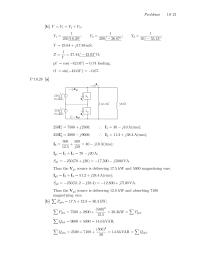
Problems 10–21 [b] Y=Y1+Y2+Y3; Y1=1 P 10.28 [a] 250I∗ 1= 7500 + j2500; · . . I1= 30 −j10 A(rms); 250I∗ 2= 2800 −j9600; · . . I2= 11.2 + j38.4 A(rms); I3=500 12.5+500 j50 = 40 −j10 A(rms); Ig1=I1+I3= […]
Electrical Engineering Chapter 10 Homework Sinusoidal Steady State Power Calculations
10 Sinusoidal Steady State Power Calculations Assessment Problems AP 10.1 [a] V = 100/−45◦V,I= 20/15◦A. Therefore [b] V = 100/−45◦,I= 20/165◦; P= 1000 cos(−210◦) = −866.03 W,B→A; Q= 1000 sin(−210◦) = 500 VAR,A→B. [c] V = 100/−45◦,I= 20/−105◦; P= 1000 […]
Electrical Engineering Chapter 9 Homework Superposition must be used because the frequencies
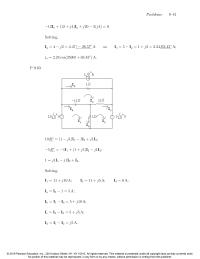
5/0=1I1+ (1 + j1)I2j1I3; 1=j1I1j1I2+I3. Ia=I31 = 5 A; Ib=I1I3=5+j10 A; Ic=I2I3=5+j5 A; Id=I1I2=j5A. Problems 9–41 12Ia+ (12 + j4)Ig+j20 5(j4) = 0. P 9.63 10/0= (1 j1)I11I2+j1I3; Solving, I1= 11 + j10 A; I2= 11 + j5 A; I3= […]
Electrical Engineering Chapter 9 Homework The denominator in the above expression is purely real
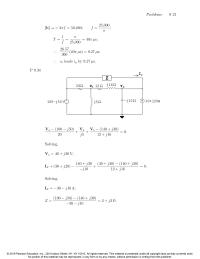
Va(100 j50) 20 +Va j5+Va(140 + j30) 12 + j16 =0. IZ+ (30 + j20) 140 + j30 j10 +(40 + j30) (140 + j30) 12 + j16 =0. Solving, IZ=30 j10 A; Z=(100 j50) (140 + j30) 30 j10 […]
Electrical Engineering Chapter 9 Homework The impedance will be purely resistive when the
AP 9.1 [a] V = 170/40V. AP 9.2 [a] v= 18.6 cos(ωt54)V. =29.16 + j39.14 = 48.81/126.68. Therefore i= 48.81 cos(ωt+ 126.68) mA. =8.98 + j72.24 = 72.79/97.08. v= 72.79 cos(ωt+97.08)V. AP 9.3 [a] ωL= (104)(20 ⇥103) = 200 Ω. […]
Electrical Engineering Chapter 8 Homework No portion of this material may be reproduced
α2<ω 2 0: underdamped. ωd=p50024002= 300 rad/s; vo=Vf+B0 1e400tcos 300t+B0 2e400tsin 300t; vo(1) = 200(0.08) = 16 V; vo(0) = 0 = Vf+B0 1= 0 so B0 1=16 V; dvo dt (0) = 0 = 400B0 1+ 300B0 2so B0 […]
Electrical Engineering Chapter 8 Homework This is an example of a circuit going directly into steady
[b] iR=v R= 40[e20,000te80,000t] mA,t0+. [c] iC=IiLiR=[8e20,000t+32e80,000t] mA,t0+. [b] iC(t)=IiRiL= 24 ⇥103v 625 iL = [24e32,000tcos 24,000t32e32,000tsin 24,000t] mA,t0+. P 8.26 v=L diL dt != 960,000te40,000tkV,t0. s1,2=1000 ±p1000264 ⇥104=1000 ±600 rad/s; s1=400 rad/s; s2=1600 rad/s; io=If+A0 1e400t+A0 2e1600t; If=12 400 […]
Electrical Engineering Chapter 8 Homework Natural and Step Responses of RLC Circuits
[b] α= 5000 = 1 2RC ,therefore C=1µF; s1,2=−5000 ±s25 ×106−(103)(106) 20 =(−5000 ±j5000) rad/s. [c] 1 √LC = 20,000,therefore C= 125 nF; s1,2=−40 ±q(40)2−202103, s1=−5.36 krad/s,s 2=−74.64 krad/s. [a] v(0)=v(0+)=0,therefore iR(0+)=0. Natural and Step Responses of RLC Circuits Assessment […]
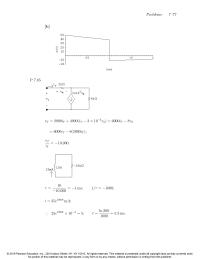
Electrical Engineering Chapter 7 Homework Open circuit voltage calculation
τ=10 −10,000 =−1 ms; 1/τ=−1000; i= 25e1000tmA; · .. 25e1000t×10−3= 5; t=ln 200 1000 =5.3 ms. Problems 7–77 [b] P 7.85 © 2019 Pearson Education, Inc., 330 Hudson Street, NY, NY 10013. All rights reserved. This material is protected under […]
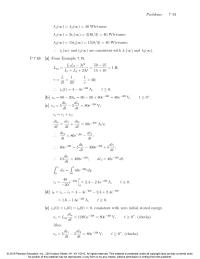
Electrical Engineering Chapter 7 Homework No portion of this material may be reproduced
vo=Leq dt = 1(80)e−20t= 80e−20tV,t0+.(checks) Also, vo=5 di1 dt 5di2 dt = 80e−20tV,t0+.(checks) τ=L R=1 20;1 τ= 20; · .. i o(t)=44e−20tA,t0. [b] vo= 80 20io= 80 80 + 80e−20t= 80e−20tV,t0+. dio dt =di1 dt +di2 dt = 80e−20tA/s; · […]
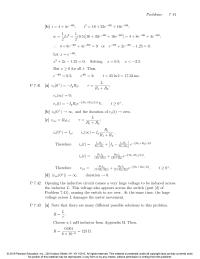
Electrical Engineering Chapter 7 Homework Opening the inductive circuit causes a very large
R1+R2 io(0+)=Ig;io(1)=Ig R1 R1+R2 . Therefore io(t)= IgR1 R1+R2+hIgIgR1 R1+R2ie−[(R1+R2)/L]t io(t)= R1Ig (R1+R2)+R2Ig (R1+R2)e−[(R1+R2)/L]t. Therefore vsw =R1Ig (1+R1/R2)+R2Ig (1+R1/R2)e−[(R1+R2)/L]t,t0+. [d] |vsw(0+)|!1; duration !0. Problem 7.41), causing the switch to arc over. At the same time, the large voltage across Ldamages […]
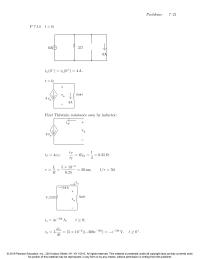
Electrical Engineering Chapter 7 Homework Response First order And Circuits
iT=4vT;vT iT =RTh =1 4=0.25 Ω; τ=L R=5⇥10−3 0.25 = 20 ms; 1/τ= 50. io=4e−50tA,t0; vo=Ldio dt = (5 ⇥10−3)(200e−50t)=e−50tV,t0+. Problems 7–21 P 7.14 t<0; Find Th´evenin resistance seen by inductor: © 2019 Pearson Education, Inc., 330 Hudson Street, NY, […]
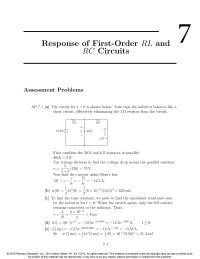
Electrical Engineering Chapter 7 Homework A source flows through the short circuit
remains connected to the inductor. Thus, τ=L R=8⇥10−3 2= 4 ms. [d] i(t)=i(0−)et/τ=12.5e−t/0.004 =12.5e−250tA,t0. [e] i(5 ms) = 12.5e−250(0.005) =12.5e−1.25 =3.58 A. So w(5 ms) = 1 2Li2(5 ms) = 1 2(8) ⇥10−3(3.58)2= 51.3 mJ. Response of First-Order RL and […]
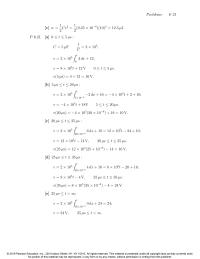
Electrical Engineering Chapter 6 Homework Combine two 10 mH inductors in parallel to get a 5
v=2⇥105Zt 04dx + 12; v=8⇥105t+12V 0t5µs. v(5 µs) = 4 + 12 = 16 V. v=2⇥105Zt 5⇥10−62dx +16=4⇥105t+ 2 + 16; v=4⇥105t+ 18V 5 t20 µs. v(20 µs) = 4⇥105(20 ⇥106) + 18 = 10 V. v= 12 ⇥105t14 V,20 […]
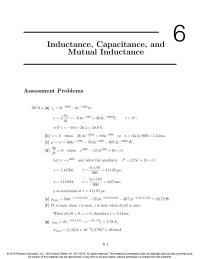
Electrical Engineering Chapter 6 Homework Summing the voltages around mesh 1 yields
When di/dt = 0, v= 0, therefore t=1.54 ms. [g] imax = 8[e−0.3(1.54) −e−1.2(1.54)]=3.78 A; wmax = (1/2)(4 ×10−3)(3.78)2= 28.6 mJ. v=Ldig dt =−9.6e−300t+38.4e−1200tV,t>0+; v(0+)=−9.6+38.4=28.8V. [b] v= 0 when 38.4e−1200t=9.6e−300tor t= (ln 4)/900 = 1.54 ms. [c] p=vi = 384e−1500t−76.8e−600t−307.2e−2400tW. […]
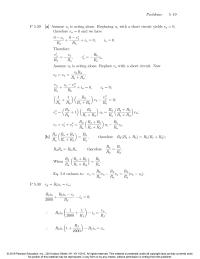
Electrical Engineering Chapter 5 Homework Third Allows The Load Resistor Voltage And
v0 o Rb =va Ra ,v 0 o=Rb Ra va. vn Ra +vnv00 o Rb +in=0,i n= 0; ✓1 Ra +1 Rb◆✓ Rd Rc+Rd◆vbv00 o Rb = 0; v00 o=✓Rb Ra +1 ◆✓ Rd Rc+Rd◆vb=Rd Ra✓Ra+Rb Rc+Rd◆vb; vo=v0 o+v00 o=Rd […]
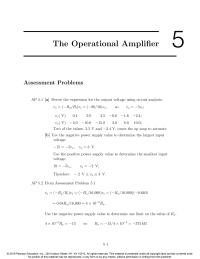
Electrical Engineering Chapter 5 Homework Thus For 040 The Operational
−15 = −5vs,v s=3 V. Use the positive power supply value to determine the smallest input voltage: 10 = −5vs,v s=−2 V; Therefore −2V≤vs≤3V. vo=(−Rf/Ri)vs=(−Rx/16,000)vs=(−Rx/16,000)(−0.640) =0.64Rx/16,000 = 4 ×10⁻⁵Rx. 4×10⁻⁵Rx=−15 so Rx=−15/4×10−5=−375 kΩ. The Operational Amplifier Assessment Problems AP 5.1 […]
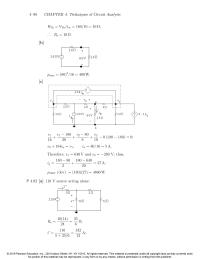
Electrical Engineering Chapter 4 Homework A source acting alone
pmax = (80)2/16 = 400 W. v1 16 +v1180 20 +v280 8+v2 10 0.1(80 180) = 0; v2+ 184iφ=v1;iφ= 80/16 = 5 A. Therefore, v1= 640 V and v2=280 V; thus, ig=180 80 2+180 640 20 = 27 A; p180V […]
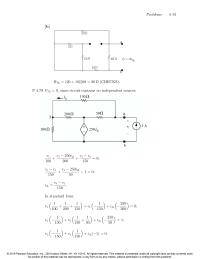
Electrical Engineering Chapter 4 Homework Place The Equations In standard Form
vtv1 150 +vt250i∆ 50 1=0; i∆=vtv1 150 . v1✓1 150◆+vt✓1 150 +1 50◆+i∆✓250 50 ◆= 1; v1✓1 150◆+vt✓1 150◆+i∆(1) = 0. Problems 4–81 [b] P 4.79 VTh = 0, since circuit contains no independent sources. v1 100 +v1250i∆ 200 +v1vt […]
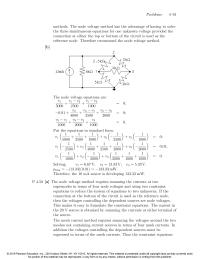
Electrical Engineering Chapter 4 Homework The node voltage method has the advantage of having
0.01 + v2 4000 +v2v1 2500 +v2v3 2000 =0; v3v1 1000 +v3v2 2000 +v3 1000 =0. v1✓1 2500◆+v2✓1 4000 +1 2500 +1 2000◆+v3✓1 2000◆=0.01; v1✓1 1000◆+v2✓1 2000◆+v3✓1 2000 +1 1000 +1 1000◆=0. Solving, v1=6.67 V; v2= 13.33 V; v3=5.33 V. […]
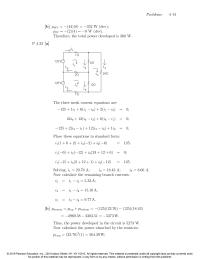
Electrical Engineering Chapter 4 Homework The three mesh current equations are
−125 + 1i1+6(i1−i6)+2(i1−i3) = 0; 24i6+ 12(i6−i3)+6(i6−i1) = 0; −125 + 2(i3−i1) + 12(i3−i6)+1i3=0, i1(−6) + i3(−12) + i6(24 + 12 + 6) = 0; i1(−2) + i3(2 + 12 + 1) + i6(−12) = 125. Solving, i1= 23.76 A; […]
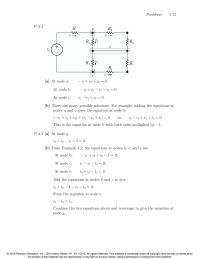
Electrical Engineering Chapter 4 Homework Combine the two equations above and rearrange
(−i1+i2+i4)+(i1−i3+i5) = 0 so i2−i3+i4+i5=0. This is the equation at node b with both sides multiplied by −1. i4+i6−i5−I=0. At node b: −i1+i2+i6−I= 0; At node c: i1−i3−i5= 0; At node e: i3+i4−i2=0. i2+i6−I−i3−i5=0. From the equation at node e, […]
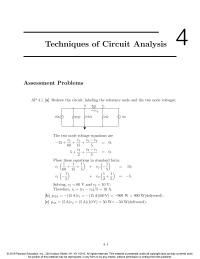
Electrical Engineering Chapter 4 Homework Returning Back The Original Circuit Note That
15 + v1 60 +v1 15 +v1v2 5=0; 5+v2 2+v2v1 5=0. v1✓1 5◆+v2✓1 2+1 5◆=5. Solving, v1= 60 V and v2= 10 V; Therefore, i1=(v1v2)/5 = 10 A. [b] p15A =(15 A)v1=(15 A)(60 V) = 900 W = 900 W(delivered). […]
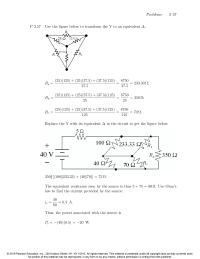
Electrical Engineering Chapter 3 Homework Now Redraw The Circuit Using
Find the equivalent resistance to the right of the 5 Ωresistor: 350k[(100k233.33) + (40k70)] = 75 Ω. is=40 80 =0.5A. Thus, the power associated with the source is Ps=(40)(0.5) = 20 W. Problems 3–37 P 3.57 Use the figure below […]
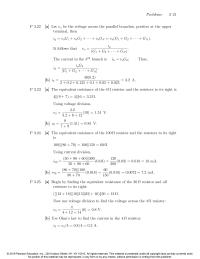
Electrical Engineering Chapter 3 Homework Simple Resistive Circuits The True Value
ig=voG1+voG2+··· +voGN=vo(G1+G2+··· +GN). It follows that vo=ig (G1+G2+··· +GN). ik=igGk [G1+G2+··· +GN]. [b] i5=40(0.2) 2+0.2+0.125 + 0.1+0.05 + 0.025 =3.2A. 4k(9 + 7) = 4k16 = 3.2Ω. Using voltage division, v4=3.2 3.2 + 6 + 12(10) = 1.51 V. [b] […]
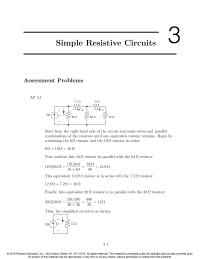
Electrical Engineering Chapter 3 Homework Start from the right hand side of the circuit
12.8Ω+7.2Ω=20Ω. Finally, this equivalent 20 Ωresistor is in parallel with the 30 Ωresistor: 20 Ωk30 Ω=(20)(30) 20 + 30 =600 50 = 12 Ω. Simple Resistive Circuits Assessment Problems AP 3.1 Start from the right hand side of the circuit […]
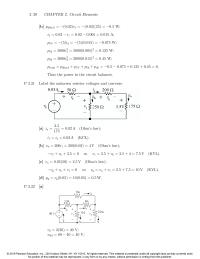
Electrical Engineering Chapter 2 Homework Use Ohms Law Express The Voltage Drop
i1=ia=0.02 A (KCL). [b] vb= 200i1= 200(0.02) = 4 V (Ohm’s law); −v1+vb+3.5 = 0 so v1=3.5+vb=3.5+4=7.5 V (KVL). [c] va=0.05(50) = 2.5 V (Ohm’s law); −vg+va+v1=0 so vg=va+v1=2.5+7.5 = 10 V (KVL). [d] pg=vg(0.05) = 10(0.05) = 0.5W. v2= […]
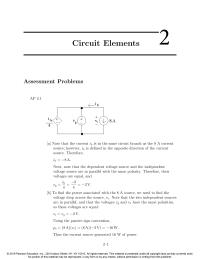
Electrical Engineering Chapter 2 Homework The Power Associated With
source. Therefore, ib=−8A. Next, note that the dependent voltage source and the independent voltage source are in parallel with the same polarity. Therefore, their voltages are equal, and vg=ib 4=−8 4=−2V. so these voltages are equal: vi=vg=−2V. Using the passive […]
Electrical Engineering Chapter 1 Homework Now we have to match the voltage and current shown
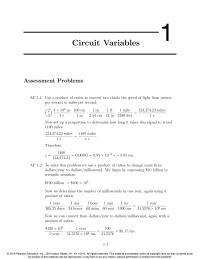
3◆3⇥108m 1s ·100 cm 1m ·1 in 2.54 cm ·1 ft 12 in ·1 mile 5280 feet =124,274.24 miles 1s . Now set up a proportion to determine how long it takes this signal to travel 1100 miles: 124,274.24 miles […]
Chemical Engineering Chapter 27 General Comments The First Printing The
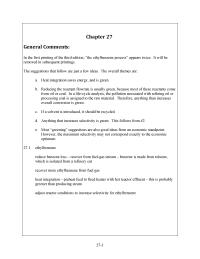
Chapter 27 General Comments: In the first printing of the third edition, “the ethylbenzene process” appears twice. It will be removed in subsequent printings. The suggestions that follow are just a few ideas. The overall themes are: a. Heat integration […]
Chemical Engineering Chapter 26 The problem is more likely on process side
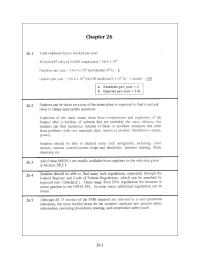
26-1 Chapter 26 26.1 26.2 26.3 26.5 26.2.1 26.4 26.2 26-2 26.6 26.7 26.8 26.9 26.7 26-3
Chemical Engineering Chapter 25 Students Often Are Eager Develop Guidelines This
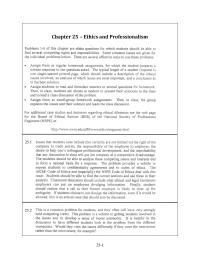
25-1 Chapter 25 Ethics and Professionalism 25.1 25.2 25-2 25.3 25.4 25.5 25.6 25.7 25.8 Codes of conduct can be obtained from companies, but often only if the company name is removed. The instructor should obtain a couple from […]
Chemical Engineering Chapter 24 But U will increase because the mass
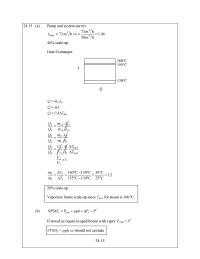
24-15 24.15 (a) Pump and system curves: 46.1 hm50 hm73 hm 73 3 3 3 max v 46% scale-up Heat Exchanger: lm ss TUAQ mQ mQ 20% scale-up Vaporizer limits scale-up since Tmax for steam is 160 C. (b) NPSHAPtank […]
Chemical Engineering Chapter 24 Since Dowtherm has been increased to compensate
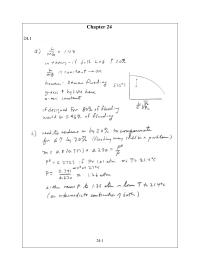
Chapter 24 24.1 24-1 24-2 24.2 24-3 24.3 24.4 24-4 24.5 24.6 24-5 24.7 24.8 24.9 24-6 24-7 24.10 24-8 24.10 (contd) 24-9 24.11 24-10 24.12 24-11 24.13 24-12 24.13 (contd) 24-13 24.13 (contd) 24-14 24.14