Problems 4–21
P 4.4
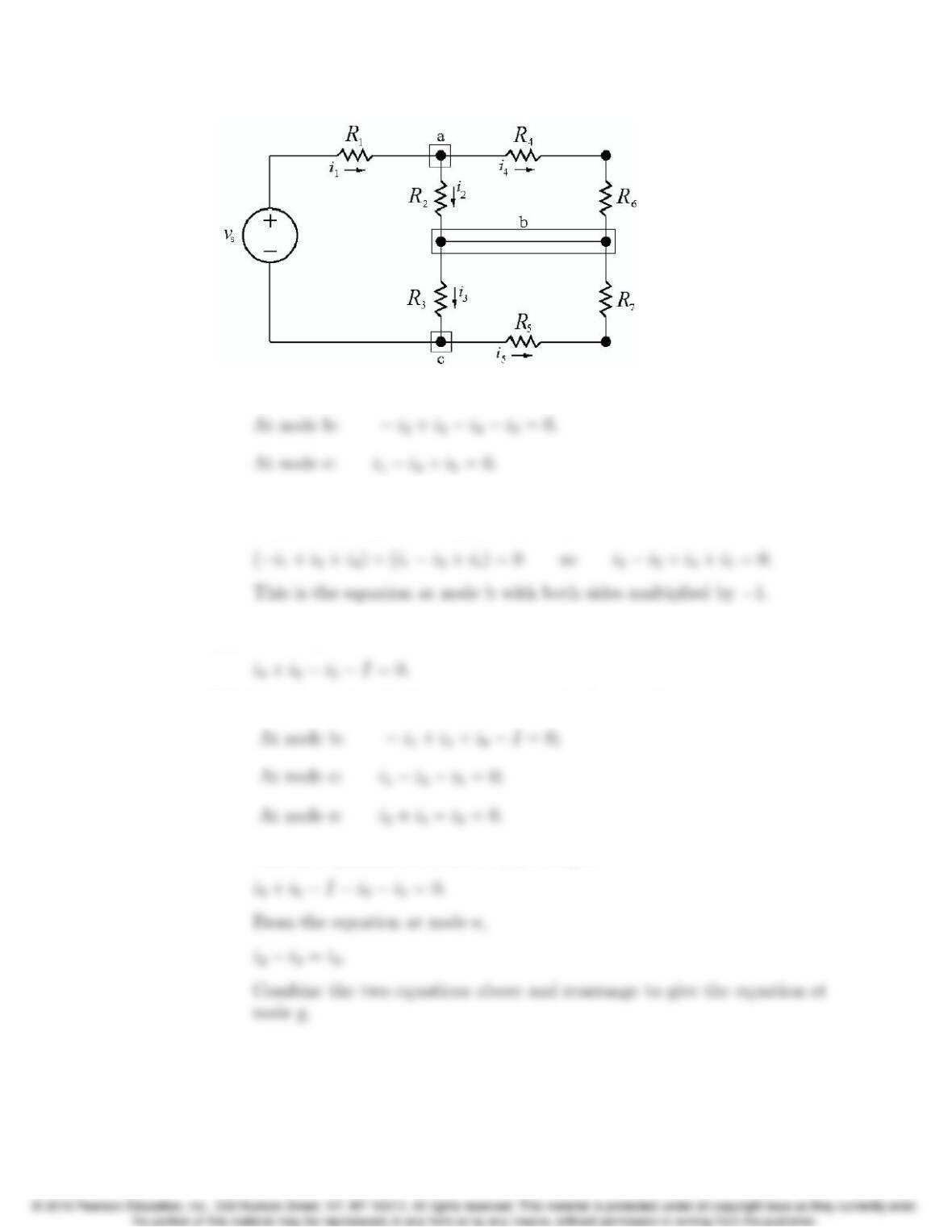
[a] At node a: −i1+i2+i4=0.
[b] There are many possible solutions. For example, adding the equations at
nodes a and c gives the equation at node b:
P 4.5 [a] At node g,
[b] From Example 4.2, the equations at nodes b, c, and e are
Add the equations at nodes b and c to give
4–22 CHAPTER 4. Techniques of Circuit Analysis
P 4.6
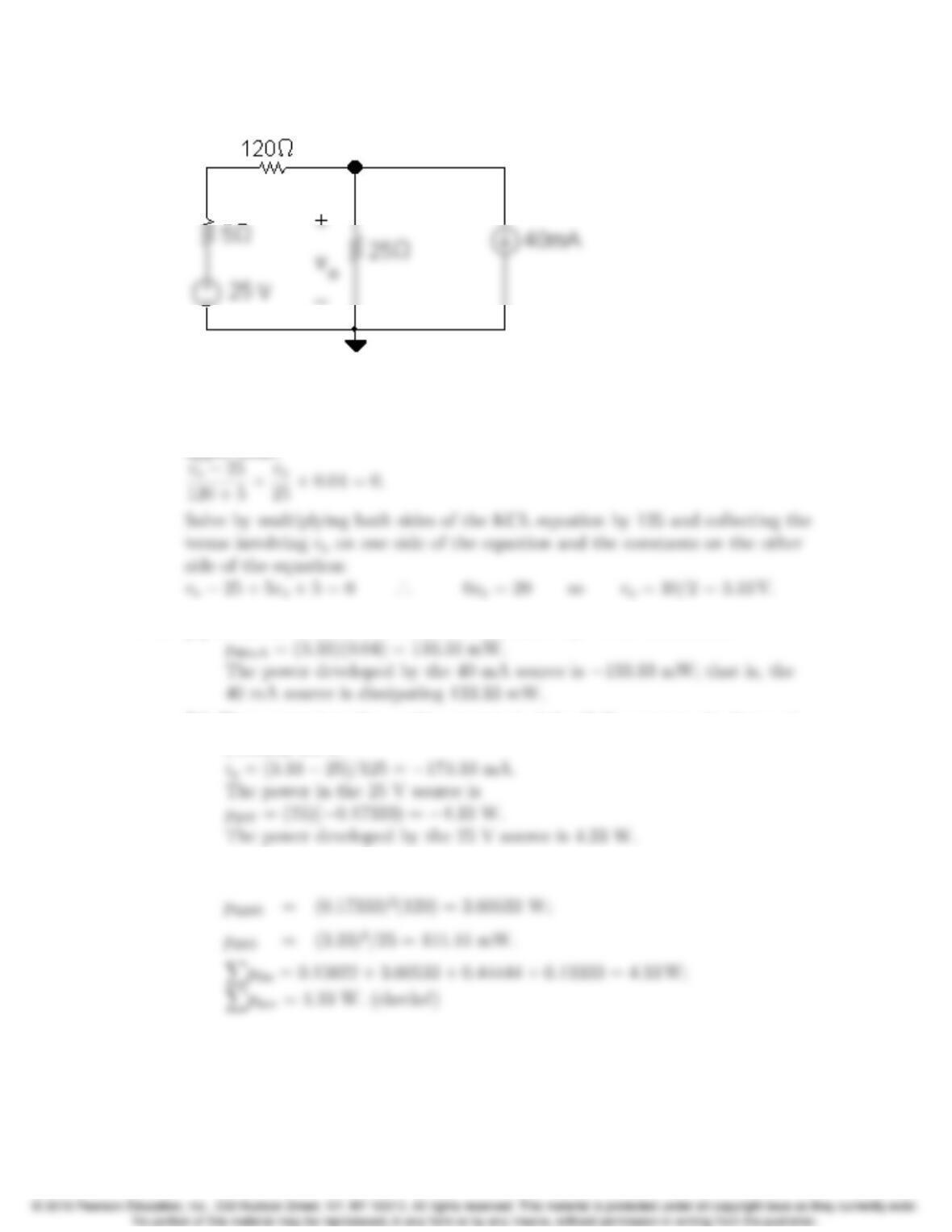
Note that we have chosen the lower node as the reference node, and that the
voltage at the upper node with respect to the reference node is vo. Write a
KCL equation (node voltage equation) by summing the currents leaving the
upper node:
P 4.7 [a] From the solution to Problem 4.6 we know vo=3.33 V; therefore
[b] The current into the positive terminal of the 25 V source in the figure of
Problem 4.6 is
[c] p5Ω=(0.17333)2(5) = 150.22 mW;
Problems 4–23
P 4.8
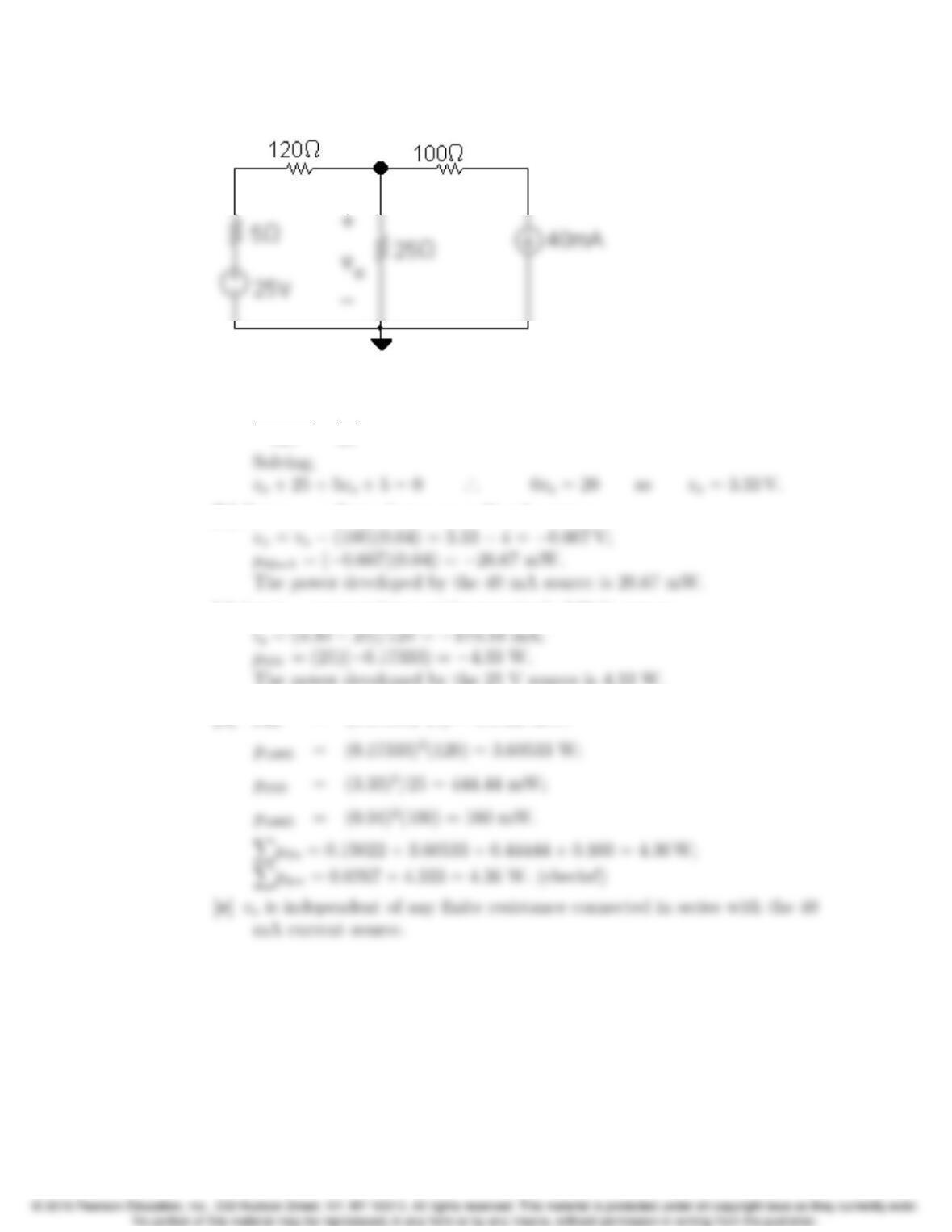
[a] The node voltage equation is:
vo−25
125 +vo
25 +0.04 = 0.
[b] Let vx= voltage drop across 40 mA source:
[c] Let ig= current into positive terminal of 25 V source:
The power developed by the 25 V source is 4.33 W.
[d] p5Ω=(0.17333)2(5) = 150.22 mW;
P 4.9
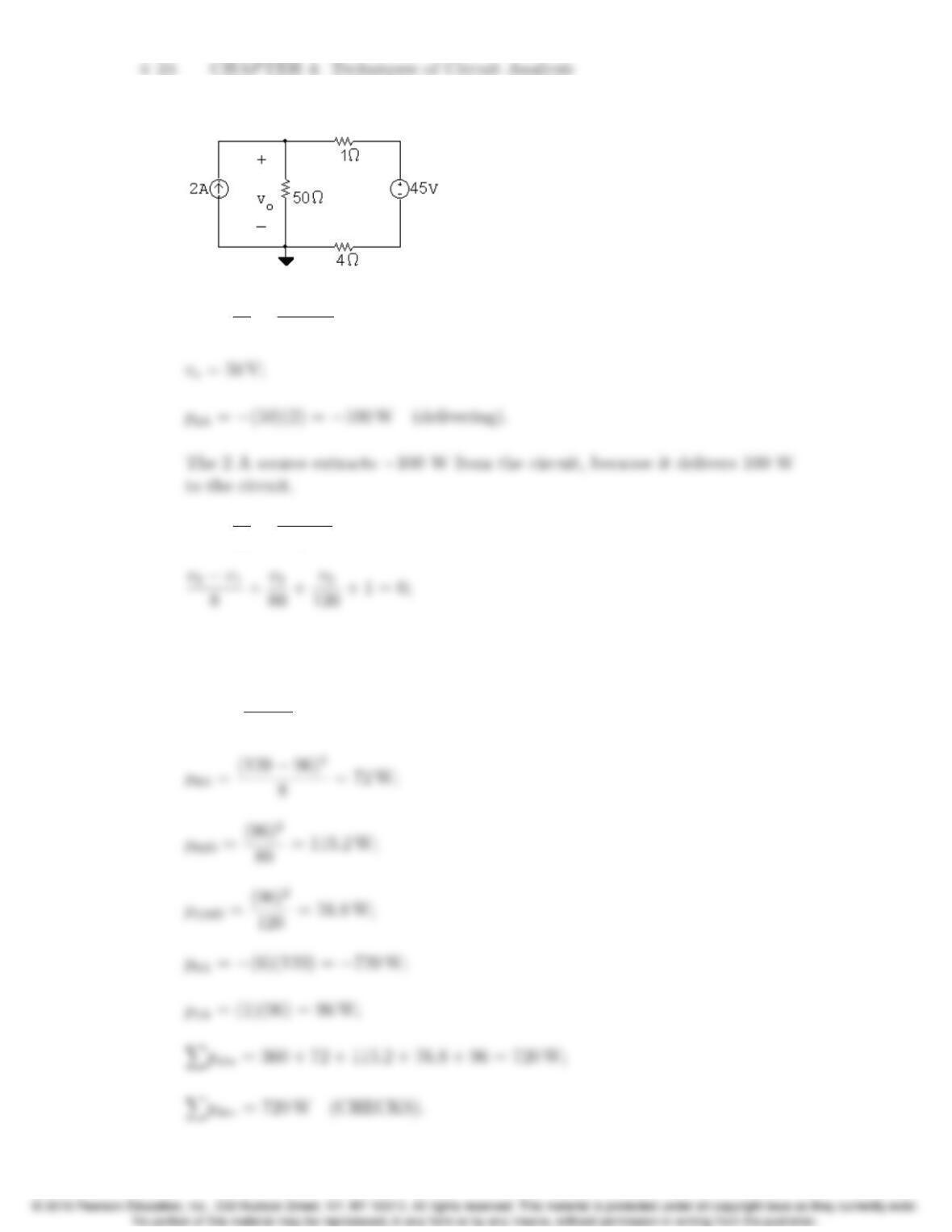
−2+ vo
50 +vo−45
1+4 = 0;
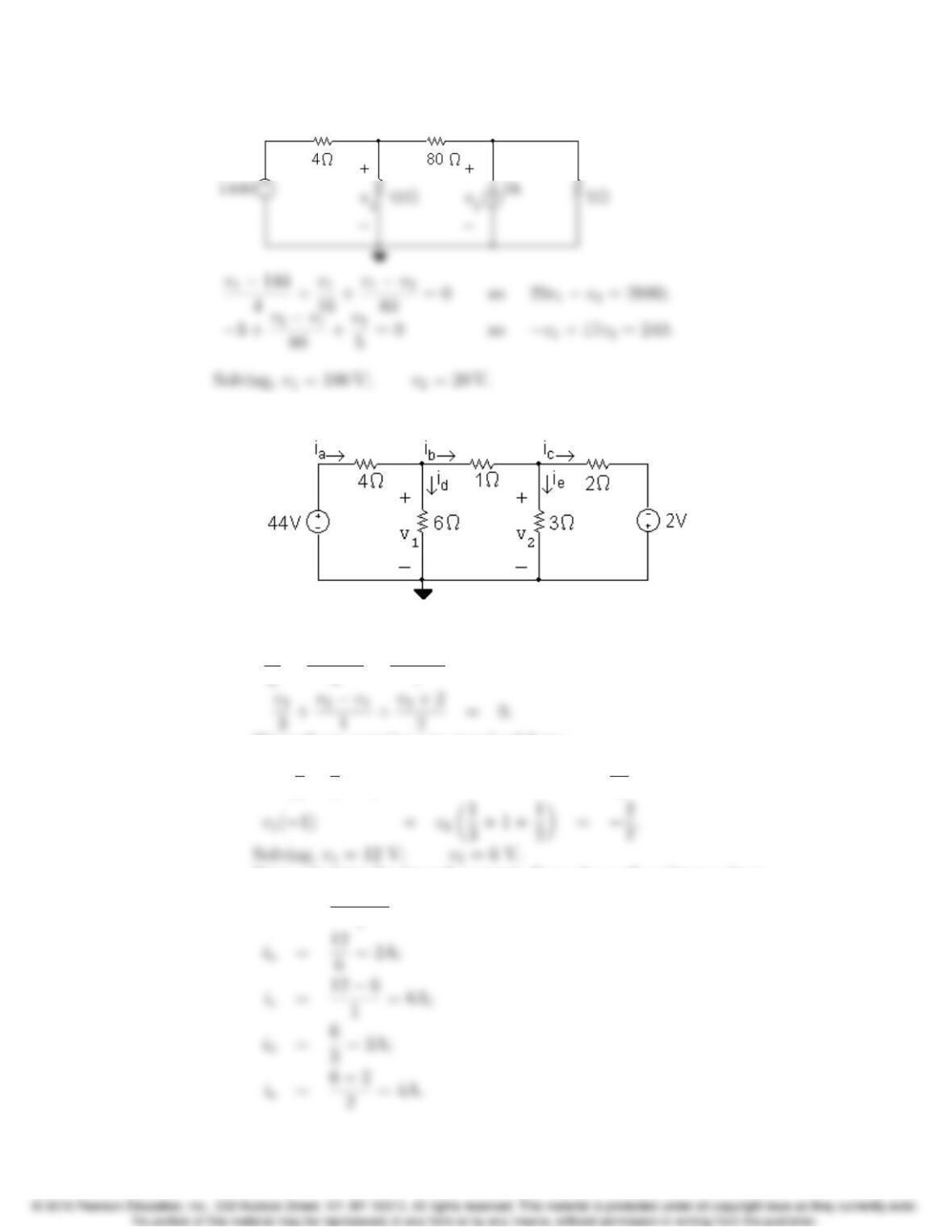
P 4.10 −6+ v1
40 +v1−v2
8= 0;
Solving, v1= 120 V; v2= 96 V.
CHECK:
p40Ω=(120)2
40 = 360 W;
Problems 4–25
P 4.11
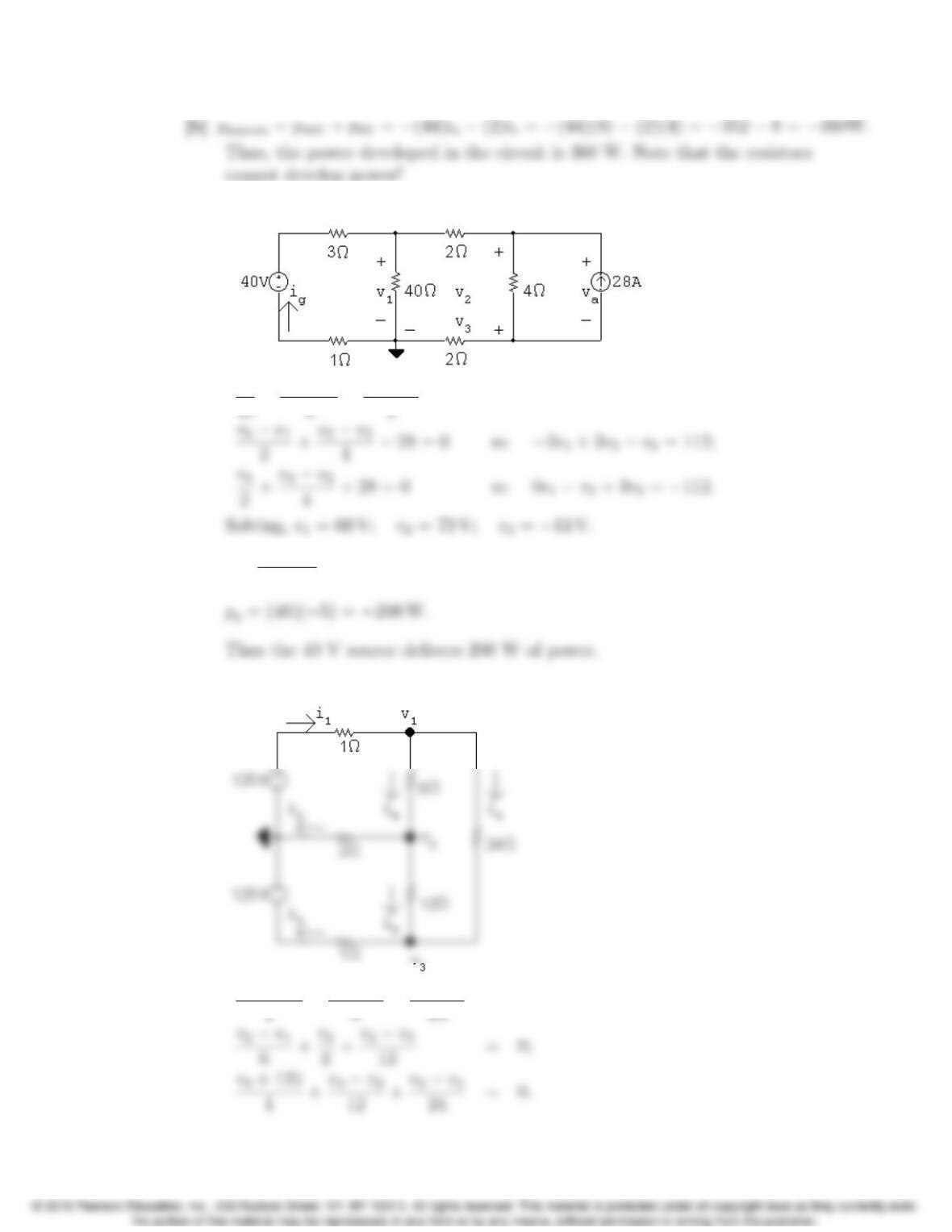
P 4.12 [a]
The two node voltage equations are:
v1
Place these equations in standard form:
v1✓1
6+1
4+1
◆+v2(−1) = 44
4;
Now calculate the branch currents from the node voltage values:
ia=44 −12
4= 8A;
4–26 CHAPTER 4. Techniques of Circuit Analysis
P 4.13 [a]
v1
[b] ig=40 −60
4=−5 A;
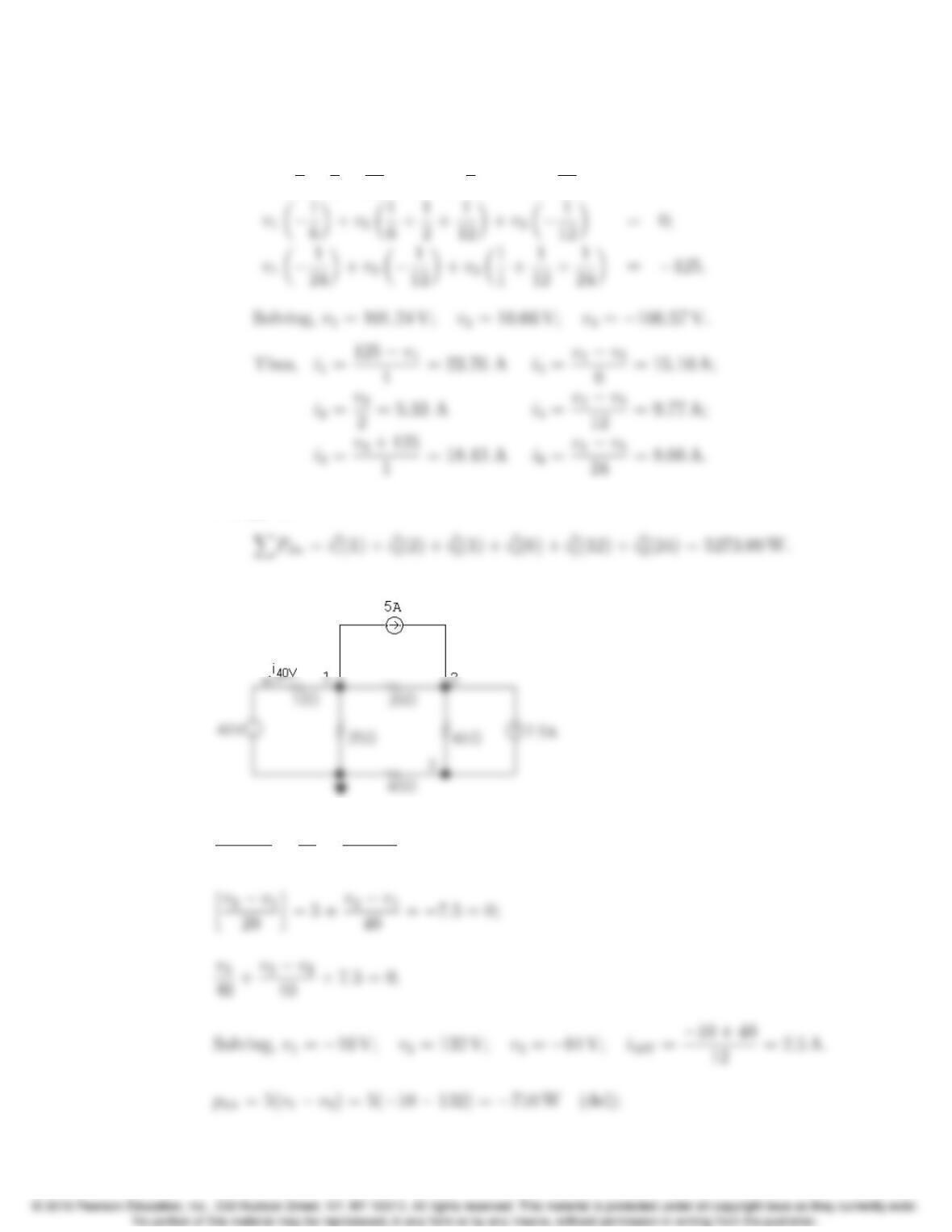
P 4.14 [a]
v1−125
Problems 4–27
In standard form:
v1✓1
1+1
6+1
24◆+v2✓−1
6◆+v3✓−1
24◆= 125;
[b] XPdev = 125i1+ 125i3= 5273.09 W;
P 4.15
v1+40
12 +v1
25 +v1−v2
20 + 5 = 0;
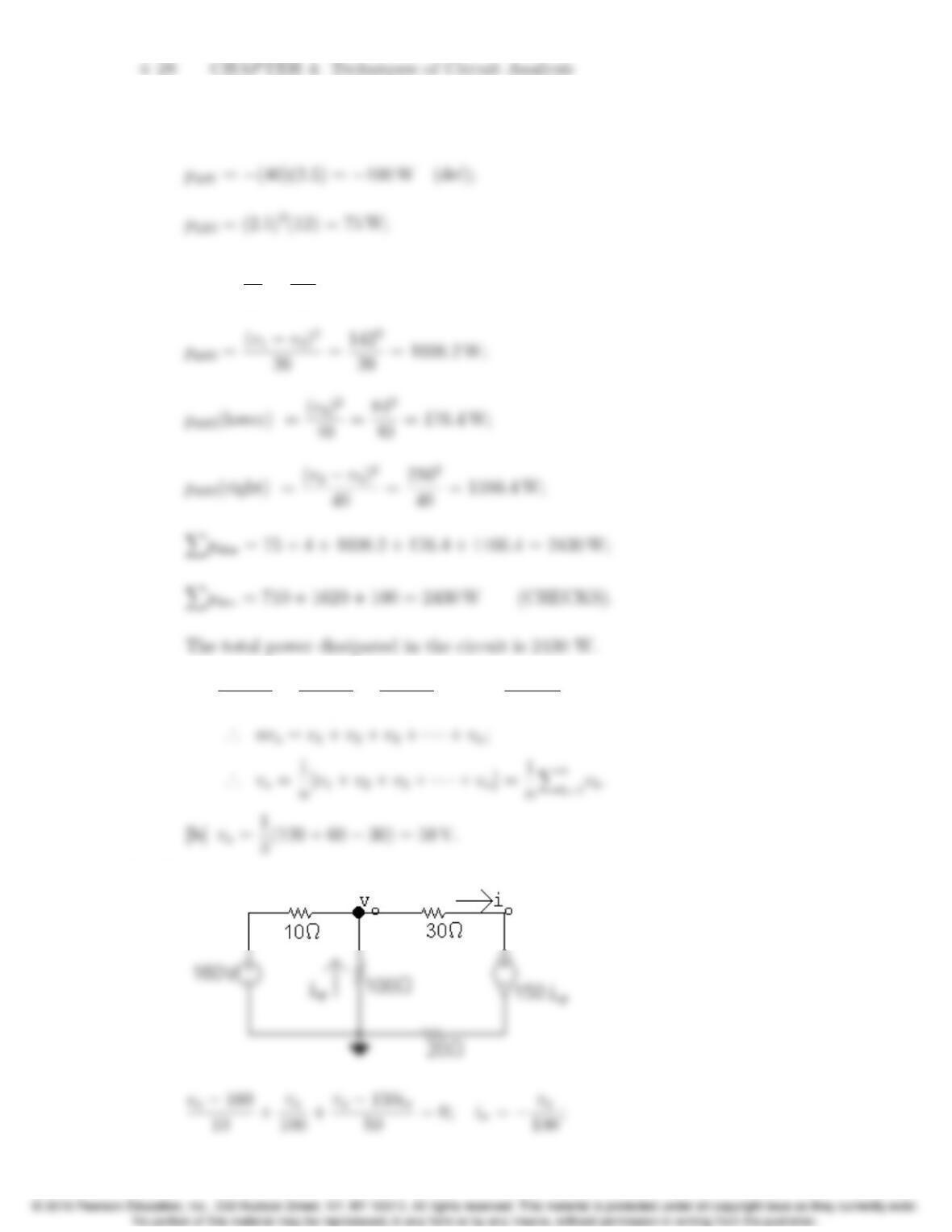
p7.5A =(−84 −132)(7.5) = −1620 W (del);
p25Ω=v2
1
25 =102
25 = 4 W;
P 4.16 [a] vo−v1
R+vo−v2
R+vo−v3
R+··· +vo−vn
R= 0;
P 4.17
Problems 4–29
Solving, vo= 100 V; iσ=−1A.
P 4.18
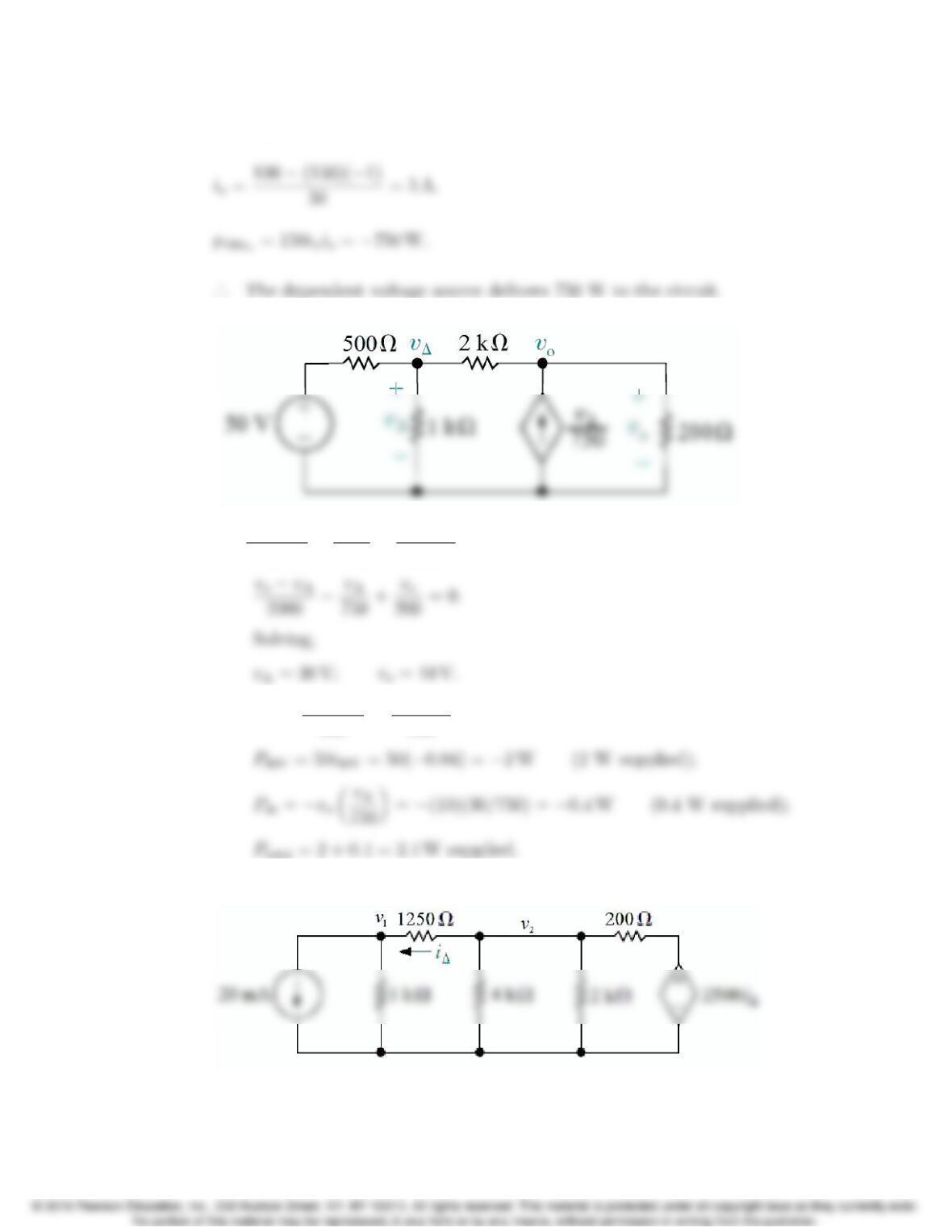
[a] v∆−50
500 +v∆
1000 +v∆−vo
2000 = 0;
[b] i50V =v∆−50
500 =30 −50
500 =−0.04 A;
P 4.19
4–30 CHAPTER 4. Techniques of Circuit Analysis
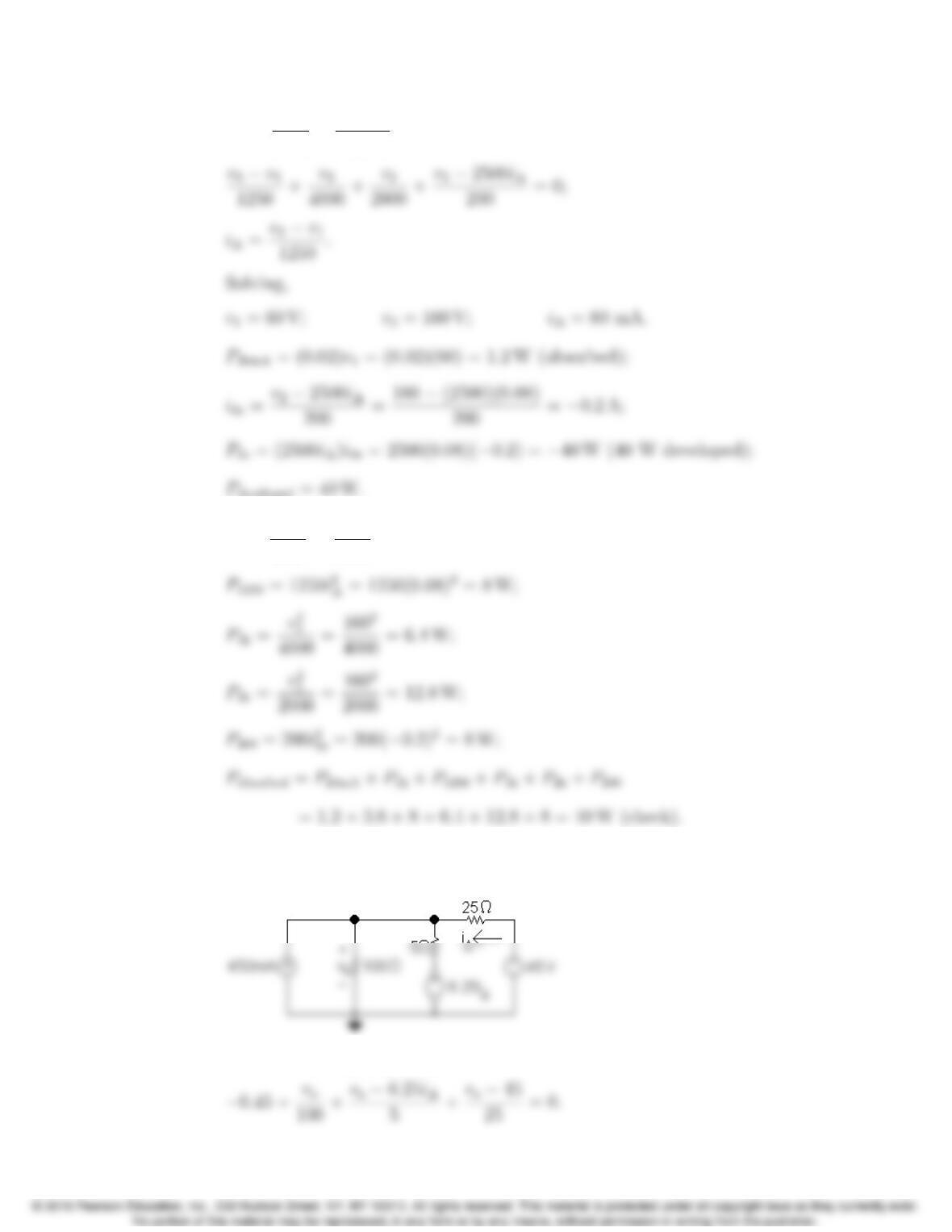
[a] 0.02 + v1
1000 +v1−v2
1250 = 0;
[b] P1k =v2
1
1000 =602
1000 =3.6 W;
P 4.20 [a]
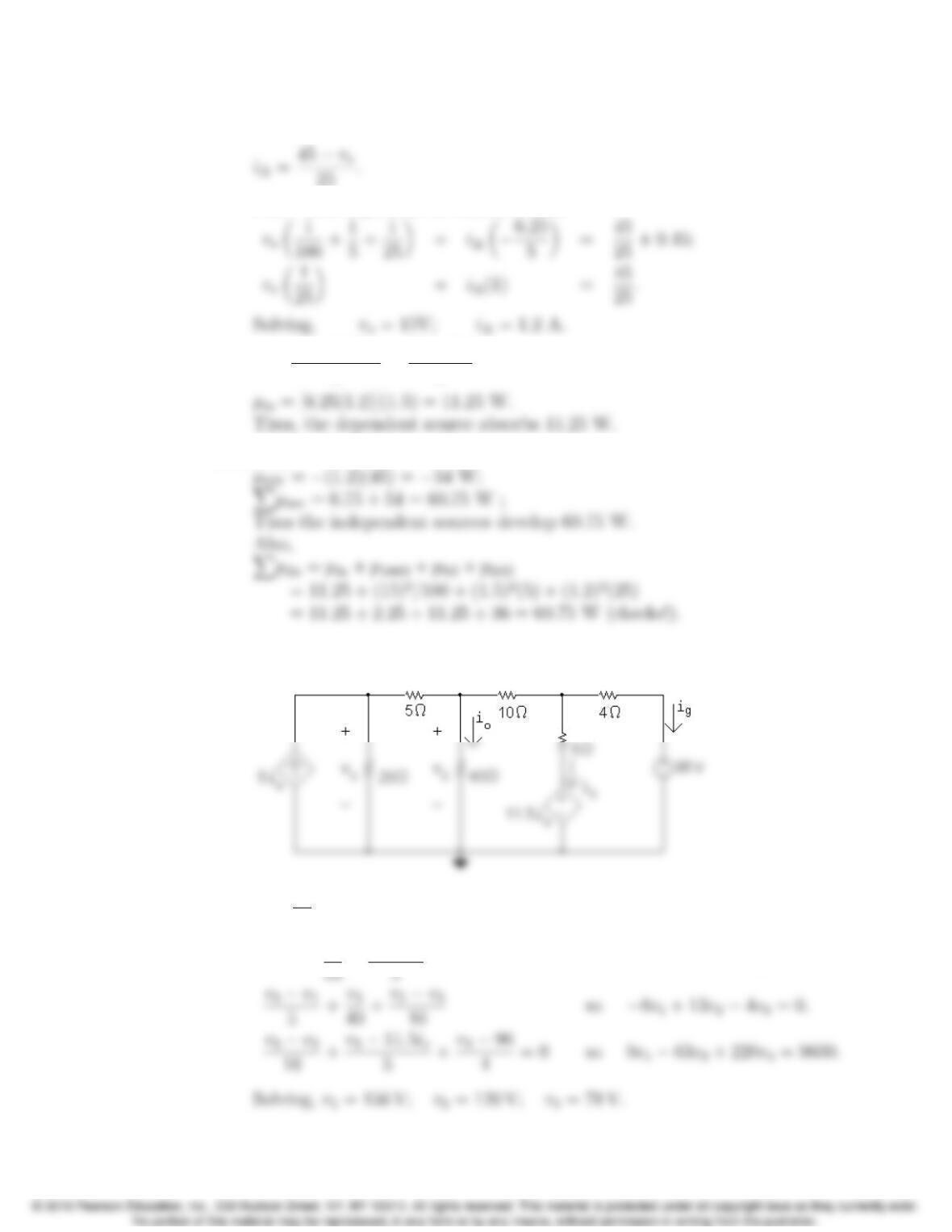
The node voltage equation is:
Problems 4–31
The dependent source constraint equation is:
Place these equations in standard form:
[b] ids =vo−6.25i∆
5=15 −7.5
5=1.5 A;
[c] p450mA =−(0.45)(15) = −6.75 W;
P 4.21 [a]
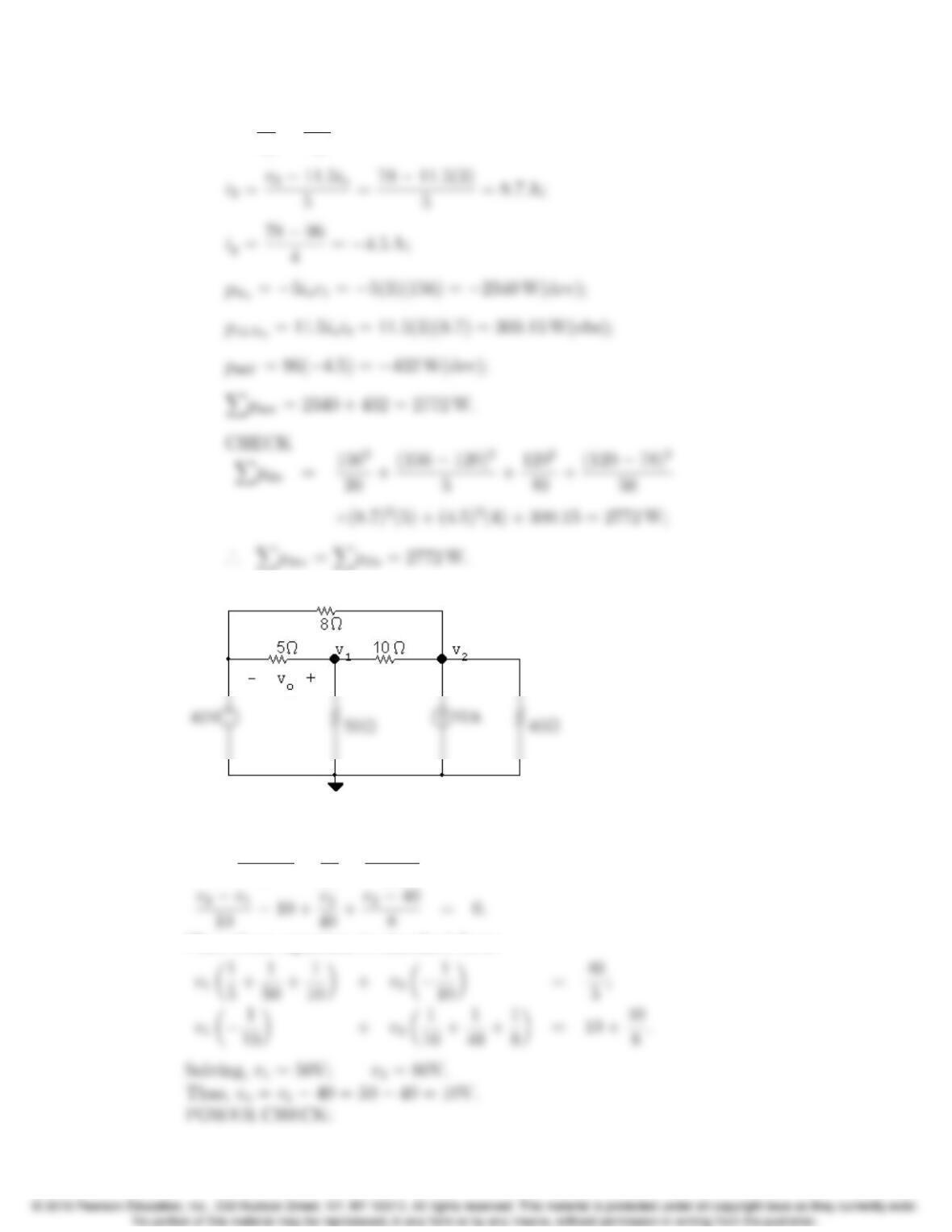
io=v2
40;
−5io+v1
4–32 CHAPTER 4. Techniques of Circuit Analysis
[b] io=v2
40 =120
40 = 3 A;
P 4.22
The two node voltage equations are:
v1−40
5+v1
50 +v1−v2
10 =0;
Place these equations in standard form:
Problems 4–33
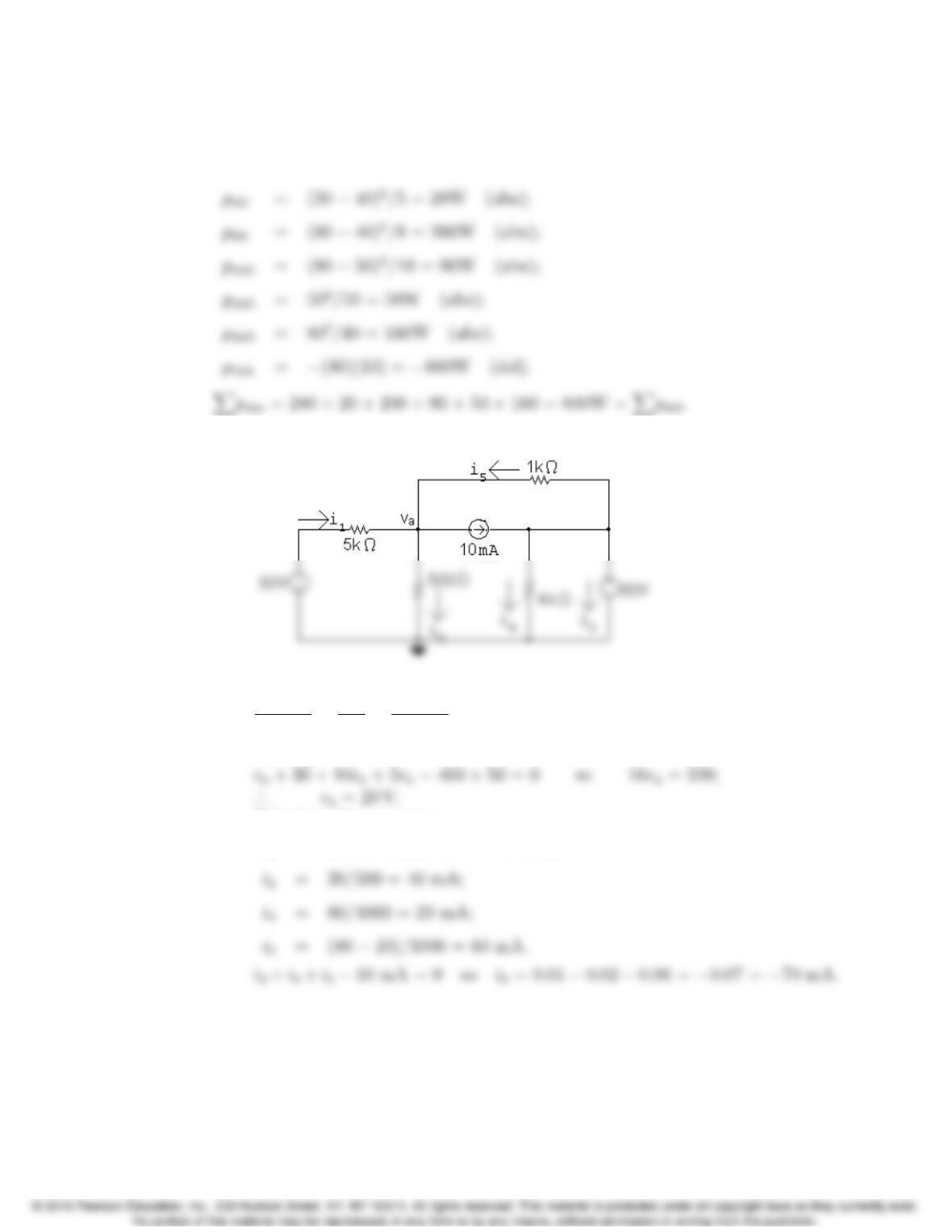
ig= (50 −40)/5 + (80 −40)/8 = 7A;
p40V = (40)(7) = 280W (abs);
P 4.23 [a]
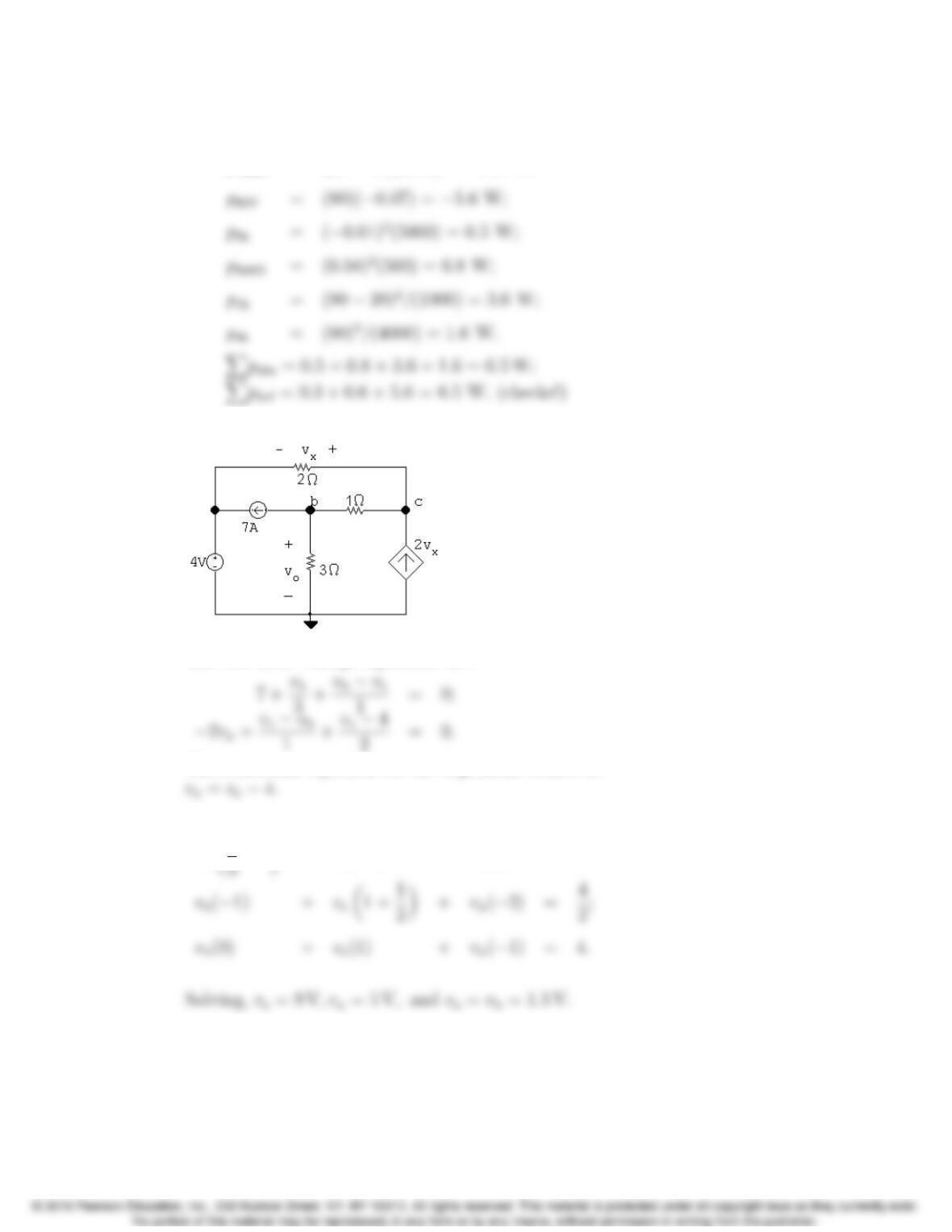
There is only one node voltage equation:
va+30
5000 +va
500 +va−80
1000 +0.01 = 0.
Solving,
Calculate the currents:
i1=(−30 −20)/5000 = −10 mA;
4–34 CHAPTER 4. Techniques of Circuit Analysis
[b] p30V = (30)(−0.01) = −0.3 W;
p10mA = (20 −80)(0.01) = −0.6 W;
P 4.24
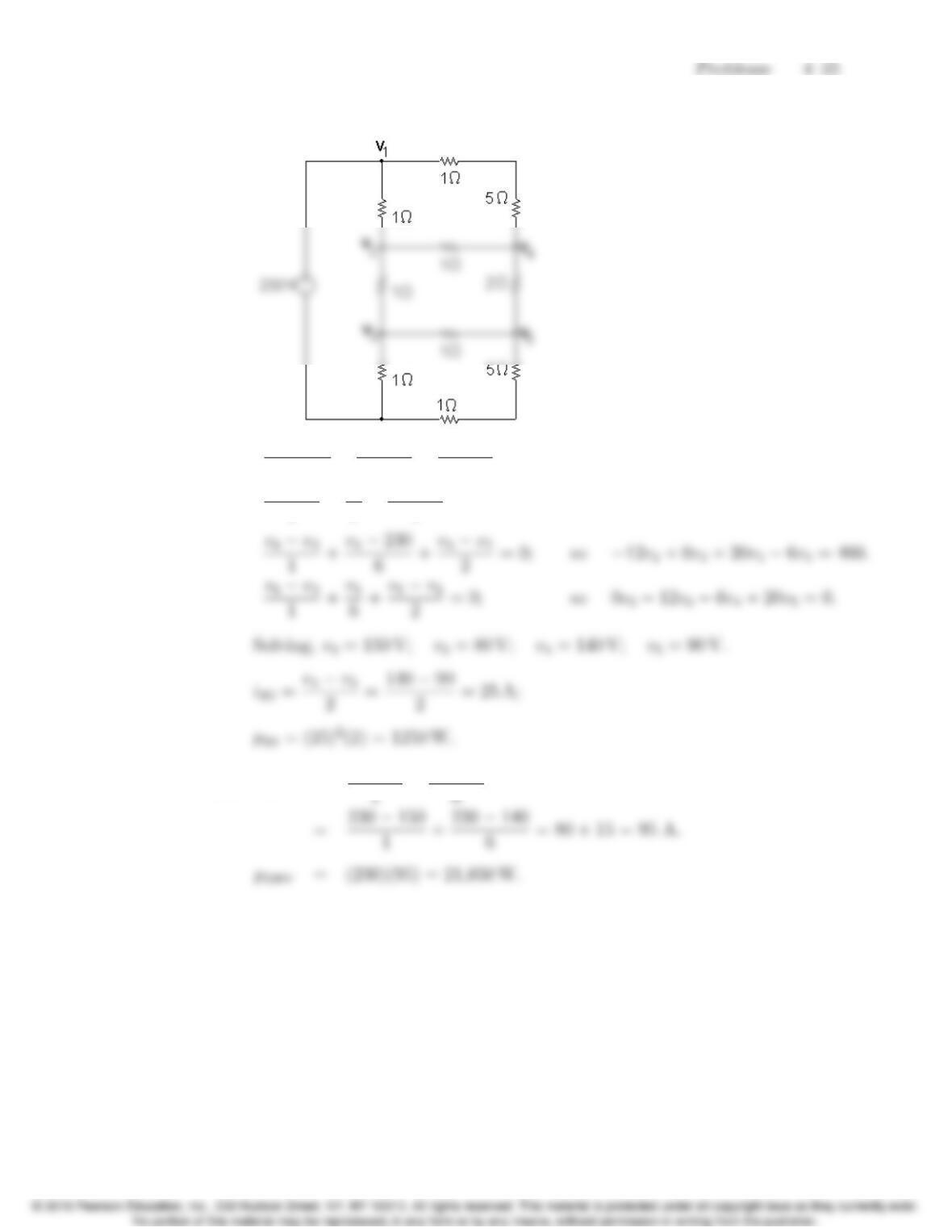
The two node voltage equations are:
The constraint equation for the dependent source is:
Place these equations in standard form:
vb✓1
◆+vc(−1) + vx(0) = −7;
P 4.25 [a]
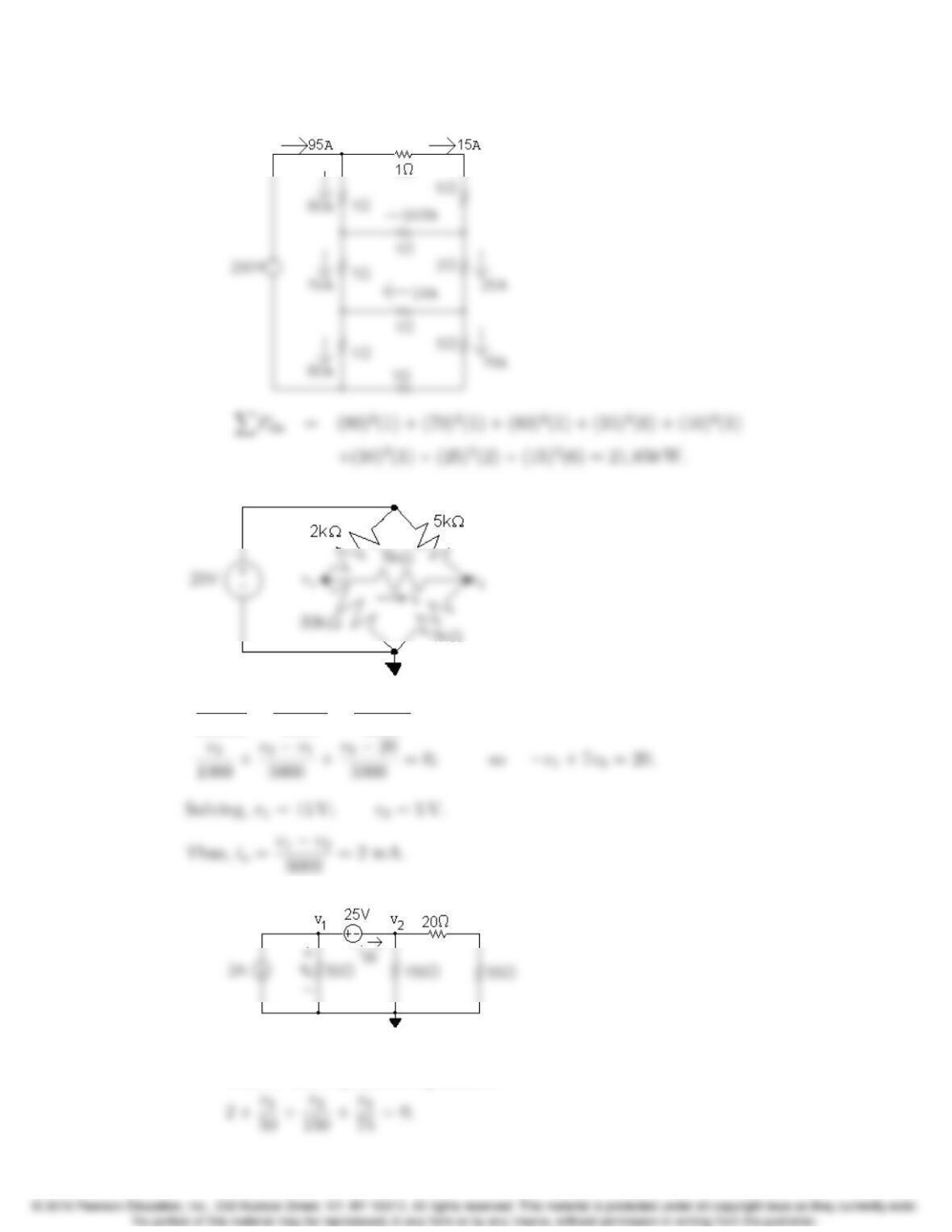
v2−230
1+v2−v4
1+v2−v3
1= 0; so 3v2−1v3−1v4+0v5= 230.
v3−v2
1+v3
1+v3−v5
1= 0; so −1v2+3v3+0v4−1v5= 0.
[b] i230V =v1−v2
4–36 CHAPTER 4. Techniques of Circuit Analysis
Check:
P 4.26
v1
30,000 +v1−v2
5000 +v1−20
2000 = 0; so 22v1−6v2= 300.
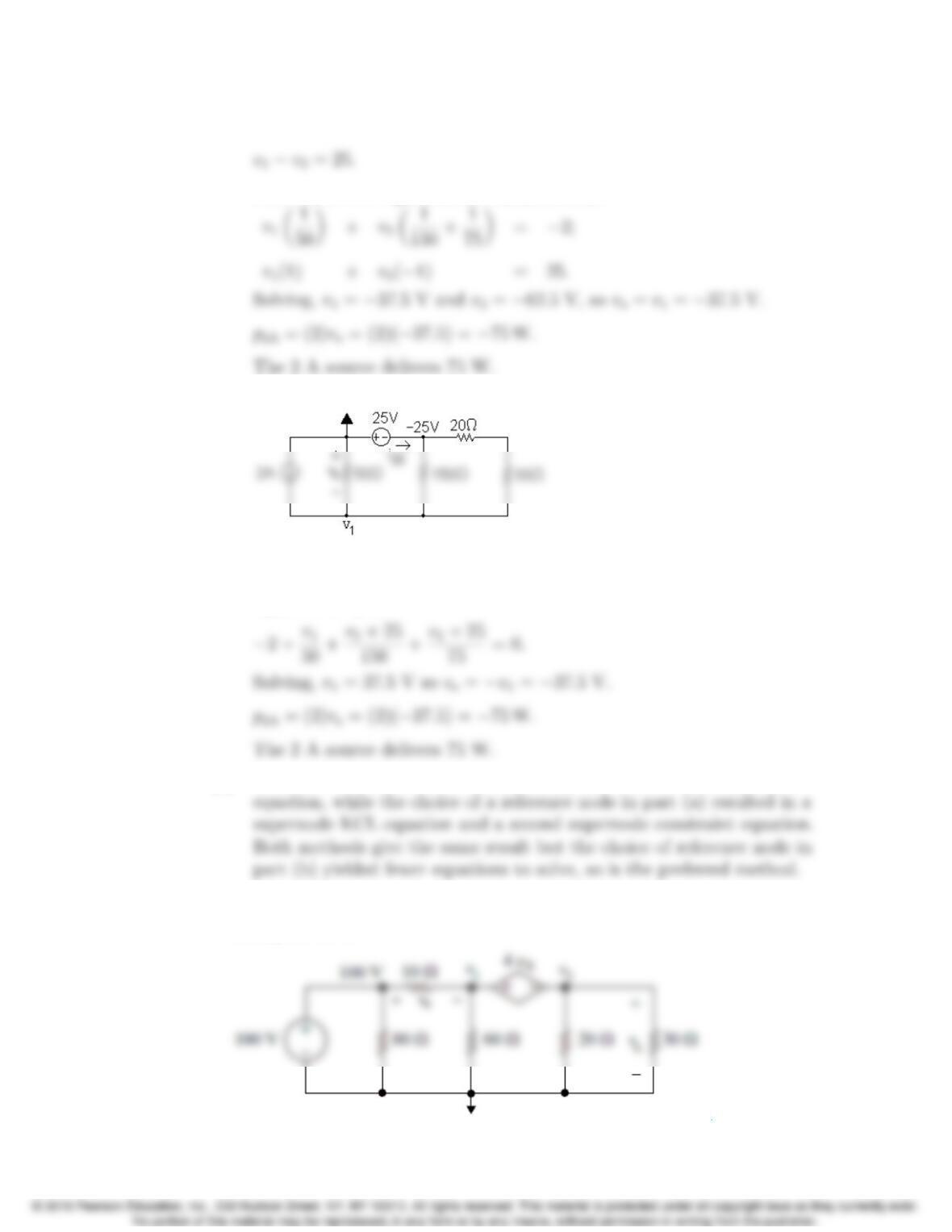
P 4.27 [a]
This circuit has a supernode includes the nodes v1,v2and the 25 V
source. The supernode equation is
Problems 4–37
The supernode constraint equation is
Place these two equations in standard form:
[b]
This circuit now has only one non-reference essential node where the
voltage is not known – note that it is not a supernode. The KCL
equation at v1is
[c] The choice of a reference node in part (b) resulted in one simple KCL
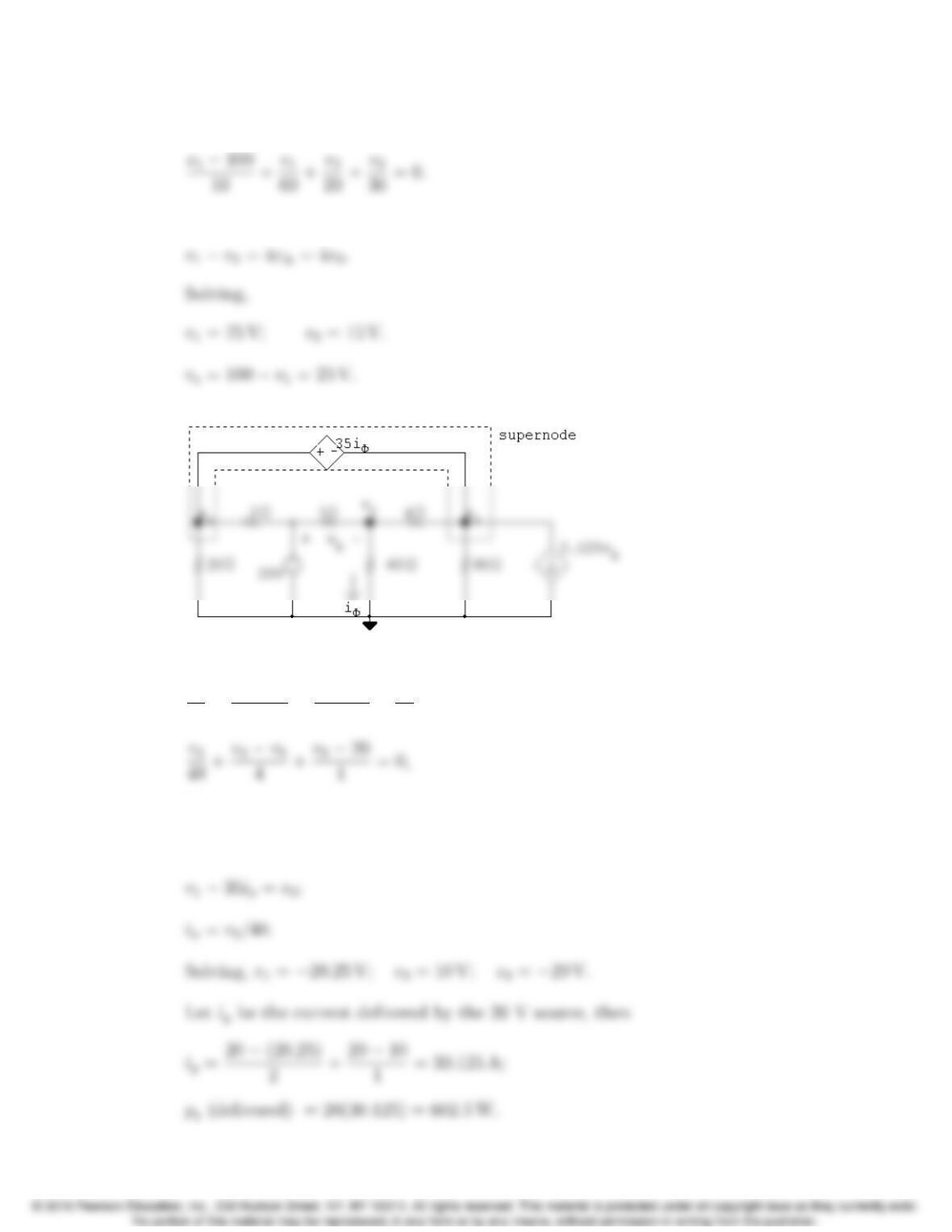
P 4.28 Place 4v∆inside a supernode and use the lower node as a reference. The
resulting circuit is
4–38 CHAPTER 4. Techniques of Circuit Analysis
The supernode KCL equation is
The dependent source constraint equation is
P 4.29
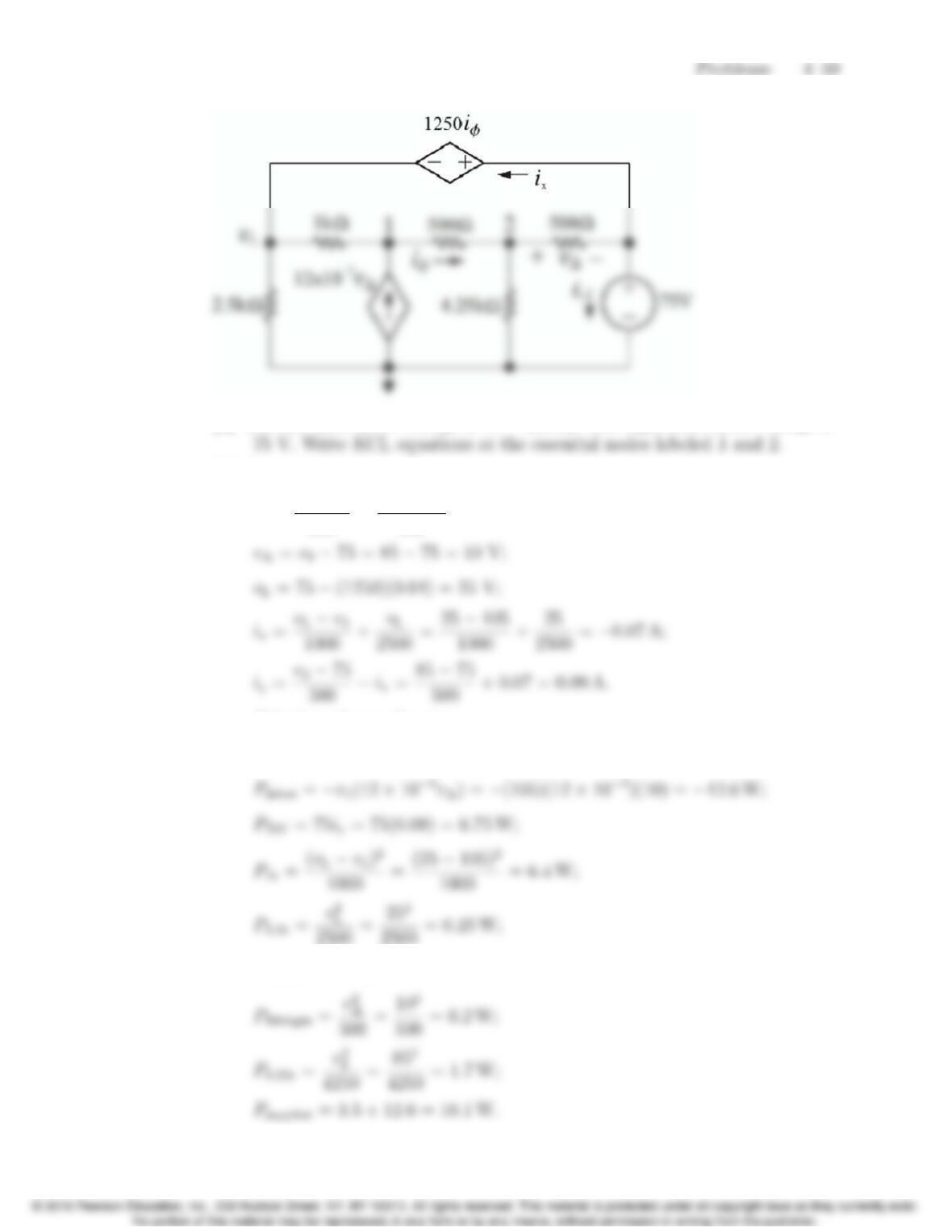
Node equations:
v1
20 +v1−20
2+v3−v2
4+v3
80 +3.125v∆= 0;
Constraint equations:
v∆= 20 −v2;
P 4.30
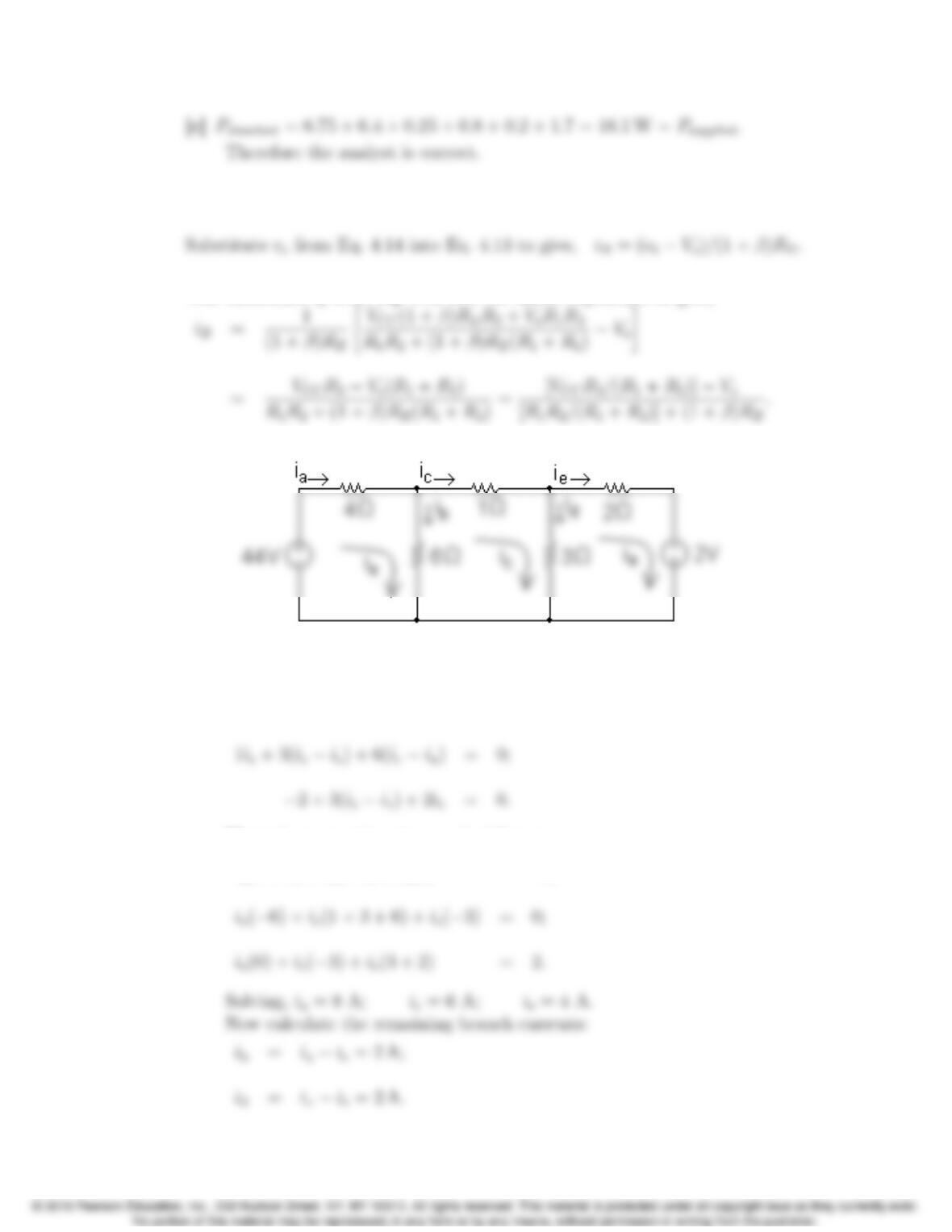
[a] The left-most node voltage is 75 −1250iφ. The right-most node voltage is
[b] From the values given,
iφ=v1−v2
500 =105 −85
500 =0.04 A;
Calculate the total power:
Pdstop = 1250iφ(ix) = 1250(0.04)(−0.07) = −3.5 W;
2500 =252
2500 =0.25 W;
P500mid = 500i2
φ= 500(0.04)2=0.8 W;
4–40 CHAPTER 4. Techniques of Circuit Analysis
P 4.31 From Eq. 4.13, iB=vc/(1 + β)RE,
Now substitute vbfrom Eq. 4.16 into the above expression to give,
P 4.32 [a]
The three mesh current equations are:
−44 + 4ia+6(ia−ic) = 0;
Place these equations in standard form:
ia(4 + 6) + ic(−6) + ie(0) = 44;