Natural and Step Responses of
RLC Circuits
Assessment Problems
AP 8.1 [a] 1
(2RC)2=1
LC ,therefore C= 500 nF.
AP 8.2 iL=1
50 ×103Zt
0[−14e5000x+26e20,000x]dx +30×103
AP 8.3 From the given values of R, L, and C, s1=−10 krad/s and s2=−40 krad/s.
8–1
8
8–2 CHAPTER 8. Natural and Step Responses of RLC Circuits
[d] v=[A1e10,000t+A2e40,000t]V,t≥0+;
[b] iR(0+)= 10 V
62.5⌦= 160 mA;
[c] B1=v(0+)=10V,dvc(0+)
dt =ωdB2−αB1.
[d] iL=−(iR+iC); iR=v/R;iC=Cdv
dt ;
3sin 6000t] mA,t≥0.
Problems 8–3
[d] D2=v(0+)=50,dv(0+)
dt =D1−αD2;
[e] v= [50e500t−50,000te500t] V;
AP 8.6 [a] iR(0+)=V0
R=40
500 =0.08 A.
[e] iL=If+B0
1eαtcos ωdt+B0
2eαtsin ωdt, If=I=−1 A;
AP 8.7 i(0+) = 0, since there is no source connected to Lfor t<0.
8–4 CHAPTER 8. Natural and Step Responses of RLC Circuits
Vf+B0
1=V0so B0
1=V0−Vf= 50 −100 = −50;
AP 8.8 i=CdvC
dt
AP 8.9 [a] From AP 8.7, I0= 0, V0= 50 V, and Vf= 100 V. Then,
α=R
2L= 10,000; ω0=s1
LC = 10,000; the response is critically damped.
[b] i=CdvC
dt
Problems 8–5
Problems
P 8.1 [a] α=1
2RC =1
2(1000)(2 ×10⁶)= 250;
[c] Note — we want ωd= 120 rad/s:
P 8.2 [a] iR(0) = 15
200 = 75mA;
[b] α=1
2RC =1
2(200)(0.2×10⁶)= 12,500;
8–6 CHAPTER 8. Natural and Step Responses of RLC Circuits
[c] iC=Cdv
dt
P 8.3 α=1
2RC =1
2(250)(0.2×10⁶)= 104;
Critical damping:
v=D1teαt+D2eαt;
Problems 8–7
P 8.4 1
2RC =1
2(312.5)(0.2×10⁶)= 8000;
·
.. response is underdamped.
P 8.5 [a] α=1
2RC = 1250,ω
o= 103,therefore overdamped.
s1=−500,s
2=−2000,
8–8 CHAPTER 8. Natural and Step Responses of RLC Circuits
[b]
P 8.6 [a] −α+qα2−ω2
o=−1000;
[b] iR=v(t)
R=5e1000t−11.25e4000tA,t≥0+;
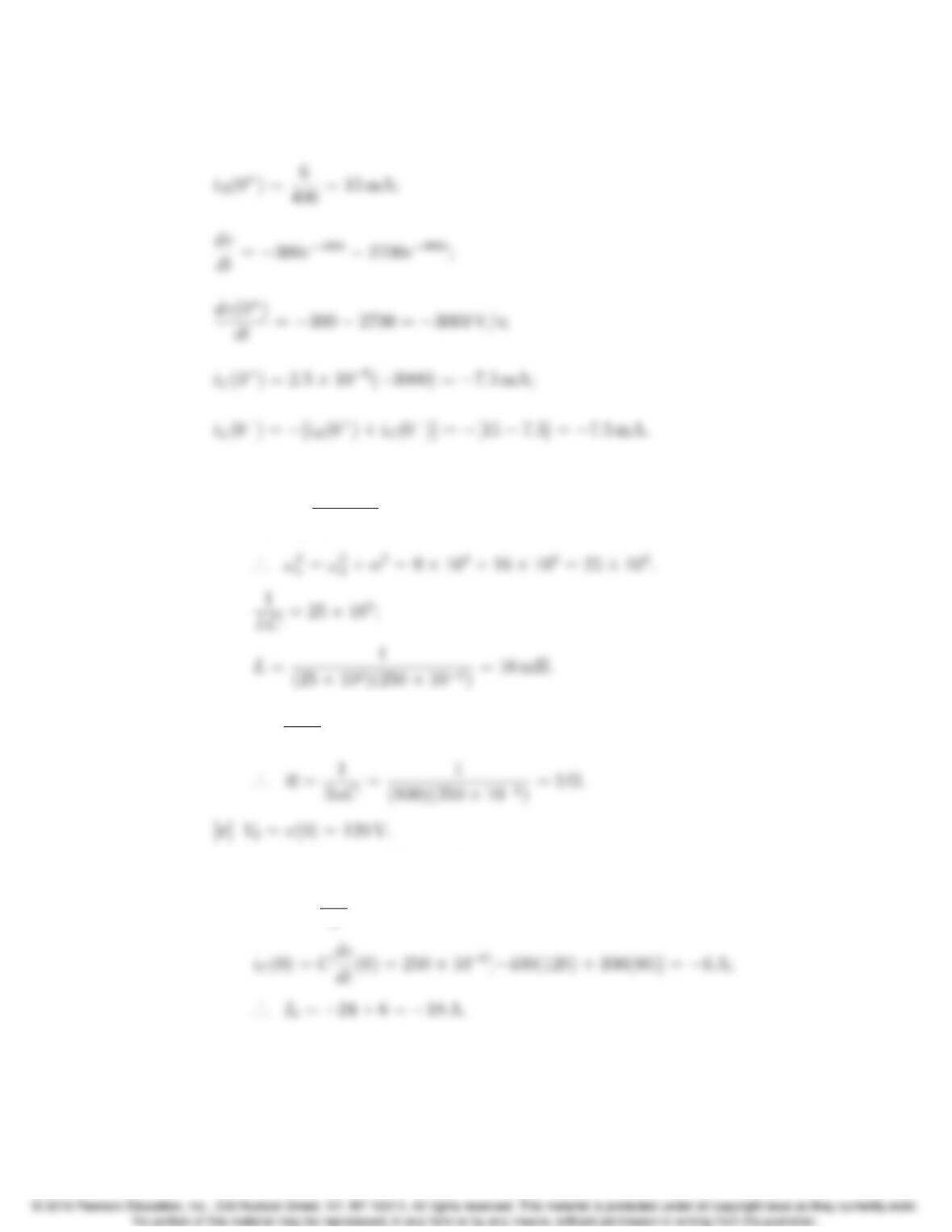
P 8.7 α= 1000/2 = 500;
Problems 8–9
v(0+) = 3(1 + 1) = 6 V;
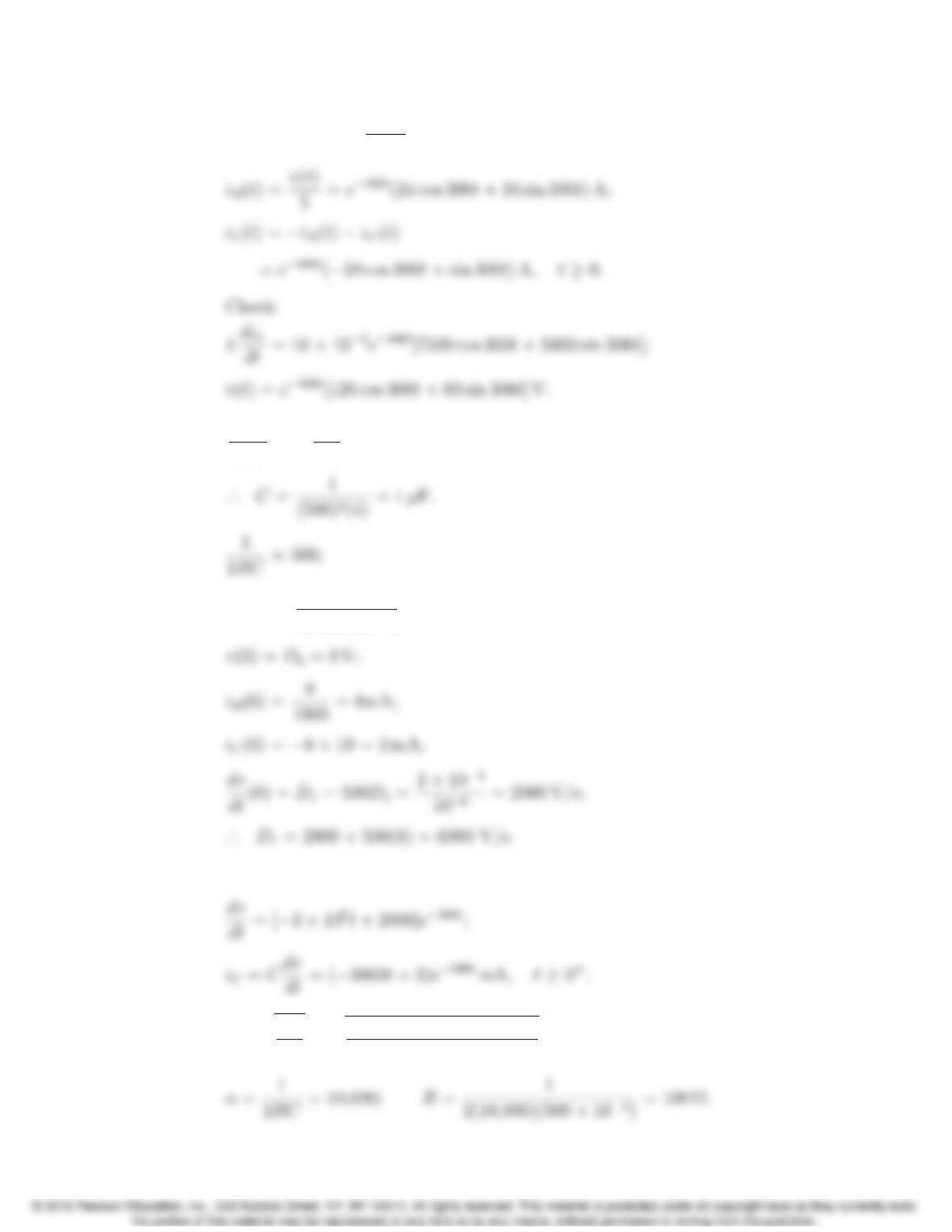
P 8.8 [a] α= 400; ωd= 300;
ωd=qω2
o−α2;
[b] α=1
2RC ;
[d] I0=iL(0) = −iR(0) −iC(0);
iR(0) = 120
5= 24 A;
8–10 CHAPTER 8. Natural and Step Responses of RLC Circuits
[e] iC(t) = 250 ×106dv(t)
dt =e400t(−17 sin 300t−6 cos 300t) A;
P 8.9 [a] ✓1
2RC ◆2
=1
LC = (500)2;
·
.. R=1
2(500)(106)=1k⌦.
[b] v= 6000te500t+8e500tV,t≥0;
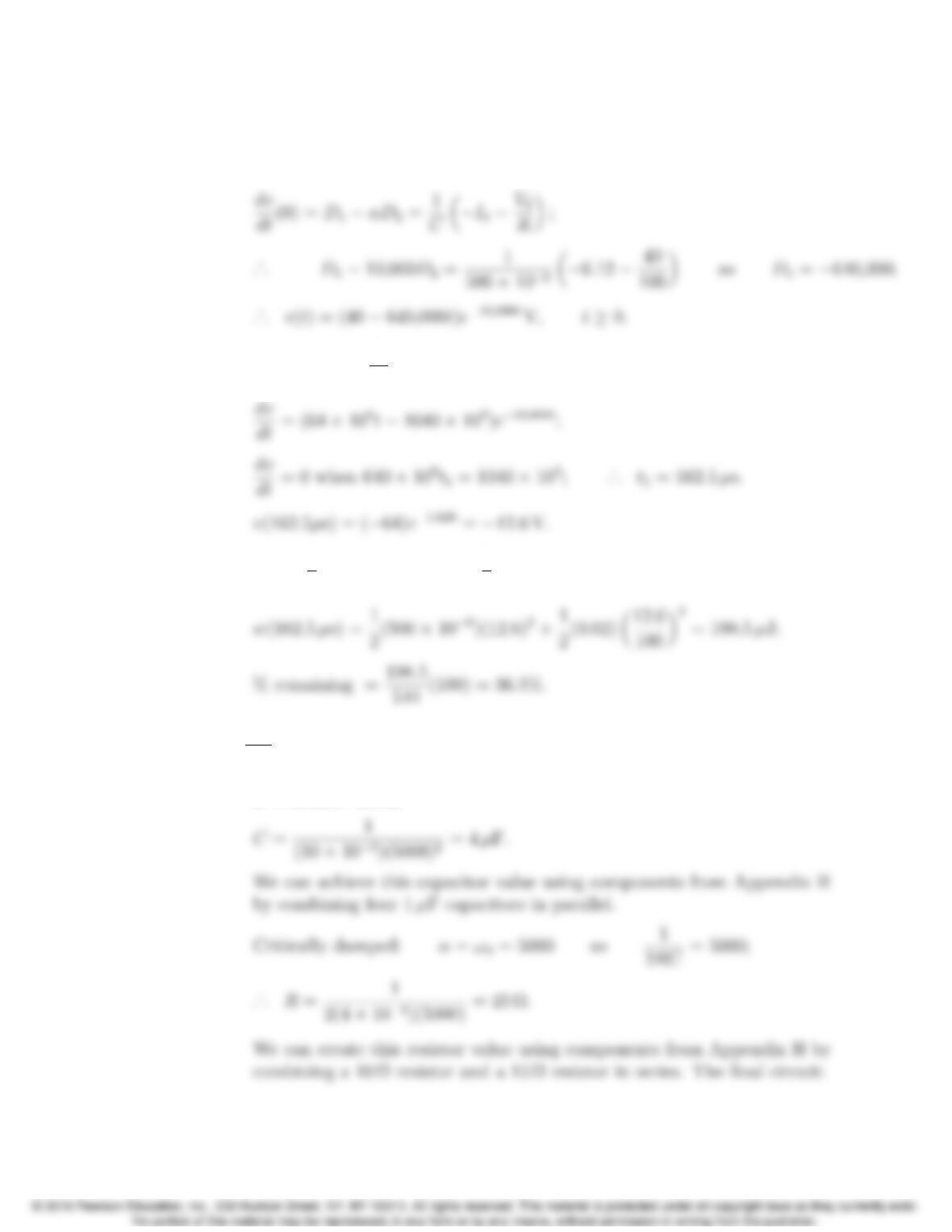
P 8.10 [a] ωo=s1
LC =s1
(20 ×103)(500 ×109)= 10,000;
Problems 8–11
[b] v(t)=D1te10,000t+D2e10,000t
v(0) = 40 V = D2;
[c] iC(t) = 0 when dv
dt (t)=0;
[d] w(0) = 1
2(500 ×109)(40)2+1
2(0.02)(0.012)2= 544 µJ;
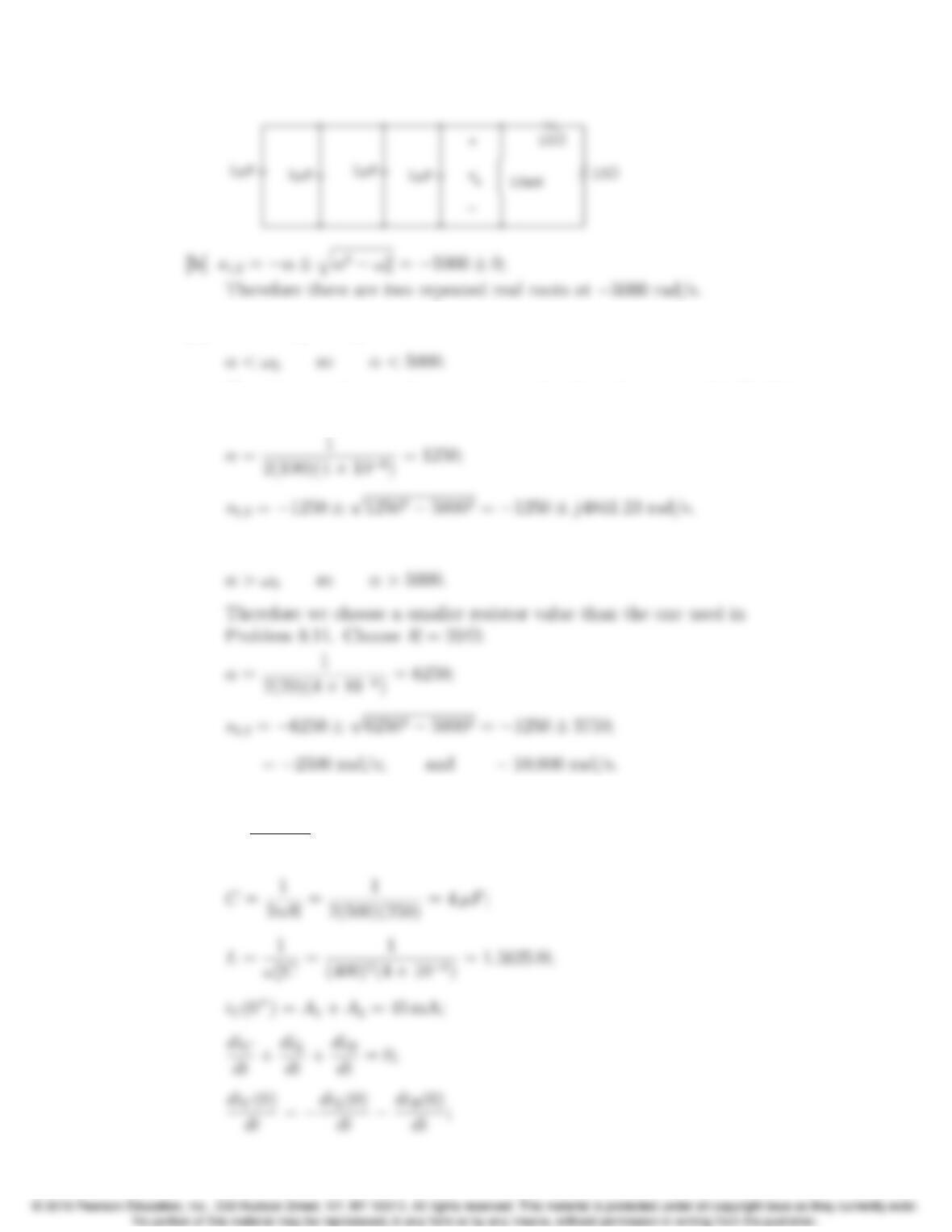
P 8.11 [a] 1
LC = 50002.
There are many possible solutions. This one begins by choosing
L= 10 mH. Then,
8–12 CHAPTER 8. Natural and Step Responses of RLC Circuits
P 8.12 [a] Underdamped response:
Therefore we choose a larger resistor value than the one used in Problem
8.11. Choose R= 100 ⌦:
[b] Overdamped response:
P 8.13 [a] 2α= 1000; α= 500 rad/s;
2qα2−ω2
o= 600; ωo= 400 rad/s;
diL(0)
dt =0
1.5625 = 0 A/s;
[b] By hypothesis
v=A3e200t+A4e800t,t≥0;
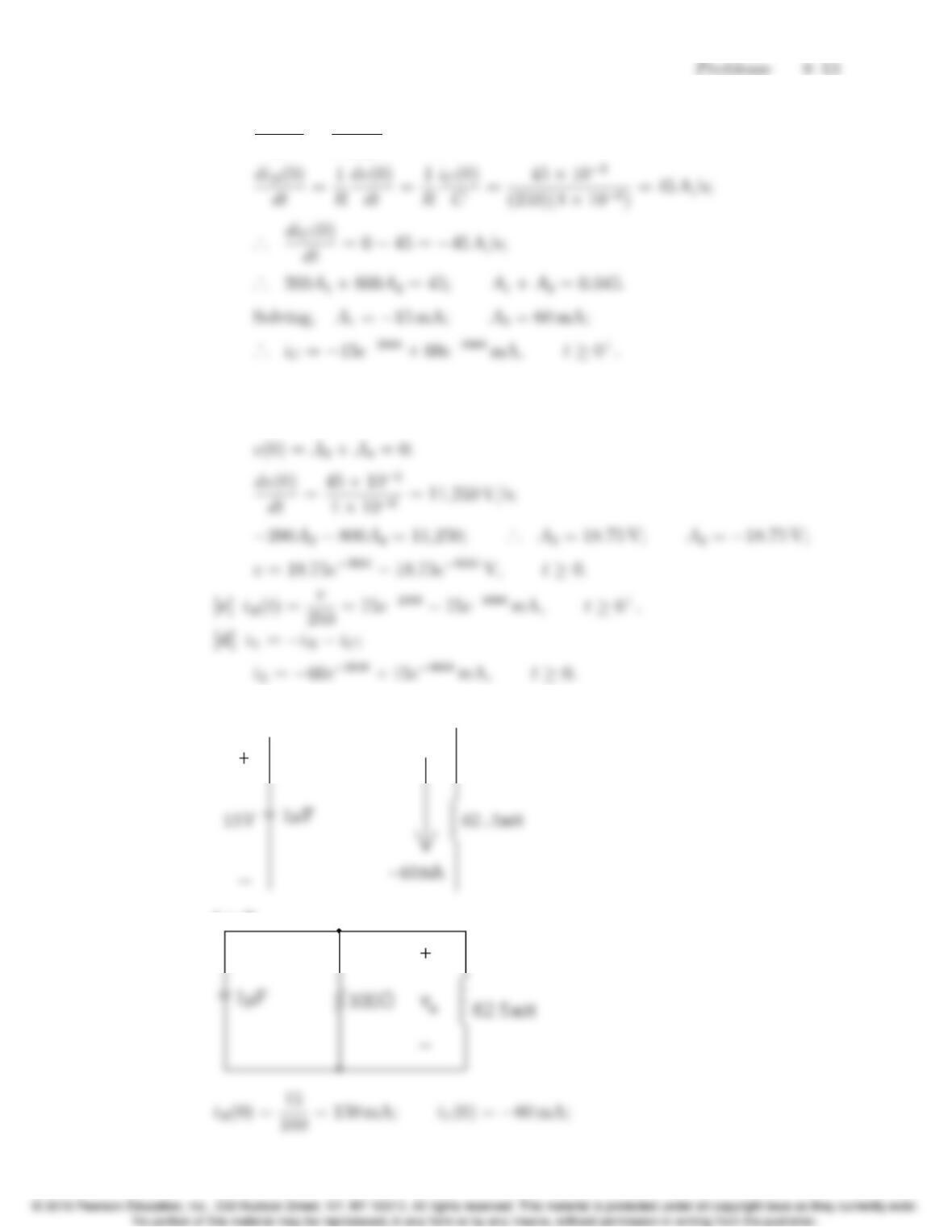
P 8.14 t<0: Vo= 15 V,I
o=−60 mA.
t>0:
iC(0) = −150 −(−60) = −90 mA;
·
.. v
o=A1e2000t+A2e8000t.
P 8.15 ω2
o=1
LC =1
(62.5×10³)(106)= 16 ×106;
vo(t)=D1te4000t+D2e4000t;
iC(0)
Problems 8–15
P 8.16 ω2
o=1
LC =1
(62.5×10³)(106)= 16 ×106;
vo(0) = B1= 15 V;
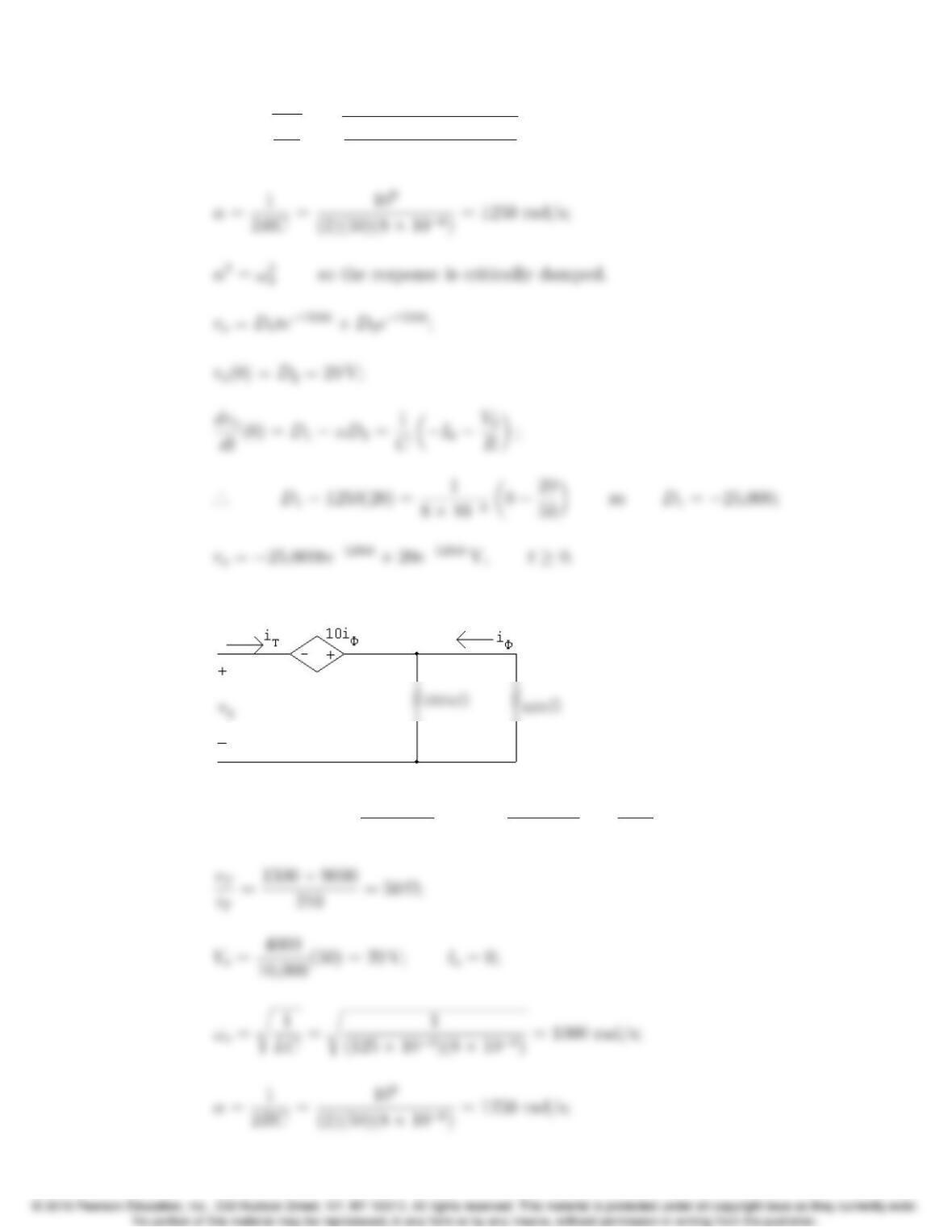
P 8.17
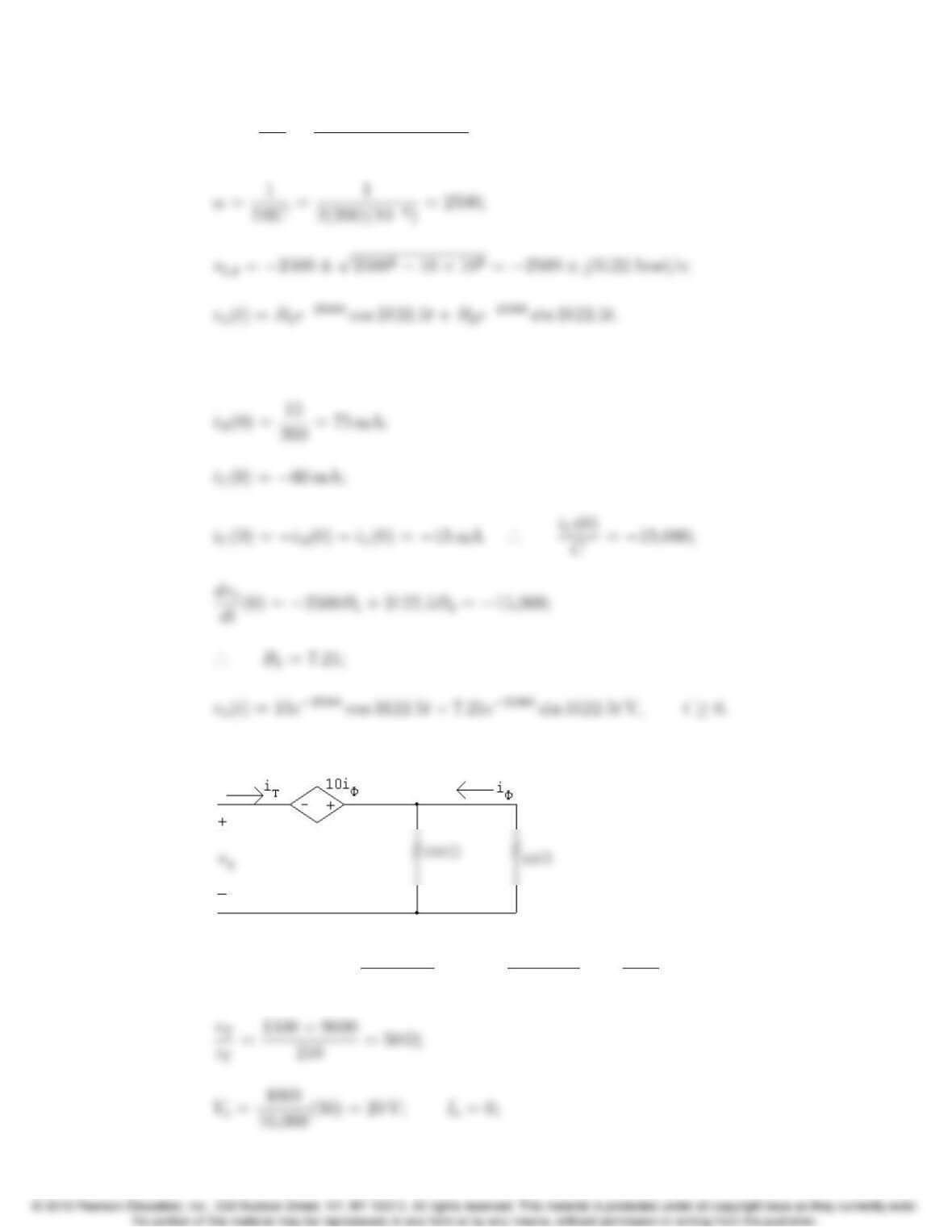
vT=−10iφ+iT (150)(60)
210 !=−10−iT(150)
210 +iT
9000
210 ;
iC(0) = −iR(0) −iL(0) = −20
50 =−0.4 A;
α2<ω
2
0so the response is underdamped.
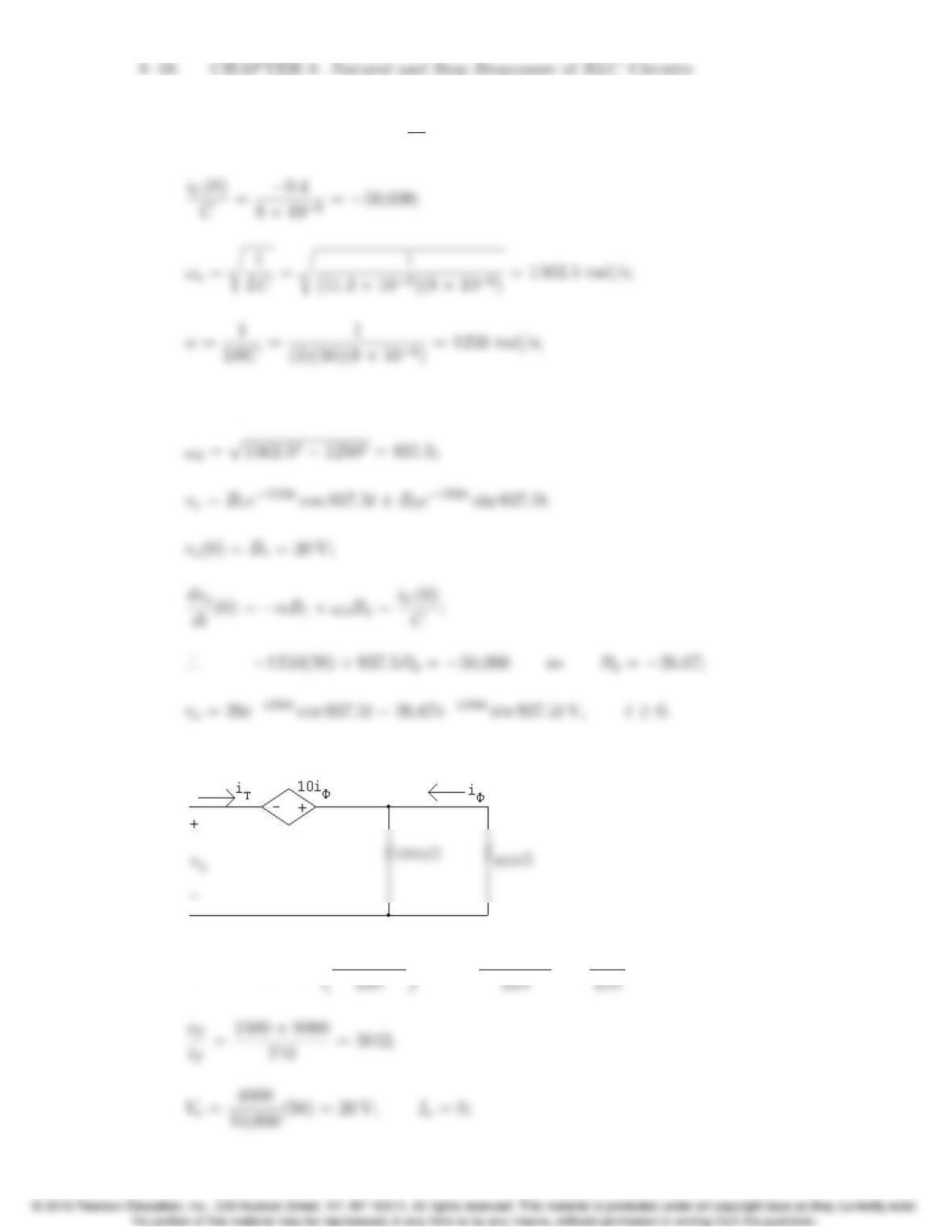
P 8.18
vT=−10iφ+iT (150)(60)
9000
Problems 8–17
ωo=s1
LC =s1
(80 ×103)(8 ×10⁶)= 1250 rad/s;
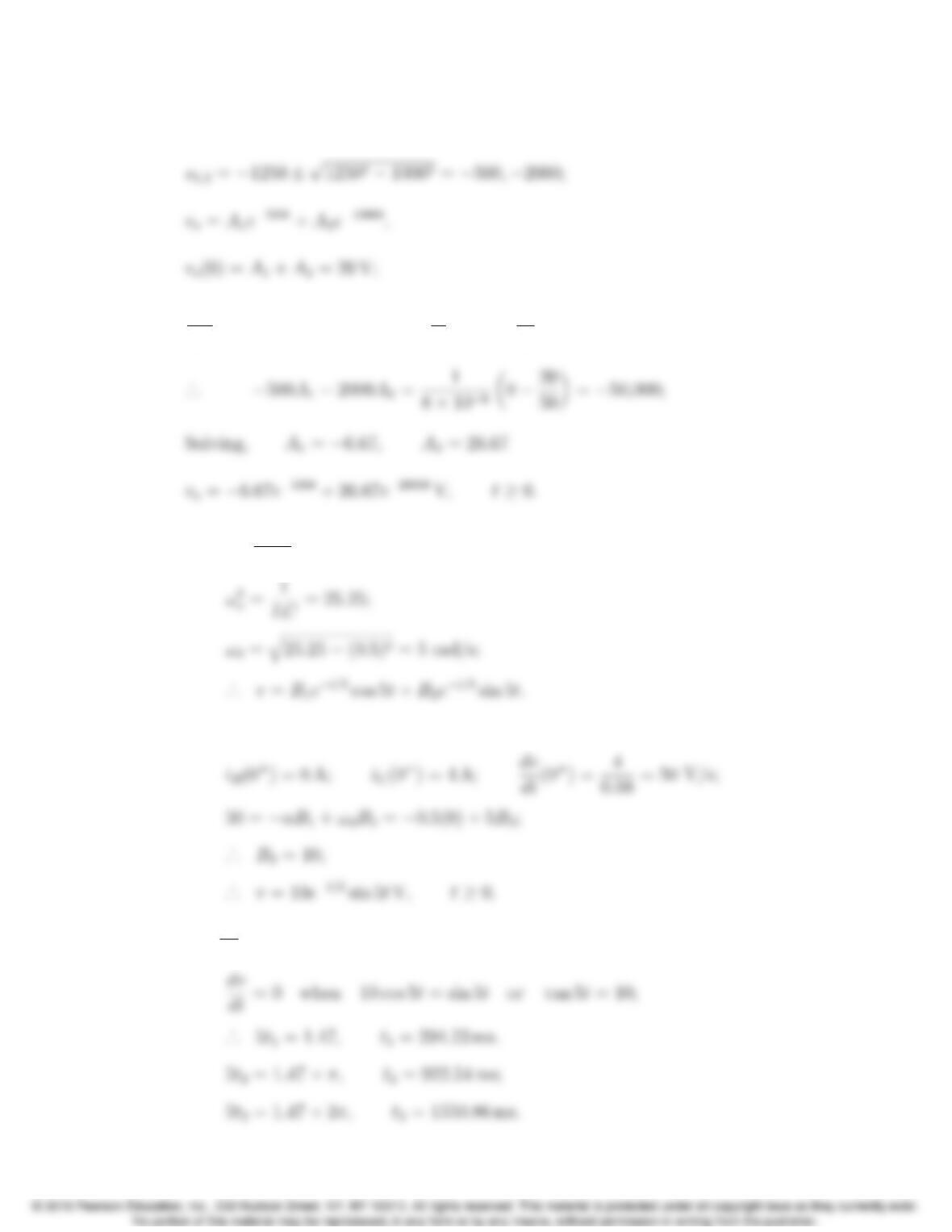
P 8.19
vT=−10iφ+iT (150)(60)
210 !=−10−iT(150)
210 +it
9000
210 ;
8–18 CHAPTER 8. Natural and Step Responses of RLC Circuits
α2>ω
2
0so the response is overdamped.
dvo
dt (0) = −500A1−2000A2=1
C✓−I0−V0
R◆;
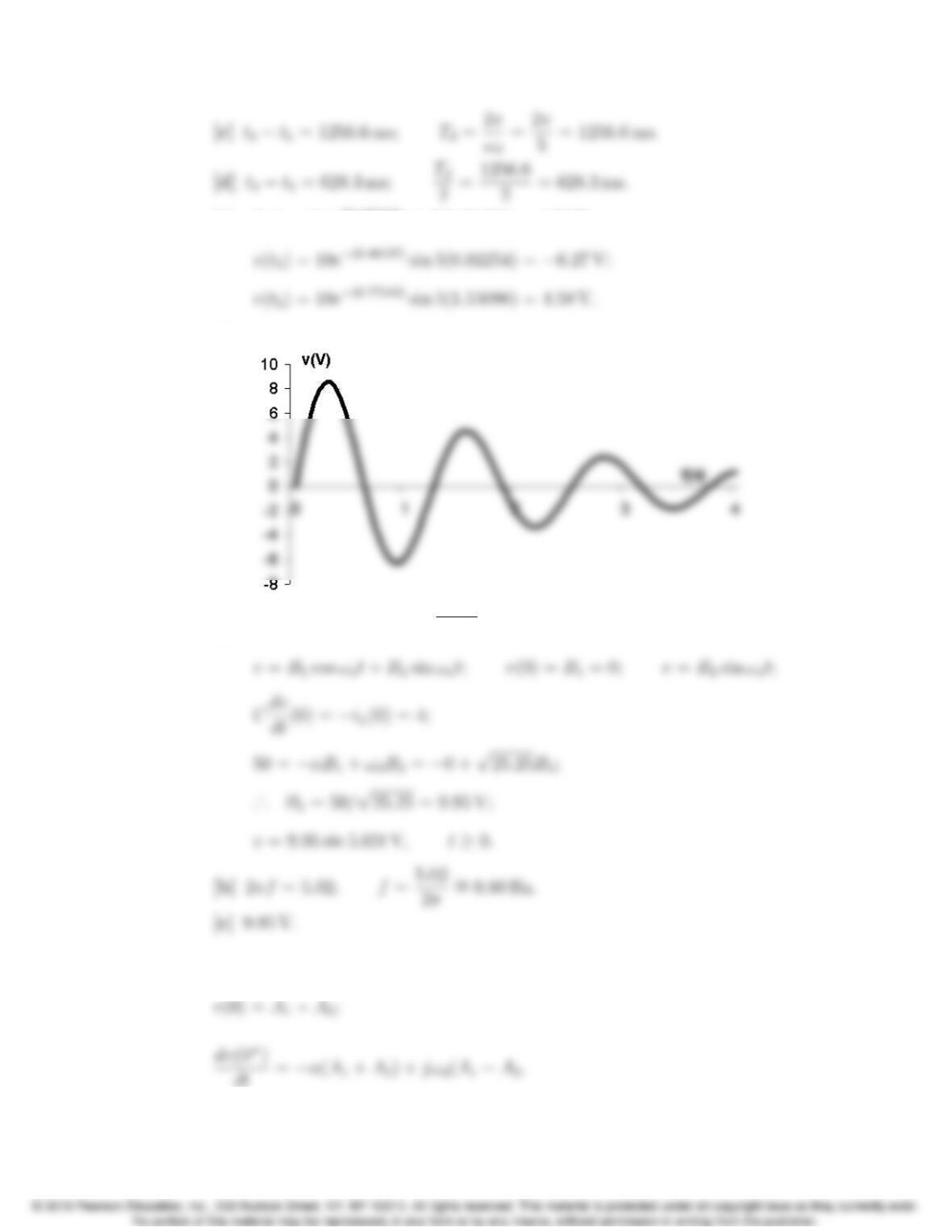
P 8.20 [a] α=1
2RC =0.5 rad/s;
v(0) = B1= 0; v=B2et/2sin 5t;
[b] dv
dt =−5et/2sin 5t+10et/2(5 cos 5t);
Problems 8–19
[e] v(t1)=10e(0.147115) sin 5(0.29423) = 8.59 V;
[f]
P 8.21 [a] α= 0; ωd=ωo=√25.25 = 5.02 rad/s;
P 8.22 From the form of the solution we have
8–20 CHAPTER 8. Natural and Step Responses of RLC Circuits
We know both v(0) and dv(0+)/dt will be real numbers. To facilitate the
algebra we let these numbers be K1and K2, respectively. Then our two
simultaneous equations are
K1=A1+A2;
The characteristic determinant is
The numerator determinants are
N1=
K11
K2(−α−jωd)
=−(α+jωd)K1−K2
P 8.23 By definition, B1=A1+A2. From the solution to Problem 8.22 we have
A1+A2=2ωdK1
2ωd
=K1.