Balanced Three-Phase Circuits
Assessment Problems
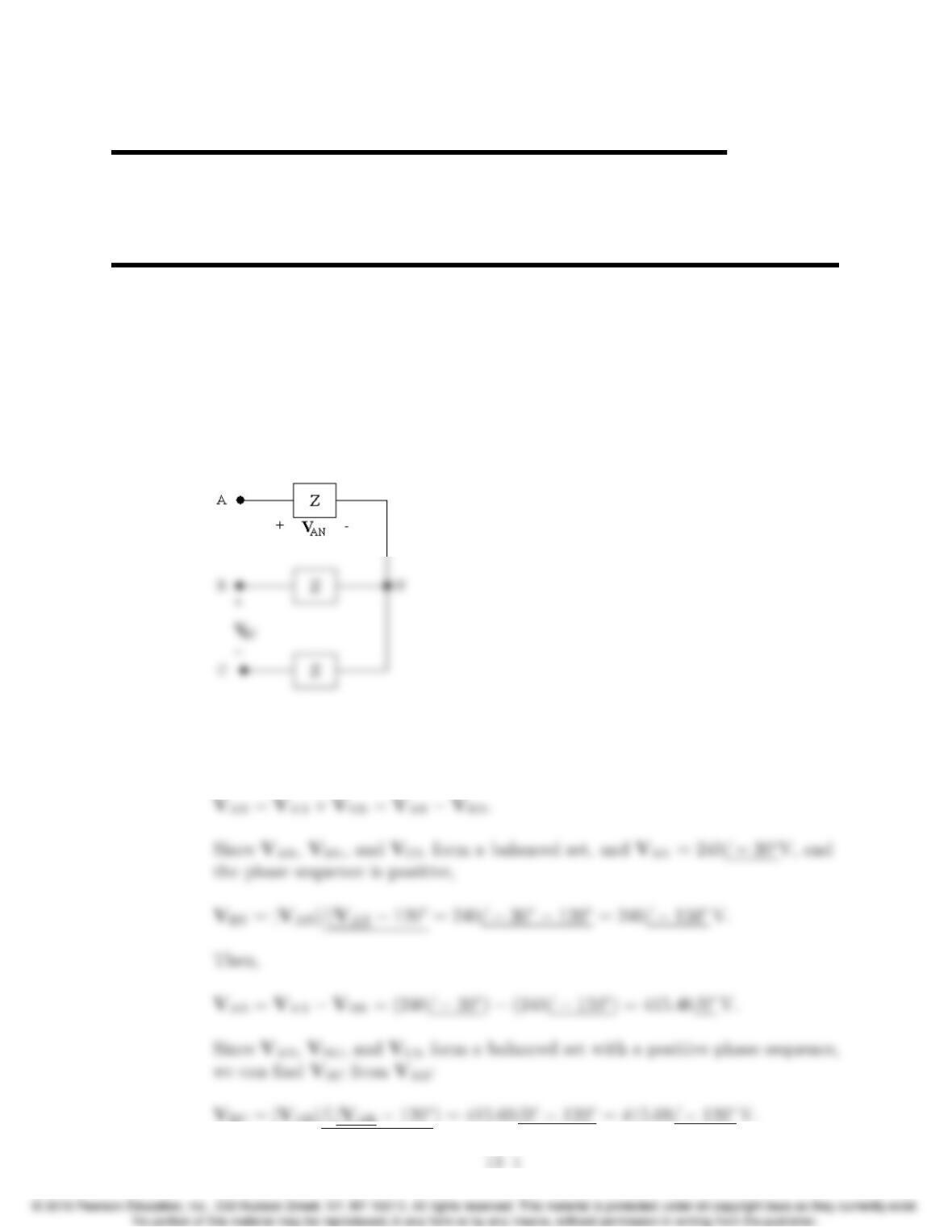
AP 11.1 Make a sketch:
We know VAN and wish to find VBC. To do this, write a KVL equation to
find VAB, and use the known phase angle relationship between VAB and VBC
to find VBC.
11
11–2 CHAPTER 11. Balanced Three-Phase Circuits
Thus,
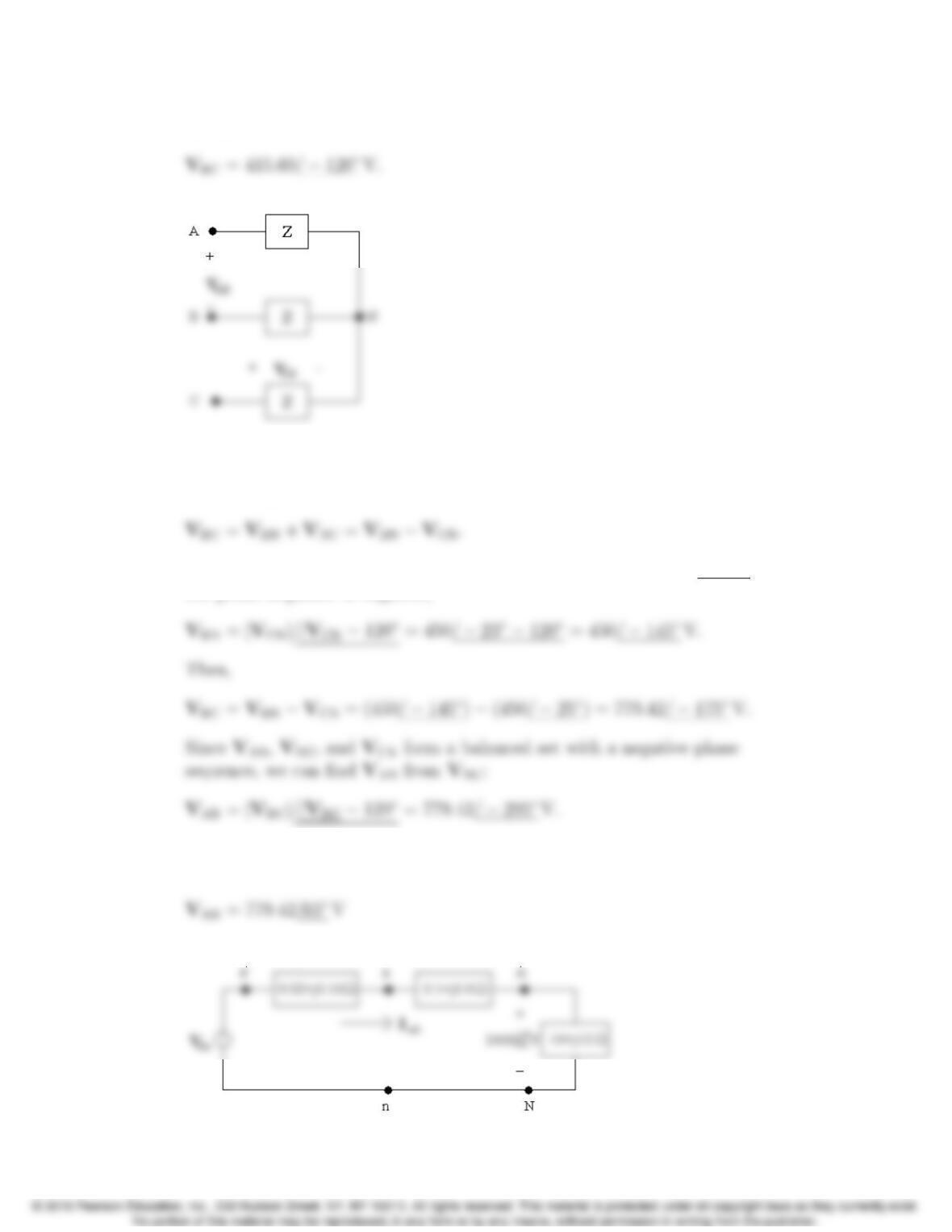
AP 11.2 Make a sketch:
We know VCN and wish to find VAB. To do this, write a KVL equation to
find VBC, and use the known phase angle relationship between VAB and VBC
to find VAB.
Since VAN,VBN, and VCN form a balanced set, and VCN = 450/25V, and
the phase sequence is negative,
But we normally want phase angle values between +180and 180. We add
360to the phase angle computed above. Thus,
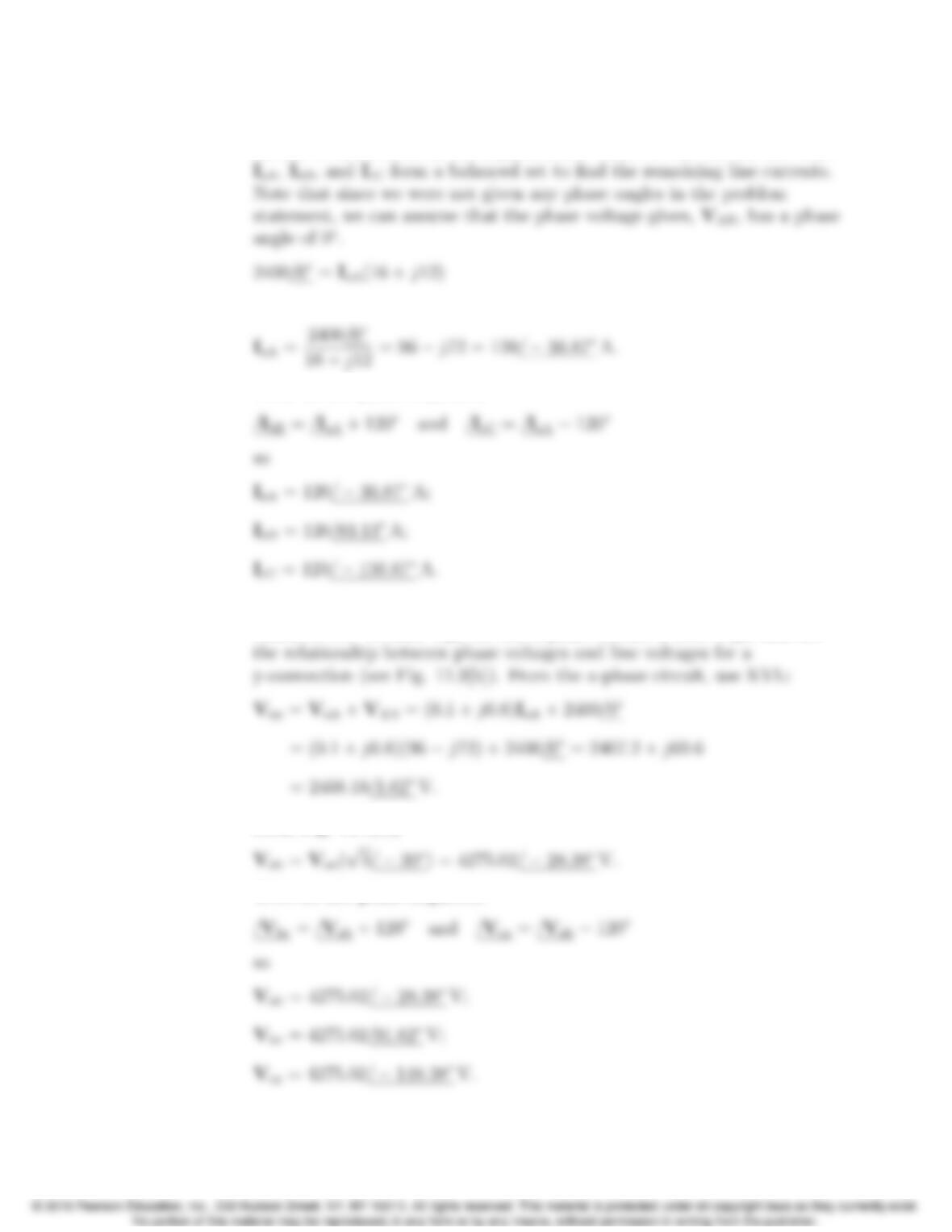
AP 11.3 Sketch the a-phase circuit:
Problems 11–3
[a] We can find the line current using Ohm’s law, since the a-phase line
current is the current in the a-phase load. Then we can use the fact that
so
With an acb phase sequence,
[b] The line voltages at the source are Vab Vbc, and Vca. They form a
balanced set. To find Vab, use the a-phase circuit to find VAN, and use
From Fig. 11.9(b),
With an acb phase sequence,
11–4 CHAPTER 11. Balanced Three-Phase Circuits
[c] Using KVL on the a-phase circuit
With an acb phase sequence,
AP 11.4
AP 11.5
IaA =12
/(65120)= 12/55;
AP 11.6 [a] IAB =” 1
p3!/30#[69.28/10] = 40/20A.
AP 11.7
AP 11.8 [a] |S|=p3(208)(73.8) = 26,587.67 VA;
Problems 11–5
AP 11.9 [a] VAN = 2450
p3!/0V; VANI⇤
aA =S= 144 + j192 kVA.
Therefore
11–6 CHAPTER 11. Balanced Three-Phase Circuits
Problems
P 11.1 [a] First, convert the cosine waveforms to phasors:
Va= 180/27;Vb= 180/147;Vc= 180/93.
Subtract the phase angle of the a-phase from all phase angles:
[b] First, convert the cosine waveforms to phasors:
Subtract the phase angle of the a-phase from all phase angles:
P 11.2 [a] Va= 180/0V;
[b] Va= 180/90V;
[c] Va= 400/270V = 400/90V;
Problems 11–7
[d] Va= 200/30V;
[e] Va= 208/42V;
P 11.3 Va=Vm/0=Vm+j0;
P 11.6 [a] Unbalanced, because the load impedance in every phase is different.
11–8 CHAPTER 11. Balanced Three-Phase Circuits
[c] VAB =VAN VBN;
P 11.8 Zga +Zla +ZLa = 60 + j80 Ω;
Let nbe the reference node. Then,
Solving for VNyields
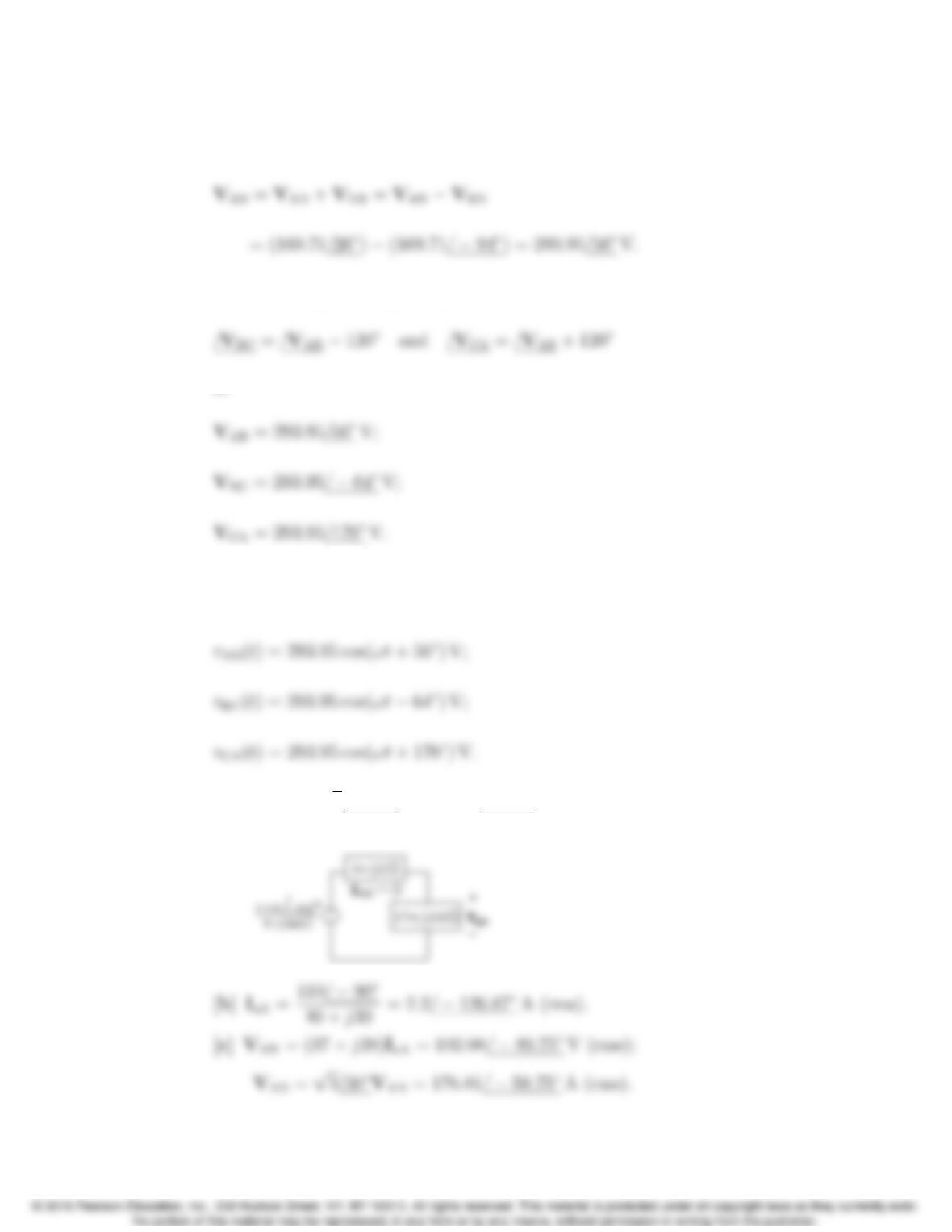
P 11.9 Make a sketch of the load in the frequency domain. Note that we convert the
time domain line-to-neutral voltages to phasors:
Problems 11–9
Note that these three voltages form a balanced set with an abc phase
sequence. First, use KVL to find VAB:
With an abc phase sequence,
so
To get back to the time domain, perform an inverse phasor transform of the
three line voltages, using a frequency of ω:
P 11.10 [a] Van =1/p3/30Vab = 110/90V (rms).
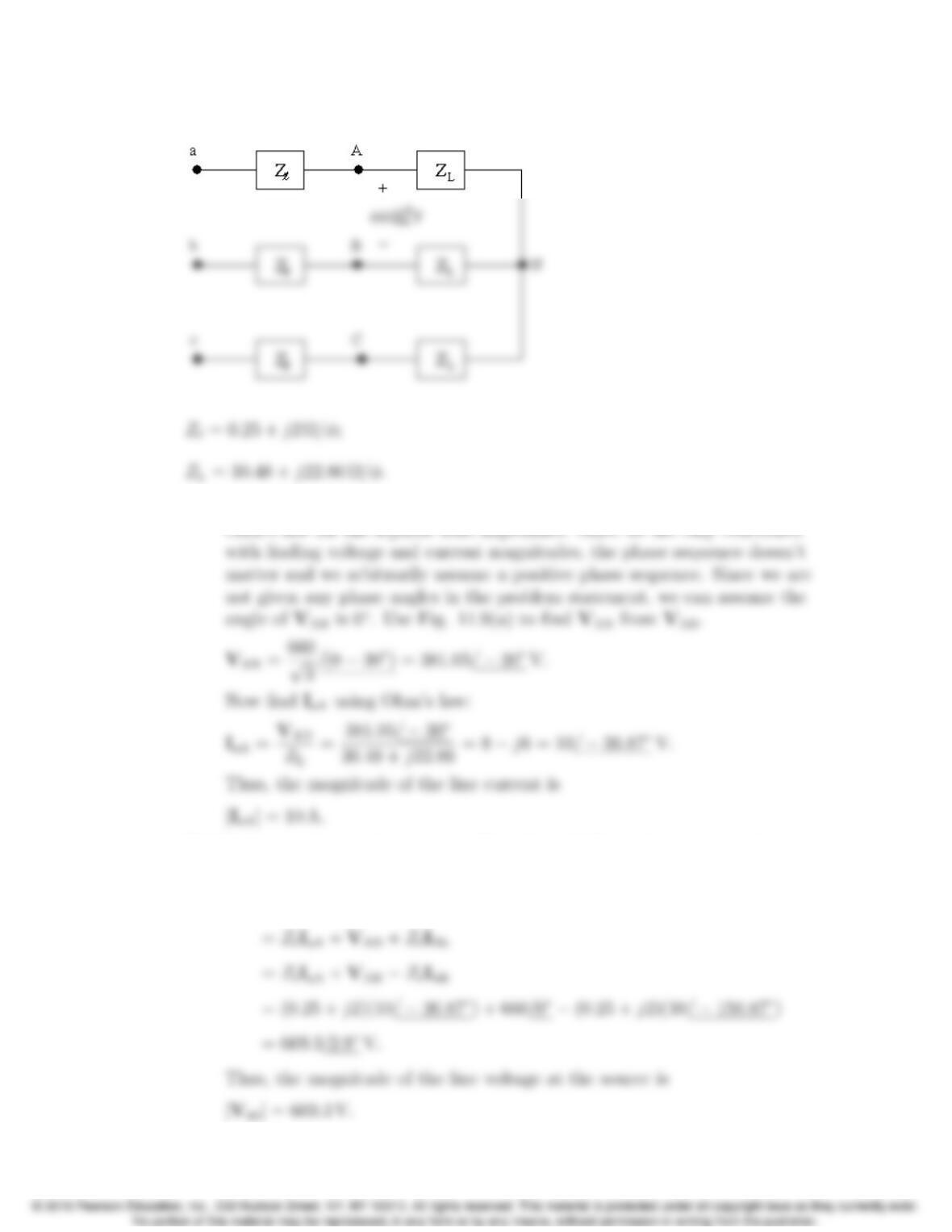
The a-phase circuit is
11–10 CHAPTER 11. Balanced Three-Phase Circuits
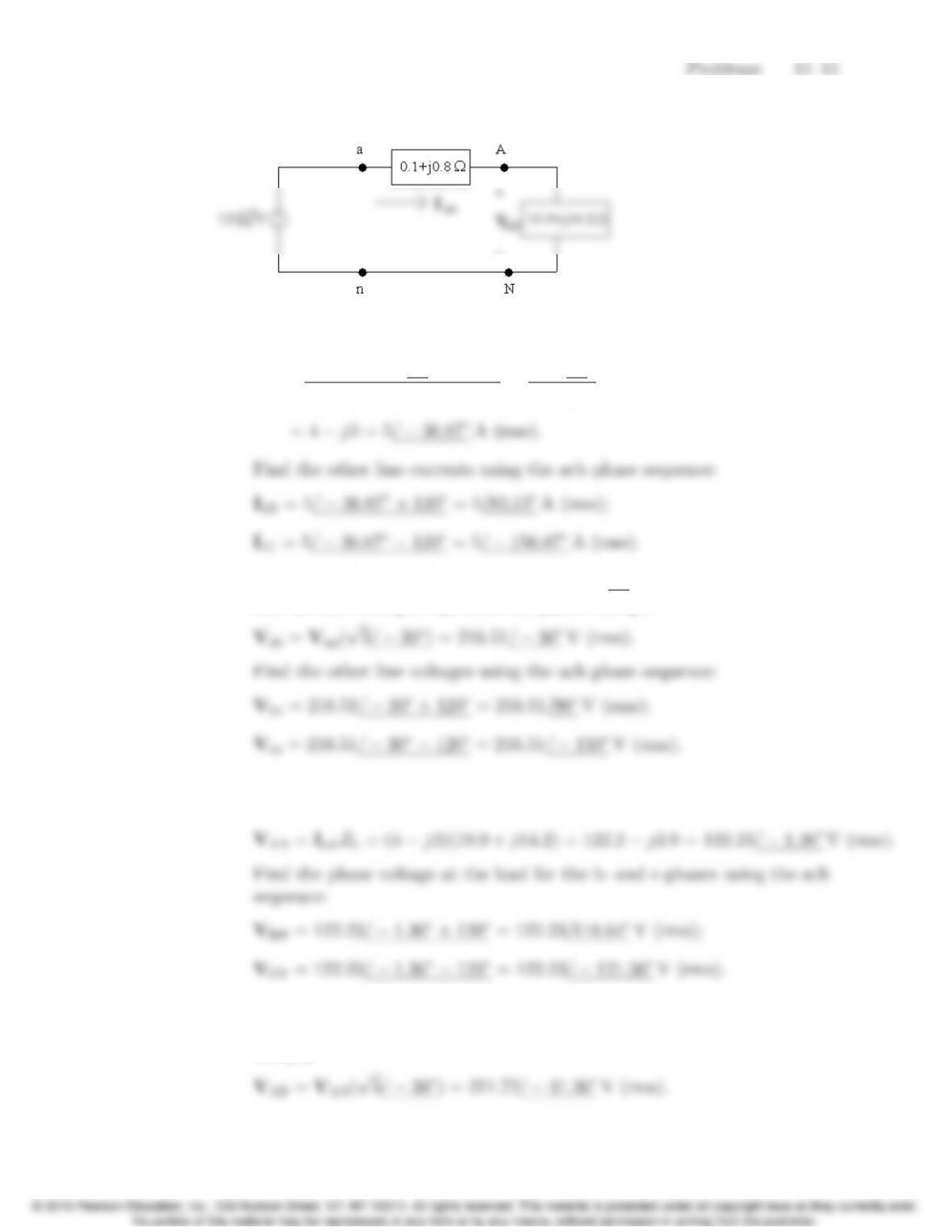
P 11.11 Make a sketch of the three-phase line and load:
[a] The line currents are IaA,IbB, and IcC. To find IaA, first find VAN and use
[b] The line voltage at the source is Vab. From KVL on the top loop of the
three-phase circuit,
Vab =VaA +VAB +VBb
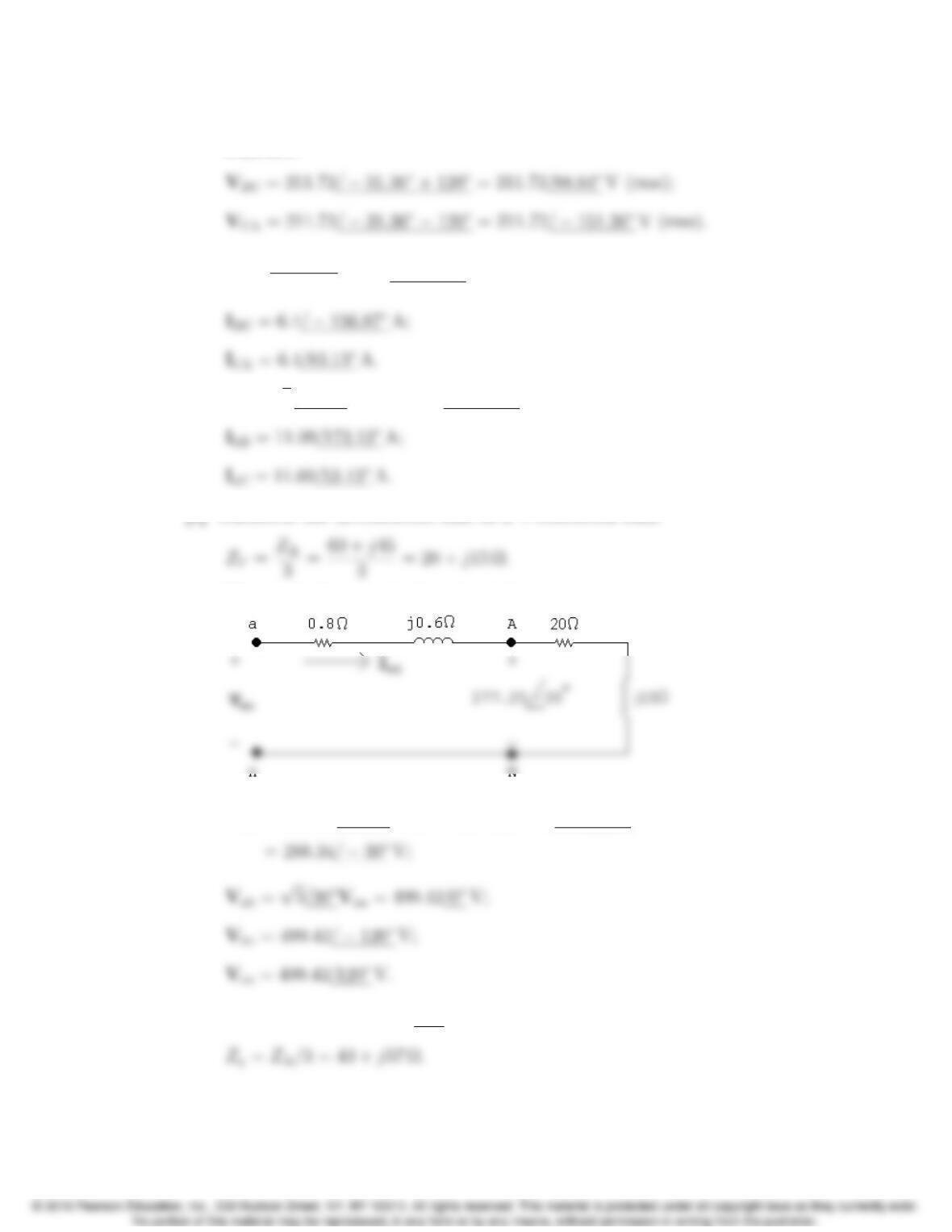
P 11.12 Make a sketch of the a-phase:
[a] Find the a-phase line current from the a-phase circuit:
IaA =125/0
0.1+j0.8+19.9+j14.2=125/0
20 + j15
[b] The phase voltage at the source is Van = 125/0V. Use Fig. 11.9(b) to
find the line voltage, Van, from the phase voltage:
[c] The phase voltage at the load in the a-phase is VAN. Calculate its value
using IaA and the load impedance:
[d] The line voltage at the load in the a-phase is VAB. Find this line voltage
from the phase voltage at the load in the a-phase, VAN, using Fig,
11.9(b):
11–12 CHAPTER 11. Balanced Three-Phase Circuits
Find the line voltage at the load for the b- and c-phases using the acb
sequence:
P 11.13 [a] IAB =480
60 + j45 =6.4/36.87A;
[b] IaA =p3/30IAB = 11.09/66.87A;
[c] Transform the ∆-connected load to a Y-connected load:
The single-phase equivalent circuit is:
Van = 277.25/30+ (0.8+j0.6)(11.09/66.87)
P 11.14 [a] Van =Vbn 120= 150/15V (rms);
Problems 11–13
The a-phase circuit is
P 11.15 Zy=Z∆/3=4+j3Ω.
The a-phase circuit is
P 11.16 Van =1/p3/30Vab =208
p3/20V (rms);
The a-phase circuit is
Zeq = (4 + j3)k(1 j3) = 2.6j1.8Ω;
11–14 CHAPTER 11. Balanced Three-Phase Circuits
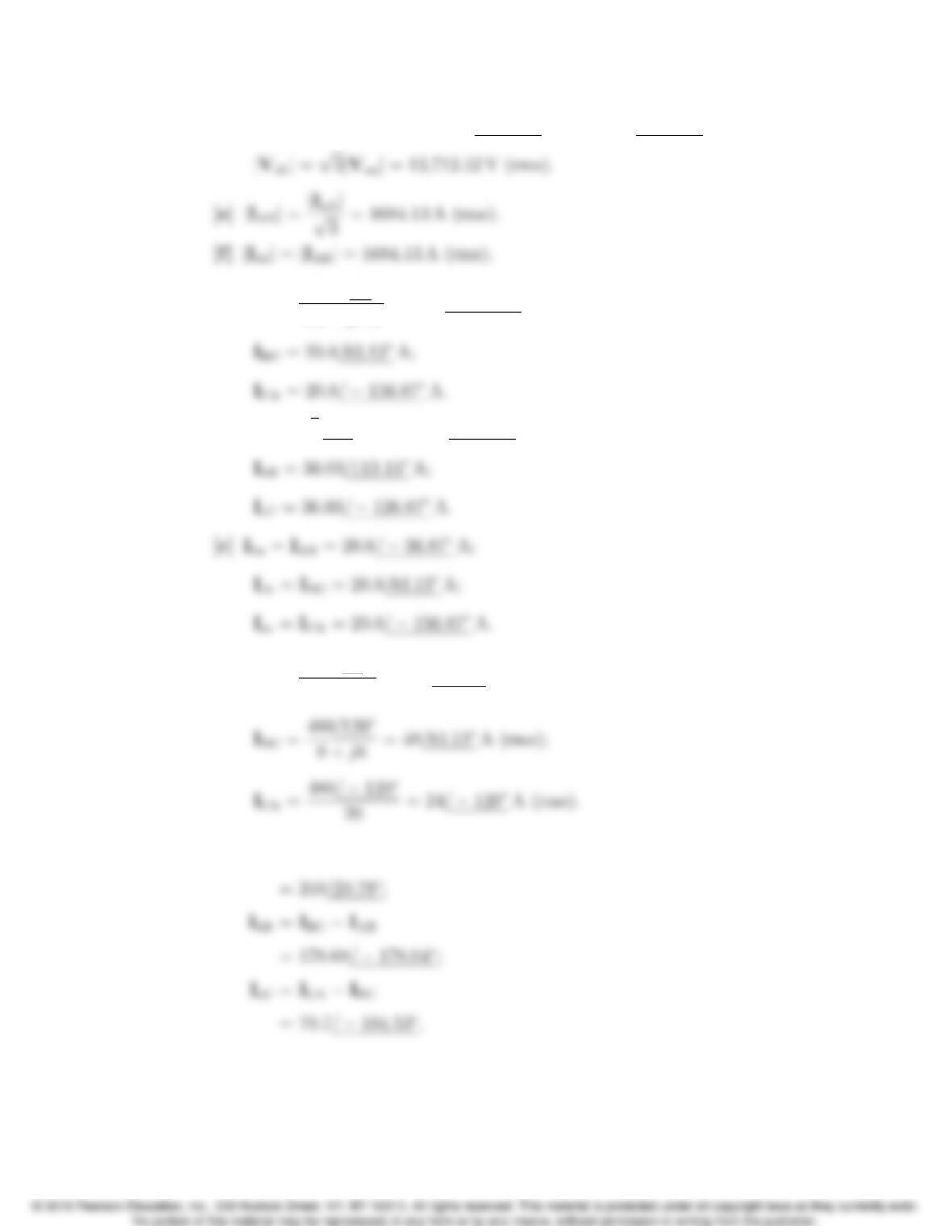
P 11.17 [a]
[d] Van = (145.8/6.49)(j1) + 7650/p3 = 4435.6/1.87V;
P 11.18 [a]
Problems 11–15
[d] Van = (2.372 + j1.319)(2917/29.6) = 7616.93/0.52V (rms);
P 11.19 [a] IAB =4160/0
160 + j120 = 20.8/36.87A;
[b] IaA =p3/30IAB = 36.03/6.87A;
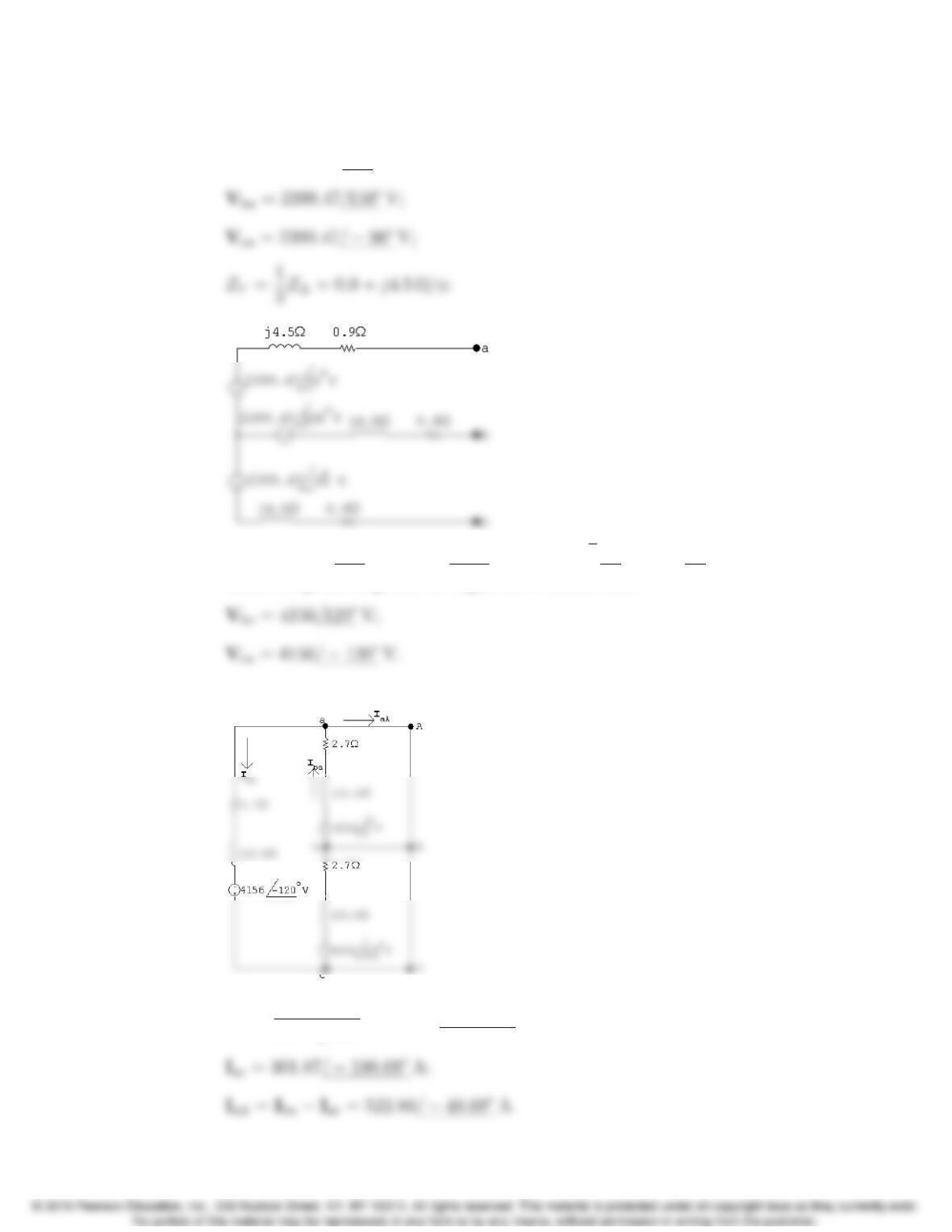
P 11.20 [a] IAB =480/0
2.4j0.7= 192/16.26A (rms);
[b] IaA =IAB ICA
11–16 CHAPTER 11. Balanced Three-Phase Circuits
P 11.21 [a] Since the phase sequence is acb (negative) we have:
Van = 2399.47/30V;
[b] Vab = 2399.47/302399.47/150= 2399.47p3/0= 4156/0V.
Since the phase sequence is negative, it follows that
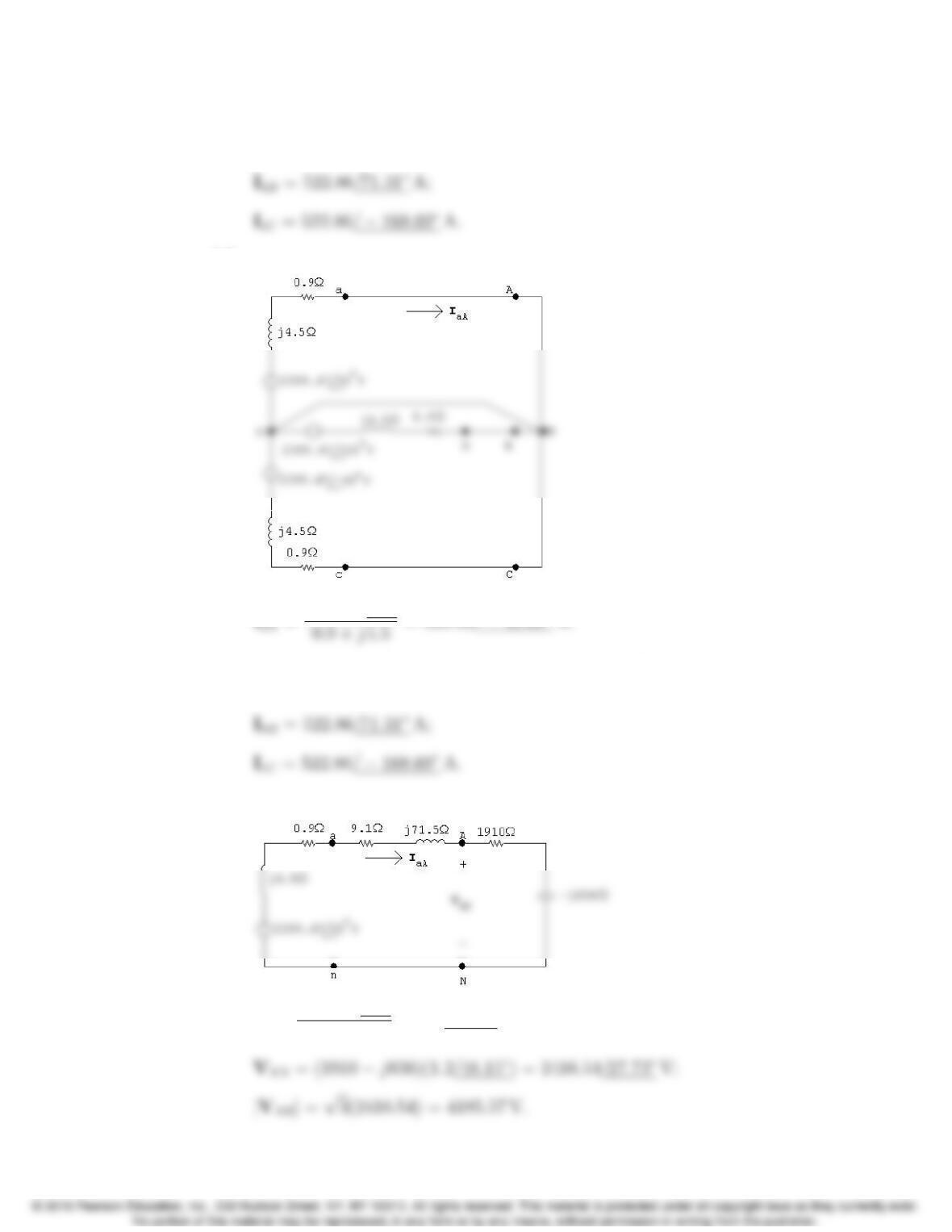
[c]
Iba =4156
2.7+j13.5= 301.87/78.69A;
Problems 11–17
Since we have a balanced three-phase circuit and a negative phase
sequence we have:
[d]
Since we have a balanced three-phase circuit and a negative phase
sequence we have:
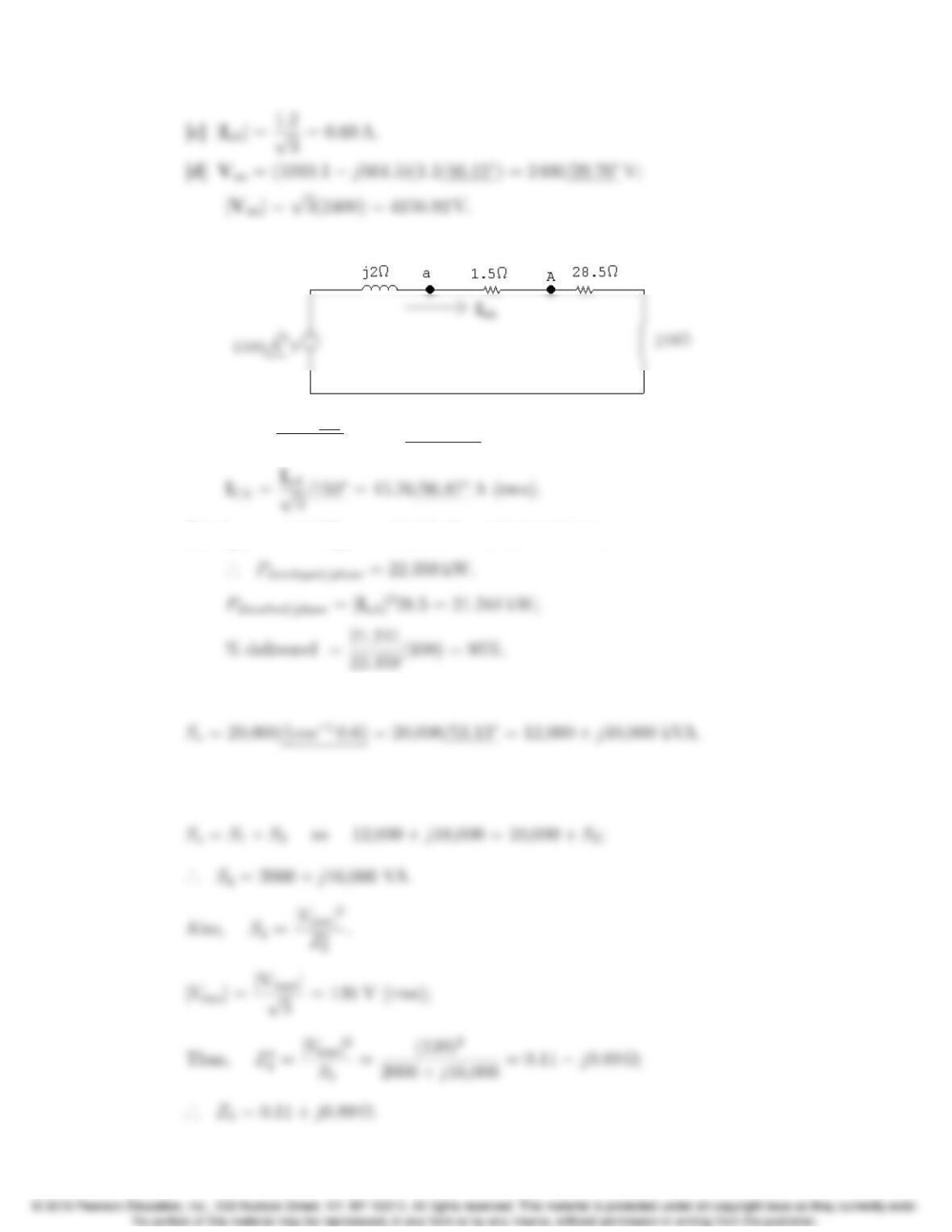
P 11.22 [a]
[b] IaA =2399.47/30
1920 j556 =1.2/46.15A;
11–18 CHAPTER 11. Balanced Three-Phase Circuits
P 11.23 [a]
IaA =1365/0
30 + j40 = 27.3/53.13A (rms);
[b] Sg/=1365I⇤
aA =22,358.75 j29,811.56 VA;
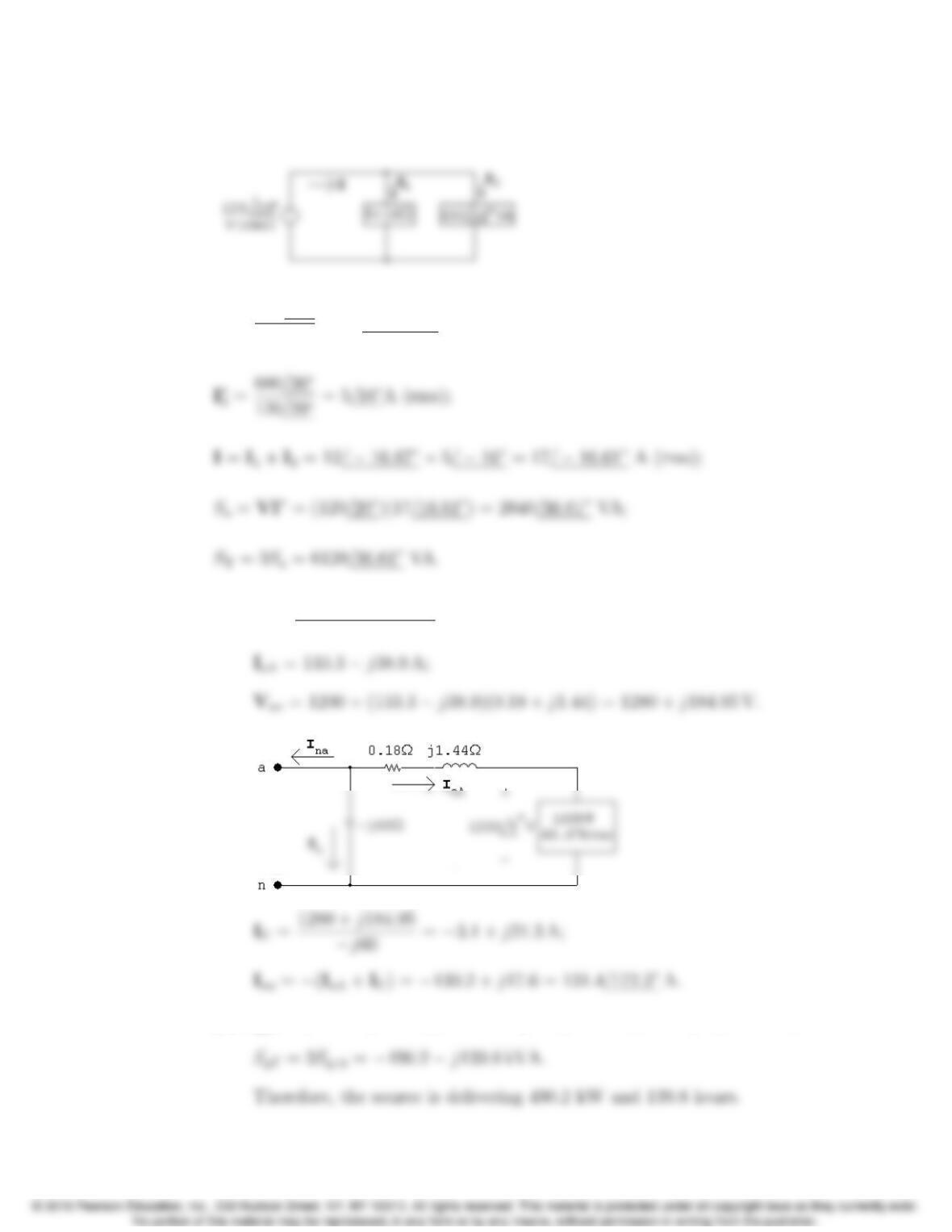
P 11.24 The complex power of the source per phase is
This complex power per phase must equal the sum of the per-phase complex
powers of the two loads:
Problems 11–19
P 11.25 The a-phase of the circuit is shown below:
I1=120/20
8 + j6= 12/16.87A (rms);
P 11.26 [a] I⇤
aA =(160 + j46.67)103
1200 = 133.3+j38.9;
[b] Sg/= (1280 + j184.95)(130.2j17.6) = 163,400 j46,608.5 VA;