Inductance, Capacitance, and
Mutual Inductance
Assessment Problems
AP 6.1 [a] ig=8e−300t−8e−1200tA;
[d] dp
dt = 0 when e1800t−12.5e900t+16=0.
[f] Wis max when iis max, iis max when di/dt is zero.
6–1
6
AP 6.2 [a] i=Cdv
dt = 24 ×10−6d
dt[e−15,000tsin 30,000t]
AP 6.3 [a] v=✓1
C◆Zt
0−
idx+v(0−)
AP 6.4 [a] Leq =60(240)
[d] i1=1
0.06 Zt
0+(−0.03e−5x)dx + 3 = (0.1e−5t+2.9) A;
AP 6.5 v1=1
2×10⁻⁶Zt
0+240 ×10−6e−10xdx −10 = (−12e−10t+ 2) V;
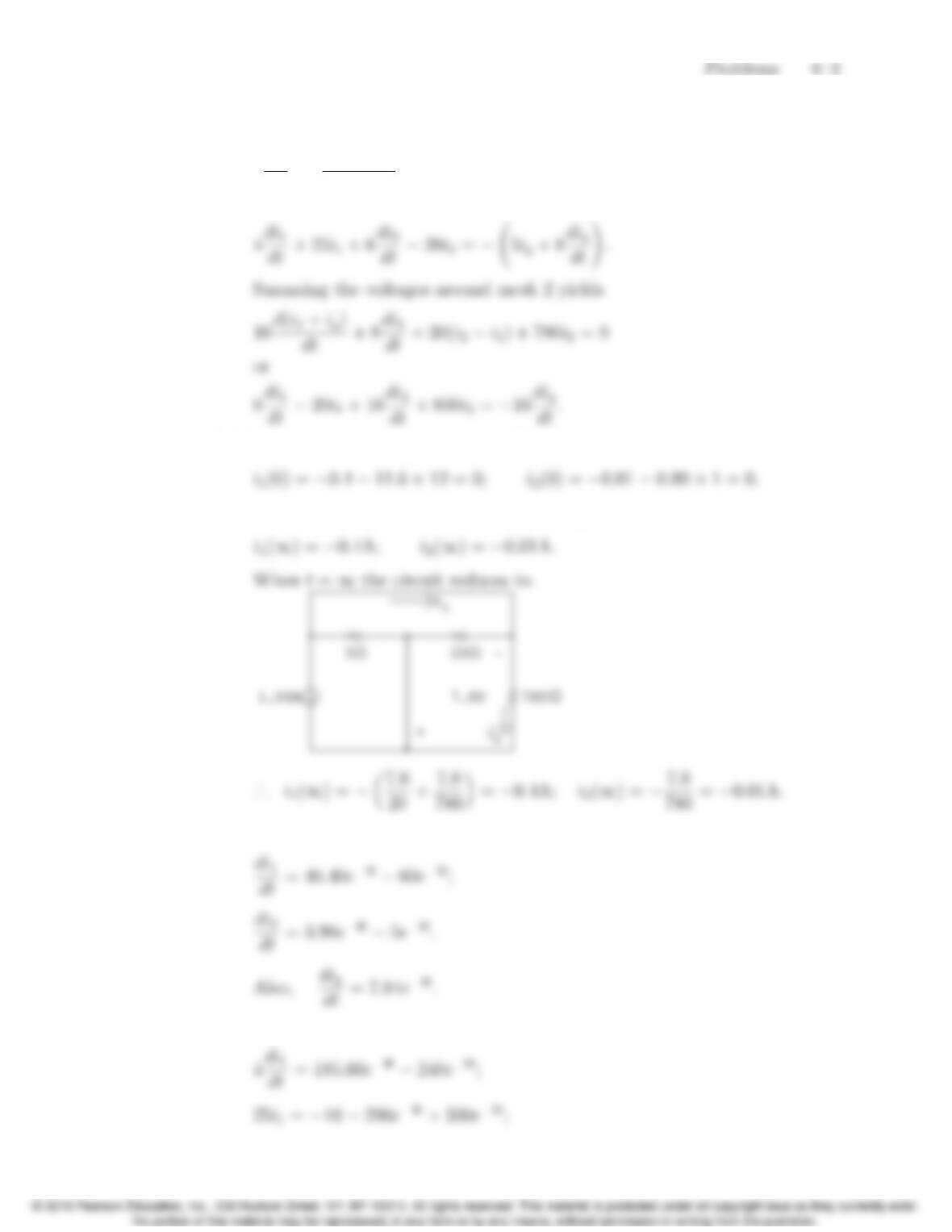
AP 6.6 [a] Summing the voltages around mesh 1 yields
4di1
dt +8d(i2+ig)
dt + 20(i1−i2)+5(i1+ig)=0
or
[b] From the solutions given in part (b)
These values agree with zero initial energy in the circuit. At infinity,
From the solutions for i1and i2we have
Thus
6–4 CHAPTER 6. Inductance, Capacitance, and Mutual Inductance
Test:
185.60e−4t−240e−5t−10 −290e−4t+ 300e−5t+31.68e−4t−40e−5t
Also,
8di1
Test:
371.20e−4t−480e−5t+ 8 + 232e−4t−240e−5t+63.36e−4t−80e−5t
Problems 6–5
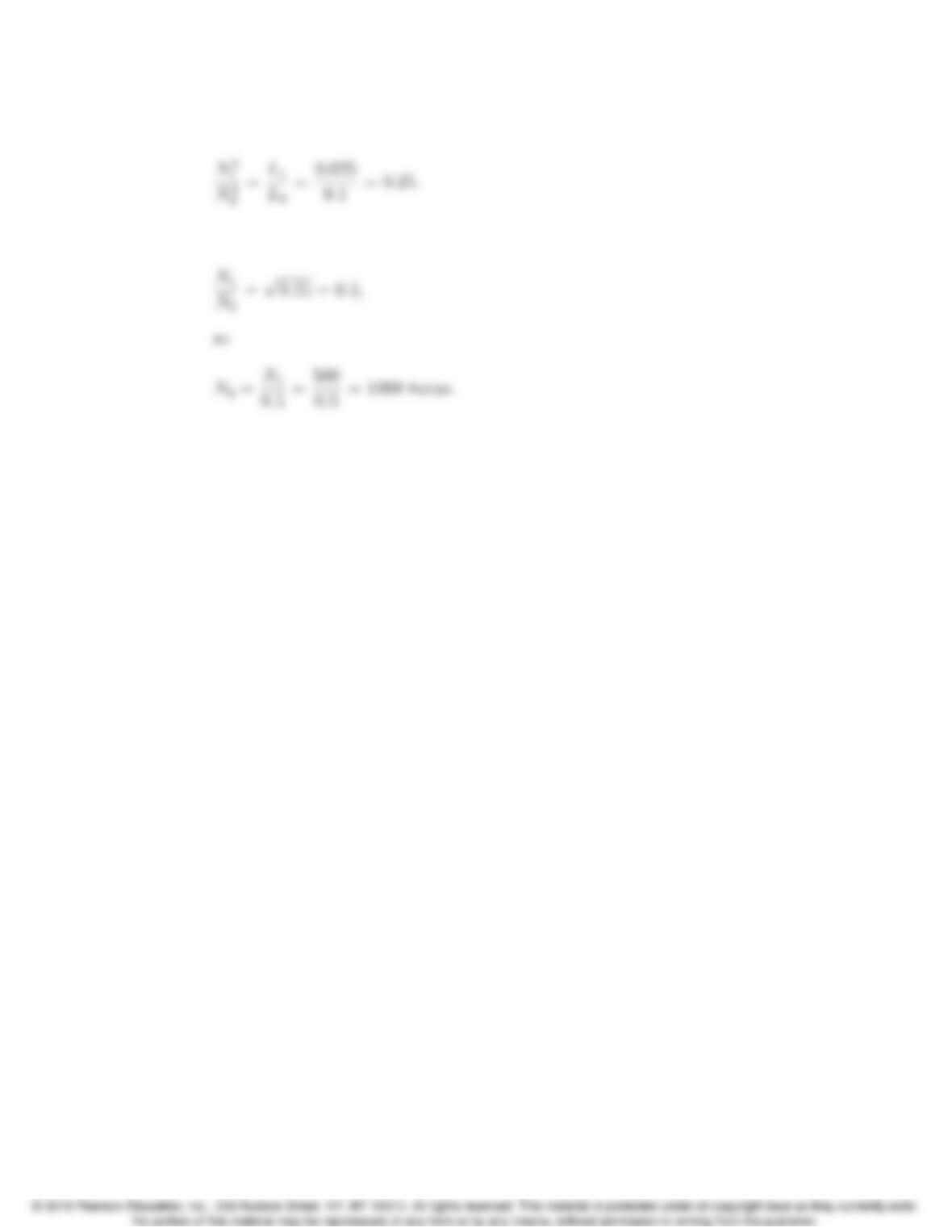
AP 6.7 Since P1=P2,
Therefore,
6–6 CHAPTER 6. Inductance, Capacitance, and Mutual Inductance
Problems
P 6.1 [a] v=Ldi
dt;
[b] p=vi.
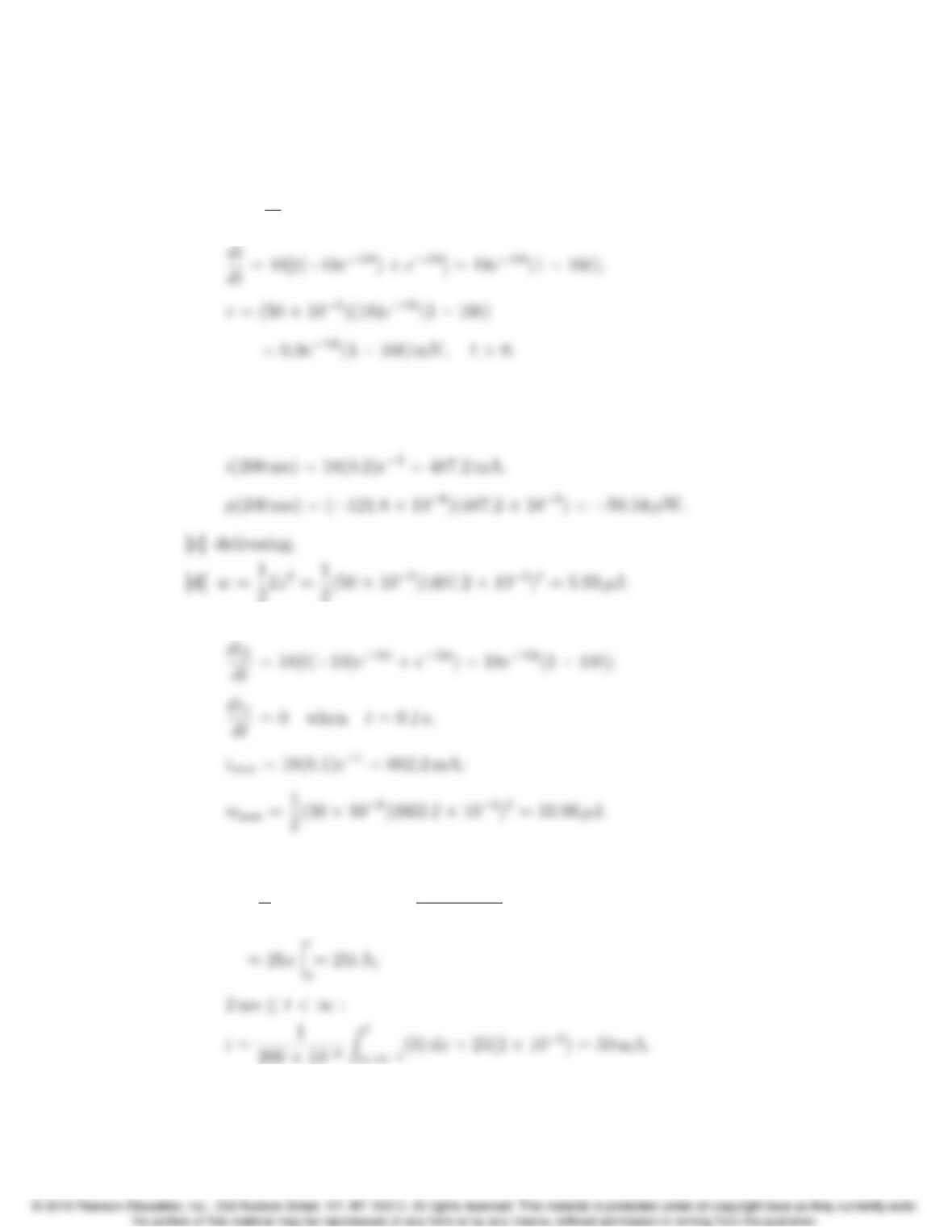
v(200 ms) = 0.9e−2(1 −2) = −121.8µV.
[e] The energy is a maximum where the current is a maximum:
P 6.2 [a] 0≤t≤2 ms :
i=1
LZt
0vsdx +i(0) = 1
200 ×10−6Zt
05×10−3dx +0
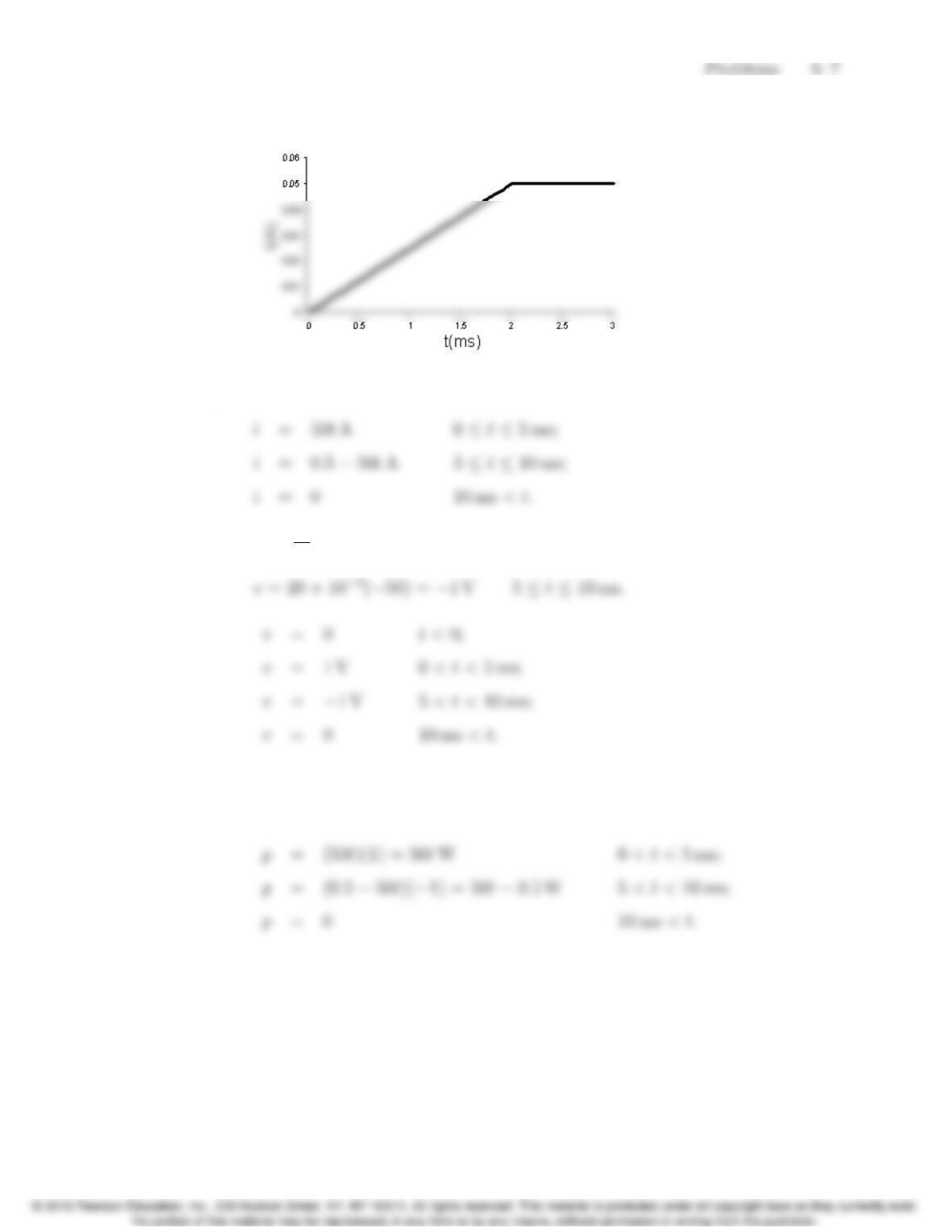
[b]
P 6.3 [a] i=0 t<0;
[b] v=Ldi
dt = 20 ×10−3(50) = 1 V 0 ≤t≤5 ms;
p=vi.
p=0 t<0;
6–8 CHAPTER 6. Inductance, Capacitance, and Mutual Inductance
w=0 t<0;
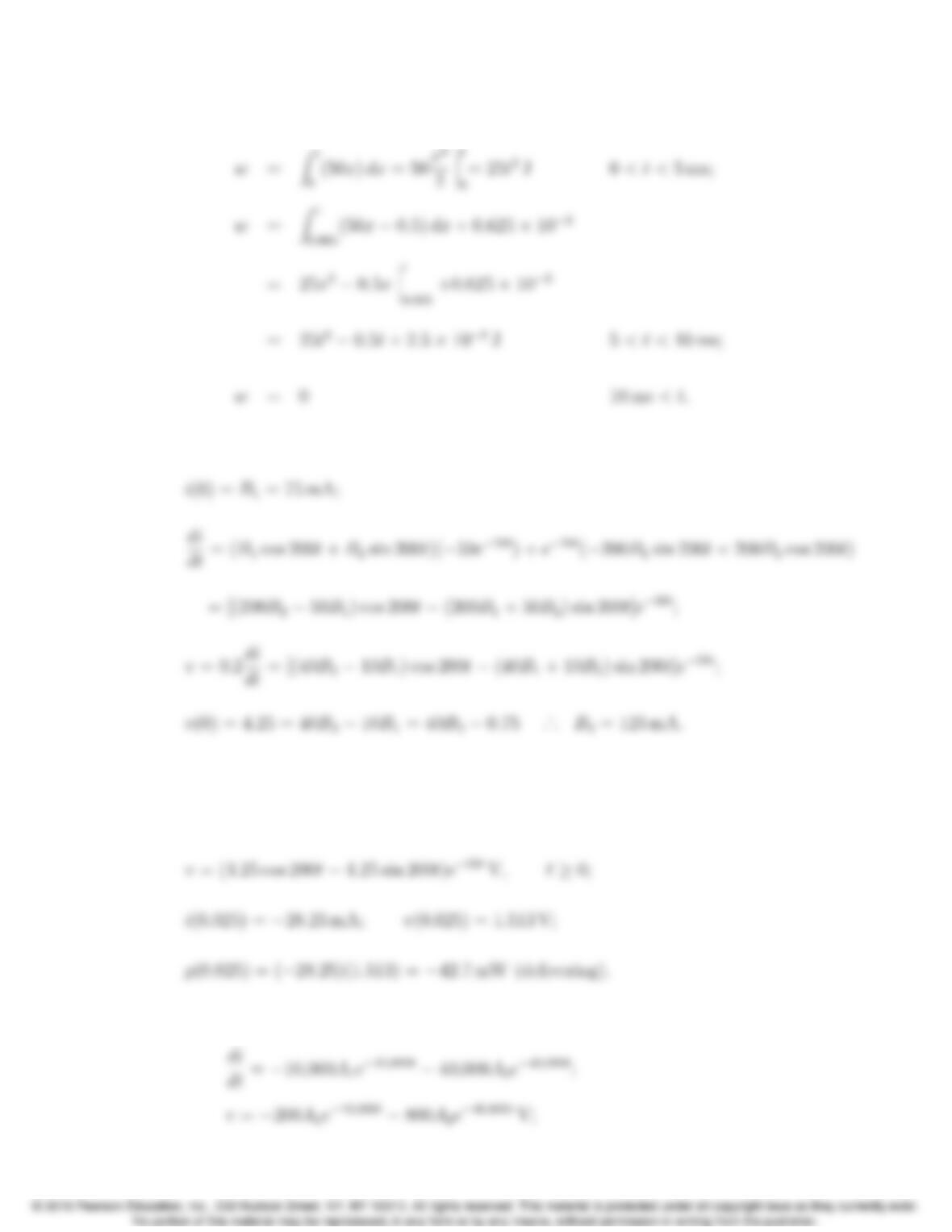
P 6.4 i=(B1cos 200t+B2sin 200t)e−50t;
Thus,
i= (75 cos 200t+ 125 sin 200t)e−50tmA,t≥0;
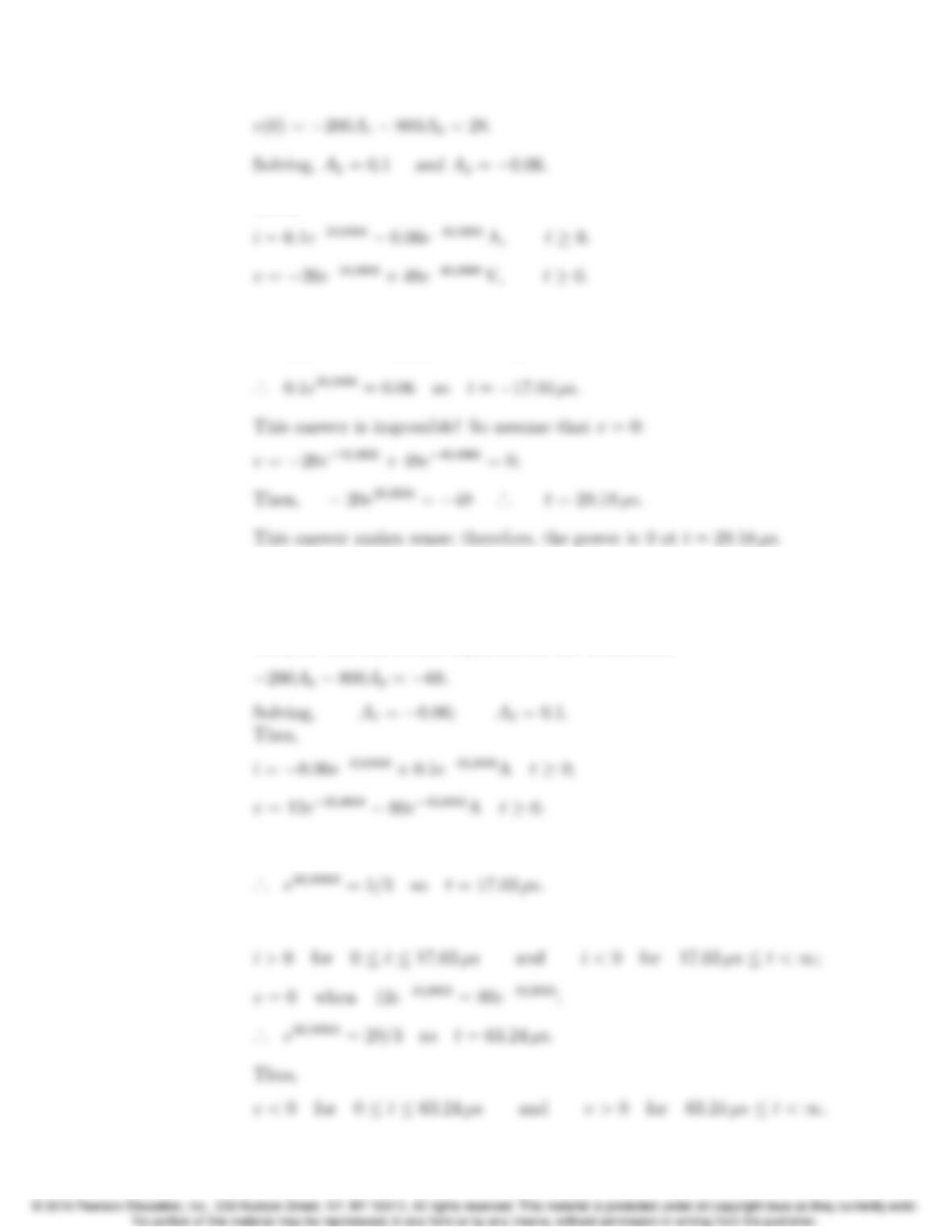
P 6.5 [a] i(0) = A1+A2=0.04;
Problems 6–9
Thus,
[b] If p= 0 then either i= 0 or v= 0. Suppose i= 0:
i=0.1e−10,000t−0.06e−40,000t= 0;
P 6.6 [a] From Problem 6.5 we have
A1+A2=0.04.
Now, we add the second equation for the coefficients:
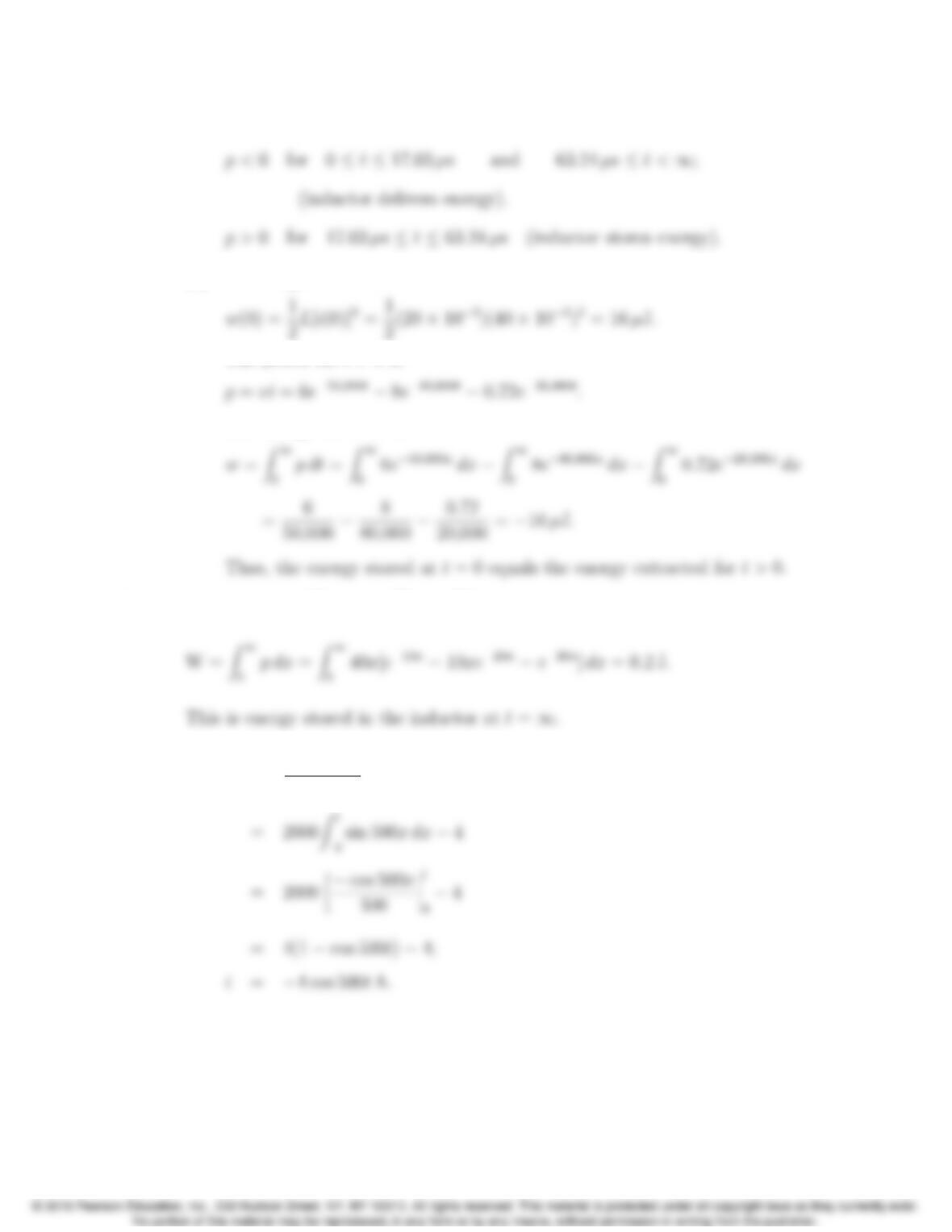
[b] i= 0 when 0.06e−10,000t=0.1e−40,000t;
Thus,
6–10 CHAPTER 6. Inductance, Capacitance, and Mutual Inductance
Therefore,
[c] The energy stored at t= 0 is
The power for t>0 is
The energy for t>0 is
P 6.7 p=vi = 40t[e−10t−10te−20t−e−20t].
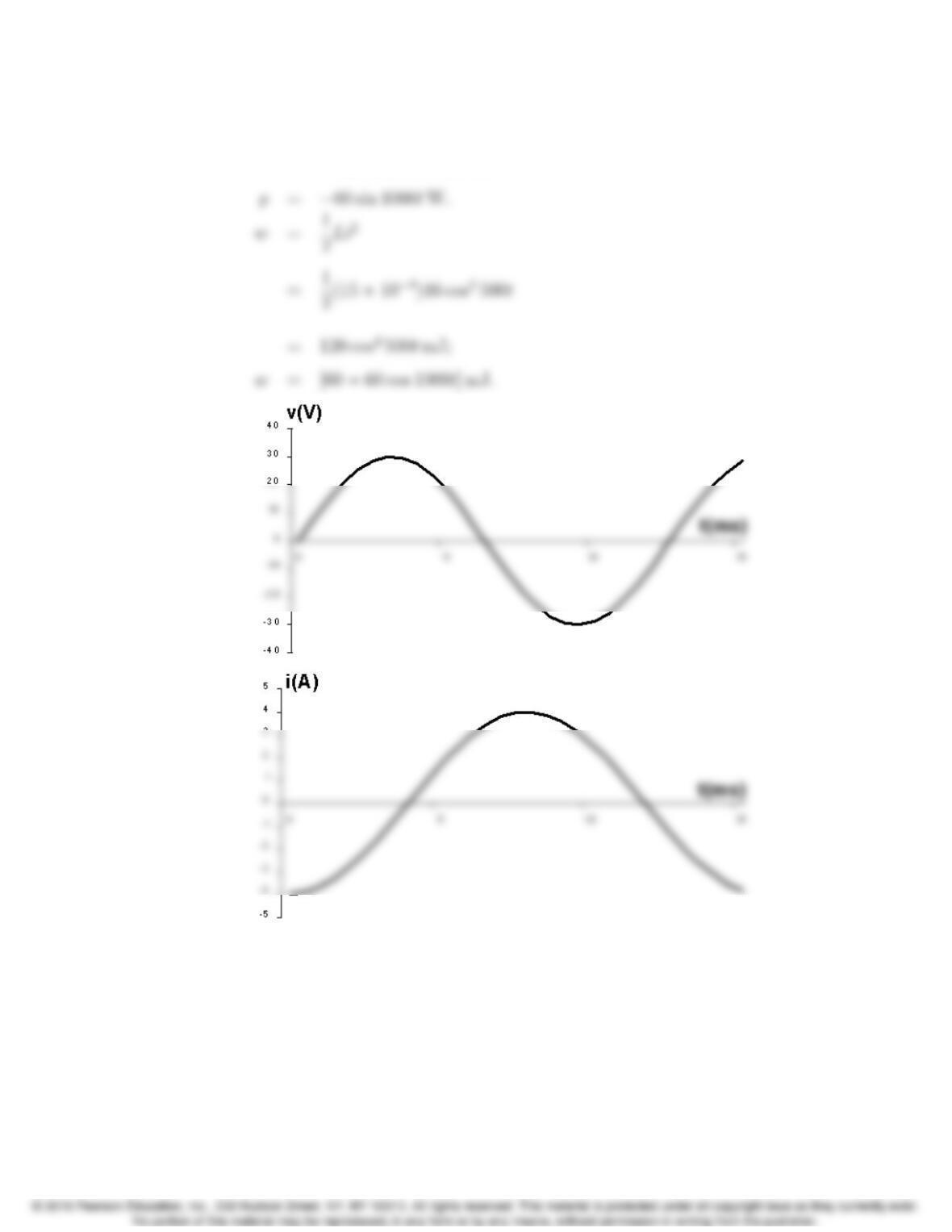
P 6.8 [a] i=1
15 ×10−3Zt
030 sin 500x dx −4
Problems 6–11
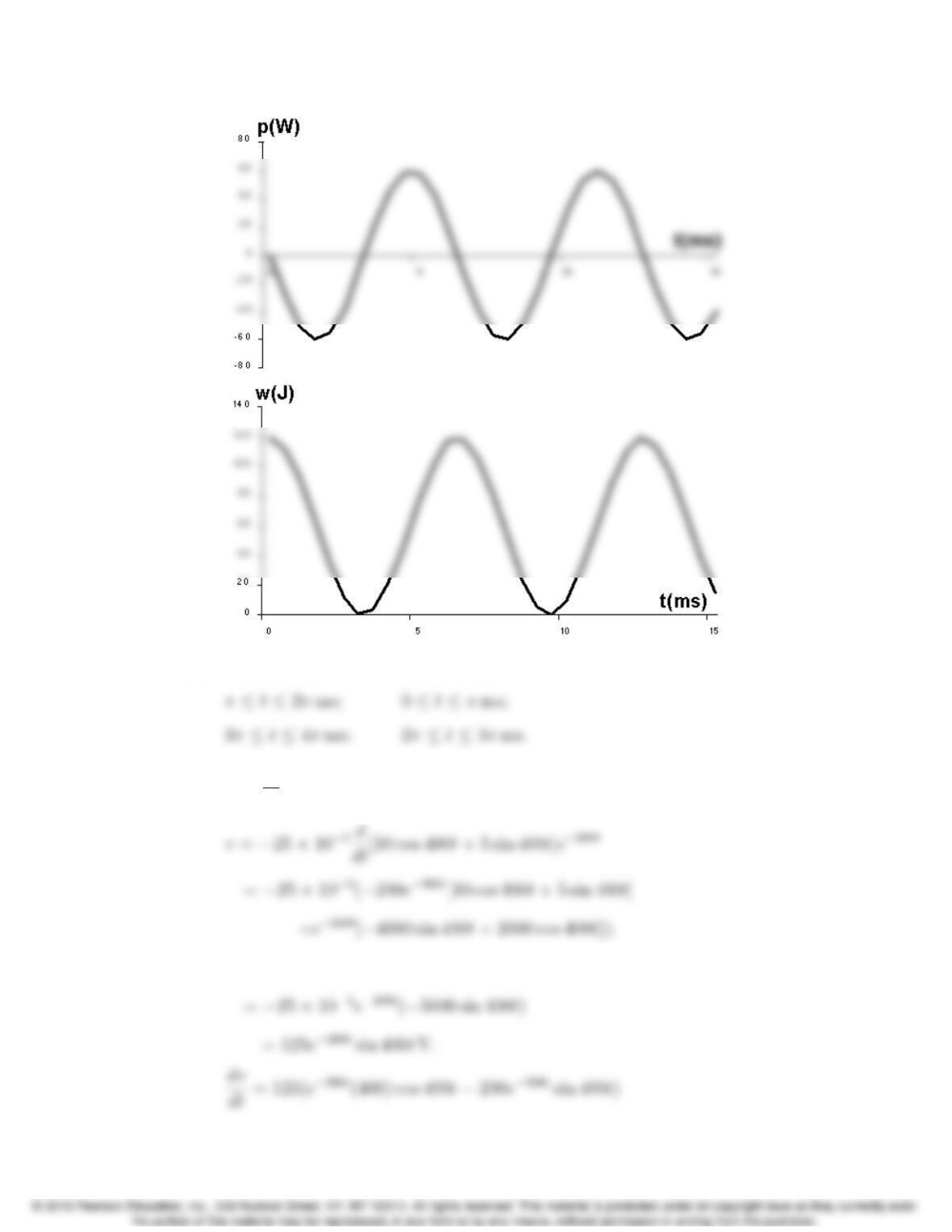
[b] p=vi = (30 sin 500t)(−4 cos 500t)
=−120 sin 500tcos 500t;
6–12 CHAPTER 6. Inductance, Capacitance, and Mutual Inductance
[c] Absorbing power: Delivering power:
P 6.9 [a] v=Ldi
dt;
v=−25 ×10−3e−200t(−1000 sin 400t−4000 sin 400t)
Problems 6–13
P 6.10 [a] 0≤t≤1s:
v=−100t;
i(1) = −10 .
·
.. i =1
5Zt
1(100x−200) dx −10
6–14 CHAPTER 6. Inductance, Capacitance, and Mutual Inductance
i=1
5Zt
5(−100x+ 600) dx +30
[c]
P 6.11 0 ≤t<2s:
iL(2) = 1.3 A;
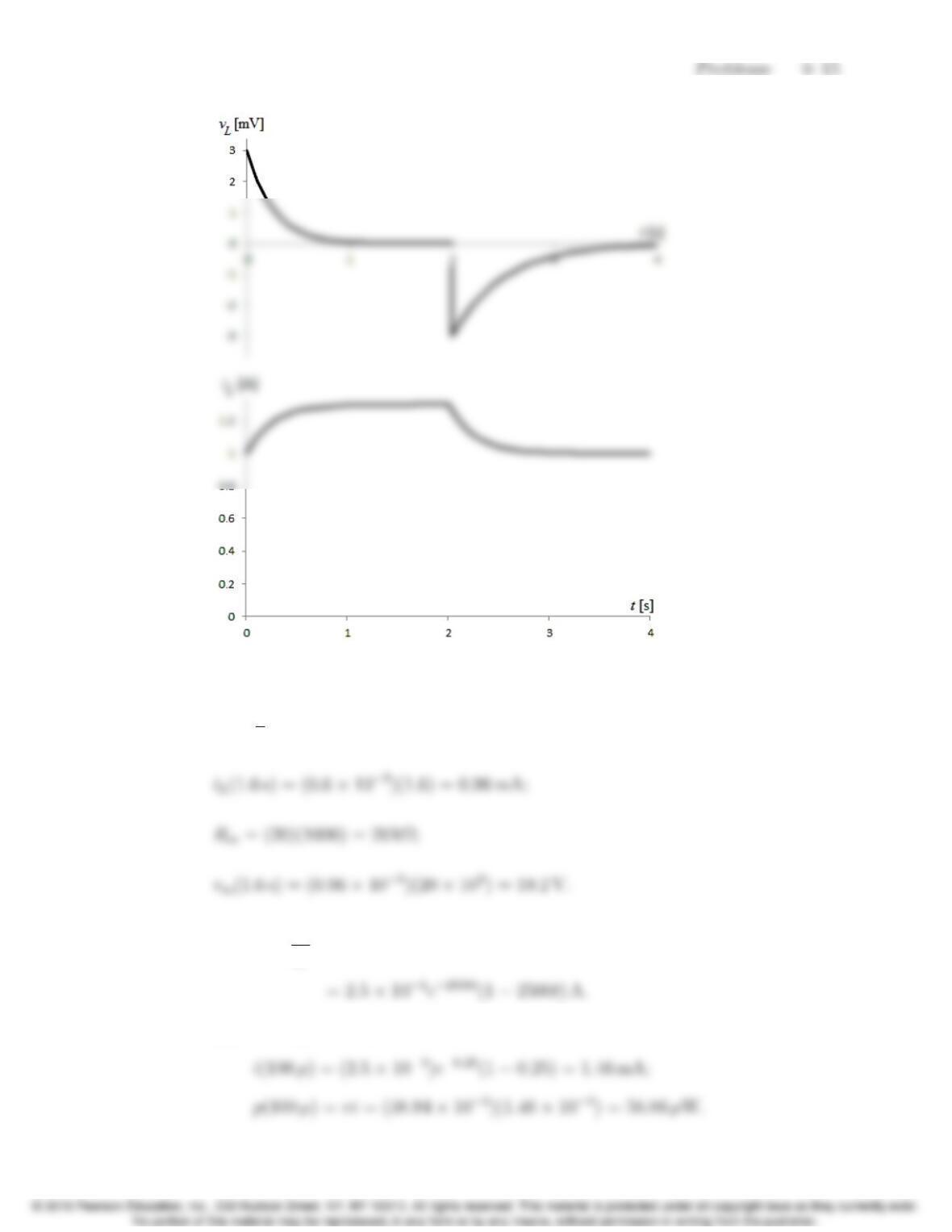
P 6.12 For 0 ≤t≤1.6 s:
iL=1
5Zt
03×10−3dx +0=0.6×10⁻³t;
P 6.13 [a] i=Cdv
dt = (5 ×10⁻⁶)[500t(−2500)e−2500t+ 500e−2500t]
[b] v(100 µ) = 500(100 ×10−6)e−0.25 = 38.94 mV;
6–16 CHAPTER 6. Inductance, Capacitance, and Mutual Inductance
[e] The energy is maximum when the voltage is maximum:
P 6.14 v=−10 V,t≤0; C=0.8µF;
[b] dv
dt = 1000e−1000t(50 cos 500t+ 20 sin 500t)
−e−1000t(−25,000 sin 500t+10,000 cos 500t)
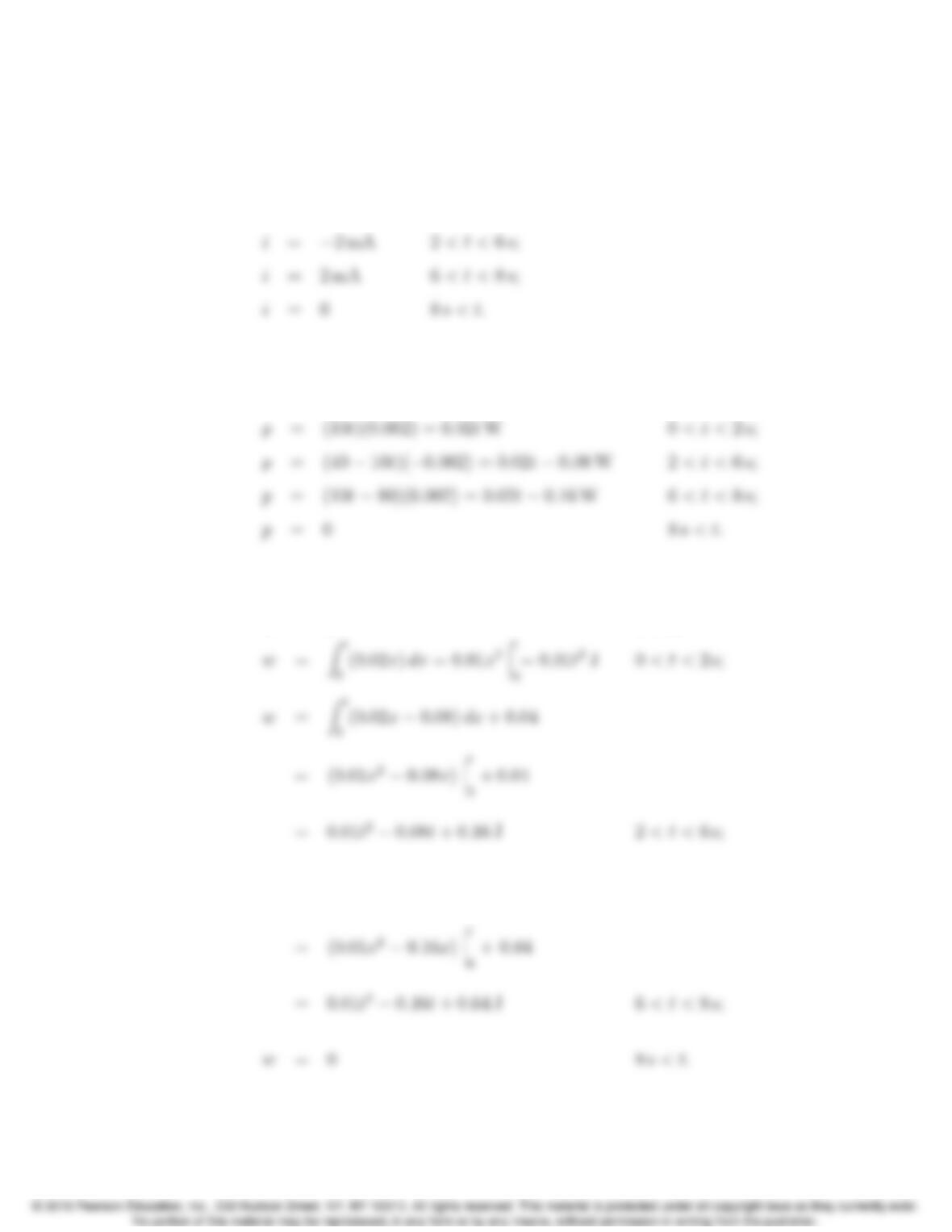
P 6.15 [a] v=0 t<0;
v=10tA 0 ≤t≤2 s;
Problems 6–17
[b] i=Cdv
dt :
i=0 t<0;
i= 2 mA 0 <t<2 s;
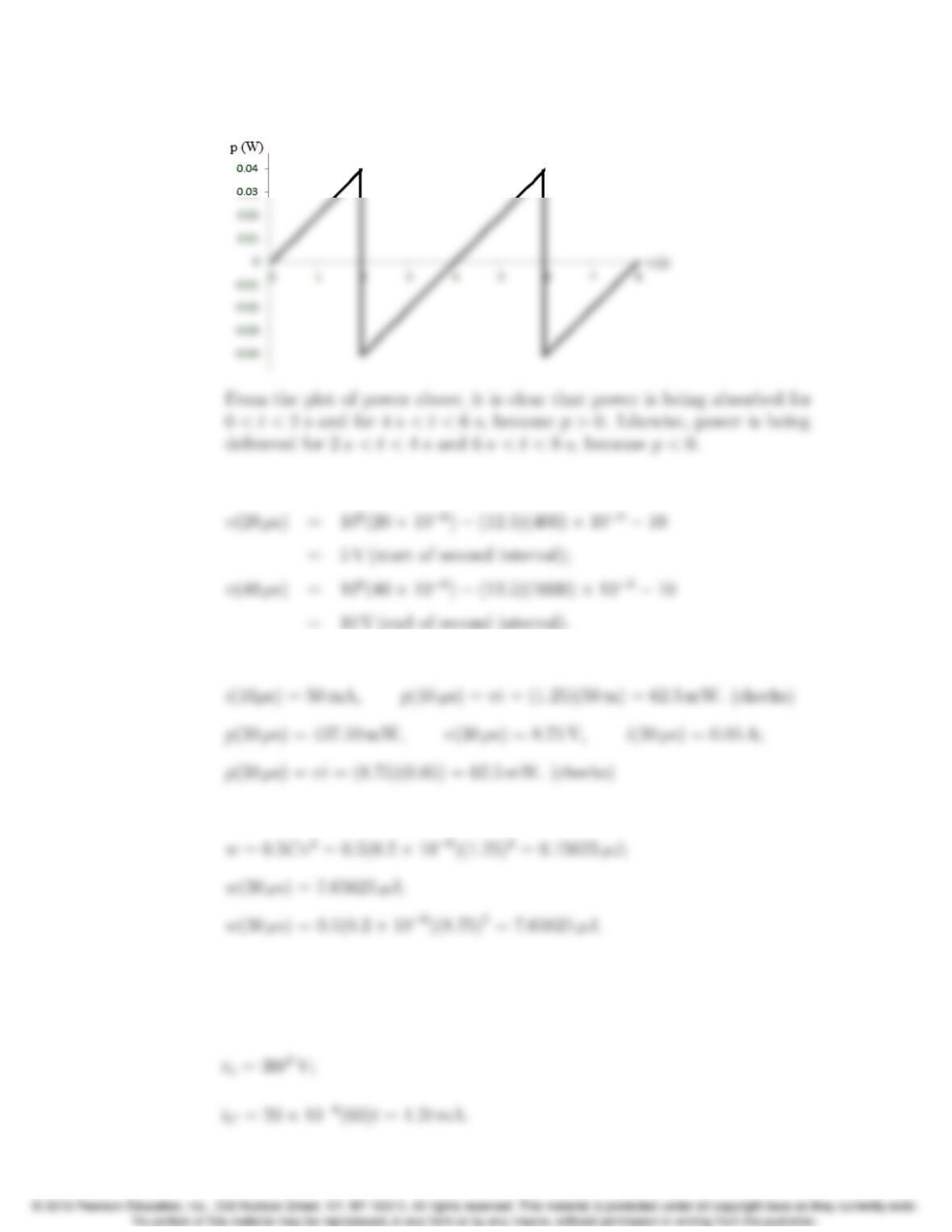
p=vi :
p=0 t<0;
w=Zp dx :
w=0 t<0;
w=Zt
6(0.02x−0.16) dx +0.04
6–18 CHAPTER 6. Inductance, Capacitance, and Mutual Inductance
[c]
P 6.16 [a] v(20 µs) = 12.5×10⁹(20 ×10−6)2= 5 V (end of first interval);
[b] p(10µs) = 62.5×10¹²(10−5)3= 62.5 mW,v(10 µs) = 1.25 V,
[c] w(10 µs) = 15.625 ×10¹²(10 ×10−6)4=0.15625 µJ;
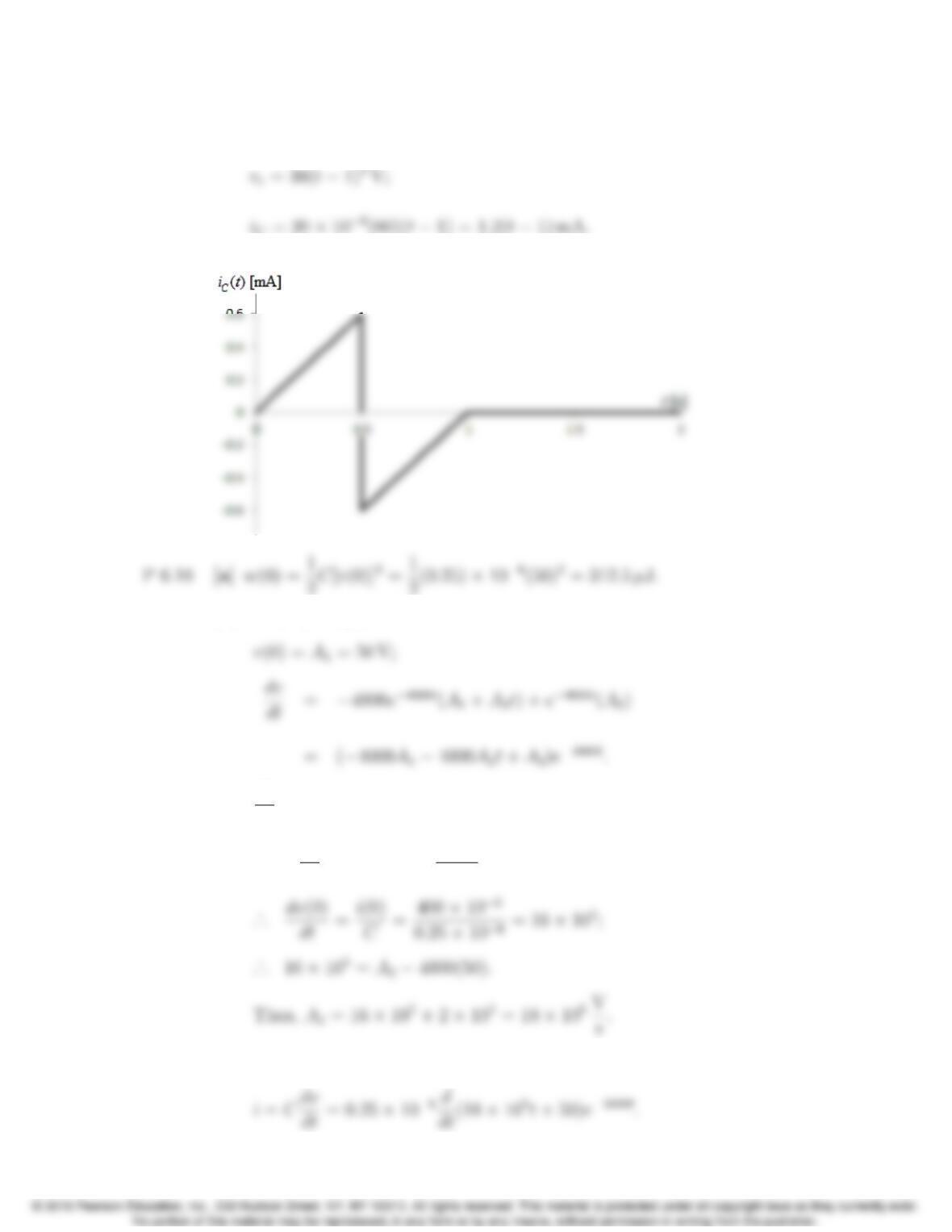
P 6.17 iC=C(dv/dt)
0<t<0.5:
Problems 6–19
0.5<t<1:
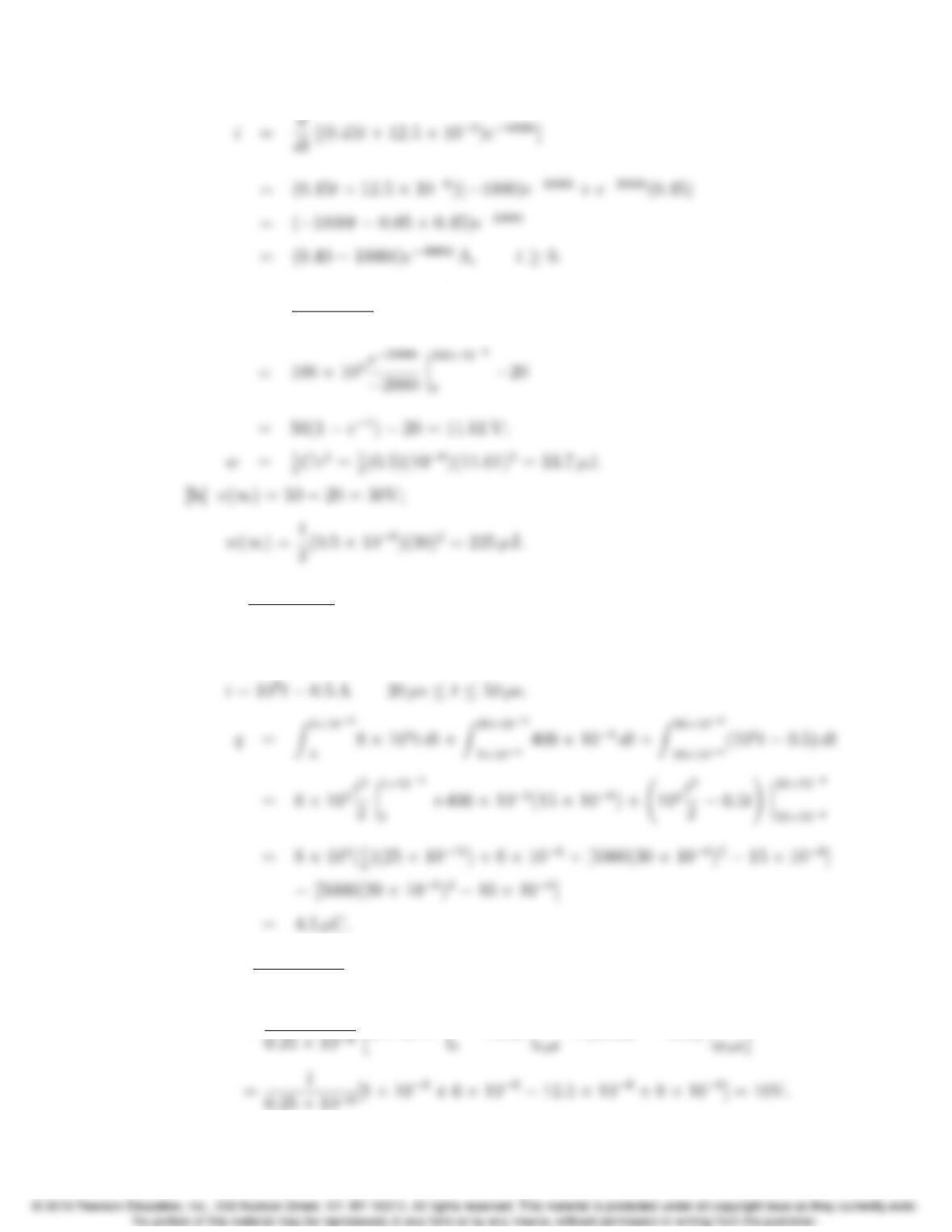
[b] v=(A1+A2t)e−4000t;
dv
dt (0) = A2−4000A1;
i=Cdv
dt ,i(0) = Cdv(0)
dt ;
[c] v= (18 ×105t+ 50)e−4000t;
6–20 CHAPTER 6. Inductance, Capacitance, and Mutual Inductance
P 6.19 [a] v=1
0.5×10⁻⁶Z500×10−6
050 ×10−3e−2000tdt −20
P 6.20 [a] i=400 ×10−3
5×10⁻⁶t=8×10⁴tA0≤t≤5µs;
i= 400 ×10−3A5≤t≤20 µs;
[b] v=1
0.25 ×10⁻⁶Z5µs
08×104x dx +Z20 µs
5µs0.4x dx +Z50 µs
20 µs(104x−0.5) dx
=1
5µs
+0.4t
20 µs
50 µs