Circuit Variables
Assessment Problems
AP 1.1 Use a product of ratios to convert two-thirds the speed of light from meters
per second to miles per second:
✓2
AP 1.2 To solve this problem we use a product of ratios to change units from
dollars/year to dollars/millisecond. We begin by expressing $10 billion in
scientific notation:
1
1–2 CHAPTER 1. Circuit Variables
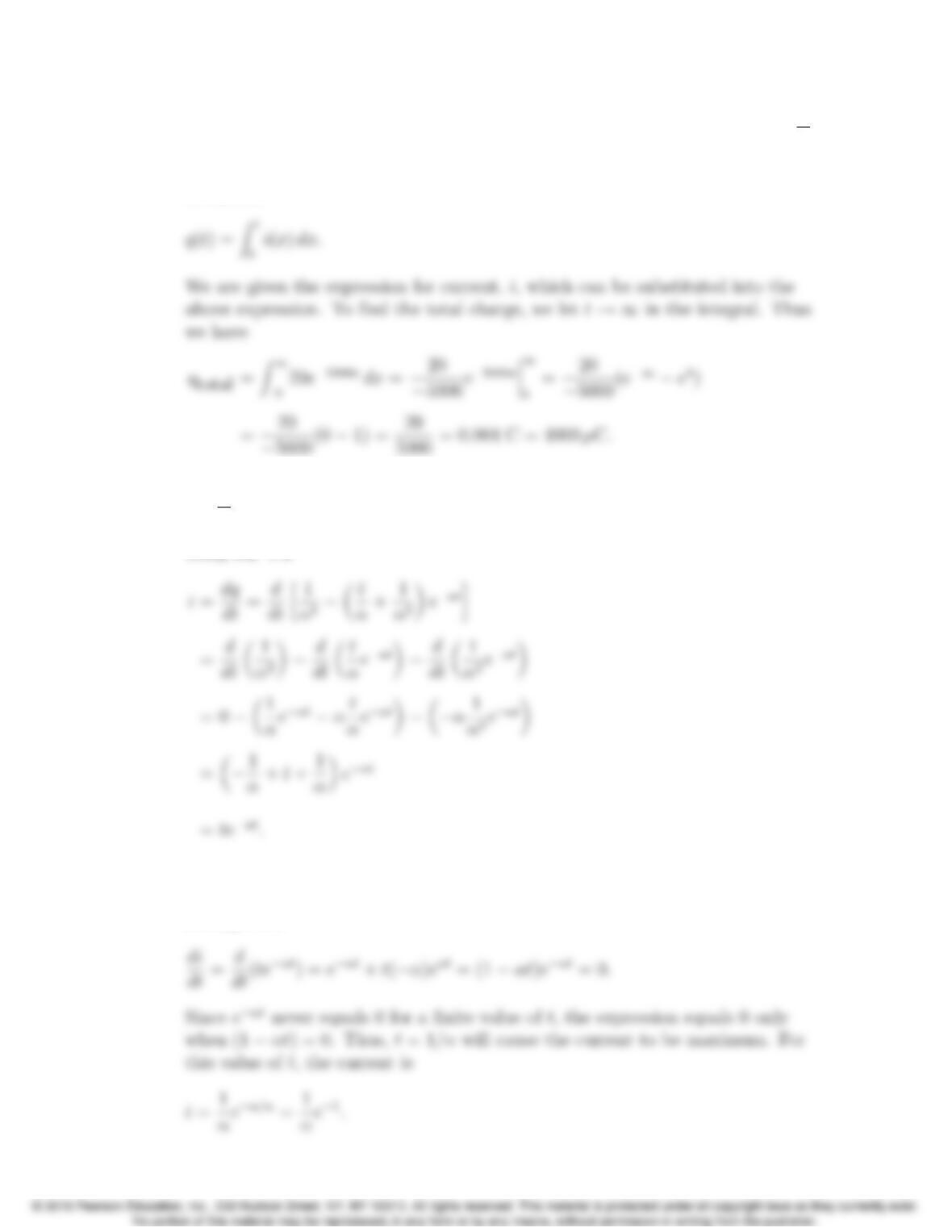
AP 1.3 Remember from Eq. 1.2, current is the time rate of change of charge, or i=dq
dt
In this problem, we are given the current and asked to find the total charge.
To do this, we must integrate Eq. 1.2 to find an expression for charge in terms
of current:
AP 1.4 Recall from Eq. 1.2 that current is the time rate of change of charge, or
i=dq
dt . In this problem we are given an expression for the charge, and asked to
find the maximum current. First we will find an expression for the current
using Eq. 1.2:
Now that we have an expression for the current, we can find the maximum
value of the current by setting the first derivative of the current to zero and
solving for t:
Problems 1–3
Remember in the problem statement, ↵=0.03679. Using this value for ↵,
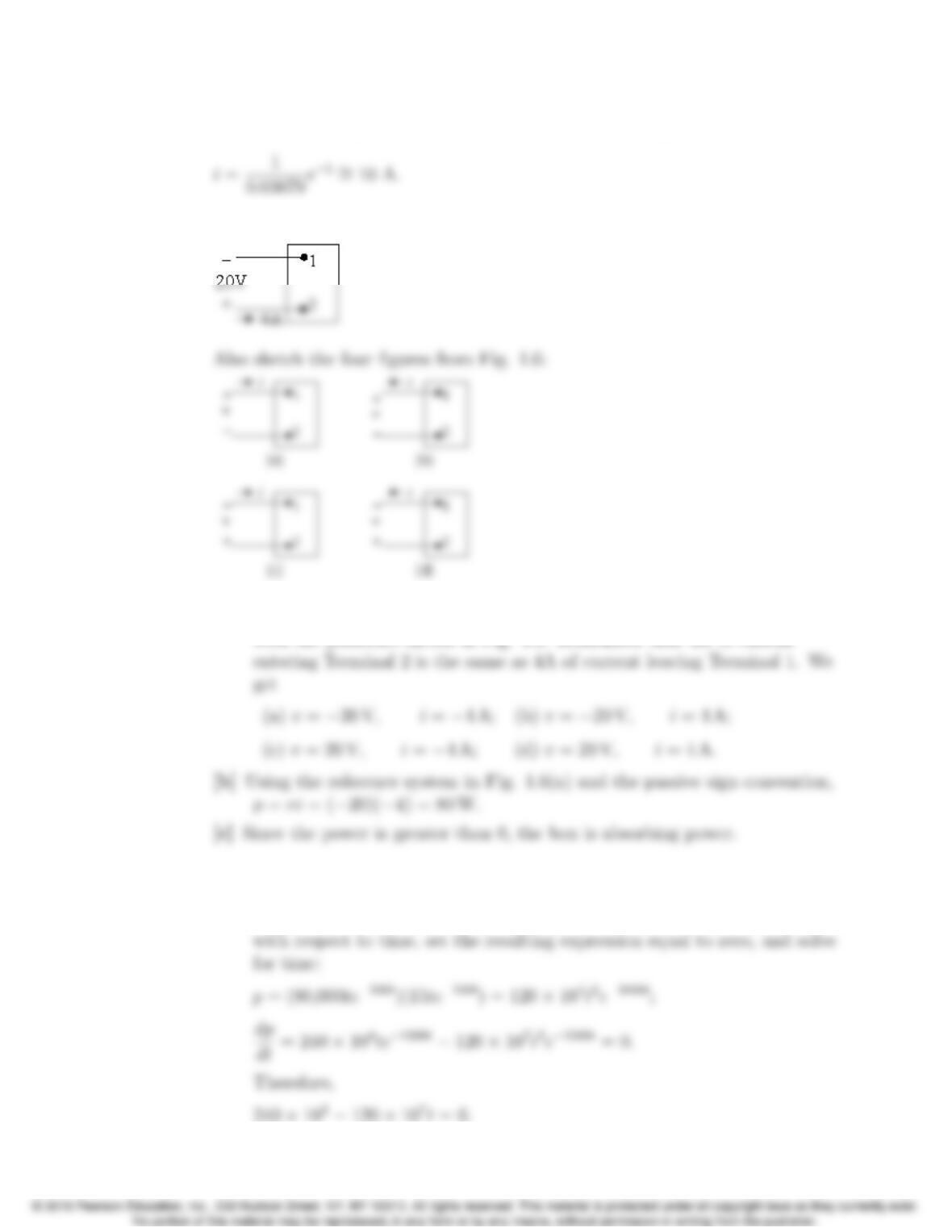
AP 1.5 Start by drawing a picture of the circuit described in the problem statement:
[a] Now we have to match the voltage and current shown in the first figure
with the polarities shown in Fig. 1.6. Remember that 4A of current
AP 1.6 [a] Applying the passive sign convention to the power equation using the
voltage and current polarities shown in Fig. 1.5, p=vi. To find the time
at which the power is maximum, find the first derivative of the power
1–4 CHAPTER 1. Circuit Variables
Solving,
[b] The maximum power occurs at 2 ms, so find the value of the power at 2
ms:
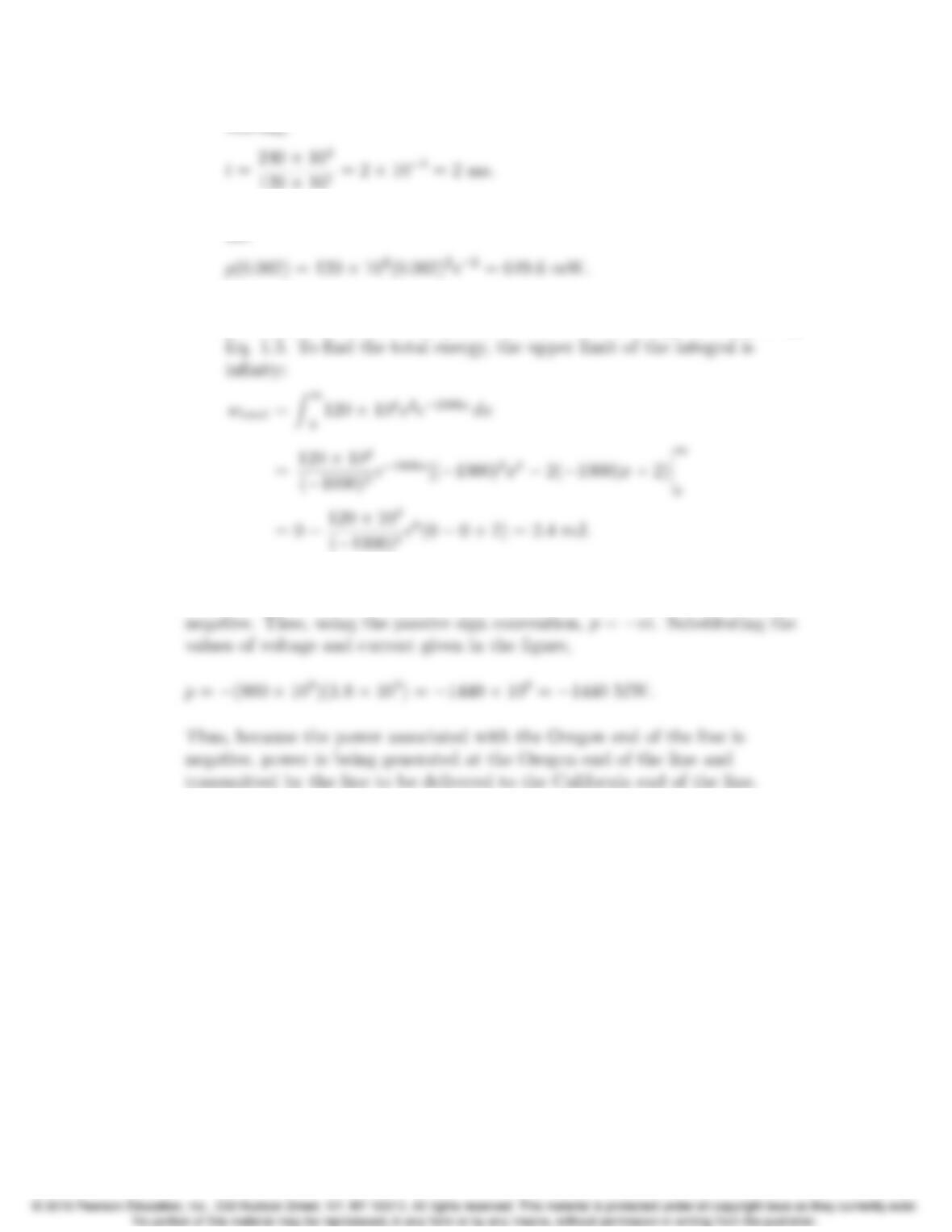
[c] From Eq. 1.3, we know that power is the time rate of change of energy, or
p=dw/dt. If we know the power, we can find the energy by integrating
AP 1.7 At the Oregon end of the line the current is leaving the upper terminal, and
thus entering the lower terminal where the polarity marking of the voltage is
Problems 1–5
Chapter Problems
P 1.2 [a] To begin, we calculate the number of pixels that make up the display:
npixels = (3840)(2160) = 8,294,400 pixels.
P 1.3 [a] We can set up a ratio to determine how long it takes the bamboo to grow
10 µm First, recall that 1 mm = 103µm. Let’s also express the rate of
growth of bamboo using the units mm/s instead of mm/day. Use a
P 1.4 (480)(320) pixels
1 frame ·2 bytes
1 pixel ·30 frames
1 sec =9.216 ⇥106bytes/sec;
1–6 CHAPTER 1. Circuit Variables
P 1.5 [a] 20,000 photos
(11)(15)(1) mm3=xphotos
1 mm3;
P 1.7 First we use Eq. 1.2 to relate current and charge:
We solve the integral and make the substitutions for the limits of the integral,
remembering that sin 0 = 0:
P 1.8 w=qV = (1.6022 ⇥1019)(6) = 9.61 ⇥1019 =0.961 aJ.
P 1.10 [a] First we use Eq. 1.2 to relate current and charge:
i=dq
dt =0.125e2500t.
To find the charge, we can integrate both sides of the last equation. Note
that we substitute xfor qon the left side of the integral, and yfor ton
the right side of the integral:
P 1.11 [a] First we use Eq. (1.2) to relate current and charge:
i=dq
dt = 40te500t.
We solve the integral and make the substitutions for the limits of the
integral:
P 1.12 [a] In Car B, the current iis in the direction of the voltage drop across the
12 V battery(the current iflows into the + terminal of the battery of
[b] w(t)=Zt
0p dx;1.5 min = 1.5·60 s
1 min = 90 s;
P 1.13 Assume we are standing at box A looking toward box B. Use the passive sign
convention to get p=vi, since the current iis flowing into the + terminal of
the voltage v. Now we just substitute the values for vand iinto the equation
P 1.14 p= (12)(0.1) = 1.2 W; 4 hr ·3600 s
1 hr = 14,400 s;
P 1.15 [a]
p=vi =(20)(5) = 100 W.
P 1.16 [a] p=vi =(20)(5) = 100 W, so power is being absorbed by the box.
Problems 1–9
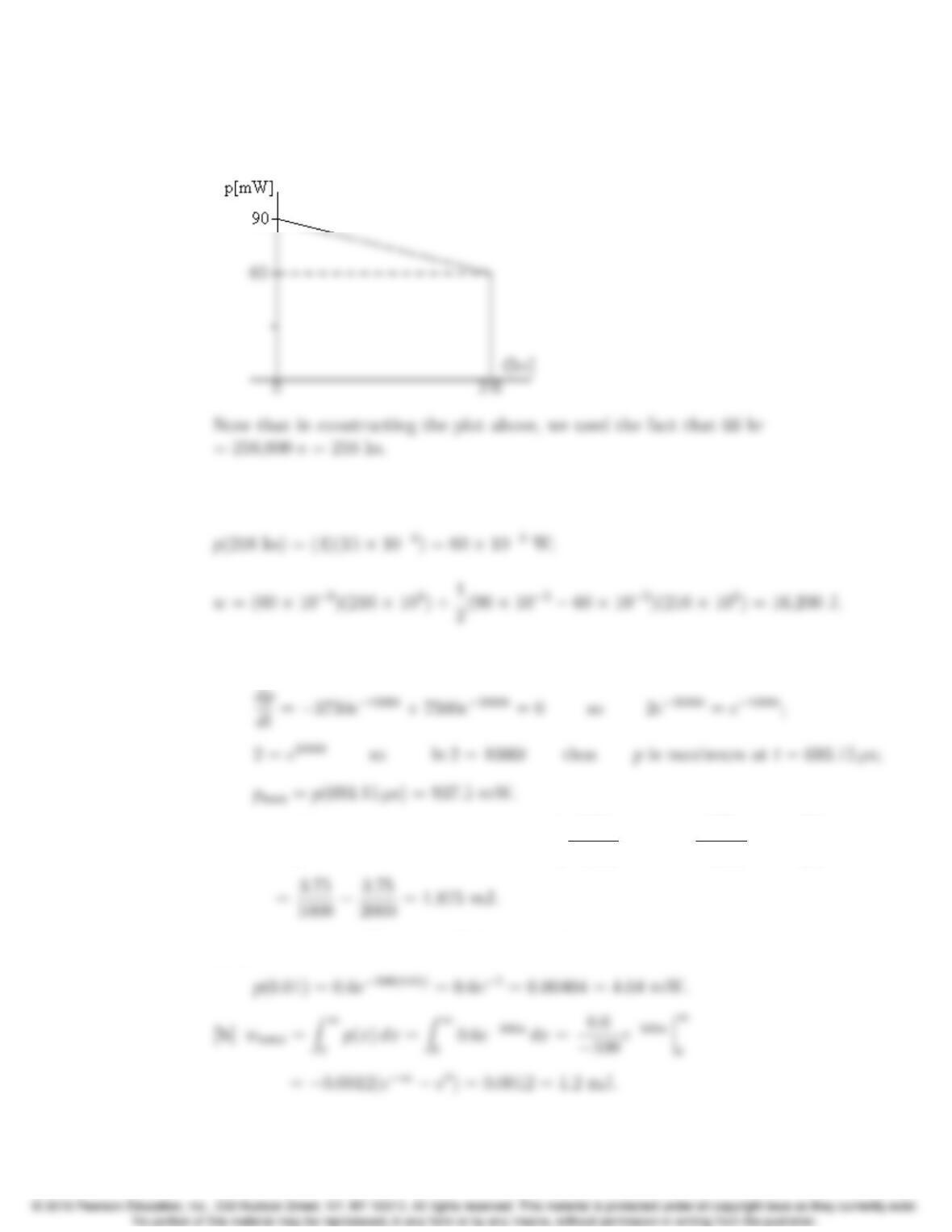
P 1.17 p=vi;w=Zt
0p dx.
Since the energy is the area under the power vs. time plot, let us plot pvs. t.
p(0) = (6)(15 ⇥103)=90⇥103W;
P 1.18 [a] p=vi = (0.05e1000t)(75 75e1000t) = (3.75e1000t3.75e2000t) W;
[b] w=Z1
0[3.75e1000t3.75e2000t]dt =3.75
1000e1000t3.75
2000e2000t
1
0
P 1.19 [a] p=vi = (15e250t)(0.04e250t)=0.6e500tW;
1–10 CHAPTER 1. Circuit Variables
P 1.20 [a] p=vi
= [(1500t+1)e750t](0.04e750t)
[b] pmax = [(60)(0) + 0.04]e0=0.04
[c] w=Zt
0pdx
P 1.21 [a] p=vi =0.25e3200t0.5e2000t+0.25e800t;
P 1.22 [a] p=vi = [104t+5)e400t][(40t+0.05)e400t]
Problems 1–11
[c] w=Zt
0pdx
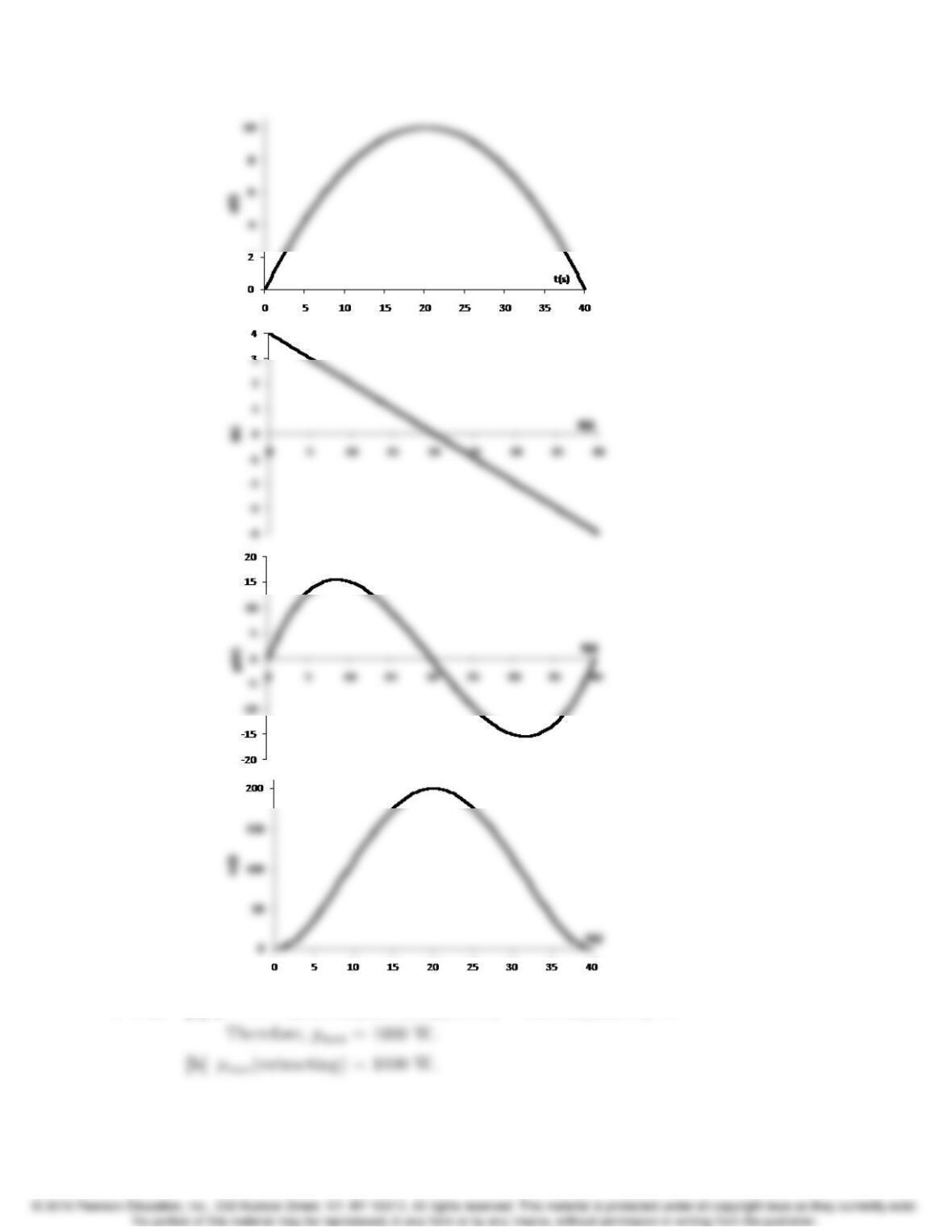
P 1.23 [a] We can find the time at which the power is a maximum by writing an
expression for p(t)=v(t)i(t), taking the first derivative of p(t)
and setting it to zero, then solving for t. The calculations are shown below:
p=0t<0,p=0 t>40 s;
[b] The maximum power was calculated in part (a) to determine the time at
[e] w=Zt
0pdx =Zt
0(4x0.3x2+0.005x3)dx =2t20.1t3+0.00125t4.
w(0) = 0 J; w(30) = 112.5 J;
1–12 CHAPTER 1. Circuit Variables
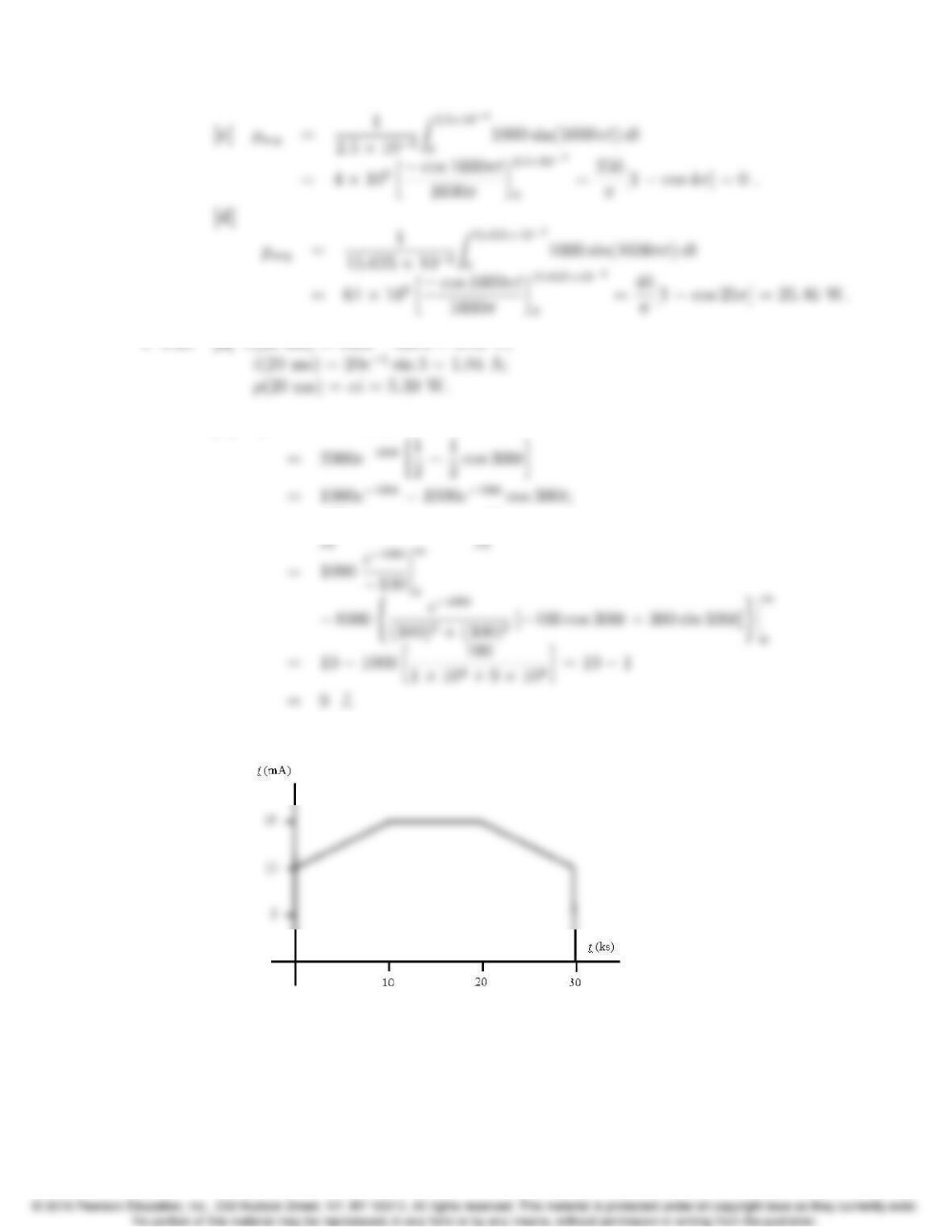
P 1.24 [a] p=vi = 2000 cos(800⇡t) sin(800⇡t) = 1000 sin(1600⇡t)W.
Problems 1–13
[b] p=vi = 2000e100tsin.2150t
w=Z1
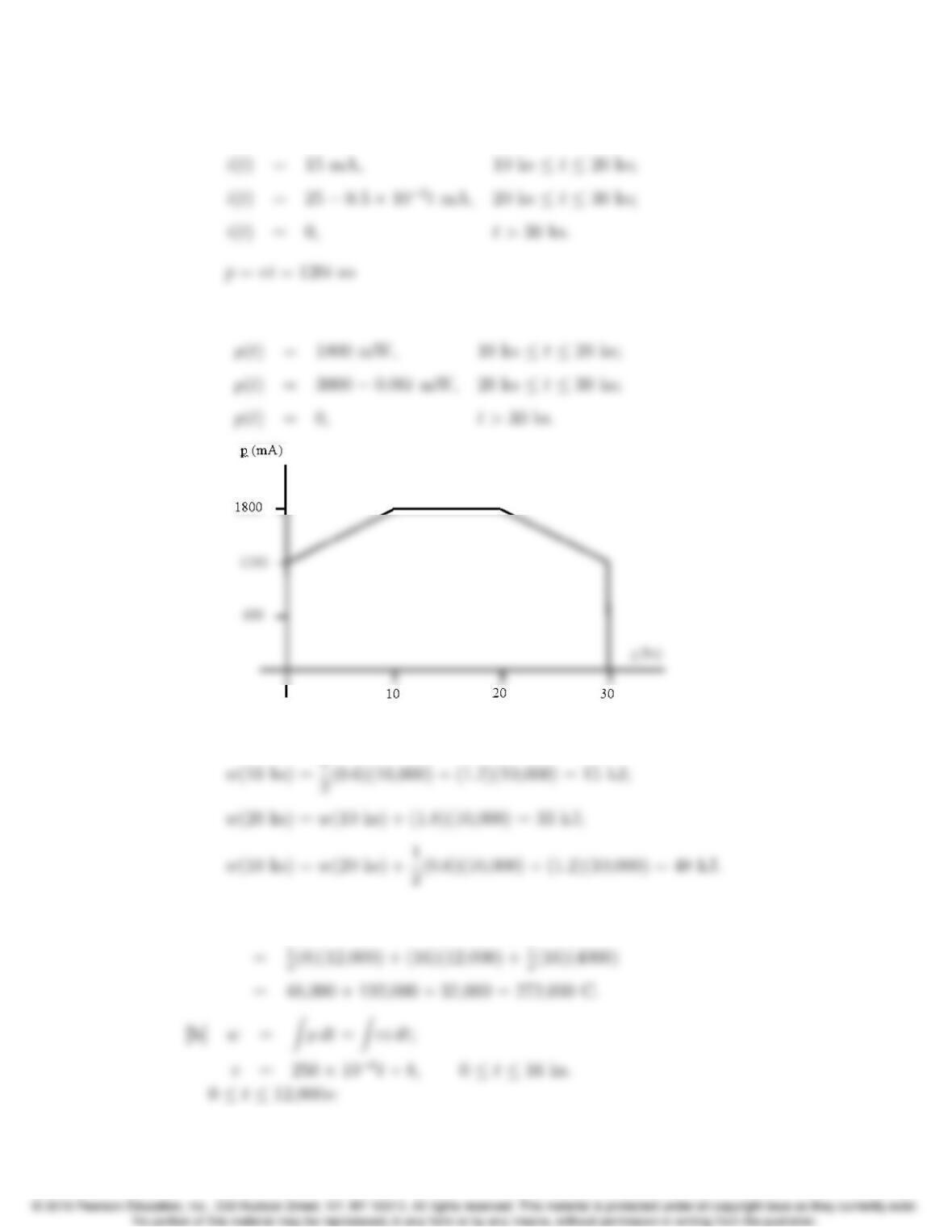
P 1.26 [a]
1–14 CHAPTER 1. Circuit Variables
[b] i(t) = 10 + 0.5⇥103tmA, 0 t10 ks;
p(t) = 1200 + 0.06tmW, 0 t10 ks;
[c] To find the energy, calculate the area under the plot of the power:
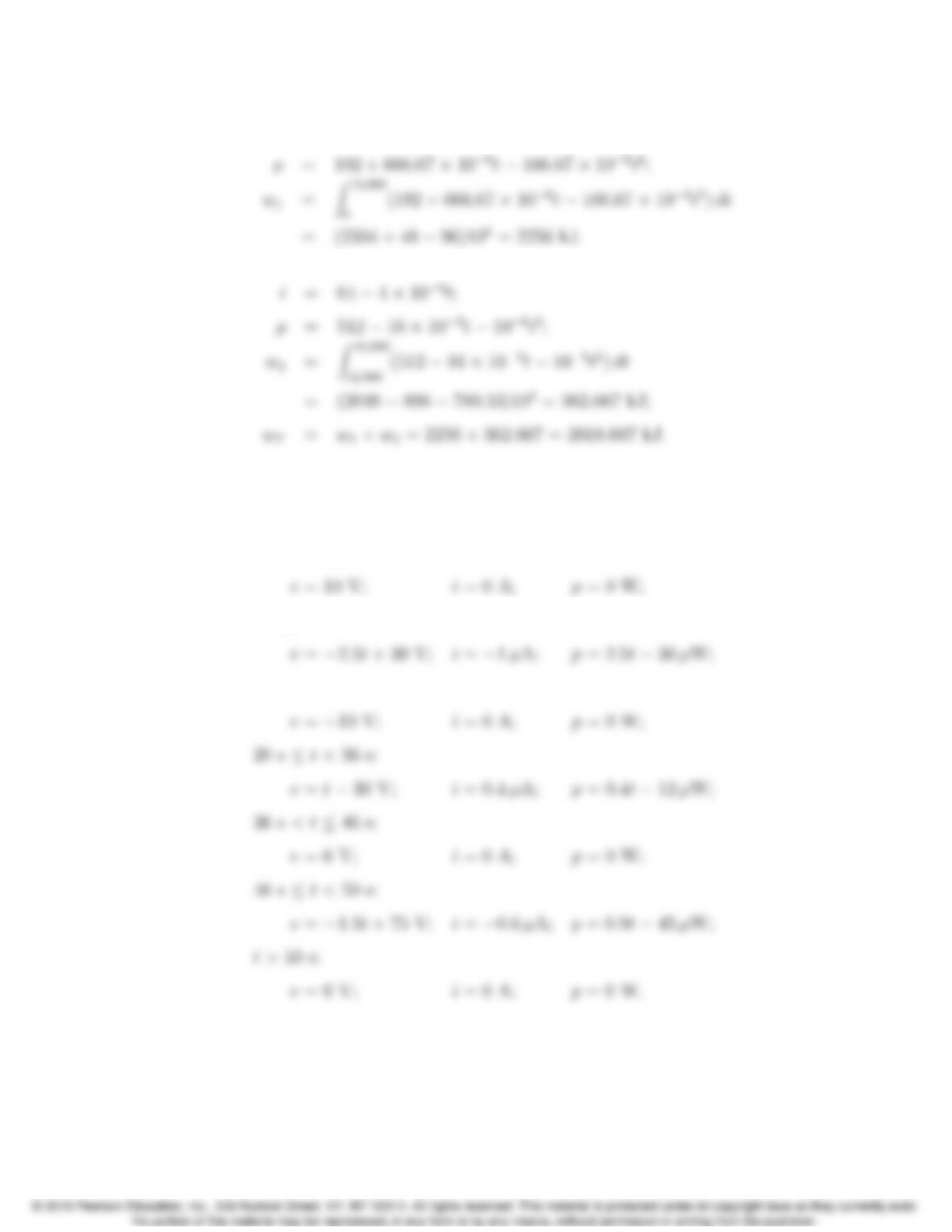
P 1.27 [a] q= area under ivs. tplot
Problems 1–15
i=24666.67 ⇥106t;
12,000 s t16,000 s:
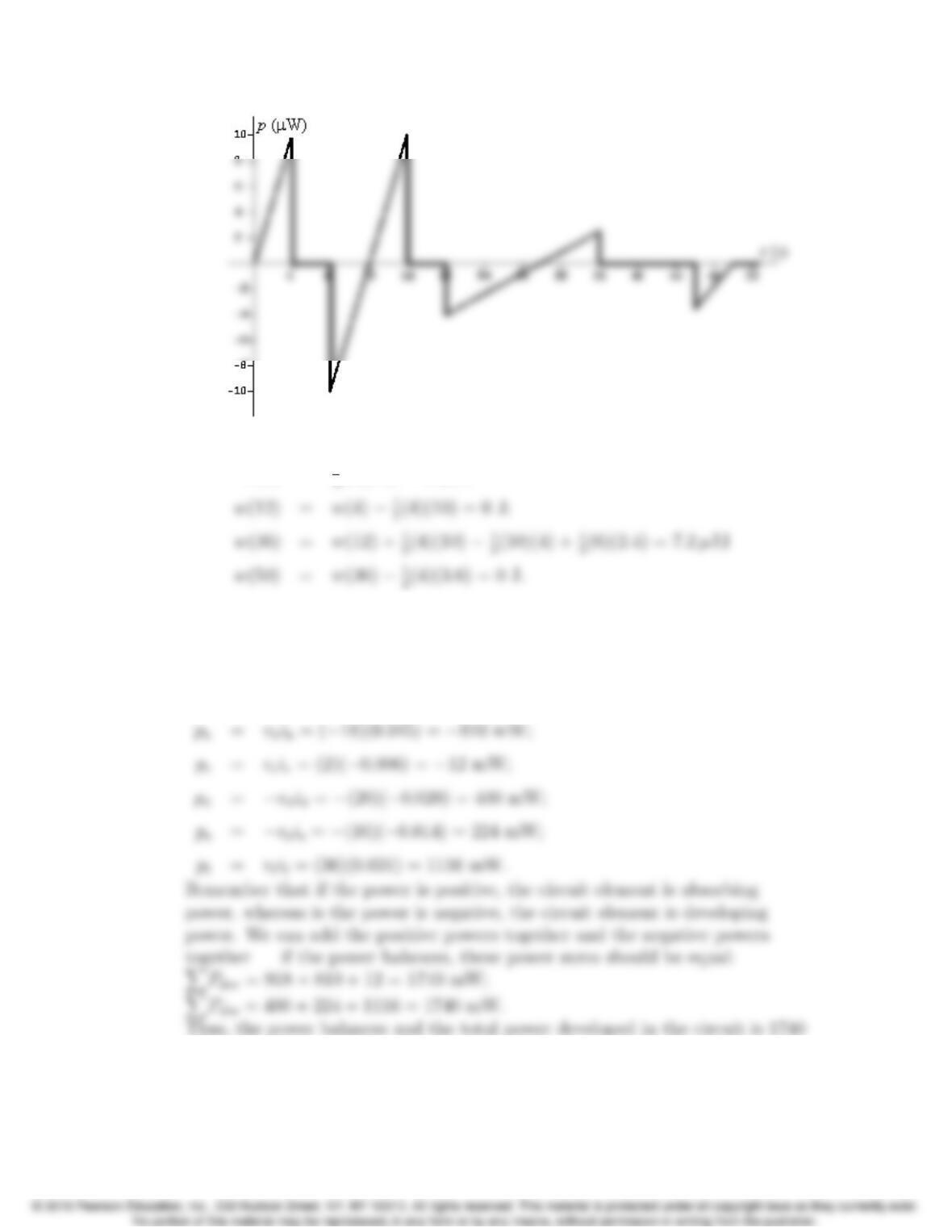
P 1.28 [a] 0st<4 s:
v=2.5tV; i=1µA; p=2.5tµW;
4s<t8 s:
8st<16 s:
16s<t20 s:
1–16 CHAPTER 1. Circuit Variables
[b] Calculate the area under the curve from zero up to the desired time:
w(4) = 1
P 1.29 We use the passive sign convention to determine whether the power equation
is p=vi or p=vi and substitute into the power equation the values for v
and i, as shown below:
pa=vaia=(18)(0.051) = 918 mW;
mW.
P 1.30 [a] Remember that if the circuit element is absorbing power, the power is
positive, whereas if the circuit element is supplying power, the power is
Problems 1–17
[b] The current can be calculated using i=p/v or i=p/v, with proper
application of the passive sign convention:
ia=pa/va=(600)/(400) = 1.5 A;
P 1.31 pa=vaia=(3000)(0.250) = 750 W;
Therefore,
P 1.32 [a] If the power balances, the sum of the power values should be zero:
[b] When the power is positive, the element is absorbing power. Since
1–18 CHAPTER 1. Circuit Variables
[c] The voltage can be calculated using v=p/i or v=p/i, with proper
application of the passive sign convention:
va=pa/ia= (0.175)/(0.025) = 7 V;
vb=pb/ib= (0.375)/(0.075) = 5 V;
P 1.33 [a] From the diagram and the table we have
pa=vaia=(900)(22.5) = 20,250 W;
pb=vbib=(105)(52.5) = 5512.5 W;
[b] The di↵erence between the power delivered to the circuit and the power
absorbed by the circuit is
P 1.34 pa=vaia= (120)(10) = 1200 W;
pb=vbib=(120)(9) = 1080 W;
pc=vcic= (10)(10) = 100 W;
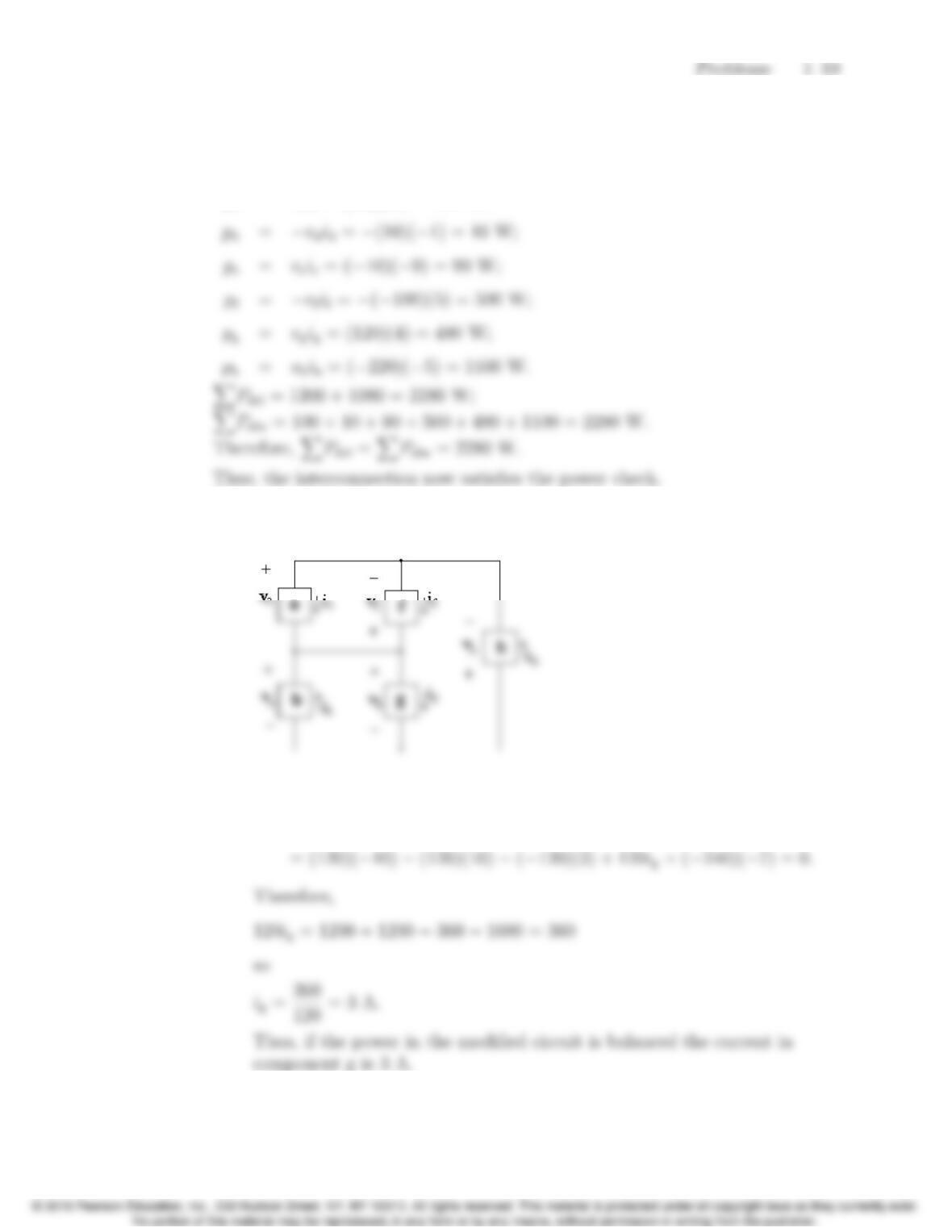
P 1.35 [a] The revised circuit model is shown below:
[b] The expression for the total power in this circuit is
vaiavbibvfif+vgig+vhih