Fourier Series
Assessment Problems
AP 16.1
av=1
TZ2T/3
0Vmdt +1
TZT
2T/3✓Vm
3◆dt =7
9Vm=7πV;
AP 16.2 [a] av=7π= 21.99 V.
[b] a1=5.196; a2=2.598; a3= 0; a4=1.299; a5=1.039.
AP 16.3 Odd function with both half- and quarter-wave symmetry.
16
16–2 CHAPTER 16. Fourier Series
bk= 0 for keven;
AP 16.4 [a] From the results of Assessment Problem 16.1:
av= 21.99 V;
[b] ω0=2π
T=2π
0.12566 = 50 rad/s.
Problems 16–3
AP 16.5 The Fourier series for the input voltage is
vi=8A
π2
1
X
n=1,3,5,… ✓1
n2sin nπ
2◆sin nω0(t+T/4)
8A
π2=8(281.25π2)
π2= 2250 mV;
From the circuit we have
Vo=Vi
R+ (1/jωC)·1
jωC=Vi
1+jωRC;
16–4 CHAPTER 16. Fourier Series
AP 16.6 [a] ωo=2π
T=2π
0.2π(103)=10
4rad/s;
vg(t) = 840
1
X
n=1,3,5,…
1
nsin nπ
2cos n10,000tV
Vg1= 840/0V; Vg3= 280/180V;
Vo1=Vg1H1= 17.50/88.81V;
Problems 16–5
AP 16.7
w0=2π⇥103
2094.4= 3 rad/s.
VR=2
2+s+1/s(Vg)= 2sVg
s2+2s+1;
H(s)= VR
Vg!=2s
s2+2s+1;
P1=(15.588/p2)2
2= 60.75 W;
16–6 CHAPTER 16. Fourier Series
AP 16.8 Odd function with half- and quarter-wave symmetry, therefore av=0,a
k=0
for all k, bk= 0 for keven; for kodd we have
AP 16.9 [a] Irms =s2
T(2)2✓T
8◆(2) + (8)2✓3T
8T
8◆=p34 = 5.7683 A.
[d] Using just the terms C1–C9,
AP 16.10 T= 32 ms,therefore 8 ms requires shifting the function T/4 to the right.
P 16.1 [a] ωoa =2π
200 ⇥106= 31,415.93 rad/s;
[d] The periodic function in Fig. P16.1(a):
ava =0.
bka =2
TZT/4
040 sin 2πkt
Tdt +2
TZT/2
T/480 sin 2πkt
Tdt
The periodic function in Fig. P16.1(b):
16–8 CHAPTER 16. Fourier Series
akb =2
TZT/8
T/8100 cos 2πkt
Tdt =200
T
T
2πksin 2πk
Tt
T/8
T/8
=200
πksin πk
4.
[e] For the periodic function in Fig. P16.1(a),
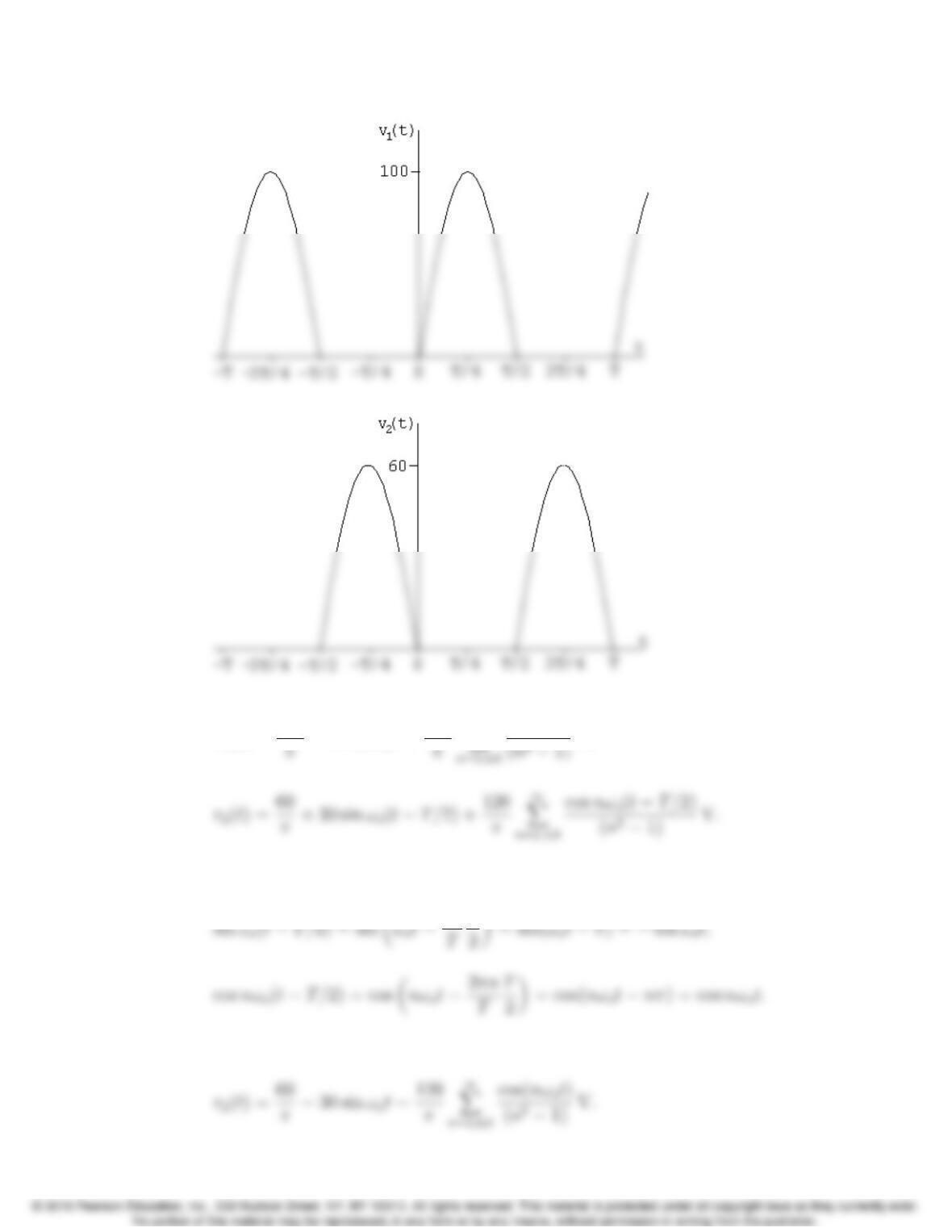
P 16.2 In studying the periodic function in Fig. P16.2 note that it can be visualized
as the combination of two half-wave rectified sine waves, as shown in the figure
below. Hence we can use the Fourier series for a half-wave rectified sine wave
with a magnitude of Vm, which is derived first.
av=1
TZT/2
0Vmsin ✓2π
T◆t dt =Vm
π;
Problems 16–9
v1(t) = 100
1
X
cos nωot
Observe the following:
T
Using the observations above and that fact that nis even,
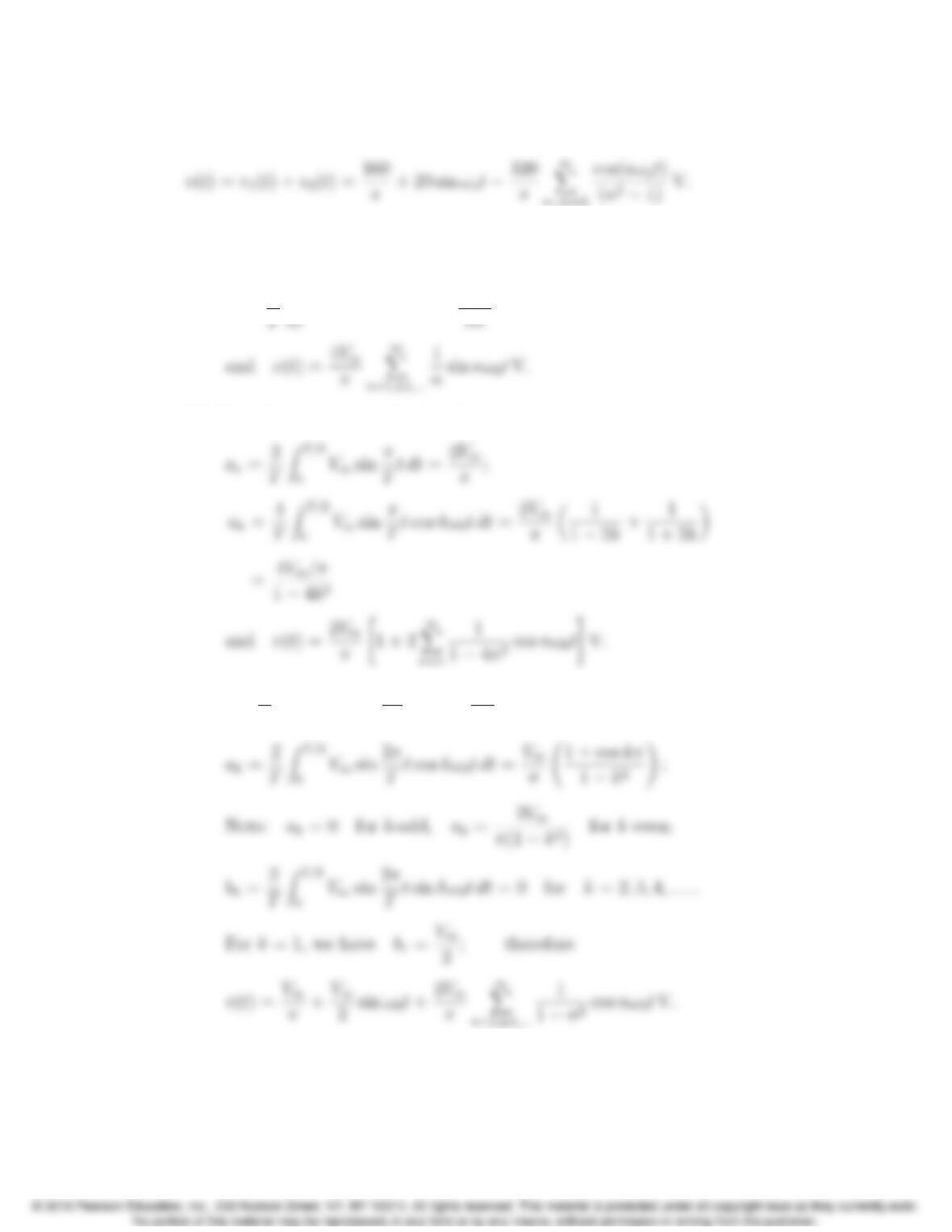
16–10 CHAPTER 16. Fourier Series
Thus,
P 16.3 [a] Odd function with half- and quarter-wave symmetry, av=0,a
k= 0 for all
k, bk= 0 for even k;forkodd we have
bk=8
[b] Even function: bk= 0 for k
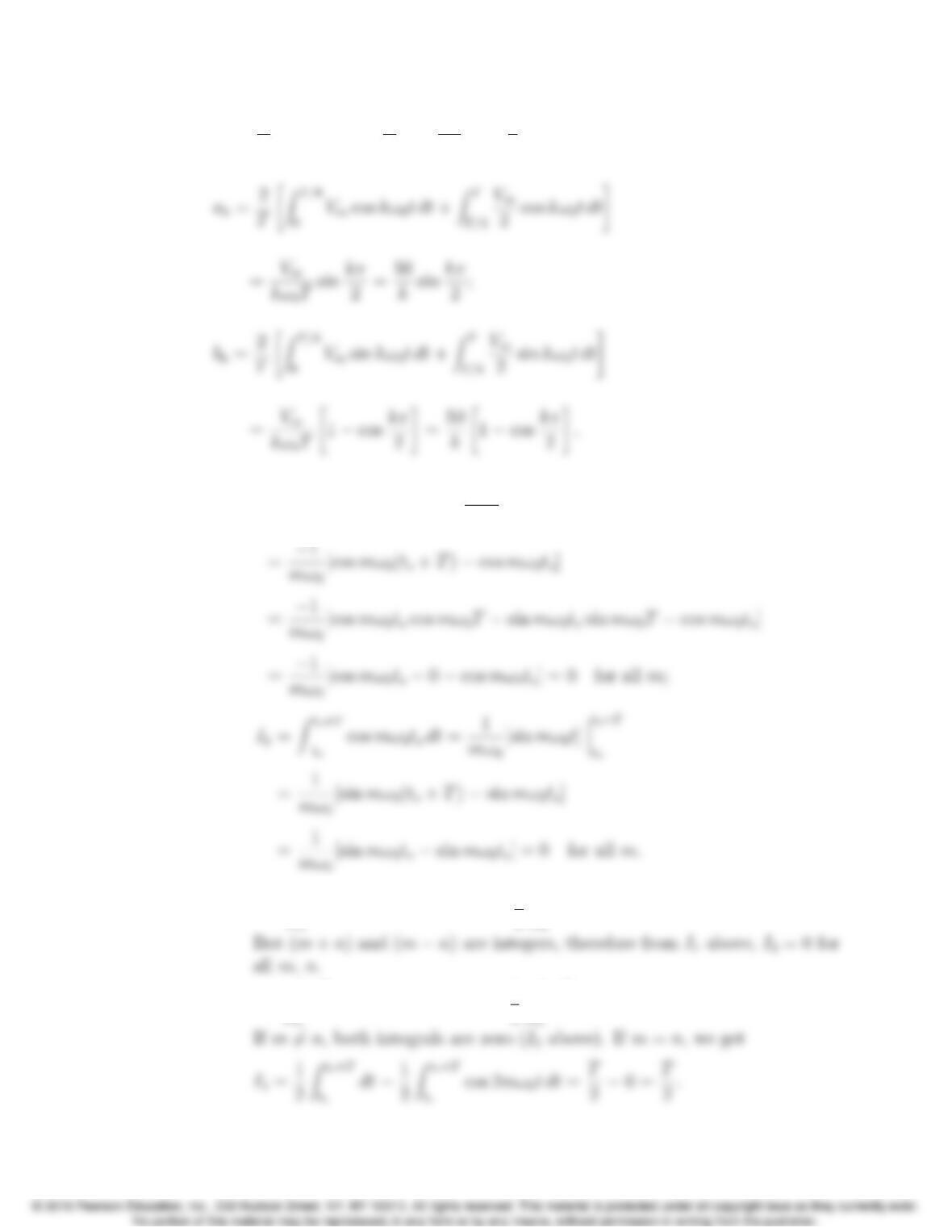
[c] av=1
TZT/2
0Vmsin ✓2π
T◆t dt =Vm
π;
Problems 16–11
P 16.4 av=1
TZT/4
0Vmdt +1
TZT
T/4
Vm
2dt =5
8Vm= 62.5πV;
P 16.5 [a] I1=Zto+T
to
sin mω0t dt =1
mω0
cos mω0t
to+T
to
[b] I3=Zto+T
cos mω0tsin nω0t dt =1
2Zto+T
[sin(m+n)ω0tsin(mn)ω0t]dt.
[c] I4=Zto+T
sin mω0tsin nω0t dt =1
[cos(mn)ω0tcos(m+n)ω0t]dt.
16–12 CHAPTER 16. Fourier Series
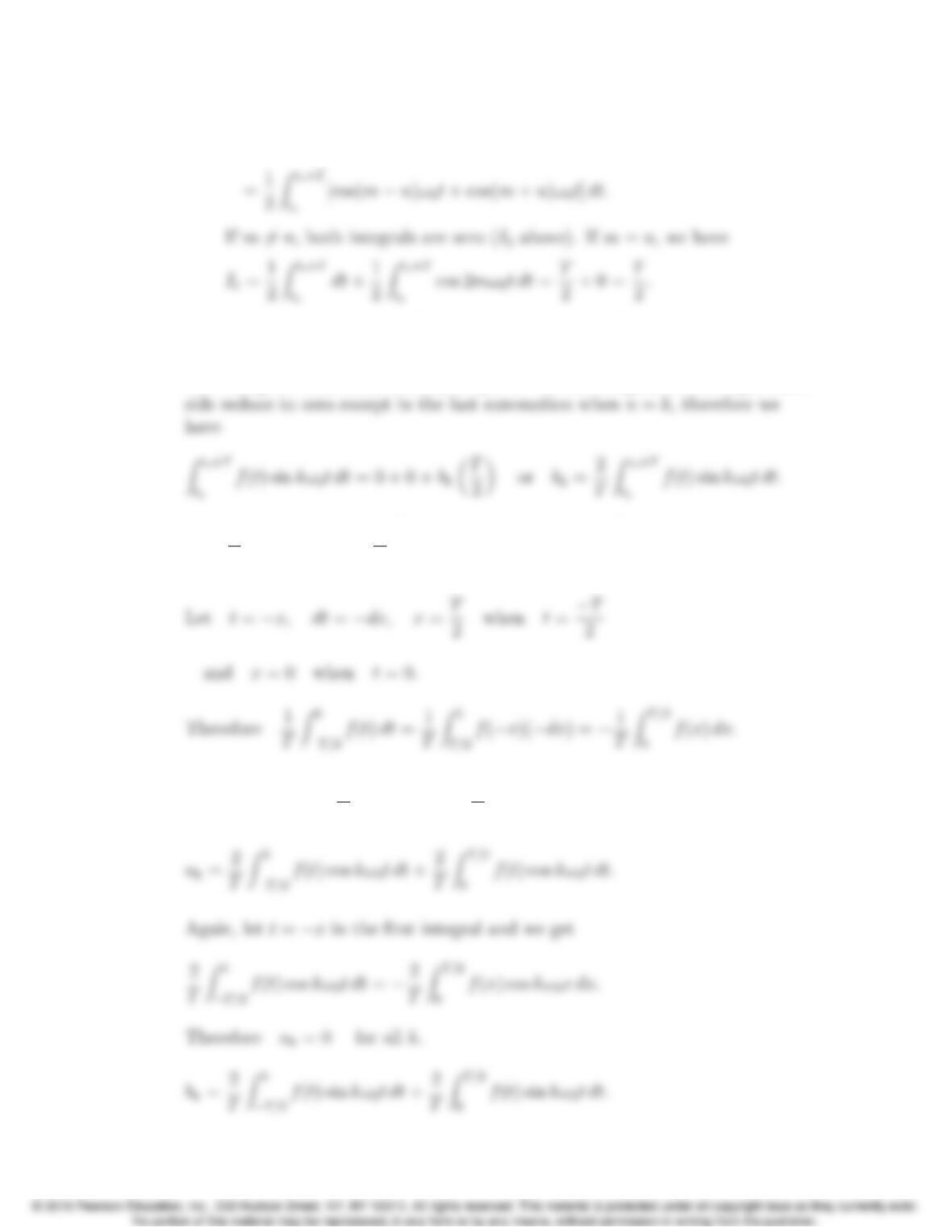
[d] I5=Zto+T
to
cos mω0tcos nω0t dt
P 16.6 f(t) sin kω0t=avsin kω0t+
1
X
n=1
ancos nω0tsin kω0t+
1
X
n=1
bnsin nω0tsin kω0t.
Now integrate both sides from toto to+T. All the integrals on the right-hand
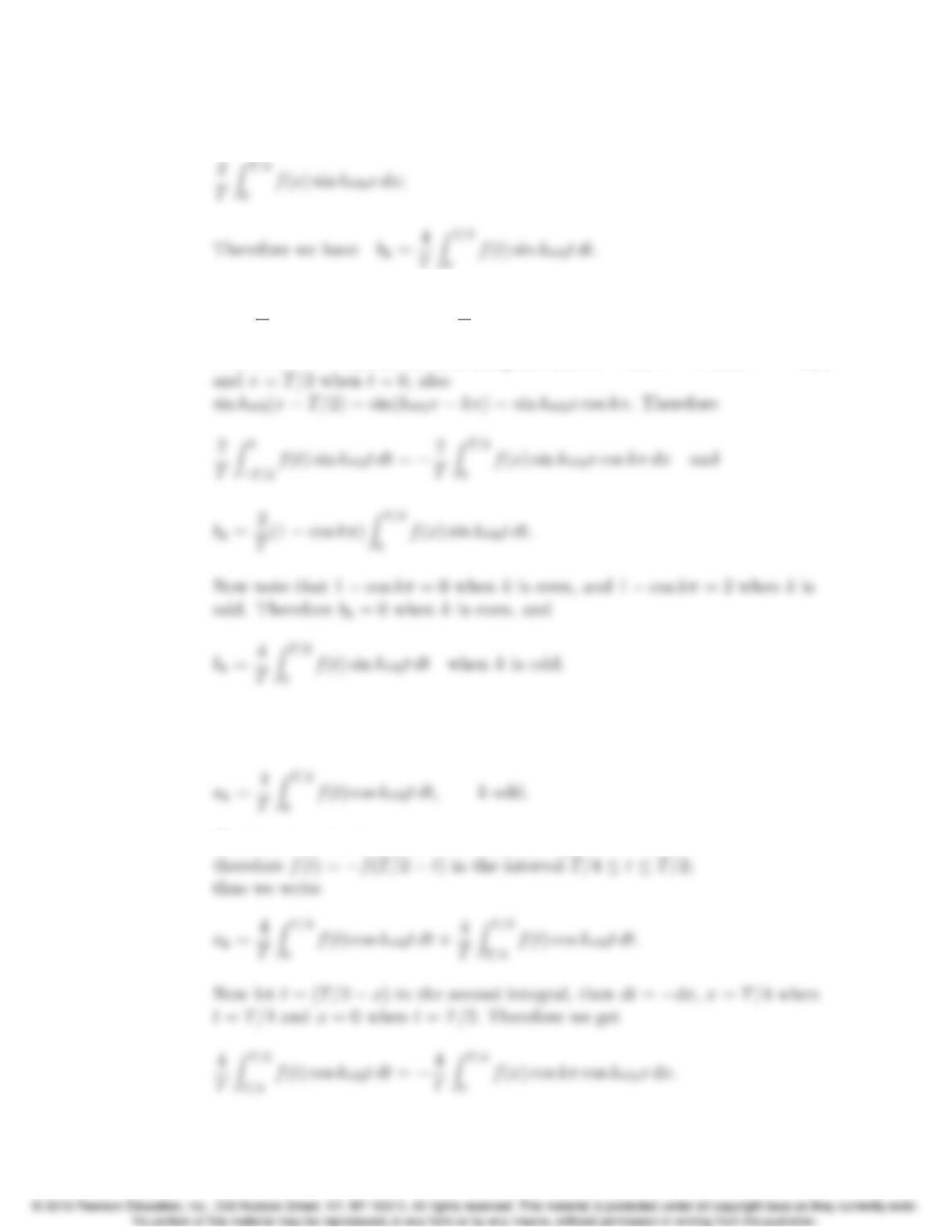
P 16.7 av=1
TZto+T
to
f(t)dt =1
T(Z0
T/2f(t)dt +ZT/2
0f(t)dt);
Therefore av=1
TZT/2
0f(t)dt +1
TZT/2
0f(t)dt = 0;
Problems 16–13
Using the substitution t=x, the first integral becomes
P 16.8 bk=2
TZ0
T/2f(t) sin kω0t dt +2
TZT/2
0f(t) sin kω0t dt.
Now let t=xT/2 in the first integral, then dt =dx, x = 0 when t=T/2
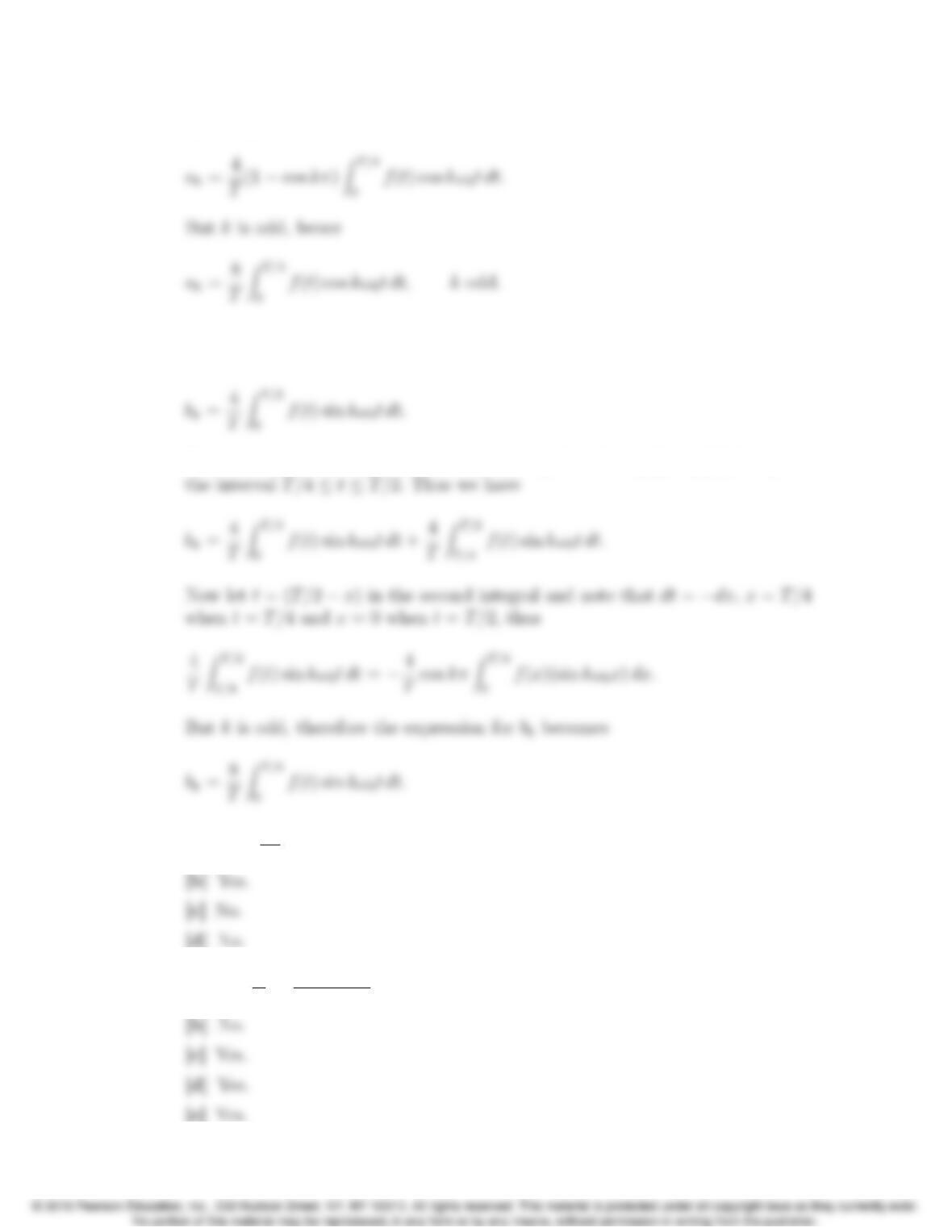
P 16.9 Because the function is even and has half-wave symmetry, we have av=0,
ak= 0 for keven, bk= 0 for all kand
The function also has quarter-wave symmetry;
16–14 CHAPTER 16. Fourier Series
Therefore we have
P 16.10 Because the function is odd and has half-wave symmetry, av=0,a
k= 0 for all
k, and bk= 0 for keven. For kodd we have
The function also has quarter-wave symmetry, therefore f(t)=f(T/2t) in
P 16.11 [a] ωo=2π
T=πrad/s.
P 16.12 [a] f=1
T=1
16 ⇥103= 62.5 Hz.
Problems 16–15
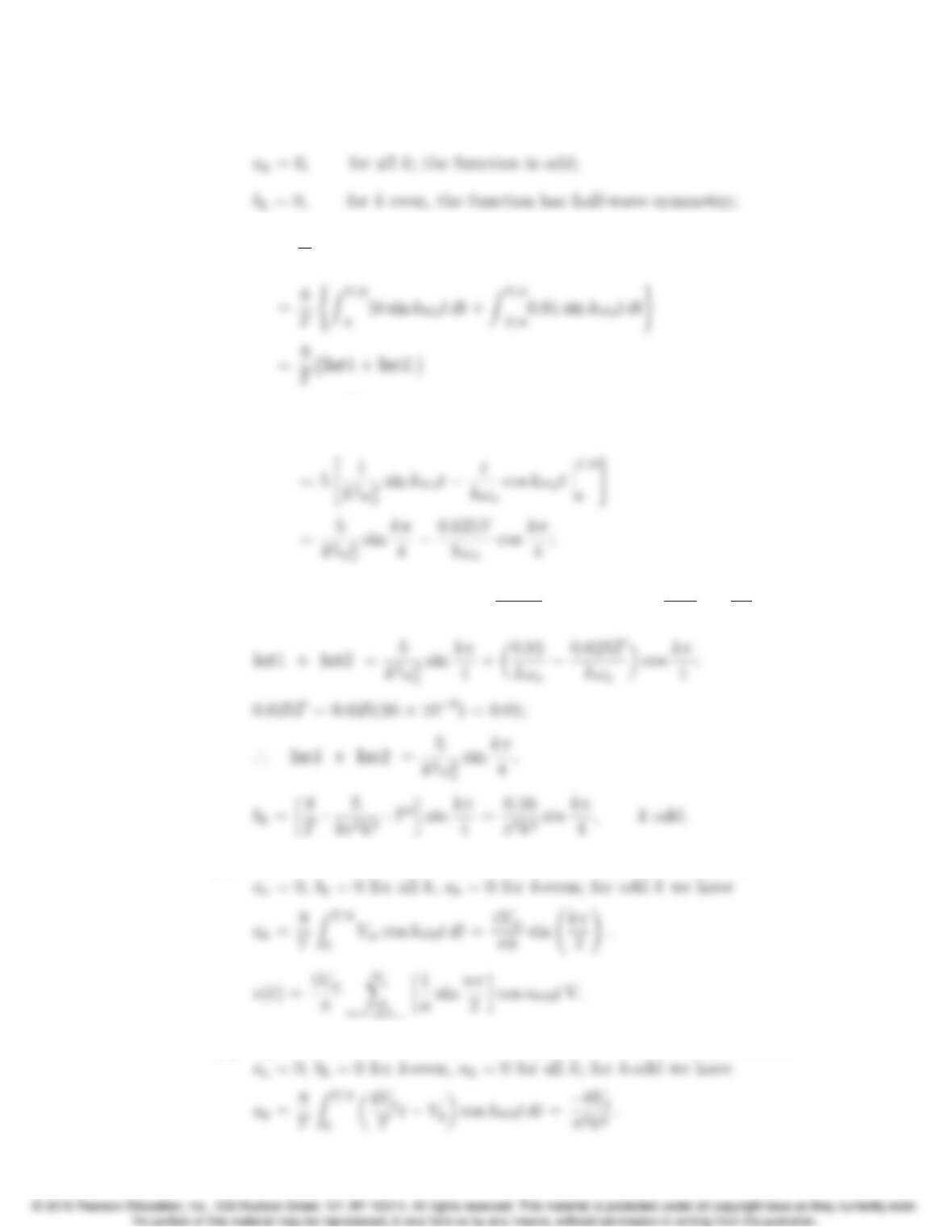
[f] av=0,function is odd;
bk=8
TZT/4
0f(t) sin kωot, k odd
Int1 = 5ZT/8
0tsin kωot dt
Int2 = 0.01ZT/4
T/8sin kωot dt =0.01
kωo
cos kωot
T/4
T/8
=0.01
kωo
cos kπ
4;
P 16.13 [a] v(t) is even and has both half- and quarter-wave symmetry, therefore
[b] v(t) is even and has both half- and quarter-wave symmetry, therefore
16–16 CHAPTER 16. Fourier Series
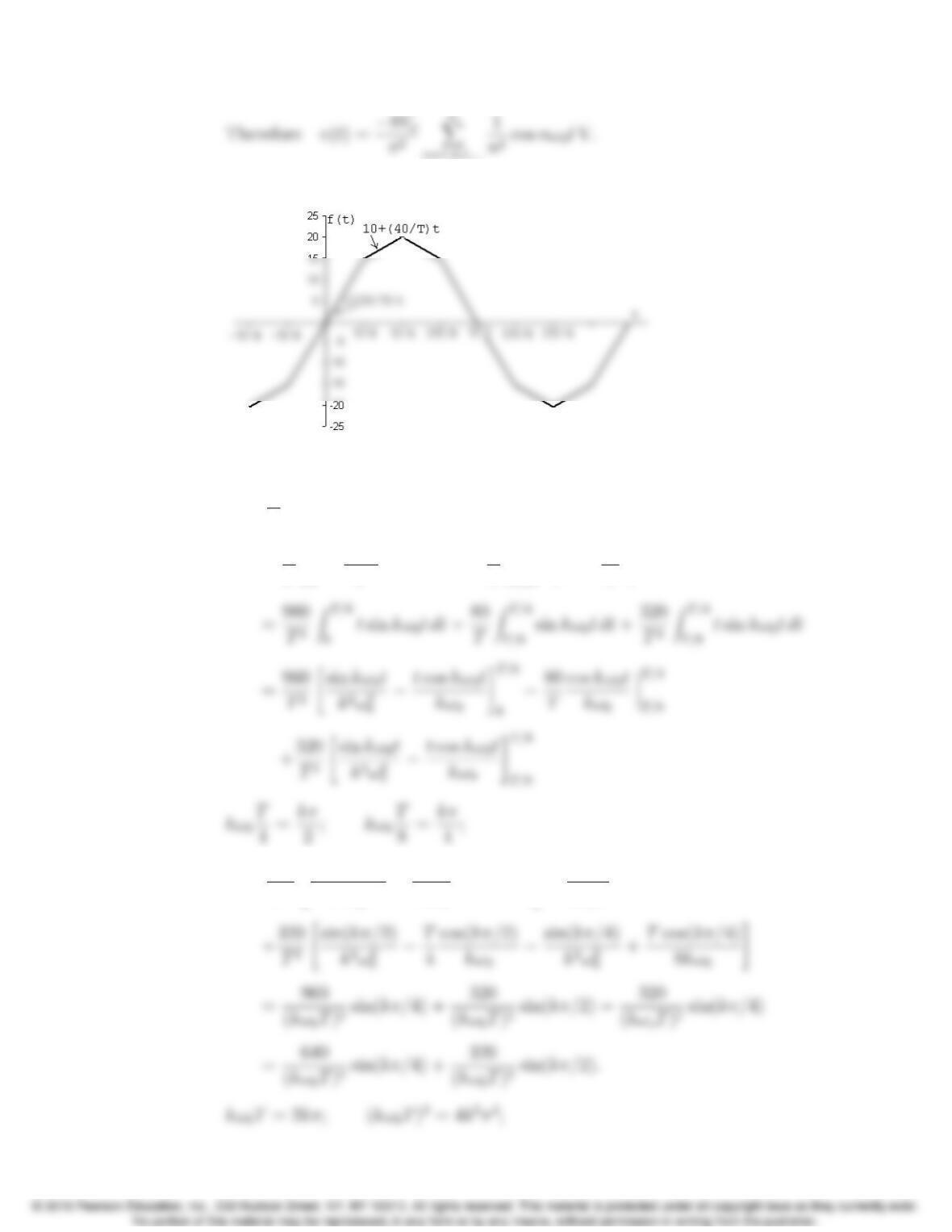
P 16.14 [a]
[b] av= 0; ak=0,for all k;bk=0,for keven.
bk=8
TZT/4
0f(t) sin kω0t dt, for kodd
=8
TZT/8
0
120t
Tsin kω0t dt +8
TZT/4
T/8✓10 + 40
Tt◆sin kω0t dt
bk=960
T2“sin(kπ/4)
k2ω2
0T
8kω0
cos(kπ/4)#80
kω0T[cos(kπ/2) cos(kπ/4)]
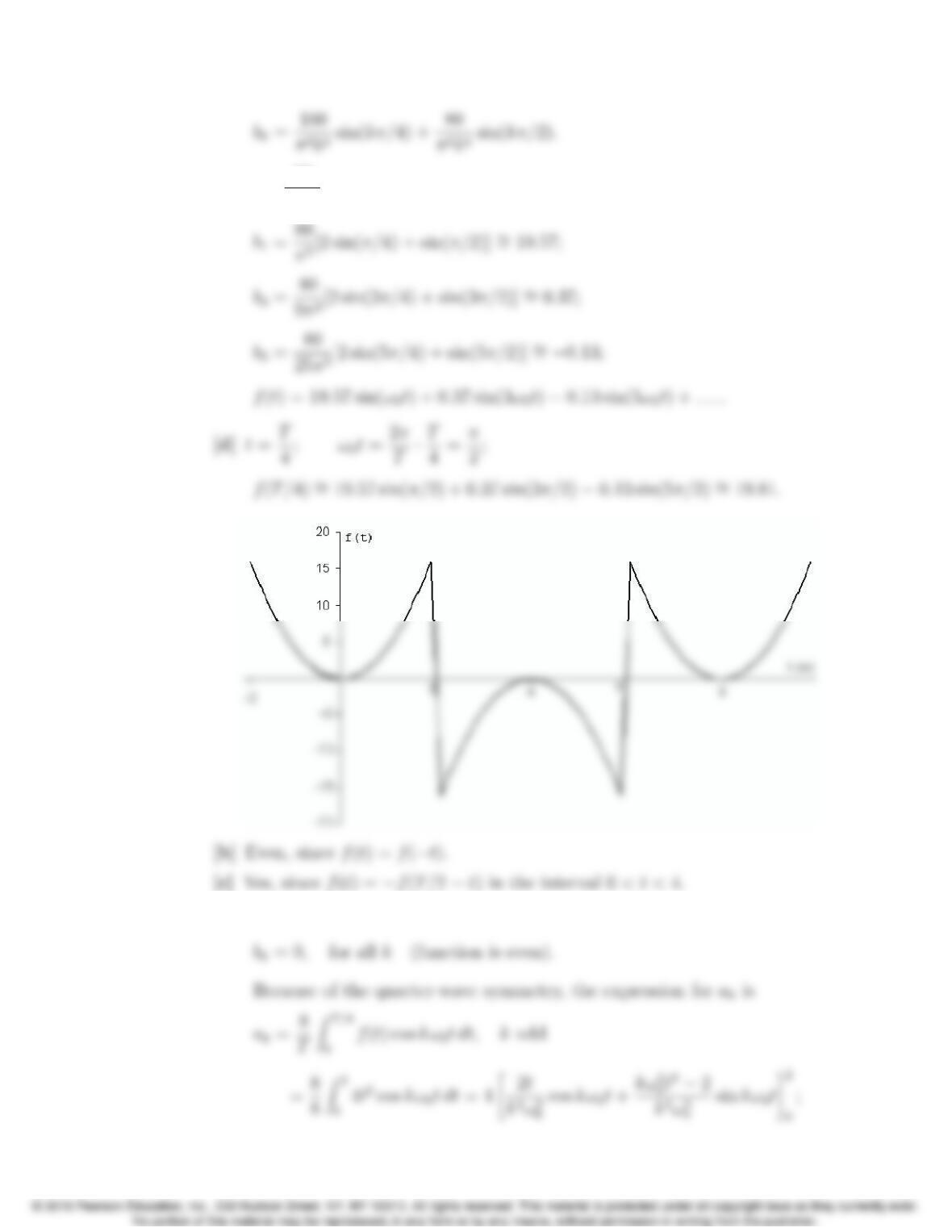
Problems 16–17
[c] bk=80
π2k2[2 sin(kπ/4) + sin(kπ/2)];
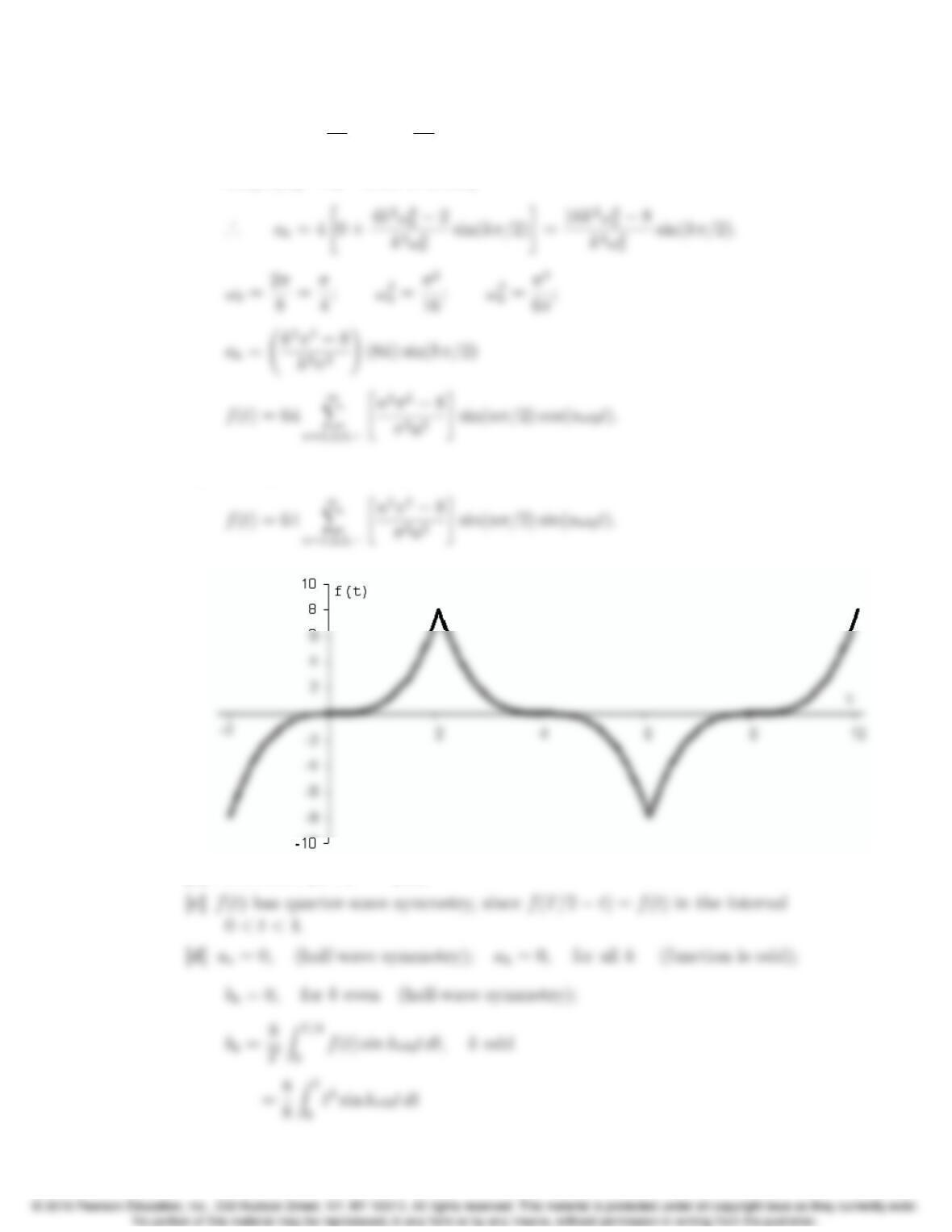
P 16.15 [a]
[d] av=0,a
k=0,for keven (half-wave symmetry);
16–18 CHAPTER 16. Fourier Series
kω0(2) = k✓2π
8◆(2) = kπ
2;
cos(kπ/2) = 0,since kis odd;
[e] cos nω0(t2) = cos(nω0tπ/2) = sin nω0t;
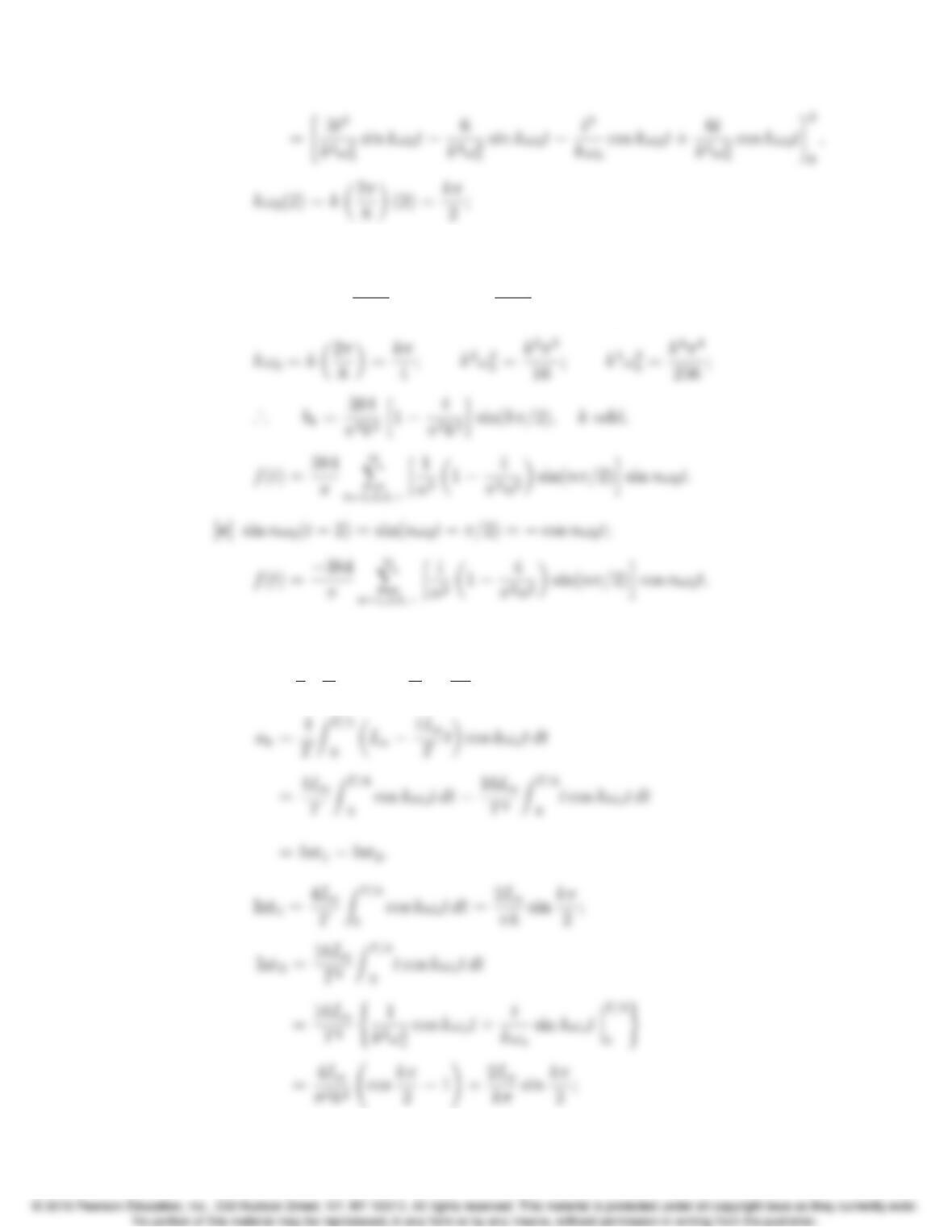
P 16.16 [a]
[b] Odd, since f(t)=f(t).
Problems 16–19
cos(kπ/2) = 0,since kis odd;
·
.. b
k=“24
k2ω2
0
sin(kπ/2) 6
k4ω2
0
sin(kπ/2)#.
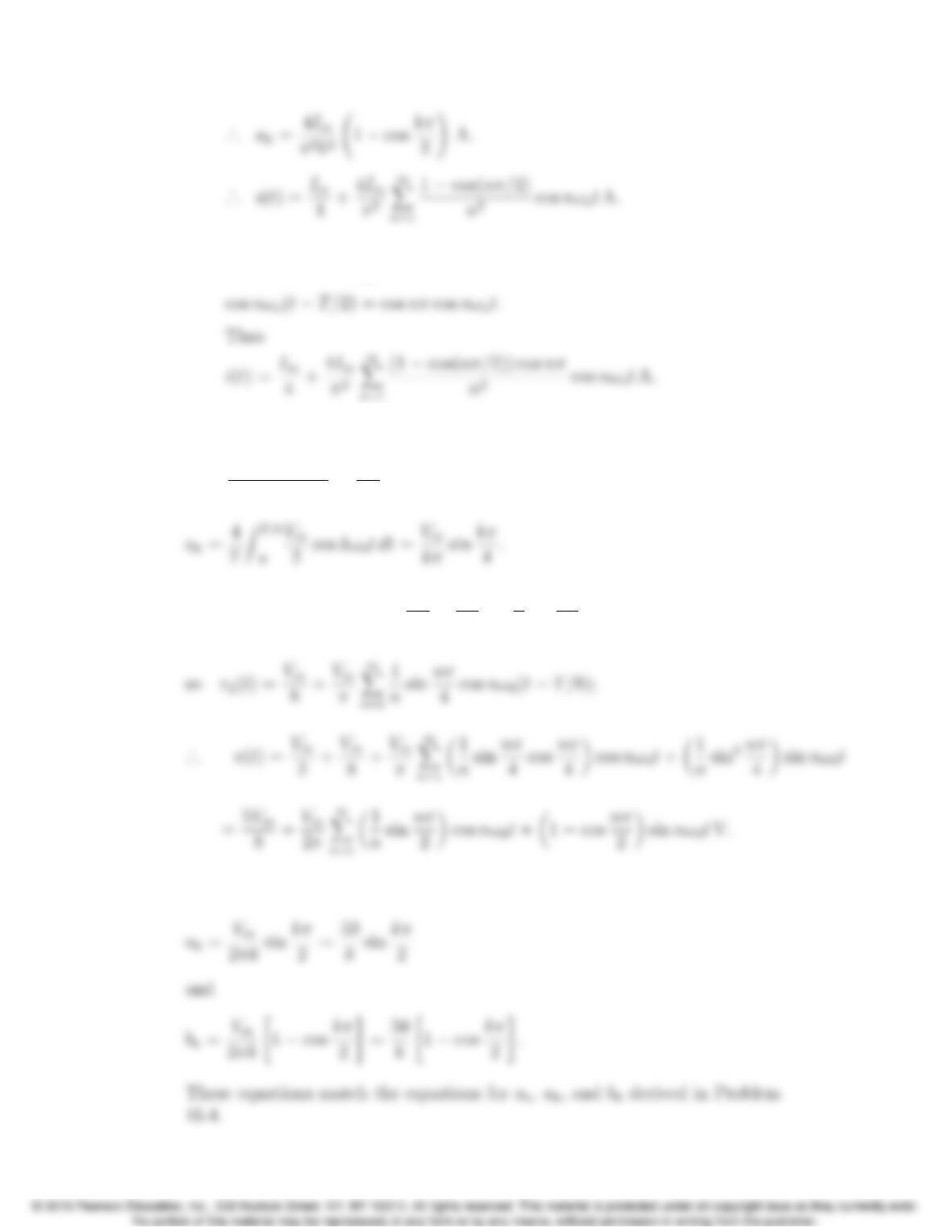
P 16.17 [a] i(t) is even, therefore bk= 0 for all k.
av=1
2·T
4·Im·2·1
T=Im
4A;
16–20 CHAPTER 16. Fourier Series
[b] Shifting the reference axis to the left is equivalent to shifting the periodic
function to the right:
P 16.18 v2(t+T/8) is even, so bk= 0 for all k.
av=(Vm/2)(T/4)
T=Vm
8;
Therefore, v2(t+T/8) = Vm
8+Vm
π
1
X
n=1
1
nsin nπ
4cos nω0t
Thus, since av=5Vm/8=62.5πV,