11–20 CHAPTER 11. Balanced Three-Phase Circuits
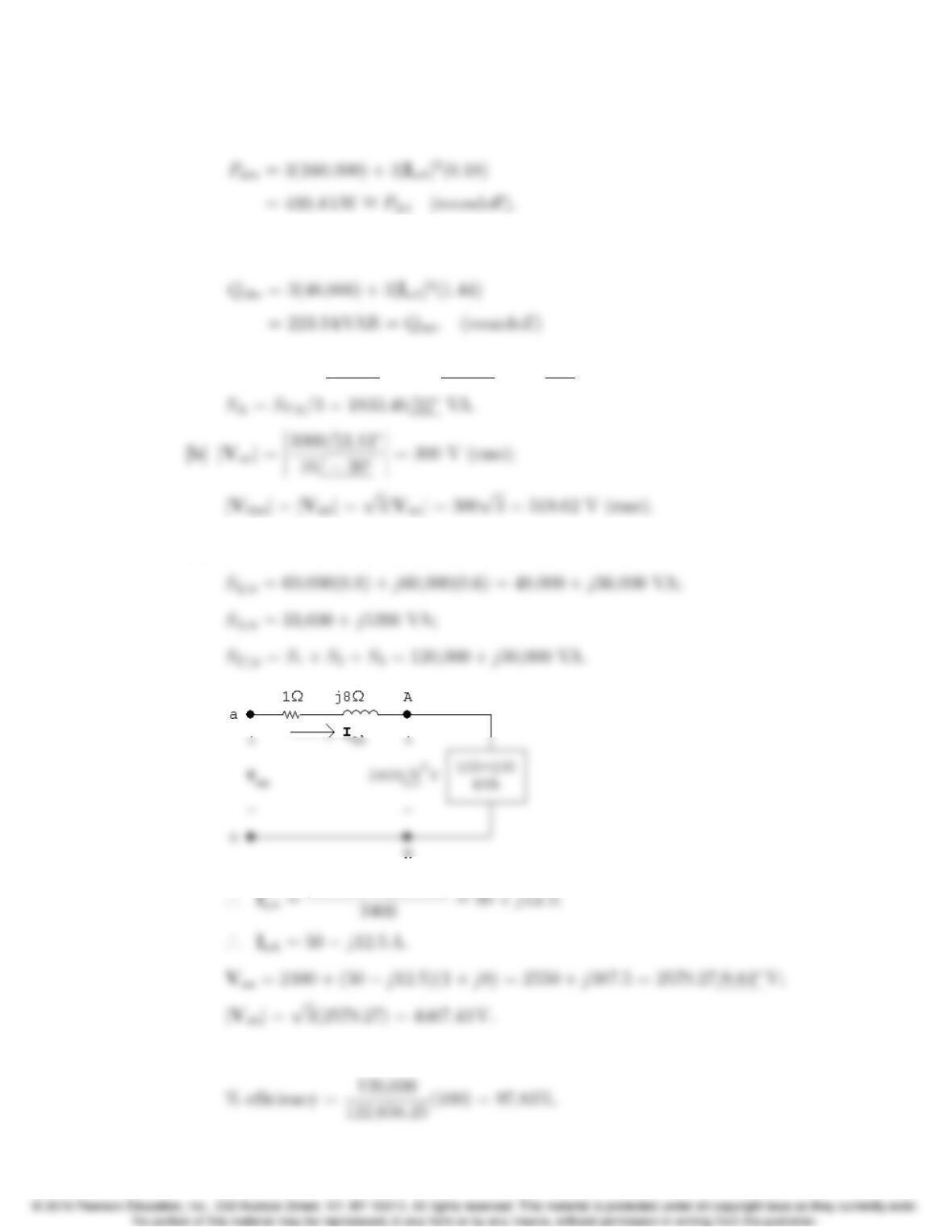
[c] Pdel = 490.2 kW;
[d] Qdel =3|IC|2(60) + 139.8×103= 223.2 kVAR;
P 11.27 [a] ST∆= 14,000/41.41−9000/53.13=5.5/22kVA;
P 11.28 [a] S1/= 40,000(0.96) −j40,000(0.28) = 38,400 −j11,200 VA;
[b] Sg/= (2550 + j387.5)(50 + j12.5) = 122,656.25 + j51,250 VA;
Problems 11–21
P 11.29 [a] S1= 10,200(0.87) + j10,200(0.493) = 8874 + j5029.13 VA;
Therefore
P 11.30 From the solution to Problem 11.20 we have:
P 11.31 Let pa,p
b,and pcrepresent the instantaneous power of phases a, b, and c,
respectively. Then assuming a positive phase sequence, we have
11–22 CHAPTER 11. Balanced Three-Phase Circuits
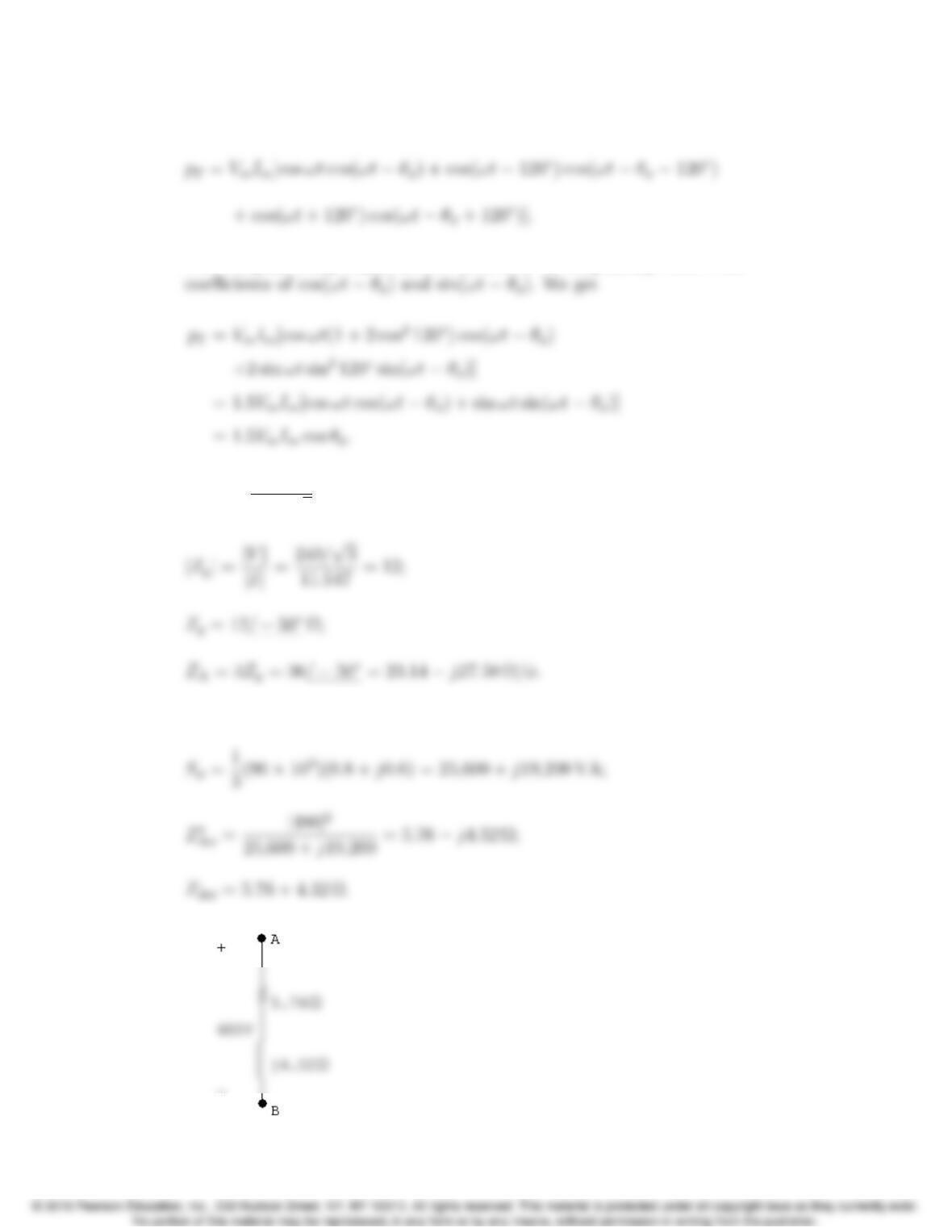
The total instantaneous power is pT=pa+pb+pc,so
Now simplify using trigonometric identities. In simplifying, collect the
P 11.32 |Iline|=1600
240/√3= 11.547 A (rms);
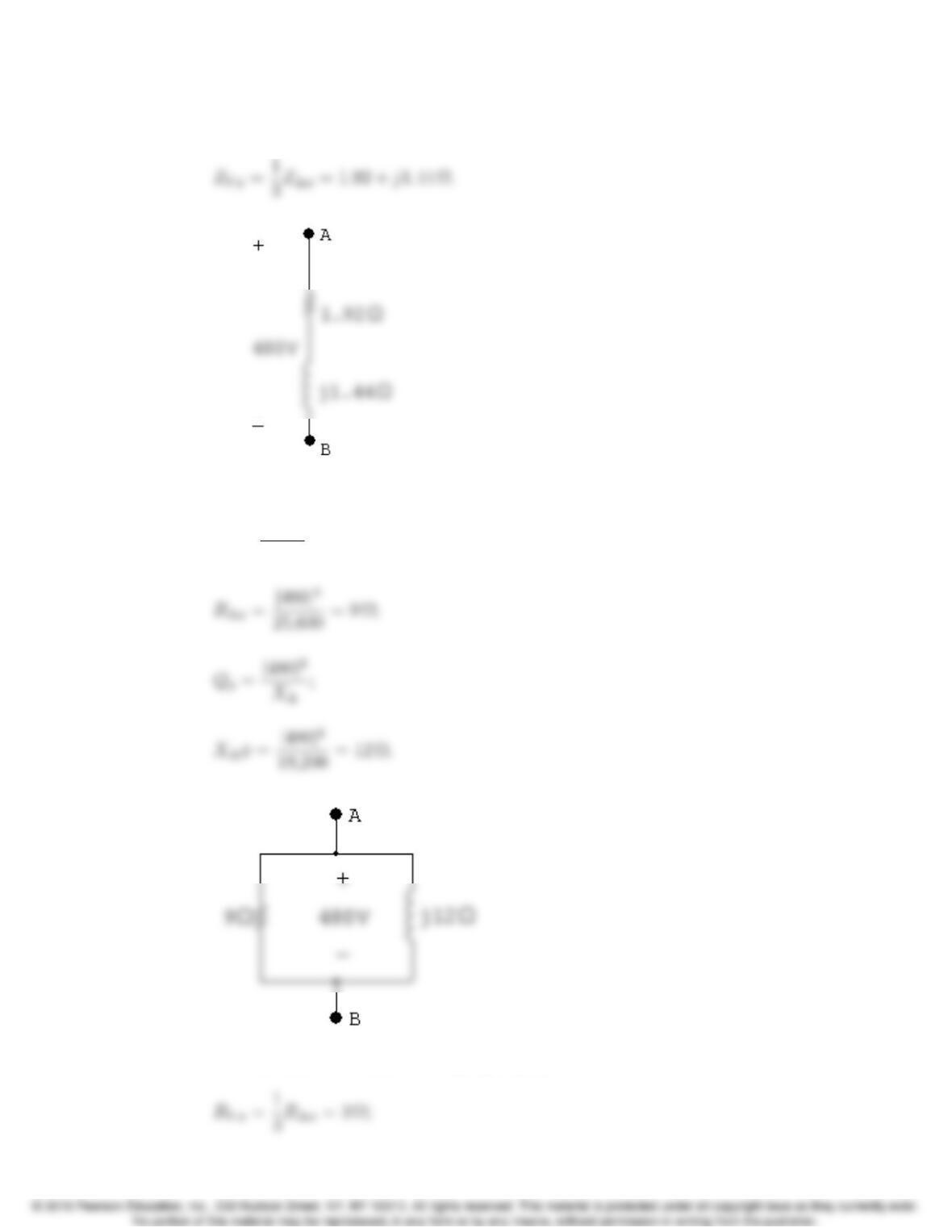
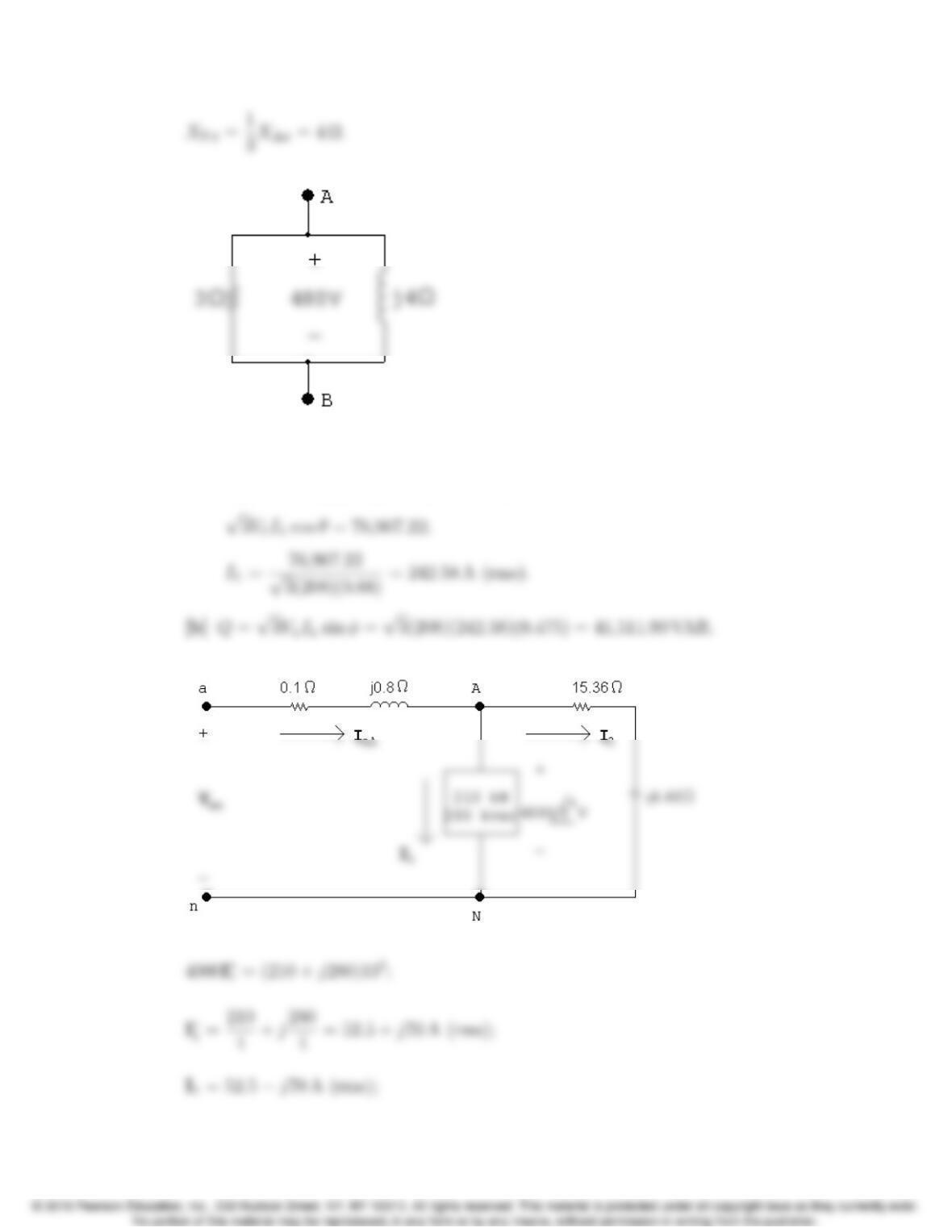
P 11.33 Assume a ∆-connected load (series):
Problems 11–23
Now assume a Y-connected load (series):
Now assume a ∆-connected load (parallel):
P=|480|2
R∆
;
Now assume a Y-connected load (parallel):
11–24 CHAPTER 11. Balanced Three-Phase Circuits
P 11.34 [a] POUT = 746 ×100 = 74,600 W;
PIN = 74,600/(0.97) = 76,907.22 W;
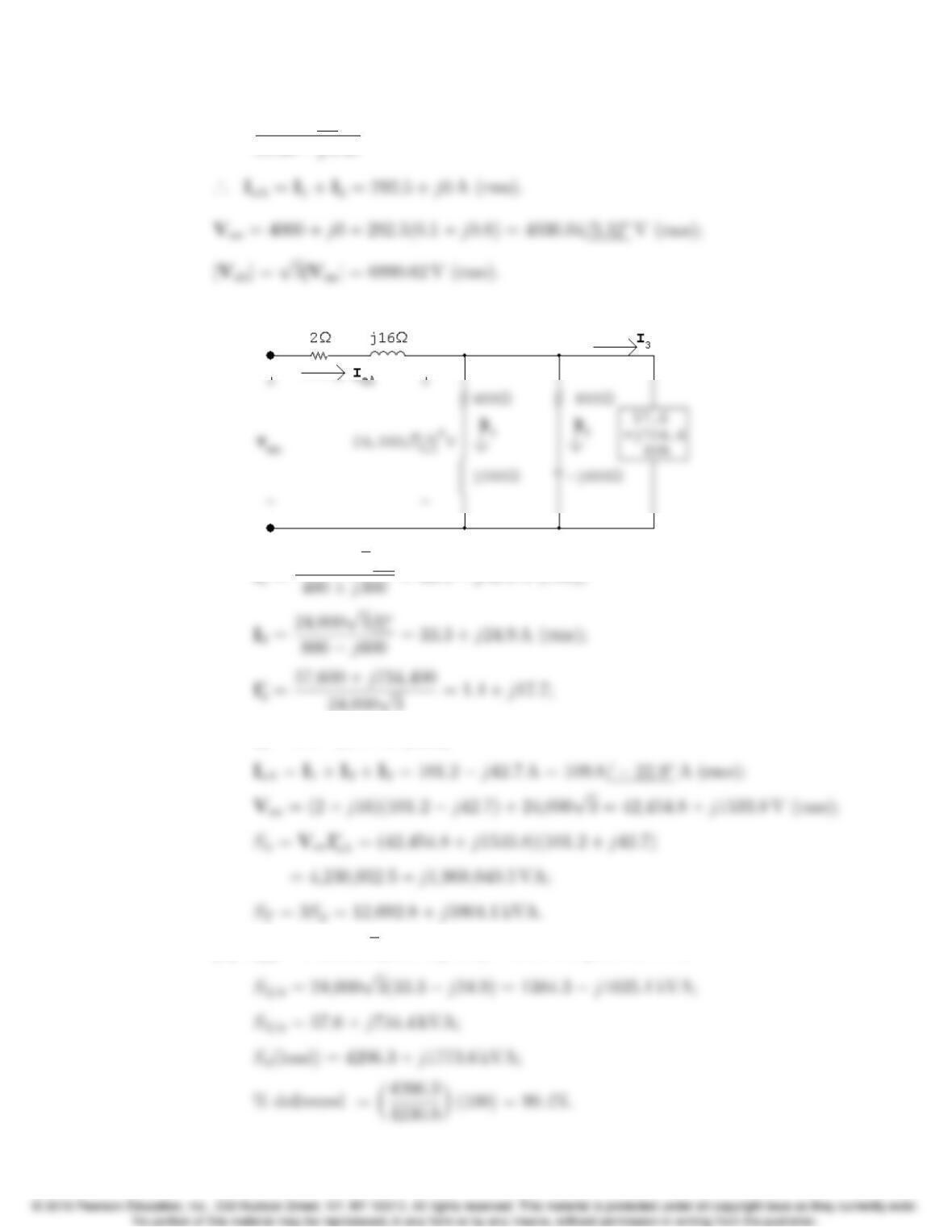
P 11.35
Problems 11–25
I2=4000/0
15.36 −j4.48 = 240 + j70 A (rms);
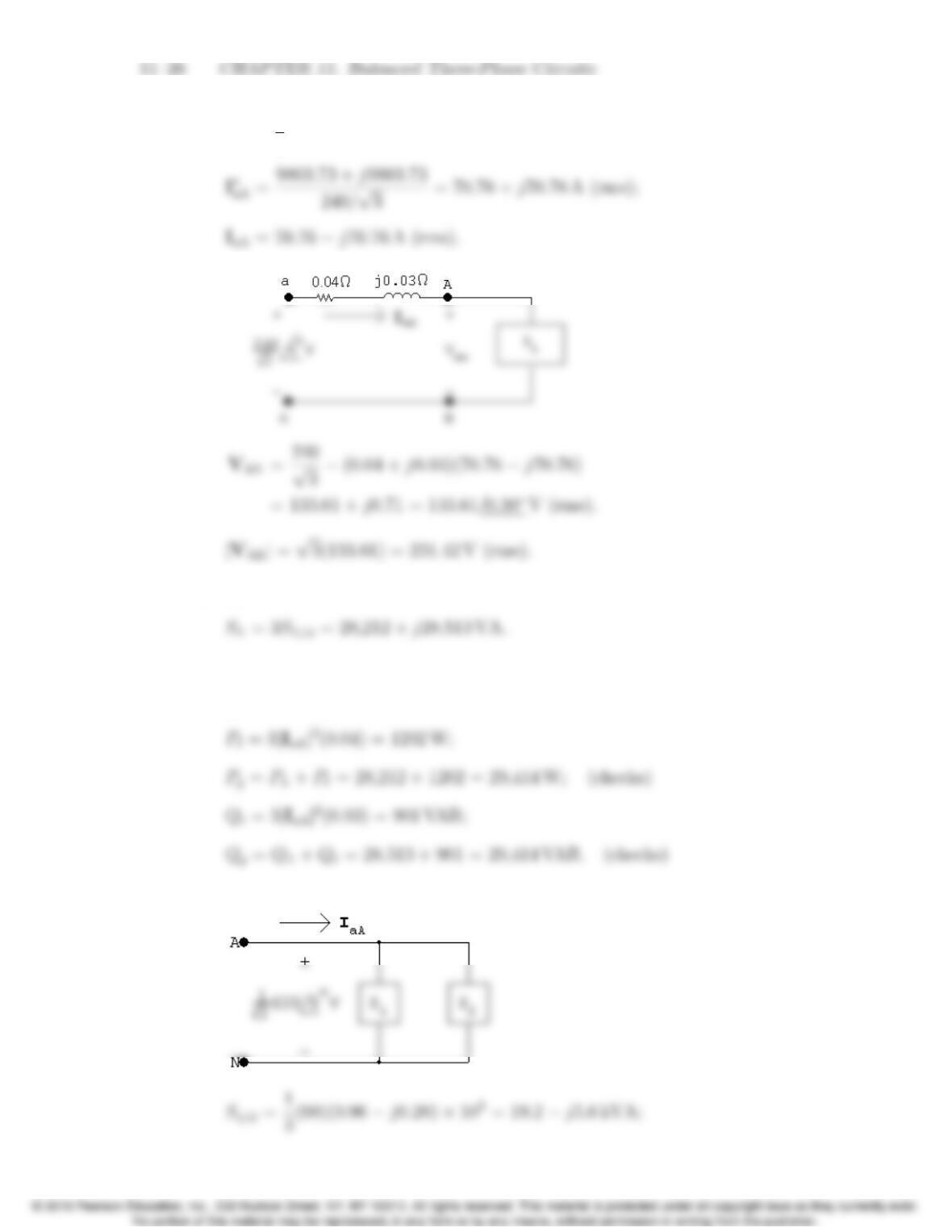
P 11.36 [a]
I1=24,000√3/0
I3=1.4−j17.7 A (rms);
[b] S1/= 24,000√3(66.5+j49.9) = 2764.4+j2074.3 kVA;
P 11.37 [a] Sg/=1
3(41.6)(0.707 + j0.707) ×103= 9803.73 + j9803.73 VA;
[b] SL/= (133.61 + j0.71)(70.76 + j70.76) = 9404 + j9504.5 VA;
Check:
Sg= 41,600(0.7071 + j0.7071) = 29,415 + j29,415 VA.
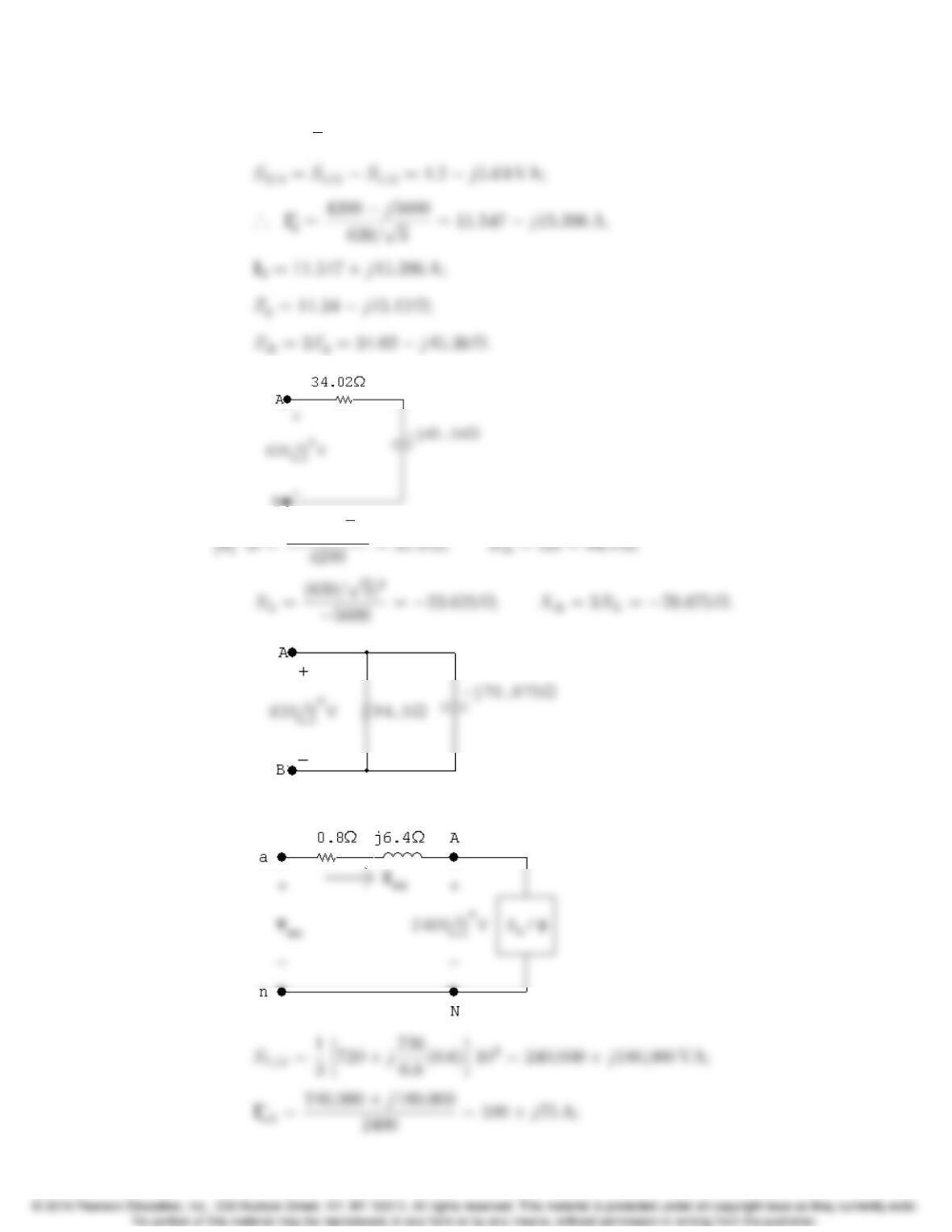
P 11.38 [a]
Problems 11–27
S1/=1
3(45) = 15 + j0 kVA;
P 11.39 [a]
11–28 CHAPTER 11. Balanced Three-Phase Circuits
IaA = 100 −j75 A;
[b]
I1= 100 −j75 A (from part [a]);
[c] |IaA|= 125 A;
[d] |IaA|= 100.125 A;
Problems 11–29
P 11.40 [a] From Assessment Problem 11.9, IaA = (101.8−j135.7) A (rms).
P 11.41 Wm1=|VAB||IaA|cos(/VAB −/IaA) = (199.58)(2.4) cos(65.68) = 197.26 W;
P 11.42 tan φ=√3(W2−W1)
W1+W2
=0.75;
P 11.43 IaA =VAN
Z
=|IL|/−θA;
11–30 CHAPTER 11. Balanced Three-Phase Circuits
P 11.44 [a] Z= 16 + j12 = 20/36.87Ω;
[b] Q= (342)(12) = 13,872 VAR;
[b] Z= (8 + j6) Ω;
Problems 11–31
P 11.46 Z=|Z|/θ=VAN
IaA
;
For a positive phase sequence,
Similarly,
For a positive phase sequence,
P 11.47 [a] Z= 160 + j120 = 200/36.87Ω
11–32 CHAPTER 11. Balanced Three-Phase Circuits
[b] Wm1= (4160)(36.03) cos(0 + 6.87) = 148,808.64 W
P 11.48 From the solution to Prob. 11.20 we have
[a] W1=|Vac||IaA|cos(θac −θaA)
[b] W2=|Vbc||IbB|cos(θbc −θbB)
[c] W1+W2= 118,421 W;
P 11.49 [a] I⇤
aA =(432/3)(0.96 −j0.28)103
7200 = 20/−16.26A;
[b] Current coil in line aA, measure IaA.
[c] IaA = 20/16.76A;
P 11.50 [a] W1=|VBA||IbB|cos θ.
Negative phase sequence:
VBA = 240√3/150V;
[b] P= (18)2(40/3) cos(−30) = 3741.23 W;
P 11.51 [a] Z=1
3Z∆=4.48 + j15.36 = 16/73.74Ω;
[b] W1+W2= 18,900 W;
[c] √3(W1−W2)=64,800 VAR;
11–34 CHAPTER 11. Balanced Three-Phase Circuits
P 11.52 [a] Negative phase sequence:
VAB = 240√3/−30V;
[b] Wm1+Wm2= 14,103.69 W.
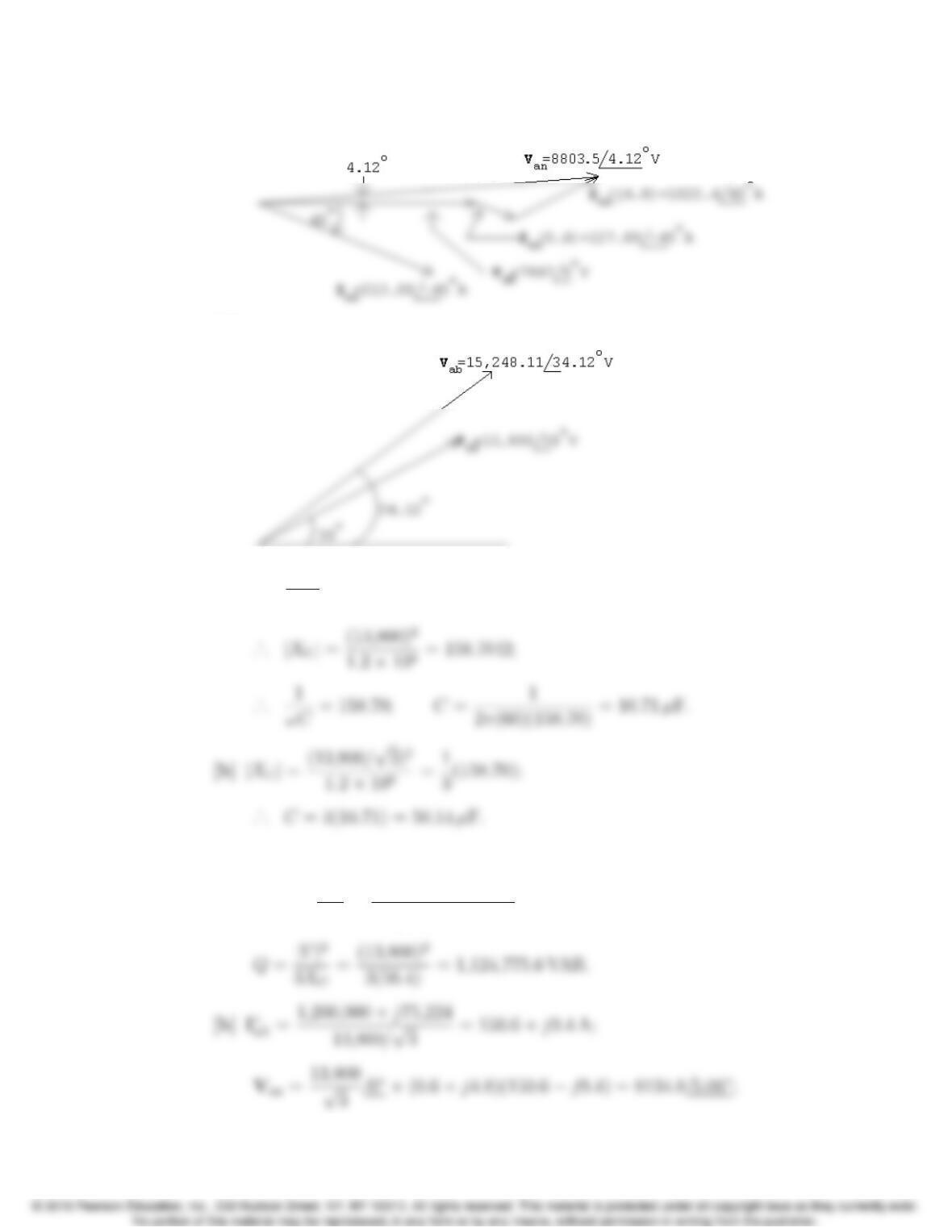
P 11.53 [a]
[b]
Problems 11–35
[c]
[d]
P 11.54 [a] Q=|V|2
XC
;
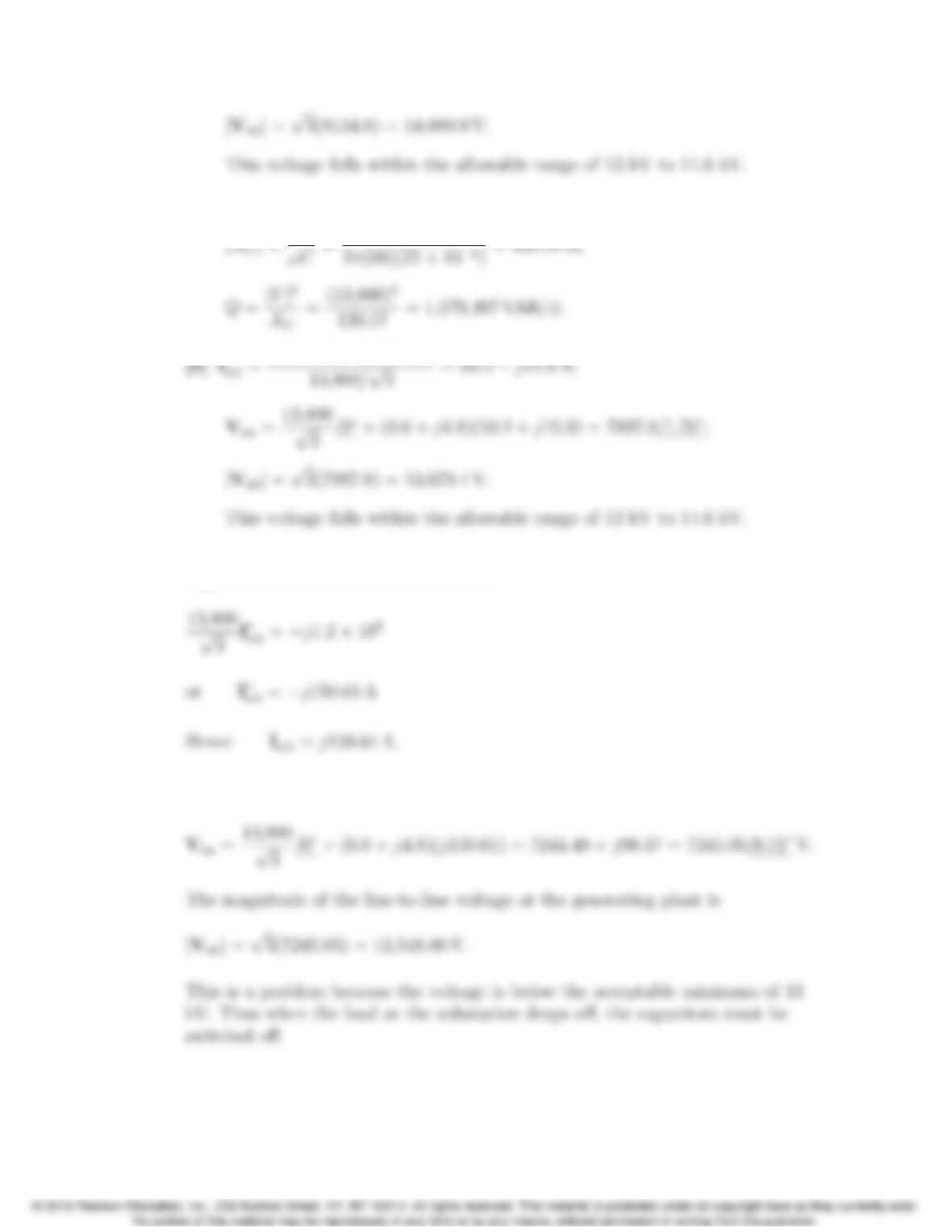
P 11.55 [a] The capacitor from Appendix H whose value is closest to 50.14 µF is 47 µF.
|XC|=1
ωC=1
2π(60)(47 ×106)= 56.4Ω;
11–36 CHAPTER 11. Balanced Three-Phase Circuits
P 11.56 [a] The capacitor from Appendix H whose value is closest to 16.71 µF is 22 µF.
P 11.57 If the capacitors remain connected when the substation drops its load, the
expression for the line current becomes
Now,
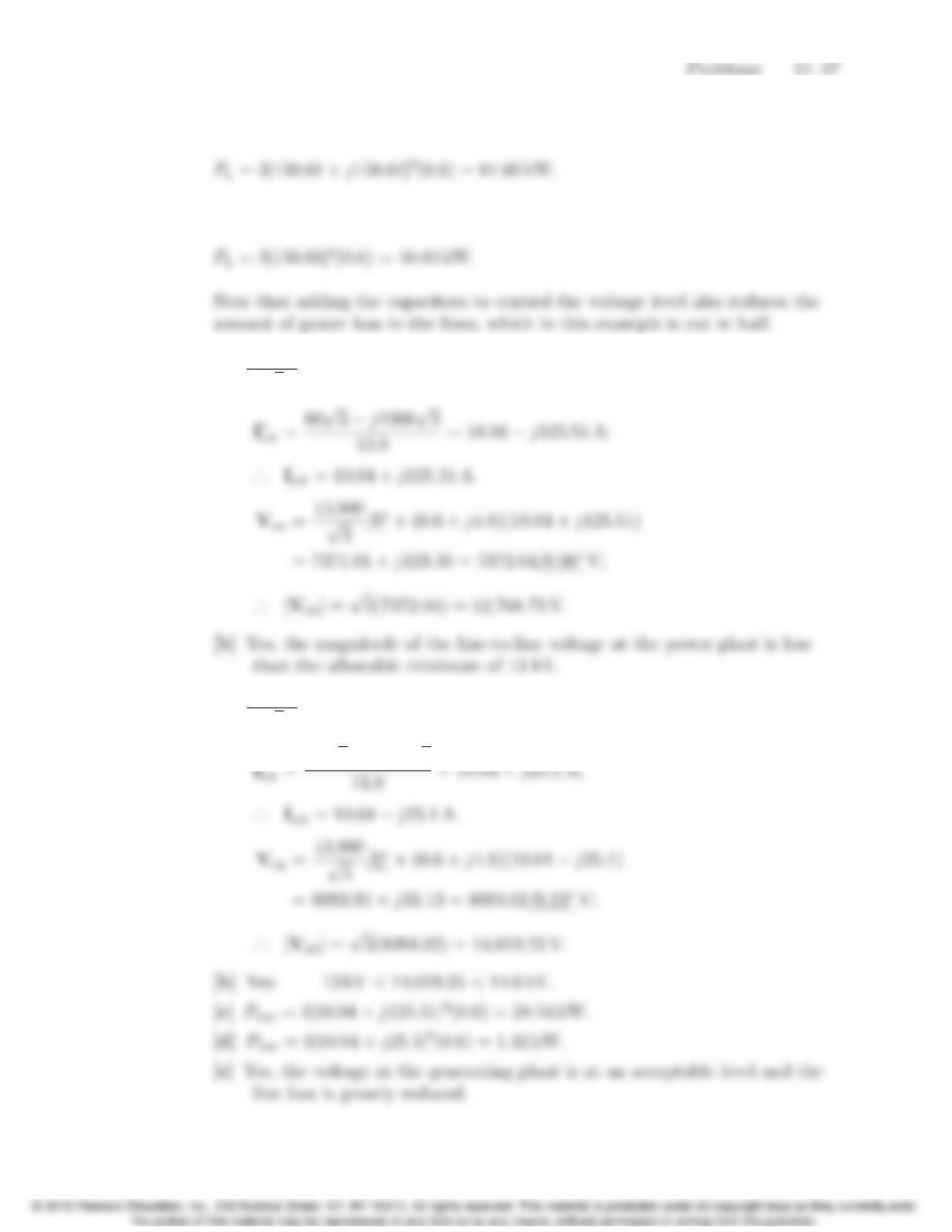
P 11.58 Before the capacitors are added the total line loss is
After the capacitors are added the total line loss is
P 11.59 [a] 13,800
√3I⇤
aA = 80 ×103+j200 ×103−j1200 ×103;
P 11.60 [a] 13,800
√3I⇤
aA = (80 + j200) ×103;