10
Sinusoidal Steady State Power
Calculations
Assessment Problems
AP 10.1 [a] V = 100/−45◦V,I= 20/15◦A.
Therefore
[b] V = 100/−45◦,I= 20/165◦;
[c] V = 100/−45◦,I= 20/−105◦;
AP 10.2
pf = cos(θv−θi) = cos[15 −(75)] = cos(−60◦) = 0.5 leading;
10–2 CHAPTER 10. Sinusoidal Steady State Power Calculations
AP 10.3
From Ex. 9.4 Irms =Iρ
√3=0.18
√3A;
AP 10.4 [a] ZL=j(2500)(0.405) = j1012.5 Ω.
The phasor domain circuit is
AP 10.5 [a] Z= (39 + j26)k(−j52) = 48 −j20 = 52/−22.62◦Ω;
[b] SL=VLI∗
L= (252.20/−4.54◦)(5.38/+ 38.23◦) = 1357/33.69◦
[d] Sg(delivering) = 250I∗
ℓ= (1152.62 −j376.36) VA.
[e] Qcap =|VL|2
−52 =(252.20)2
−52 =−1223.18 VAR.
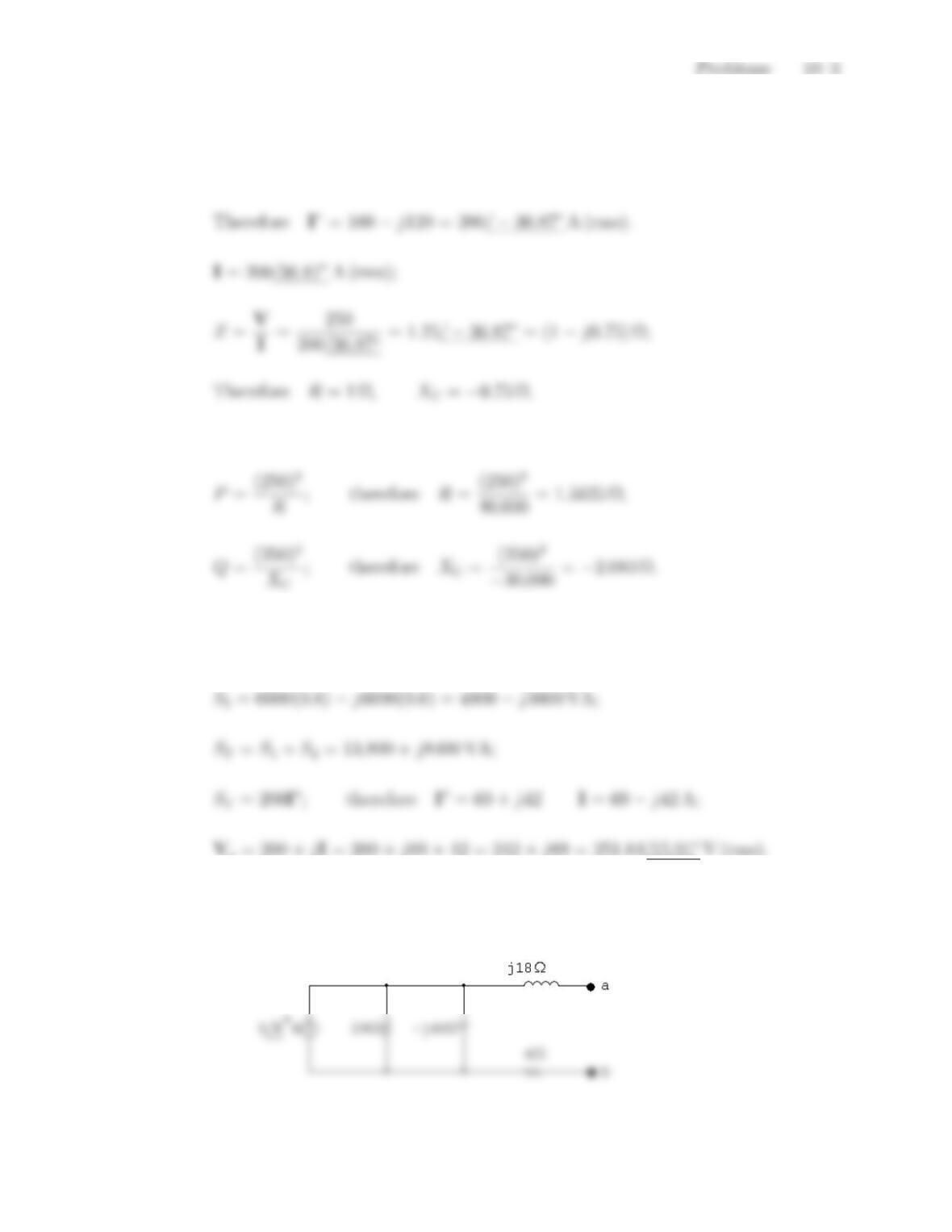
AP 10.6 Series circuit derivation:
S= 250I∗= (40,000 −j30,000);
Parallel circuit derivation
AP 10.7
S1= 15,000(0.6) + j15,000(0.8) = 9000 + j12,000 VA;
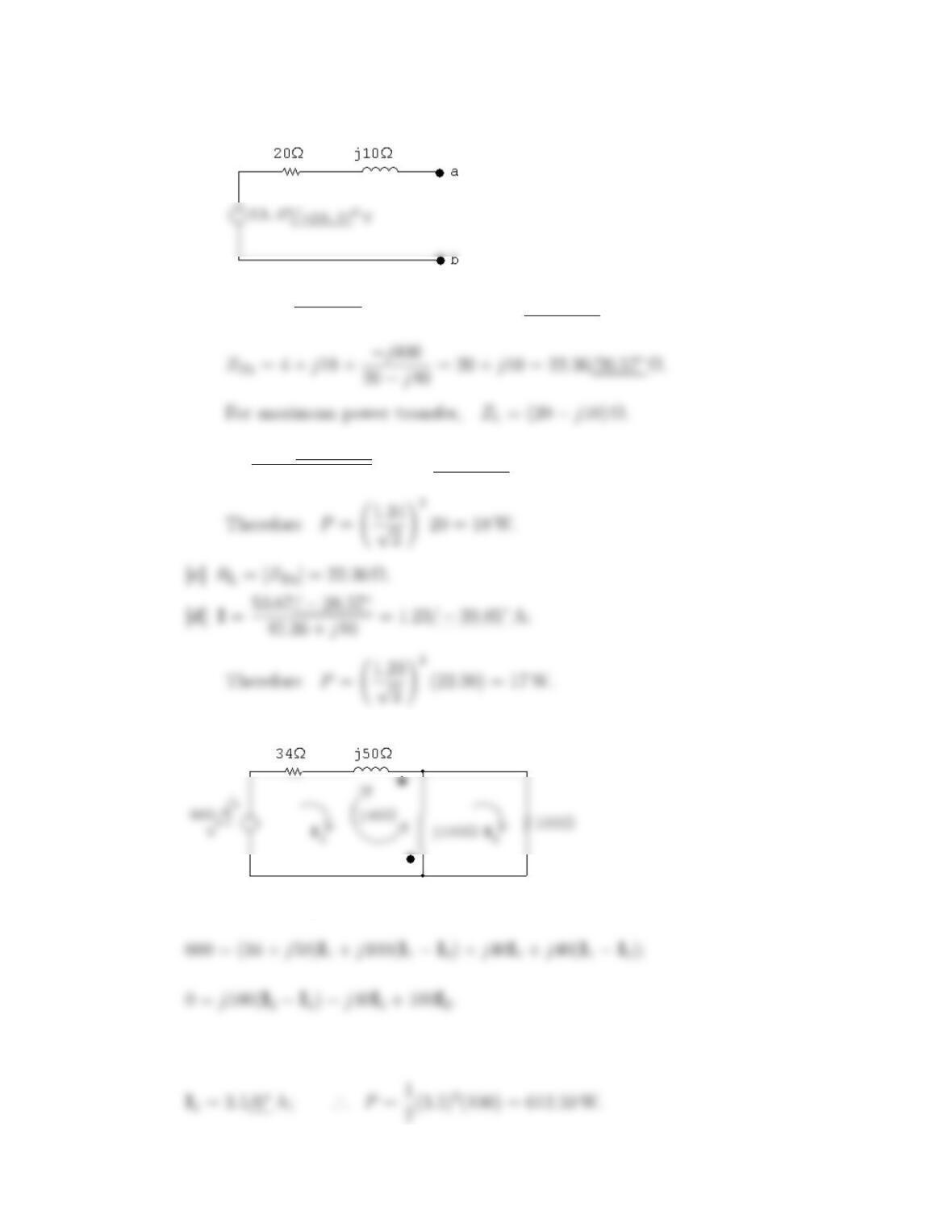
AP 10.8 [a] The phasor domain equivalent circuit and the Th´evenin equivalent are
shown below:
Phasor domain equivalent circuit:
10–4 CHAPTER 10. Sinusoidal Steady State Power Calculations
Th´evenin equivalent:
VTh = 3 −j800
20 −j40 = 48 −j24 = 53.67/−26.57◦V;
[b] I =53.67/−26.57◦
40 = 1.34/−26.57◦A;
AP 10.9
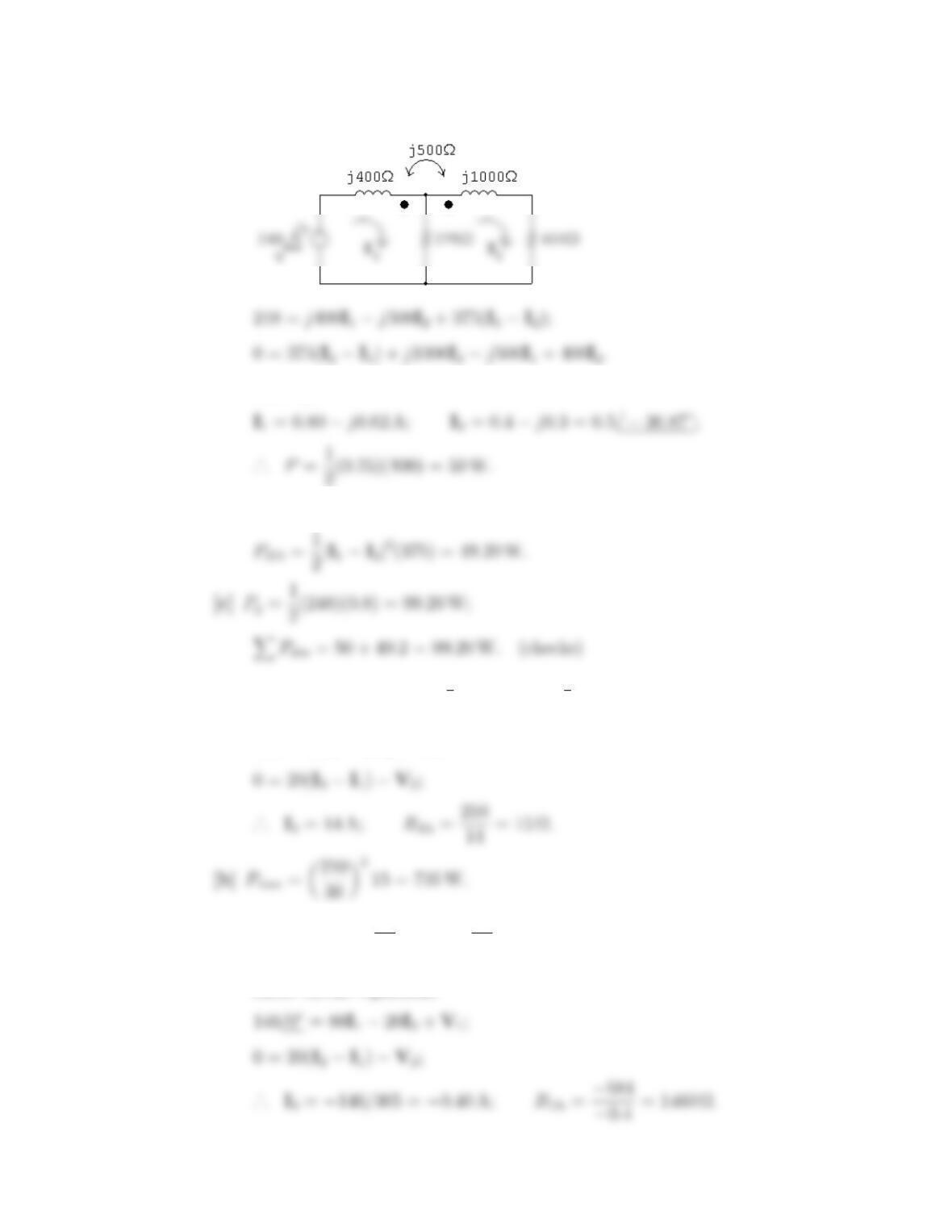
Mesh current equations:
Solving,
Problems 10–5
AP 10.10 [a]
Solving,
[b] I1−I2= 0.4−j0.32 A;
AP 10.11 [a] VTh = 210 V; V2=1
4V1;I1=1
4I2.
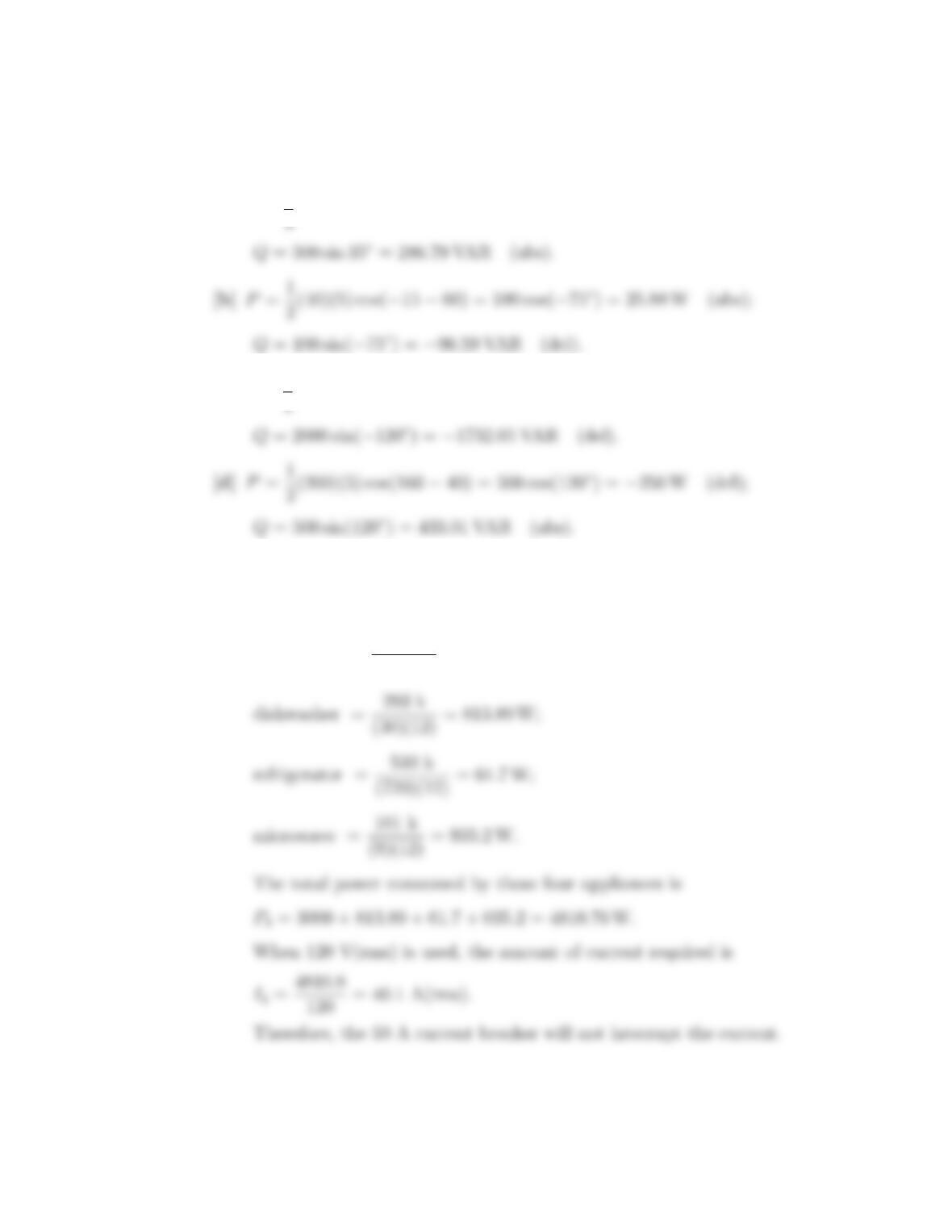
Short circuit equations:
840 = 80I1−20I2+V1;
AP 10.12 [a] VTh =−4(146/0◦) = −584/0◦V (rms);
V2= 4V1;I1=−4I2.
Short circuit equations:

10–6 CHAPTER 10. Sinusoidal Steady State Power Calculations
Problems 10–7
Problems
P 10.1 [a] P=1
[c] P=1
2(400)(10) cos(30 −150) = 2000 cos(−120◦) = −1000 W (del);
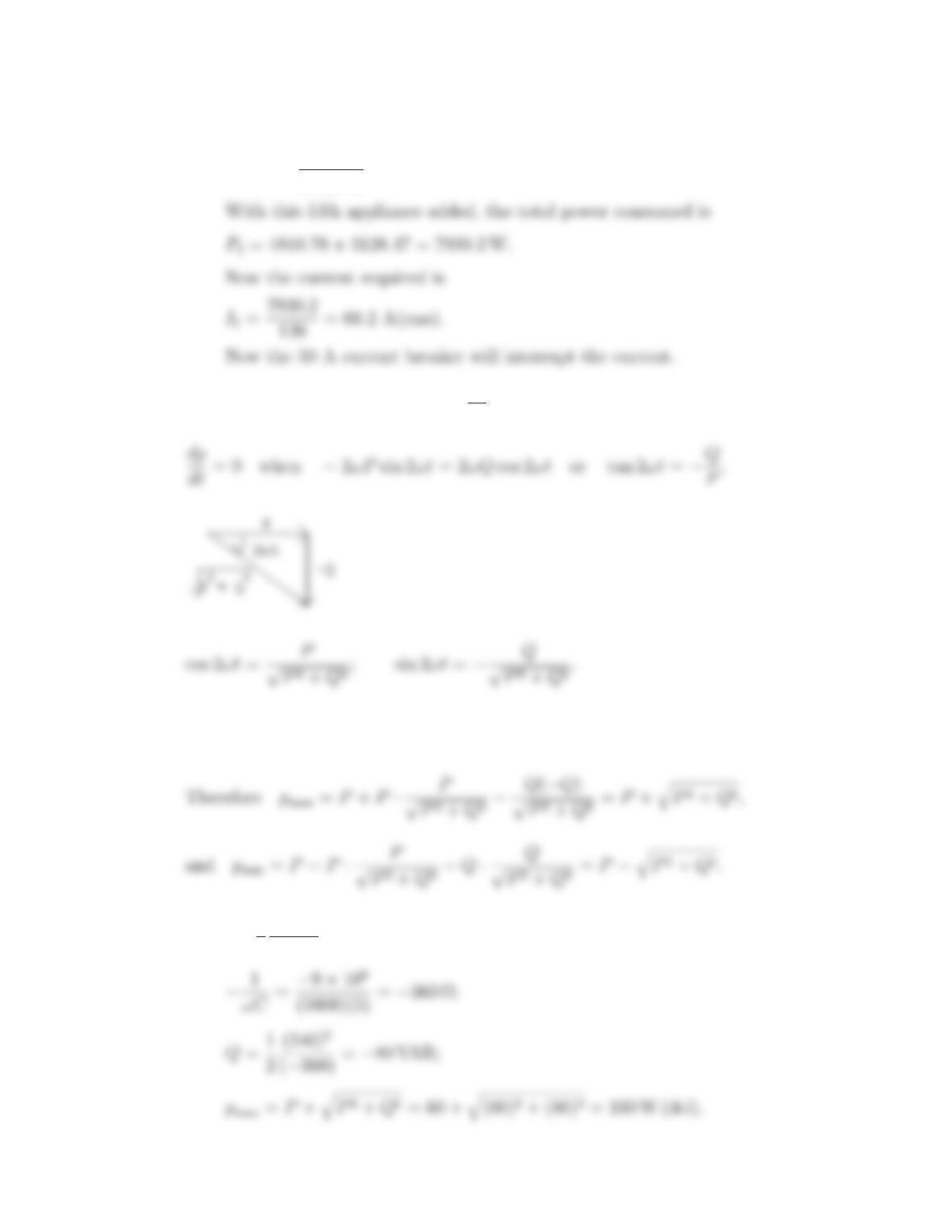
P 10.2 [a] To find the power used by an appliance, divide the yearly kW-hours used
by the product of the number of hours per month used and the number
of months:
central AC = 1080 k
(120)(3) = 3000 W;
10–8 CHAPTER 10. Sinusoidal Steady State Power Calculations
[b] the power used by the dryer is
dryer = 901 k
(24)(12) = 3128.47 W.
P 10.3 p=P+Pcos 2ωt −Qsin 2ωt;dp
dt =−2ωP sin 2ωt −2ωQ cos 2ωt;
Let θ= tan−1(−Q/P ),then pis maximum when 2ωt =θand pis minimum
when 2ωt = (θ+π).
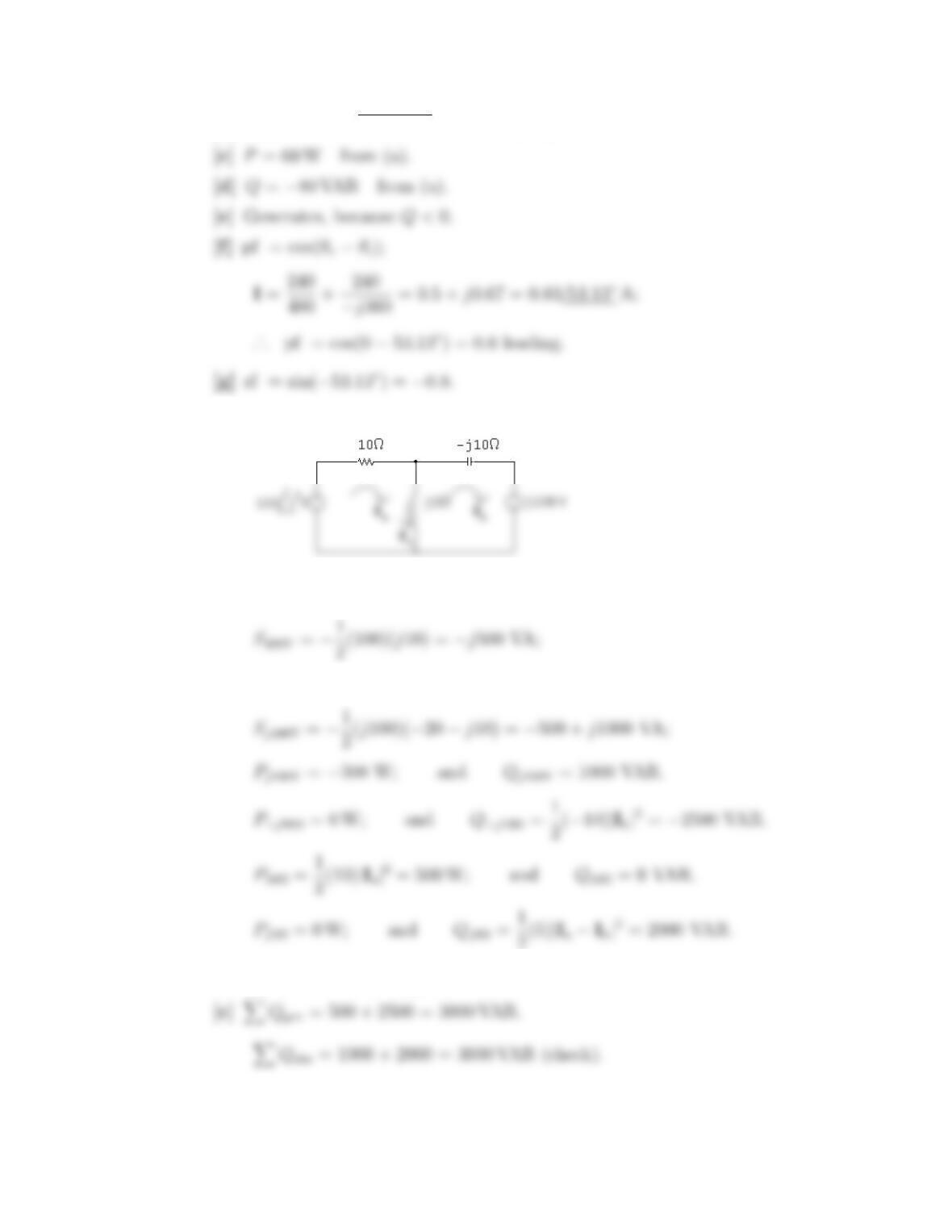
P 10.4 [a] P=1
2
(240)2
480 = 60 W;
Problems 10–9
[b] pmin = 60 −√602+ 802=−40 W (abs).
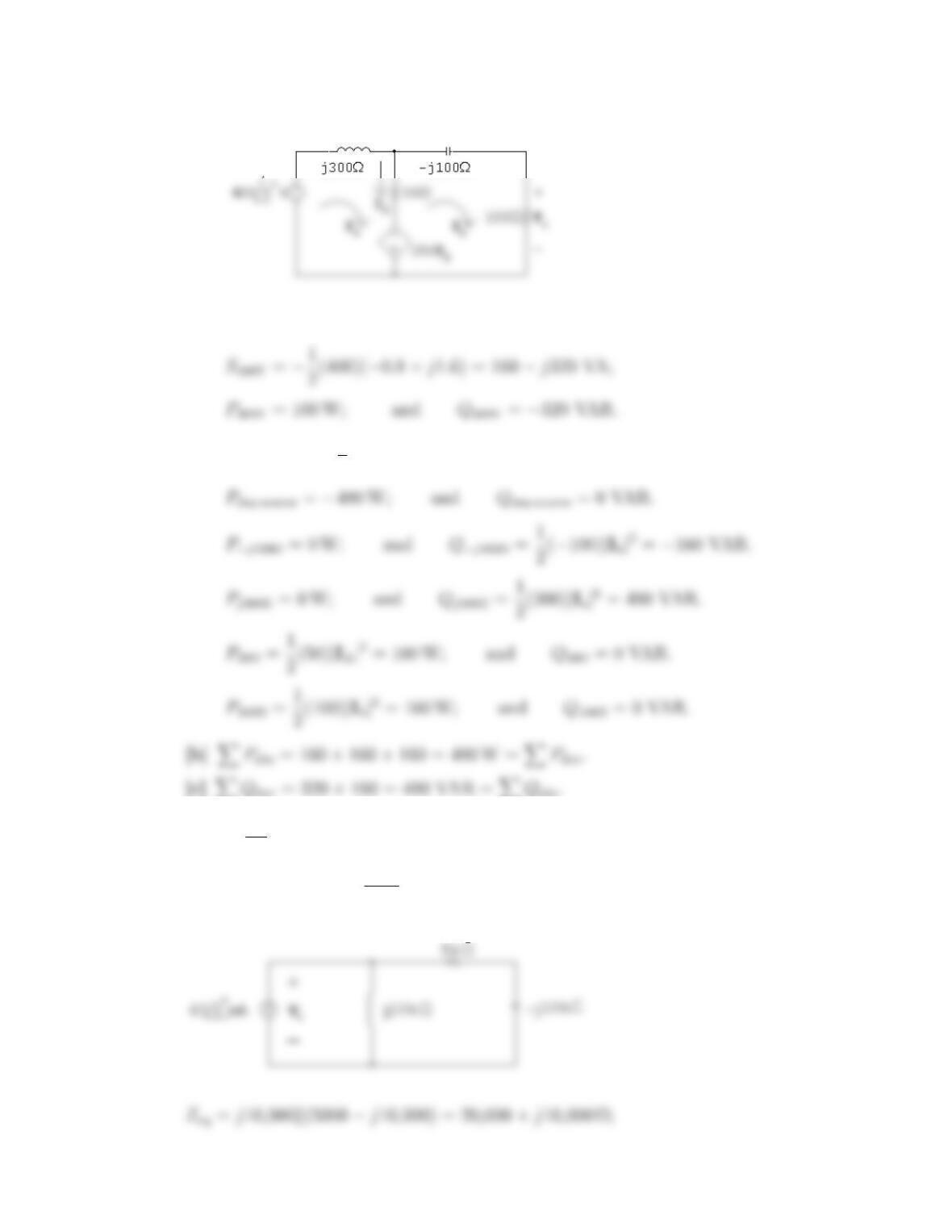
P 10.5 [a] From the solution to Problem 9.60 we have:
Ia=−j10 A and Ib=−20 + j10 A.
P100V = 0 W; and Q100V =−500 VAR.
[b] XPgen = 500 W = XPabs.
10–10 CHAPTER 10. Sinusoidal Steady State Power Calculations
P 10.6 [a] From the solution to Problem 9.64 we have
Ia=−0.8−j1.6 A; Ib=−1.6 + j0.8 A; and I∆= 0.8−j2.4 A.
Sdep.source =−1
2(150I∆)(I∆)∗=−480 + j0 VA;
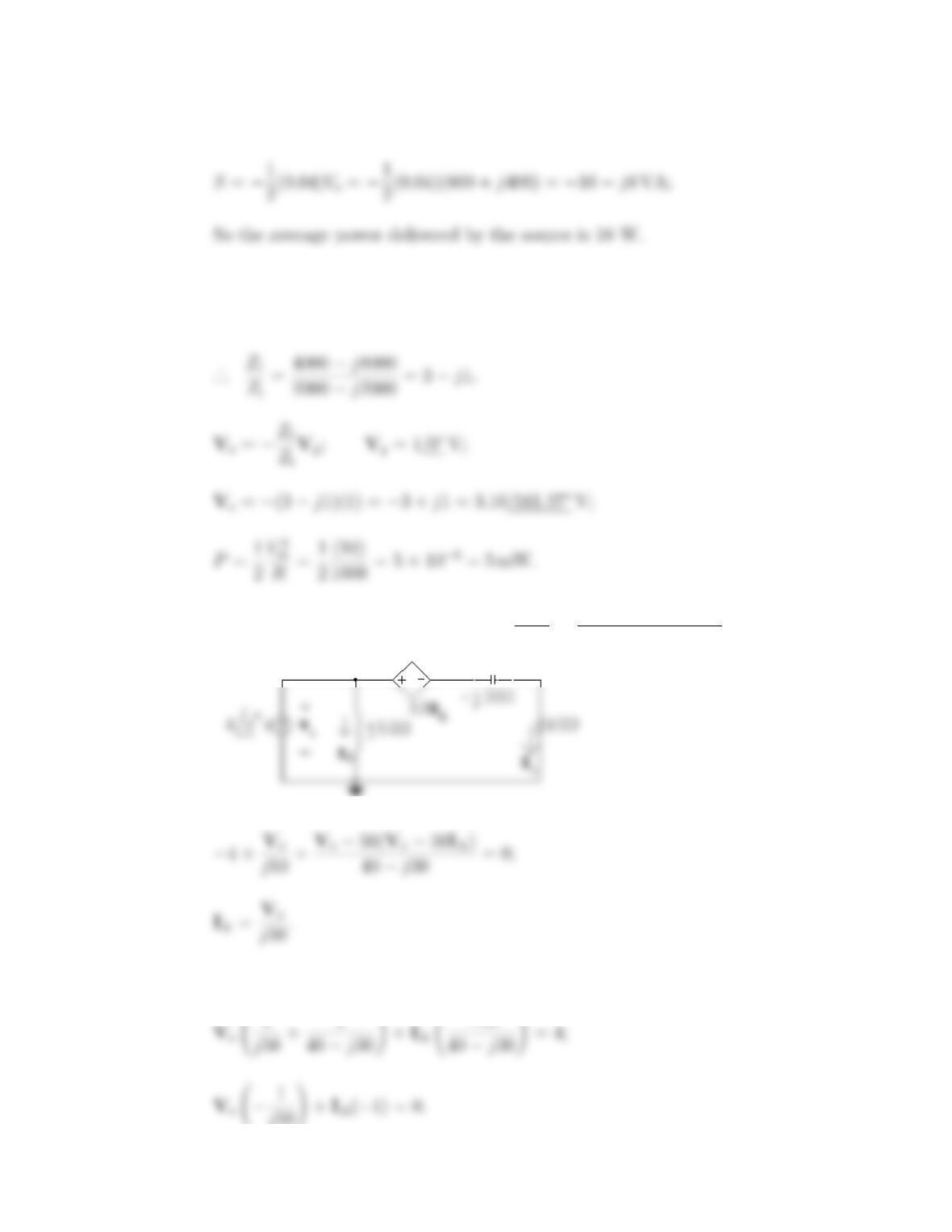
P 10.7 Ig= 40/0◦mA;
jωL =j10,000 Ω; 1
jωC =−j10,000 Ω.
Problems 10–11
Vo= (20,000 + j10,000)(0.04) = 800 + j400 V;
P 10.8 Zf=−j10,000k20,000 = 4000 −j8000 Ω;
Zi= 2000 −j2000 Ω;
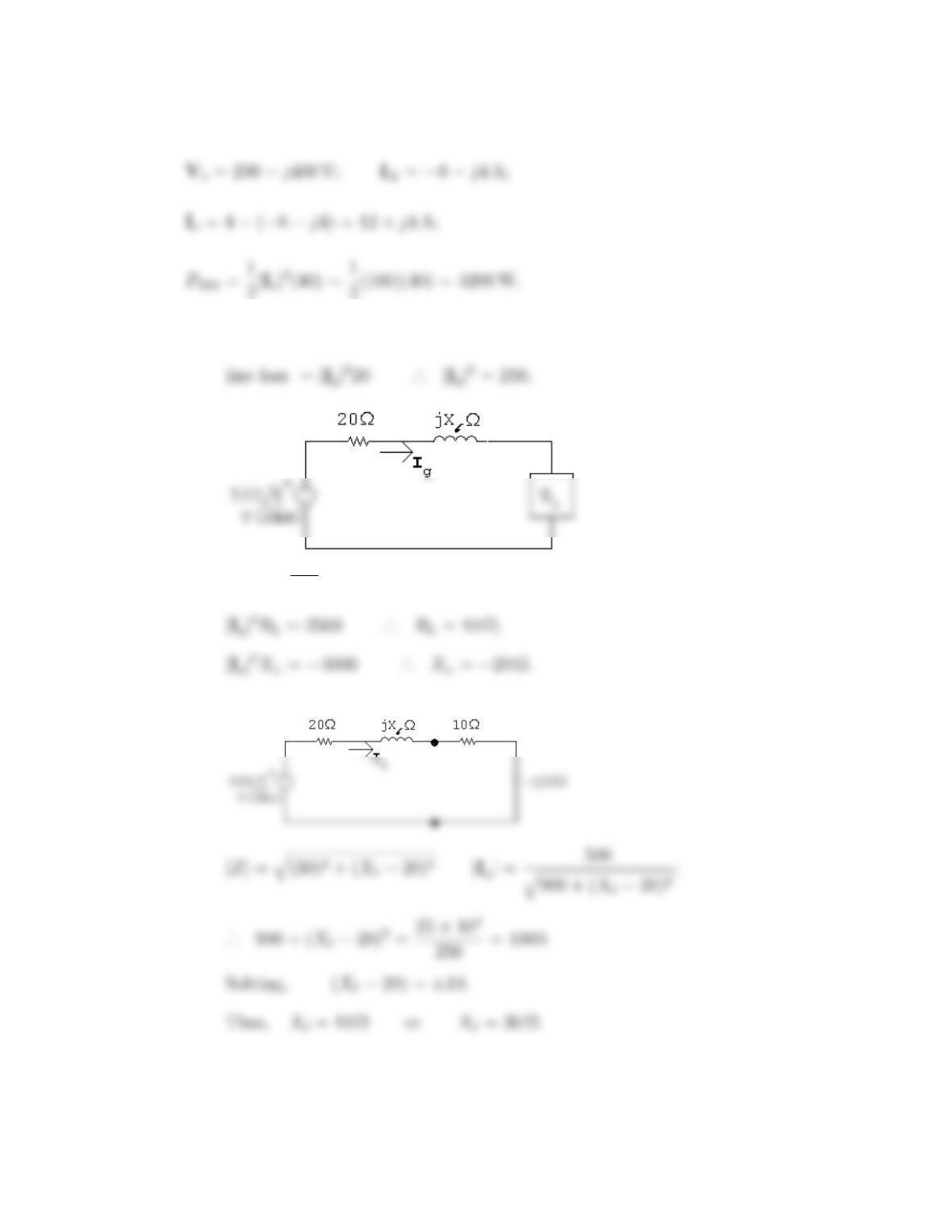
P 10.9 jωL =j105(0.5×10⁻³) = j50 Ω; 1
jωC =1
j105[(1/3) ×10−6]=−j30 Ω.
Place the equations in standard form:
10–12 CHAPTER 10. Sinusoidal Steady State Power Calculations
Solving,
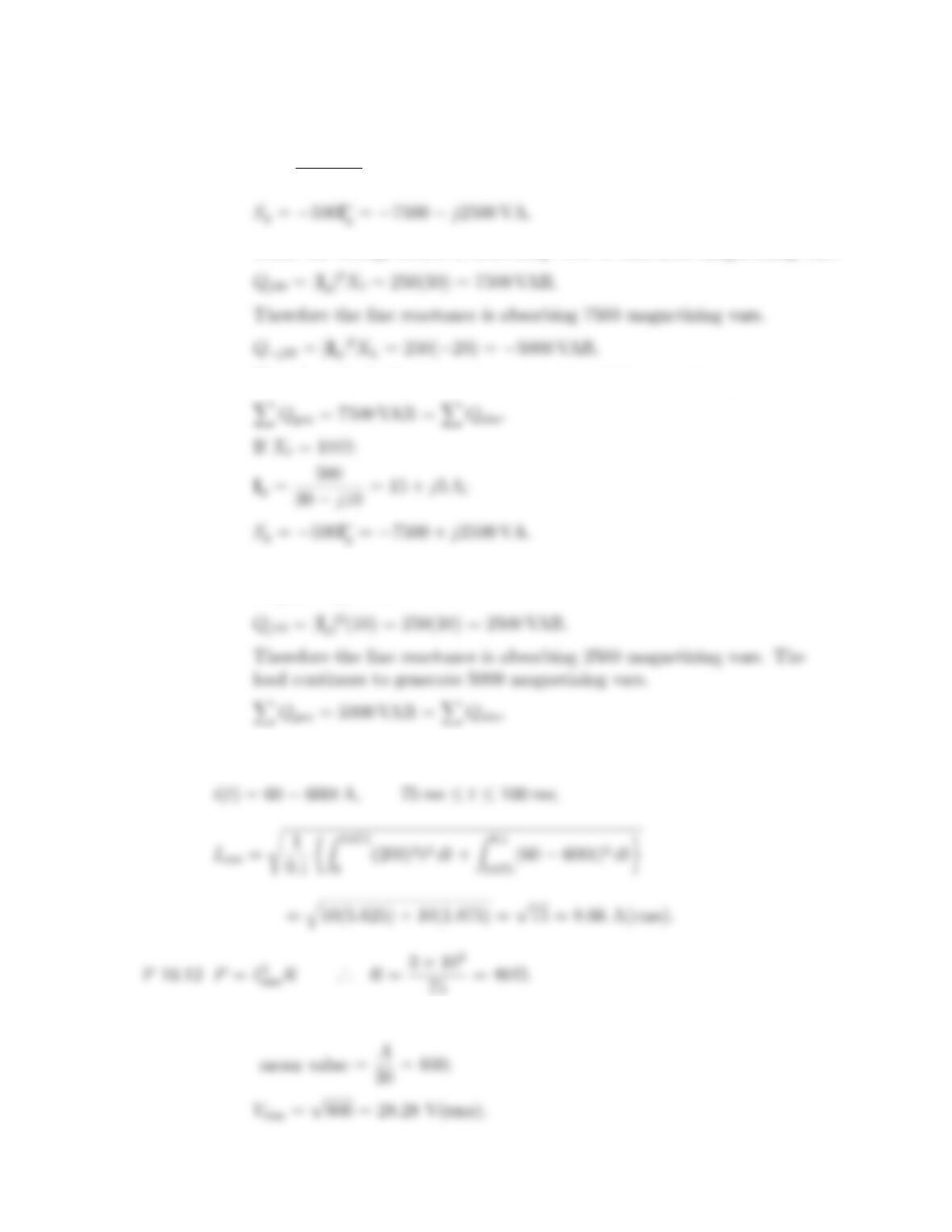
P 10.10 [a] line loss = 7500 −2500 = 5 kΩ;
|Ig|=√250 A;
Thus,
Problems 10–13
[b] If Xℓ= 30 Ω:
Ig=500
30 + j10 = 15 −j5 A;
Thus, the voltage source is delivering 7500 W and 2500 magnetizing vars.
Therefore the load reactance is generating 5000 magnetizing vars.
Thus, the voltage source is delivering 7500 W and absorbing 2500
magnetizing vars.
P 10.11 i(t) = 200tA,0≤t≤75 ms;
P 10.13 [a] A= 402(5) + (−40)2)(5) = 16,000;
10–14 CHAPTER 10. Sinusoidal Steady State Power Calculations
P=800
0.01 = 80 kΩ.
P 10.14 [a] Area under one cycle of v2
g:
A= 2(5)2(30 ×10−6) + 2(2)2(37.5×10⁻⁶)
P 10.16 Wdc =V2
dc
RT;Ws=Zto+T
to
v2
s
Rdt;
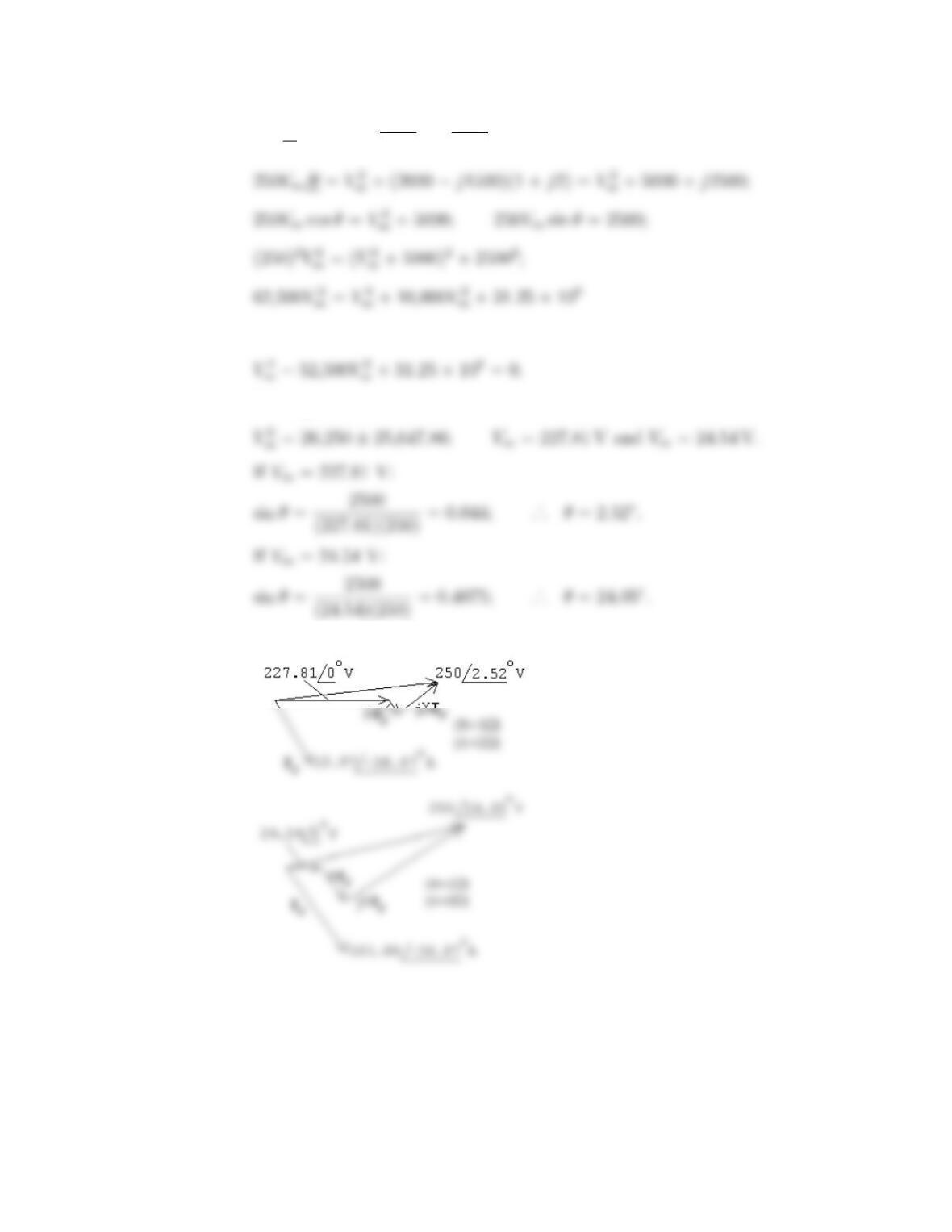
P 10.17 [a] Let VL=Vm/0◦:
Problems 10–15
250/θ=Vm+2000
Vm−j1500
Vm(1 + j2);
or
Solving,
[b]
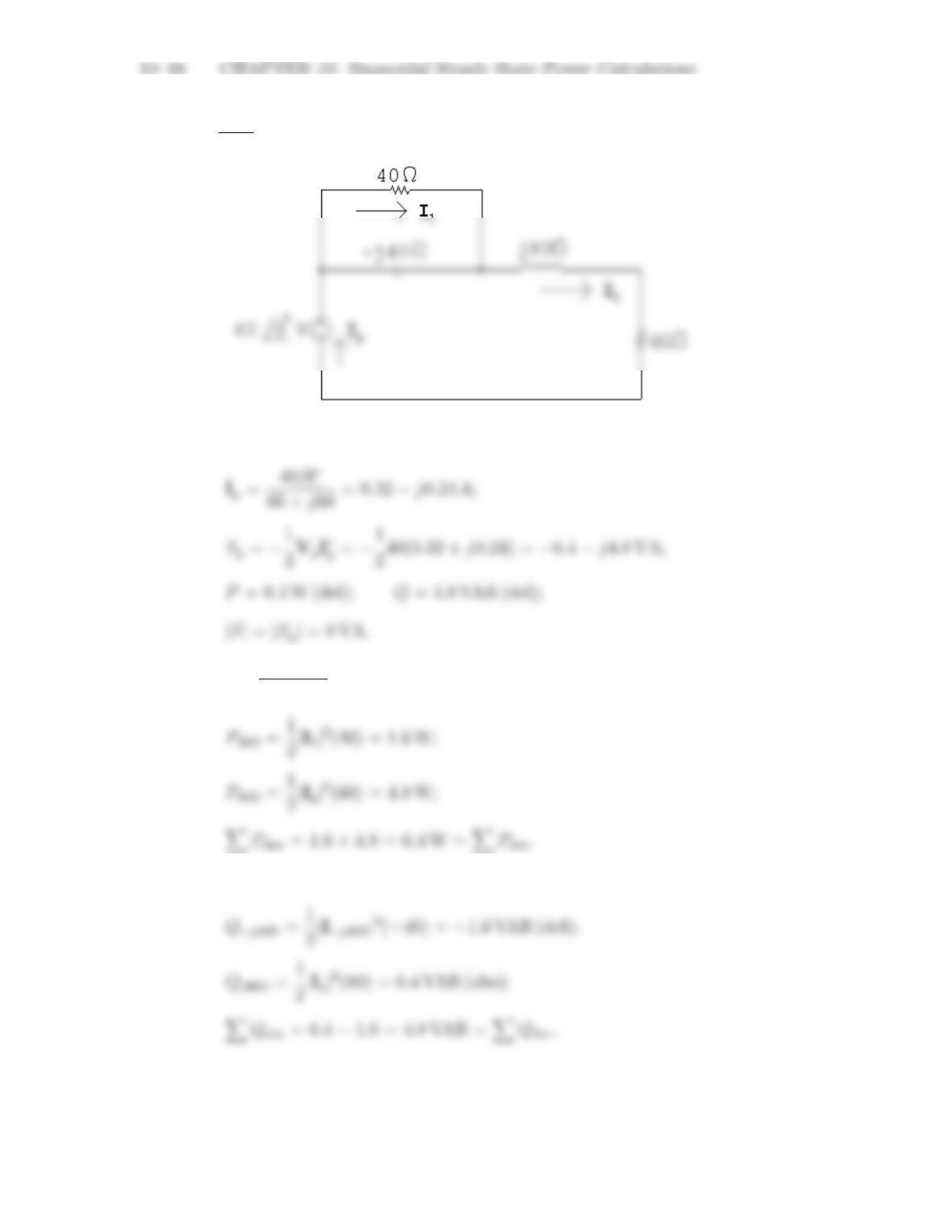
P 10.18 [a] 1
jωC =−j40 Ω; jωL =j80 Ω.
Zeq = 40k − j40 + j80 + 60 = 80 + j60 Ω;
[b] I1=−j40
40 −j40Ig= 0.04 −j0.28 A;
[c] I−j40Ω =Ig−I1= 0.28 + j0.04 A;
P 10.19 [a]
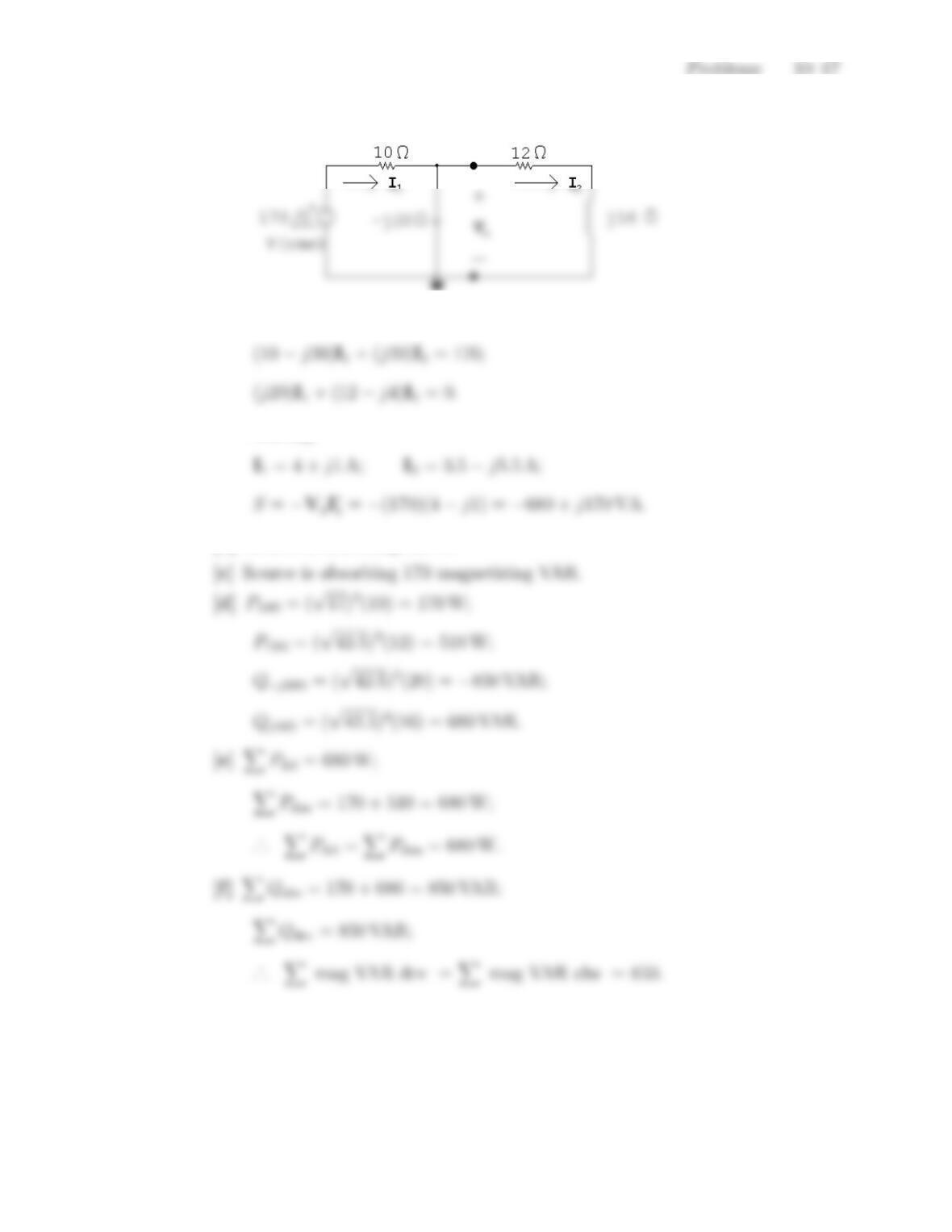
The mesh equations are:
Solving,
[b] Source is delivering 680 W.
10–18 CHAPTER 10. Sinusoidal Steady State Power Calculations
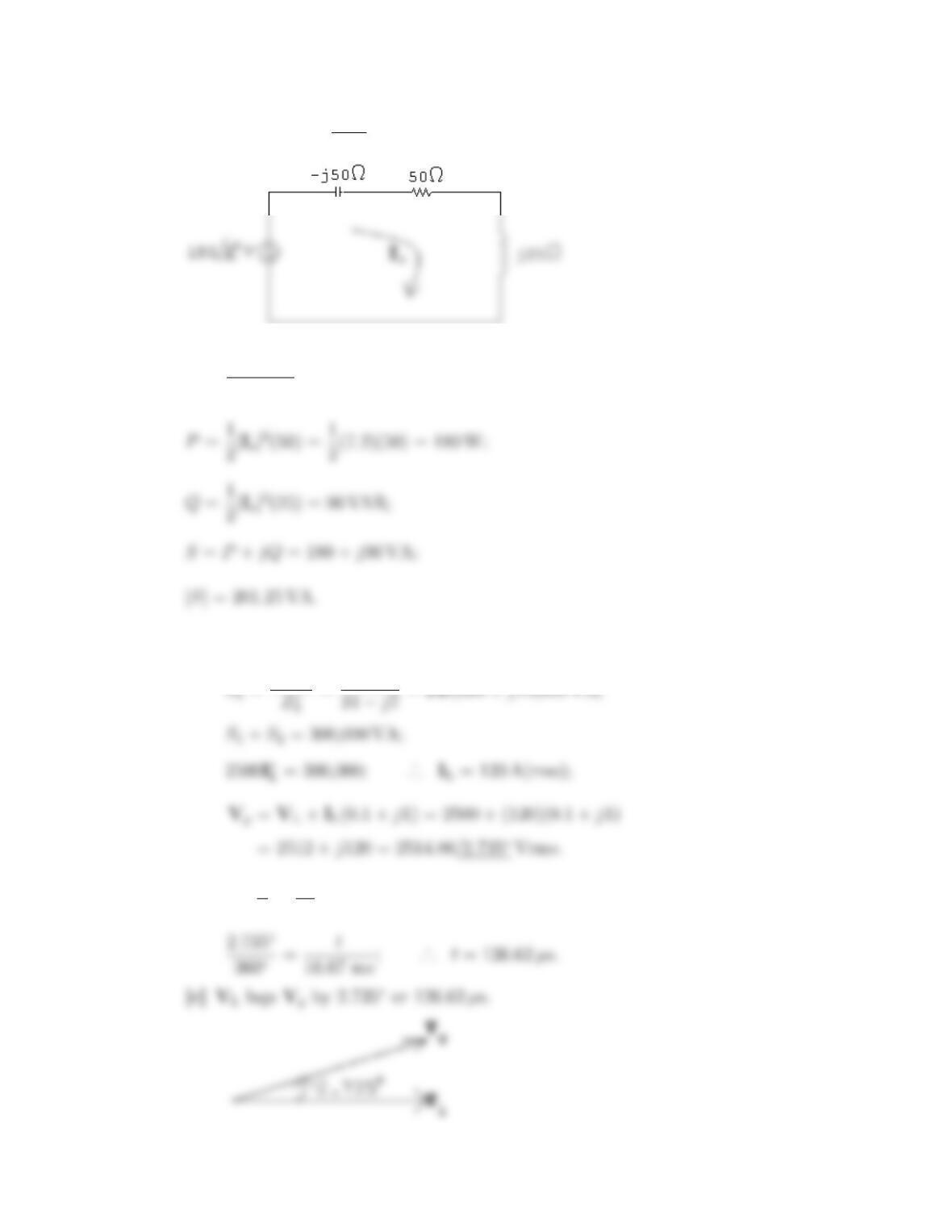
P 10.20 jωL =j25 Ω; 1
jωC =−j50 Ω.
Io=150
50 −j25 = 2.4 + j1.2 A;
P 10.21 [a] S1= 60,000 −j70,000 VA;
[b] T=1
f=1
60 = 16.67 ms;
Problems 10–19
P 10.22 ST= 4500 −j4500
0.96 (0.28) = 4500 −j1312.5 VA;
P 10.23
250I∗
1= 6000 −j8000;
250I∗
2= 9000 + j3000;
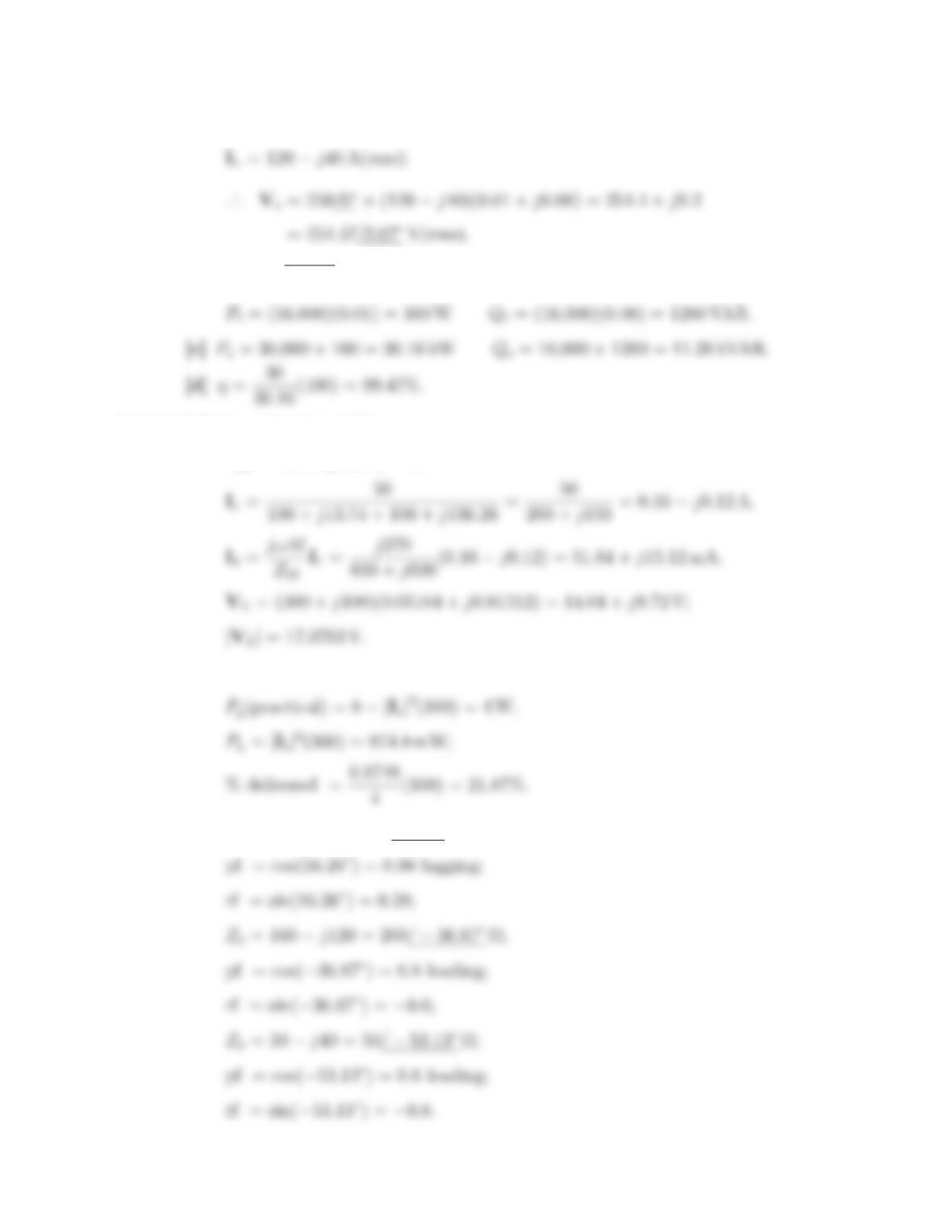
P 10.24 [a] S1= 16 + j18 kVA; S2= 6 −j8 kVA; S3= 8 + j0 kVA;
10–20 CHAPTER 10. Sinusoidal Steady State Power Calculations
P 10.25 [a] From the solution to Problem 10.24 we have
[b] |IL|=q16,000;
P 10.26 [a] From Problem 9.78,
Zab = 100 + j136.26 so
[b] Pg(ideal) = 50(0.16) = 8 W;
P 10.27 [a] Z1= 240 + j70 = 250/16.26◦Ω;