Problems 10–21
[b] Y=Y1+Y2+Y3;
Y1=1
P 10.28 [a]
250I∗
1= 7500 + j2500; ·
. . I1= 30 −j10 A(rms);
[b] XPgen = 17.5 + 12.8 = 30.3 kW;
XPabs = 7500 + 2800 + (500)2
10–22 CHAPTER 10. Sinusoidal Steady State Power Calculations
P 10.29 S1=336 k
(720)(12) +60 k
(30)(12) +101 k
(9)(12) = 1140.74 + j0 VA;
·
. . I2=355
120 = 2.96 A.
P 10.30 [a]
I1=4000 −j1000
125 = 32 −j8 A (rms);
Problems 10–23
[b] P0.05 =|Ig1|2(0.05) = 262.4 W;
P0.15 =|In|2(0.14) = 19.2 W;
P 10.31 [a] SL= 20,000(0.85 + j0.53) = 17,000 + j10,535.65 VA;
125I∗
L= (17,000 + j10,535.65); I∗
L= 136 + j84.29 A(rms);
10–24 CHAPTER 10. Sinusoidal Steady State Power Calculations
[d] Iℓ= 136 + j0 A(rms);
P 10.32 [a] I =465/0◦
124 + j93 = 2.4−j1.8 = 3/−36.87◦A(rms);
[b] YL=1
120 + j90 = 5.33 −j4 mS;
P 10.33
Problems 10–25
Iℓ= 32 −j24 + jIC= 32 + j(IC−24);
*Select the smaller value of ICto minimize the magnitude of Iℓ.
P 10.34 [a] So= original load = 1600 + j1600
0.8(0.6) = 1600 + j1200 kVA;
[c] Sa= added load = 320 −j640 = 715.54/−63.43◦kVA;
P 10.35 [a] Pbefore =Pafter = (833.33)2(0.05) = 34,727.22 W.
10–26 CHAPTER 10. Sinusoidal Steady State Power Calculations
[b] Vs(before) = 2400 + (666.67 −j500)(0.05 + j0.4)
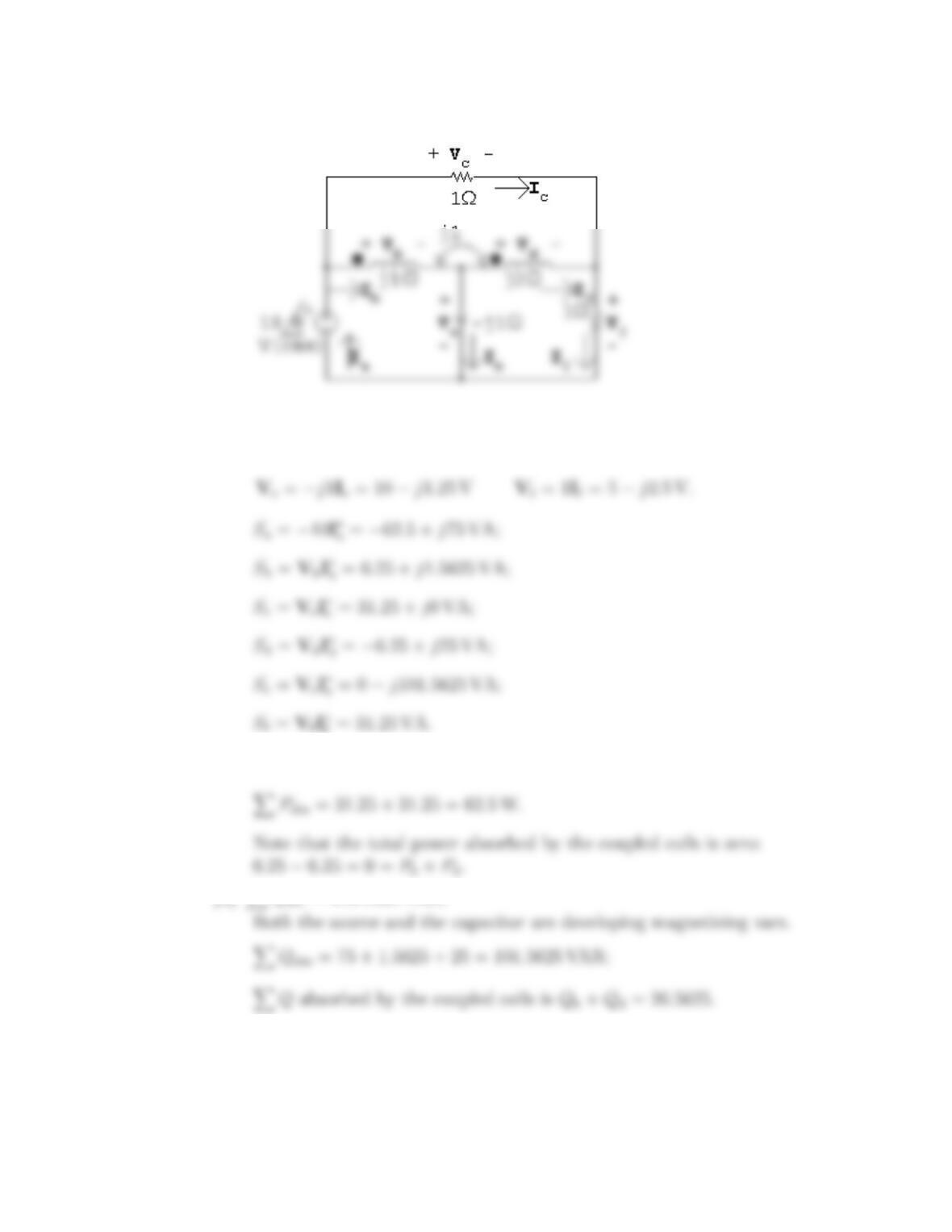
P 10.36 [a]
10 = j1(I1−I2) + j1(I3−I2)−j1(I1−I3);
Solving,
I1= 6.25 + j7.5 A(rms); I2= 5 + j2.5 A(rms); I3= 5 −j2.5 A(rms).
Problems 10–27
[b]
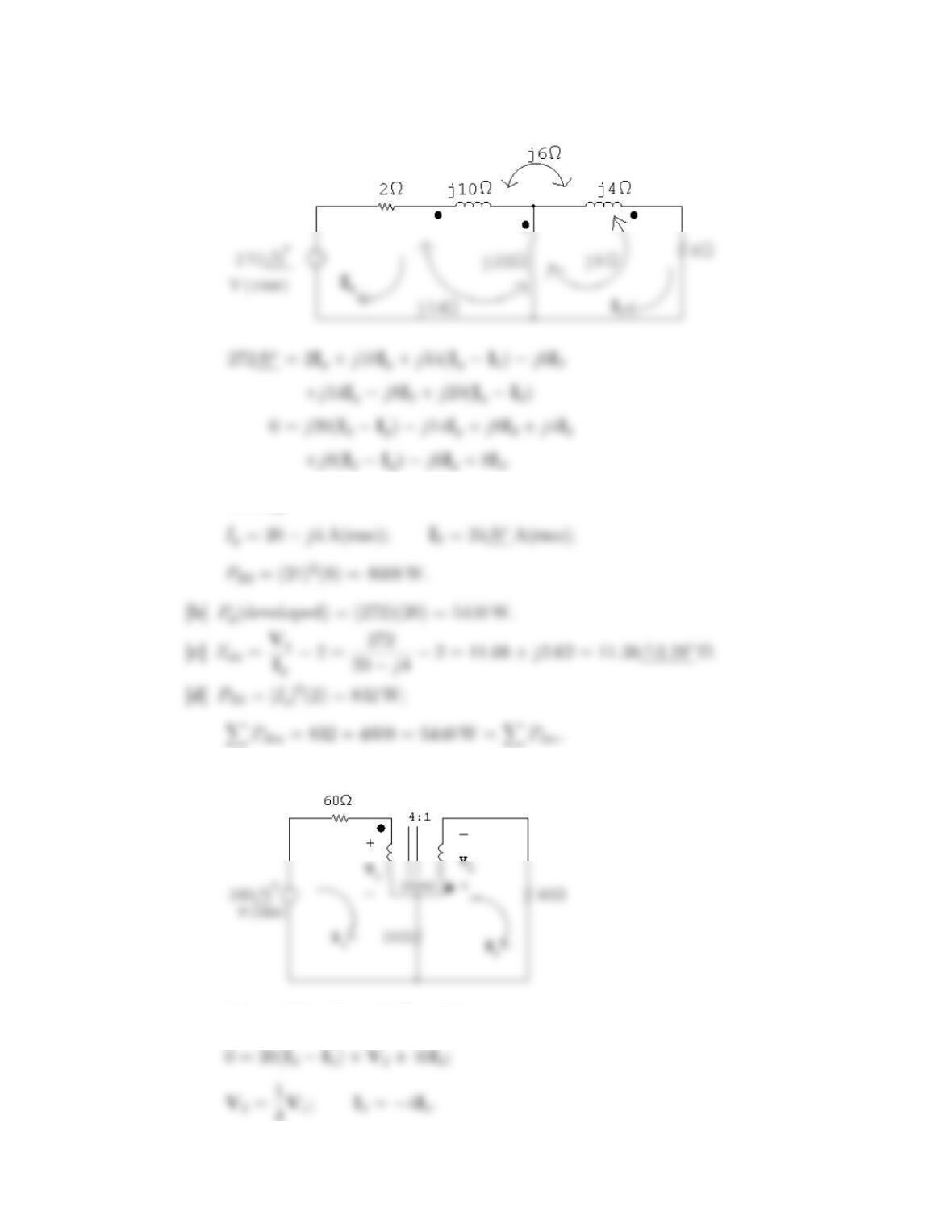
Va= 10 V Vb=j1Ib+j1Id=j1.25 V;
Vc= 1Ic= 5 + j2.5 V Vd=j2Id−j1Ib= 5 + j1.25 V;
f= 31.25 VA.
[c] XPdev = 62.5 W;
[d] XQdev = 101.5625 VAR;
10–28 CHAPTER 10. Sinusoidal Steady State Power Calculations
P 10.37 [a]
Solving,
P 10.38 [a]
300 = 60I1+V1+ 20(I1−I2);
Problems 10–29
Solving,
V1= 260 V (rms); V2= 65 V (rms);
[b] I20Ω =I1−I2= 1.25 A(rms);
P 10.39 [a] Zab =1 + N1
N22
(1 −j2) = 25 −j50 Ω;
[b] Pg=−100(2.5/0◦) = −250 W;
P 10.40 [a] 25a2
1+ 4a2
2= 500;
I25 =a1I;P25 =a2
1I2(25);
10–30 CHAPTER 10. Sinusoidal Steady State Power Calculations
[b] I =2000/0◦
500 + 500 = 2/0◦A(rms);
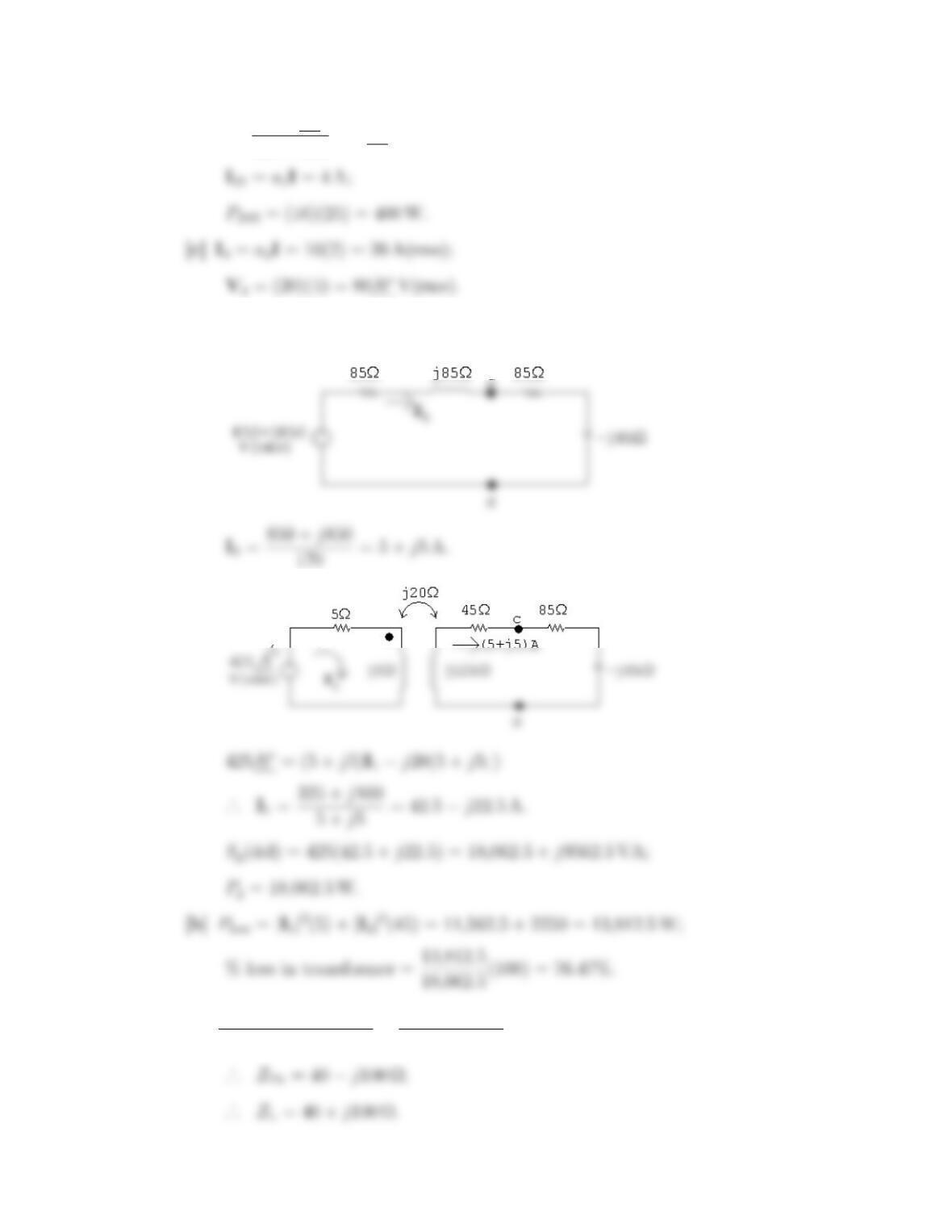
P 10.41 [a] From Problem 9.75, ZTh = 85 + j85 Ω and VTh = 850 + j850 V. Thus, for
maximum power transfer, ZL=Z∗
Th = 85 −j85 Ω:
P 10.42 [a] 115.2 + j33.6−240
ZTh
+115.2 + j33.6
80 −j60 = 0;
Problems 10–31
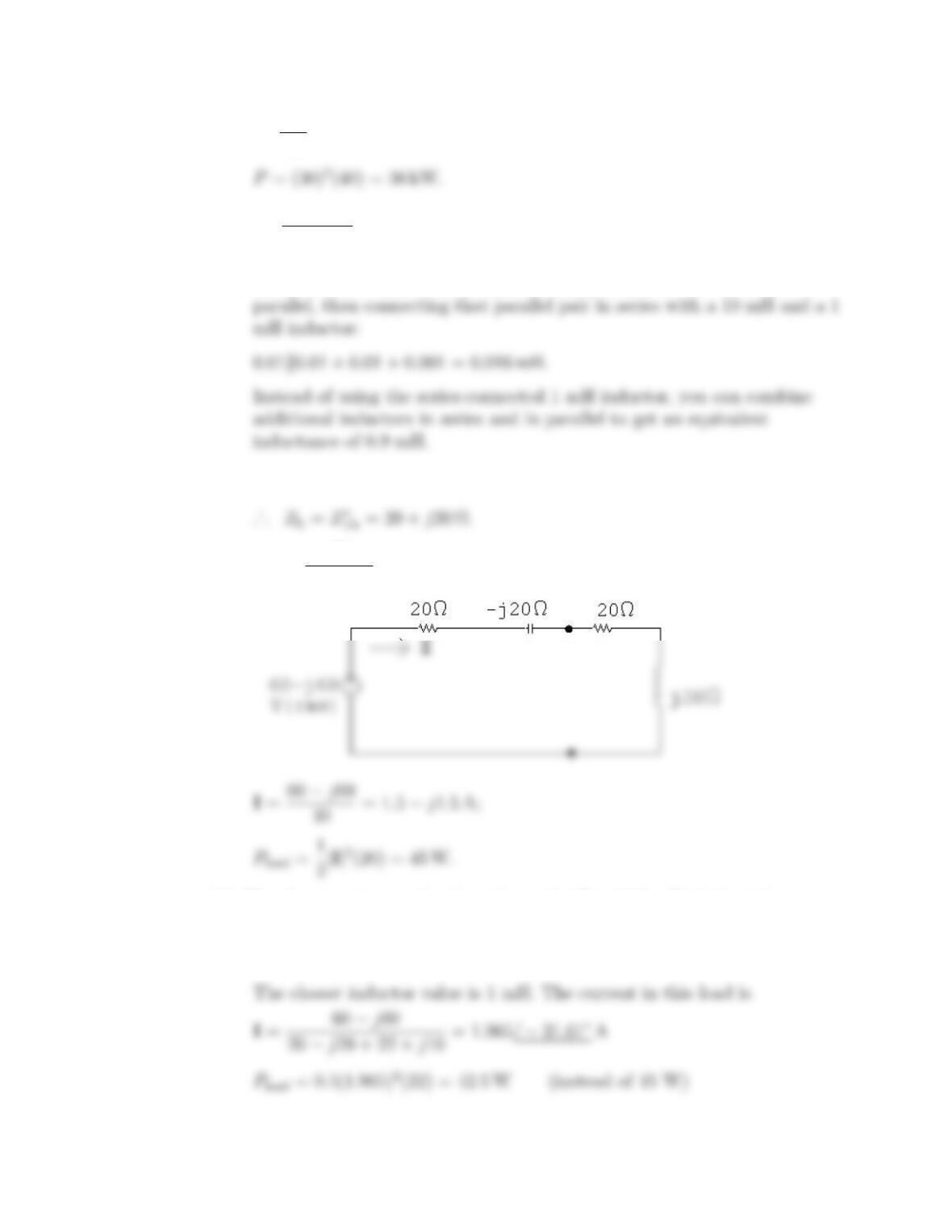
[b] I =240
80 = 30 A(rms);
[c] L=100
2π(1000) = 15.9 mH;
Construct the 40 Ω resistor by connecting four 10 Ω resistors in series.
Construct a 16 mH inductor by connecting two 10 mH inductors in
P 10.43 [a] ZTh =j40k40 −j40 = 20 −j20;
[b] VTh =40
40 + j40(120) = 60 −j60 V.
[c] The closest resistor value from Appendix H is 22 Ω . Find the inductor
value:
10,000L= 20 so L= 2 mH.
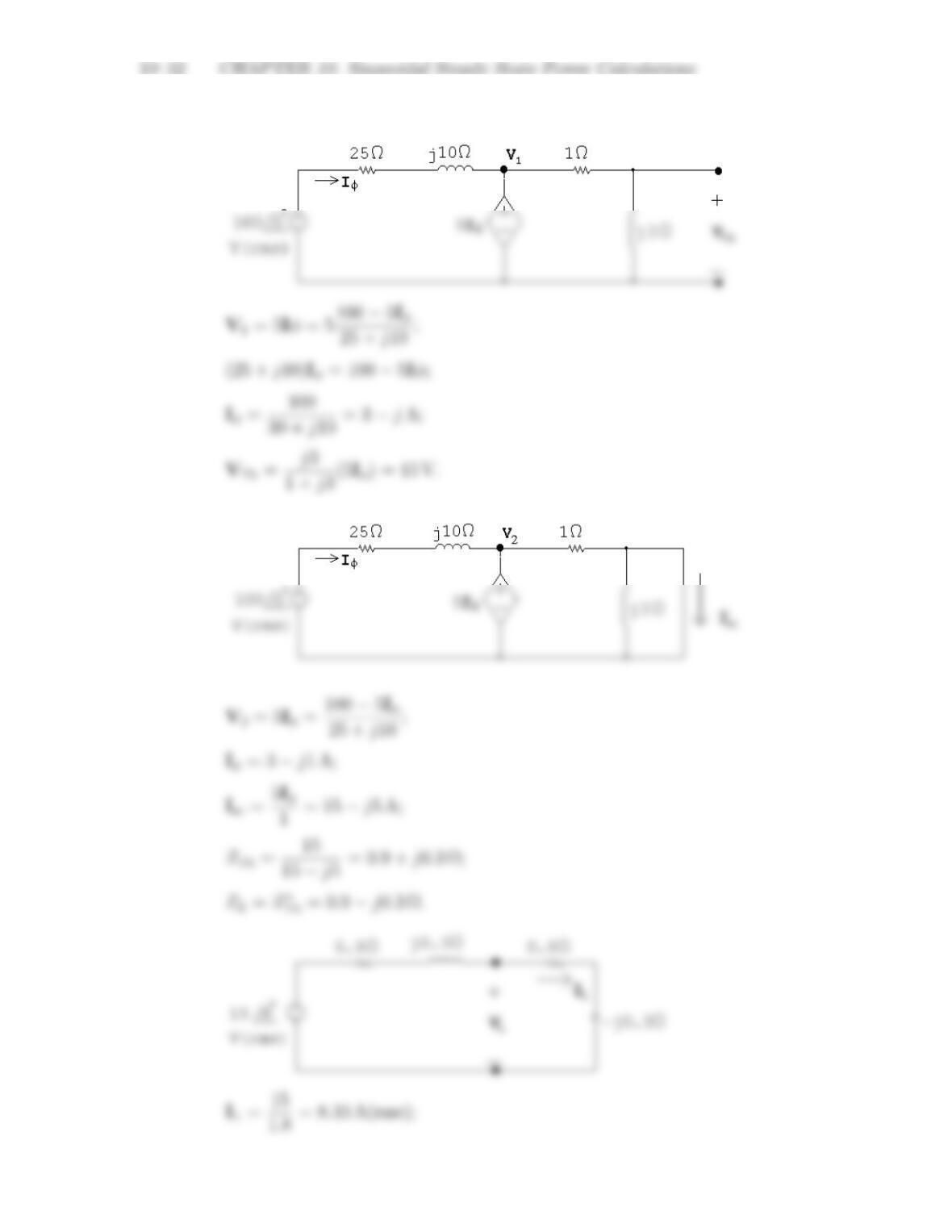
P 10.44 [a] Open circuit voltage:
Short circuit current:
Problems 10–33
[b] VL= (0.9−j0.3)(8.33) = 7.5−j2.5 V(rms).
I1=VL
Checks:
P25Ω = (10)(25) = 250 W;
10–34 CHAPTER 10. Sinusoidal Steady State Power Calculations
P 10.45 ZL=|ZL|/θ◦=|ZL|cos θ◦+j|ZL|sin θ◦.
Thus |I|=|VTh|
q(RTh +|ZL|cos θ)2+ (XTh +|ZL|sin θ)2.
Let D= demoninator in the expression for P, then
P 10.46 [a] ZTh = [(3 + j4)k − j8] + 7.32 −j17.24 = 15 −j15 Ω;
[b] VTh =−j8
3−j4(112.5) = 144 −j108 V(rms).
[c] Pick the 22 Ω resistor from Appendix H for the closest match:
Problems 10–35
P 10.47 [a] Open circuit voltage:
Short circuit current:
Isc = 0.1Vφ+Vφ
−j5= (0.1 + j0.2)Vφ;
10–36 CHAPTER 10. Sinusoidal Steady State Power Calculations
[b]
[c]
[d]
Problems 10–37
IL=Vφ
j5= 5 −j10 A (rms);
Thus,
P 10.48 [a] The real power lost in the line is minimum if the line current is minimum.
The line current is minimum if the power factor of the load is 1, making
[b] Iwo =13,800
300 +13,800
j100 = 46 −j138 A(rms);
[c] Pℓwo =|46 −j138|21.5 = 31.74 kW;
P 10.49 [a] First find the Th´evenin equivalent:
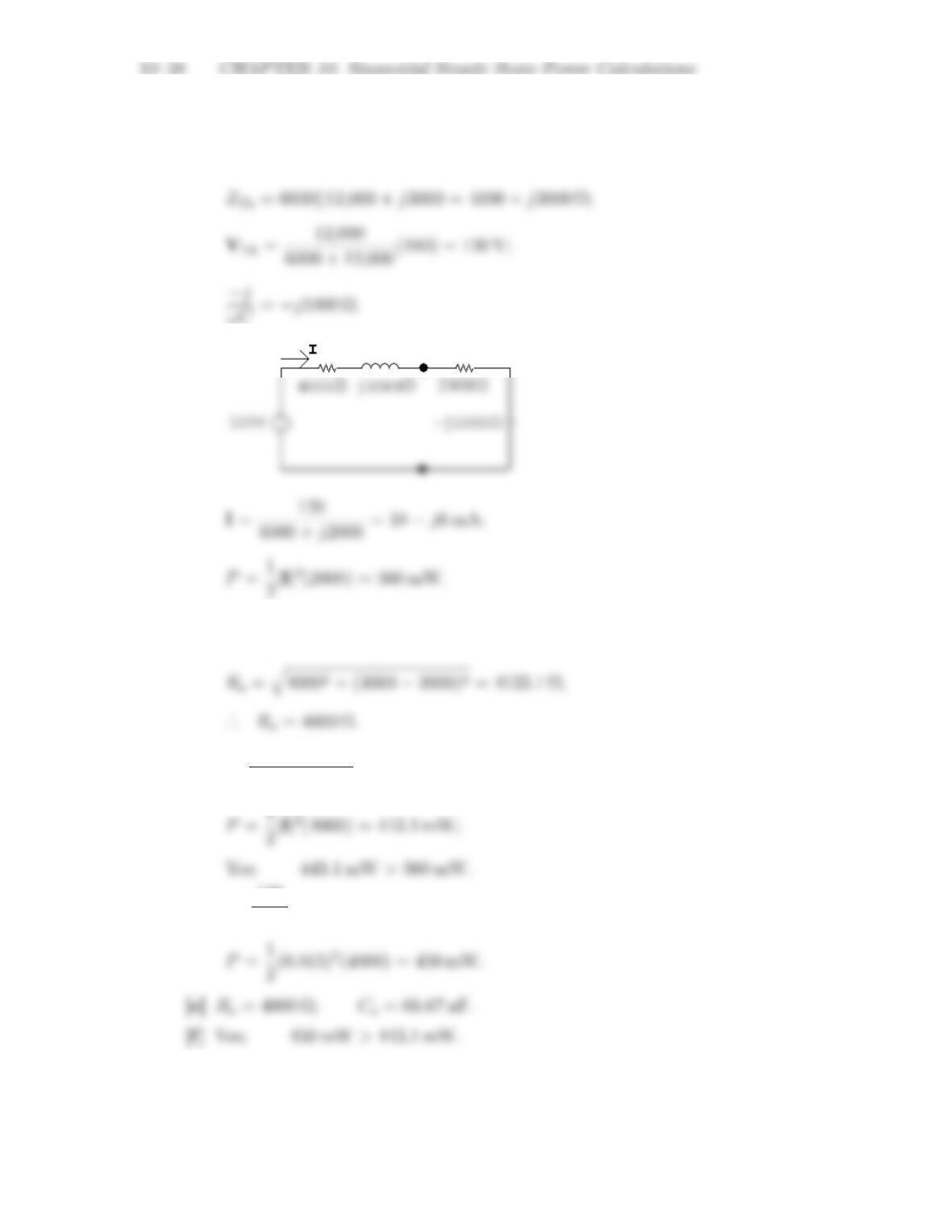
jωL =j3000 Ω;
[b] Set Co= 0.1µF so −j/ωC =−j2000 Ω.
Set Roas close as possible to
[c] I =120
8000 + j1000 = 14.77 −j1.85 mA;
[d] I =120
8000 = 15 mA;