Problems 8–37
P 8.49 iC(0) = 0; vo(0) = 50 V;
α=R
2L=8000
2(160 ⇥103)= 25,000 rad/s;
P 8.50 α=R
2L=200
2(0.025) = 400 rad/s;
ωo=s1
LC =s1
(250 ⇥103)(16 ⇥106)= 500 rad/s;
P 8.51 α=R
2L=250
2(0.025) = 500 rad/s;
ωo=s1
LC =s1
(250 ⇥103)(16 ⇥106)= 500 rad/s;
P 8.52 α=R
2L=312.5
2(0.025) = 625 rad/s;
Problems 8–39
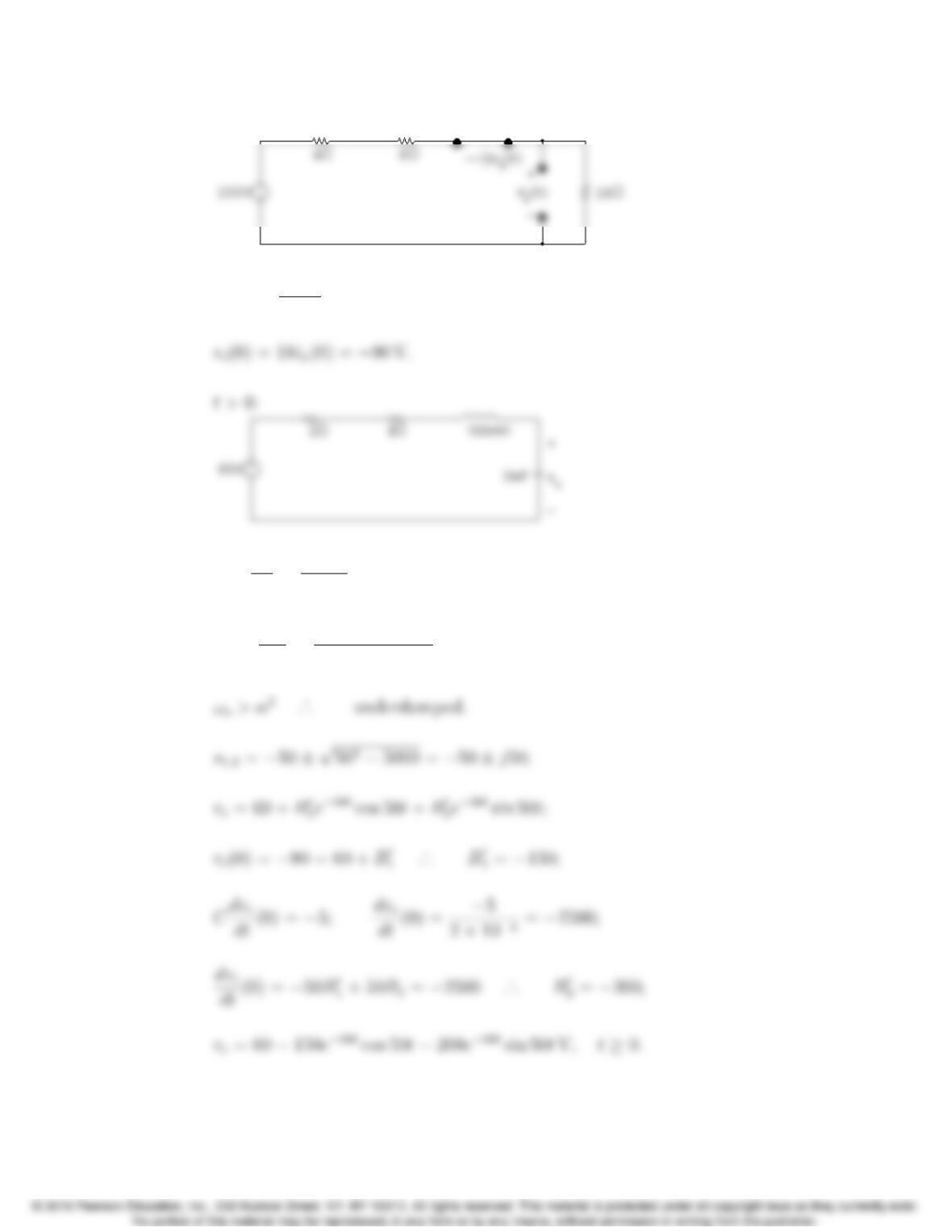
P 8.53 t<0:
iL(0) = 150
30 =5 A;
α=R
2L=10
2(0.1) = 50 rad/s;
ω2
o=1
LC =1
(0.1)(2 ⇥103)= 5000;
8–40 CHAPTER 8. Natural and Step Responses of RLC Circuits
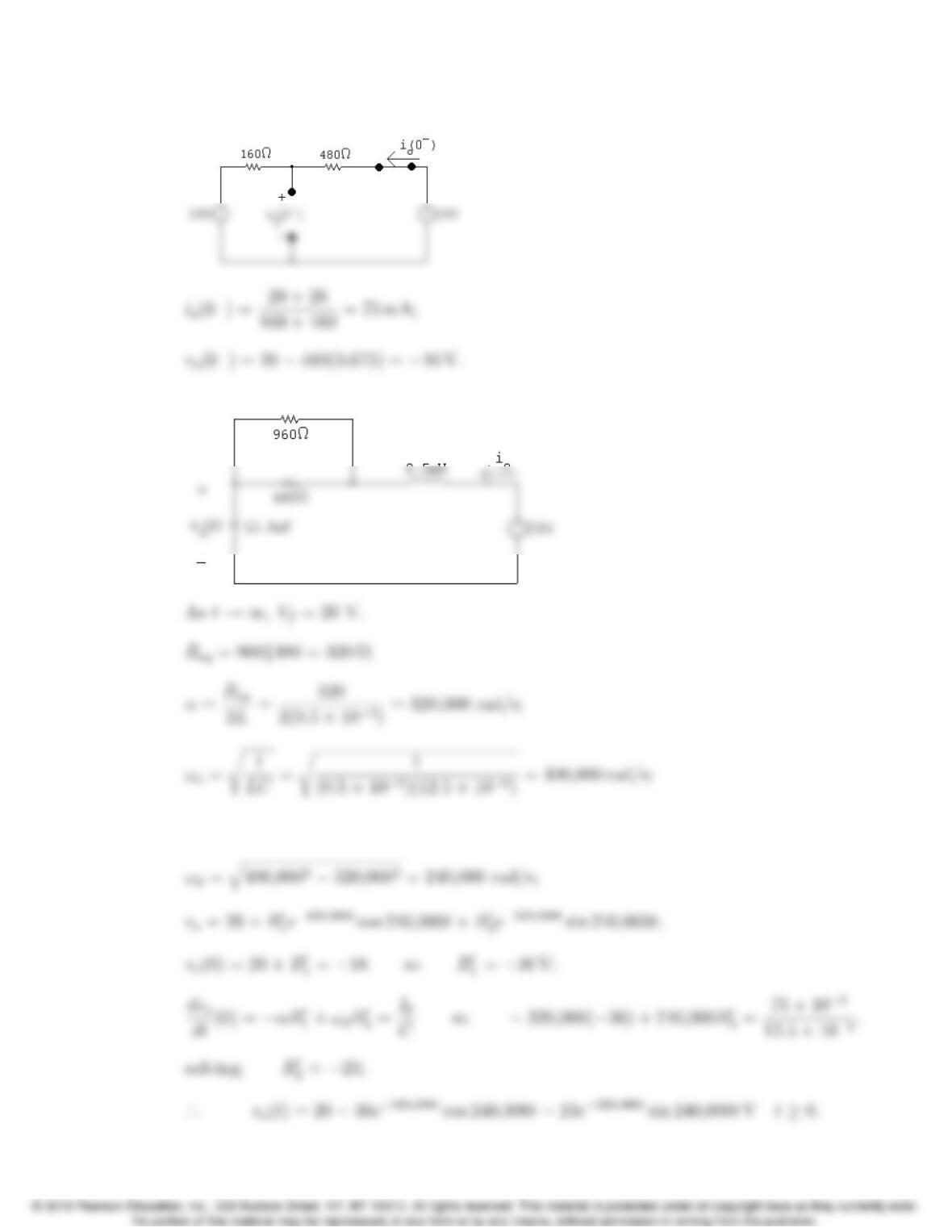
P 8.54 t<0:
t0:
α2<ω
2
0: underdamped.
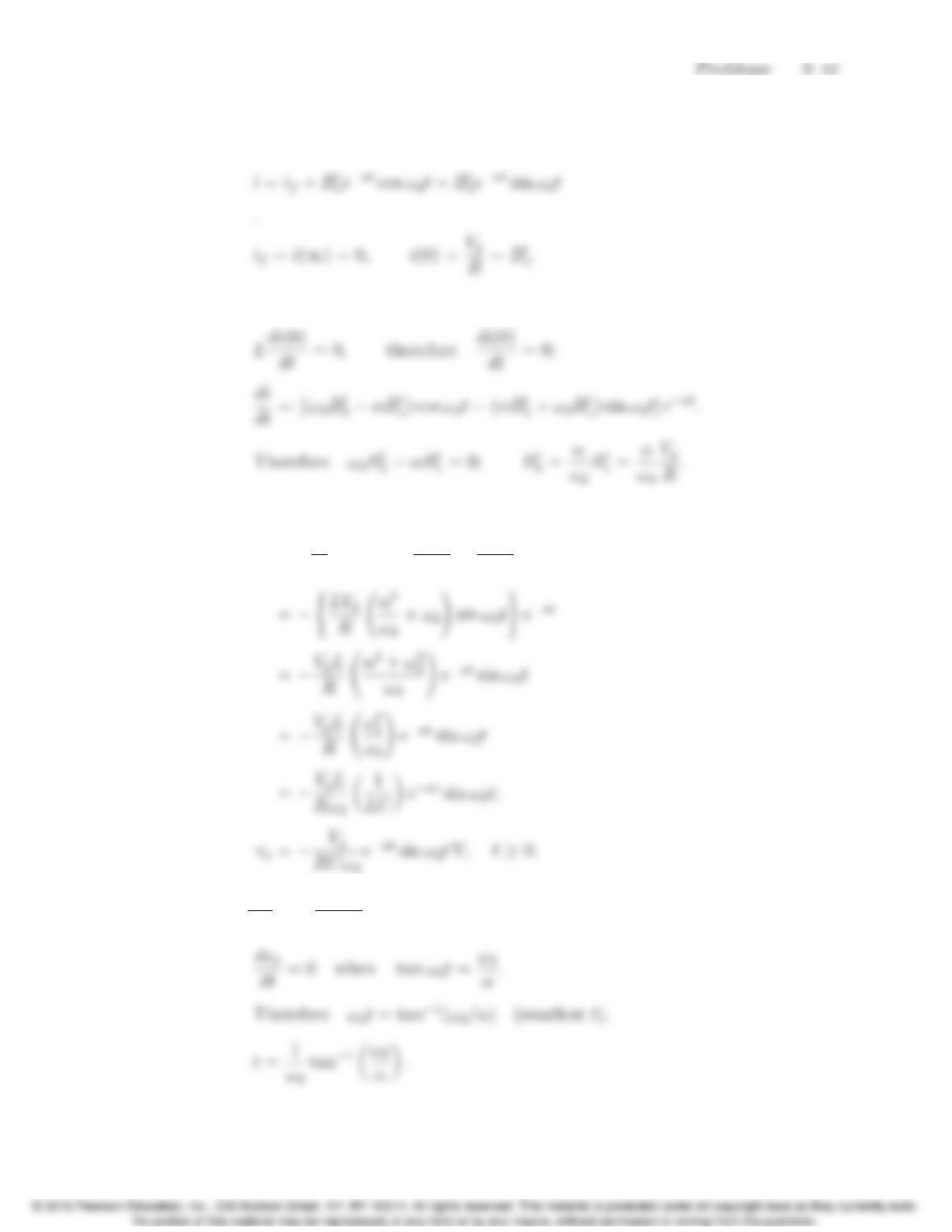
P 8.55 [a] Let ibe the current in the direction of the voltage drop vo(t).Then by
hypothesis
Therefore i=B0
1eαtcos ωdt+B0
2eαtsin ωdt.
Therefore
vo=Ldi
dt =(L α2Vg
ωdR+ωdVg
R!sin ωdt)eαt
[b] dvo
dt =Vg
ωdRC {ωdcos ωdtαsin ωdt}eαt;
8–42 CHAPTER 8. Natural and Step Responses of RLC Circuits
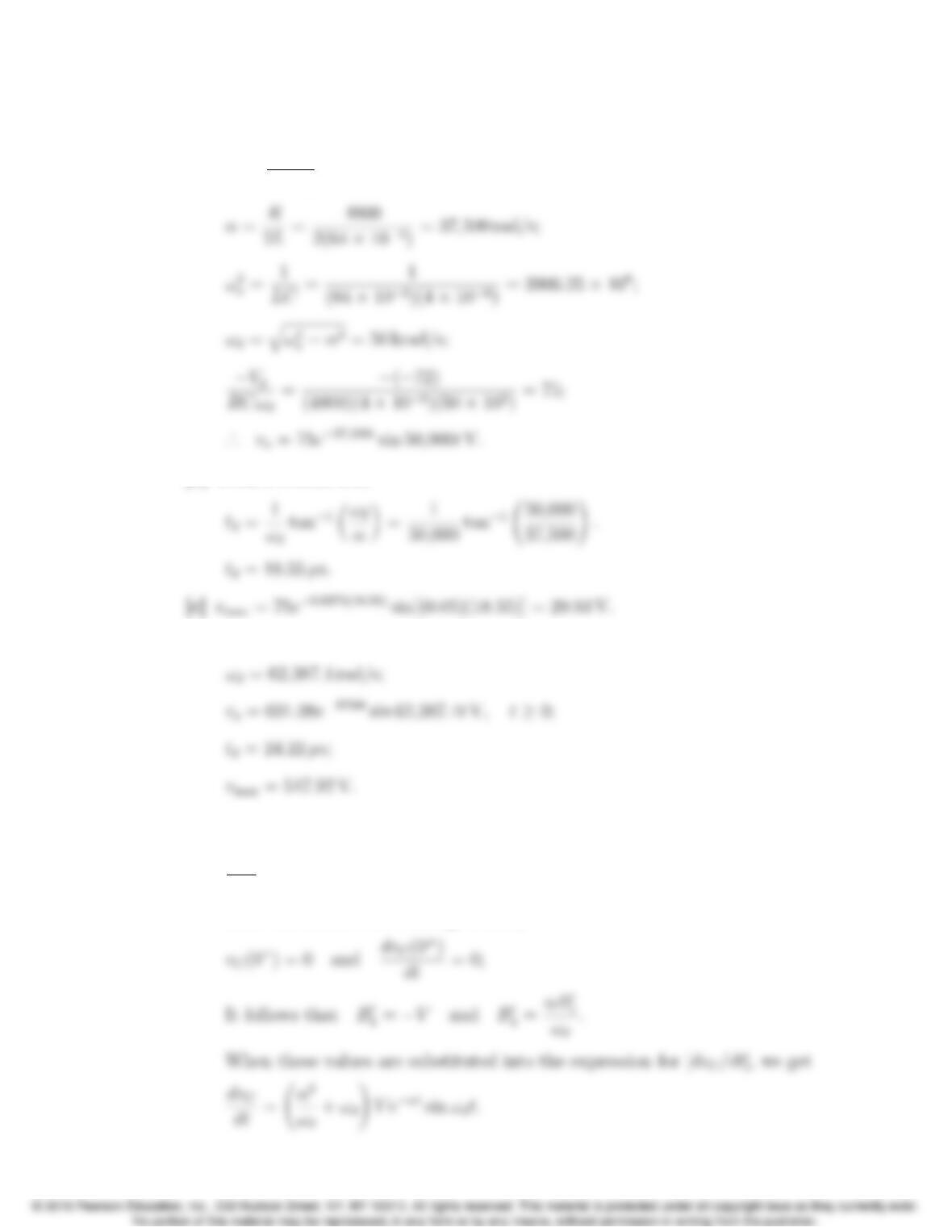
P 8.56 [a] From Problem 8.55 we have
vo=Vg
RCωd
eαtsin ωdt;
[b] From Problem 8.55
[d] R= 480 Ω;α= 3750 rad/s;
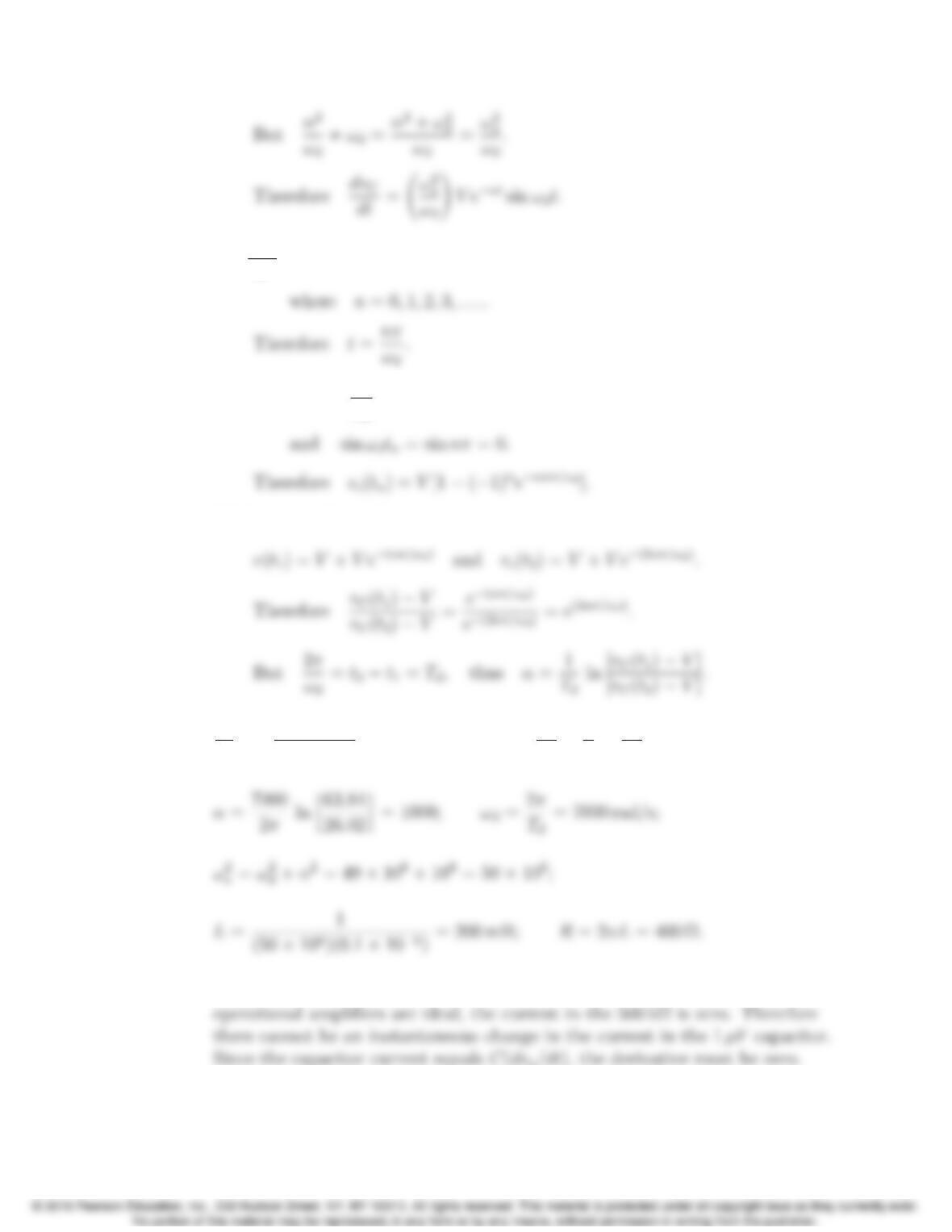
P 8.57 [a] vC=V+[B0
1cos ωdt+B0
2sin ωdt]eαt;
dvC
dt = [(ωdB0
2αB0
1)cosωdt(αB0
2+ωdB0
1) sin ωdt]eαt.
Since the initial stored energy is zero,
Problems 8–43
[b] dvC
dt = 0 when sin ωdt=0,or ωdt=nπ,
[c] When tn=nπ
ωd
,cos ωdtn=cosnπ=(1)n,
[d] It follows from [c] that
P 8.58 1
Td
ln (vc(t1)V
vc(t3)V);Td=t3t1=3π
7π
7=2π
7ms;
P 8.59 At t= 0 the voltage across each capacitor is zero. It follows that since the
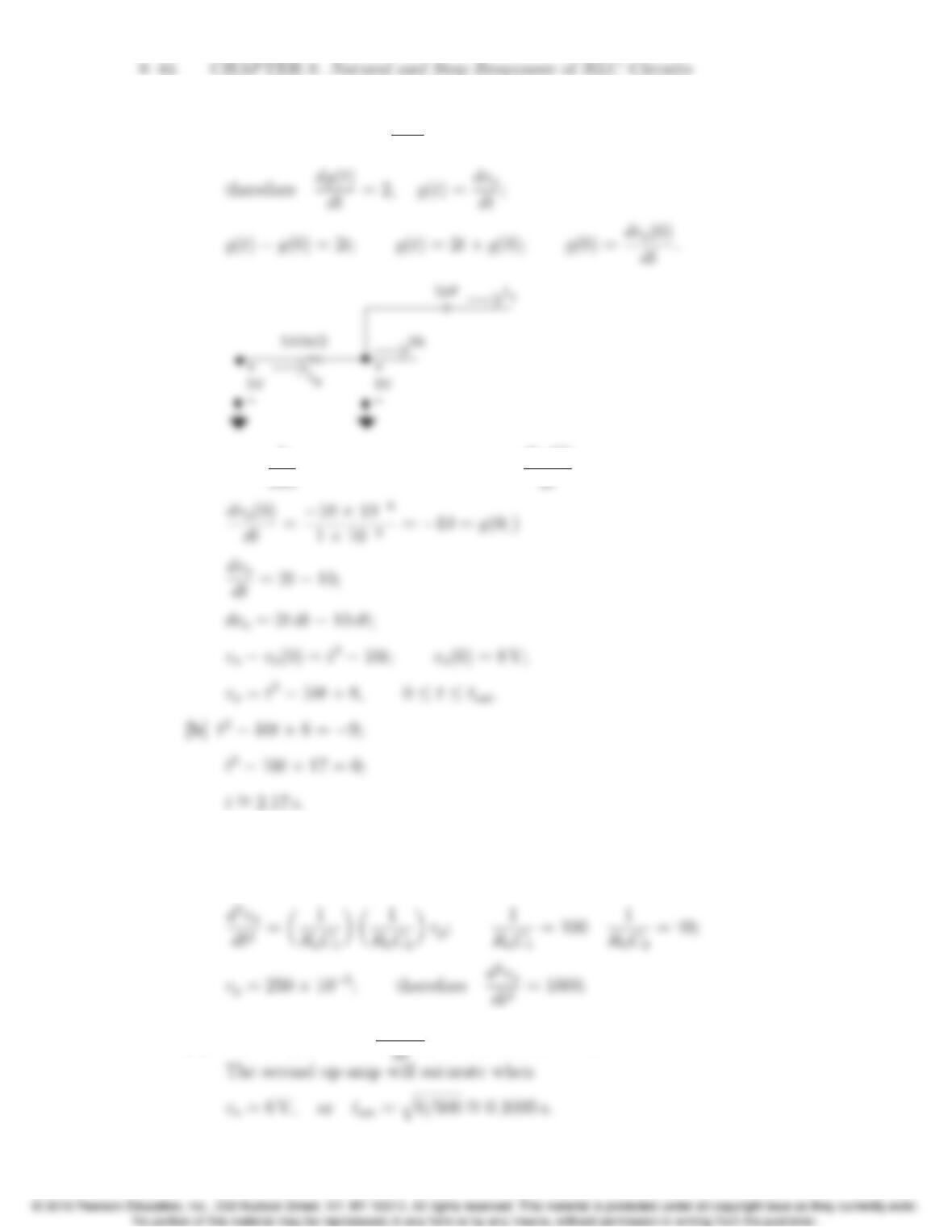
P 8.60 [a] From Example 8.13 d2vo
dt2= 2;
iR=5
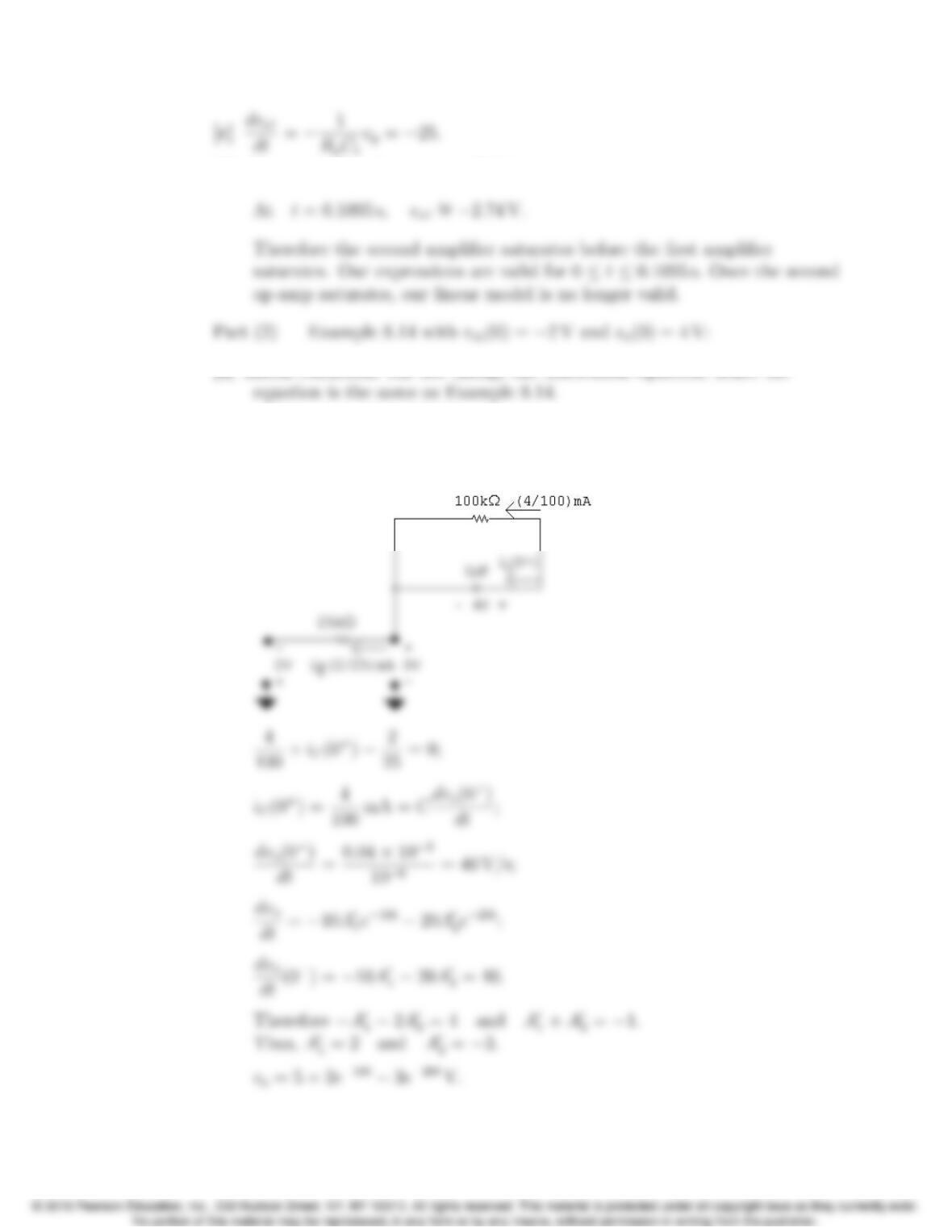
P 8.61 Part (1) — Example 8.14, with R1and R2removed:
[a] Ra= 100 kΩ;C1=0.1µF; Rb= 25 kΩ;C2=1µF;
[b] Since vo(0) = 0 = dvo(0)
Problems 8–45
[d] Since vo1(0) = 0,v
o1=25tV;
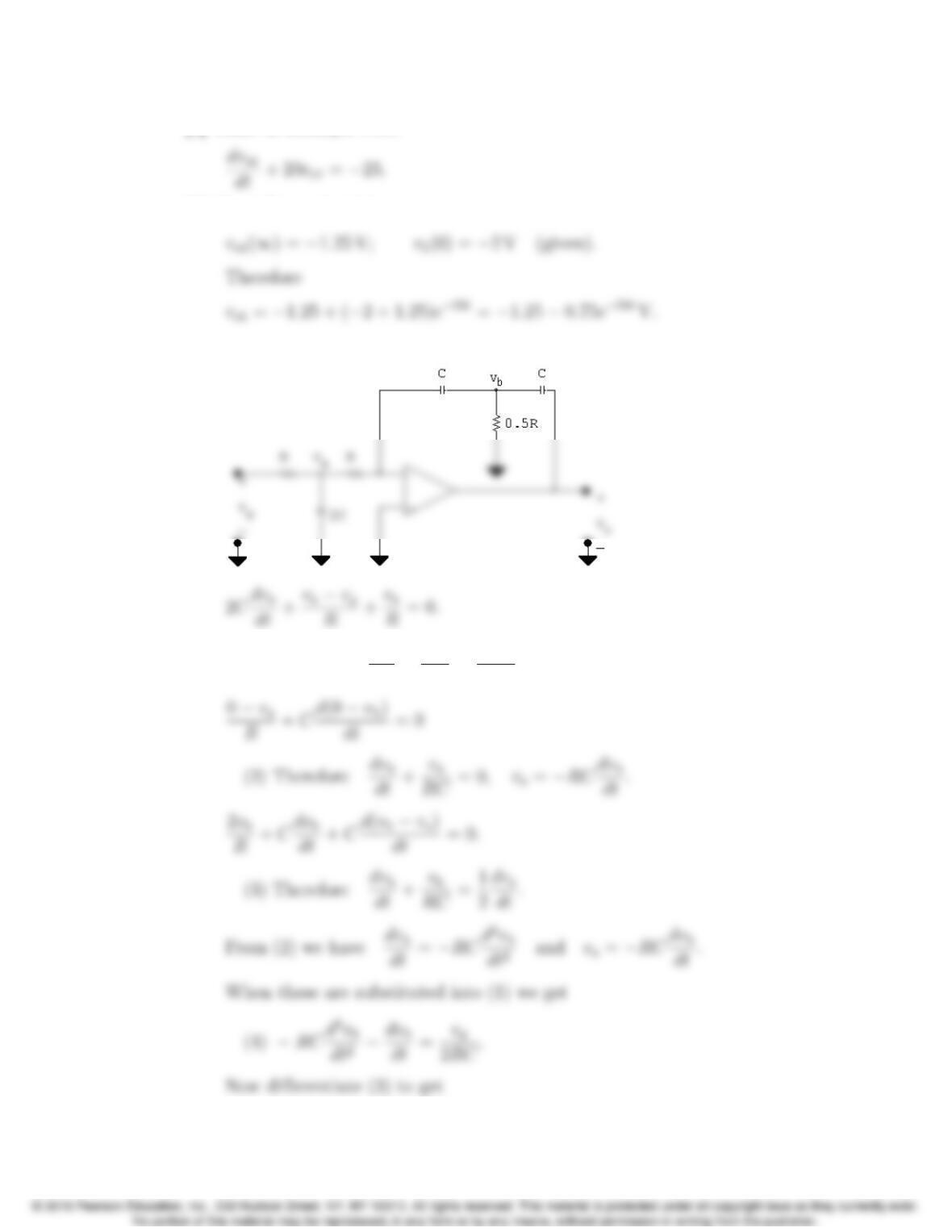
[a] Initial conditions will not change the differential equation; hence the
[b] vo=5+A0
1e10t+A0
2e20t(from Example 8.14);
vo(0) = 4 = 5 + A0
1+A0
2.
8–46 CHAPTER 8. Natural and Step Responses of RLC Circuits
[c] Same as Example 8.14:
[d] From Example 8.14:
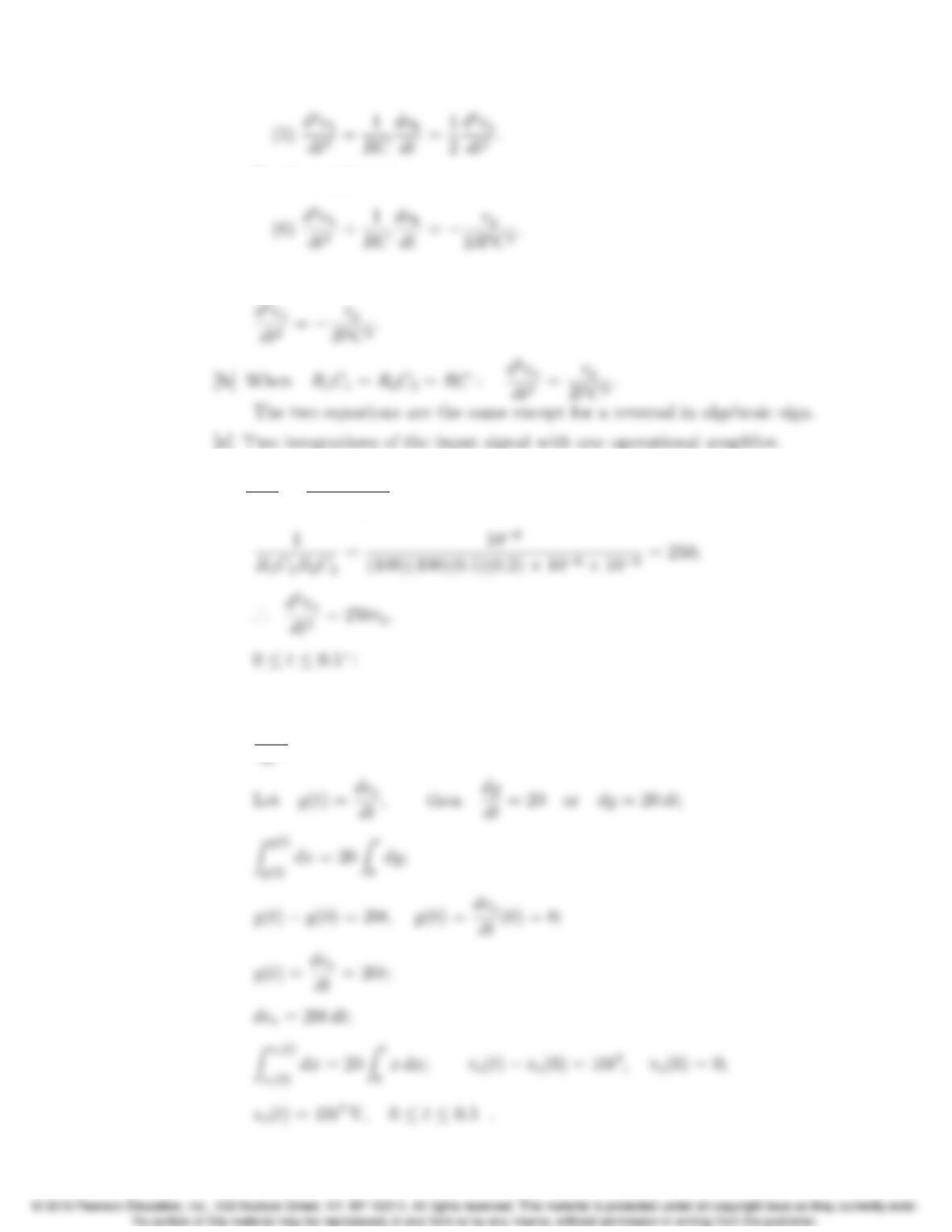
P 8.62 [a]
(1) Therefore dva
dt +va
RC =vg
2RC .
Problems 8–47
But from (4) we have
Now substitute (6) into (5)
P 8.63 [a] d2vo
dt2=1
R1C1R2C2
vg;
vg= 80 mV;
d2vo
8–48 CHAPTER 8. Natural and Step Responses of RLC Circuits
Zvo1(t)
vo1(0) dx =1.6Zt
0dy;
vo1(t)vo1(0) = 1.6t, vo1(0) = 0;
Zg(t)
g(0.5+)dx =10 Zt
0.5dy;
·
.. g(t)=10t+ 5 + 10 = 10t+15= dvo
dt ;
Problems 8–49
Summary:
[b] 12.5=5t2
sat +15tsat 3.75;
P 8.64 τ1= (106)(0.5⇥106)=0.50 s;
·
.. d2vo
dt2+3dvo
dt +2vo= 20
s2+3s+2=0.
8–50 CHAPTER 8. Natural and Step Responses of RLC Circuits
vo(t)=1020et+10e2tV,0t0.5s.
At t=0.5 s:
0.5st1:
Solving,
Problems 8–51
P 8.65 [a] f(t) = inertial force + frictional force + spring force
[b] d2x
dt2=f
M✓D
M◆ dx
dt !✓K
M◆x;
Given vA=d2x
dt2,then
Box Number Function
1 inverting and scaling
P 8.66 [a] ω0=s1
LC =s1
(5 ⇥109)(2 ⇥1012)= 1010 rad/sec;
8–52 CHAPTER 8. Natural and Step Responses of RLC Circuits
[c] Because the inductor and capacitor are assumed to be ideal, none of the
P 8.67 [a] ω0=2πf0=2π(2 ⇥109)=4π⇥109rad/s;
[b] vo(t)= V
ω0RC sin ω0t=4
(4π⇥109)(10)(6.33 ⇥1012)sin 4π⇥109t
P 8.68 [a] α=R
2L=0.01
2(5 ⇥109)= 106rad/s;
[c] ωd=qω2
0α2=q(1010)2(106)2⇡1010 rad/s;
[d] Because of the added resistance, the oscillation now occurs within a
decaying exponential envelope (see Fig. 8.9). The form of the