Introduction to the Laplace
Transform
Assessment Problems
AP 12.1 [a] cosh βt=eβt+eβt
2.
Therefore,
[b] sinh βt=eβt−eβt
2.
Therefore,
L{sinh βt}=1
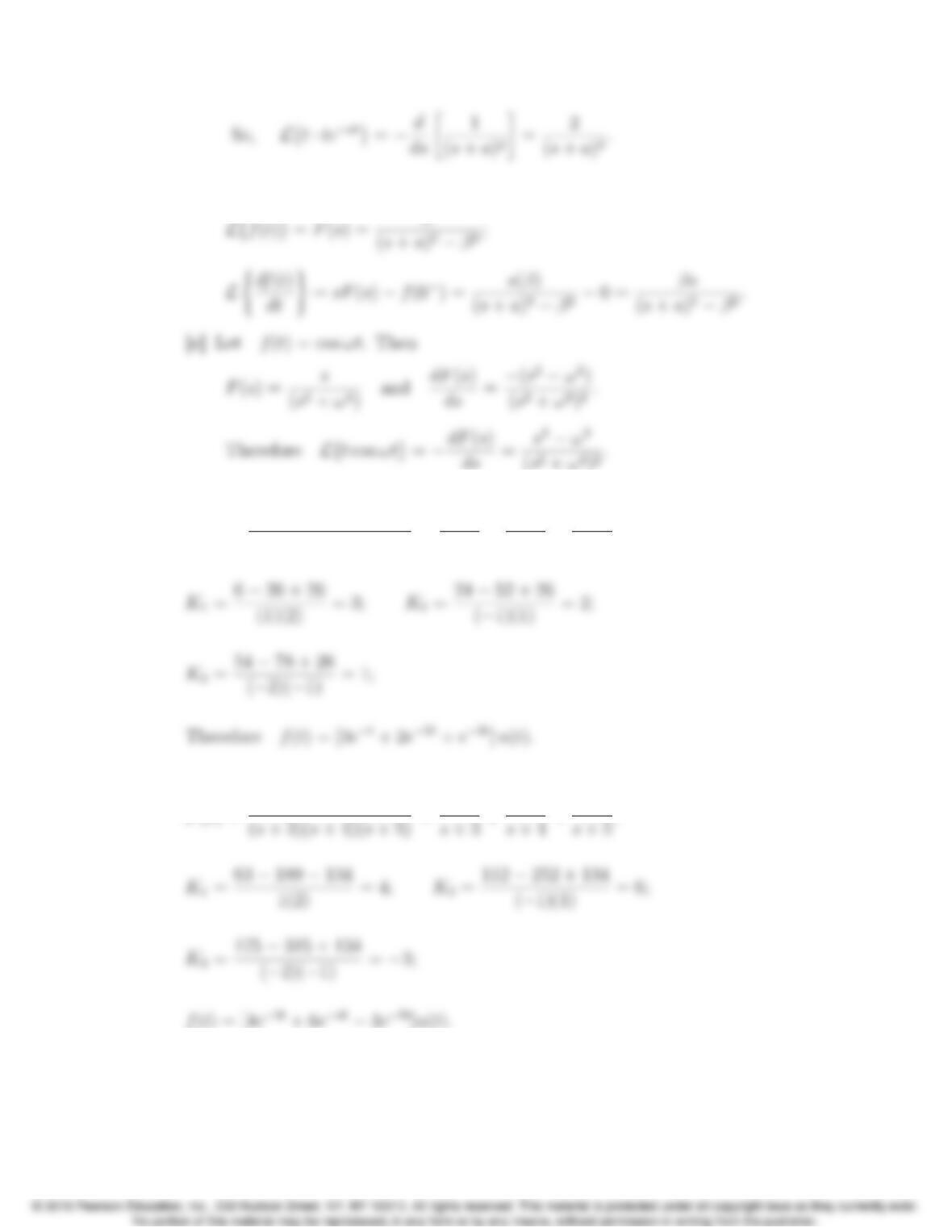
AP 12.2 [a] Let f(t)=teat:
F(s)=L{teat}=1
12–1
12
12–2 CHAPTER 12. Introduction to the Laplace Transform
[b] Let f(t)=eat sinh βt, then
AP 12.3
F(s)= 6s2+26s+26
(s+ 1)(s+ 2)(s+3) =K1
s+1+K2
s+2+K3
s+3;
AP 12.4
F(s)= 7s2+63s+ 134
Problems 12–3
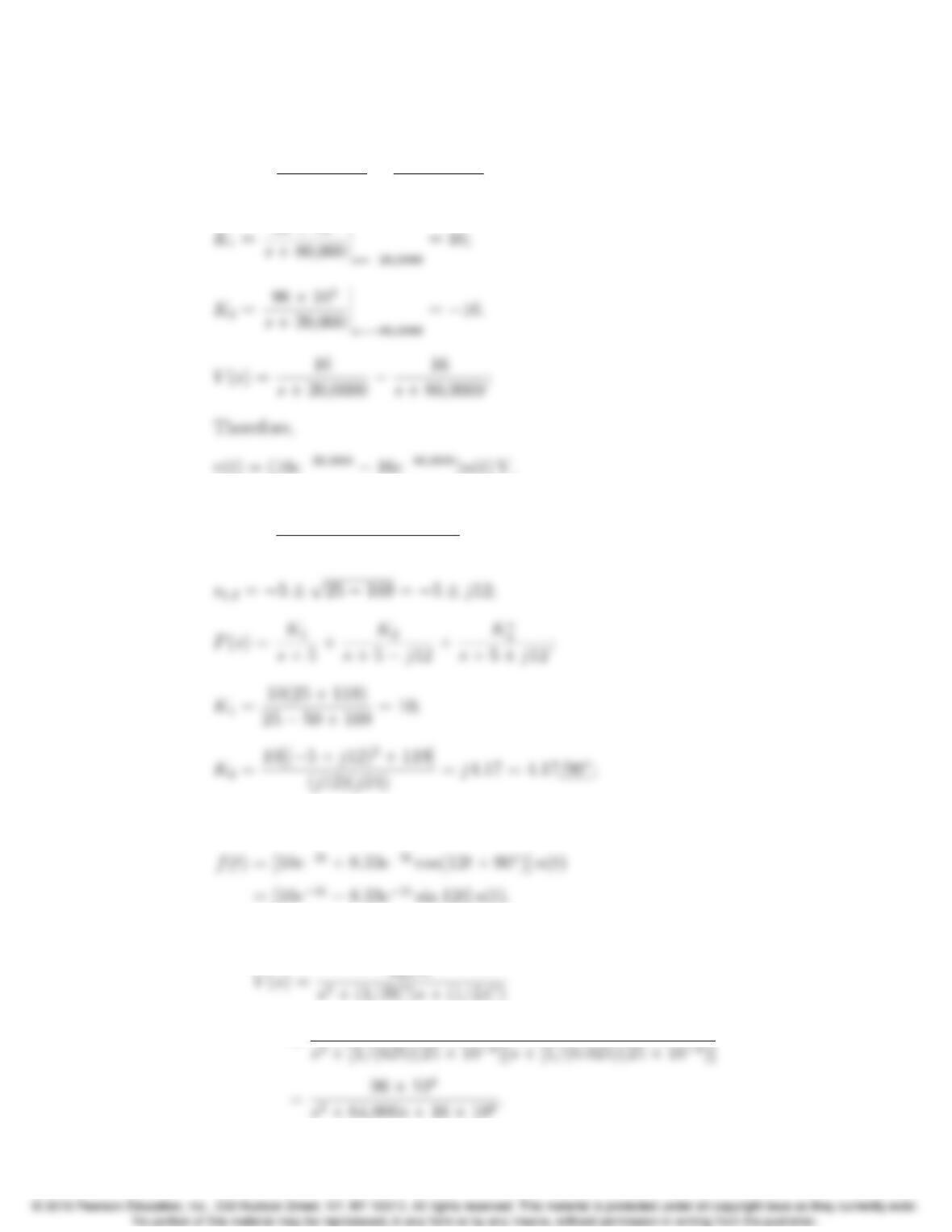
AP 12.5 From Example 12.2,
V(s)= K1
s+20,0000 +K2
s+80,0000.
AP 12.6
F(s)= 10(s2+ 119)
(s+ 5)(s2+10s+ 169);
Therefore
AP 12.7 [a] Using the expression for V(s) found for the circuit in Fig. 12.16,
=0.024/(25 ×109)
12–4 CHAPTER 12. Introduction to the Laplace Transform
AP 12.8
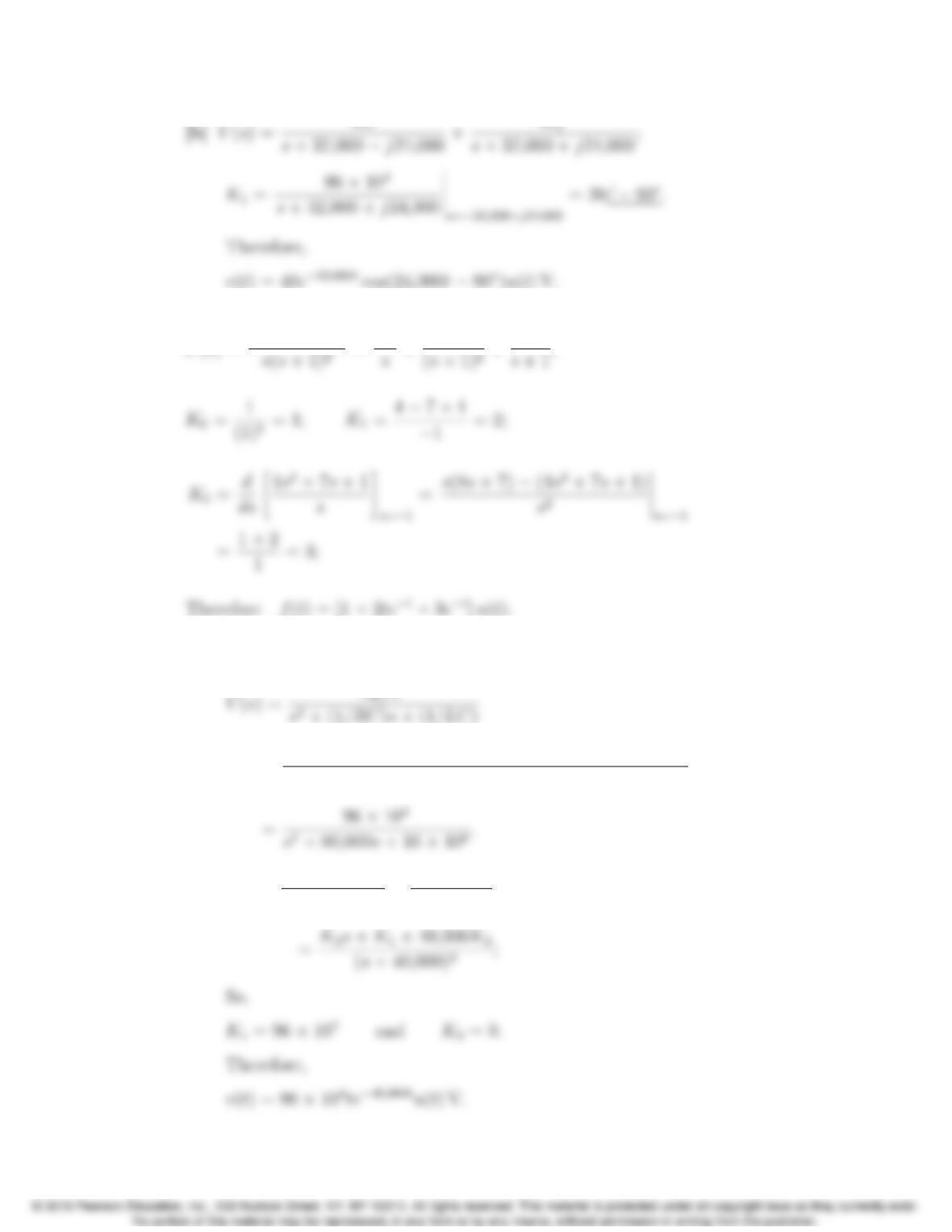
F(s)=4s2+7s+1
AP 12.9 [a] Using the expression for V(s) found for the circuit in Fig. 12.16,
=0.024/(25 ×109)
s2+ [1/(500)(25 ×109)]s+ [1/(0.025)(25 ×109)]
[b] V(s)= K1
(s+40,000)2+K2
s+40,000
AP 12.10
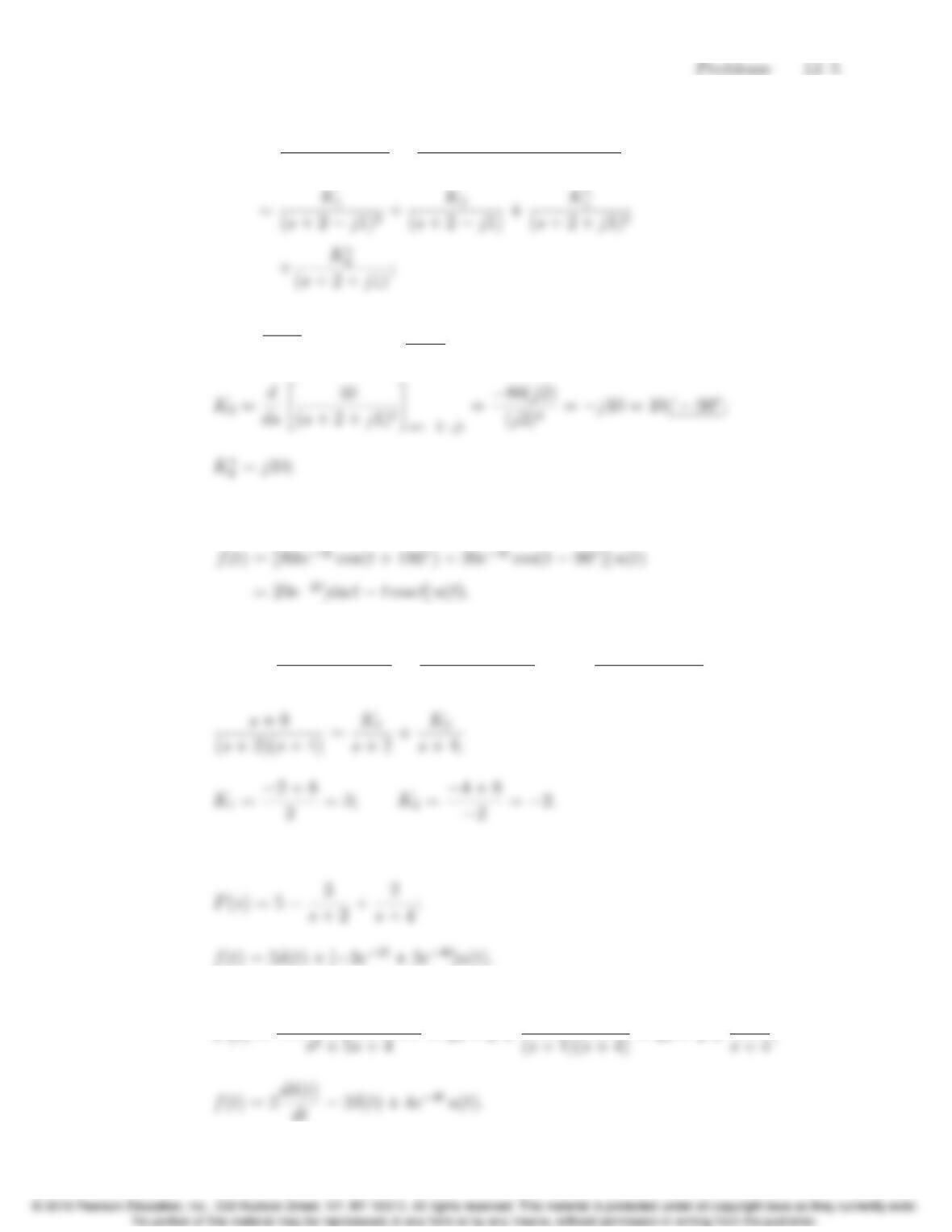
F(s)= 40
(s2+4s+5)
2=40
(s+2−j1)2(s+2+j1)2
K1=40
(j2)2=−10 = 10/180and K⇤
1=−10;
Therefore
AP 12.11
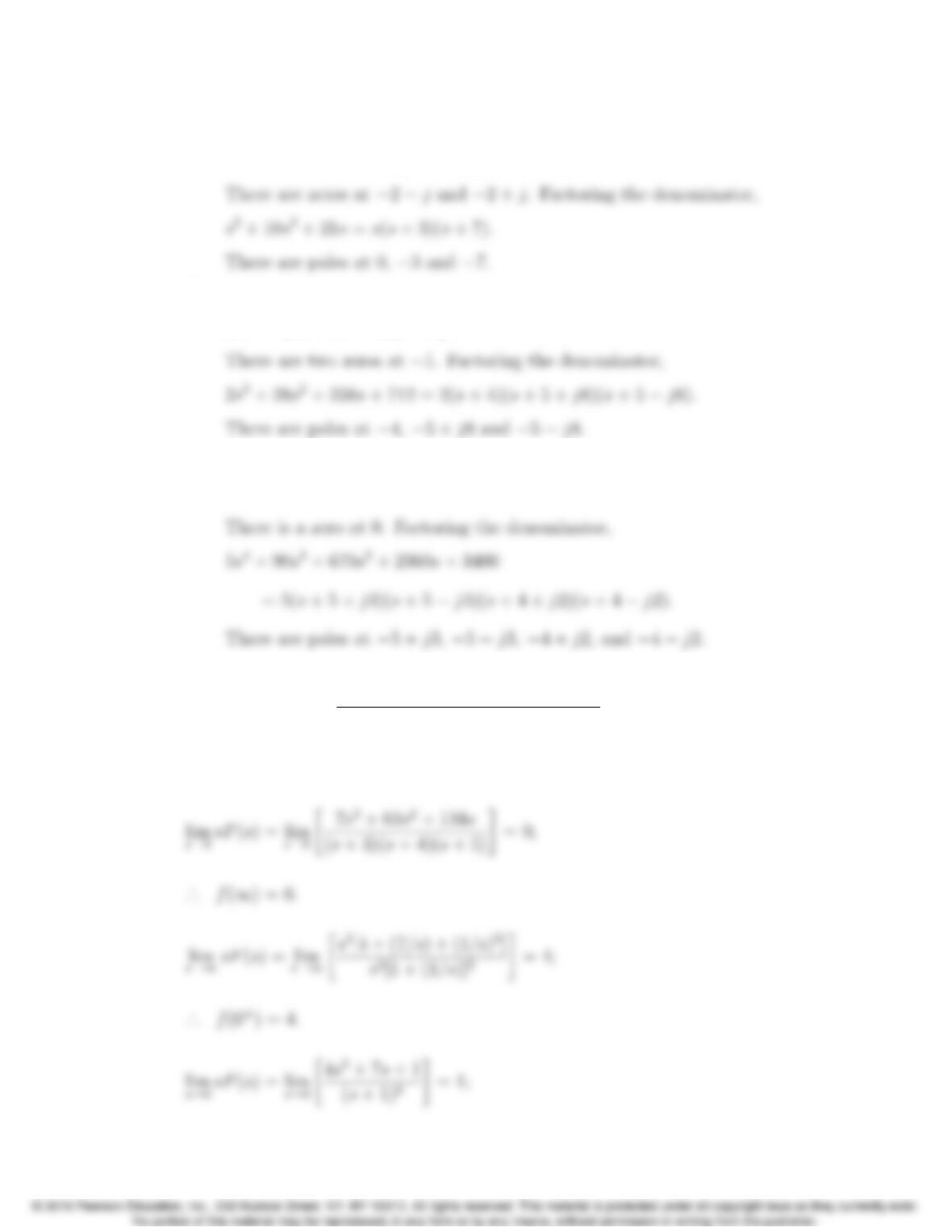
F(s)=5s2+29s+32
(s+ 2)(s+4) =5s2+29s+32
s2+6s+8 =5−s+8
(s+ 2)(s+4);
Therefore,
AP 12.12
12–6 CHAPTER 12. Introduction to the Laplace Transform
AP 12.13 [a] Factoring the numerator,
20s2+80s+ 100 = 20(s+2+j)(s+2−j).
[b] Factoring the numerator,
10s2+20s+ 10 = 10(s+1)
2.
[c] The numerator is
125s.
AP 12.14
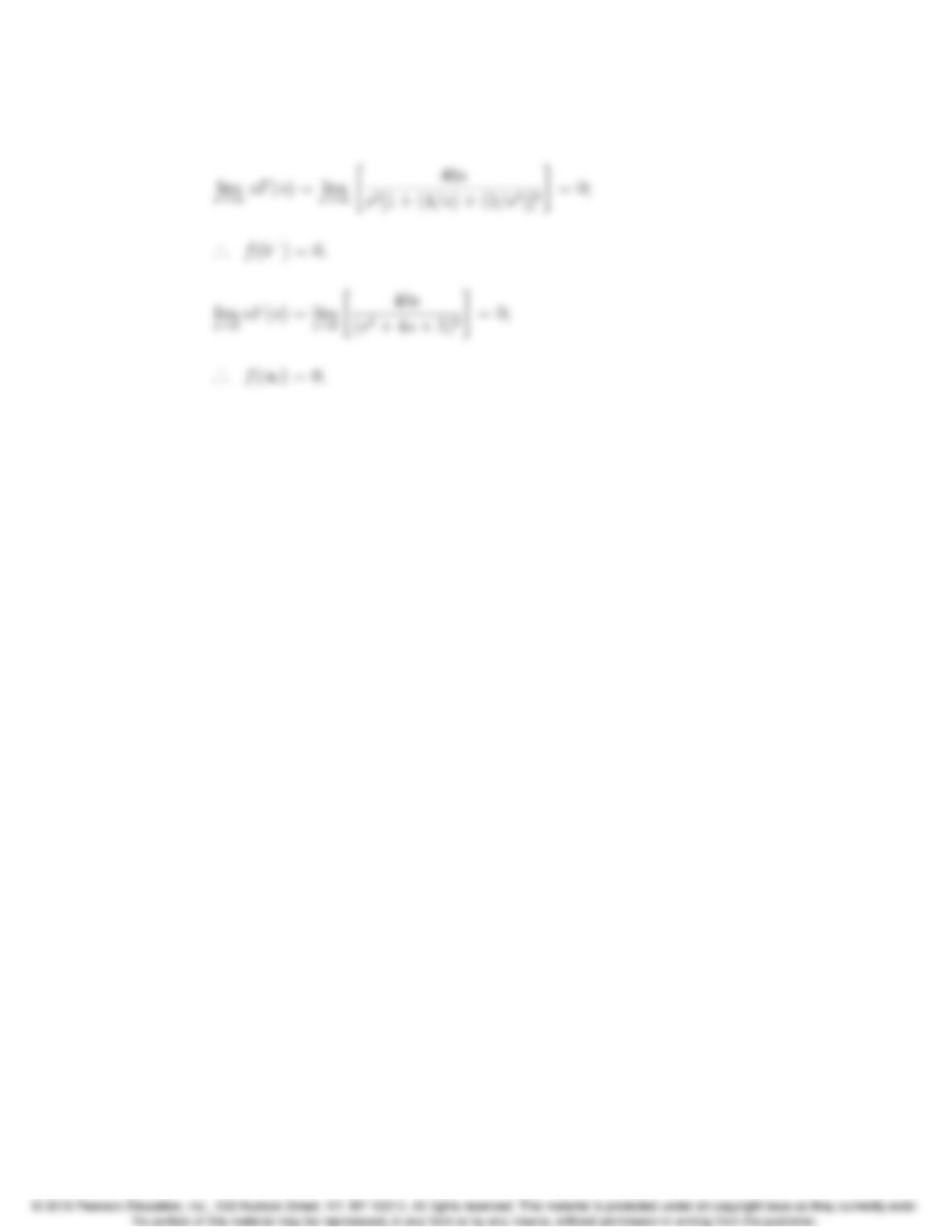
lim
s!1 sF (s) = lim
s!1 “7s3[1 + (9/s) + (134/(7s2))]
s3[1 + (3/s)][1 + (4/s)][1 + (5/s)]#= 7;
·
.. f(0+)=7.
Problems 12–7
·
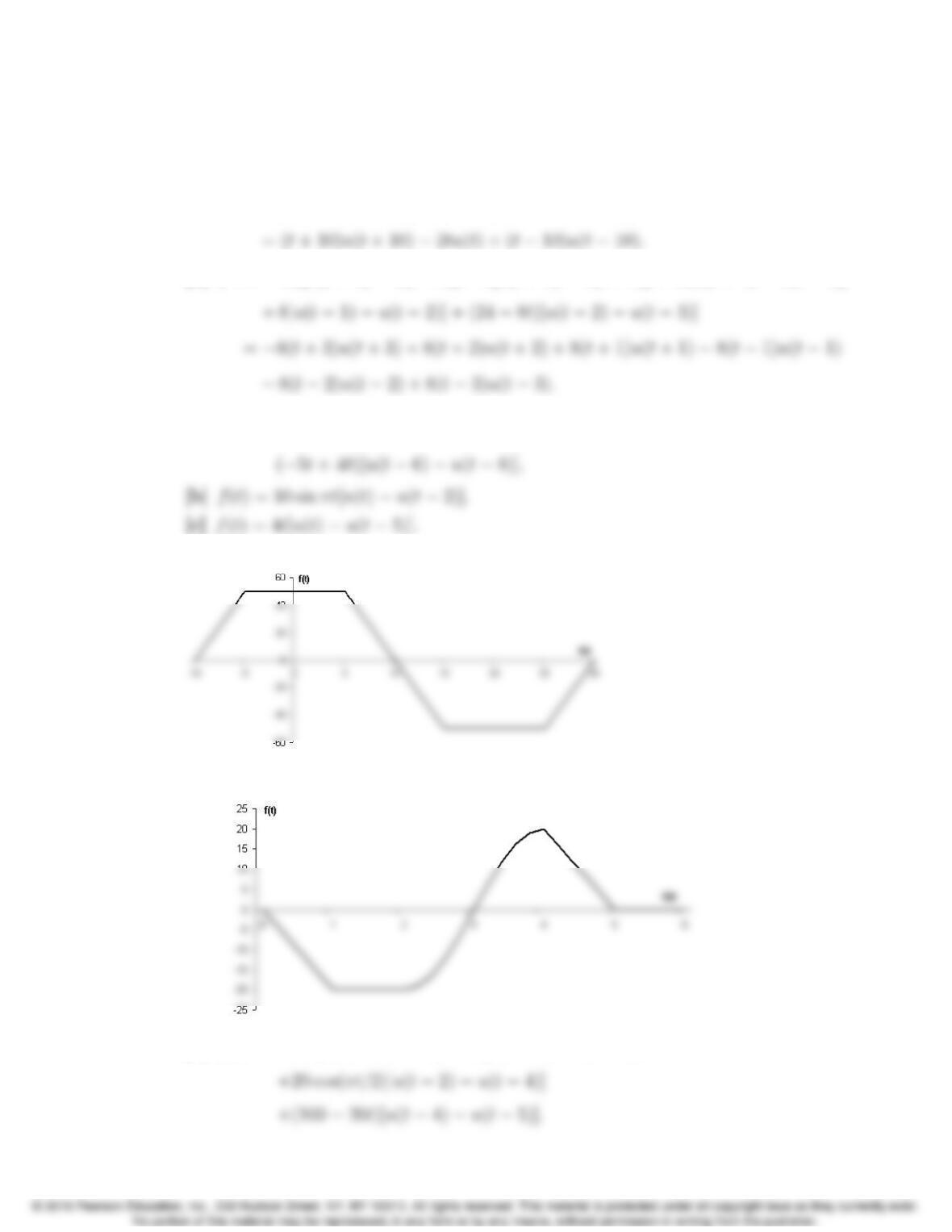
.. f(∞)=1.
12–8 CHAPTER 12. Introduction to the Laplace Transform
Problems
P 12.1 [a] (10 + t)[u(t+ 10) −u(t)] + (10 −t)[u(t)−u(t−10)]
[b] (−24 −8t)[u(t+3)−u(t+ 2)] −8[u(t+2)−u(t+ 1)] + 8t[u(t+1)−u(t−1)]
P 12.2 [a] f(t)=5t[u(t)−u(t−2)] + 10[u(t−2) −u(t−6)]+
P 12.3
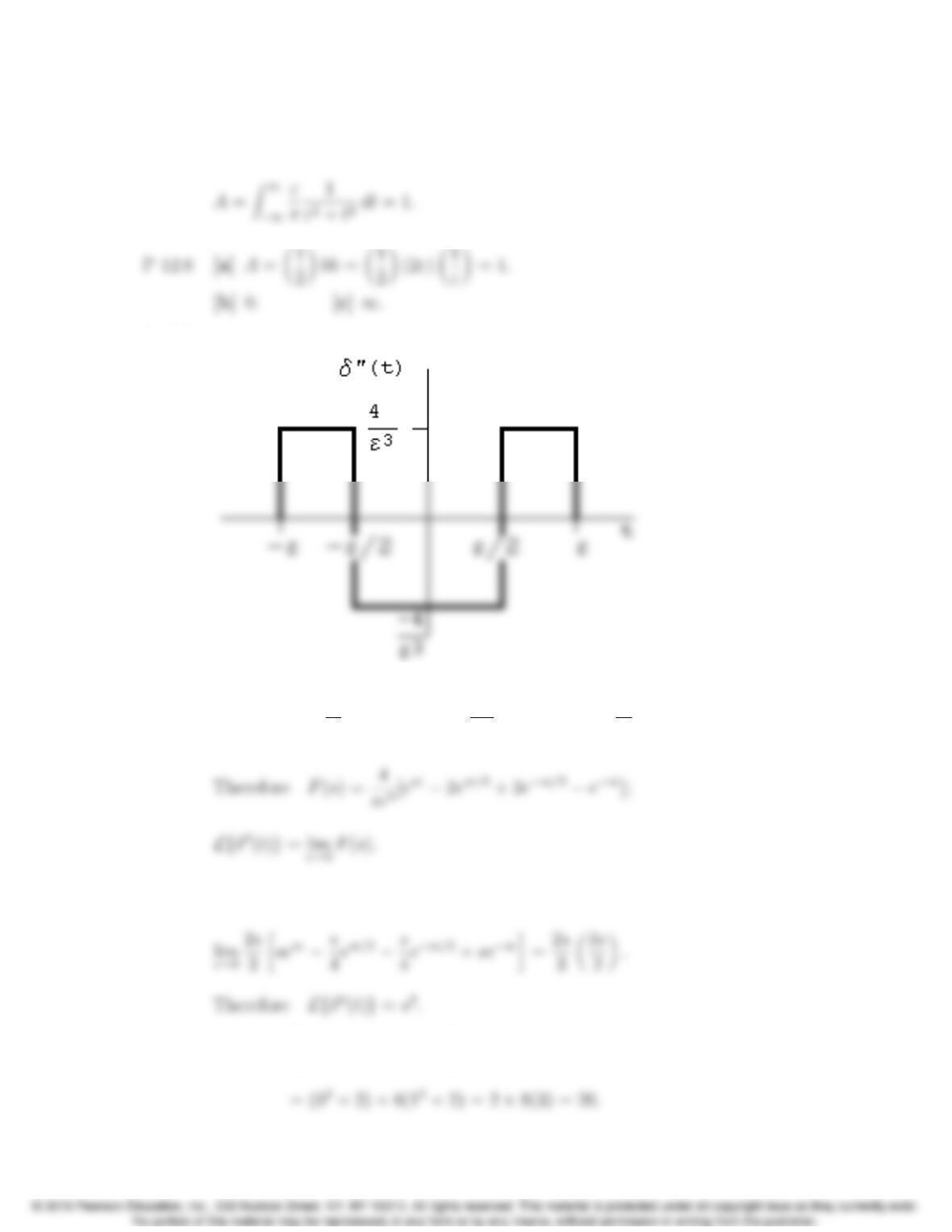
P 12.4 [a]
[b] f(t)=−20t[u(t)−u(t−1)] −20[u(t−1) −u(t−2)]
Problems 12–9
P 12.5 As ε→0 the amplitude →∞; the duration →0; and the area is independent
of ε,i.e.,
P 12.7
F(s)=Zε/2
ε
4
ε3est dt +Zε/2
ε/2✓−4
ε3◆est dt +Zε
ε/2
4
ε3est dt.
After applying L’Hopital’s rule three times, we have
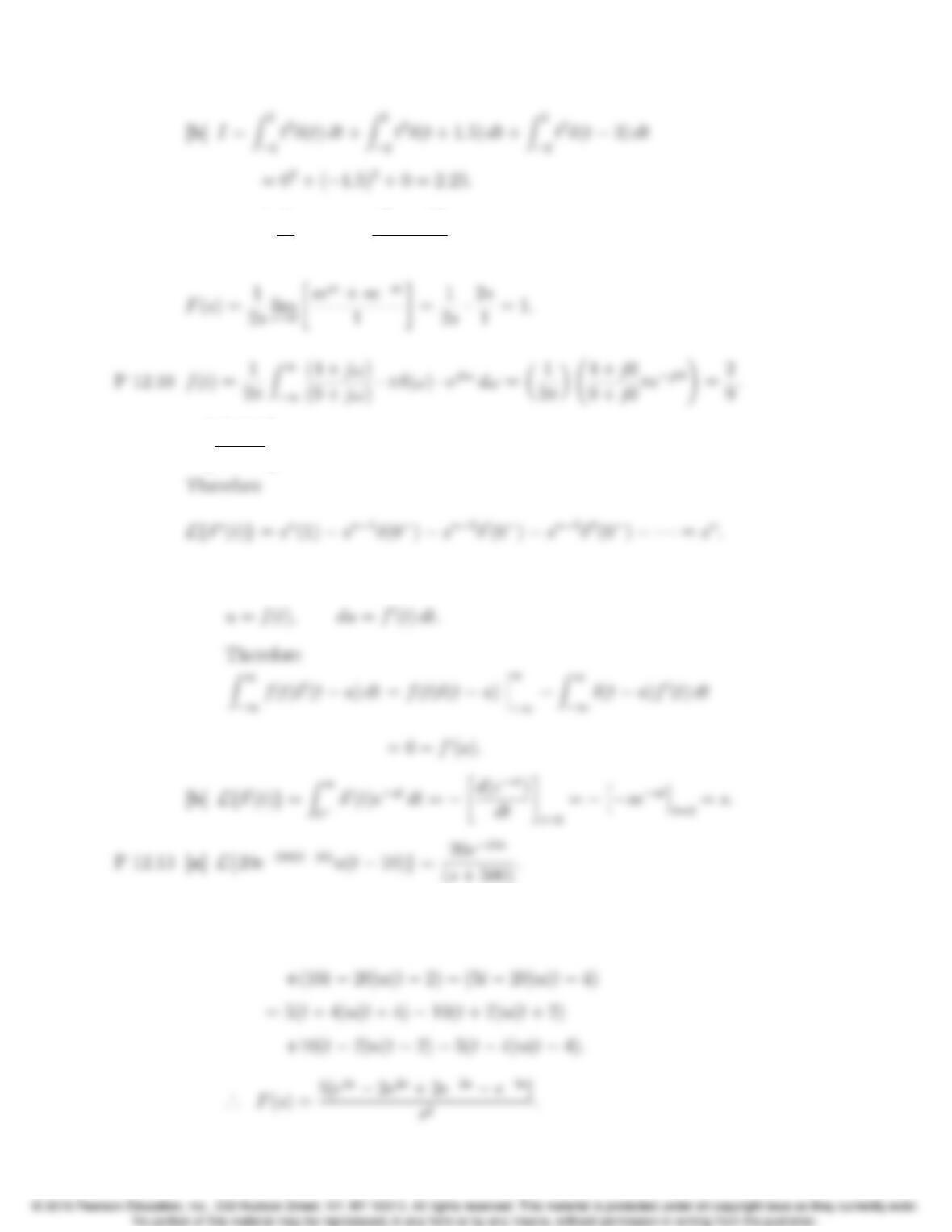
P 12.8 [a] I=Z3
1(t3+2)δ(t)dt +Z3
18(t3+2)δ(t−1) dt
12–10 CHAPTER 12. Introduction to the Laplace Transform
P 12.9 F(s)=Zε
ε
1
2εest dt =esε−esε
2εs.
P 12.11 L(dnf(t)
dtn)=snF(s)−sn1f(0)−sn2f0(0)−···.
P 12.12 [a] Let dv =δ0(t−a)dt, v =δ(t−a),
[b] First rewrite f(t) as
f(t) = (5t+ 20)u(t+4)−(10t+ 20)u(t+2)
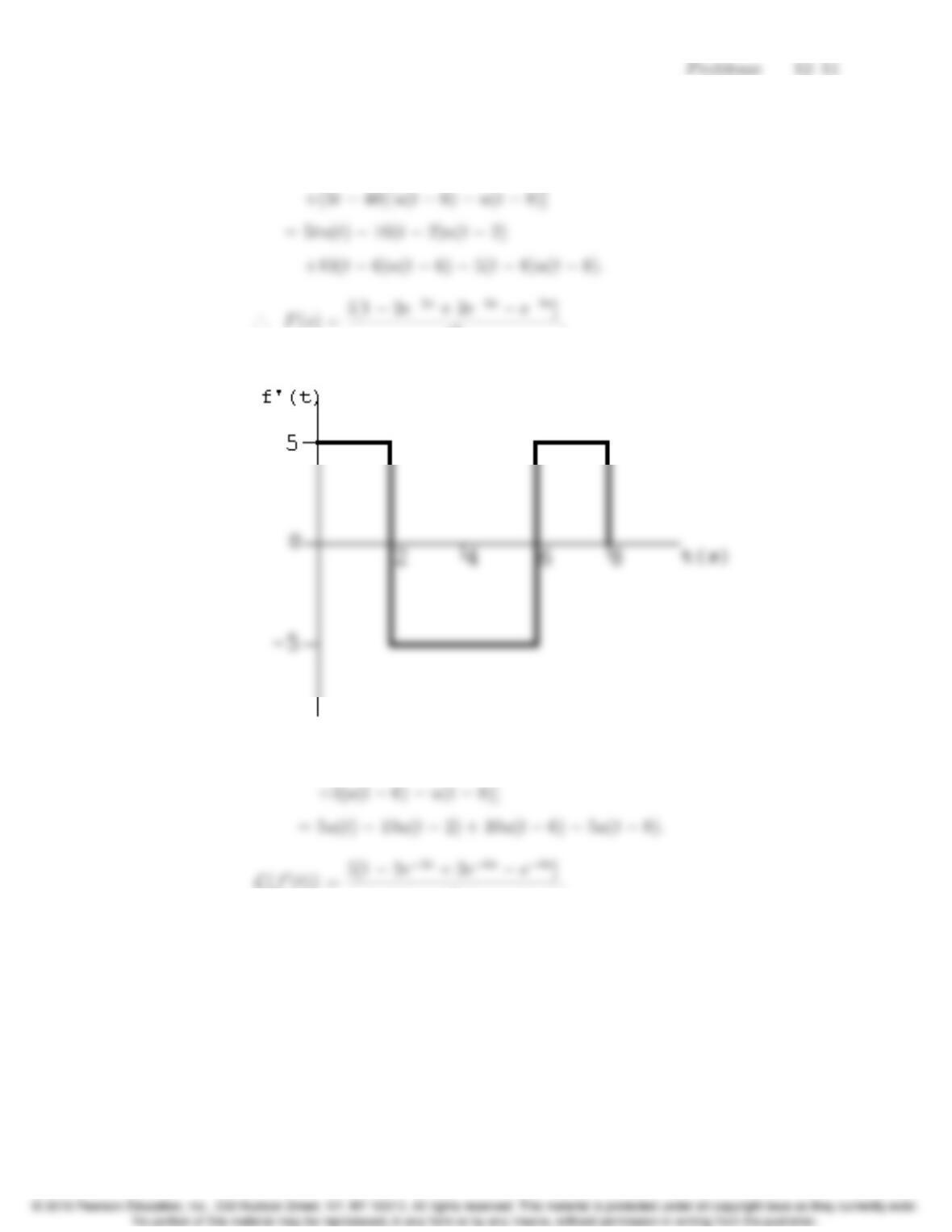
P 12.14 [a] f(t)=5t[u(t)−u(t−2)]
+(20 −5t)[u(t−2) −u(t−6)]
s2.
[b]
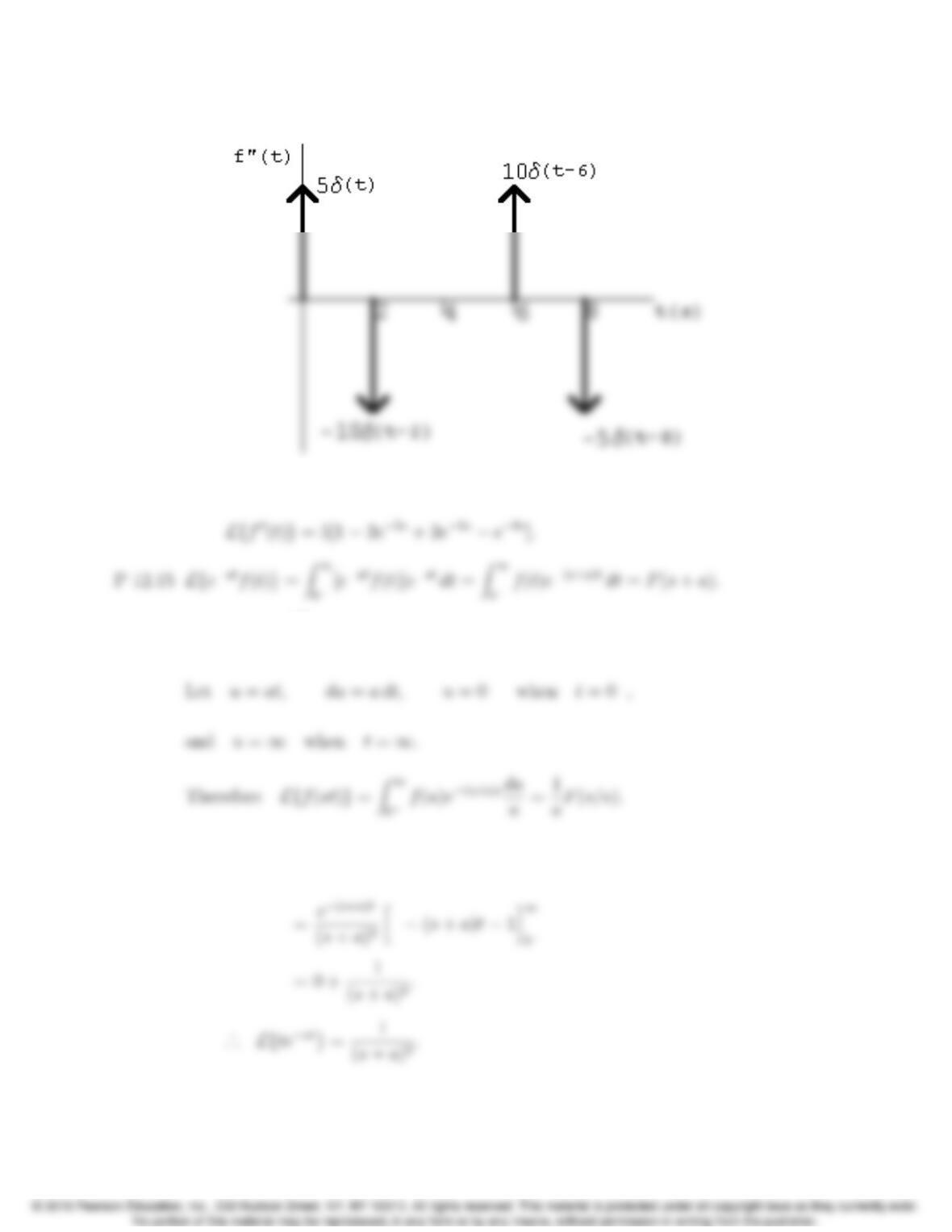
f0(t) = 5[u(t)−u(t−2)] −5[u(t−2) −u(t−6)]
s.
12–12 CHAPTER 12. Introduction to the Laplace Transform
[c]
f00(t)=5δ(t)−10δ(t−2) + 10δ(t−6) −5δ(t−8).
P 12.16 L{f(at)}=Z1
0−
f(at)est dt
P 12.17 [a] L{teat}=Z1
0−
te(s+a)tdt
Problems 12–13
[b] L(d
dt(teat)u(t))=s
(s+a)2−0.
P 12.18 [a] L⇢Zt
0−
eax dx=F(s)
s=1
s(s+a).
P 12.19 [a] Zt
0−
x dx =t2
2.
L(t2
2)=1
2Z1
0−
t2est dt
[b] L⇢Zt
0−
x dx=L{t}
s=1/s2
s=1
s3.
12–14 CHAPTER 12. Introduction to the Laplace Transform
[b] sin ωt=ejωt−ejωt
j2.
Therefore
[c] sin(ωt+θ) = (sin ωtcos θ+ cos ωtsin θ).
Therefore
[e] f(t) = cosh tcosh θ+ sinh tsinh θ.
From Assessment Problem 12.1(a)
P 12.21 [a] dF (s)
ds =d
ds Z1
0−
f(t)est dt=−Z1
0−
tf(t)est dt
[b] d2F(s)
ds2=Z1
0−
t2f(t)est dt;d3F(s)
ds3=Z1
0−−t3f(t)est dt.
[c] L{t5}=L{t4t}=(−1)4d4
ds4✓1
s2◆=120
s6;
Problems 12–15
L{tetcosh t}:.
From Assessment Problem 12.1(a),
Thus
P 12.22 [a] L(dsin ωt
dt u(t))=sω
s2+ω2−sin(0) = sω
s2+ω2.
[d] dsin ωt
dt = (cos ωt)·ω,L{ωcos ωt}=ωs
s2+ω2;
P 12.23 [a] L{f0(t)}=Zε
ε
est
2εdt +Z1
ε−aea(tε)est dt
12–16 CHAPTER 12. Introduction to the Laplace Transform
P 12.24 [a] f1(t)=eat cos ωt;F1(s)= s+a
(s+a)2+ω2;
[c] d
dt[eat cos ωt]=−ωeat sin ωt−aeat cos ωt;
P 12.25 [a] Z1
sF(u)du =Z1
sZ1
0−
f(t)eut dtdu =Z1
0−Z1
sf(t)eut dudt
[b] L{tsin βt}=2βs
(s2+β2)2;
Problems 12–17
P 12.26 Ig(s)= 1.2s
s2+1;1
RC =1.6; 1
LC = 1; 1
C=1.6.
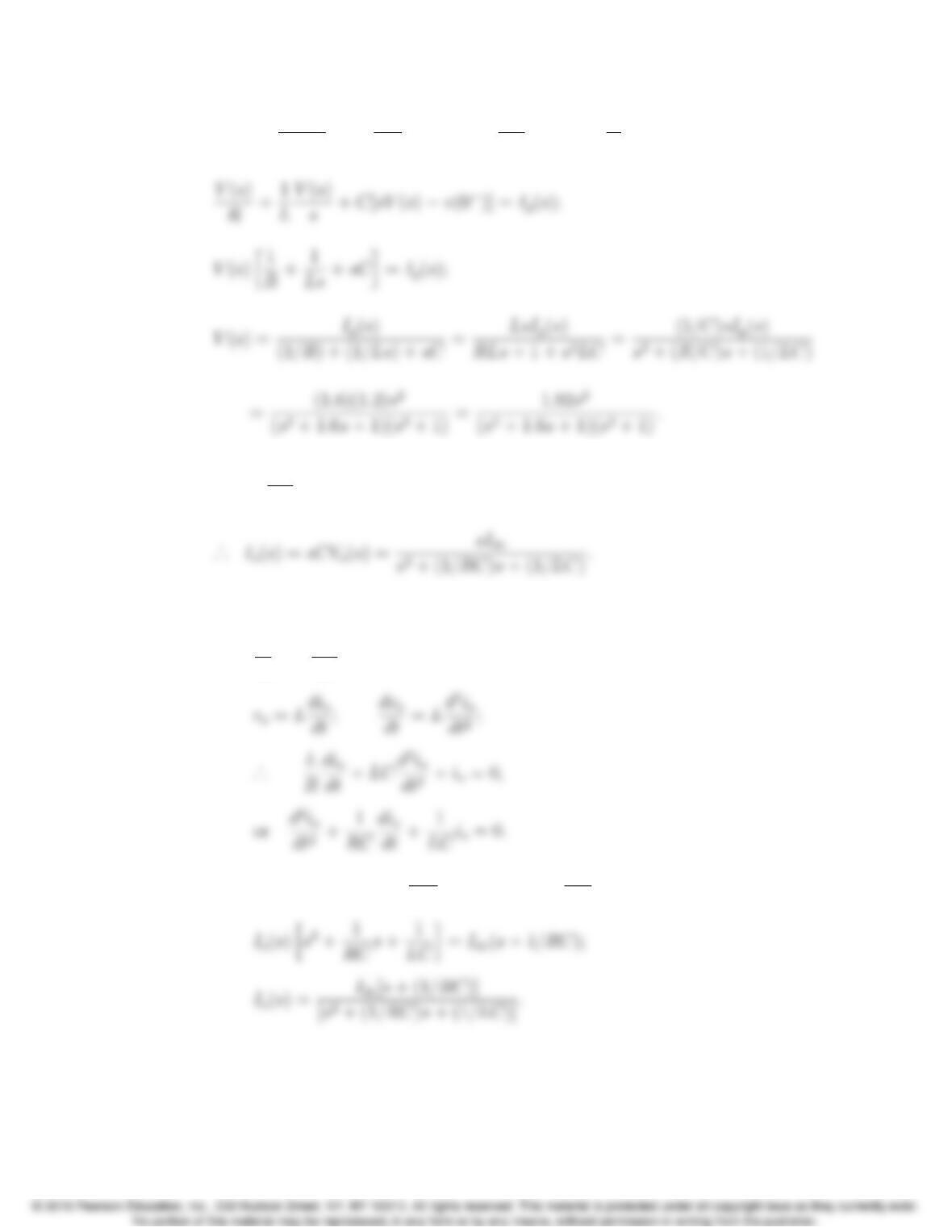
P 12.27 io=Cdvo
dt ;
P 12.28 [a] For t≥0+:
vo
R+Cdvo
dt +io= 0;
[b] s2Io(s)−sIdc −0+ 1
RC [sIo(s)−Idc]+ 1
LC Io(s)=0;