Problems 8–21
P 8.24 [a] v=L diL
dt != 16[e20,000te80,000t]V,t0.
P 8.25 [a] v=L diL
dt != 40e32,000tsin 24,000tV,t0.
P 8.27 α=1
2RC =1
2(400)(1.25 ⇥106)= 1000;
ω2
o=1
LC =1
(1.25 ⇥106)(1.25) = 64 ⇥104;
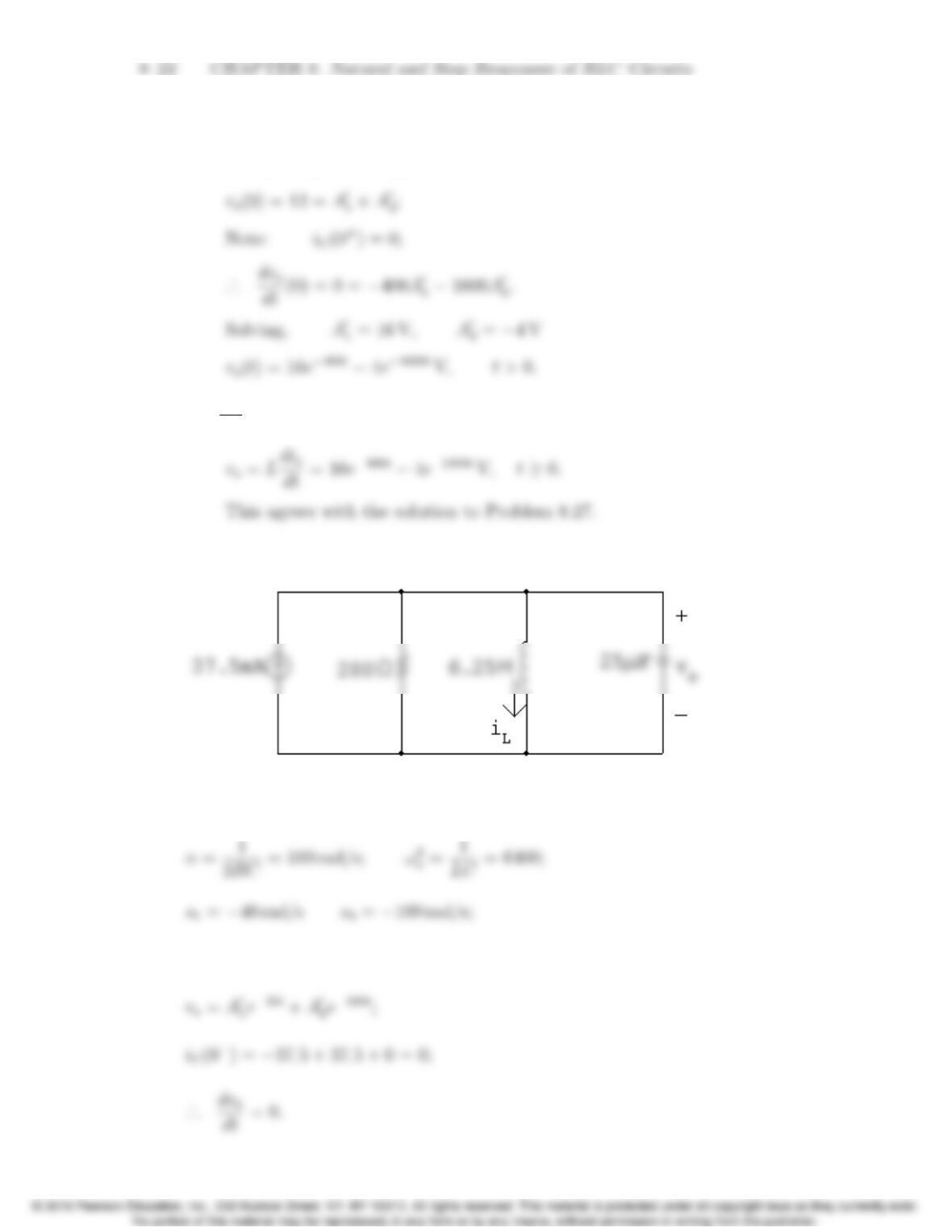
P 8.28 [a] vo(1)=0=Vf;
·
.. v
o=A0
1e400t+A0
2e1600t.
[b] dio
dt = [12.8e400t3.2e1600t];
P 8.29 iL(0)=iL(0+)=37.5 mA.
For t>0:
iL(0)=iL(0+)=37.5 mA;
vo(1)=0=Vf;
Problems 8–23
dvo
dt (0) = 40A0
1160A0
2;
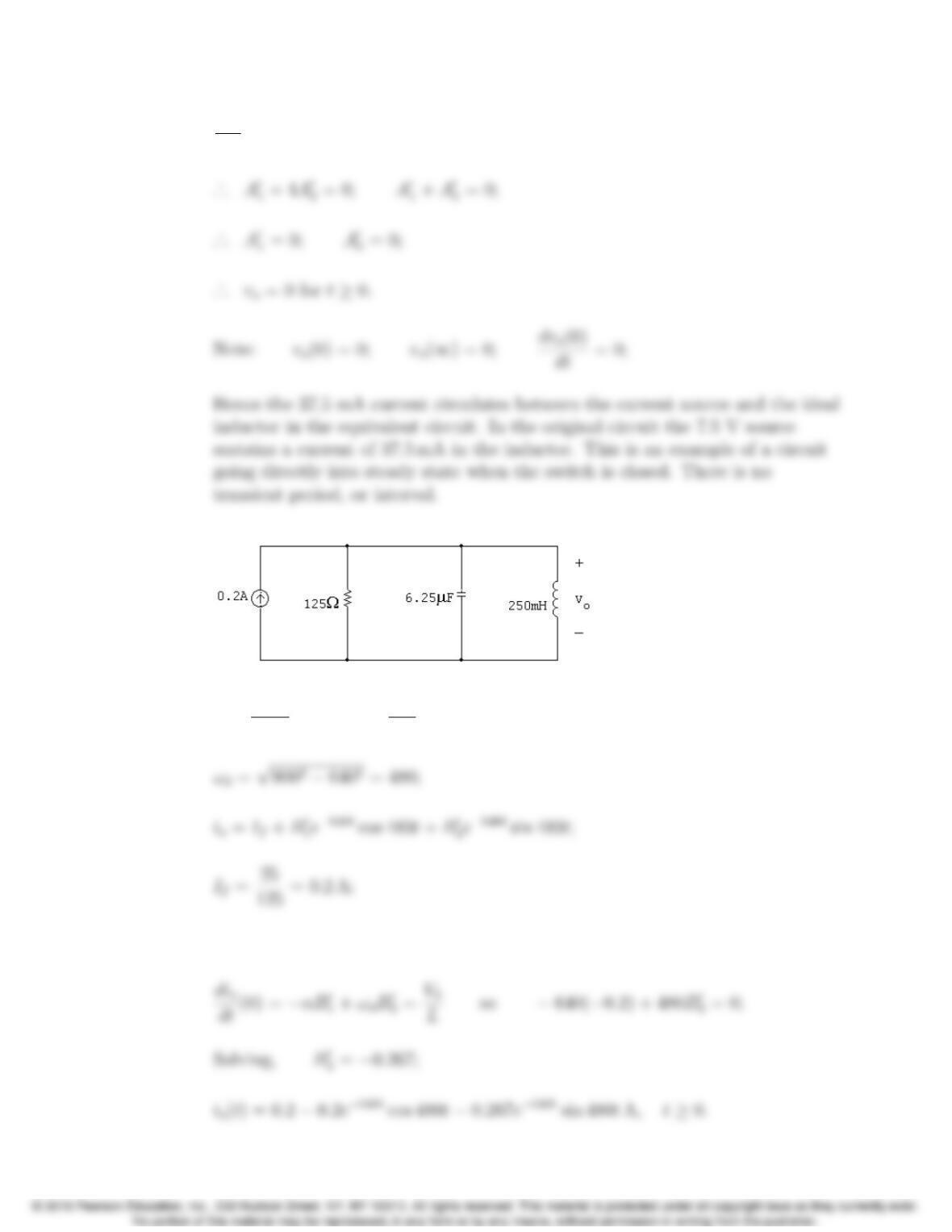
P 8.30 For t>0:
α=1
2RC = 640; 1
LC = 64 ⇥104;
io(0) = 0.2+B0
1= 0 so B0
1=0.2;
8–24 CHAPTER 8. Natural and Step Responses of RLC Circuits
P 8.31 [a] α=1
2RC = 640; 1
LC = 64 ⇥104;
ωd=p80026402= 480;
[b] From the solution to Problem 8.30,
io(t)=0.20.2e640tcos 480t0.267e640tsin 480tA;
P 8.32 ωo=s1
LC =s1
(25 ⇥103)(62.5⇥106)= 800 rad/s;
If= 2 A;
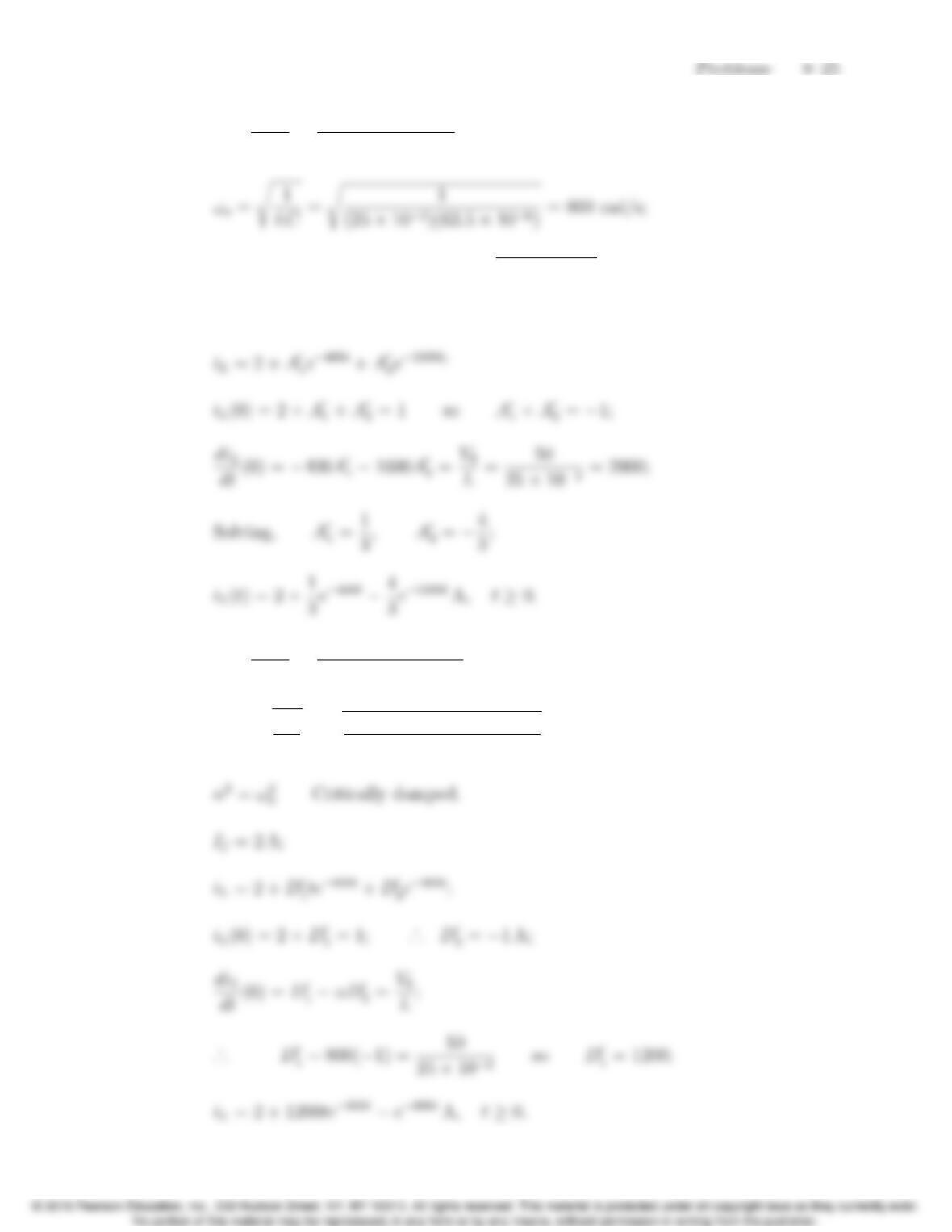
P 8.33 α=1
2RC =1
2(8)(62.5⇥106)= 1000 rad/s;
Overdamped: s1,2=1000 ±p100028002=400,1600 rad/s;
If= 2 A;
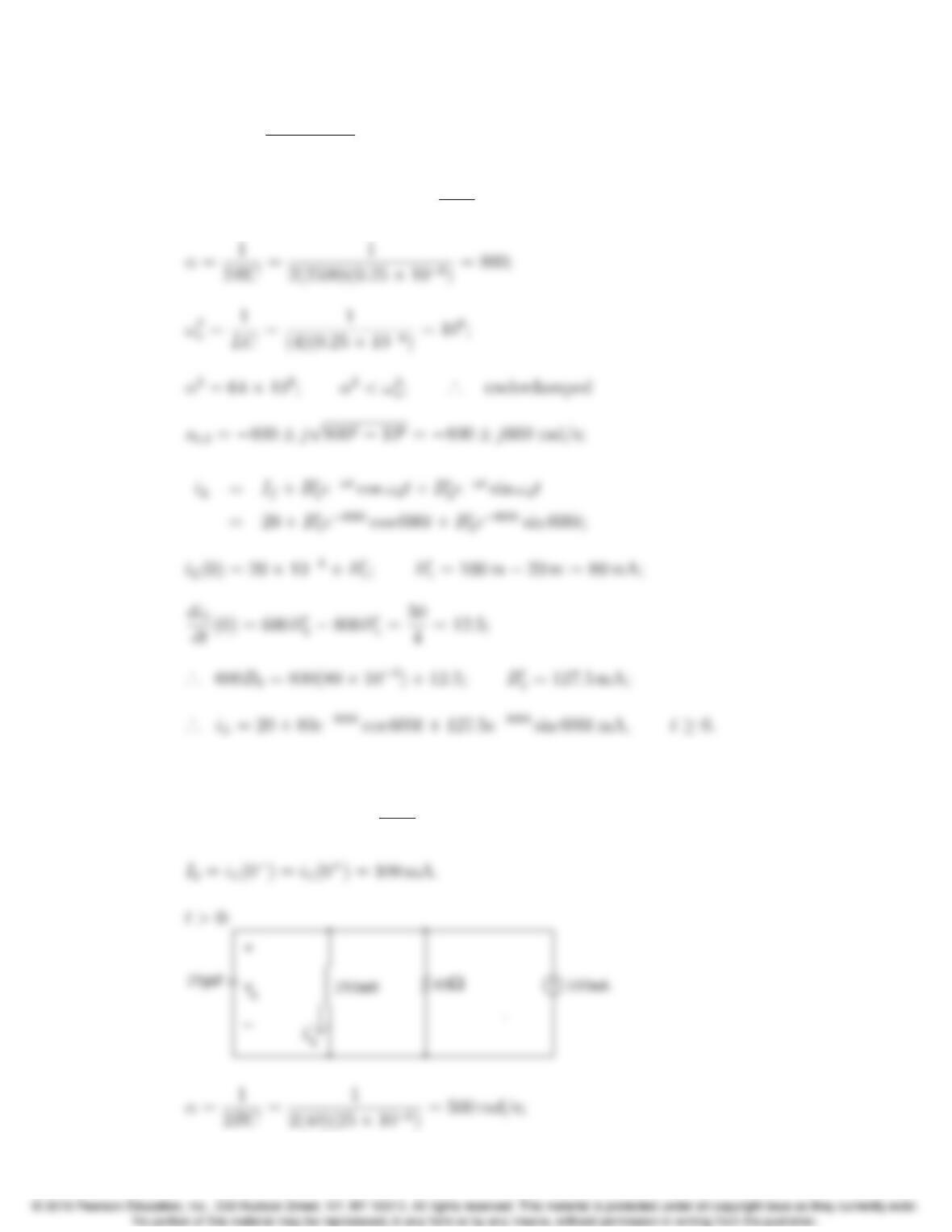
P 8.34 α=1
2RC =1
2(10)(62.5⇥106)= 800;
ωo=s1
LC =s1
(25 ⇥103)(62.5⇥106)= 800 rad/s;
8–26 CHAPTER 8. Natural and Step Responses of RLC Circuits
P 8.35 vC(0+)= 3.75 ⇥103
11.25 ⇥103(150) = 50 V;
iL(0+) = 100 mA; iL(1)= 150
7500 = 20 mA;
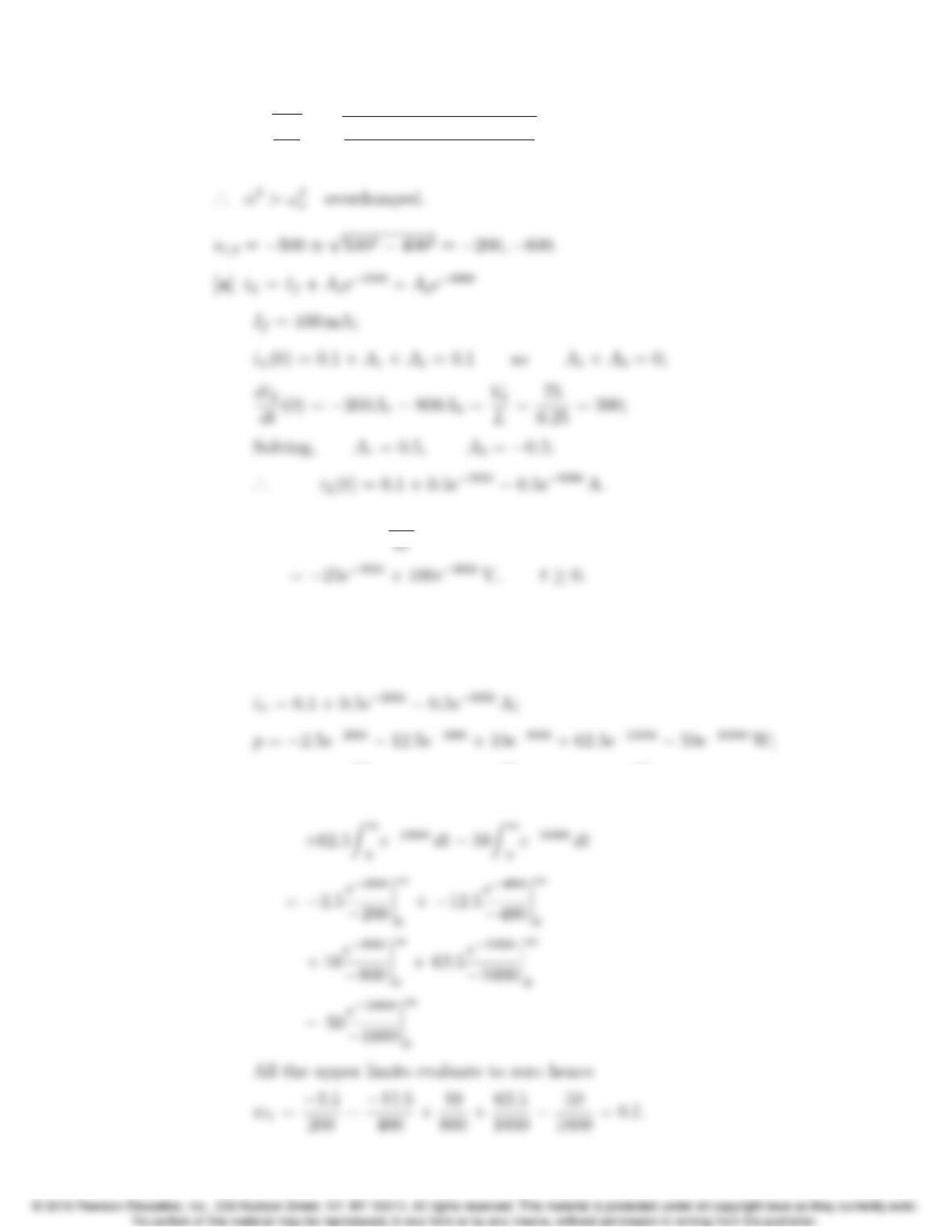
P 8.36 t<0:
V0=vo(0)=vo(0+)=3000
4000(100) = 75 V;
Problems 8–27
ωo=s1
LC =s1
(250 ⇥103)(25 ⇥106)= 400;
[b] vC(t)=vL(t)=LdiL
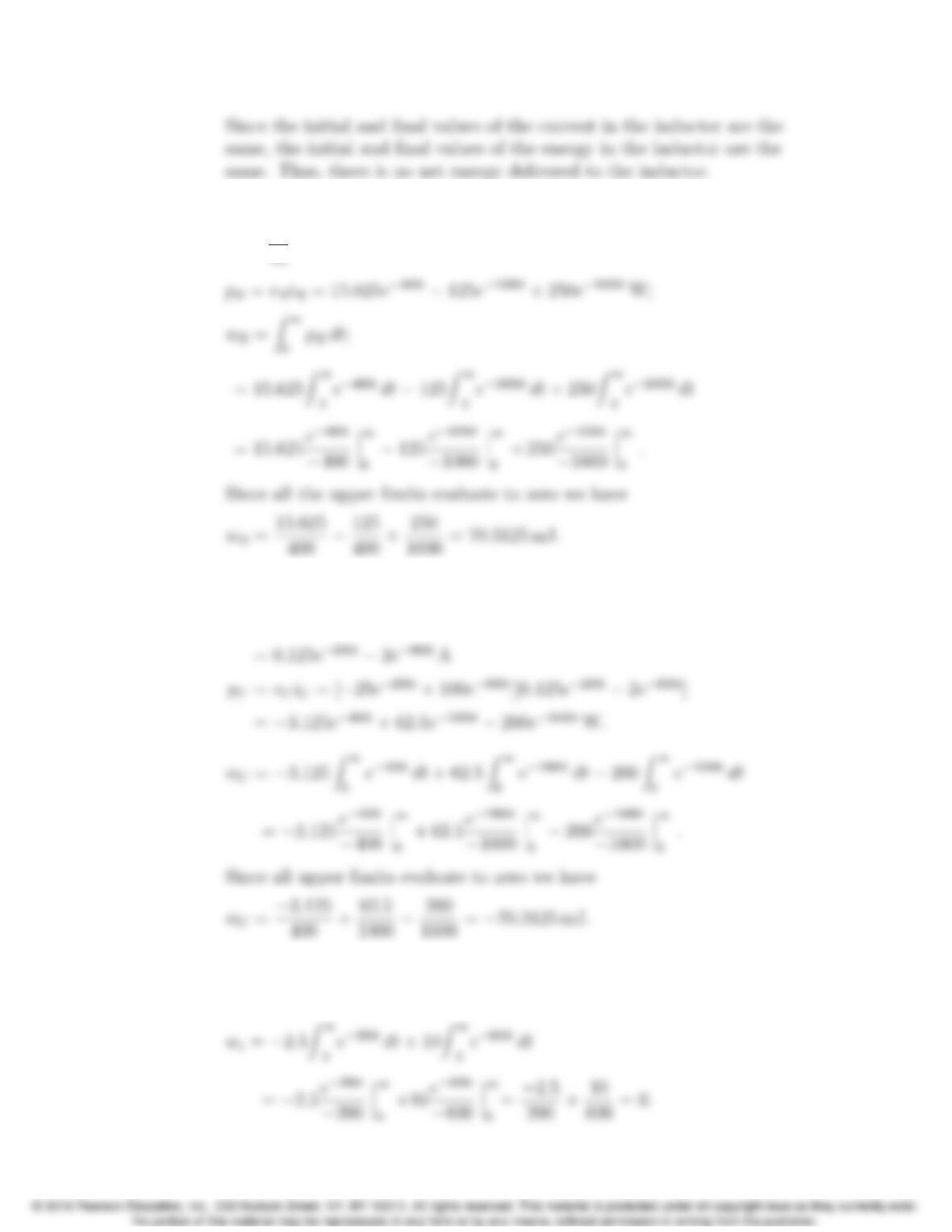
P 8.37 [a] wL=Z1
0
pdt =Z1
0
vLiLdt;
vL=25e200t+ 100e800tV;
wL=2.5Z1
0
e200tdt 12.5Z1
0
e400tdt +10
Z1
0
e800tdt
8–28 CHAPTER 8. Natural and Step Responses of RLC Circuits
[b] vR=25e200t+ 100e800tV;
iR=vR
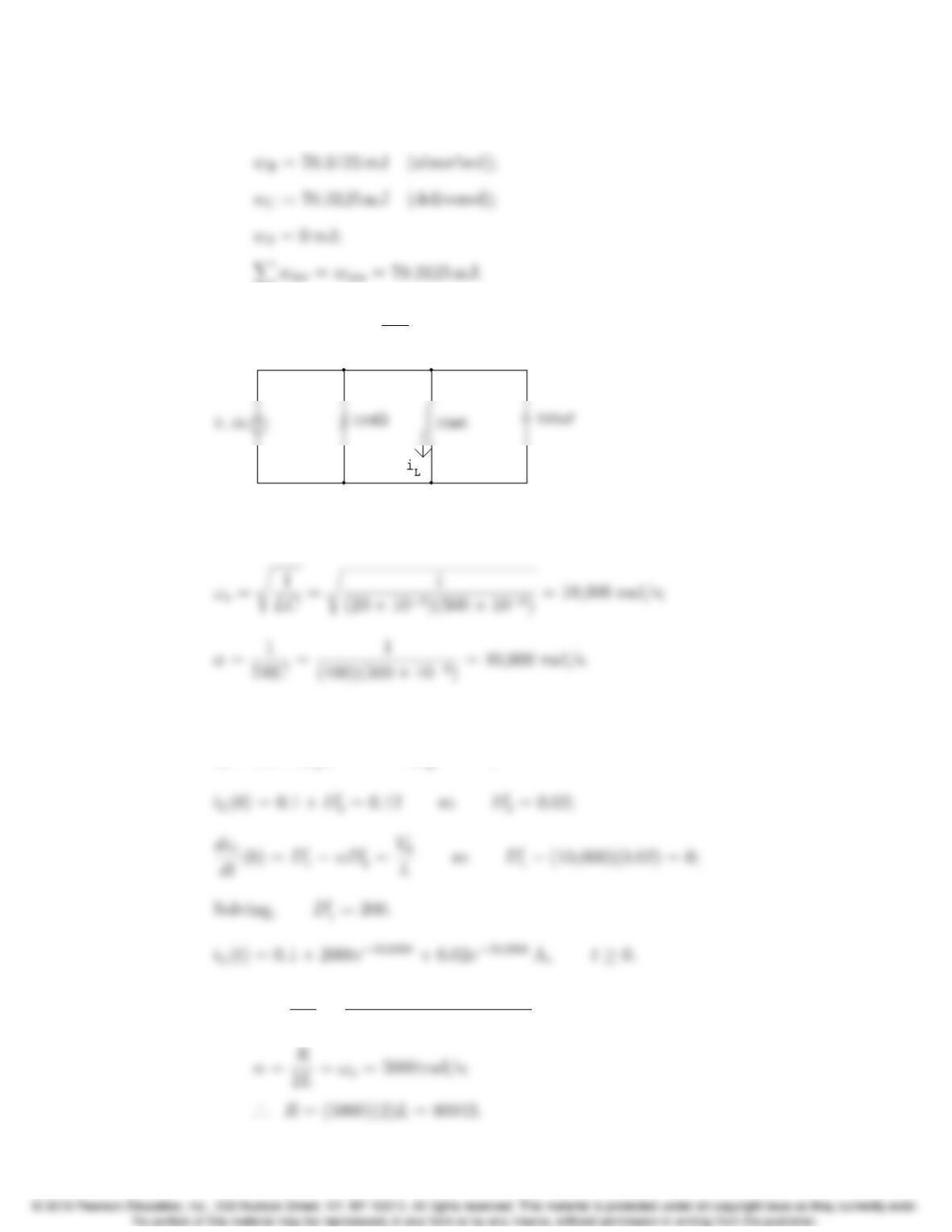
[c] 0.1=iR+iC+iL(mA);
iC=0.1(0.625e200t+2.5e800t)(0.1+0.5e200t0.5e800t)
[d] is= 100 mA;
ps(del) = 0.1v=2.5e200t+10e800tW;
Problems 8–29
[e] wL= 0 J;
P 8.38 t<0: iL(0)= 36
300 =0.12 A; vC(0) = 0 V.
The circuit reduces to:
iL(1)=0.1 A;
Critically damped:
iL=0.1+D0
P 8.39 [a] ω2
o=1
LC =1
(80 ⇥103)(0.5⇥106)= 25 ⇥106;
8–30 CHAPTER 8. Natural and Step Responses of RLC Circuits
[b] i(0) = iL(0) = 30 mA;
[c] vC=D1te5000t+D2e5000t;
P 8.40 [a] 2α= 5000; α= 2500 rad/s;
qα2ω2
o= 1500; ω2
o=4⇥106;ωo= 2000 rad/s;
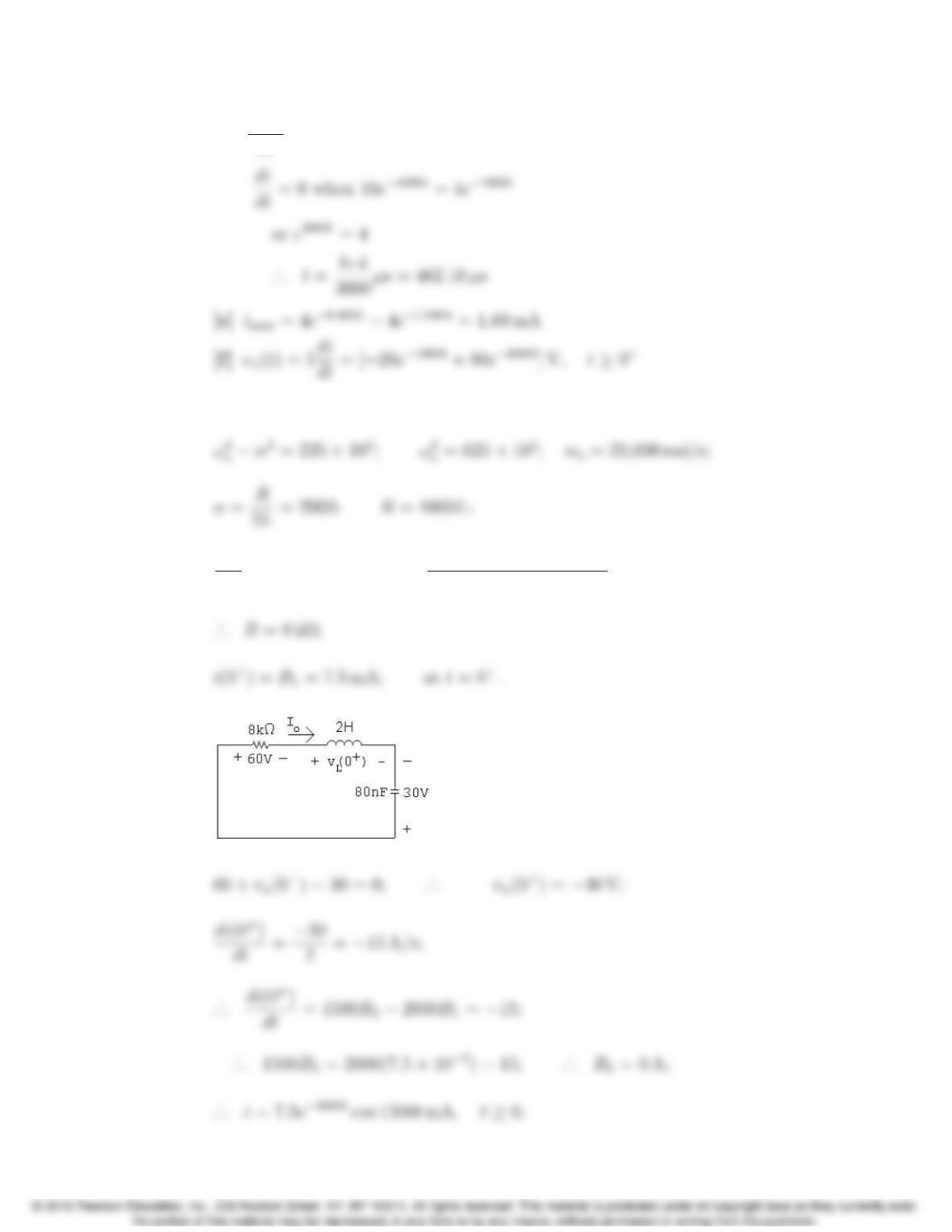
[b] i(0) = 0;
dt =60
5= 12 A/s.
[c] i(t)=A1e1000t+A2e4000t;
i(0) = A1+A2= 0;
Problems 8–31
[d] di(t)
dt =4e1000t+16e4000t
P 8.41 α= 2000 rad/s; ωd= 1500 rad/s;
1
LC = 625 ⇥104;L=1
(625 ⇥104)(80 ⇥109)= 2 H;
8–32 CHAPTER 8. Natural and Step Responses of RLC Circuits
P 8.42 From Prob. 8.41 we know vcwill be of the form
From Prob. 8.41 we have
and
P 8.43 [a] 1
LC = 20,0002.
There are many possible solutions. This one begins by choosing
L= 1 mH. Then,
We can create this resistor value using components from Appendix H by
combining a 10 Ωresistor and two 15 Ωresistors in series. The final
circuit:
Problems 8–33
P 8.44 [a] Underdamped response:
8.43 to give a smaller value of α. For convenience, pick α= 16,000 rad/s:
[b] Overdamped response:
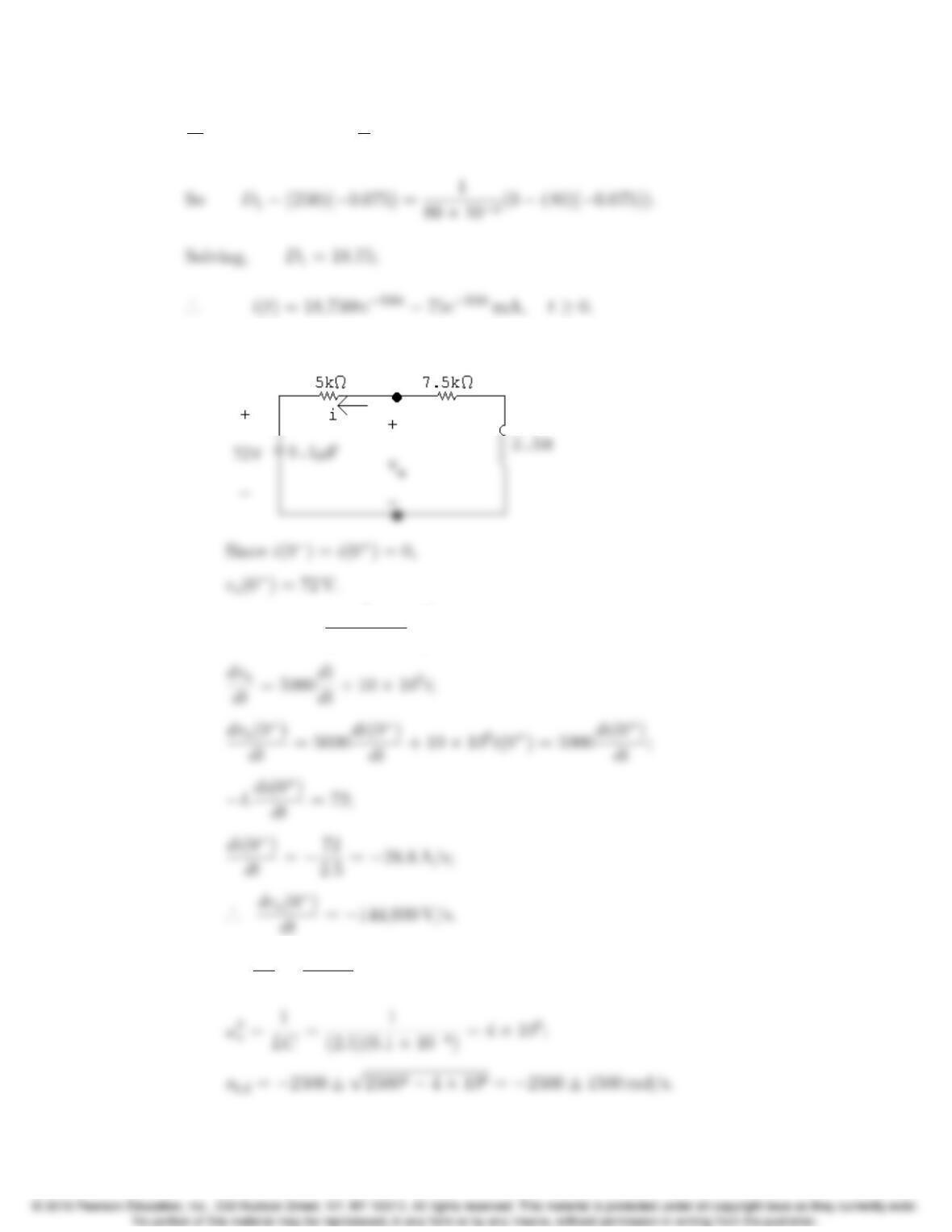
P 8.45 t<0: I0=75 mA; V0=0.
t>0:
Critically damped:
8–34 CHAPTER 8. Natural and Step Responses of RLC Circuits
di
dt(0) = D1αD2=1
L(V0RI0).
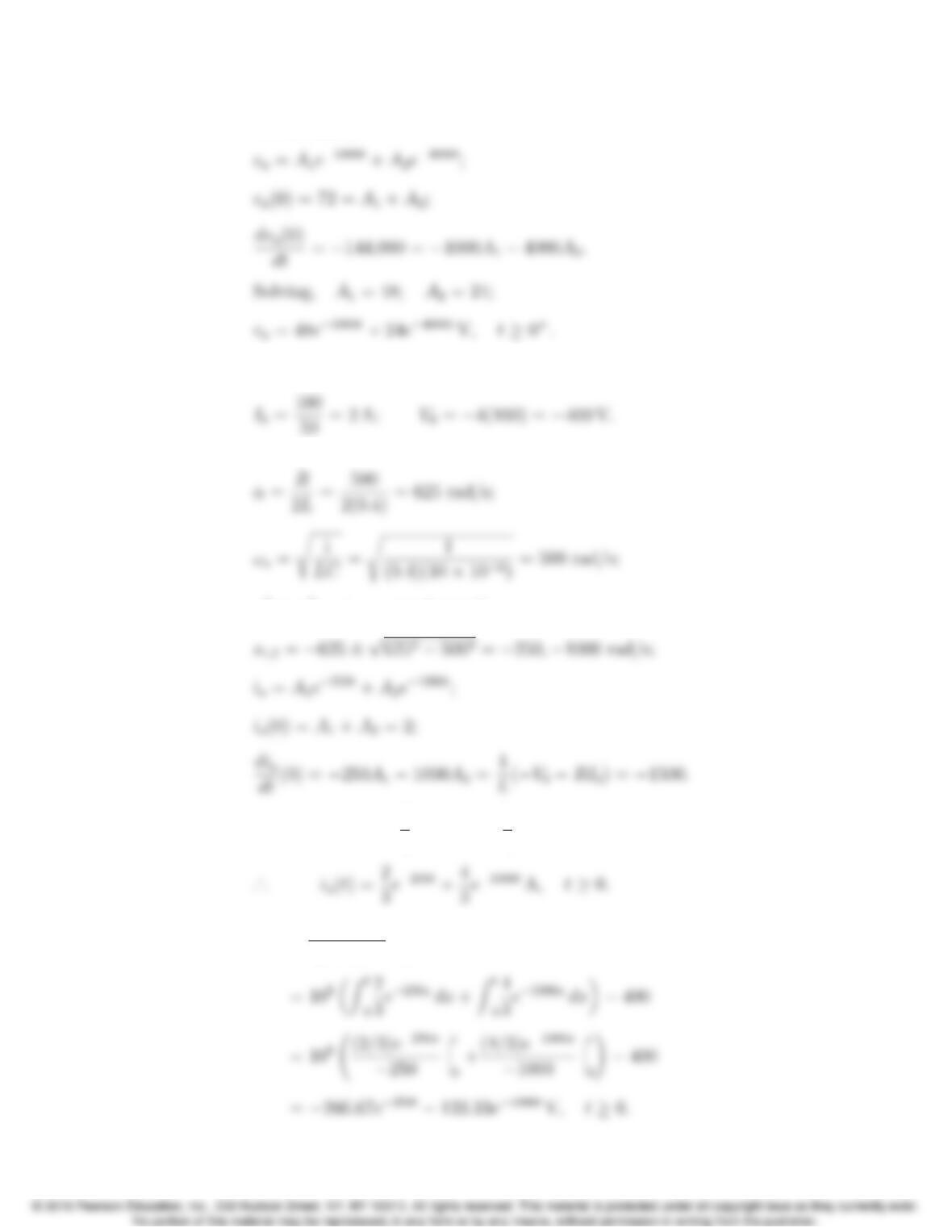
P 8.46 [a] For t>0:
[b] va= 5000i+1
0.1⇥106Zt
0
idx+ 72;
[c] α=R
2L=12,500
2(2.5) = 2500 rad/s;
Problems 8–35
Overdamped:
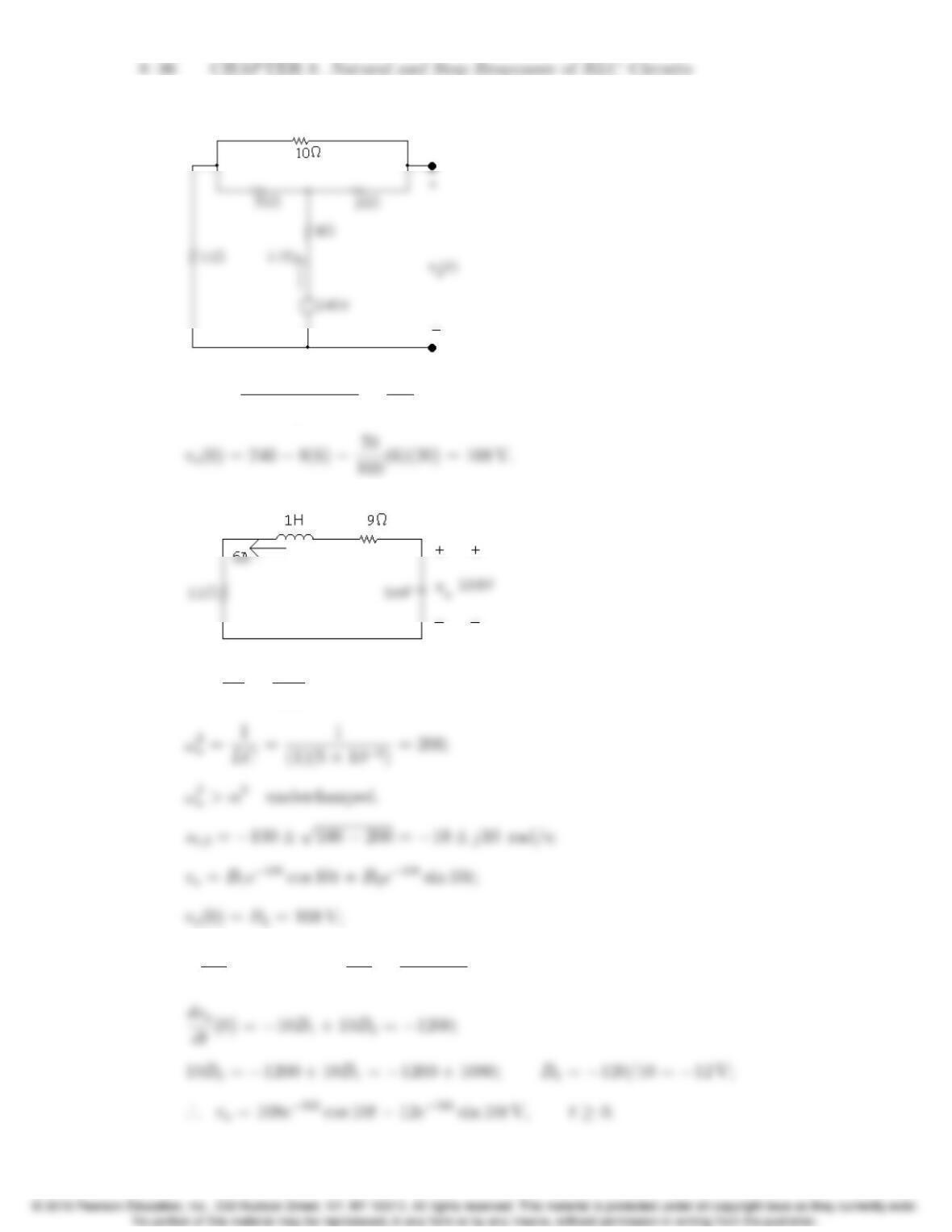
P 8.47 [a] t<0:
t>0:
α2<ω
2
o
·
.. overdamped.
Solving, A1=2
3;A2=4
3;
[b] vo(t)= 1
10 ⇥106Zt
0
io(x)dx 400
P 8.48 t<0:
i(0) = 240
8+30k70 + 11 =240
40 = 6 A;
t>0:
α=R
2L=20
2(1) = 10,α
2= 100;
Cdvo
dt (0) = 6,dvo
dt =6
5⇥103=1200 V/s;