Problems 4–41
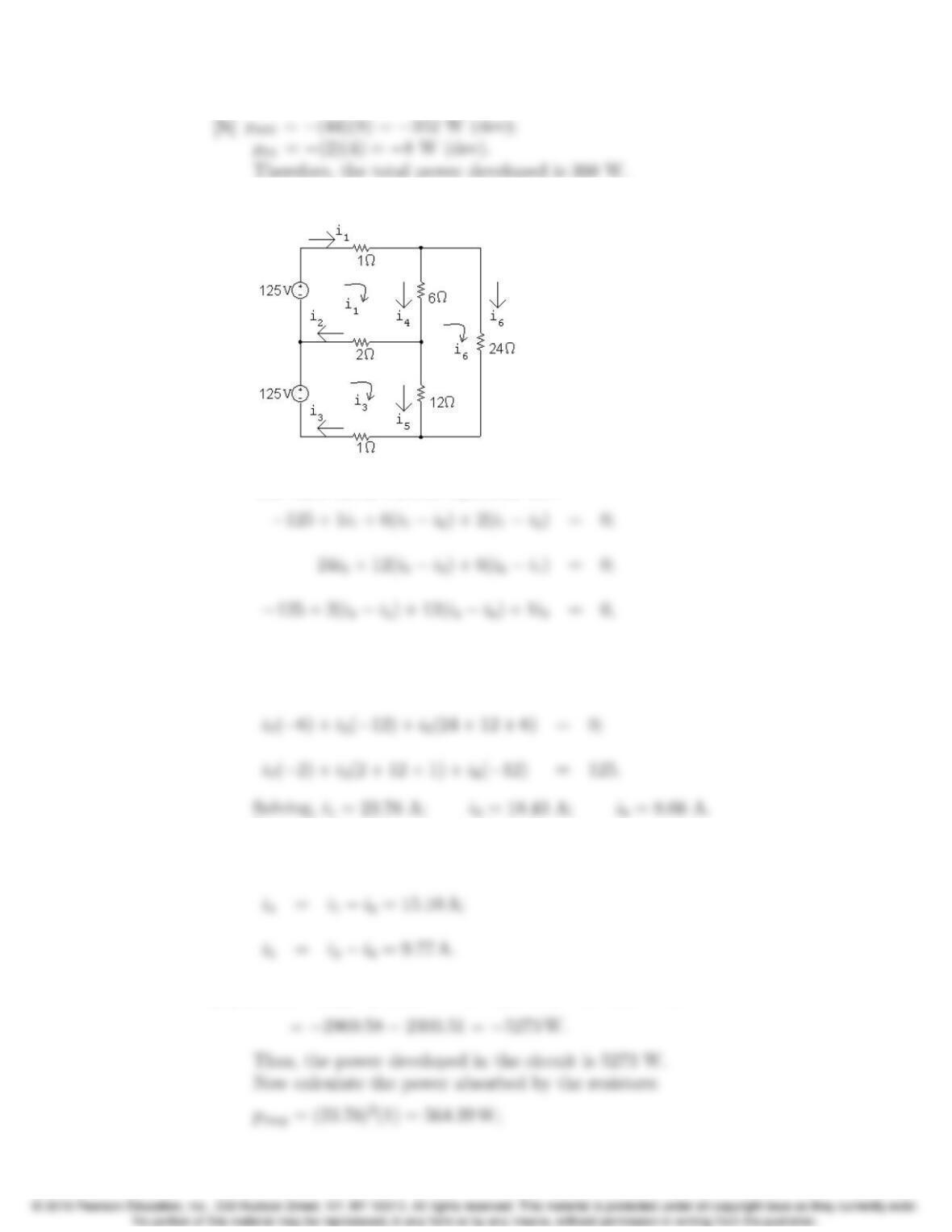
P 4.33 [a]
The three mesh current equations are:
Place these equations in standard form:
i1(1 + 6 + 2) + i3(−2) + i6(−6) = 125;
Now calculate the remaining branch currents:
i2=i1−i3=5.33 A;
[b] psources =ptop +pbottom =−(125)(23.76) −(125)(18.43)
4–42 CHAPTER 4. Techniques of Circuit Analysis
p2= (5.33)2(2) = 56.79 W;
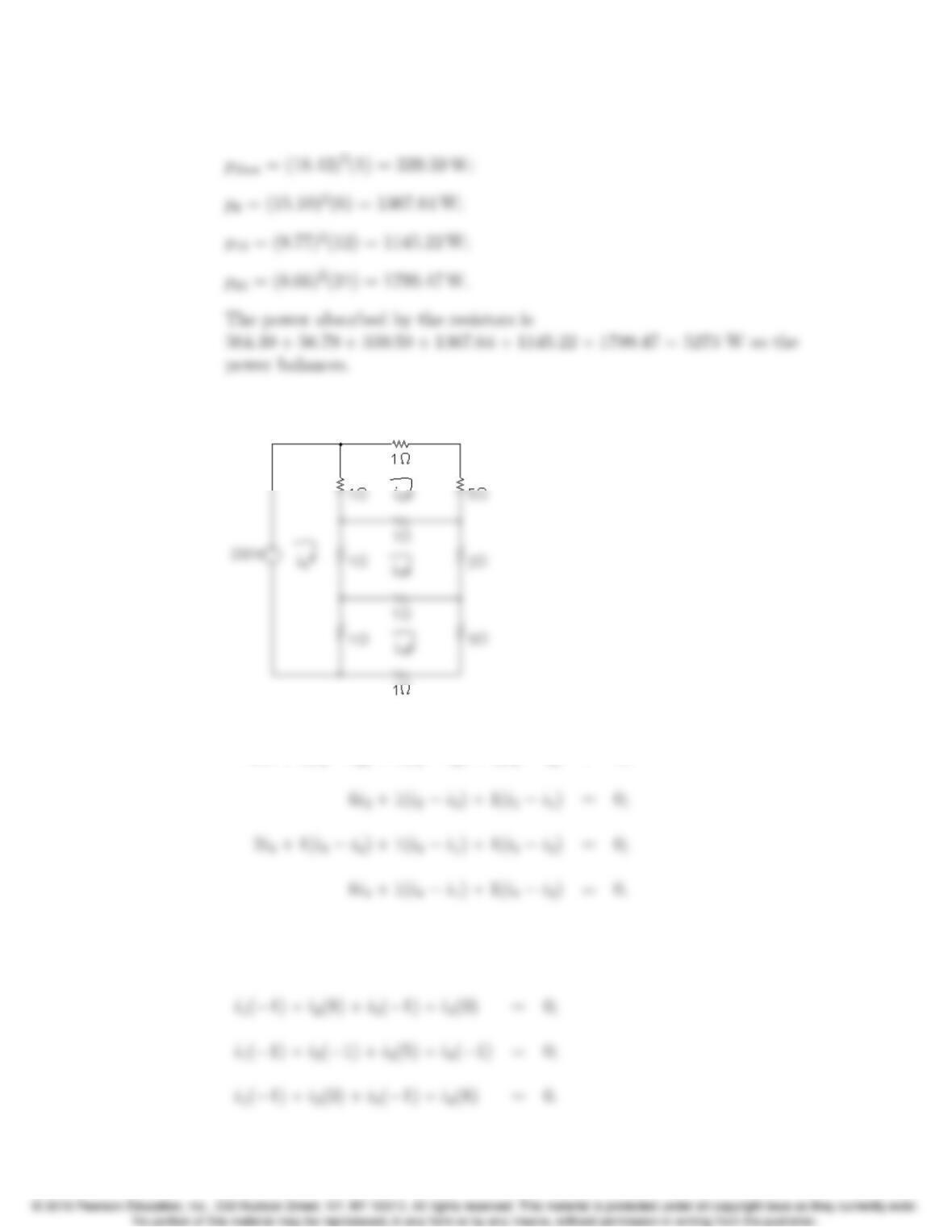
P 4.34 [a]
The four mesh current equations are:
−230 + 1(i1−i2)+1(i1−i3)+1(i1−i4) = 0;
Place these equations in standard form:
i1(3) + i2(−1) + i3(−1) + i4(−1) = 230;
Problems 4–43
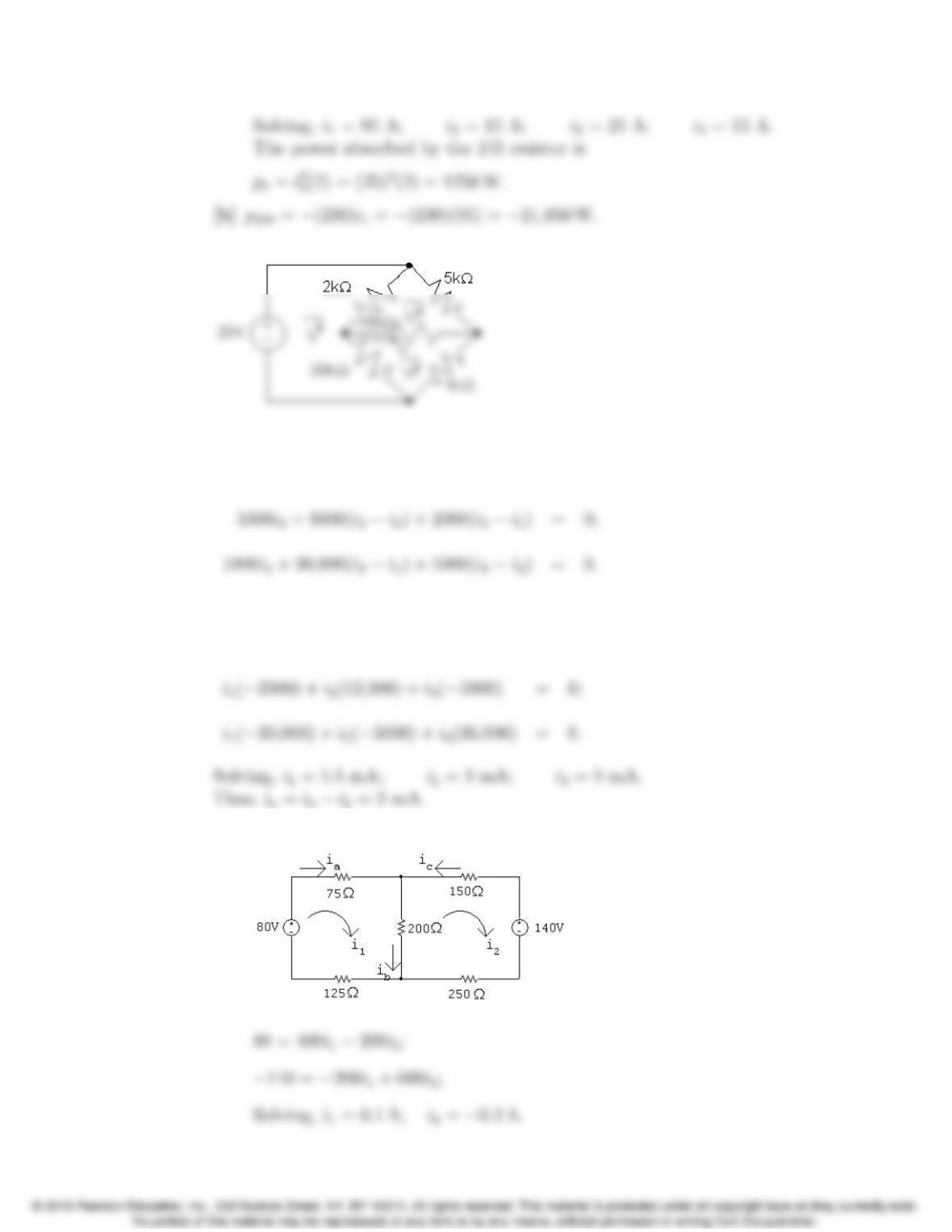
P 4.35
The three mesh current equations are:
−20 + 2000(i1−i2)+30,000(i1−i3) = 0;
Place these equations in standard form:
i1(32,000) + i2(−2000) + i3(−30,000) = 20;
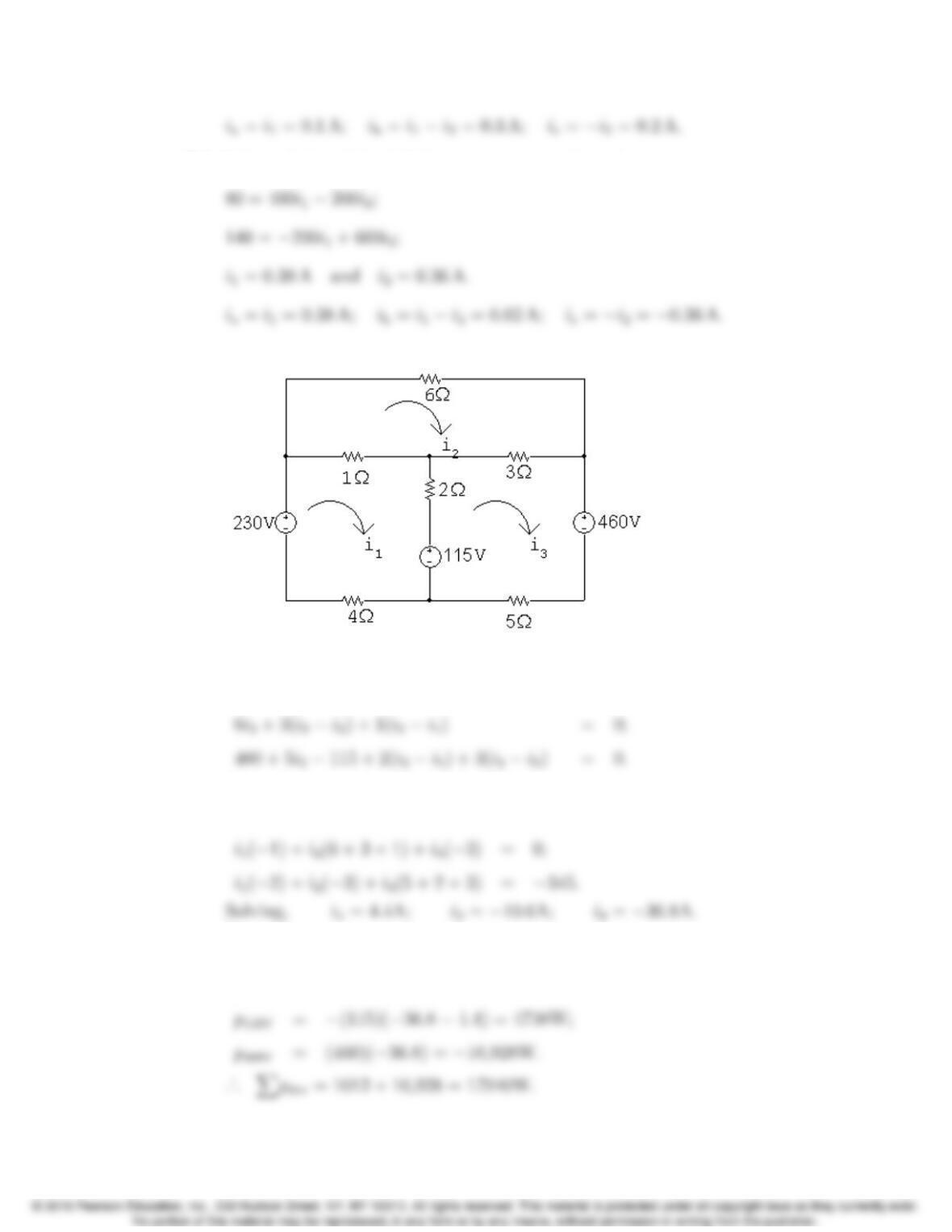
P 4.36 [a]
4–44 CHAPTER 4. Techniques of Circuit Analysis
[b] If the polarity of the 140 V source is reversed, we have
P 4.37 [a]
The mesh current equations are:
−230 + 1(i1−i2)+2(i1−i3) + 115 + 4i1=0;
Place these equations in standard form:
i1(1 + 2 + 4) + i2(−1) + i3(−2) = 115;
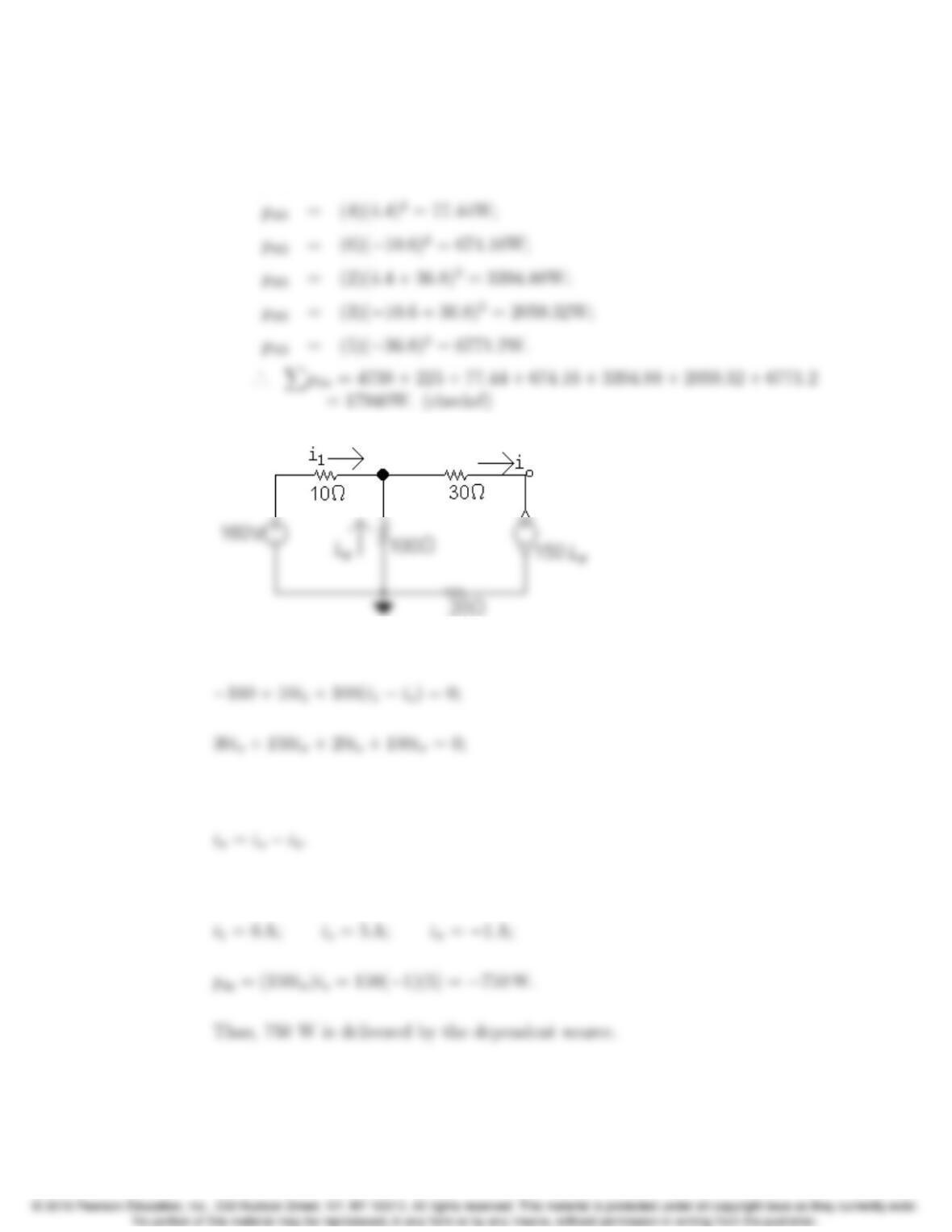
The only components that can develop power in the circuit are the
sources:
p230V =−(230)(4.4) = −1012W;
Problems 4–45
[b] From part (a) we know that the 115 V source is dissipating power;
compute the power dissipated by the resistors:
p1Ω= (1)(4.4+10.6)2= 225W;
P 4.38
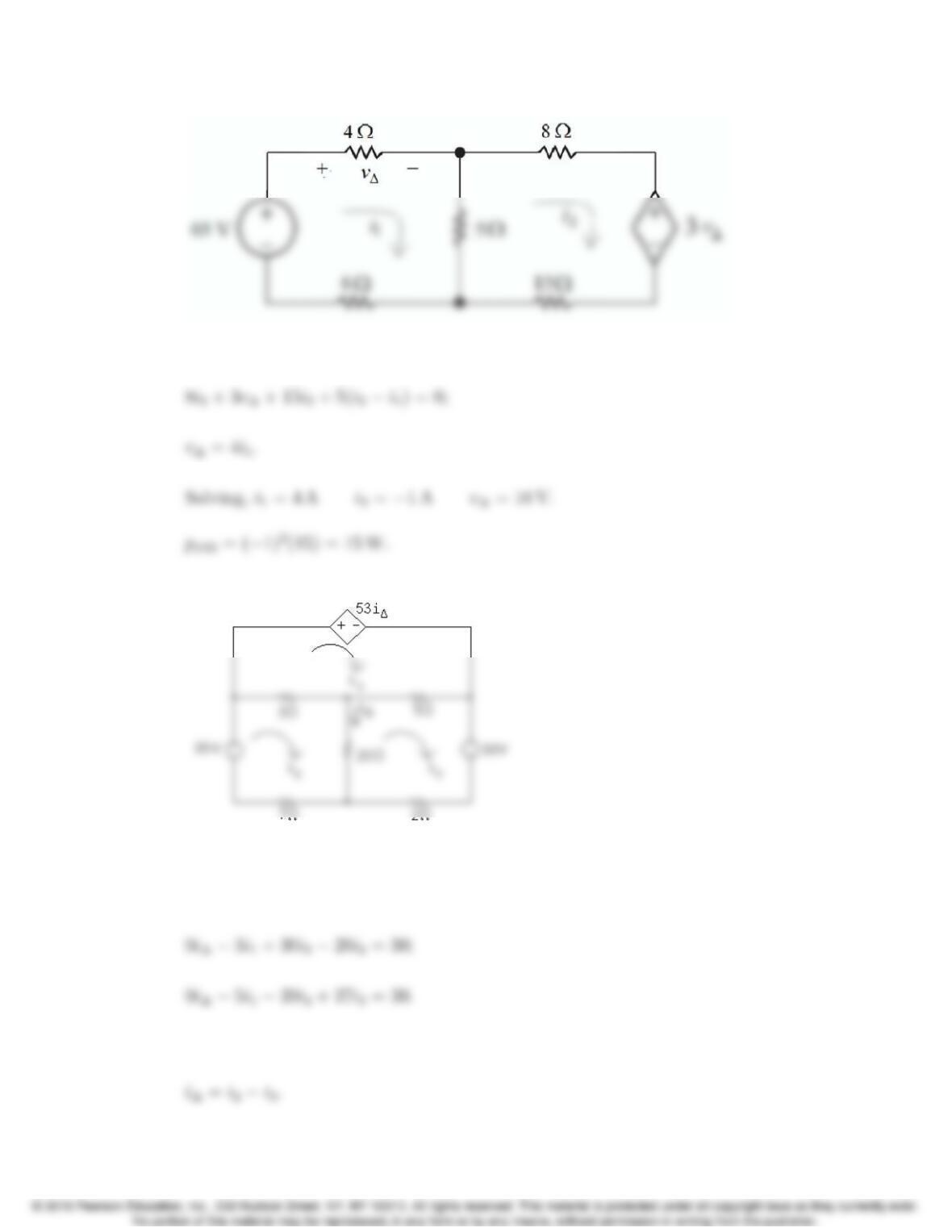
The two KCL equations are
The dependent source constraint equation is
Solving,
4–46 CHAPTER 4. Techniques of Circuit Analysis
P 4.39
−65 + 4i1+5(i1−i2)+6i1= 0;
P 4.40
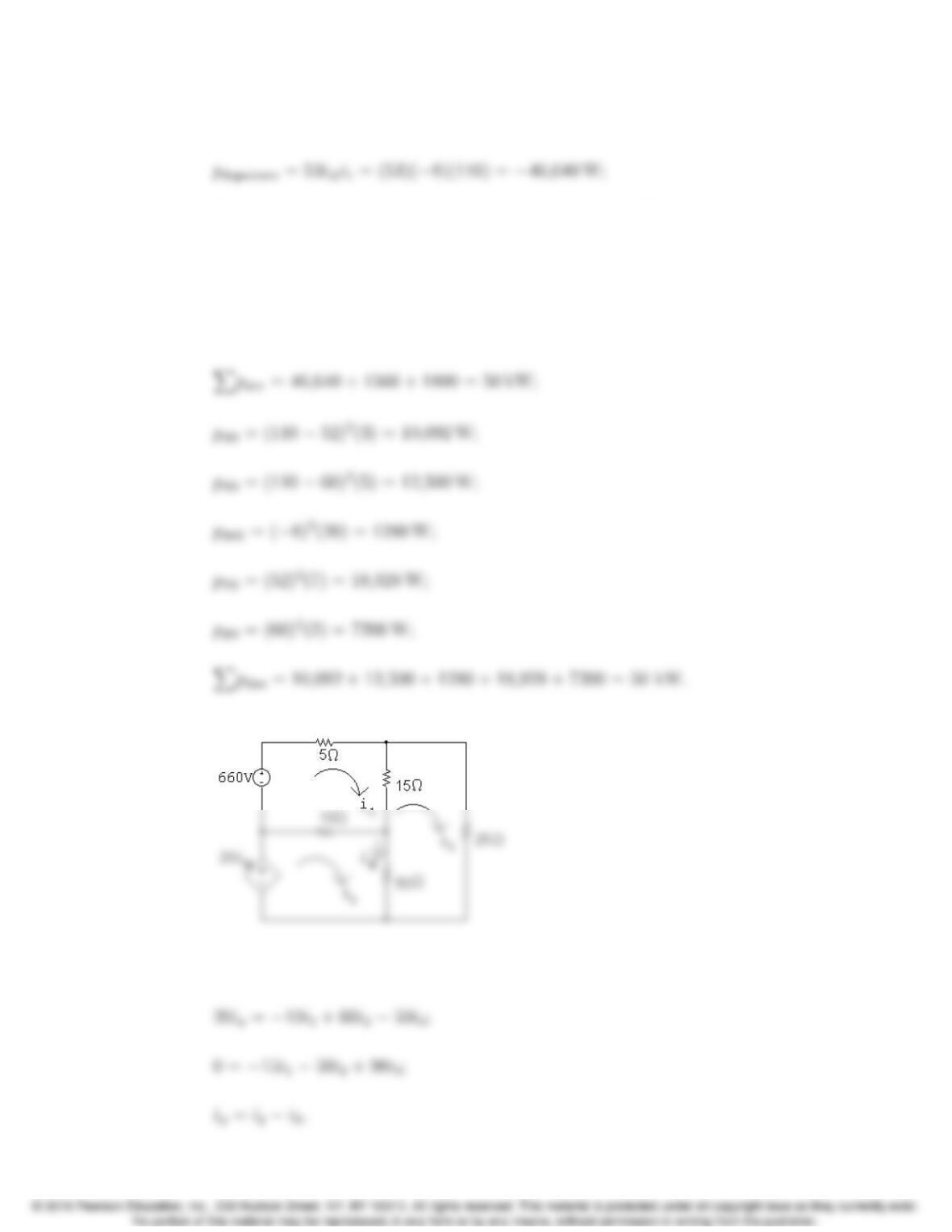
Mesh equations:
53i∆+8i1−3i2−5i3= 0;
Constraint equations:
Problems 4–47
Solving, i1= 110 A; i2= 52 A; i3= 60 A; i∆=−8 A.
Therefore, the dependent source is developing 46,640 W.
CHECK:
p30V =−30i2=−1560 W (left source);
p30V =−30i3=−1800 W (right source);
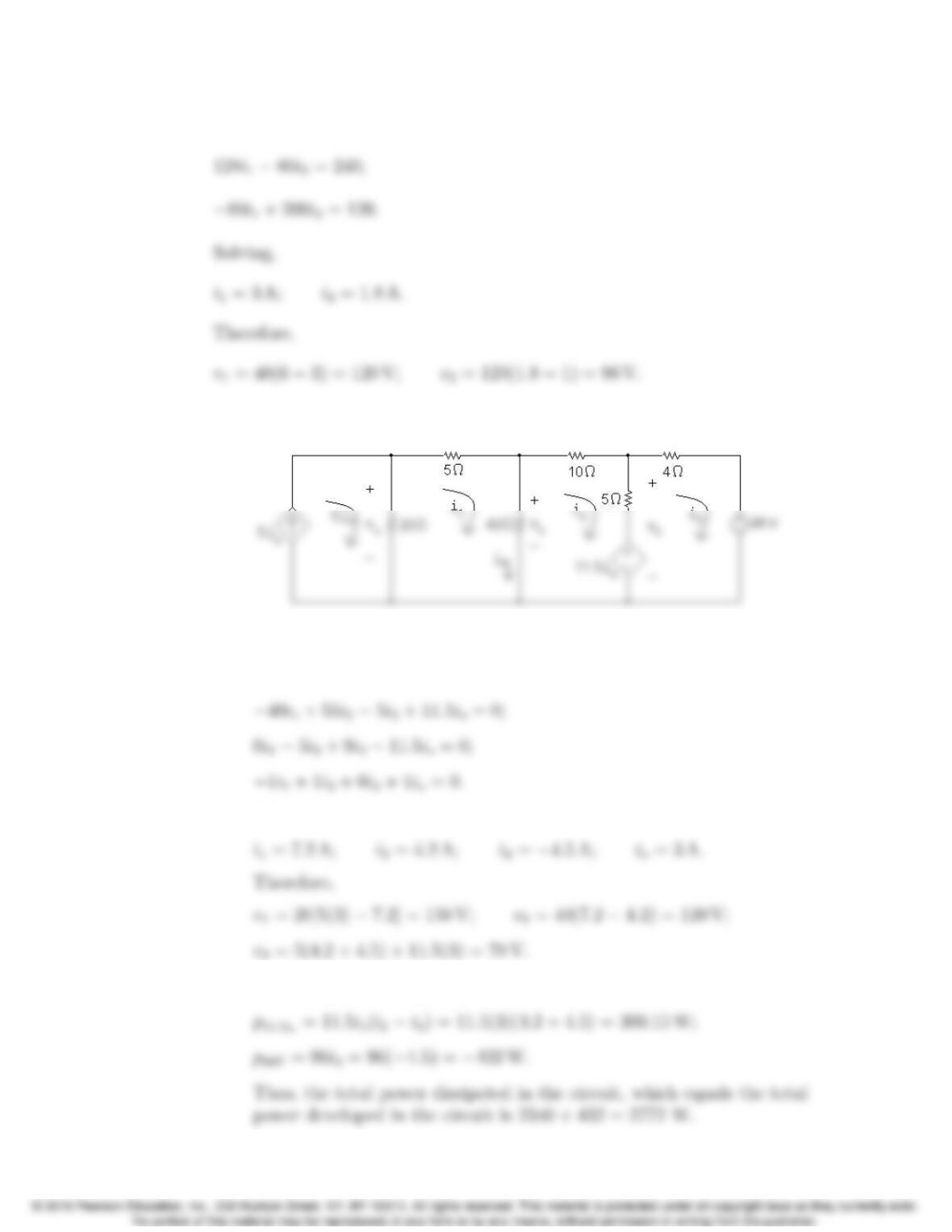
P 4.41
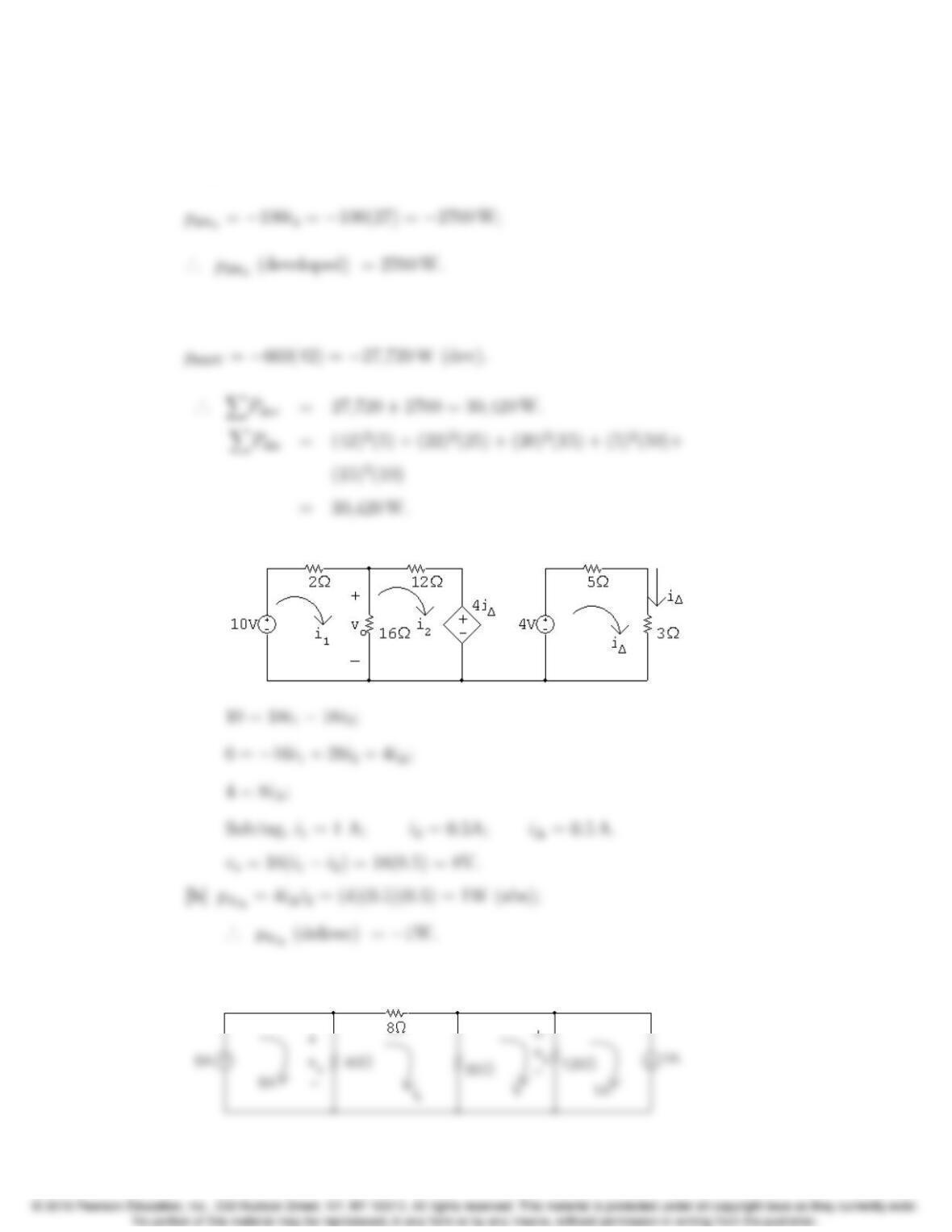
660 = 30i1−10i2−15i3;
4–48 CHAPTER 4. Techniques of Circuit Analysis
Solving, i1= 42 A; i2= 27 A; i3= 22 A; iφ= 5 A.
20iφ= 100 V;
CHECK:
P 4.42 [a]
P 4.43
Problems 4–49
Mesh equations:
P 4.44 [a]
Mesh equations:
65i1−40i2+0i3−100io= 0;
Solving,
[b] p5io=−5iov1=−5(3)(156) = −2340 W;
P 4.45
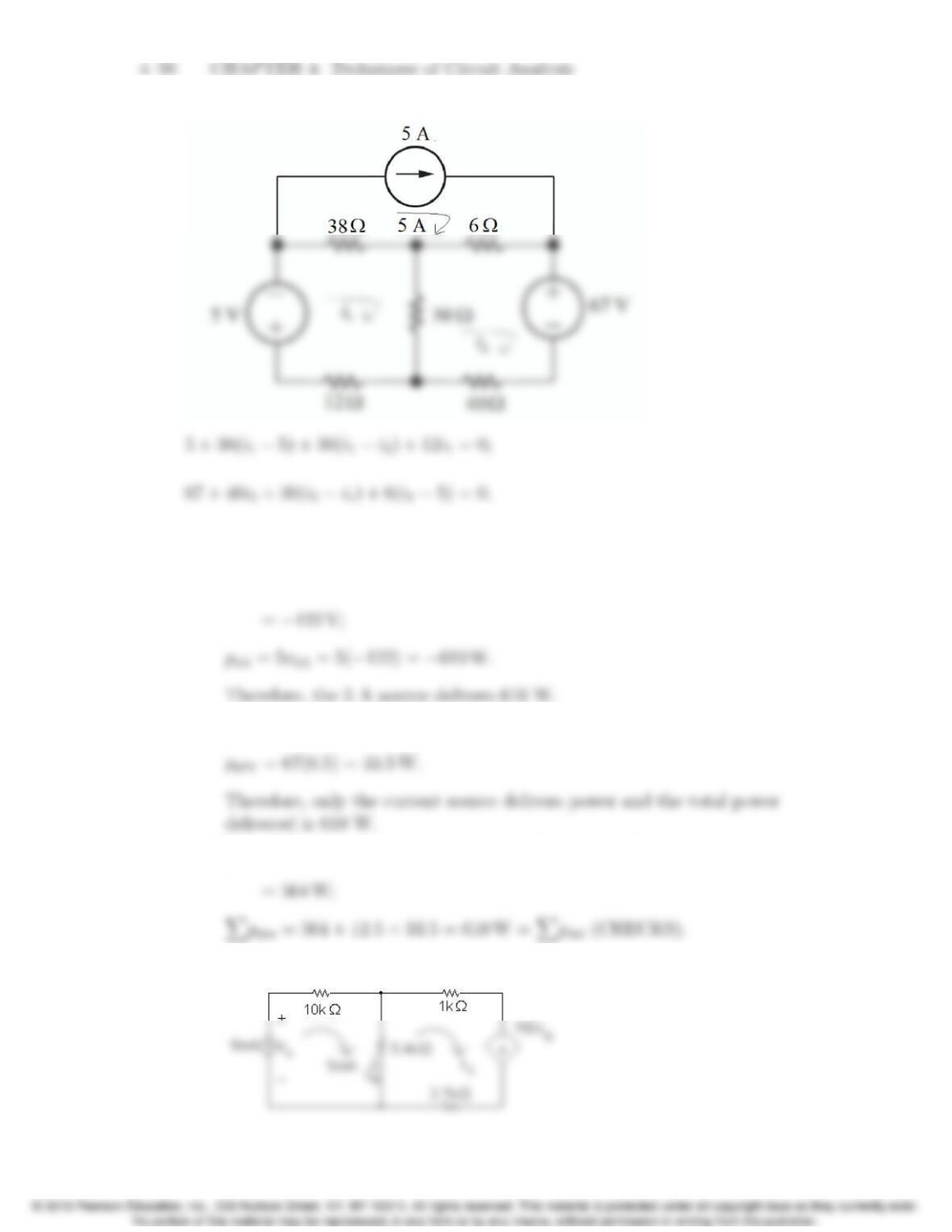
Solving, i1=2.5 A; i2=0.5A.
[a] v5A = 38(2.5−5) + 6(0.5−5)
[b] p5V = 5(2.5) = 12.5 W;
[c] Xpresistors = (2.5)2(38) + (4.5)2(6) + (2)2(30) + (2.5)2(12) + (0.5)2(40)
P 4.46 [a]
Problems 4–51
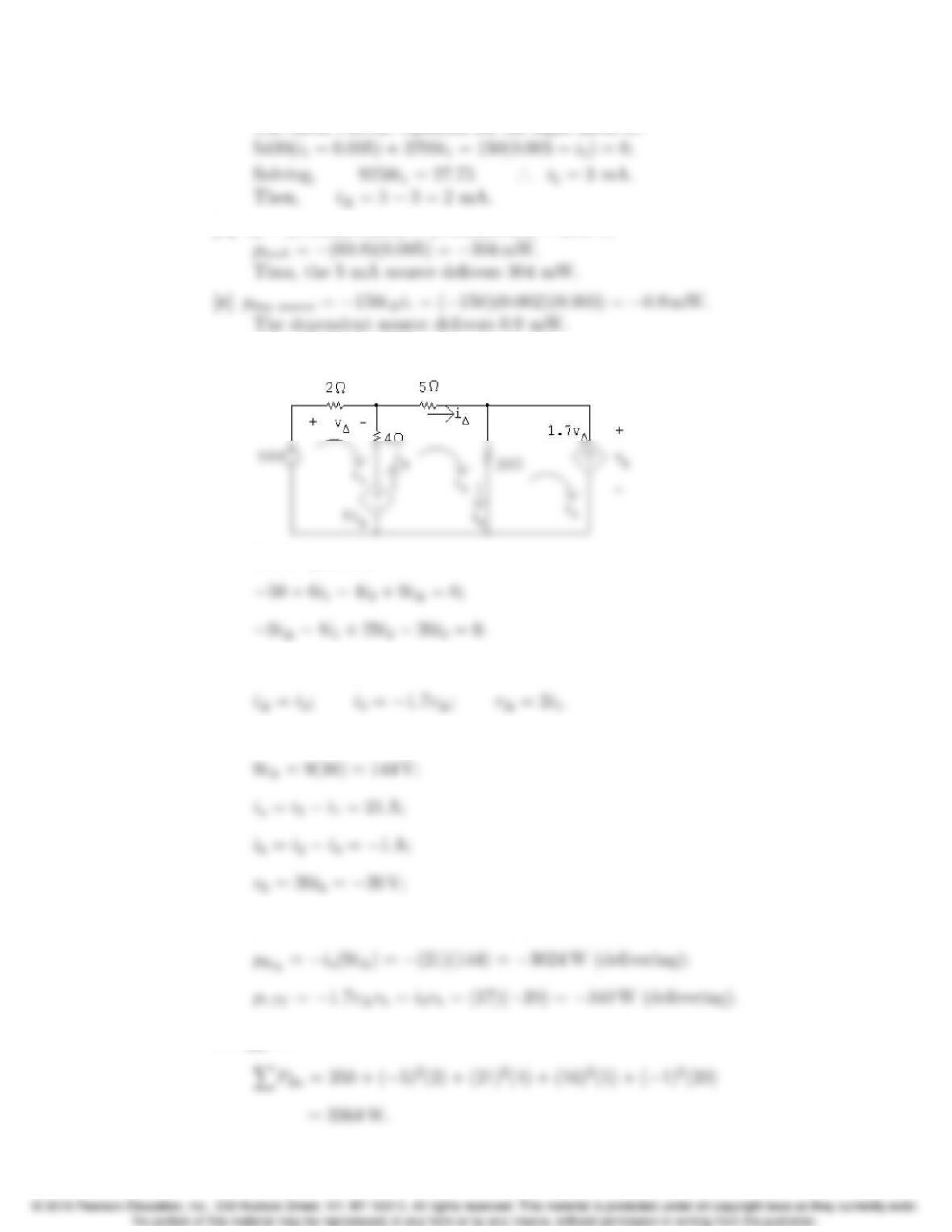
The mesh current equation for the right mesh is:
[b] vo= (0.005)(10,000) + (5400)(0.002) = 60.8 V;
P 4.47 [a]
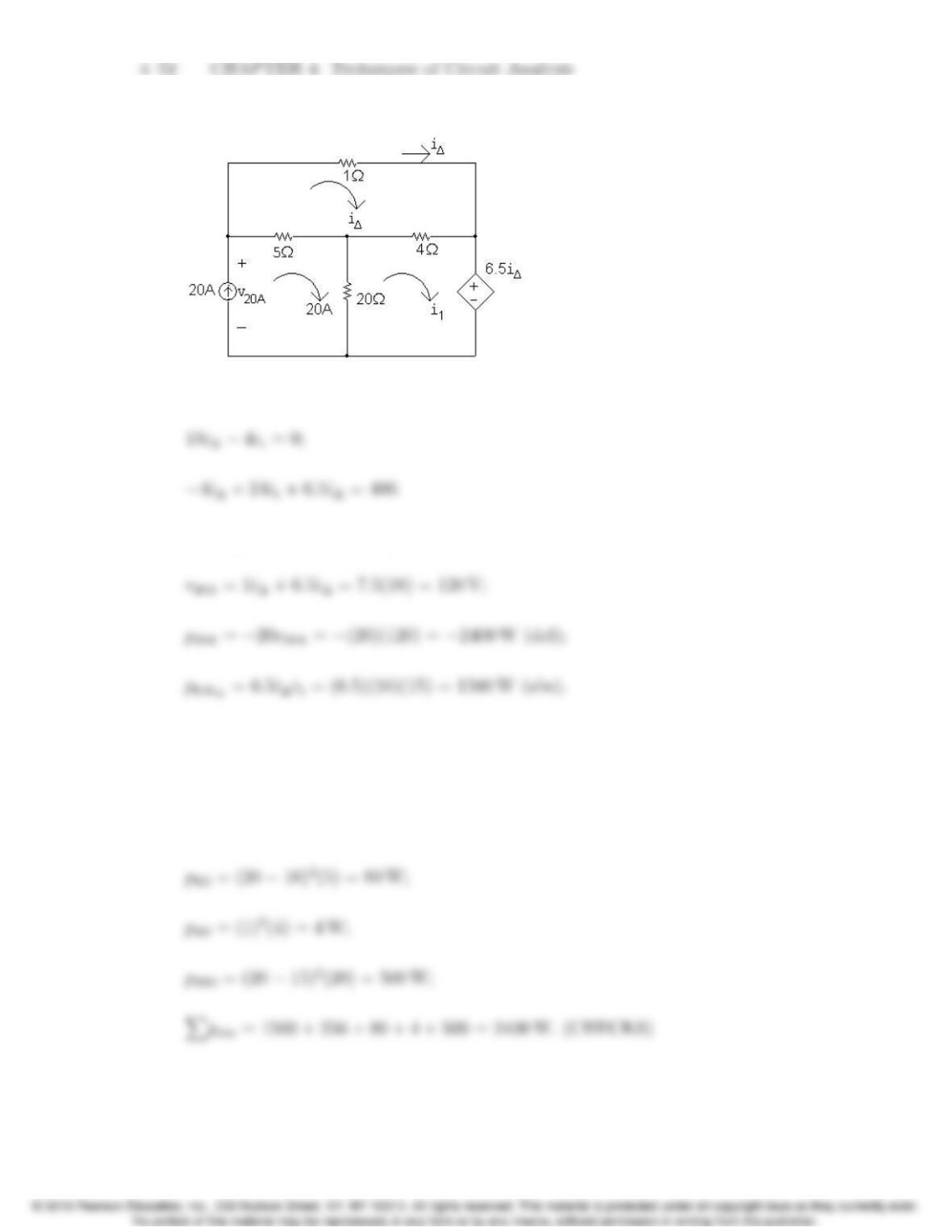
Mesh equations:
Constraint equations:
Solving, i1=−5 A; i2= 16 A; i3= 17 A; v∆=−10 V.
p50V =−50i1= 250 W (absorbing);
[b] XPdev = 3024 + 340 = 3364 W;
P 4.48
Mesh equations:
Solving, i1= 15 A; i∆= 16 A.
Therefore, the independent source is developing 2400 W, all other elements are
absorbing power, and the total power developed is thus 2400 W.
CHECK:
p1Ω= (16)2(1) = 256 W;
Problems 4–53
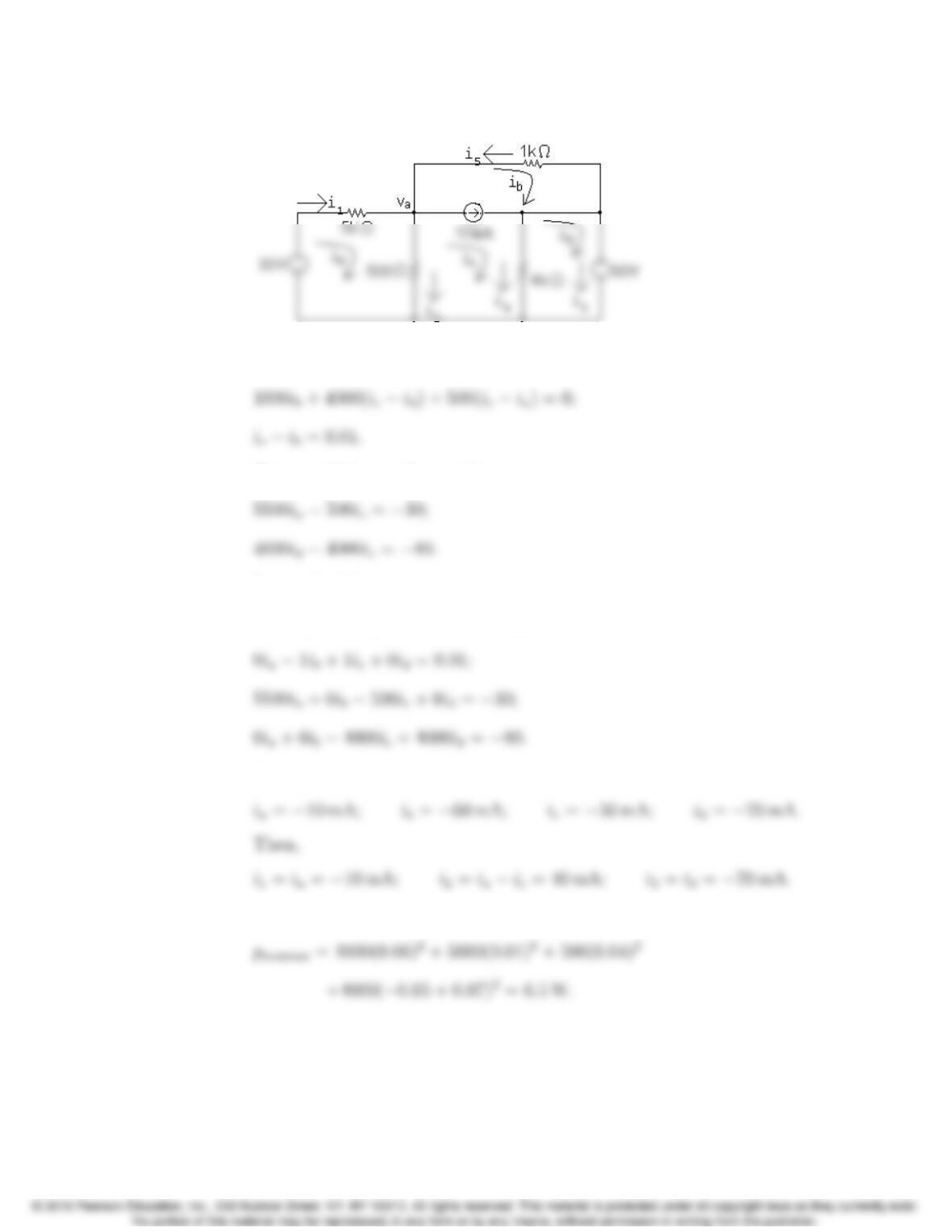
P 4.49 [a]
Supermesh equations:
Two remaining mesh equations:
In standard form,
−500ia+ 1000ib+ 4500ic−4000id= 0;
Solving:
[b] psources = 30(−0.01) + [1000(−0.06)](0.01) + 80(−0.07) = −6.5 W;
4–54 CHAPTER 4. Techniques of Circuit Analysis
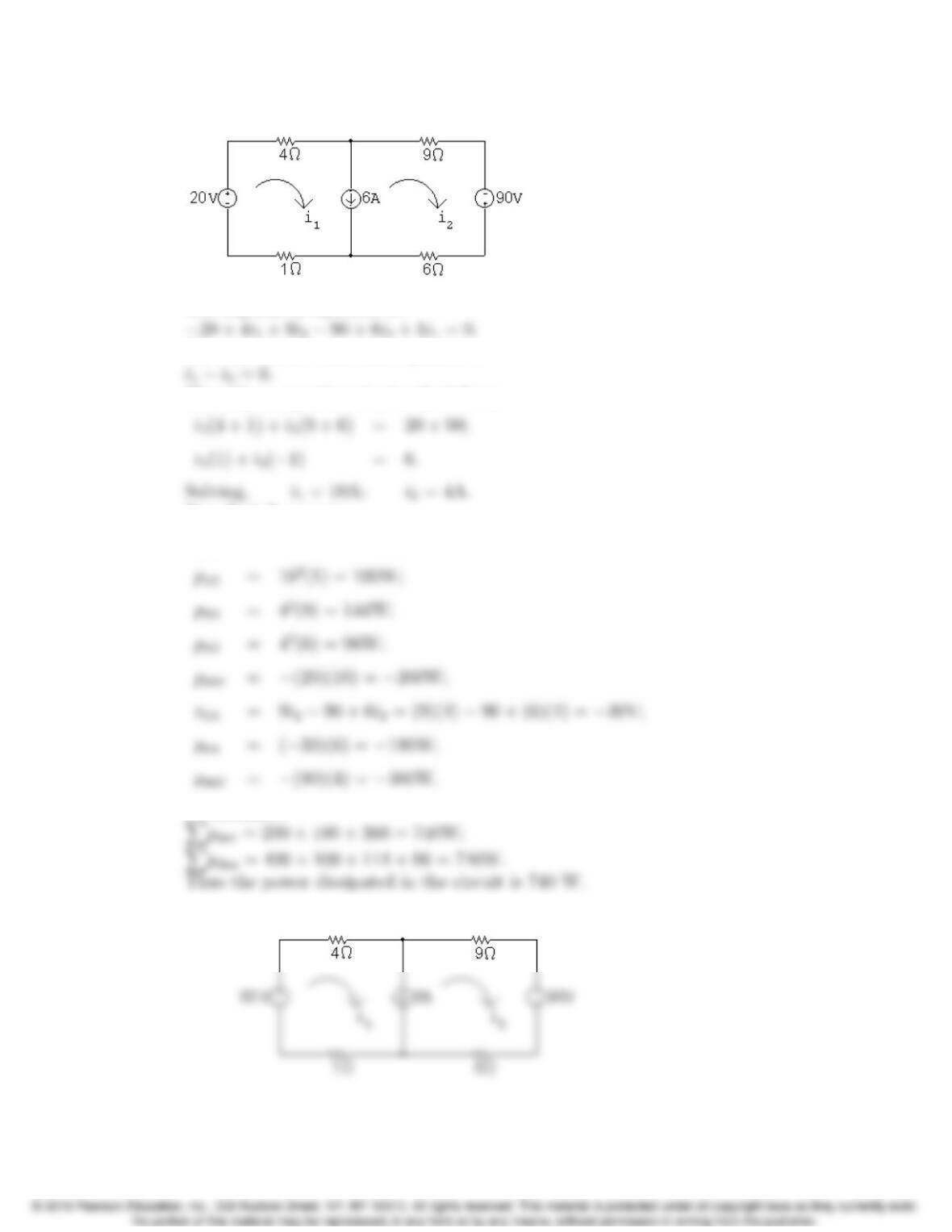
P 4.50
The supermesh equation is:
The supermesh constraint equation is :
Place these equations in standard form:
Now find the power:
p4Ω=10
2(4) = 400W;
In summary:
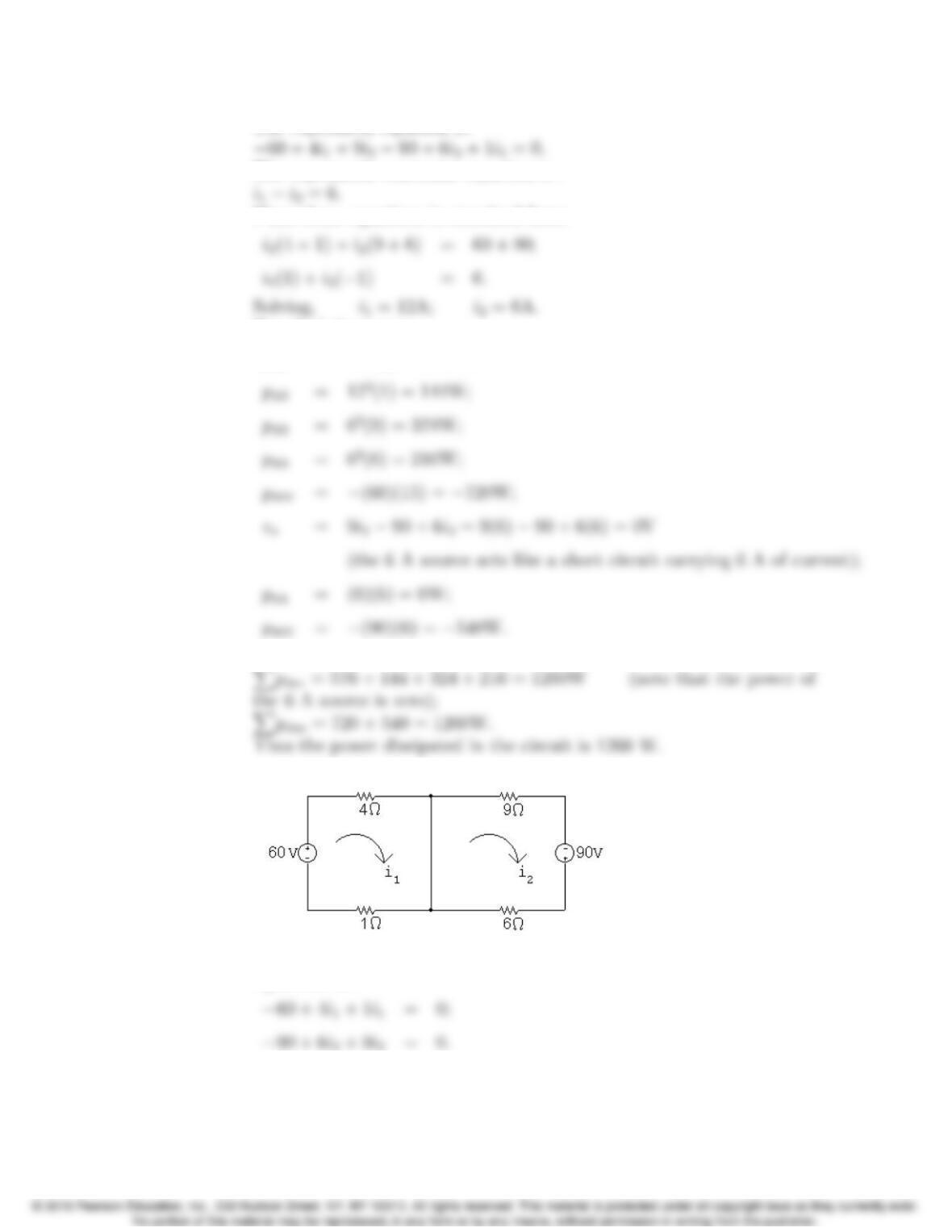
P 4.51 [a]
Problems 4–55
The supermesh equation is:
The supermesh constraint equation is :
Place these equations in standard form:
Now find the power:
p4Ω=12
2(4) = 576W;
In summary:
Xpdev = 576 + 144 + 324 + 216 = 1260W (note that the power of
[b]
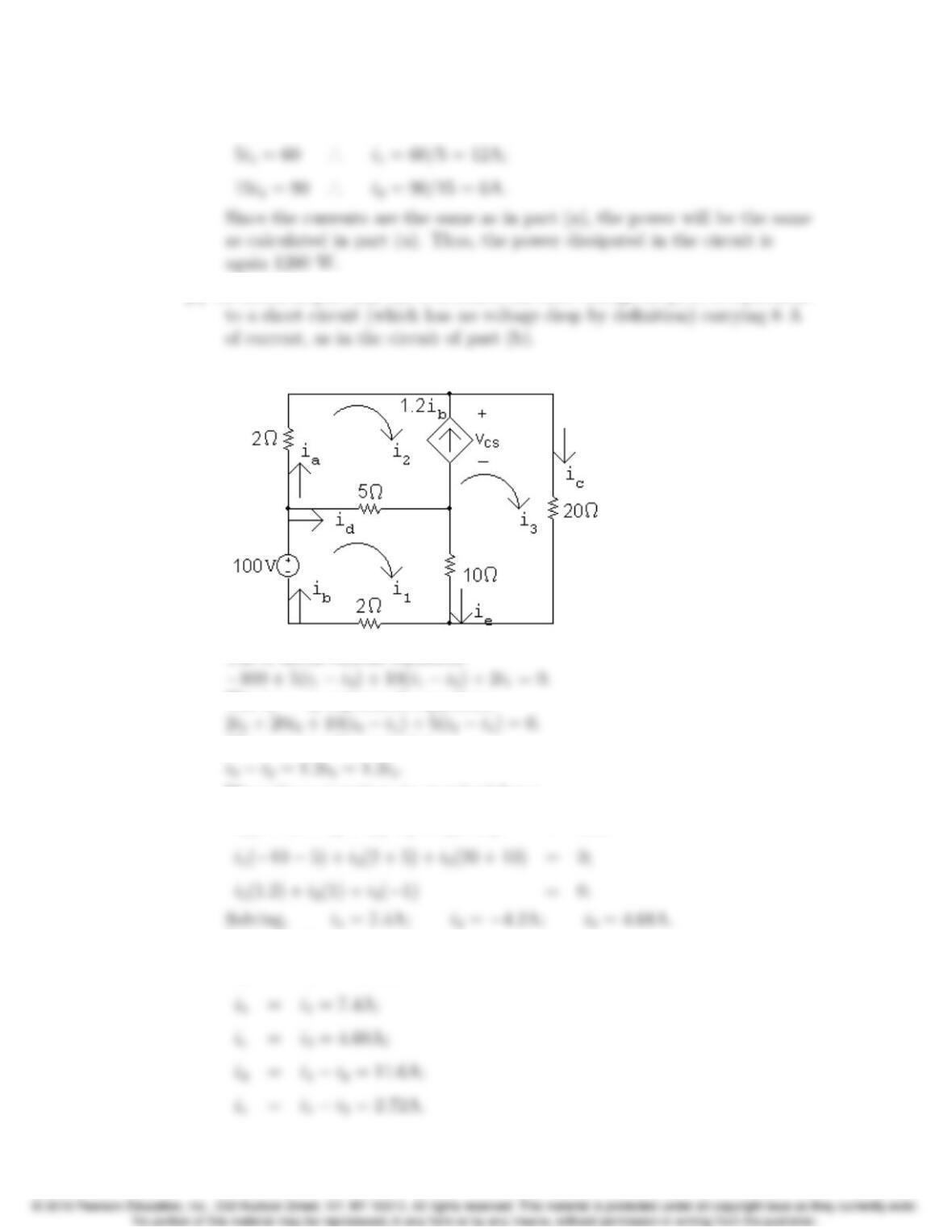
Now there is no longer a supermesh. The two simple mesh current
equations are:
4–56 CHAPTER 4. Techniques of Circuit Analysis
Since these equations are uncoupled, each can be solved separately:
[c] As noted in part (a), the 6 A source has zero voltage drop, so is equivalent
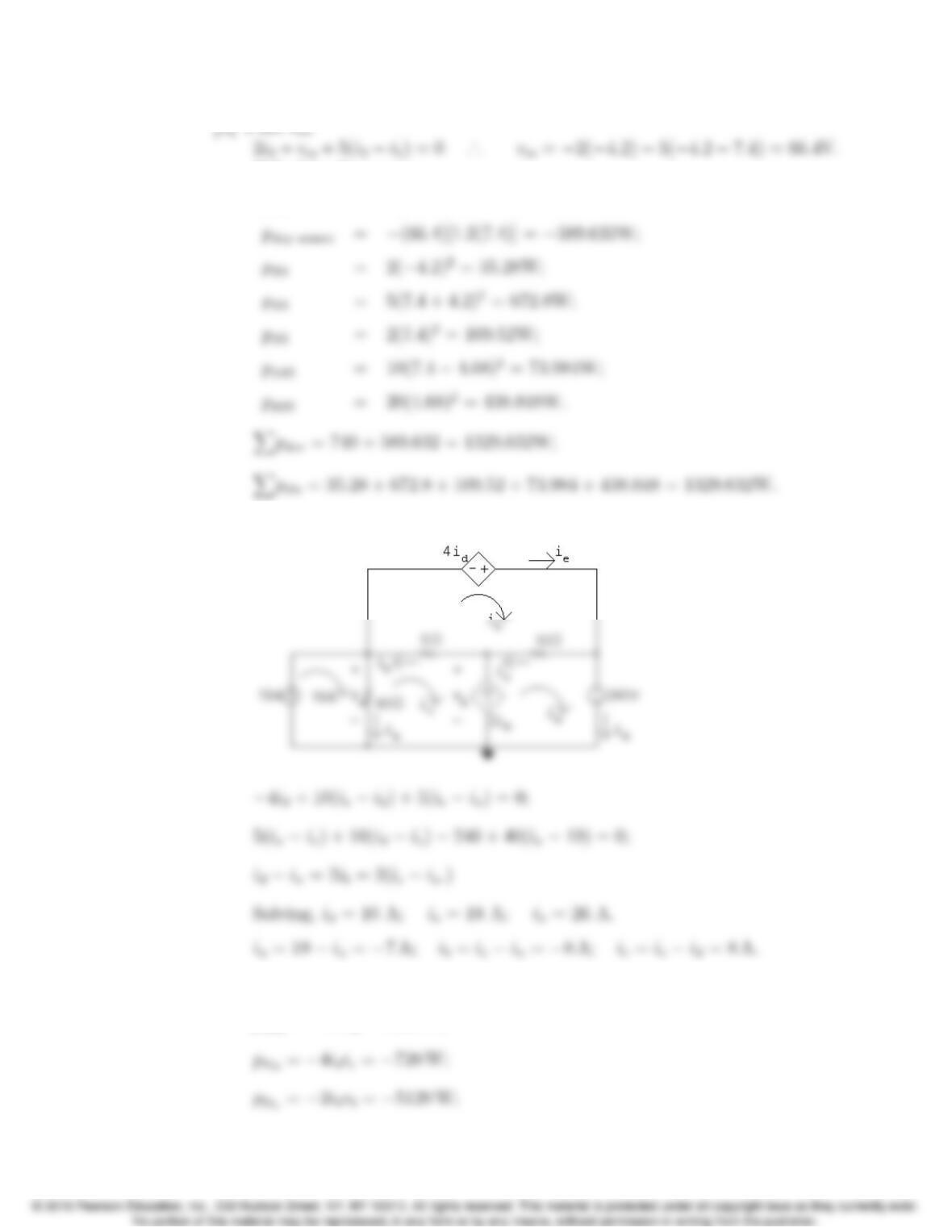
P 4.52 [a]
The i1mesh current equation:
The i2—i3supermesh equationa:
The supermesh constraint:
Place these equations in standard form:
i1(5 + 10 + 2) + i2(−5) + i3(−10) = 100;
Solve for the requested currents:
ia=i2=−4.2A;
Problems 4–57
Calculate the power:
p100V =−(100)(7.4) = −740W;
P 4.53 [a]
[b] va= 40ia=−280 V; vb=5ib+40ia=−320 V;
p19A =−19va= 5320 W;
4–58 CHAPTER 4. Techniques of Circuit Analysis
p240V =−240id=−2400 W;
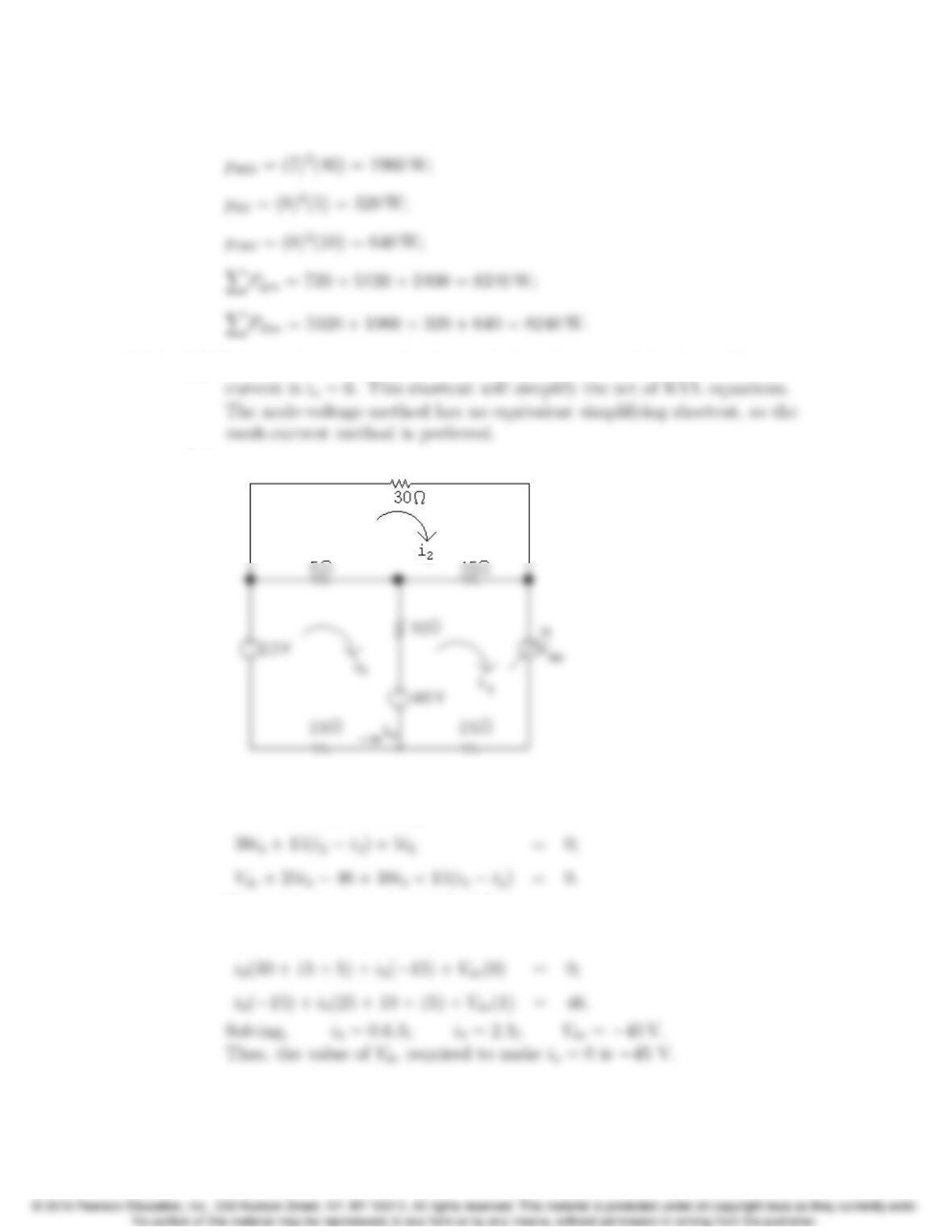
P 4.54 [a] If the mesh-current method is used, then the value of the lower left mesh
[b]
Write the mesh current equations. Note that if io= 0, then i1= 0:
−23 + 5(−i2) + 10(−i3) + 46 = 0;
Place the equations in standard form:
i2(−5) + i3(−10) + Vdc(0) = −23;
Problems 4–59
[c] Calculate the power:
p23V =−(23)(0) = 0 W;
p46V =−(46)(2) = −92 W;
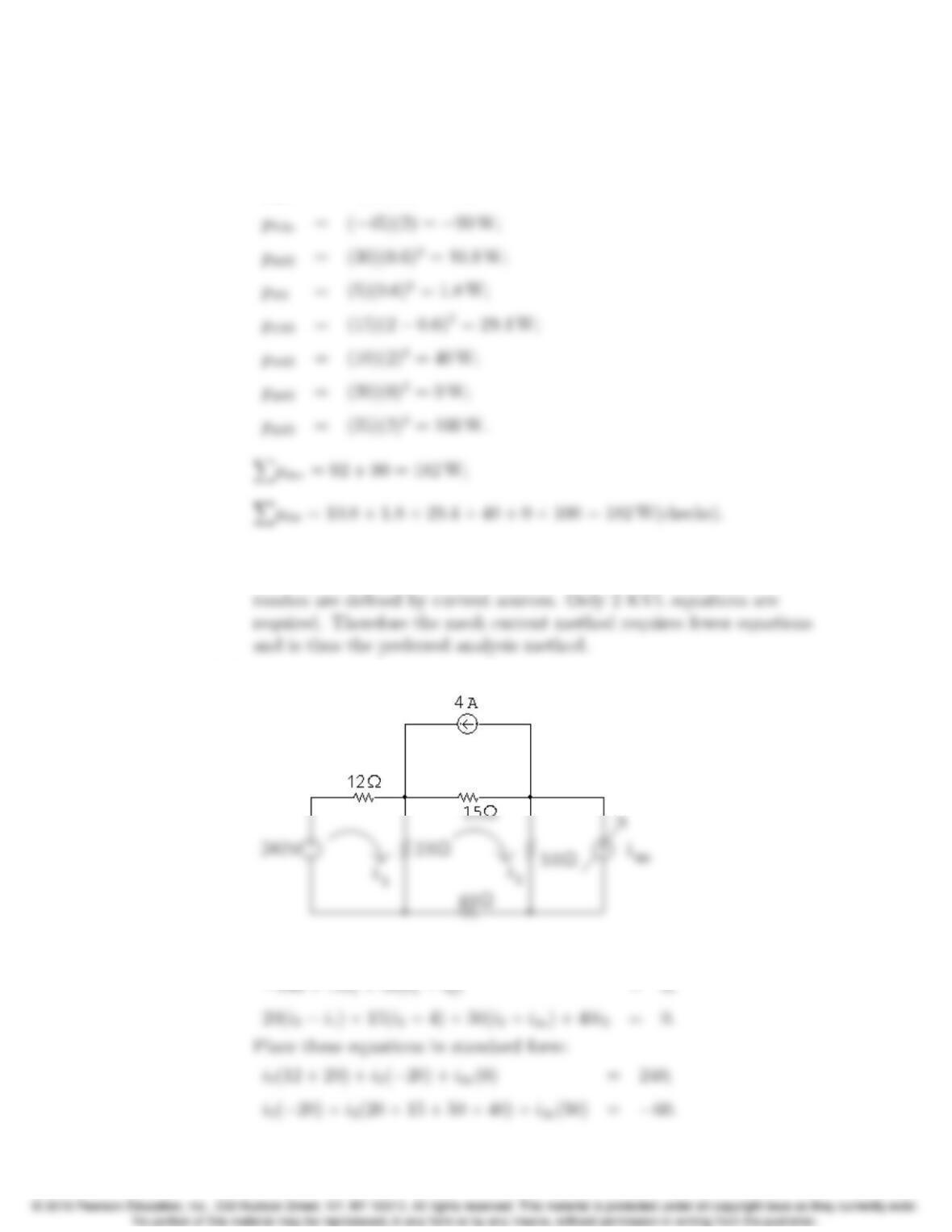
P 4.55 [a] There are 4 essential nodes so using the node voltage method requires 3
KCL equations. There are 4 meshes, but the currents in two of those
[b]
The mesh current equations:
4–60 CHAPTER 4. Techniques of Circuit Analysis
But if the power associated with the 4 A source is zero, the voltage drop
across the source must be zero. This means that the voltage drop across
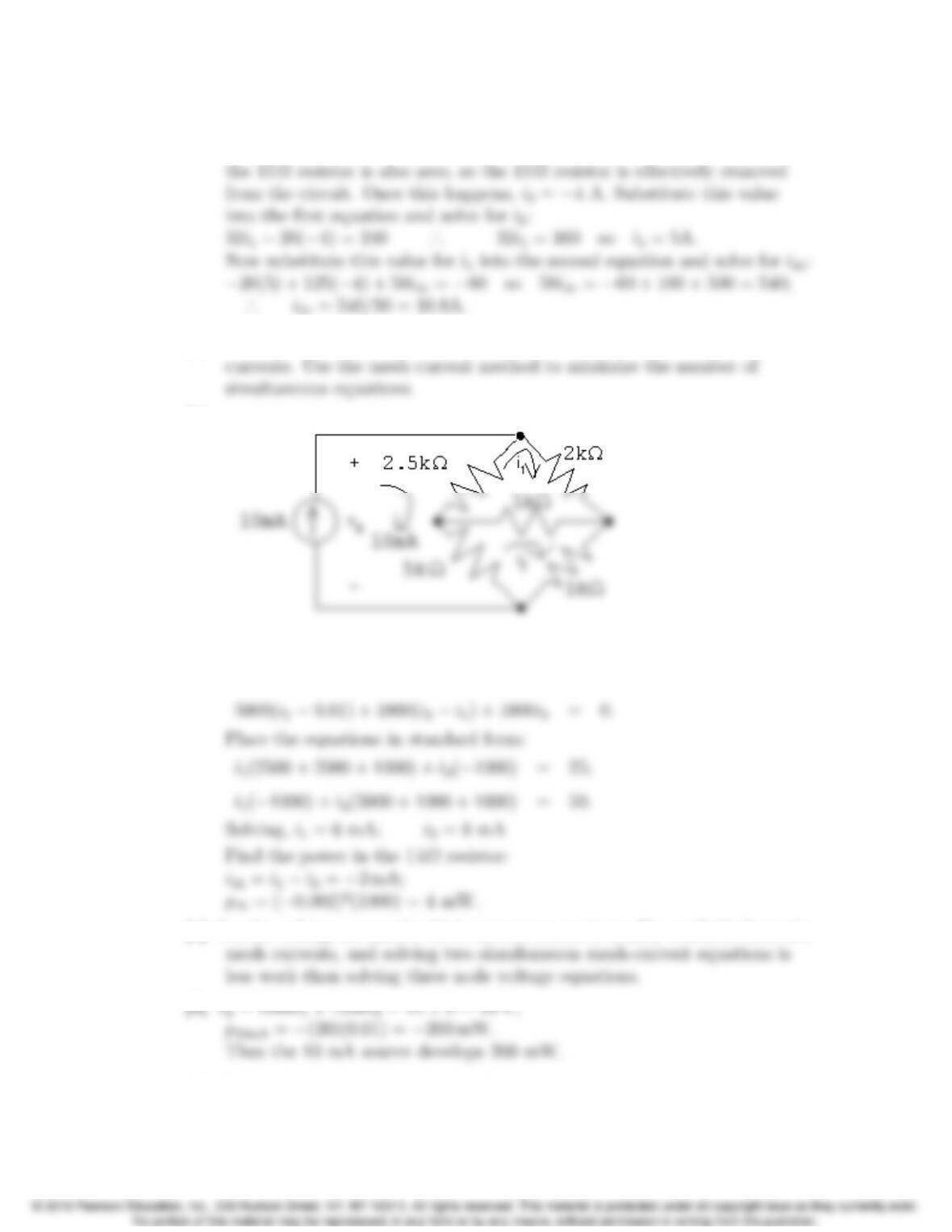
P 4.56 [a] There are three unknown node voltages and only two unknown mesh
[b]
The mesh current equations:
2500(i1−0.01) + 2000i1+ 1000(i1−i2) = 0;
[c] No, the voltage across the 10 A current source is readily available from the
P 4.57 [a] There are three unknown node voltages and three unknown mesh currents,
so the number of simultaneous equations required is the same for both