Archives: Quiz
978-1319066604 Chapter 26 Part 3
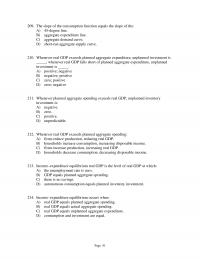
Page 41 209. The slope of the consumption function equals the slope of the: A) 45-degree line. B) aggregate expenditure line. C) aggregate demand curve. D) short-run aggregate supply curve. 210. Whenever real GDP exceeds planned aggregate expenditure, unplanned investment […]
978-1319066604 Chapter 26 Part 2
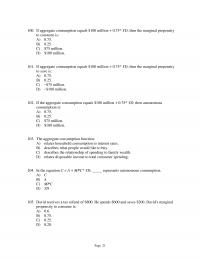
Page 21 100. If aggregate consumption equals $100 million + 0.75* YD, then the marginal propensity to consume is: A) 0.75. B) 0.25. C) $75 million. D) $100 million. 101. If aggregate consumption equals $100 million + 0.75* YD, then […]
978-1319066604 Chapter 26 Part 1
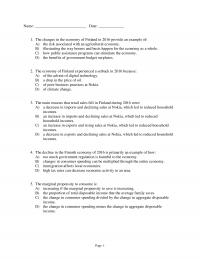
Page 1 Name: __________________________ Date: _____________ 1. The changes in the economy of Finland in 2016 provide an example of: A) the risk associated with an agricultural economy. B) illustrating the way booms and busts happen for the economy as […]
978-1319066604 Chapter 25 Part 5
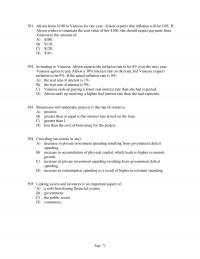
Page 72 391. Alison lends $100 to Vanessa for one year. Alison expects that inflation will be 10%. If Alison wishes to maintain the real value of her $100, she should expect payment from Vanessa in the amount of: A) […]
978-1319066604 Chapter 25 Part 4
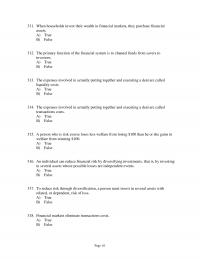
Page 61 311. When households invest their wealth in financial markets, they purchase financial assets. A) True B) False 312. The primary function of the financial system is to channel funds from savers to investors. A) True B) False 313. […]
978-1319066604 Chapter 25 Part 3
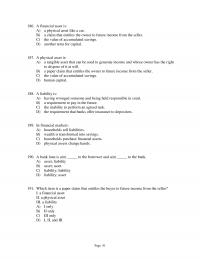
Page 41 186. A financial asset is: A) a physical asset like a car. B) a claim that entitles the owner to future income from the seller. C) the value of accumulated savings. D) another term for capital. 187. A […]
978-1319066604 Chapter 25 Part 2
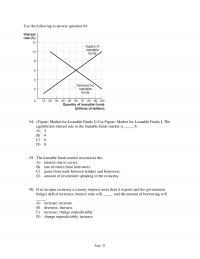
Page 21 Use the following to answer question 94: 94. (Figure: Market for Loanable Funds I) Use Figure: Market for Loanable Funds I. The equilibrium interest rate in the loanable funds market is _____%. A) 2 B) 4 C) 6 […]
978-1319066604 Chapter 25 Part 1
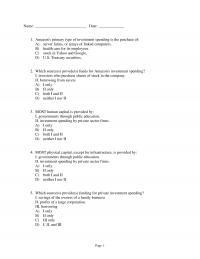
Page 1 Name: __________________________ Date: _____________ 1. Amazon’s primary type of investment spending is the purchase of: A) server farms, or arrays of linked computers. B) health care for its employees. C) stock in Yahoo and Google. D) U.S. Treasury […]
978-1319066604 Chapter 24 Part 4
Page 53 283. The value of real GDP divided by population for a given country: A) is the real GDP per capita. B) is always increasing in value for any country. C) remains constant for developing countries. D) is per […]
978-1319066604 Chapter 24 Part 3
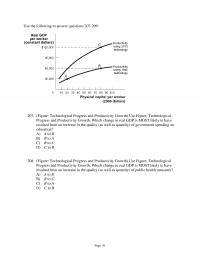
Page 41 Use the following to answer questions 207-209: 207. (Figure: Technological Progress and Productivity Growth) Use Figure: Technological Progress and Productivity Growth. Which change in real GDP is MOST likely to have resulted from an increase in the quality […]

978-1319066604 Chapter 24 Part 2
Page 21 102. (Figure: Technological Progress and Productivity Growth) Use Figure: Technological Progress and Productivity Growth. If there is a significant increase in human capital per worker (all other factors remaining unchanged), it is BEST indicated by a move from: […]
978-1319066604 Chapter 24 Part 1
Page 1 Name: __________________________ Date: _____________ 1. A key input for measuring economic growth is: A) the size of the government’s budget. B) real GDP per capita. C) life expectancy. D) the Dow Jones stock market index. 2. Which factor […]
978-1319066604 Chapter 23 Part 4
Page 56 306. If a labor market is in equilibrium at a wage that sets the quantity of labor demanded equal to the quantity of labor supplied, how can there still be unemployment? 307. Minimum wages and efficiency wages are […]
978-1319066604 Chapter 23 Part 3
Page 41 207. Deflation is a(n): A) decrease in the purchasing power of a unit of money. B) appreciation of the nation’s currency. C) decrease in the average level of prices. D) increase in the average level of prices. 208. […]
978-1319066604 Chapter 23 Part 2
Page 21 100. Sam, who is 55 years old and has been a steelworker for 30 years, is unemployed because the steel plant in his town closed and moved to Mexico. Sam is _____ unemployed. A) cyclically B) permanently C) […]
978-1319066604 Chapter 23 Part 1
Page 1 Name: __________________________ Date: _____________ 1. Employment is the total: A) labor force. B) population of working age. C) number of people actively working, either full time or part time. D) number of people not unemployed. 2. The labor […]
978-1319066604 Chapter 22 Part 5
Page 76 398. In the circular-flow diagram, the value of household income (the sum of wages, dividends, interest, rental income, and transfer payments) equals the sum of: A) household tax payments. B) consumer spending, private saving, and household tax payments. […]
978-1319066604 Chapter 22 Part 4
Page 61 292. (Table: Real and Nominal Output) Use Table: Real and Nominal Output. The price index in year 1, using year 3 as the base period, is: A) 25. B) 50. C) 100. D) 150. 293. (Table: Real and […]
978-1319066604 Chapter 22 Part 3
Page 41 198. (Table: Per Capita GDP) Per capita nominal GDP in 2011 was: A) $600. B) $400. C) $300. D) $30. 199. (Table: Per Capita GDP) Use Table: Per Capita GDP. Per capita nominal GDP in 2014 was: A) […]
978-1319066604 Chapter 22 Part 2
Page 21 96. Enchanté Inc., a designer clothing company, buys $400 worth of silk and $30 worth of accessories to produce each dress. If the value added by Enchanté is equal to $200, then according to the value-added approach, the […]
978-1319066604 Chapter 22 Part 1
Page 1 Name: __________________________ Date: _____________ 1. The national accounts do NOT keep track of: A) the spending of consumers and the government. B) the sales of producers. C) business investment. D) exchange rates. 2. The national income and product […]
978-1319066604 Chapter 21 Part 2
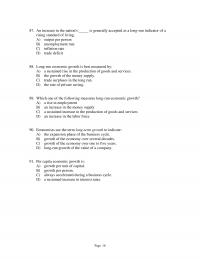
Page 16 87. An increase in the nation’s _____ is generally accepted as a long-run indicator of a rising standard of living. A) output per person B) unemployment rate C) inflation rate D) trade deficit 88. Long-run economic growth is […]
978-1319066604 Chapter 21 Part 1
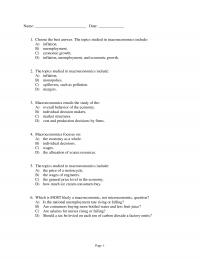
Page 1 Name: __________________________ Date: _____________ 1. Choose the best answer. The topics studied in macroeconomics include: A) inflation. B) unemployment. C) economic growth. D) inflation, unemployment, and economic growth. 2. The topics studied in macroeconomics include: A) inflation. B) […]
978-1319066604 Chapter 20 Part 3
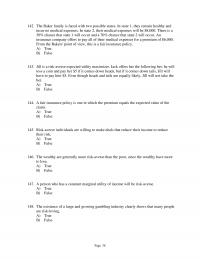
142. The Baker family is faced with two possible states. In state 1, they remain healthy and incur no medical expenses. In state 2, their medical expenses will be $8,000. There is a 30% chance that state 1 will occur […]
978-1319066604 Chapter 20 Part 2
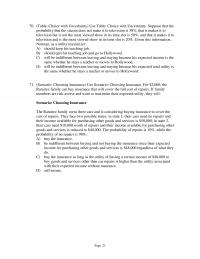
Page 21 70. (Table: Choice with Uncertainty) Use Table: Choice with Uncertainty. Suppose that the probability that the sitcom does not make it to television is 30%, that it makes it to television but is not the most viewed show […]
978-1319066604 Chapter 20 Part 1
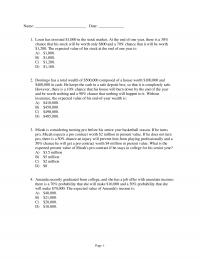
Page 1 Name: __________________________ Date: _____________ 1. Louis has invested $1,000 in the stock market. At the end of one year, there is a 30% chance that his stock will be worth only $800 and a 70% chance that it […]
978-1319066604 Chapter 19 Part 4
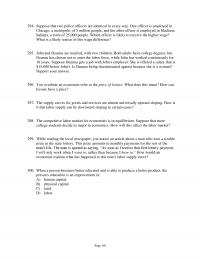
Page 60 294. Suppose that two police officers are identical in every way. One officer is employed in Chicago, a metropolis of 5 million people, and the other officer is employed in Madison, Indiana, a town of 25,000 people. Which […]
978-1319066604 Chapter 19 Part 3
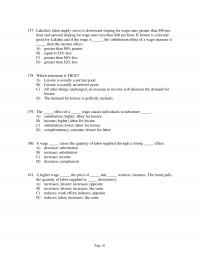
Page 41 177. Lakisha’s labor supply curve is downward sloping for wage rates greater than $40 per hour and upward sloping for wage rates less than $40 per hour. If leisure is a normal good for Lakisha and if the […]
978-1319066604 Chapter 19 Part 2
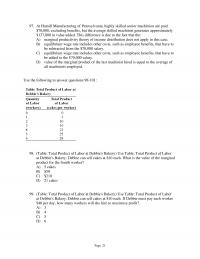
Page 21 97. At Hamill Manufacturing of Pennsylvania, highly skilled senior machinists are paid $70,000, excluding benefits, but the average skilled machinist generates approximately $137,000 in value added. This difference is due to the fact that the: A) marginal productivity […]
978-1319066604 Chapter 19 Part 1
Page 1 Name: __________________________ Date: _____________ 1. G. Reecy’s Hamburger Joint is a fast-food restaurant. Which factor is associated with production? A) the raw meat used for the hamburgers B) the hamburger buns C) the cook D) the concentrate that […]
978-1319066604 Chapter 18 Part 2
Page 14 75. Some countries, including Canada, have adopted a health care system in which the government pays the medical bills. This is known as a(n) _____ system. A) employment-based B) private health insurance C) means-tested D) single-payer 76. Progress […]
978-1319066604 Chapter 18 Part 1
Page 1 Name: __________________________ Date: _____________ 1. Government payments to individuals for which no good or service is exchanged are: A) spending. B) purchases. C) spending on goods and services. D) transfer payments. 2. Which transaction is a transfer payment? […]
978-1319066604 Chapter 17 Part 3
Page 41 176. Airplane seats are rival in consumption. A) True B) False 177. A good is excludable if nonpayers can be prevented from consuming it. A) True B) False 178. Goods are said to be rival in consumption because […]
978-1319066604 Chapter 17 Part 2
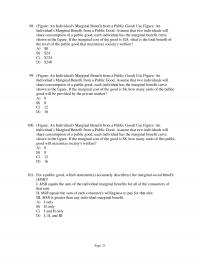
Page 21 98. (Figure: An Individual’s Marginal Benefit from a Public Good) Use Figure: An Individual’s Marginal Benefit from a Public Good. Assume that two individuals will share consumption of a public good; each individual has the marginal benefit curve […]
978-1319066604 Chapter 17 Part 1
Page 1 Name: __________________________ Date: _____________ 1. Which example is considered a nonexcludable good? A) health care B) national defense C) education D) ice cream 2. Which example BEST fits the characteristics of a private good? A) a professor giving […]
978-1319066604 Chapter 16 Part 3
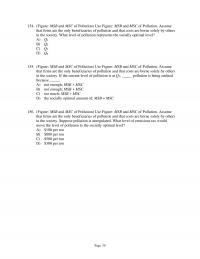
Page 39 154. (Figure: MSB and MSC of Pollution) Use Figure: MSB and MSC of Pollution. Assume that firms are the only beneficiaries of pollution and that costs are borne solely by others in the society. What level of pollution […]
978-1319066604 Chapter 16 Part 2
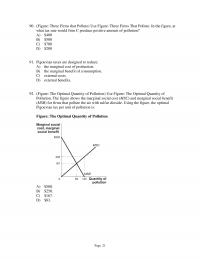
Page 21 90. (Figure: Three Firms that Pollute) Use Figure: Three Firms That Pollute. In the figure, at what tax rate would firm C produce positive amount of pollution? A) $400 B) $500 C) $700 D) $200 91. Pigouvian taxes […]
978-1319066604 Chapter 16 Part 1
Page 1 Name: __________________________ Date: _____________ 1. A market economy will produce _____ without any government regulation. A) too little pollution B) too much pollution C) the socially optimal amount of pollution D) the amount of pollution that maximizes total […]
978-1319066604 Chapter 15 Part 4
Page 52 232. A monopolistically competitive firm is operating in the short run at the optimal level of output and is earning positive economic profits. Describe how this industry will adjust in the long run. 233. A monopolistically competitive firm […]
978-1319066604 Chapter 15 Part 3
Page 41 166. Monopolistically competitive firms produce less than the output at which average total cost is minimized in the long run. As a result, there is: A) irrational capacity. B) excess capacity. C) product differentiation. D) zero economic profit. […]
978-1319066604 Chapter 15 Part 2
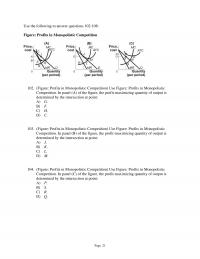
Page 21 Use the following to answer questions 102-108: Figure: Profits in Monopolistic Competition 102. (Figure: Profits in Monopolistic Competition) Use Figure: Profits in Monopolistic Competition. In panel (A) of the figure, the profit-maximizing quantity of output is determined by […]
978-1319066604 Chapter 15 Part 1
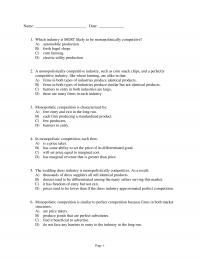
Page 1 Name: __________________________ Date: _____________ 1. Which industry is MOST likely to be monopolistically competitive? A) automobile production B) fresh bagel shops C) corn farming D) electric utility production 2. A monopolistically competitive industry, such as corn snack chips, […]
978-1319066604 Chapter 14 Part 4
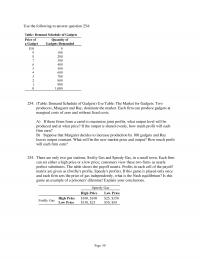
Use the following to answer question 254: 254. (Table: Demand Schedule of Gadgets) Use Table: The Market for Gadgets. Two producers, Margaret and Ray, dominate the market. Each firm can produce gadgets at marginal costs of zero and without fixed […]
978-1319066604 Chapter 14 Part 3
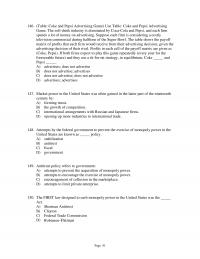
146. (Table: Coke and Pepsi Advertising Game) Use Table: Coke and Pepsi Advertising Game. The soft-drink industry is dominated by Coca-Cola and Pepsi, and each firm spends a lot of money on advertising. Suppose each firm is considering a costly […]
978-1319066604 Chapter 14 Part 2
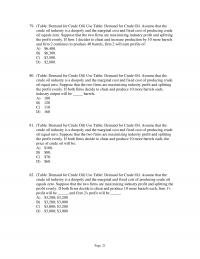
Page 21 79. (Table: Demand for Crude Oil) Use Table: Demand for Crude Oil. Assume that the crude oil industry is a duopoly and the marginal cost and fixed cost of producing crude oil equals zero. Suppose that the two […]
978-1319066604 Chapter 14 Part 1
Page 1 Name: __________________________ Date: _____________ 1. In an oligopoly: A) there are many sellers. B) there are no barriers to entry. C) firms recognize their interdependence. D) total surplus is maximized. 2. The MOST important source of oligopoly in […]
978-1319066604 Chapter 13 Part 4
Page 60 284. A monopolist who engages in perfect price discrimination charges each consumer a price equal to that consumer’s willingness to pay. A) True B) False 285. In perfect price discrimination, consumer surplus is larger than it is in […]
978-1319066604 Chapter 13 Part 3
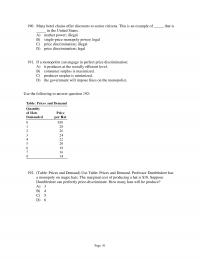
Page 41 190. Many hotel chains offer discounts to senior citizens. This is an example of _____ that is _____ in the United States. A) market power; illegal B) single-price monopoly power; legal C) price discrimination; illegal D) price discrimination; […]
978-1319066604 Chapter 13 Part 2
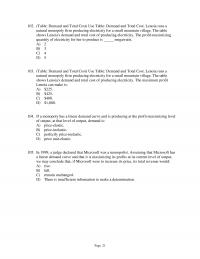
Page 21 102. (Table: Demand and Total Cost) Use Table: Demand and Total Cost. Lenoia runs a natural monopoly firm producing electricity for a small mountain village. The table shows Lenoia’s demand and total cost of producing electricity. The profit-maximizing […]
978-1319066604 Chapter 13 Part 1
Page 1 Name: __________________________ Date: _____________ 1. Market structures are categorized by: A) the number and size of the firms. B) whether products are differentiated and the extent of advertising. C) the number of firms and whether products are differentiated. […]