142.
The Baker family is faced with two possible states. In state 1, they remain healthy and
incur no medical expenses. In state 2, their medical expenses will be $8,000. There is a
30% chance that state 1 will occur and a 70% chance that state 2 will occur. An
insurance company offers to pay all of their medical expenses for a premium of $6,000.
From the Bakers’ point of view, this is a fair insurance policy.
A)
True
B)
False
143.
Jill is a risk-averse expected-utility maximizer. Jack offers her the following bet: he will
toss a coin and pay her $5 if it comes down heads, but if it comes down tails, Jill will
have to pay him $5. Even though heads and tails are equally likely, Jill will not take the
bet.
A)
True
B)
False
144.
A fair insurance policy is one in which the premium equals the expected value of the
claim.
A)
True
B)
False
145.
Risk-averse individuals are willing to make deals that reduce their income to reduce
their risk.
A)
True
B)
False
146.
The wealthy are generally more risk-averse than the poor, since the wealthy have more
to lose.
A)
True
B)
False
147.
A person who has a constant marginal utility of income will be risk-averse.
A)
True
B)
False
148.
The existence of a large and growing gambling industry clearly shows that many people
are risk-loving.
A)
True
B)
False
Page 39
149.
Through insurance and other devices, the modern economy offers many ways for
individuals to reduce their exposure to risk.
A)
True
B)
False
150.
Risk-averse individuals will always buy insurance, regardless of the premiums charged.
A)
True
B)
False
151.
Buying a warranty on a new television is an example of paying to avoid risk.
A)
True
B)
False
152.
An efficient allocation of risk occurs when those most willing to bear risk insure those
who are least willing to bear risk.
A)
True
B)
False
153.
Two possible events are independent if they happen at different times and in different
places.
A)
True
B)
False
154.
The easiest risks to reduce by diversification are those associated with positively
correlated events.
A)
True
B)
False
155.
Private information can cause economic inefficiency by preventing mutually beneficial
transactions.
A)
True
B)
False
Page 40
156.
Common strategies to deal with the problem of adverse selection include screening
(using observable information to make inferences about private information), signaling
(engaging in actions that reveal one’s private information), and establishing a good
reputation.
A)
True
B)
False
157.
Moral hazard occurs only when people fail to do what is in their best interest.
A)
True
B)
False
158.
Adverse selection and moral hazard do not affect the efficiency of the market.
A)
True
B)
False
159.
You have one ticket for a raffle with a grand prize of $1,000. There are two prizes worth
$100 and five prizes worth $20. If only 100 tickets have been distributed, what is the
expected value of your winnings?
160.
You are risk-neutral. You are considering the purchase of a $10 ticket for a raffle with a
grand prize of $1,000. There are two prizes worth $100 and five prizes worth $20. If
you know that only 100 tickets will be sold, should you purchase the ticket?
161.
You are considering the purchase of one ticket for a raffle with a grand prize of $1,000.
There are two prizes worth $100 and five prizes worth $20. If you know that only 100
tickets will be sold, what is the most you would pay for one raffle ticket?
162.
Jaleh has just landed a great job and plans to buy a fancy car worth $100,000. Jaleh is
otherwise risk-averse, but she likes to drive fast, so the probability that she wrecks the
car (a total loss of $100,000) is 0.1. The probability that she has no accidents is 0.9. If
an insurance company were to offer Jaleh a fair insurance policy that completely
replaced her car, how much would she pay? What is the most she would pay for an
insurance policy that would completely replace her car if she totaled it?
Page 41
163.
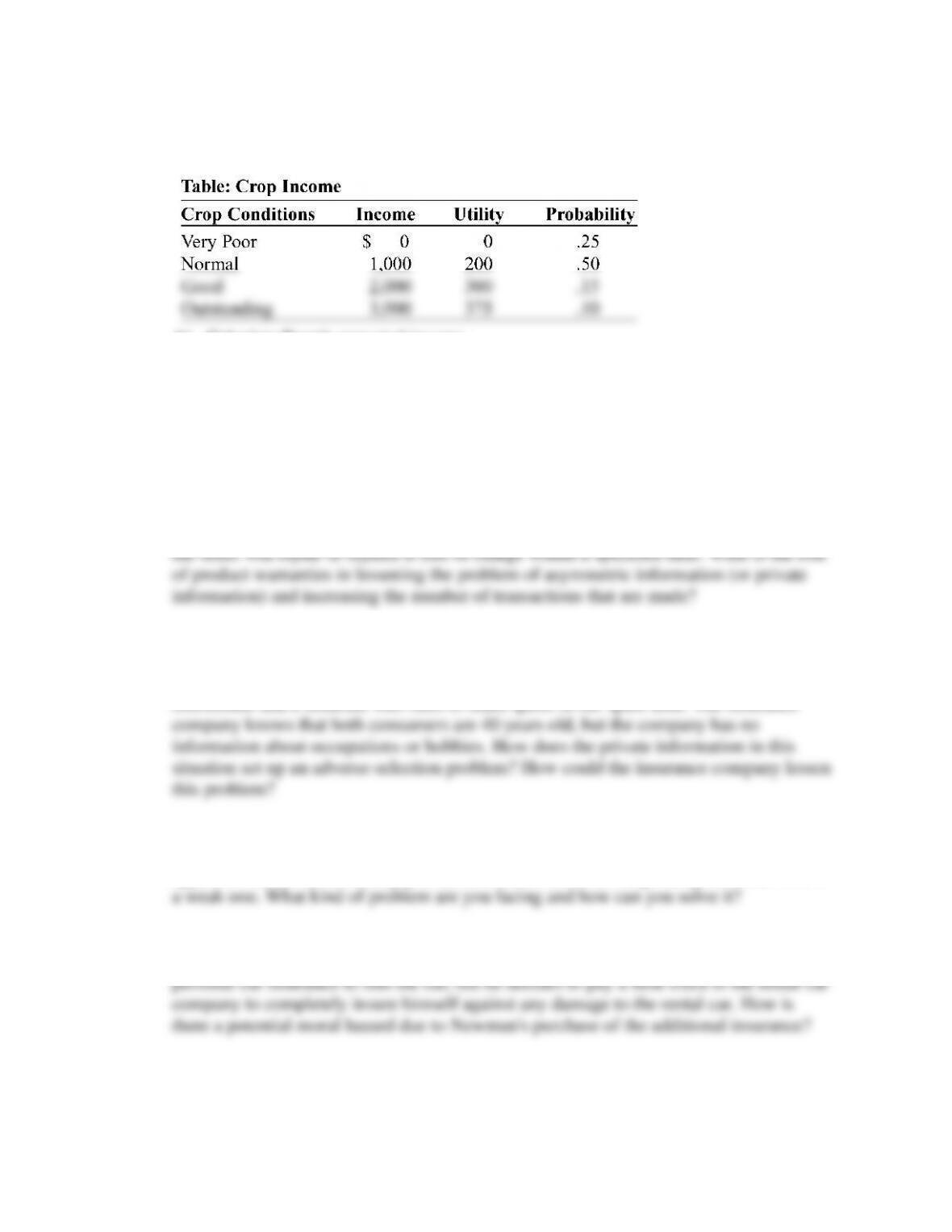
(Table: Crop Income) Use Table: Crop Income. Brent is a farmer, and his income
depends on the weather.
A) Calculate Brent’s expected income.
B) Calculate Brent’s expected utility.
164.
Most college-bound high school seniors apply for admission to several colleges of
varying reputations and admission standards. Explain how this behavior is similar to
diversification of assets discussed in the chapter.
165.
The seller of a product will sometimes offer a warranty that if the product is defective,
the seller will repair or replace it free of charge within a specified time. What is the role
of product warranties in lessening the problem of asymmetric information (or private
information) and increasing the number of transactions that are made?
166.
Two consumers go to the insurance company to purchase life insurance. James is a
smoker and a police officer who races motorcycles in his spare time. Kathy is a
nonsmoker and a librarian who likes to make quilts in her spare time. The insurance
company knows that both consumers are 40 years old, but the company has no
information about occupations or hobbies. How does the private information in this
situation set up an adverse-selection problem? How could the insurance company lessen
this problem?
167.
You own a shoe store and need a new sales associate. You have a large stack of
applications, but unfortunately you have no idea who is a strong salesperson and who is
a weak one. What kind of problem are you facing and how can you solve it?
168.
Newman has decided to take a road trip in a rental car. He has the minimum amount of
personal car insurance to rent the car, but he decides to pay a little extra to the rental car
company to completely insure himself against any damage to the rental car. How is
there a potential moral hazard due to Newman’s purchase of the additional insurance?
Page 42
169.
(Scenario: Health Costs) Use Scenario: Health Costs. Given the fact that Alan has a
40% chance of developing a health problem, what is the expected value of Alan’s health
care costs for the coming year?
Scenario: Health Costs
Alan is hoping for a healthy year, meaning that he would have zero health costs. Given
his habits, there is a 40% chance that Alan will develop a health issue resulting in
$50,000 in health costs. Assume these are the only two conditions that could exist for
Alan in the coming year.
A)
$0
B)
$50,000
C)
$20,000
D)
$16,000
170.
(Scenario: Health Costs) Use Scenario: Health Costs. Suppose that Alan decides to
change his habits dramatically and, as a result, decreases the probability of his
developing a health problem such that he now has a 20% chance of becoming ill. What
is the expected value of Alan’s health costs now?
Scenario: Health Costs
Alan is hoping for a healthy year, meaning that he would have zero health costs. Given
his habits, there is a 40% chance that Alan will develop a health issue resulting in
$50,000 in health costs. Assume these are the only two conditions that could exist for
Alan in the coming year.
A)
$0
B)
$10,000
C)
$20,000
D)
$2,000
Page 43
171.
(Scenario: Health Costs) Use Scenario: Health Costs. When Alan’s probability of
developing a health problem decreases, holding everything else constant, Alan’s
expected value of health care costs:
Scenario: Health Costs
Alan is hoping for a healthy year, meaning that he would have zero health costs. Given
his habits, there is a 40% chance that Alan will develop a health issue resulting in
$50,000 in health costs. Assume these are the only two conditions that could exist for
Alan in the coming year.
A)
increases.
B)
decreases.
C)
stays constant.
D)
increases, decreases, or stays constant.
172.
If the probability that one person will develop a health problem is greater than that of
another person and if they buy insurance from the same provider, the person with a
higher probability will MOST likely pay:
A)
the same as the other person.
B)
more than will the person with the lower probability.
C)
less than will the person with the lower probability.
D)
All people, regardless of probabilities, pay the same amount for insurance.
173.
An individual finds that, as their income increases, their total utility also increases, but
at a decreasing rate. This occurrence can be attributed to:
A)
diminishing marginal utility.
B)
being risk-neutral.
C)
expected values.
D)
efficient allocation of risk.
174.
Given uncertainty, individuals attempt to maximize their:
A)
adverse selection.
B)
expected utility.
C)
risk aversion.
D)
consumption.
Page 44
175.
Suppose that, for the coming year, a family has calculated its expected value for car
repairs to be $3,000. The family decides to buy a car insurance policy that would cover
such claims. This insurance policy would cost a total of $3,000 for the household. This
insurance policy is:
A)
overcharging the family and is not fair.
B)
an example of a fair insurance policy.
C)
undercharging the family.
D)
not appropriate for the family, and they should not buy it.
176.
Organized-gambling venues such as those at Las Vegas tend to attract:
A)
risk-loving individuals only.
B)
even risk-averse people because they are designed to allow individuals to win.
C)
people who may be irrational in their choice of gambling and are often risk-averse.
D)
only professional gamblers.
177.
Lucy decides to buy car insurance because:
A)
she wishes to increase her exposure to risk.
B)
she wants to decrease her exposure to risk.
C)
she is not risk-averse.
D)
her marginal utility is not strongly dependent on her income.
178.
Risk-averse individuals:
A)
will not gamble at casinos such as those found in Las Vegas.
B)
will pay higher insurance premiums based on their risk aversion.
C)
are a minority of the population.
D)
have upward-sloping marginal utility functions.
179.
Warranties that cover the cost of a repair or replacement will:
A)
decrease the consumer’s expected utility from consuming the good.
B)
increase the consumer’s expected utility from consuming the good.
C)
have no impact on the consumer’s expected utility from consuming the good.
D)
reverse the consumer’s diminishing marginal utility.
180.
When Lloyd’s of London offered to provide insurance to merchant ships in the
eighteenth century, Lloyd’s was:
A)
exhibiting risk-averse behavior.
B)
less sensitive to risk than were those who requested insurance.
C)
attempting to decrease its exposure to risk.
D)
not very rational in its behavior.
Page 45
181.
_____ of insurance are often risk-averse, and _____ of insurance are interested in
reducing their exposure to risk.
A)
Demanders; suppliers
B)
Demanders; demanders
C)
Suppliers; demanders
D)
Suppliers; suppliers
182.
(Scenario: Flood Area) Use Scenario: Flood Area. A flood may occur, causing you to
lose your entire home. In this case, your expected loss resulting from the flood would
be:
Scenario: Flood Area
Suppose that you own a home that is estimated to be worth $250,000. You live in a
flood plain; as a result, the probability that you will lose your home to a flood is 30%.
A)
$250,000.
B)
$75,000.
C)
$15,000.
D)
$100,000.
183.
(Scenario: Flood Area) Use Scenario: Flood Area. Suppose that an insurance company
offers you flood insurance. MOST likely, this insurance would require a premium
payment:
Scenario: Flood Area
Suppose that you own a home that is estimated to be worth $250,000. You live in a
flood plain; as a result, the probability that you will lose your home to a flood is 30%.
A)
greater than $250,000.
B)
greater than $75,000.
C)
less than $15,000.
D)
equal to $100,000.
184.
In a particular insurance market, there is a decrease in the degree of risk aversion among
buyers. Holding everything else constant, the equilibrium premium will _____ and the
equilibrium quantity of insurance will _____.
A)
increase; increase
B)
decrease; decrease
C)
increase; decrease
D)
decrease; increase
Page 46
185.
In a particular insurance market, there is a decrease in the degree of risk aversion among
suppliers. Holding everything else constant, the equilibrium premium will _____ and
the equilibrium quantity of insurance will _____.
A)
increase; increase
B)
decrease; decrease
C)
increase; decrease
D)
decrease; increase
186.
As a result of frequent flooding, the insurance market has noted a positive correlation
between flooding and the amount of insurance monies paid out for such floods. Holding
demand for insurance constant, if flooding is expected to continue to be a problem,
flood insurance premiums will MOST likely:
A)
rise.
B)
fall.
C)
stay the same.
D)
rise, fall, or stay the same.
187.
Suppose that a person rolls a typical six-sided die. What is the probability that the die
will come up with a 1, two times in a row?
A)
1 in 6
B)
1 in 3
C)
1 in 36
D)
1 in 12
188.
Suppose that a person rolls a typical six-sided die. What is the probability that the die
will come up with a 1 and then a 2?
A)
1 in 3
B)
1 in 36
C)
1 in 6
D)
2 in 5
189.
Two individuals make up the auto insurance market. Bonnie drives well, and the
probability of her having an accident is 10% this year. Lisa also drives carefully, and her
probability of having an accident is 5%. What is the probability that Bonnie and Lisa
will both have accidents this year?
A)
0.15%
B)
0.75%
C)
0.005%
D)
0.5%
Page 47
190.
The pooling of risk is a _____ form of diversification that produces a payoff with a very
_____ risk.
A)
weak; large
B)
weak; small
C)
strong; large
D)
strong; small
191.
Economic growth that is not industry-specific is MOST likely to:
A)
have no effect on most businesses.
B)
result in many businesses doing well.
C)
result in many businesses not doing well.
D)
affect only a few select businesses.
192.
As a result of frequent flooding, the insurance market has noted a positive correlation
between flooding and the amount of insurance monies paid out for such floods. Holding
demand for insurance constant, if flooding is expected to continue to be a problem:
A)
flood insurance providers will reap greater profits.
B)
more insurance companies will provide such insurance.
C)
flood insurance markets may eventually collapse since the risks of damage cannot
be offset by diversification.
D)
flood insurance premiums will decrease.
193.
As a result of frequent flooding, the insurance market has noted a positive correlation
between flooding and the amount of insurance monies paid out for such floods.
Moreover, the probability of such flooding has been increasing. As a result,
homeowners in flood plains will find that flood insurance:
A)
is easy to acquire and relatively inexpensive.
B)
is very costly and relatively difficult to find.
C)
premiums have not changed since the insurance continues to offer the same
coverage.
D)
is relatively expensive but easy to acquire.
194.
The insurance industry operates on the principles of:
A)
risk trading and diversification.
B)
exploitation and capital accumulation.
C)
moral hazard and irrationality.
D)
adverse selection and diminishing marginal utility.
Page 48
195.
Toyotas are known for their quality and durability. As a result, compared with other
used-car markets, adverse selection in the used-Toyota market is:
A)
equally likely.
B)
relatively unlikely.
C)
more likely.
D)
not expected.
196.
When an individual knows more about his or her own actions than other people do,
incentives are distorted, which causes:
A)
moral hazard.
B)
adverse selection.
C)
screening.
D)
signaling.
197.
Moral hazard:
A)
increases the ability of markets to allocate risk efficiently.
B)
decreases the ability of markets to allocate risk efficiently.
C)
has no impact on the ability of markets to allocate risk efficiently.
D)
encourages the provision of 100% insurance coverage.
198.
Moral hazard can be reduced by:
A)
the use of 100% insurance coverage.
B)
imposing a deductible on insurance coverage.
C)
taking away personal stakes for people with private information.
D)
offering fewer incentives to people with private information to act in a less risky
manner.
199.
Insurance premiums often fall substantially if a buyer purchases a policy with a high
deductible, and such a policy is often purchased by individuals who self-identify as:
A)
low-risk drivers.
B)
high-risk drivers.
C)
drivers who do not care what their premium costs are.
D)
neither high- nor low-risk drivers.
Page 49
200.
(Scenario: Used-Car Market) Use Scenario: Used-Car Market. The expected value of a
used car is:
Scenario: Used-Car Market
In the used-car market, cars of poor quality are called lemons, while cars of good quality
are called plums. Suppose that the probability of obtaining a lemon is 60% and the
probability of obtaining a plum is 40%. Also, assume that a plum is worth $15,000 and a
lemon is worth $3,000.
A)
$9,000.
B)
$7,800.
C)
$18,000.
D)
$10,500.
201.
(Scenario: Used-Car Market) Use Scenario: Used-Car Market. If buyers cannot
distinguish between lemons and plums, eventually this used-car market will:
Scenario: Used-Car Market
In the used-car market, cars of poor quality are called lemons, while cars of good quality
are called plums. Suppose that the probability of obtaining a lemon is 60% and the
probability of obtaining a plum is 40%. Also, assume that a plum is worth $15,000 and a
lemon is worth $3,000.
A)
be made up mostly of lemons.
B)
have buyers who will have a 50% chance of choosing a plum.
C)
be made up mostly of plums.
D)
be made up of 50% plums and 50% lemons.
202.
(Scenario: Used-Car Market) Use Scenario: Used-Car Market. Adverse selection in this
used-car market occurs because of:
Scenario: Used-Car Market
In the used-car market, cars of poor quality are called lemons, while cars of good quality
are called plums. Suppose that the probability of obtaining a lemon is 60% and the
probability of obtaining a plum is 40%. Also, assume that a plum is worth $15,000 and a
lemon is worth $3,000.
A)
asymmetric information.
B)
risk-loving behavior.
C)
moral hazard.
D)
diversification.
Answer Key
Page 51
45.
A
46.
B
47.
C
48.
B
49.
D
50.
D
51.
B
52.
C
53.
D
54.
B
55.
C
56.
C
57.
D
58.
B
59.
A
60.
B
61.
B
62.
B
63.
C
64.
A
65.
C
66.
B
67.
A
68.
A
69.
D
70.
B
71.
C
72.
A
73.
C
74.
A
75.
C
76.
D
77.
C
78.
C
79.
B
80.
A
81.
C
82.
D
83.
C
84.
C
85.
A
86.
D
87.
B
88.
C
89.
B
90.
C
Page 52
91.
C
92.
A
93.
C
94.
A
95.
C
96.
B
97.
D
98.
C
99.
B
100.
C
101.
C
102.
C
103.
C
104.
D
105.
D
106.
C
107.
A
108.
D
109.
D
110.
A
111.
D
112.
C
113.
A
114.
C
115.
C
116.
D
117.
A
118.
D
119.
D
120.
D
121.
B
122.
C
123.
B
124.
A
125.
D
126.
A
127.
D
128.
A
129.
A
130.
B
131.
C
132.
A
133.
B
134.
D
135.
C
136.
D
Page 53
137.
B
138.
D
139.
B
140.
A
141.
B
142.
B
143.
A
144.
A
145.
A
146.
B
147.
B
148.
B
149.
A
150.
B
151.
A
152.
A
153.
B
154.
B
155.
A
156.
A
157.
B
158.
B
159.
160.
161.
162.
163.
164.
165.
166.
167.
168.
169.
C
170.
B
171.
B
172.
B
173.
A
174.
B
175.
B
176.
C
177.
B
178.
B
179.
B
180.
B
181.
B
182.
B
Page 54
183.
B
184.
B
185.
D
186.
A
187.
C
188.
B
189.
D
190.
D
191.
B
192.
C
193.
B
194.
A
195.
B
196.
A
197.
B
198.
B
199.
A
200.
B
201.
A
202.
A