Page 21
100.
Sam, who is 55 years old and has been a steelworker for 30 years, is unemployed
because the steel plant in his town closed and moved to Mexico. Sam is _____
unemployed.
A)
cyclically
B)
permanently
C)
frictionally
D)
structurally
101.
The labor demand curve is negatively sloped because:
A)
more people are willing to work at low wages than at high wages.
B)
more people are willing to work at high wages than at low wages.
C)
employers are willing to hire more people at low wages.
D)
employers are willing to hire more people at high wages.
102.
The labor supply curve is positively sloped because:
A)
more people are willing to work at low wages than at high wages.
B)
more people are willing to work at high wages than at low wages.
C)
employers are willing to hire more people at low wages.
D)
employers are willing to hire more people at high wages.
103.
Structural unemployment CANNOT be caused by:
A)
minimum wages.
B)
labor unions.
C)
efficiency wages.
D)
fluctuations in the business cycle.
104.
Structural unemployment CANNOT be caused by:
A)
a government-mandated floor on the price of labor set above the equilibrium wage.
B)
collective bargaining efforts that secure higher wages for unionized workers than
for nonunionized workers.
C)
offering high wages to attract high-quality workers.
D)
granting Social Security benefits to laid-off workers.
105.
Last month, Brent lost his job at the auto parts factory because the factory relocated to
Asia. Brent has been looking for similar jobs in his town but has found no openings.
Brent is BEST classified as:
A)
structurally unemployed.
B)
frictionally unemployed.
C)
a discouraged worker.
D)
out of the labor force.
Page 22
106.
Last month, Brent lost his job at the auto parts factory because the factory relocated to
Asia. Brent and his former coworkers have been looking for similar jobs, but they have
found no openings. In Brent’s town, the _____ labor has _____.
A)
supply of; fallen
B)
supply of; risen
C)
demand for; risen
D)
demand for; fallen
107.
If a worker becomes unemployed because of an increase in the minimum wage, that
worker is:
A)
frictionally unemployed.
B)
structurally unemployed.
C)
cyclically unemployed.
D)
engaged in a job search.
108.
A binding minimum wage in a labor market is set _____ the equilibrium wage and
causes a _____ of labor.
A)
below; surplus
B)
below; shortage
C)
above; surplus
D)
above; shortage
Use the following to answer questions 109-114:
Page 23
109.
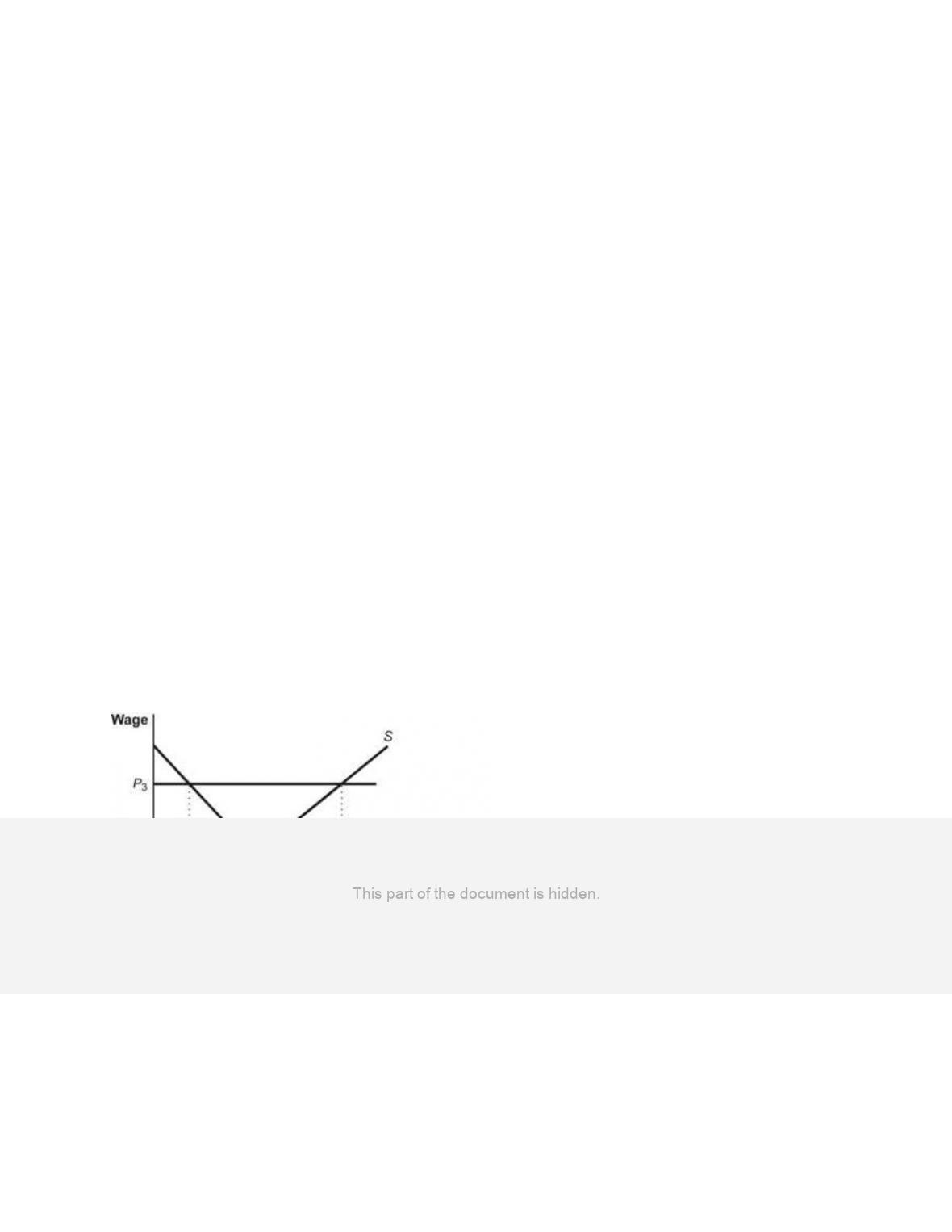
(Figure: The Minimum Wage) Use Figure: The Minimum Wage. Which point on the
x-axis is a binding minimum wage?
A)
P1
B)
P2
C)
P3
D)
zero
110.
(Figure: The Minimum Wage) Use Figure: The Minimum Wage. What is the quantity of
labor demanded at a binding minimum wage of P3?
A)
Q1
B)
Q2
C)
Q3
D)
Q4
111.
(Figure: The Minimum Wage) Use Figure: The Minimum Wage. What is the quantity of
labor supplied at a binding minimum wage of P3?
A)
Q1
B)
Q2
C)
Q3
D)
Q4
112.
(Figure: The Minimum Wage) Use Figure: The Minimum Wage. The binding minimum
wage of P3 leads to surplus of labor of:
A)
Q3 – Q1.
B)
Q3 – Q2.
C)
Q4 – Q1.
D)
Q4 – Q2.
113.
(Figure: The Minimum Wage) Use Figure: The Minimum Wage. By how much does the
quantity of labor supplied rise when the government imposes a binding minimum wage
of P3?
A)
Q4 – Q1
B)
Q3 – Q2
C)
Q2 – Q1
D)
Q4 – Q2
Page 24
114.
(Figure: The Minimum Wage) Use Figure: The Minimum Wage. By how much does the
quantity of labor demanded fall when the government imposes a binding minimum
wage of P3?
A)
Q4 – Q1
B)
Q3 – Q2
C)
Q2 – Q1
D)
Q4 – Q2
115.
It is generally accepted that a binding minimum wage does NOT:
A)
decrease the quantity of labor demanded.
B)
increase unemployment.
C)
increase the amount of labor supplied.
D)
decrease the amount of labor supplied.
Use the following to answer questions 116-118:
116.
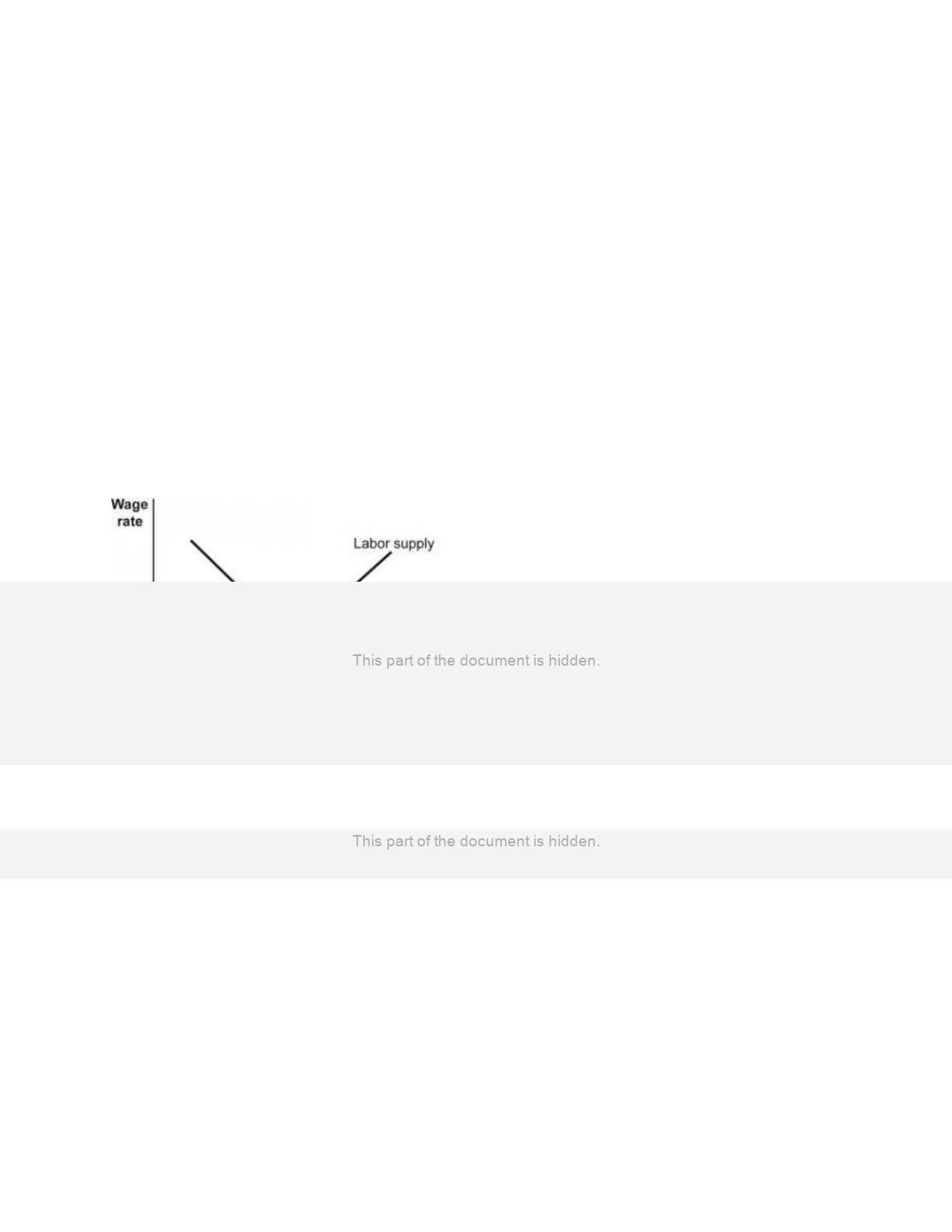
(Figure: The Effect of a Minimum Wage) Use Figure: The Effect of a Minimum Wage.
Suppose the labor market is in equilibrium at E when the government imposes a
minimum wage of WF. The quantity of labor supplied may_____, resulting in structural
unemployment.
A)
decrease to QD
B)
stay at QE
C)
increase to QS
D)
stay at WE
Page 25
117.
(Figure: The Effect of a Minimum Wage) Use Figure: The Effect of a Minimum Wage.
Suppose the labor market is in equilibrium at E when the government imposes a
minimum wage of WF. Structural unemployment, assuming all workers without a job
are searching, will equal:
A)
QS – QD.
B)
QE – QD.
C)
QS – QE.
D)
zero.
118.
(Figure: The Effect of a Minimum Wage) Use Figure: The Effect of a Minimum Wage.
Suppose that, after some time with a minimum wage of WF, the government abolishes
the minimum wage. Employment will:
A)
decrease to QE.
B)
increase to QE.
C)
stay at QE.
D)
be impossible to determine.
119.
A minimum wage of $7.25 per hour can cause structural unemployment if the
equilibrium wage is:
A)
$7.25.
B)
$8.00.
C)
$6.85.
D)
$7.30.
120.
In the absence of minimum wages, efficiency wages, or labor unions, a decline in the
demand for labor will likely result in _____ if wages are flexible.
A)
higher levels of employment
B)
no changes in employment
C)
a lower level of employment but likely no change in the unemployment rate
D)
a lower level of employment and a higher unemployment rate
121.
When the demand for labor is falling and employers have committed to high wages,
_____ unemployment will result.
A)
frictional
B)
cyclical
C)
permanent
D)
structural
Page 26
122.
Firms pay an efficiency wage because:
A)
it reduces the risk of losing the best workers.
B)
it is required by law.
C)
they don’t have to offer health insurance if they pay efficiency wages.
D)
it reduces the employee’s income tax liability.
123.
Efficiency wages are usually set by employers to:
A)
reduce unemployment.
B)
increase employment.
C)
provide an incentive for better performance.
D)
increase employment and provide better incentives for performance.
124.
Efficiency wages are:
A)
above equilibrium to encourage better performance.
B)
below equilibrium to encourage better performance to get a raise.
C)
responsible for all structural unemployment.
D)
above equilibrium to encourage better performance and are responsible for all
structural unemployment.
125.
Efficiency wages encourage:
A)
workers to look for a better job.
B)
potential workers to remain out of the labor force.
C)
workers to stay in their current job.
D)
workers to get more job training.
126.
Efficiency wages are:
A)
market equilibrium wages.
B)
set above equilibrium wages to act as an incentive for better performance.
C)
set below the equilibrium wage to increase profits.
D)
allowed to be below minimum wage.
127.
If the actual unemployment rate is 7% and the cyclical unemployment rate is 2%, then
the natural rate of unemployment is:
A)
2%.
B)
5%.
C)
7%.
D)
9%.
Page 27
128.
If the actual unemployment rate is 7% and the natural rate is 5%, then the cyclical rate
is:
A)
2%.
B)
5%.
C)
7%.
D)
9%.
129.
If actual unemployment is 6.2% and the natural rate is 4%, cyclical unemployment is:
A)
6.2%.
B)
10.2%.
C)
4%.
D)
2.2%.
130.
The natural rate of employment is achieved when:
A)
the actual rate of unemployment is zero.
B)
it is above the actual rate of unemployment.
C)
the quantity of labor supplied is equal to the quantity of labor demanded.
D)
there is no cyclical unemployment.
131.
The natural rate of unemployment is:
A)
the rate during recessions.
B)
equal to the sum of frictional and cyclical unemployment.
C)
equal to the sum of frictional and structural unemployment.
D)
cyclical unemployment less frictional unemployment.
132.
The rate of unemployment when the economy is at full employment is:
A)
zero.
B)
the natural rate.
C)
the structural rate.
D)
less than the full employment rate of unemployment.
133.
The deviations from the natural rate of unemployment in the actual rate of
unemployment are:
A)
seasonal.
B)
frictional.
C)
cyclical.
D)
structural.
Page 28
134.
Cyclical unemployment:
A)
occurs when people are between jobs.
B)
is a lack of good matches between available jobs and skills.
C)
is the normal unemployment around which the actual unemployment rate
fluctuates.
D)
is the deviation from the natural rate in the actual rate of unemployment.
135.
Deviations from the natural rate of unemployment are _____ unemployment.
A)
frictional
B)
structural
C)
random
D)
cyclical
136.
Natural unemployment equals _____ unemployment plus _____ unemployment.
A)
frictional; structural
B)
cyclical; structural
C)
frictional; cyclical
D)
frictional; both structural and cyclical
137.
Which example illustrates cyclical unemployment?
A)
An autoworker is laid off because a recession has caused a decline in sales.
B)
A geologist is permanently laid off from an oil company because of a technological
advance.
C)
A worker at a fast-food restaurant quits work and attends college.
D)
A real estate agent leaves a job in Texas and searches for a similar, higher-paying
job in California.
138.
Unemployment is at its natural level if there is no:
A)
unemployment.
B)
frictional unemployment.
C)
structural employment.
D)
cyclical unemployment.
139.
The sum of the frictional and structural rates of unemployment is the:
A)
cyclical rate of unemployment.
B)
cyclical rate of employment.
C)
natural rate of unemployment.
D)
natural rate of employment.
Page 29
140.
Cyclical unemployment:
A)
rises during a recession.
B)
falls during a recession.
C)
rises during an expansion.
D)
is a part of natural unemployment.
141.
The natural rate of unemployment is:
A)
composed of frictional, structural, and cyclical unemployment.
B)
equal to zero.
C)
always greater than the actual unemployment rate.
D)
composed of structural and frictional unemployment.
142.
The natural level of unemployment contains no_____ unemployment.
A)
minority
B)
structural
C)
frictional
D)
cyclical
143.
Cyclical unemployment is the result of:
A)
normal job turnover (job searches).
B)
discrimination.
C)
the business cycle.
D)
the minimum wage.
144.
When the economy is at full employment, _____ is zero.
A)
unemployment
B)
cyclical unemployment
C)
frictional unemployment
D)
the natural rate of unemployment
145.
In February 2012, the Bureau of Labor Statistics calculated the unemployment rate to be
8.3%. If frictional unemployment was 2% and structural unemployment was 3.2%, then
cyclical unemployment was _____%.
A)
2.5
B)
3.1
C)
12.5
D)
5.5
Page 30
146.
In February 2012, the Bureau of Labor Statistics calculated the unemployment rate to be
8.3%. If frictional unemployment was 3.1% and structural unemployment was 3.2%,
then the natural rate of unemployment was:
A)
4.5%.
B)
2.0%.
C)
1%.
D)
6.3%.
147.
The National Bureau of Economic Research announced that the U.S. economic
recession that began in December of 2007 hit a trough in June of 2009. During that
period, which type of unemployment increased for sure?
A)
frictional
B)
natural
C)
cyclical
D)
structural
148.
According to the Bureau of Labor Statistics, the actual unemployment rate was 8.3% in
February 2012 and the natural rate of unemployment was 5.2%. The _____
unemployment rate was _____%.
A)
frictional; 4
B)
cyclical; 3.1
C)
structural; 4
D)
cyclical; 14
149.
As the average age of the labor force increased from the end of the 1970s to the end of
the 1990s, the natural rate of unemployment:
A)
increased.
B)
decreased.
C)
was unaffected.
D)
was unpredictable.
150.
Generous unemployment benefits are likely to cause a(n):
A)
increase in the employment level.
B)
reduction in job search time.
C)
decrease in the unemployment rate.
D)
increase in the unemployment rate.
Page 31
151.
Which situation is likely to increase the natural rate of unemployment?
A)
the entrance of many new people into the labor force
B)
a decrease in unemployment compensation benefits
C)
a decrease in job search time due to information advances like the Internet
D)
the elimination of the minimum wage
152.
Since the 1950s, the natural unemployment rate in the United States has:
A)
remained relatively constant.
B)
increased steadily.
C)
decreased steadily.
D)
risen and fallen.
153.
Suppose that immigration laws are relaxed and many workers from other nations enter
the U.S. labor force. The _____ labor will _____.
A)
demand for; increase
B)
demand for; decrease
C)
supply of; decrease
D)
supply of; increase
154.
Increases in unemployment compensation:
A)
reduce unemployment.
B)
increase unemployment.
C)
increase the number of jobs available.
D)
decrease the number of jobs available.
155.
When the unemployment rate is high, there is political demand to increase the benefit
period for unemployment compensation. In a standard analysis, doing so will lead to:
A)
reductions in unemployment.
B)
increases in the unemployment rate.
C)
more job creation.
D)
more job destruction.
156.
According to the Congressional Budget Office, the natural rate of unemployment:
A)
has continually declined since 1950.
B)
was at its lowest by the end of the 1970s.
C)
has continually risen since 1950.
D)
rose until the end of the 1970s and has declined since then.

Page 32
157.
One factor that raises the natural rate of unemployment is:
A)
a population boom that increases the number of young workers joining the labor
force.
B)
the loss of labor union membership across industries.
C)
the loss of retirement funds so that more people in the baby-boom generation
continue to work past the typical retirement age.
D)
the use of new technology in the workplace that increases labor productivity.
158.
The natural rate of unemployment:
A)
would increase if a larger percentage of the labor force were over 25 years old.
B)
would increase if union membership fell.
C)
would increase if unemployment benefits were increased.
D)
will always remain fixed.
159.
If more women enter or reenter the labor force, the natural rate of unemployment is
likely to:
A)
decrease.
B)
remain unchanged.
C)
increase.
D)
decrease if they are well educated.
160.
Recent declines in union membership are likely _____ the natural rate of
unemployment.
A)
to increase
B)
to decrease
C)
not to affect
D)
to alter unpredictably
161.
Which pair of policies is likely to reduce the natural rate of unemployment?
A)
job training and employment subsidies
B)
high minimum wages and generous unemployment benefits
C)
job training and higher minimum wages
D)
employment subsidies and policies designed to strengthen labor unions
162.
One factor that reduces the natural rate of unemployment is:
A)
a binding minimum wage.
B)
the recent proliferation of temporary employment agencies.
C)
a slowdown in productivity growth.
D)
government policies such as those that produced Eurosclerosis.
Page 33
163.
The natural rate of unemployment will NOT rise due to:
A)
more generous terms for unemployment compensation.
B)
an increase in union membership.
C)
an increase in labor productivity that translates into greater demand for labor.
D)
a surge in the number of young and inexperienced workers.
164.
Increases in unemployment benefits:
A)
increase the natural rate of unemployment.
B)
decrease the natural rate of unemployment.
C)
affect everyone the same by increasing the natural rate of unemployment.
D)
affect everyone the same by decreasing the natural rate of unemployment.
165.
Unemployment rates are usually higher in Europe than they are in the United States
because:
A)
the minimum wage is higher in the United States than it is in Europe.
B)
U.S. economic policy is much more effective than is European economic policy.
C)
there are more unskilled, uneducated workers in Europe than there are in the
United States.
D)
unemployment benefits are more generous in Europe than they are in the United
States.
166.
Which statement is FALSE?
A)
Both frictional and structural unemployment can occur, even if unemployment is at
its natural level.
B)
Cyclical unemployment is unemployment in excess of the natural rate.
C)
A new college graduate looking for that first professional job may be frictionally
unemployed.
D)
Efficiency wages may cause frictional unemployment.
167.
Deflation is a:
A)
decrease in unemployment.
B)
decreasing aggregate price level.
C)
decline in wages.
D)
recession.
168.
If deflation occurs and your income is fixed, your real income:
A)
will fall.
B)
will go up.
C)
will still be equal to your nominal income.
D)
is constant.
Page 34
169.
Over the past year, Eli has been working very hard. His employer has taken notice and
is giving Eli a 6% raise in salary. During this past year, overall prices in the economy
have increased by 4%. Given this information, Eli’s real wage has:
A)
stayed constant.
B)
increased by 6%.
C)
increased by 2%.
D)
decreased by 4%.
170.
If money income remains the same while the average price level doubles:
A)
nominal income will fall.
B)
real income will fall.
C)
interest rates will fall.
D)
purchasing power will increase.
171.
In 2002, France replaced its national currency, the franc, with the:
A)
euro.
B)
U.S. dollar.
C)
British pound.
D)
Chinese yuan.
172.
If the U.S. dollar were replaced with a “new dollar” at an exchange rate of 1 new dollar
for 5 old dollars, then a loan of $10,000 would become a debt of _____ new dollars.
A)
50,000
B)
10,000
C)
9,995
D)
2,000
173.
If the U.S. dollar were replaced with a “new dollar” at an exchange rate of 1 new dollar
for 8 old dollars, then a mortgage of $100,000 would become a debt of _____ new
dollars.
A)
12,500
B)
99,992
C)
100,000
D)
800,000
Page 35
174.
If the U.S. dollar were replaced with a “new dollar” at an exchange rate of 1 new dollar
for 4 old dollars, then an hourly wage of $10 would become an hourly wage of _____
new dollars.
A)
2.50
B)
6
C)
10
D)
60
175.
The real wage is the wage rate _____ the price level.
A)
plus
B)
minus
C)
divided by
D)
multiplied by
176.
Income divided by the price level is _____ income.
A)
personal
B)
real
C)
disposable
D)
national
177.
If the wage rate is $9 per hour and the price level is 2, then the real wage is:
A)
$18.
B)
$11.
C)
$7.
D)
$4.50.
178.
If Jim’s income is $80,000 and the price level is 4, then Jim’s real income is:
A)
$20,000.
B)
$320,000.
C)
$84,000.
D)
$80,000.
179.
If the price level increases, real wages will:
A)
increase.
B)
decrease.
C)
remain constant.
D)
fluctuate randomly.
Page 36
180.
If the price level decreases, real income will:
A)
increase.
B)
decrease.
C)
remain constant.
D)
fluctuate randomly.
181.
Increases in the average level of prices are called:
A)
depreciation.
B)
deflation.
C)
inflation.
D)
expectations.
Use the following to answer questions 182-183:
182.
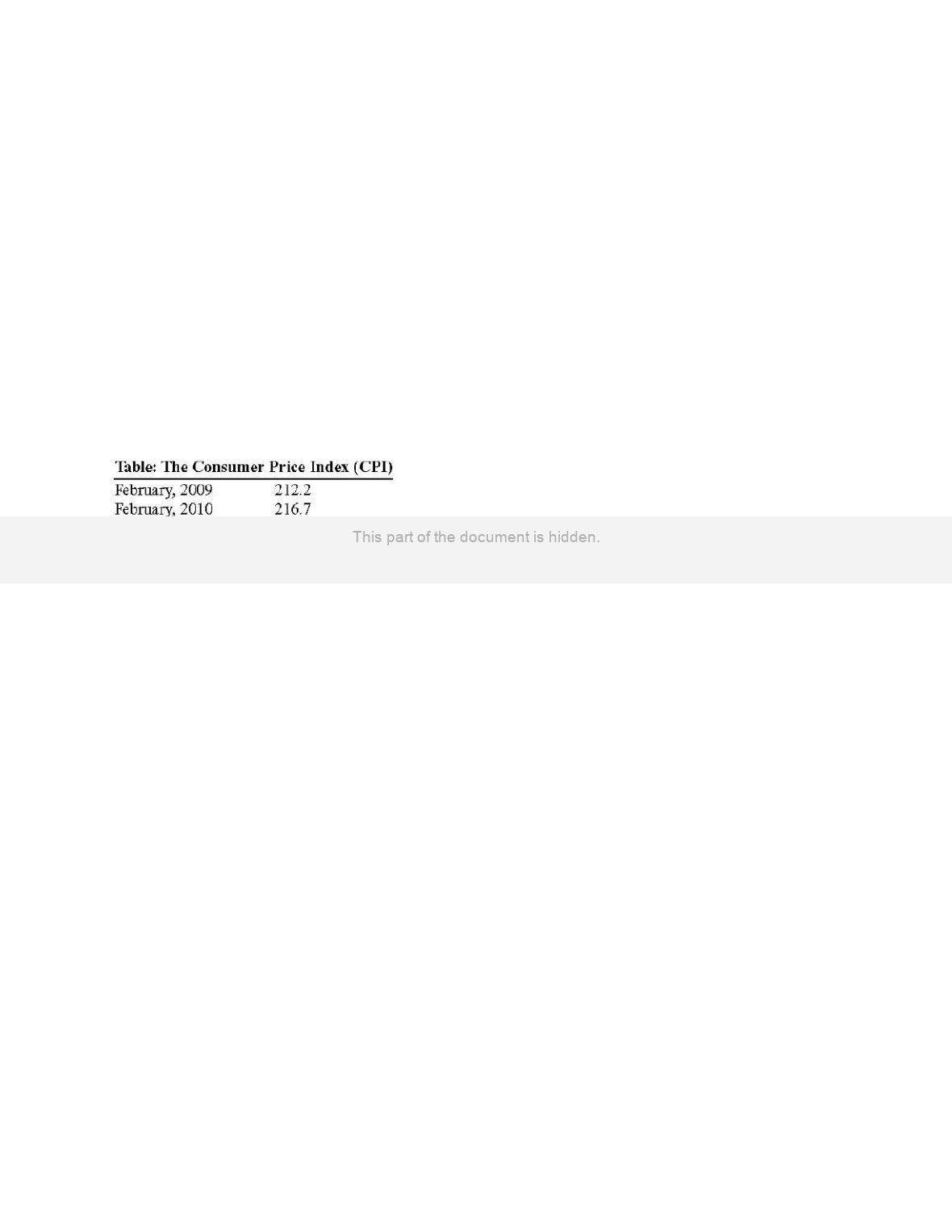
(Table: The Consumer Price Index (CPI)) Use Table: The Consumer Price Index (CPI).
The inflation rate between 2011 and 2012 was _____%.
A)
10
B)
3.7
C)
1.4
D)
24.6
183.
(Table: The Consumer Price Index (CPI)) Use Table: The Consumer Price Index (CPI).
The consumer price index in 2009 was 212.2. In 2010, it was 216.7. What was the rate
of inflation from 2009 to 2010?
A)
12.2%
B)
4.5%
C)
2.1%
D)
16.7%
Page 37
184.
The consumer price index in 1979 was 72.6. In 1980, it was 82.4. What was the rate of
inflation from 1979 to 1980?
A)
13.5%
B)
11.89%
C)
17.6%
D)
9.8%
185.
Shoe-leather costs are the:
A)
effect of inflation on the prices of food, clothes, and other necessities.
B)
increased cost of transactions due to inflation.
C)
high price of leather goods.
D)
effect of inflation on transportation costs.
186.
Which example is a LIKELY response to inflation?
A)
People choose to carry higher money balances.
B)
People tend to make fewer transactions.
C)
People tend to make more transactions.
D)
People tend to hold on to fewer interest-bearing assets.
187.
When hyperinflation forces Emily to visit her bank very frequently to keep her cash
holdings to a minimum, economists say that Emily has a:
A)
shoe-leather cost.
B)
menu cost.
C)
unit-of-account cost.
D)
Fisher effect.
188.
The introduction of ATMs reduced the:
A)
menu costs of inflation.
B)
shoe-leather costs of inflation.
C)
unit-of-account costs of inflation.
D)
amount of seigniorage.
189.
Shoe-leather costs are the costs of:
A)
the raw material used in production.
B)
the increased number of transactions as inflation increases.
C)
living adjustments as inflation increases.
D)
having to change prices as inflation increases.
Page 38
190.
The costs that arise from the way inflation makes money a less reliable unit of
measurement are:
A)
shoe-leather costs.
B)
menu costs.
C)
unit-of-account costs.
D)
medium of exchange costs.
191.
When hyperinflation forces Pedro to change the price stickers on the books in his
bookstore very frequently to keep up with the aggregate price level, economists say that
Pedro has a:
A)
shoe-leather cost.
B)
menu cost.
C)
unit-of-account cost.
D)
debt deflation.
192.
Suppose that a country has a progressive income tax code and taxable income is
calculated in nominal terms, but the schedule of income tax rates is NOT indexed to
inflation. An individual whose income keeps up with inflation over time will pay:
A)
a lower rate of the alternative minimum tax.
B)
a lower percentage of income in taxes over time.
C)
the same percentage of income in taxes over time.
D)
a higher percentage of income in taxes over time.
193.
The inflation rate is the:
A)
price level in the current year minus the price level in the previous year.
B)
price level in the current year plus the price level in the previous year.
C)
percentage change in the price level from one year to the next.
D)
price level in the current year multiplied by the price level in the previous year.
194.
Since 1960 in the United States, the price level has:
A)
fluctuated randomly by large amounts.
B)
remained the same.
C)
decreased.
D)
increased.
195.
Since 1960 in the United States, the rate of inflation has:
A)
fluctuated.
B)
remained the same.
C)
decreased.
D)
increased.

Page 39
196.
Since the 1960s, the U.S. price level has _____ and the inflation rate has _____.
A)
remained constant; increased
B)
increased; fluctuated
C)
decreased; decreased
D)
fluctuated; remained constant
197.
(Table: Price Levels) Use Table: Price Levels. What is the rate of inflation from 2011 to
2012?
A)
0%
B)
2.9%
C)
4.5%
D)
6.4%
198.
(Table: Price Levels) Use Table: Price Levels. What is the rate of inflation from 2012 to
2013?
A)
6.4%
B)
4.5%
C)
2.9%
D)
2.0%
199.
(Table: Price Levels) Use Table: Price Levels. What is the rate of inflation from 2013 to
2014?
A)
1.1%
B)
2.6%
C)
2.9%
D)
2.0%
200.
Unit-of-account costs of inflation are the:
A)
costs associated with money not being a reliable unit of measurement.
B)
costs of transactions associated with avoiding the inflation tax.
C)
costs associated with businesses changing prices.
D)
transfers the government gets from printing money.

Page 40
201.
Menu costs of inflation are the:
A)
costs associated with money not being a reliable unit of measurement.
B)
costs of transactions associated with avoiding the inflation tax.
C)
costs associated with businesses changing prices.
D)
revenue the government gets from printing money.
202.
Costs of inflation do NOT include _____ costs.
A)
menu
B)
shoe-leather
C)
unit-of-account
D)
efficiency-wage
203.
Menu costs refer to the increased cost of:
A)
food in a time of inflation.
B)
eating out when inflation increases.
C)
changing listed prices.
D)
the minimum wage.
204.
Unit-of-account costs refer to the:
A)
increase in prices during inflation.
B)
decrease in the value of money during inflation.
C)
loss of the reliability of money as a relative unit of measurement.
D)
increased costs of servicing bank accounts during inflation.
205.
Menu costs are the:
A)
costs of money becoming less reliable.
B)
real costs of changing listed prices.
C)
increase in the transaction costs caused by inflation.
D)
adjustments to the cost of living.
206.
During rapid price inflation, firms must frequently change prices. The cost of changing
listed prices is known as the _____ cost.
A)
menu
B)
real interest rate
C)
shoe-leather
D)
unit-of-account