
Page 41
Use the following to answer questions 207-209:
207.
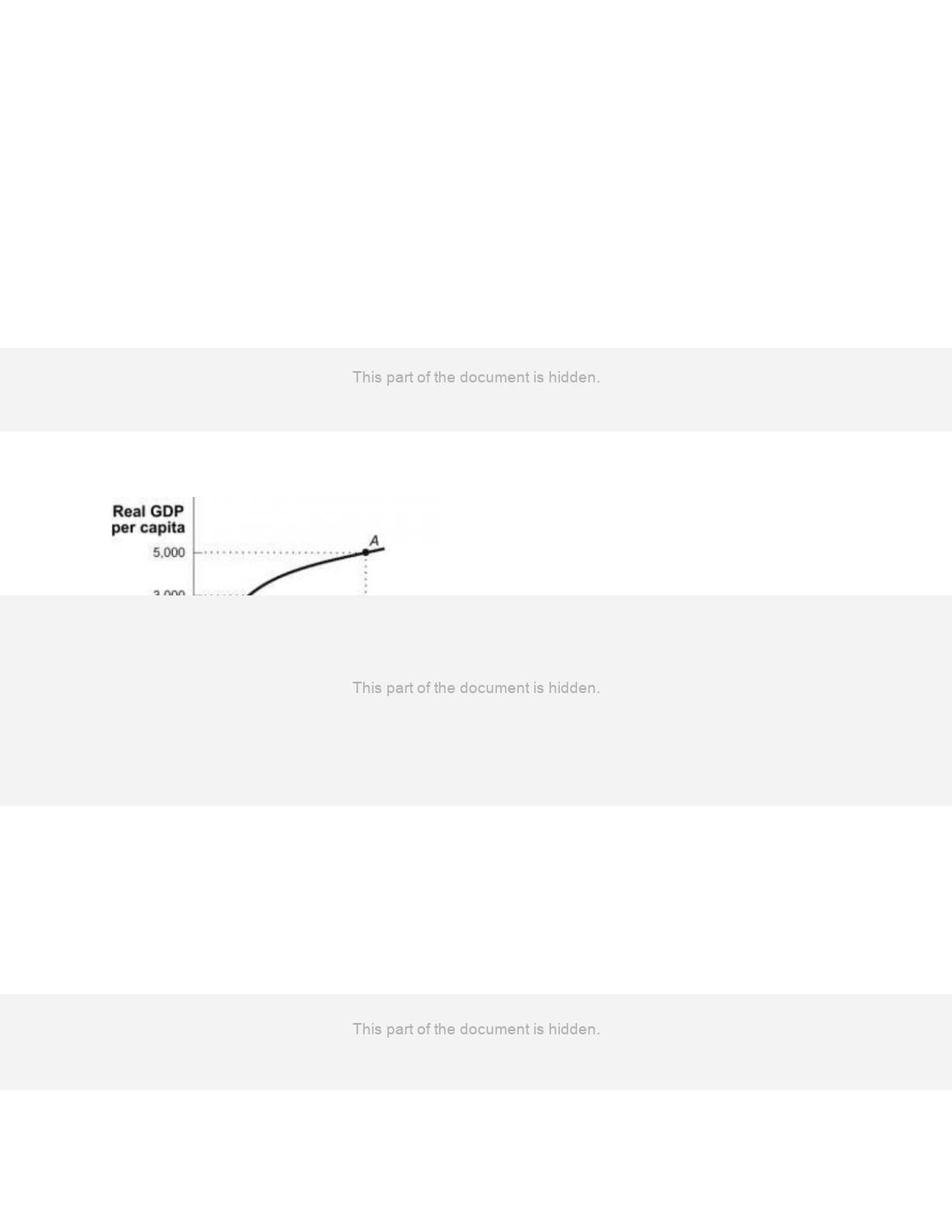
(Figure: Technological Progress and Productivity Growth) Use Figure: Technological
Progress and Productivity Growth. Which change in real GDP is MOST likely to have
resulted from an increase in the quality (as well as quantity) of government spending on
education?
A)
A to B
B)
B to A
C)
B to C
D)
C to B
208.
(Figure: Technological Progress and Productivity Growth) Use Figure: Technological
Progress and Productivity Growth. Which change in real GDP is MOST likely to have
resulted from an increase in the quality (as well as quantity) of public health measures?
A)
A to B
B)
B to C
C)
B to A
D)
C to B

Page 42
209.
(Figure: Technological Progress and Productivity Growth) Use Figure: Technological
Progress and Productivity Growth. Which change in real GDP is MOST likely to have
resulted from a gradual decline in property rights because of excessive government
intervention?
A)
A to B
B)
B to C
C)
C to B
D)
C to A
210.
South Korea has real GDP per capita of $25,000, while England has real GDP per capita
of $50,000. If real GDP per capita in South Korea grows at 7% and England’s real GDP
per capita grows at 3.5%, how long will it take for real GDP per capita in the two
nations to converge?
A)
10 years
B)
20 years
C)
25 years
D)
35 years
211.
Sweden has real GDP per capita of $50,000, while Chile has real GDP per capita of
$25,000. If real GDP per capita in Sweden grows at 2% and Chile’s real GDP per capita
grows at 4%, how long will it take for real GDP per capita in the two nations to
converge?
A)
10 years
B)
20 years
C)
25 years
D)
35 years
212.
Suppose that South Korea is growing at 7% per year and is producing real GDP per
capita of about $28,000, while Norway is growing at 3.5% per year and is producing
real GDP per capita of $56,000. If all else stays equal, the real GDP per capita for these
two countries will converge in _____ years.
A)
40
B)
20
C)
10
D)
4
213.
More than 50% of the world’s population lives in countries whose population is poorer
than the United States population was a century ago.
A)
True
B)
False
Page 43
214.
As a result of the long-term growth between 1900 and 2010, the output per person in the
United States was about twice as large in 2010 as it was in 1900.
A)
True
B)
False
215.
According to the rule of 70, a 10% annual increase in real GDP would lead to a
doubling of real GDP in seven years.
A)
True
B)
False
216.
If an economy has a real GDP per capita growth rate of 2%, it will take 14 years for
GDP per capita to double.
A)
True
B)
False
217.
If an economy doubles its growth rate in per capita GDP over 14 years, then the growth
rate in per capita GDP averaged 5% per year.
A)
True
B)
False
218.
A rise in real GDP that is the same as the rate of population growth leaves the average
standard of living unchanged.
A)
True
B)
False
219.
Long-run economic growth depends almost entirely on rising productivity.
A)
True
B)
False
220.
Increases in human capital will promote economic growth.
A)
True
B)
False
221.
The three main reasons that the average U.S. worker today produces far more than his or
her counterpart did a century ago are more physical capital, more human capital, and a
great deal of technological progress.
A)
True
B)
False
Page 44
222.
If technology improves, then it takes more inputs to produce the same output as the last
period.
A)
True
B)
False
223.
Physical capital consists of man-made resources like machines and buildings.
A)
True
B)
False
224.
The aggregate production function typically increases at an increasing rate with
additions to capital.
A)
True
B)
False
225.
Diminishing returns to physical capital means that, as more and more physical capital is
added to fixed amounts of human capital with a fixed technology, eventually real GDP
per worker declines.
A)
True
B)
False
226.
According to estimates of the aggregate production function, each 1% increase in
physical capital, holding human capital and technology constant, raises labor
productivity by 0.33%.
A)
True
B)
False
227.
Growth accounting estimates the contribution of each major factor in the aggregate
production function to economic growth.
A)
True
B)
False
228.
The aggregate production function exhibits diminishing returns to labor but not to
physical capital.
A)
True
B)
False

Page 45
229.
The aggregate production function shows how productivity depends on natural
resources and financial capital.
A)
True
B)
False
230.
Growth accounting is a fast-growing industry that assists taxpayers in filing their taxes
online.
A)
True
B)
False
231.
Growth accounting estimates the contribution to economic growth of each factor in the
aggregate production function.
A)
True
B)
False
232.
Total factor productivity is the amount of output that can be achieved with a given
amount of factor inputs.
A)
True
B)
False
233.
In 1798, the English economist Thomas Malthus predicted that a growing population
and a fixed supply of land would eventually cause productivity to fall.
A)
True
B)
False
234.
Malthus’s predictions have proved to be true, and they explain why U.S. productivity
growth slowed between the 1970s and the mid-1990s.
A)
True
B)
False
235.
Malthus’s predictions have proved to be false because the negative effects on
productivity of population growth have been outweighed by advances in technology and
increases in both human and physical capital.
A)
True
B)
False
Page 46
236.
Most of the rapidly growing Asian nations, though poor, have increased their
productivity by providing a very good basic education for their citizens.
A)
True
B)
False
237.
Research and development is what we call spending to develop and implement new
technologies.
A)
True
B)
False
238.
In 1820, Mexico had a somewhat higher real GDP per capita than did Japan, but today
Japan’s is higher than Mexico’s.
A)
True
B)
False
239.
In 2015, the United States spent 38% of its GDP on investment, while China spent only
16% of its GDP on investment.
A)
True
B)
False
240.
Sources of funds for investment spending include both foreign and domestic savings.
A)
True
B)
False
241.
The average level of education, measured by the number of years the average adult has
spent in school, is higher in Argentina than it is in China.
A)
True
B)
False
242.
Research and development is defined as spending to develop and implement new
technologies.
A)
True
B)
False
243.
An example of a public good that encourages economic growth is public health services,
such as vaccinations.
A)
True
B)
False

Page 47
244.
To encourage an increase in economic growth rates, governments should increase
regulation of the economy.
A)
True
B)
False
245.
The convergence hypothesis says that international differences in real GDP per capita
tend to increase over time.
A)
True
B)
False
246.
According to the convergence hypothesis, differences in GDP per capita among
countries tend to narrow over time because countries that start with a lower real GDP
per capita tend to have negative growth rates.
A)
True
B)
False
247.
According to the convergence hypothesis, differences in GDP per capita among
countries tend to narrow over time because countries that start with a lower real GDP
per capita tend to have higher growth rates.
A)
True
B)
False
248.
High rates of savings and investment and a lack of consumption spending have
contributed to the recent stagnant economic growth in Latin America.
A)
True
B)
False
249.
One factor contributing to a slow rate of economic growth in Latin America is that
broad basic education has been underemphasized in most countries.
A)
True
B)
False
250.
In the 1980s, many economists believed that one problem in Latin America was a lack
of government intervention in markets and recommended that the government seize
ownership of many struggling companies.
A)
True
B)
False
Page 48
251.
Having achieved sustained rapid growth, Chile is an exception to the disappointing slow
economic growth among most other Latin American nations.
A)
True
B)
False
252.
According to Jeff Sachs of Columbia University, Africa is politically unstable because it
is poor and not the other way around.
A)
True
B)
False
253.
Between 1980 and 1994, growth rates of real GDP per capita in sub-Saharan Africa
ranged from 20% to 30%.
A)
True
B)
False
254.
Between 1980 and 1994, growth rates of real GDP per capita in sub-Saharan Africa fell
by more than 10%.
A)
True
B)
False
255.
According to the convergence hypothesis, the richest countries have the fastest growth
rate of real GDP per capita.
A)
True
B)
False
256.
According to the convergence hypothesis, the poorest countries have the fastest growth
rate of real GDP per capita.
A)
True
B)
False
257.
Because the gap in real GDP per capita between Western Europe, North America, and
parts of Asia is widening, the convergence hypothesis is wrong.
A)
True
B)
False
Page 49
258.
According to conditional convergence, the real GDP per capita of poor nations will
never catch up to that of wealthy nations because of the condition of the military in poor
nations.
A)
True
B)
False
259.
Conditional convergence suggests that if adjustments were made for differences in
education, infrastructure, and other factors that contribute to growth, poorer countries
would have higher growth rates.
A)
True
B)
False
260.
Sustainable long-run economic growth is long-run growth that can continue in the face
of decreases in the growth rate of the world’s population.
A)
True
B)
False
261.
Sustainable long-run economic growth can continue in the face of the limited supplies
of natural resources and the impact of growth on the environment.
A)
True
B)
False
262.
Between 1990 and 2005, the price of oil was high relative to prices in the 1970s and
1980s, and consumers responded by buying small, fuel-efficient cars.
A)
True
B)
False
263.
Between 1990 and 2005, the price of oil was low relative to prices in the 1970s and
1980s, and consumers responded by buying large, fuel-inefficient vehicles.
A)
True
B)
False
264.
After the price of oil increased in the 1970s, the growth rate of the United States
declined substantially.
A)
True
B)
False
Page 50
265.
A negative externality is a good or a service that the government or a private business
provides to a foreign country.
A)
True
B)
False
266.
A negative externality is a cost that individuals or firms impose on others without
having to pay compensation.
A)
True
B)
False
267.
Greenhouse gas emissions are an example of a negative externality.
A)
True
B)
False
268.
Carbon taxes and cap and trade systems are market-based incentives that are likely to be
effective in limiting greenhouse gas emissions.
A)
True
B)
False
269.
The purpose of a cap and trade system is to encourage trade between countries by
limiting the amount of tariffs that can be imposed on traded goods.
A)
True
B)
False
270.
A cap and trade system limits, or caps, the total amount of a negative externality, and
producers must buy licenses to generate that externality.
A)
True
B)
False
271.
When tracking economic growth, why do economists prefer real GDP per capita over:
a. real GDP?
b. nominal GDP per capita?
272.
A nation’s real GDP per capita increased from $250 billion to $275 billion in one year.
Calculate the nation’s growth rate.

Page 51
273.
A nation’s real GDP increased from $250 billion to $265 billion in one year. In that
same year, the nation’s population increased from 125 million to 130 million. Calculate
the nation’s real GDP per capita growth rate.
274.
A nation’s real GDP increased from $225 billion to $230 billion in one year. In that
same year, the nation’s population increased from 125 million to 126 million.
a. Calculate the nation’s real GDP per capita growth rate.
b. If this nation maintained this growth rate, how many years would it take for real GDP
per capita to double?
Use the following to answer question 275:
275.
(Figure: The Aggregate Production Function) Use Figure: The Aggregate Production
Function. Does it exhibit diminishing returns to physical capital? Explain.
276.
Suppose that country A has a domestic savings rate of 3%, while country B has a
savings rate of 8%. Which country is likely to have the higher rate of economic growth?
Why?
277.
Two politicians are debating the best ways to spur long-term growth in the nation’s real
GDP per capita. Candidate X says we should lower income taxes so that households
have more money to spend on goods and services. Candidate Y says we should lower
taxes on interest income so that households have more incentive to save. Which
candidate has the right idea?
Page 52
278.
Many impoverished nations struggle with diseases like malaria. How would reduction or
elimination of malaria contribute to long-run economic growth?
279.
Fifty years ago, East Asia, Latin America, and Africa were all relatively poor areas.
Why did East Asia have fairly rapid growth in real GDP per capita, while economic
growth in Latin America and Africa was generally low?
280.
Suppose that fossil fuels become much scarcer in the next 50 years. With a growing
global demand for energy and the looming threat of rising global temperatures, it would
seem to be a recipe for a dramatic decrease in the growth rate of economic activity. Why
do many economists believe that economies can continue to grow, even in the face of
resource scarcity?
Use the following to answer questions 281-282:
281.
(Figure: Nations A and B) Use Figure: Nations A and B. Suppose that, in 1960, each
nation had $100 of physical capital for each worker and in 2010 each nation had $400 of
physical capital per worker. Compute the growth of real GDP per capita for both
nations.
282.
(Figure: Nations A and B) Use Figure: Nations A and B. Suppose that, in 1960, each
nation had $100 of physical capital for each worker and in 2010 each nation had $400 of
physical capital per worker. Clearly, in both 1960 and in 2010, nation A was producing
more real output per capita with the same amount of physical capital per worker. What
could explain the difference in these aggregate production functions?