Page 1
Name: __________________________ Date: _____________
1.
The changes in the economy of Finland in 2016 provide an example of:
A)
the risk associated with an agricultural economy.
B)
illustrating the way booms and busts happen for the economy as a whole.
C)
how public assistance programs can stimulate the economy.
D)
the benefits of government budget surpluses.
2.
The economy of Finland experienced a setback in 2016 because:
A)
of the advent of digital technology.
B)
a drop in the price of oil.
C)
of poor business practices at Nokia.
D)
of climate change.
3.
The main reasons that retail sales fell in Finland during 2016 were:
A)
a decrease in imports and declining sales at Nokia, which led to reduced household
incomes.
B)
an increase in imports and declining sales at Nokia, which led to reduced
household incomes.
C)
an increase in exports and rising sales at Nokia, which led to reduced household
incomes.
D)
a decrease in exports and declining sales at Nokia, which led to reduced household
incomes.
4.
The decline in the Finnish economy of 2016 is primarily an example of how:
A)
too much government regulation is harmful to the economy.
B)
changes in consumer spending can be multiplied through the entire economy.
C)
immigration affects local economies.
D)
high tax rates can decrease economic activity in an area.
5.
The marginal propensity to consume is:
A)
increasing if the marginal propensity to save is increasing.
B)
the proportion of total disposable income that the average family saves.
C)
the change in consumer spending divided by the change in aggregate disposable
income.
D)
the change in consumer spending minus the change in aggregate disposable
income.
Page 2
6.
The marginal propensity to consume equals the:
A)
proportion of consumer spending as a function of aggregate disposable income.
B)
change in savings divided by the change in aggregate disposable income.
C)
ratio of the change in consumer spending to the change in aggregate disposable
income.
D)
change in savings divided by the change in consumer spending.
7.
The marginal propensity to save plus the marginal propensity to consume must equal:
A)
zero.
B)
one.
C)
income.
D)
savings.
8.
If the MPS = 0.1, then the multiplier equals:
A)
1.
B)
5.
C)
9.
D)
10.
9.
If the multiplier equals 4, then the marginal propensity to save must be equal to:
A)
0.25.
B)
0.5.
C)
0.75.
D)
the marginal propensity to consume.
10.
Suppose that the marginal propensity to consume is 0.8 and investment spending
increases by $100 billion. The increase in real GDP is:
A)
$100 billion, the same amount as investment spending.
B)
$125 billion, composed of $100 billion in investment spending and $25 billion in
consumption.
C)
$80 billion, composed of $100 billion in investment spending and a decrease in
consumption of $20 billion.
D)
$500 billion, composed of $100 billion in investment spending and $400 billion in
consumption.
11.
If the marginal propensity to save is 0.3, the size of the multiplier is:
A)
3.3.
B)
2.3.
C)
1.3.
D)
0.7.
Page 3
12.
The marginal propensity to save is:
A)
savings divided by aggregate income.
B)
the fraction of an additional dollar of disposable income that is saved.
C)
1 + MPC.
D)
savings divided by aggregate income, or 1 + MPC.
13.
The multiplier is:
A)
1 / (1 – MPC).
B)
MPS / MPC.
C)
1 / (MPC).
D)
1(1 + MPC).
14.
If the marginal propensity to consume is 0.8, then the multiplier is:
A)
4.
B)
5.
C)
8.
D)
10.
15.
The marginal propensity to consume (MPC) equals the change in _____ divided by the
change in _____.
A)
consumer spending; disposable income
B)
consumer spending; investment spending
C)
consumer spending; gross domestic product
D)
disposable income; consumer spending
16.
If disposable income increases by $5 billion and consumer spending increases by $4
billion, the marginal propensity to consume equals:
A)
20.
B)
0.8.
C)
1.25.
D)
9.
17.
Suppose the marginal propensity to consume equals 0.9 and investment spending
increases by $50 billion. Assuming no taxes and no trade, real GDP will _____ by
_____.
A)
increase; $450 billion
B)
increase; $90 billion
C)
increase; $500 billion
D)
decrease; $500 billion

Page 4
18.
Assuming no taxes and no trade, the multiplier equals:
A)
MPC / MPS.
B)
1 / (1 – MPS).
C)
MPC + MPS.
D)
1 / (1 – MPC).
19.
Suppose that a financial crisis decreases investment spending by $100 billion and the
marginal propensity to consume is 0.8. Assuming no taxes and no trade, real GDP will
_____ by _____.
A)
decrease; $500 billion
B)
decrease; $200 billion
C)
decrease; $800 billion
D)
increase; $400 billion
20.
The marginal propensity to consume is the change in _____ divided by the change in
_____.
A)
savings; disposable income
B)
disposable income; consumption
C)
disposable income; savings
D)
consumption; disposable income
21.
If your disposable income increases from $10,000 to $15,000 and your consumption
increases from $9,000 to $12,000, your marginal propensity to consume is:
A)
0.2.
B)
0.4.
C)
0.6.
D)
0.8.
22.
If your disposable personal income increases from $10,000 to $15,000 and your
consumption increases from $9,000 to $13,000, your marginal propensity to consume is:
A)
0.2.
B)
0.4.
C)
0.6.
D)
0.8.
Page 5
23.
The marginal propensity to consume plus the marginal propensity to save must:
A)
equal each other.
B)
equal 1.
C)
be less than 1.
D)
be greater than 1.
24.
The value of the marginal propensity to consume is:
A)
1.
B)
greater than 1.
C)
between 0 and 1.
D)
less than 0 and greater than -1.
25.
An increase in the marginal propensity to consume:
A)
increases the multiplier.
B)
shifts the autonomous investment line upward.
C)
decreases the multiplier.
D)
shifts the autonomous investment line downward.
26.
Which formula MOST accurately depicts the expenditure multiplier?
A)
1/(1– MPS)
B)
1/(MPC – 1)
C)
1/(1 – MPC)
D)
1/(1 + MPC)
27.
If MPC = 0.9, the multiplier is:
A)
10.
B)
90.
C)
9.
D)
1.
28.
The _____ the _____, the _____ the multiplier.
A)
smaller; level of wealth; bigger
B)
bigger; marginal propensity to save; bigger
C)
bigger; marginal propensity to consume; smaller
D)
bigger; marginal propensity to consume; bigger

Page 6
29.
Suppose that investment spending increases by $50 billion and as a result the
equilibrium income increases by $200 billion. The investment multiplier is:
A)
8.
B)
10.
C)
4.
D)
0.25.
30.
Suppose that investment spending increases by $50 billion and as a result the
equilibrium income increases by $200 billion. The value of the marginal propensity to
consume is:
A)
0.8.
B)
0.4.
C)
0.75.
D)
4.
31.
If the multiplier is 4 and investment spending falls by $100 billion, the change in real
GDP will be:
A)
–$400 billion.
B)
$400 billion.
C)
$25 billion.
D)
–$25 billion.
32.
Suppose that the government increases spending by $100 billion as a stimulus package.
If the marginal propensity to consume is 0.6, then real GDP will:
A)
decrease by $250 billion.
B)
increase by $250 billion.
C)
increase by $600 billion.
D)
decrease by $400 billion.
33.
Suppose that the U.S. economy is in a severe recession. Most households are trying to
save more of their income than before. This increase in private savings will lead to:
A)
an increase in real GDP, as more savings means more funds for business
investment.
B)
a fall in real GDP, as more savings means people will spend less.
C)
no change in real GDP, because there is no savings multiplier.
D)
an increase in real GDP, as an increase in savings will make people wealthier.
Page 7
34.
If the marginal propensity to save is small, it will:
A)
make the multiplier smaller.
B)
make the multiplier larger.
C)
not affect the value of the multiplier.
D)
increase the interest rate.
35.
The marginal propensity to consume is the increase in consumer spending when _____
increase(s) by $1.
A)
investment spending
B)
taxes
C)
disposable income
D)
savings
36.
The marginal propensity to save is the increase in household savings when _____
increase(s) by $1.
A)
investment spending
B)
taxes
C)
consumption
D)
disposable income
37.
In a simple, closed economy (no government or foreign sector), if disposable income
increases by $100 and $70 is consumed, _____ is saved.
A)
$30
B)
$70
C)
$100
D)
$170
38.
In a simple, closed economy (no government or foreign sector), if disposable income
increases by $100 and $30 is saved, _____ is consumed.
A)
$30
B)
$70
C)
$100
D)
$170
39.
A $50 million increase in investment spending will eventually cause equilibrium real
GDP to:
A)
decrease by $50 million.
B)
increase by $50 million.
C)
increase by more than $50 million.
D)
increase by less than $50 million.
Page 8
40.
A $70 million decrease in investment spending will cause real GDP to:
A)
decrease by $70 million.
B)
increase by $70 million.
C)
decrease by less than $70 million.
D)
decrease by more than $70 million.
41.
An initial change in the desired level of spending by firms, households, or government
at a given level of real GDP is a(n):
A)
autonomous change in aggregate spending.
B)
multiplier-induced change in spending.
C)
endogenous spending.
D)
budget surplus.
42.
In a simple, closed economy (no government or foreign sector), if the marginal
propensity to save is 0.2, the marginal propensity to consume must be:
A)
0.2.
B)
0.8.
C)
1.2.
D)
0.16.
43.
In a simple, closed economy (no government or foreign sector), if the marginal
propensity to consume is 0.7, the marginal propensity to save must be:
A)
1.7.
B)
0.7.
C)
0.3.
D)
0.21.
44.
In a simple, closed economy (no government or foreign sector), if the marginal
propensity to consume increases, the marginal propensity to save will:
A)
increase.
B)
decrease.
C)
remain constant.
D)
fluctuate randomly.

Page 9
45.
In a simple, closed economy (no government or foreign sector), if the marginal
propensity to save decreases, the marginal propensity to consume will:
A)
increase.
B)
decrease.
C)
remain constant.
D)
fluctuate randomly.
46.
In a simple, closed economy (no government or foreign sector), if disposable income
increases by $1,000 and consumption increases by $600, the marginal propensity to
consume is:
A)
$600.
B)
$400.
C)
1.67.
D)
0.60.
47.
In a simple, closed economy (no government or foreign sector), if disposable income
increases by $1,000 and consumption increases by $600, the marginal propensity to save
is:
A)
$600.
B)
$400.
C)
2.5.
D)
0.40.
48.
In a simple, closed economy (no government or foreign sector), if disposable income
increases by $1,000 and consumption increases by $600, the multiplier is:
A)
$600.
B)
0.6.
C)
2.5.
D)
0.40.
49.
In a simple, closed economy (no government or foreign sector), disposable income
increases from $2,000 to $3,000. If consumption increases from $1,500 to $2,100, the
marginal propensity to consume is:
A)
$600.
B)
0.71.
C)
0.60.
D)
0.50.
Page 10
50.
In a simple, closed economy (no government or foreign sector), disposable income
increases from $2,000 to $3,000. If consumption increases from $1,500 to $2,100, the
marginal propensity to save is:
A)
$600.
B)
$400.
C)
0.80.
D)
0.40.
51.
In a simple, closed economy (no government or foreign sector), disposable income
increases from $2,000 to $3,000. If consumption increases from $1,500 to $2,100, the
multiplier is:
A)
6.
B)
2.5.
C)
0.60.
D)
0.40.
52.
In a simple, closed economy (no government or foreign sector), disposable income
decreases from $6,000 to $4,000. If consumption decreases from $4,500 to $3,000, the
marginal propensity to consume is:
A)
–0.75.
B)
–0.20.
C)
0.75.
D)
1.
53.
In a simple, closed economy (no government or foreign sector), disposable income
decreases from $6,000 to $4,000. If consumption decreases from $4,500 to $3,000, the
marginal propensity to save is:
A)
0.25.
B)
–0.25.
C)
1.125.
D)
0.75.
54.
In a simple, closed economy (no government or foreign sector), disposable income
decreases from $6,000 to $4,000. If consumption decreases from $4,500 to $3,000, the
multiplier is:
A)
0.25.
B)
4.
C)
1.125.
D)
–4.
Page 11
55.
If the marginal propensity to consume increases, the multiplier will:
A)
increase.
B)
decrease.
C)
remain constant.
D)
fluctuate randomly.
56.
If the marginal propensity to save increases, the multiplier will:
A)
increase.
B)
decrease.
C)
remain constant.
D)
fluctuate randomly.
57.
If the marginal propensity to consume is 0.8, the multiplier is:
A)
0.8.
B)
0.2.
C)
1.25.
D)
5.
58.
If the marginal propensity to consume is 0.5, the multiplier is:
A)
5.
B)
2.
C)
1.
D)
0.5.
59.
If the marginal propensity to save is 0.2, the multiplier is:
A)
0.8.
B)
0.2.
C)
1.25.
D)
5.
60.
If the marginal propensity to save is 0.5, the multiplier is:
A)
5.
B)
2.
C)
1.
D)
0.5.
Page 12
61.
If the multiplier is 4, the marginal propensity to consume is:
A)
3.
B)
0.80.
C)
0.75.
D)
0.25.
62.
If the multiplier is 4, the marginal propensity to save is:
A)
3.
B)
0.80.
C)
0.75.
D)
0.25.
63.
If the multiplier is 4 and autonomous government spending increases by $100 billion,
real GDP will:
A)
increase by $400 billion.
B)
decrease by $400 billion.
C)
increase by $100 billion.
D)
increase by $25 billion.
64.
If the multiplier is 4 and autonomous government spending decreases by $100 billion,
real GDP will:
A)
increase by $400 billion.
B)
decrease by $400 billion.
C)
increase by $100 billion.
D)
increase by $25 billion.
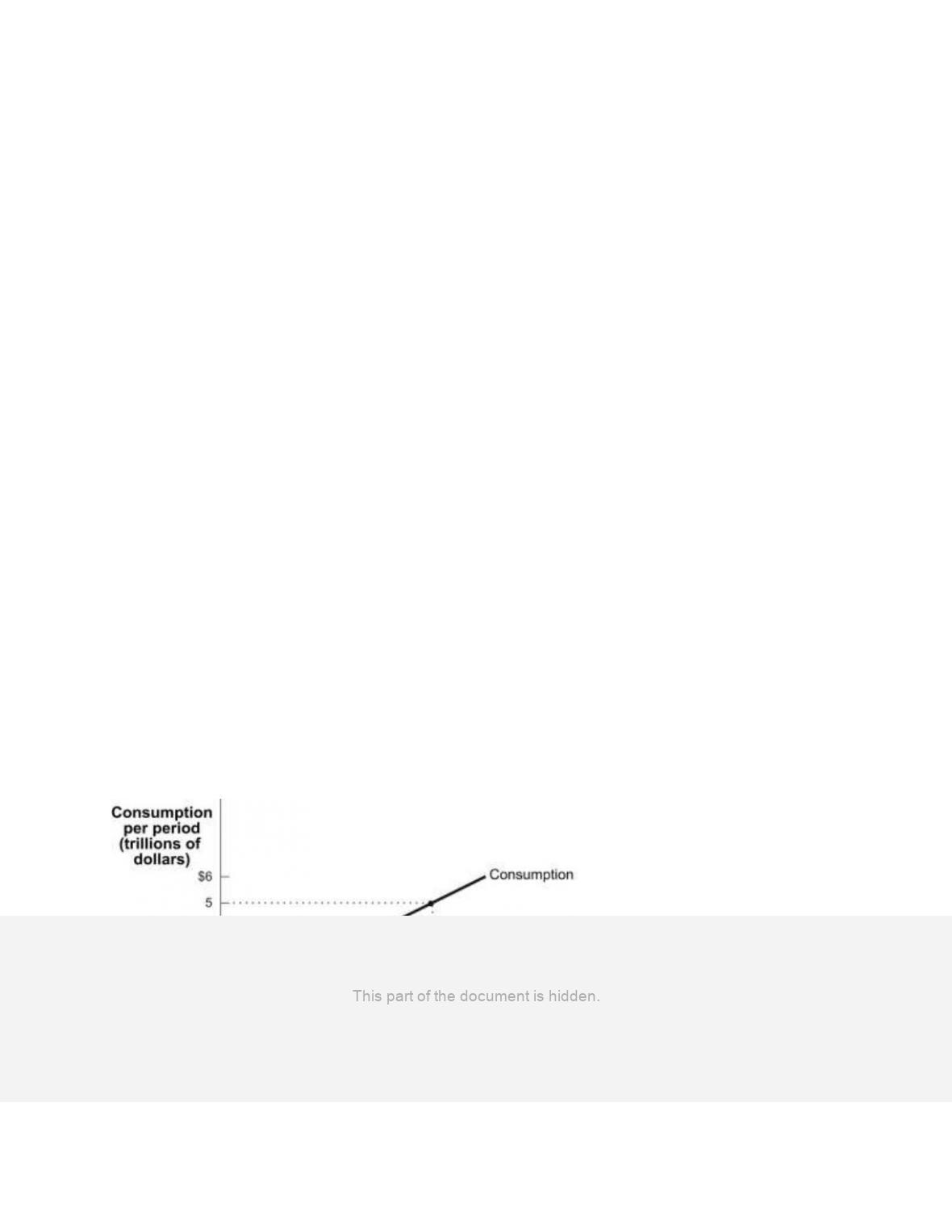
Use the following to answer questions 65-69:
Page 13
65.
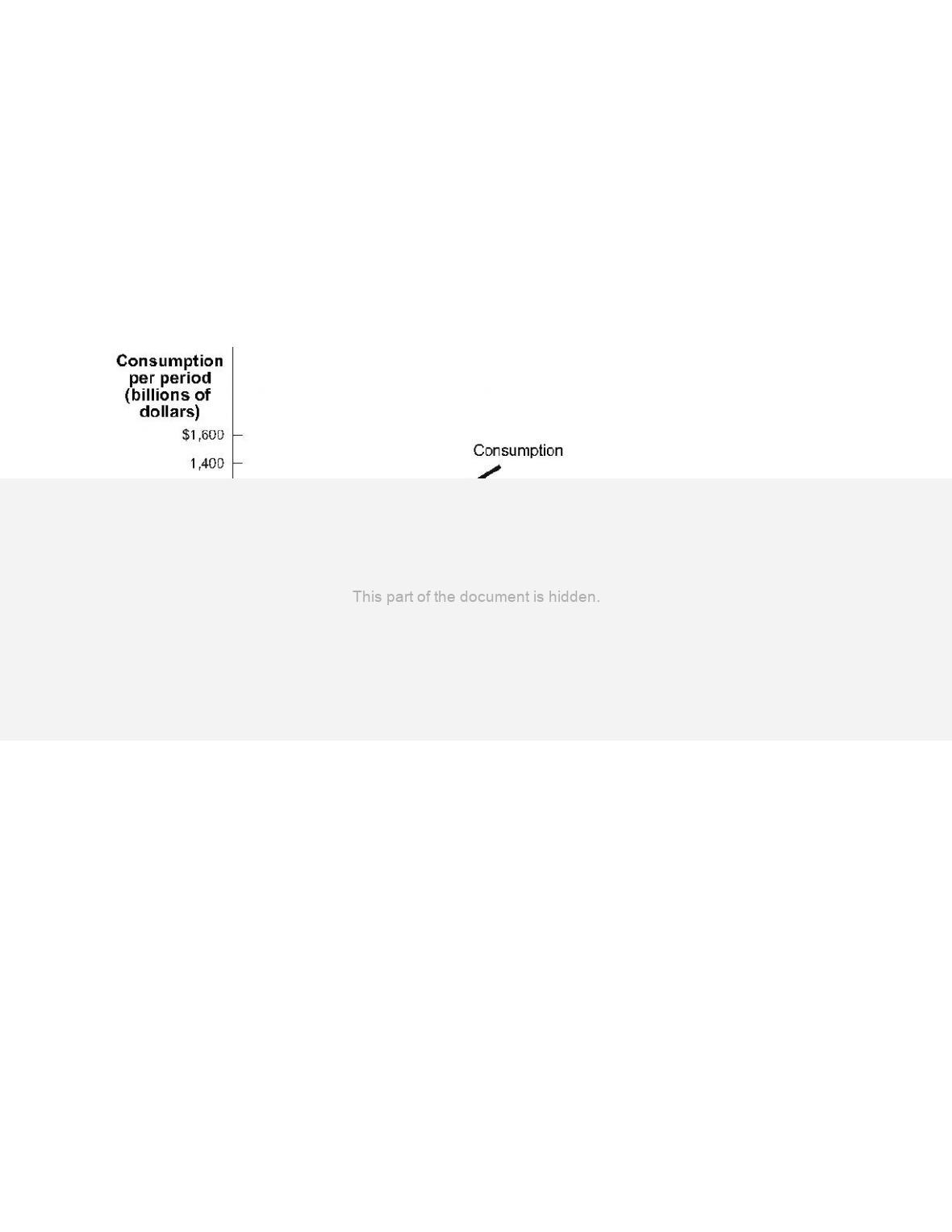
(Figure: Consumption and Real GDP) Use Figure: Consumption and Real GDP. The
slope of the consumption function is called the:
A)
marginal propensity to save.
B)
average propensity to consume.
C)
marginal propensity to consume.
D)
marginal consumption increment.
66.
(Figure: Consumption and Real GDP) Use Figure: Consumption and Real GDP. The
marginal propensity to consume is:
A)
0.
B)
0.5.
C)
1.0.
D)
2.0.
67.
(Figure: Consumption and Real GDP) Use Figure: Consumption and Real GDP. If real
GDP is $4 trillion, consumption is _____ trillion.
A)
$0.75
B)
$1
C)
$3
D)
$4
68.
(Figure: Consumption and Real GDP) Use Figure: Consumption and Real GDP. If real
GDP is $12 trillion, consumption is _____ trillion.
A)
$5
B)
$7
C)
$9
D)
$11
69.
(Figure: Consumption and Real GDP) Use Figure: Consumption and Real GDP. If real
GDP is $8 trillion, consumption is _____ trillion and savings is _____ trillion.
A)
$4; $4
B)
$5; $3
C)
$6; $2
D)
$7; $1
70.
You and a coworker have been trying to develop a linear equation that describes the
local household consumption function. Your coworker has sent you a very short email
that simply says he has finished the project and the consumption function is C = 100 +
0.75(YD). Your job is to explain this result to your supervisor. According to this
consumption function, what is the marginal propensity to consume?
A)
100
B)
0.75
C)
4
D)
0.25
71.
You and a coworker have been trying to develop a linear equation that describes the
local household consumption function. Your coworker has sent you a very short email
that simply says he has finished the project and the consumption function is C = 100 +
0.75(YD). Your job is to explain this result to your supervisor. According to this
consumption function, how much consumption spending would occur if a household
had disposable income of $1,000?
A)
$750
B)
$4,000
C)
$850
D)
$350
72.
Suppose the marginal propensity to consume changes from 0.75 to 0.9. How will this
affect the consumption function?
A)
The slope will get steeper.
B)
Autonomous consumption will increase.
C)
The function will shift downward.
D)
The slope will get steeper and autonomous consumption will increase.
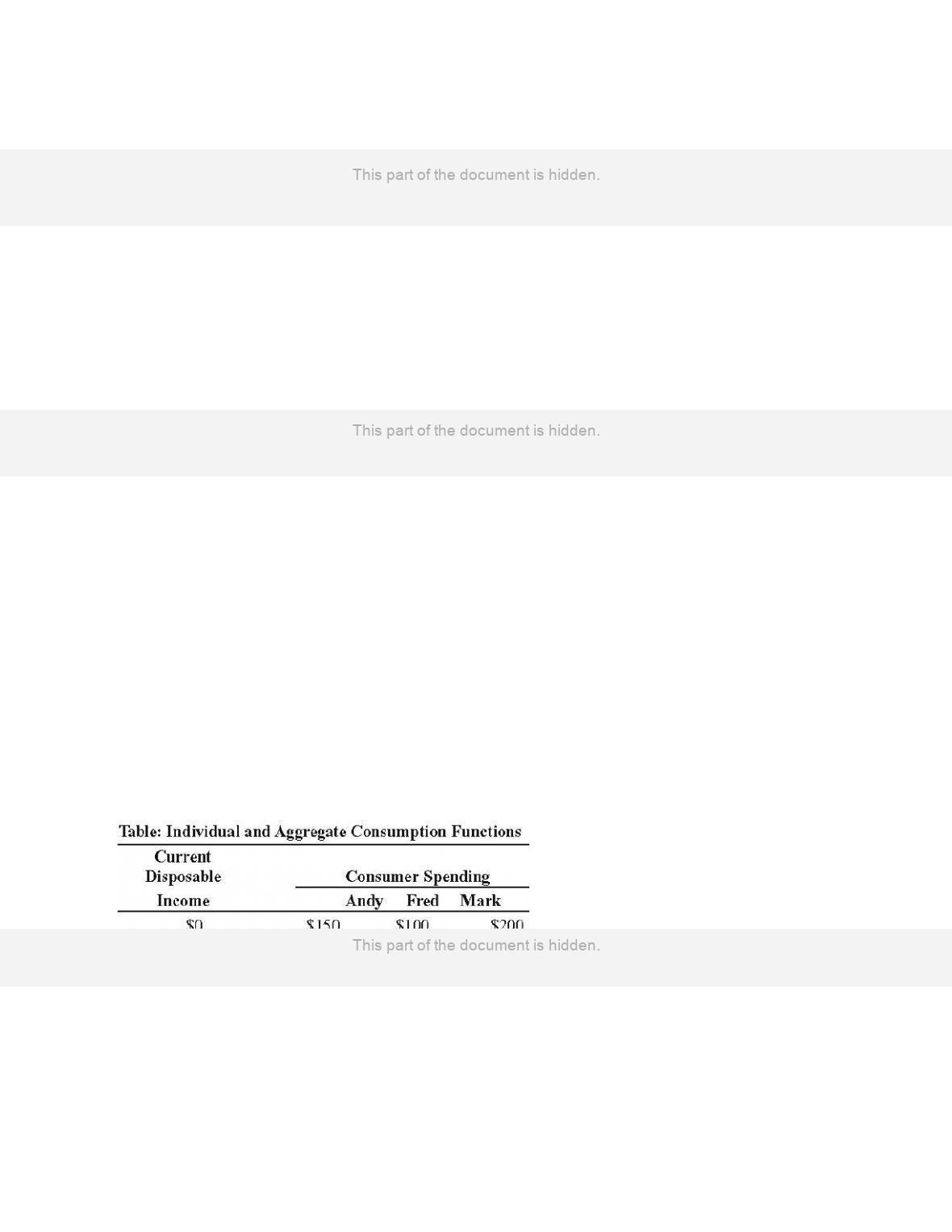
Use the following to answer questions 73-78:

Page 15
73.
(Table: Individual and Aggregate Consumption Functions) Use Table: Individual and
Aggregate Consumption Functions. Which expression represents Andy’s individual
consumption function?
A)
C = 0.15YD
B)
C = 150 + 0.5YD
C)
C = 150 + 0.8YD
D)
C = 0.95YD
74.
(Table: Individual and Aggregate Consumption Functions) Use Table: Individual and
Aggregate Consumption Functions. Which expression represents Fred’s individual
consumption function?
A)
C = 100 + 0.7YD
B)
C = 100 + 0.5YD
C)
C = 150 + 0.8YD
D)
C = 0.80YD
75.
(Table: Individual and Aggregate Consumption Functions) Use Table: Individual and
Aggregate Consumption Functions. Which expression represents Mark’s individual
consumption function?
A)
C = 200 + 1.1YD
B)
C = 450 + 0.5YD
C)
C = 0.8YD
D)
C = 200 + 0.9YD
76.
(Table: Individual and Aggregate Consumption Functions) Use Table: Individual and
Aggregate Consumption Functions. Autonomous consumption in the aggregate
consumption function is:
A)
$450.
B)
$200.
C)
$150.
D)
$100.
77.
(Table: Individual and Aggregate Consumption Functions) Use Table: Individual and
Aggregate Consumption Functions. The marginal propensity to consume in the
aggregate consumption function is:
A)
0.5.
B)
0.7.
C)
0.8.
D)
0.9.
Page 16
78.
(Table: Individual and Aggregate Consumption Functions) Use Table: Individual and
Aggregate Consumption Functions. Which of the following represents the aggregate
consumption function?
A)
C = 450 + 0.7YD
B)
C = 150 + 0.9YD
C)
C = 250 + 0.8YD
D)
C = 450 + 0.8YD
Use the following to answer questions 79-81:
79.
(Figure: Consumption and Disposable Personal Income) Use Figure: Consumption and
Disposable Personal Income. When disposable personal income is $1,200 billion,
consumption is _____ billion.
A)
$600
B)
$800
C)
$1,200
D)
$2,000
Page 17
80.
(Figure: Consumption and Disposable Personal Income) Use Figure: Consumption and
Disposable Personal Income. When disposable personal income is $2,000 billion,
consumption is _____ billion.
A)
$400
B)
$1,000
C)
$1,200
D)
$1,600
81.
(Figure: Consumption and Disposable Personal Income) Use Figure: Consumption and
Disposable Personal Income. The slope of the consumption function is:
A)
0.25.
B)
0.50.
C)
0.60.
D)
0.67.
Use the following to answer questions 82-84:
82.
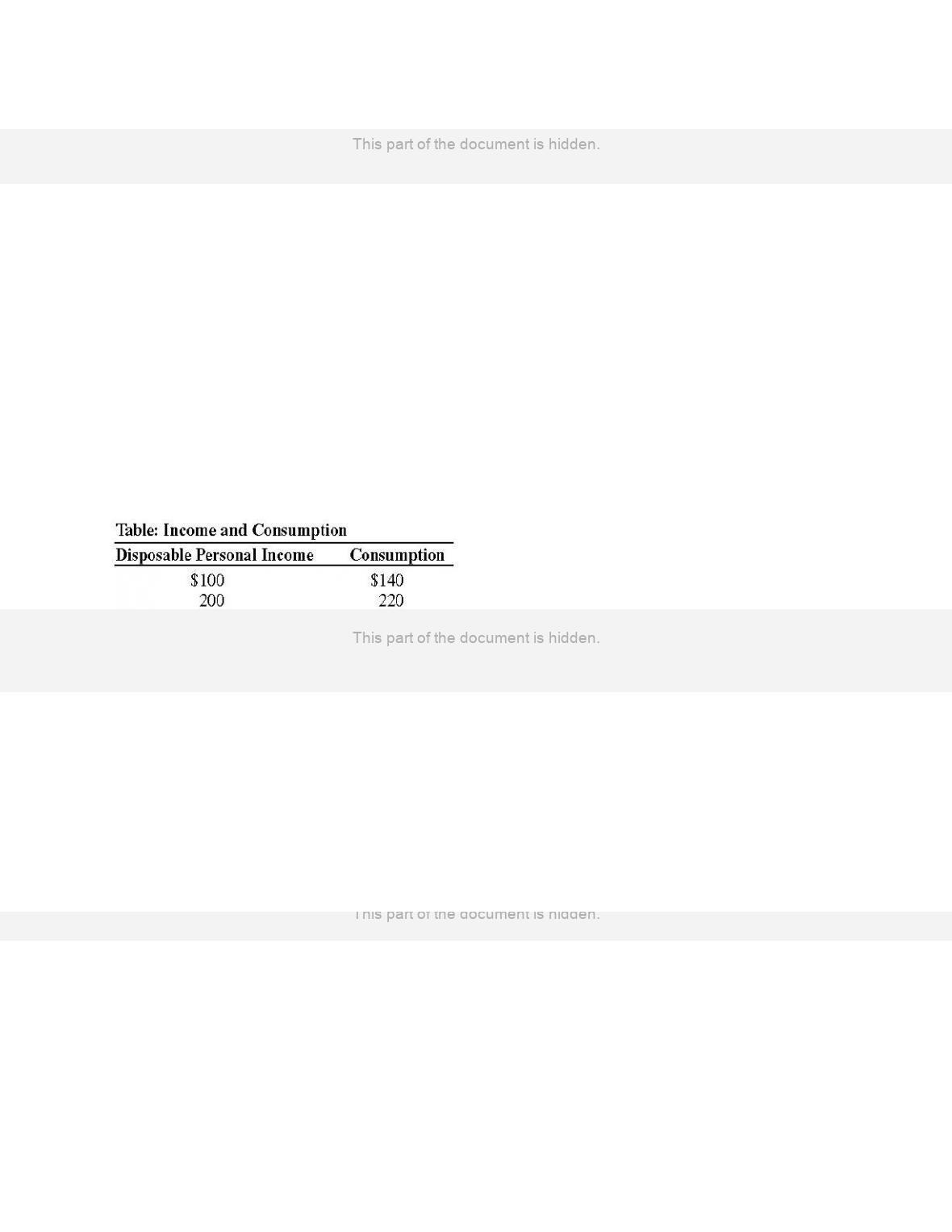
(Table: Income and Consumption) Use Table: Income and Consumption. When
disposable personal income is $200, the marginal propensity to consume is:
A)
0.00.
B)
0.20.
C)
0.80.
D)
1.40.
83.
(Table: Income and Consumption) Use Table: Income and Consumption. When
disposable personal income is $300, the marginal propensity to consume is:
A)
0.80.
B)
0.92.
C)
0.95.
D)
1.00.

Page 18
84.
(Table: Income and Consumption) Use Table: Income and Consumption. When
disposable personal income is $400, the level of personal savings is:
A)
–$40.
B)
–$20.
C)
$0.
D)
$20.
85.
The MOST important determinant of consumer spending is:
A)
the government budget deficit or surplus.
B)
the price of gasoline.
C)
the trade deficit.
D)
disposable income.
86.
Suppose that the consumption function is C = $500 + 0.8* YD, where YD is disposable
income. Autonomous consumption is:
A)
$500.
B)
0.
C)
four-fifths of disposable income.
D)
$1,300 if disposable income is $1,000.
87.
Suppose that the consumption function is C = $500 + 0.8* YD, where YD is disposable
income. The marginal propensity to consume is:
A)
$500.
B)
0.
C)
0.8.
D)
0.2.
88.
Suppose that the consumption function is C = $500 + 0.8* YD, where YD is disposable
income. The marginal propensity to save is:
A)
$500.
B)
0.
C)
0.8.
D)
0.2.
89.
Suppose that the consumption function is C = $500 + 0.8* YD, where YD is disposable
income. If income increases by $2,000, consumption will increase by:
A)
$500.
B)
$2,000.
C)
$1,600.
D)
$400.
Page 19
90.
Suppose that the consumption function is C = $500 + 0.8* YD, where YD is disposable
income. If disposable income is $1,000, savings is:
A)
–$500.
B)
$1,300.
C)
–$300.
D)
$300.
91.
When David has no income, he spends $500. If his income increases to $2,000, he
spends $1,900. Which expression represents his consumption function?
A)
C = 1.2* YD
B)
C = 0.95* YD
C)
C = $500 + 0.7* YD
D)
C = $500 + 1,000* YD
92.
Consumer spending in the United States normally accounts for approximately _____ of
the economy.
A)
30%
B)
50%
C)
70%
D)
90%
93.
The following is an algebraic representation of the consumption function: C = A +
MPC* YD. The slope of the function is represented by:
A)
C.
B)
A.
C)
MPC.
D)
YD.
Use the following to answer question 94:

Page 20
94.
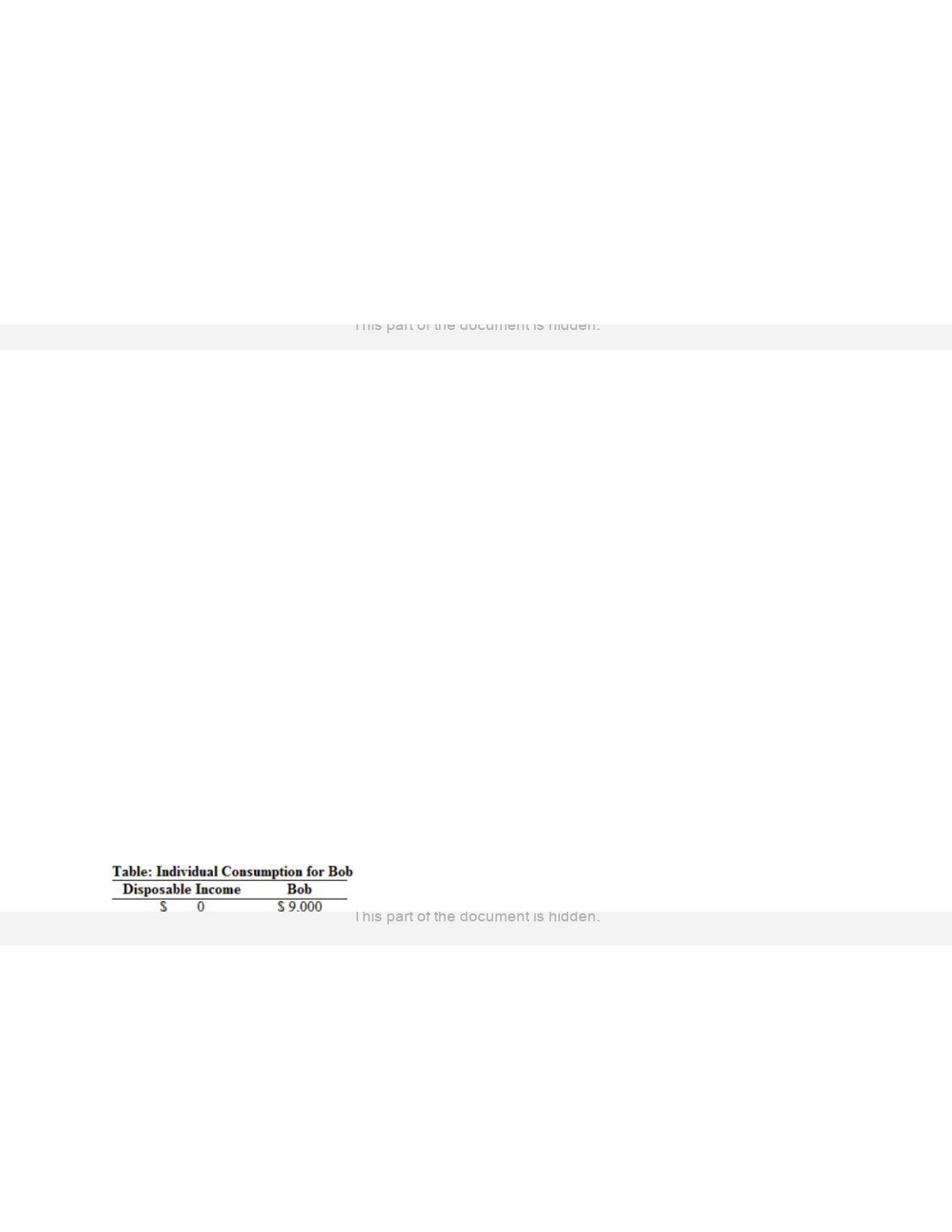
(Table: Individual Consumption for Bob) Use Table: Individual Consumption Function
for Bob. The marginal propensity to consume and autonomous consumption are _____
and _____, respectively, for Bob.
A)
0.6; $10,000
B)
0.4; $13,000
C)
0.6; $9,000
D)
0.4; $9,000
95.
The MOST important factor affecting a household’s consumer spending is:
A)
its expected disposable income.
B)
its current disposable income.
C)
its wealth.
D)
the interest rate.
96.
In the consumption function, an individual household’s consumer spending is:
A)
positively related to its current disposable income.
B)
negatively related to its autonomous consumption and its marginal propensity to
consume.
C)
positively related to the interest rate.
D)
determined by the accelerator principle.
97.
If the marginal propensity to consume is 0.5, individual autonomous consumption is
$10,000, and disposable income is $40,000, then individual consumption spending is:
A)
$20,000.
B)
$25,000.
C)
$30,000.
D)
$45,000.
98.
Assuming that A represents autonomous consumption and YD represents disposable
income, for the economy as a whole:
A)
C = MPC + (A* YD).
B)
C = A + (MPC* YD).
C)
C = (A + MPC)* YD.
D)
C = (A – MPS) + (MPC* YD).
99.
The marginal propensity to consume is _____ of the consumption function.
A)
the slope
B)
the intercept
C)
the inverse
D)
independent