Page 41
207.
Deflation is a(n):
A)
decrease in the purchasing power of a unit of money.
B)
appreciation of the nation’s currency.
C)
decrease in the average level of prices.
D)
increase in the average level of prices.
208.
An increase in the price level that is extremely rapid (say 400% per year) is called:
A)
hyperinflation.
B)
inflation.
C)
deflation.
D)
hyperdeflation.
209.
Which annual rate of inflation is hyperinflation?
A)
5%
B)
13%
C)
25%
D)
2,000%
210.
During deflation, the:
A)
general price level falls.
B)
general price level increases.
C)
interest rate rises.
D)
general price level becomes negative.
211.
Unanticipated inflation:
A)
reduces the value of money.
B)
increases the value of future obligations.
C)
increases certainty about the future.
D)
helps lenders.
212.
The use of online banking would _____ the _____ cost of a high inflation rate.
A)
increase; menu
B)
decrease; shoe-leather
C)
increase; unit-of-account
D)
decrease; unit-of-account

Page 42
213.
Annie’s credit union charges a fee for transferring funds from her money market account
to her checking account. The rate of inflation has been 12% lately, so Annie has
transferred funds from her money market account to her checking account more often
than usual. This cost is an example of the _____ cost of high inflation.
A)
unit-of-account
B)
menu
C)
shoe-leather
D)
redistributive
214.
Between 1921 and 1923, Germany underwent:
A)
deflation.
B)
disinflation.
C)
an increase in the purchasing power of its currency.
D)
hyperinflation.
215.
During Brazil’s hyperinflation of the 1990s, the economy lost real resources when the
_____ sector grew very large to cope with the consequences of the high rate of inflation.
A)
banking
B)
transportation
C)
government
D)
manufacturing
216.
During periods of high inflation, stores that publish catalogs find it necessary to revise
prices and publish new catalogs more frequently than before. This is an example of
_____ costs.
A)
unit-of-account
B)
menu
C)
shoe-leather
D)
redistributive
217.
When inflation rises quickly, borrowers will _____ and lenders will _____.
A)
be hurt; benefit
B)
benefit; be hurt
C)
be hurt; be hurt
D)
benefit; benefit
Page 43
218.
Unexpected inflation _____ lenders and _____ borrowers.
A)
benefits; hurts
B)
hurts; benefits
C)
does not affect; benefits
D)
benefits; does not affect
219.
Unanticipated inflation:
A)
increases the value of money.
B)
decreases uncertainty about the future.
C)
reduces the real value of debt.
D)
helps lenders.
220.
Unanticipated inflation does NOT:
A)
reduce the value of money.
B)
reduce the value of debt.
C)
cause uncertainty about the future.
D)
cause disinflation.
221.
Unanticipated inflation:
A)
helps those on fixed incomes.
B)
hurts borrowers and helps lenders.
C)
helps borrowers and hurts lenders.
D)
causes interest rates to decrease.
222.
Suppose that the nominal rate of interest is 7% and the inflation rate is 3%. The real rate
of interest is _____%.
A)
3
B)
4
C)
10
D)
7
223.
If the actual inflation rate is less than the expected inflation rate:
A)
lenders gain and borrowers lose.
B)
borrowers gain and lenders lose.
C)
everyone benefits.
D)
everyone is worse off.

Page 44
224.
Suppose that the real interest rate is 2.1% and the nominal interest rate is 5.4%. The
inflation rate is _____%.
A)
7.5
B)
3.3
C)
–3.3
D)
2.1
225.
Suppose that banks are issuing personal loans at 9%. If expected inflation is 3%, then
the nominal interest rate is _____% and the real interest rate is _____%.
A)
6; 9
B)
9; 6
C)
9; 3
D)
6; 12
226.
Suppose that a bank wishes to make a 5% rate of return on a one-year loan but expects
inflation over the course of the loan to be roughly 3%. Which statement is TRUE?
A)
As long as the bank charges a nominal interest rate of at least 5%, it will earn its
expected return.
B)
If the bank charges an interest rate of 8% or higher, it will earn the expected return.
C)
If the bank charges 8% and the inflation rate is less than 3%, then the bank will
have earned a higher rate of return than expected.
D)
If the bank charges 8% and the inflation rate is more than 3%, then the bank will
have earned a higher rate of return than expected.
227.
The _____ interest rate _____.
A)
nominal; can be negative
B)
real; cannot be negative
C)
real; can only be positive
D)
real; can be zero, positive, or negative
228.
A fixed interest rate of _____% with _____% inflation will yield the highest rate of
return for a lender.
A)
8; 1
B)
11; 5
C)
12; 7
D)
19; 15
229.
The nominal interest rate equals the real interest rate:
A)
times the rate of inflation.
B)
minus the rate of inflation.
C)
plus the rate of inflation.
D)
when inflation is correctly anticipated.
230.
The threat of future inflation:
A)
makes people reluctant to lend money for long periods.
B)
makes people eager to lend money for long periods.
C)
has no effect on lending money.
D)
increases the value of money paid back in the future.
231.
A bank makes a loan for one year. The nominal annual interest rate is 7.5%. The real
rate is 4%. Over the course of the year, overall prices increase by 4%. This rate of
inflation hurt the _____ because the actual rate of inflation was _____ than the
anticipated rate.
A)
borrower; lower
B)
borrower; higher
C)
lender; higher
D)
lender; lower
232.
A drop in the inflation rate is called:
A)
disinflation.
B)
deflation.
C)
stagflation.
D)
hyperinflation.
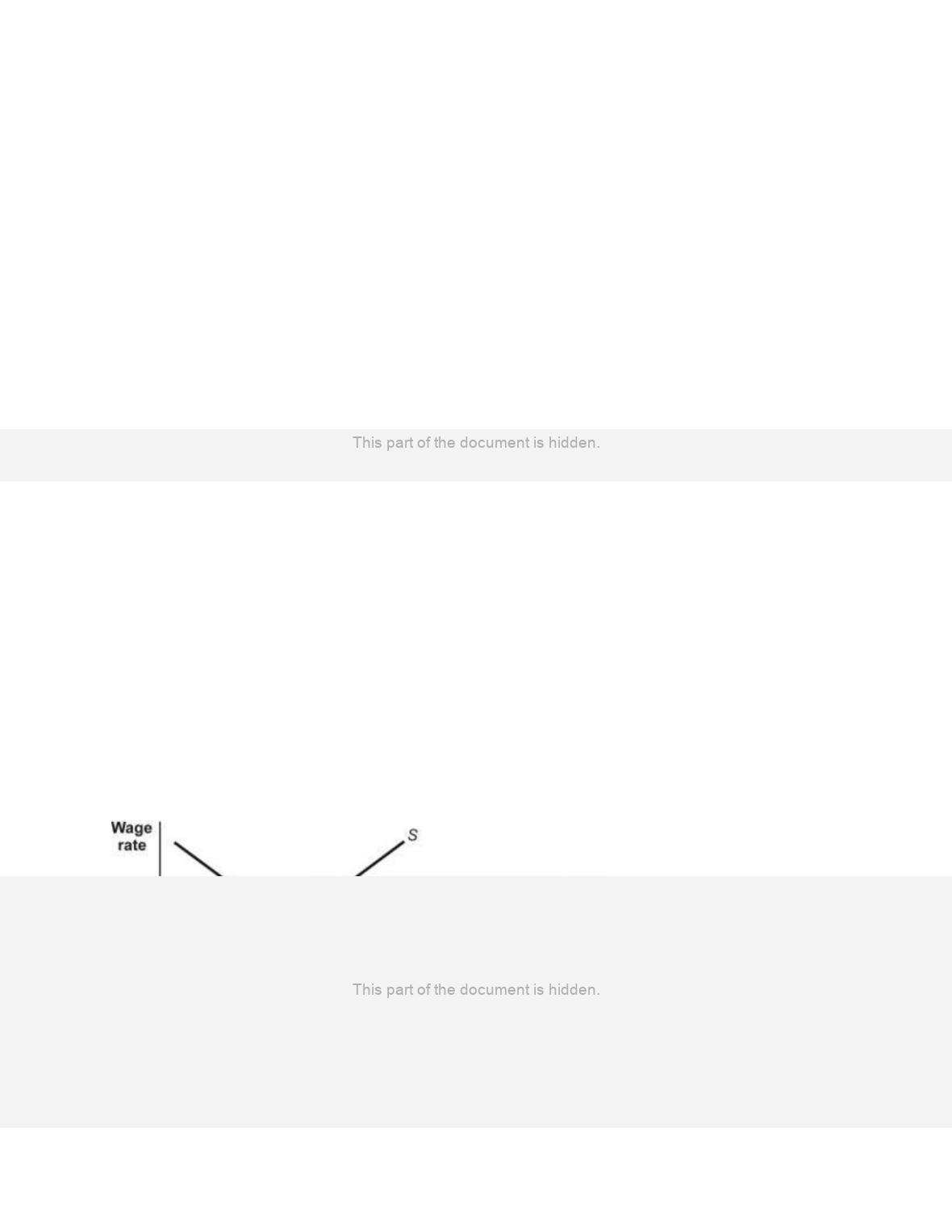
Use the following to answer questions 233-239:
Page 46
233.
(Figure: The Labor Market) Use Figure: The Labor Market. The equilibrium wage rate
is:
A)
$16.
B)
$15.
C)
$14.
D)
$17.
234.
(Figure: The Labor Market) Use Figure: The Labor Market. The level of employment at
the equilibrium wage rate is:
A)
80,000.
B)
110,000
C)
100,000.
D)
90,000.
235.
(Figure: The Labor Market) Use Figure: The Labor Market. The size of the labor force
at the equilibrium wage rate is:
A)
80,000.
B)
110,000.
C)
100,000.
D)
200,000.
236.
(Figure: The Labor Market) Use Figure: The Labor Market. The unemployment rate at
the equilibrium wage rate is _____%.
A)
0
B)
50
C)
80
D)
15
237.
(Figure: The Labor Market) Use Figure: The Labor Market. What will be the level of
employment if firms decide to pay an efficiency wage of $16?
A)
80,000
B)
100,000
C)
110,000
D)
200,000
Page 47
238.
(Figure: The Labor Market) Use Figure: The Labor Market. What is the size of the labor
force at an efficiency wage of $16?
A)
80,000
B)
100,000
C)
110,000
D)
200,000
239.
(Figure: The Labor Market) Use Figure: The Labor Market. What is the unemployment
rate at an efficiency wage of $16, assuming all workers without a job are searching?
A)
10%
B)
20%
C)
27%
D)
73%
240.
The unemployment rate is the ratio of the unemployed to the labor force.
A)
True
B)
False
241.
Discouraged workers are not working, want to work, but are not actively looking for a
job.
A)
True
B)
False
242.
Discouraged workers is another term for the unemployed.
A)
True
B)
False
243.
Underemployed people are counted as employed, even though they are not fully using
their skills.
A)
True
B)
False
244.
Counted among the unemployed are underemployed people, who cannot find a job
working as many hours as they wish.
A)
True
B)
False
Page 48
245.
The official unemployment rate is useful but is not a true measure of joblessness.
A)
True
B)
False
246.
A high unemployment rate implies a high level of GDP.
A)
True
B)
False
247.
A jobless recovery occurs when GDP is growing at a below-average rate and
unemployment is rising.
A)
True
B)
False
248.
A jobless recovery occurs when GDP is decreasing and unemployment is rising.
A)
True
B)
False
249.
Since 2007, unemployment rates have been higher than average for recent college
graduates because they are less qualified than were graduates of the 1990s.
A)
True
B)
False
250.
Long-term unemployment is usually frictional.
A)
True
B)
False
251.
Most economists agree that a binding minimum wage causes structural unemployment.
A)
True
B)
False
252.
Both binding minimum wages and union wages may cause structural unemployment.
A)
True
B)
False
Page 49
253.
The minimum wage is higher in the United States than it is in most Western European
countries.
A)
True
B)
False
254.
When the actual rate of unemployment is equal to the natural rate of unemployment, we
conclude that there is no cyclical unemployment.
A)
True
B)
False
255.
Frictional and structural unemployment are a part of the natural rate of unemployment.
A)
True
B)
False
256.
Cyclical unemployment is a result of recessions and economic downturns and is not
considered a part of the natural rate of unemployment.
A)
True
B)
False
257.
Frictional unemployment is a special type of structural unemployment.
A)
True
B)
False
258.
If the government increases the length and amount of unemployment benefits, the
unemployment rate will fall.
A)
True
B)
False
259.
If the labor force becomes younger, the natural rate of unemployment will fall.
A)
True
B)
False
260.
The unemployment rate in Western Europe has been higher than the unemployment rate
in the United States in recent years.
A)
True
B)
False
Page 50
261.
In 2002, the French adopted the British pound as their national currency.
A)
True
B)
False
262.
In 2002, the French adopted the euro as their national currency.
A)
True
B)
False
263.
When the price level increases, everyone becomes wealthier.
A)
True
B)
False
264.
When the price level increases, everyone becomes poorer.
A)
True
B)
False
265.
If the U.S. dollar were replaced with a “new dollar” at an exchange rate of 1 new dollar
for 8 old dollars, then a mortgage of $200,000 would become a debt of 25,000 new
dollars.
A)
True
B)
False
266.
If the U.S. dollar were replaced with a “new dollar” at an exchange rate of 1 new dollar
for 4 old dollars, then an hourly wage of $12 would become an hourly wage of 3 new
dollars.
A)
True
B)
False
267.
The real wage is the wage multiplied by the price level.
A)
True
B)
False
268.
Real income is income divided by the price level.
A)
True
B)
False
Page 51
269.
If the wage rate is $20 per hour and the price level is 2, then the real wage is $40 per
hour.
A)
True
B)
False
270.
If Jenny’s income is $120,000 and the price level is 4, then Jenny’s real income is
$30,000.
A)
True
B)
False
271.
The inflation rate for the current year is the price level in the current year minus the
price level in the previous year.
A)
True
B)
False
272.
The inflation rate for the current year is the percentage change in the price level from
the previous year.
A)
True
B)
False
273.
Since 1960, the price level in the United States has decreased in most years.
A)
True
B)
False
274.
Since 1960, the price level in the United States has increased in most years.
A)
True
B)
False
275.
The U.S. inflation rate was lower in the 2000s than it was in the 1970s.
A)
True
B)
False
276.
The U.S. inflation rate was higher in the 2000s than it was in the 1970s.
A)
True
B)
False
Page 52
277.
If the price level at the end of year 1 is 150 and the price level at the end of year 2 is
160, the inflation rate in year 2 is 10%.
A)
True
B)
False
278.
If the price level at the end of year 1 is 150 and the price level at the end of year 2 is
160, the inflation rate in year 2 is 6.67%.
A)
True
B)
False
279.
The use of online banking increases the unit-of-account cost of a high inflation rate.
A)
True
B)
False
280.
The increased availability of automatic teller machines has decreased the shoe-leather
costs of high inflation.
A)
True
B)
False
281.
When the rate of inflation is high, people usually transfer money from interest-bearing
accounts into checking accounts more often than when inflation is low. This is an
example of a menu cost.
A)
True
B)
False
282.
Between 1921 and 1923, Germany underwent a period of hyperinflation.
A)
True
B)
False
283.
During Brazil’s hyperinflation of the 1990s, the economy lost real resources when the
transportation sector grew very large to cope with the consequences of the high rate of
inflation.
A)
True
B)
False
Page 53
284.
During periods of high inflation, stores that publish catalogs find it necessary to revise
prices and publish new catalogs more frequently than they did before. This is an
example of menu costs.
A)
True
B)
False
285.
Unit-of-account costs arise when inflation makes it necessary to change listed prices
very often.
A)
True
B)
False
286.
Unit-of-account costs arise from the way inflation makes money a less reliable measure
of value.
A)
True
B)
False
287.
Shoe-leather costs may be especially important in the tax system when inflation distorts
the measures of income on which taxes are collected.
A)
True
B)
False
288.
Unit-of-account costs may be especially important in the tax system when inflation
distorts the measures of income on which taxes are collected.
A)
True
B)
False
289.
The real rate of interest is the nominal rate of interest times the inflation rate.
A)
True
B)
False
290.
Real interest rates can be positive, zero, or negative, but nominal interest rates can only
be zero or positive.
A)
True
B)
False
291.
The real interest rate is the nominal interest rate less the rate of inflation.
A)
True
B)
False
Page 54
292.
Unless deflation occurs, the nominal interest rate will always be greater than or equal to
the real interest rate.
A)
True
B)
False
293.
Inflation reduces nominal interest rates.
A)
True
B)
False
294.
In periods of inflation, lenders benefit because the money that they are repaid has more
purchasing power than the money they loaned initially.
A)
True
B)
False
295.
If the nominal interest rate is 4% and the inflation rate is 1%, then the real interest rate is
5%.
A)
True
B)
False
296.
If the real interest rate is 4% and the inflation rate is 1%, then the nominal interest rate is
5%.
A)
True
B)
False
297.
When policies drop the inflation rate from 10% to 5%, the economy is undergoing
disinflation.
A)
True
B)
False
298.
Disinflation is a drop in the price level.
A)
True
B)
False
299.
During the mid-1980s, Israel had a high rate of inflation, and prices often rose by more
than 10% per month.
A)
True
B)
False
Page 55
300.
The severe inflation in Israel during the mid-1980s was due to a war, an unstable
government, and civil unrest in the country.
A)
True
B)
False
301.
During times of high inflation, people hold less cash and make more withdrawals, so
banks often open new branches.
A)
True
B)
False
302.
Some economists argue that the official unemployment rate understates the true level of
unemployment. Summarize these arguments.
303.
How is it possible for the unemployment rate to overstate the true level of
unemployment?
Use the following to answer questions 304-305:
304.
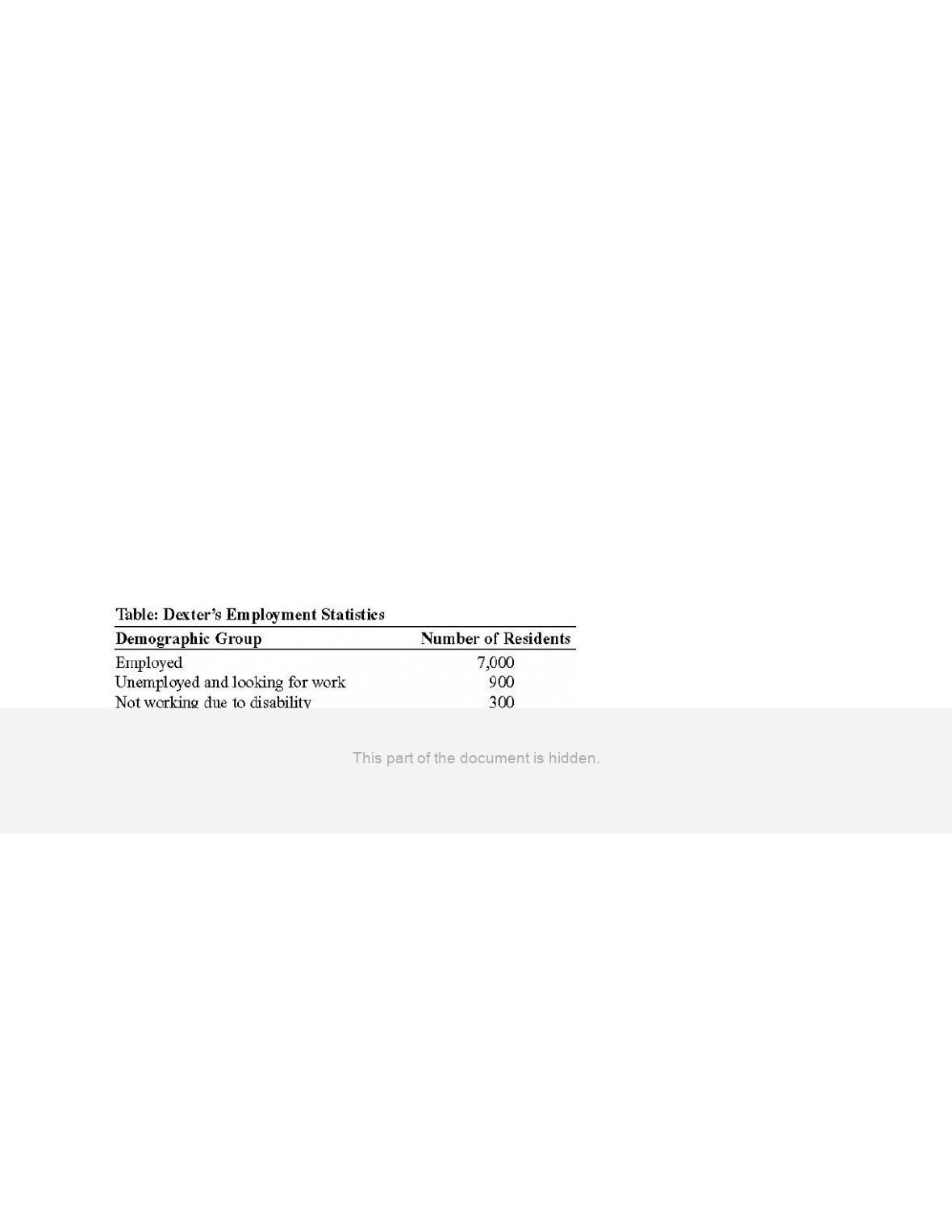
(Table: Dexter’s Employment Statistics) Use Table: Dexter‘s Employment Statistics.
Use these data to complete the following computations.
a. What is the size of the labor force?
b. What is the labor force participation rate?
305.
(Table: Dexter’s Employment Statistics) Use Table: Dexter‘s Employment Statistics.
Use these data for the following computations.
a. What is the unemployment rate?
b. Including discouraged workers, what is the unemployment rate?