Page 61
311.
When households invest their wealth in financial markets, they purchase financial
assets.
A)
True
B)
False
312.
The primary function of the financial system is to channel funds from savers to
investors.
A)
True
B)
False
313.
The expenses involved in actually putting together and executing a deal are called
liquidity costs.
A)
True
B)
False
314.
The expenses involved in actually putting together and executing a deal are called
transactions costs.
A)
True
B)
False
315.
A person who is risk averse loses less welfare from losing $100 than he or she gains in
welfare from winning $100.
A)
True
B)
False
316.
An individual can reduce financial risk by diversifying investments, that is, by investing
in several assets whose possible losses are independent events.
A)
True
B)
False
317.
To reduce risk through diversification, a person must invest in several assets with
related, or dependent, risk of loss.
A)
True
B)
False
318.
Financial markets eliminate transactions costs.
A)
True
B)
False
Page 62
319.
When corporations need to borrow large amounts of money, they can minimize their
transaction costs by getting many small loans directly from many people.
A)
True
B)
False
320.
An illiquid asset can be quickly converted to cash with little or no loss of value.
A)
True
B)
False
321.
Stocks are usually riskier than bonds but also typically earn a higher rate of return than
do bonds.
A)
True
B)
False
322.
Of all types of financial assets, transactions costs are likely to be the lowest for loans.
A)
True
B)
False
323.
More so than other financial assets, loans are specifically tailored to meet the needs of
the borrower.
A)
True
B)
False
324.
A loan is a liability to the issuer but an asset to the person taking it out.
A)
True
B)
False
325.
If Debbie gets a loan to remodel her kitchen, the loan is a liability for Debbie and an
asset for the bank that issued the loan.
A)
True
B)
False
326.
When a corporation issues a bond, it is an asset for the corporation and a liability for the
purchaser of the bond.
A)
True
B)
False
Page 63
327.
A bond is a financial asset that pays a fixed amount of interest each year and then repays
the principal on a given date.
A)
True
B)
False
328.
Loans are more liquid than bonds because they are more standardized than bonds.
A)
True
B)
False
329.
Because bonds are more standardized than loans, transactions costs for bonds are
typically lower than transactions costs for loans.
A)
True
B)
False
330.
Although loan-backed securities provide more diversification than individual loans, they
are much less liquid than individual loans.
A)
True
B)
False
331.
Securitization is the process of setting up assets by pooling individual loans and selling
shares in the pool.
A)
True
B)
False
332.
During the financial crisis of 2008, many financial assets lost value, but
mortgage-backed securities never underwent default.
A)
True
B)
False
333.
Student loans, auto loans, and credit card loans are often securitized.
A)
True
B)
False
334.
Privately held companies are owned by an individual or a few partners, who get to keep
all of the company’s profit.
A)
True
B)
False
Page 64
335.
Usually the rate of return on stock is lower than the rate of return on bonds.
A)
True
B)
False
336.
Generally, bonds are considered to be riskier than stocks.
A)
True
B)
False
337.
Bonds are less risky than stocks because a company legally must pay what it owes to
lenders before it can distribute profits to stockholders.
A)
True
B)
False
338.
If a company fails and declares bankruptcy, its physical and financial assets must be
used to pay its bondholders before the stockholders can be paid.
A)
True
B)
False
339.
A financial intermediary transforms funds gathered from many individuals into financial
assets.
A)
True
B)
False
340.
The primary purpose of financial intermediaries is to redistribute wealth by
implementing a progressive income tax.
A)
True
B)
False
341.
The primary purpose of financial intermediaries it to transform funds gathered from
savers into financial assets.
A)
True
B)
False
342.
About 75% of the financial assets that Americans own are held through financial
intermediaries rather than directly.
A)
True
B)
False
Page 65
343.
A life insurance company is a financial intermediary that sets up a stock portfolio of
shares of companies and then sells shares of the stock portfolio to investors.
A)
True
B)
False
344.
Mutual funds allow investors with a relatively small amount of money to indirectly hold
a diversified portfolio, which allows them to invest in stocks more safely than they
could otherwise.
A)
True
B)
False
345.
By doing research on the companies in their portfolios, mutual funds reduce transactions
costs for their investors.
A)
True
B)
False
346.
Banks are nonprofit financial intermediaries that collect the savings of their members
and invest those funds in a diversified portfolio of assets to provide income to members
when they retire.
A)
True
B)
False
347.
Life insurance companies are financial intermediaries that sell policies to savers and
guarantee a payment to the policyholder’s beneficiaries when the policyholder dies.
A)
True
B)
False
348.
If the price of a share of stock is expected to rise, then demanders will demand more of
it today, owners will be less willing to sell it today, and its price will rise today.
A)
True
B)
False
349.
Changes in the prices of stock are the result of changes in the supply and demand for
stocks of investors.
A)
True
B)
False
Page 66
350.
The purchaser of a share of stock receives interest each year from the stock and then
receives the purchase price of the stock at its maturity.
A)
True
B)
False
351.
The value of a stock depends primarily on investors’ assessments of its value in the past.
A)
True
B)
False
352.
Implicit rent is an estimate of the amount that homeowners would pay if they had to rent
their home and is also an estimate of the benefit of owning a home.
A)
True
B)
False
353.
The efficient markets hypothesis says that asset prices embody all publicly available
information.
A)
True
B)
False
354.
Fundamentals are the underlying determinants of a company’s future profits.
A)
True
B)
False
355.
Some economists have challenged the efficient markets hypothesis because they believe
that stocks may be incorrectly priced when markets behave irrationally.
A)
True
B)
False
356.
A bubble is a large decrease in asset prices caused by unrealistic expectations about
future prices.
A)
True
B)
False
357.
Suppose that the federal government has a budget deficit and the economy is closed.
Using the savings–investment spending identity, explain how this affects investment
spending.
Page 67
358.
Suppose the federal government has a balanced budget, the economy is open, and there
is a positive capital inflow from foreign citizens. Using the savings–investment
spending identity, explain how this affects investment spending.
359.
Assume that an economy is open to capital inflows and that the inflows are equal to
imports minus exports (IM – X). Answer the following questions.
a. Budget balance = –$20; X = $60; IM = $90; Private saving = $150. Calculate
investment spending.
b. Private saving = $200; Investment = $220; Budget balance = –$30. Calculate (IM –
X).
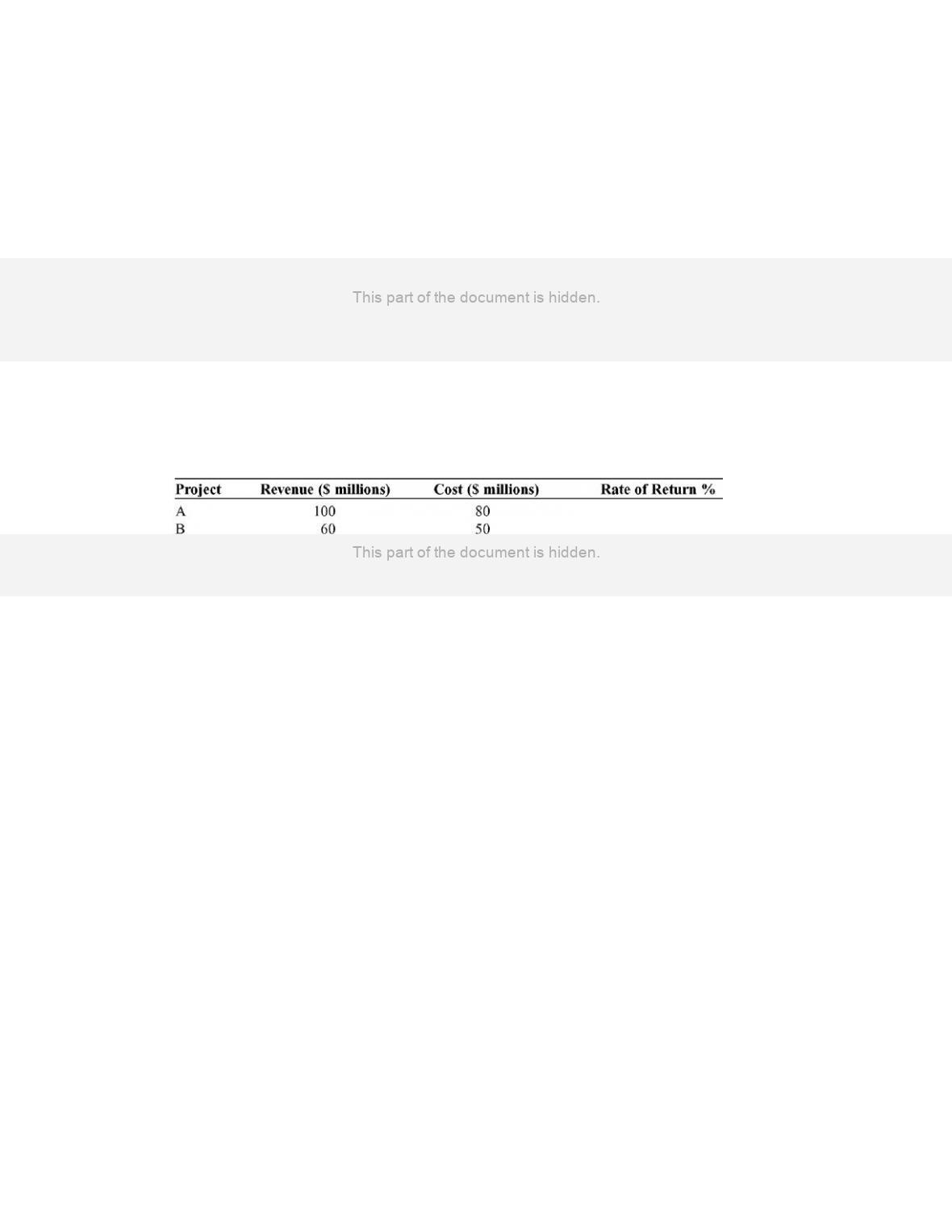
360.
The table that follows shows four possible physical investment projects, the expected
revenue from each project, and the expected cost of each project. You may assume that
each project, once completed, lasts only one year. Complete the empty column in the
table by computing the rate of return on each project.
361.
The market for loanable funds is in equilibrium. All else equal, the federal deficit is
growing. Describe how this will affect the market for loanable funds, the equilibrium
interest rate, and the equilibrium quantity of loanable funds.
362.
The market for loanable funds is in equilibrium. All else equal, the federal government
has eliminated taxes on interest earned from savings. Describe how this will affect the
market for loanable funds, the equilibrium interest rate, and the equilibrium quantity of
loanable funds.
363.
Explain what the Fisher effect implies. What does this effect tell us about the
relationship between inflation expectations and the market for loanable funds?
364.
You have contracted to borrow $2,000 from the bank for one year. The nominal rate of
interest is 8.5% and the real interest rate is 6%. At the end of the year, inflation was 1%.
How does this affect the borrower (you) and the lender (the bank)? Who is better off?

Page 68
365.
You have agreed to borrow $2,000 from the bank for one year. The nominal rate of
interest is 8.5% and the real interest rate is 6%. At the end of the year, inflation was
3.5%. How does this affect the borrower (you) and the lender (the bank)? Who is better
off?
366.
Your business has $100,000 of excess cash and is considering the purchase of some real
estate. The land will cost your firm $100,000 today, but you hope that in a year its value
will have increased because of a new shopping mall being built nearby, and you plan to
sell it for a profit. Your banker tells you that the annual rate of interest being offered to
savers is 12%. What price must you receive for the land next year for this investment to
be profitable?
367.
Consider each of these forms of investment. Identify whether it is investment spending,
an investment in physical assets, or a financial investment.
a. You purchase a 1965 Ford Mustang.
b. You buy 50 shares of stock in the Ford Motor Company.
c. Ford Motor Company builds a new plant in Tennessee.
368.
Compare stocks and bonds with respect to risk and return.
369.
Explain how a commercial bank meets both the short-term and long-term needs of its
customers.
370.
Explain how fluctuations in asset prices contributed to the financial crisis of 2008.
371.
What are the three tasks of a financial system? Explain how a mutual fund performs
these three tasks.
372.
This year, Alan purchases a home built in the 1950s. Alan’s purchase:
A)
counts as residential investment spending.
B)
counts as government spending.
C)
does not count as investment spending.
D)
is considered business fixed investment.
Page 69
373.
Human capital refers to:
A)
changes in inventories.
B)
workers’ education or training.
C)
funds available for investment spending.
D)
spending on physical capital, such as machines that aid workers.
374.
Human capital development often comes from:
A)
financial markets.
B)
government and private spending for education.
C)
the private sector, but only in capitalist economies.
D)
investment spending by businesses.
375.
Domestic savings and foreign savings are:
A)
sources of funds for investment spending.
B)
equal in terms of the composition of total savings.
C)
used for investment spending only when there is unplanned investment spending.
D)
not necessary for investment spending since government funds this spending.
376.
If an economy is closed and wishes to increase its investment spending:
A)
its only source of funding is domestic saving.
B)
its sources of funding are domestic and foreign saving.
C)
the government will have to increase its spending to provide for this.
D)
the government will increase taxes to provide for this.
377.
Which of the following is TRUE of an open economy?
A)
GDP = C + I + G + X – IM
B)
GDP = C + I + G
C)
GDP = T – TR – G
D)
GDP = SPrivate + SGovernment
378.
When government spending is less than net taxes:
A)
there is a budget deficit.
B)
government savings is negative.
C)
there is budget surplus.
D)
the economy is moving toward a balanced budget.
Page 70
379.
The budget balance equals:
A)
taxes minus government spending.
B)
taxes plus government spending.
C)
GDP minus consumption and government spending.
D)
GDP plus taxes.
380.
National savings is the sum of:
A)
private savings plus the budget balance.
B)
private savings plus government spending.
C)
investment spending plus consumption.
D)
consumption spending minus government spending.
381.
If capital inflow is negative, then a country:
A)
borrows more than it lends to other countries.
B)
lends more than it borrows from other countries.
C)
has balanced trade.
D)
imports more than it exports.
382.
If a country has a positive capital inflow, it:
A)
borrows more than it lends to foreigners.
B)
has an inflow amount equal to its X + IM.
C)
lends more than it borrows from foreigners.
D)
has an outflow amount equal to X + IM.
383.
In an open economy:
A)
a country with a positive capital inflow will also have X greater than IM.
B)
savings of foreigners may be supporting investment spending.
C)
capital inflows are always negative.
D)
investment spending equals national savings.
384.
A government has a budget deficit in an open economy. This means that:
A)
the government is spending less than its tax revenue.
B)
exports minus imports are zero.
C)
exports minus imports are positive.
D)
the government is spending more than its tax revenue.
Page 71
385.
When portions of investment spending are financed by a capital inflow:
A)
interest is being paid by government for the use of those funds.
B)
interest is being paid to a foreigner for use of those funds.
C)
consumers will need to cut back on spending.
D)
taxes will be raised to pay for this capital inflow.
386.
In the loanable funds market, borrowers:
A)
are best represented by the supply of loanable funds.
B)
are not affected by changes in the inflation rate.
C)
are best represented by the demand for loanable funds.
D)
lose money to unexpected increases in the inflation rate.
387.
Investment spending is undertaken when the rate of return is:
A)
positive.
B)
higher than the equilibrium interest rate.
C)
equal to the equilibrium interest rate.
D)
less than the equilibrium interest rate.
388.
Suppose an investment project is projected to provide $200,000 in revenues. The
investment will cost the company $180,000. Given this information, one should commit
to the project:
A)
regardless of the interest rate.
B)
if the interest rate is less than or equal to 11%.
C)
if the Fed is expected to decrease the money supply.
D)
if the interest rate is higher than 11%.
389.
Holding everything else constant, when the government uses an expansionary policy in
the presence of a deficit, it will result in a(n):
A)
increase in the equilibrium interest rate in the loanable funds market.
B)
increase in the level of private investment spending.
C)
increase in government savings.
D)
fall in the equilibrium interest rate in the loanable funds market.
390.
In the loanable funds market, savers:
A)
demand funds.
B)
supply funds.
C)
represent borrowers of funds.
D)
pay the equilibrium interest rate.