Page 21
Use the following to answer question 94:
94.
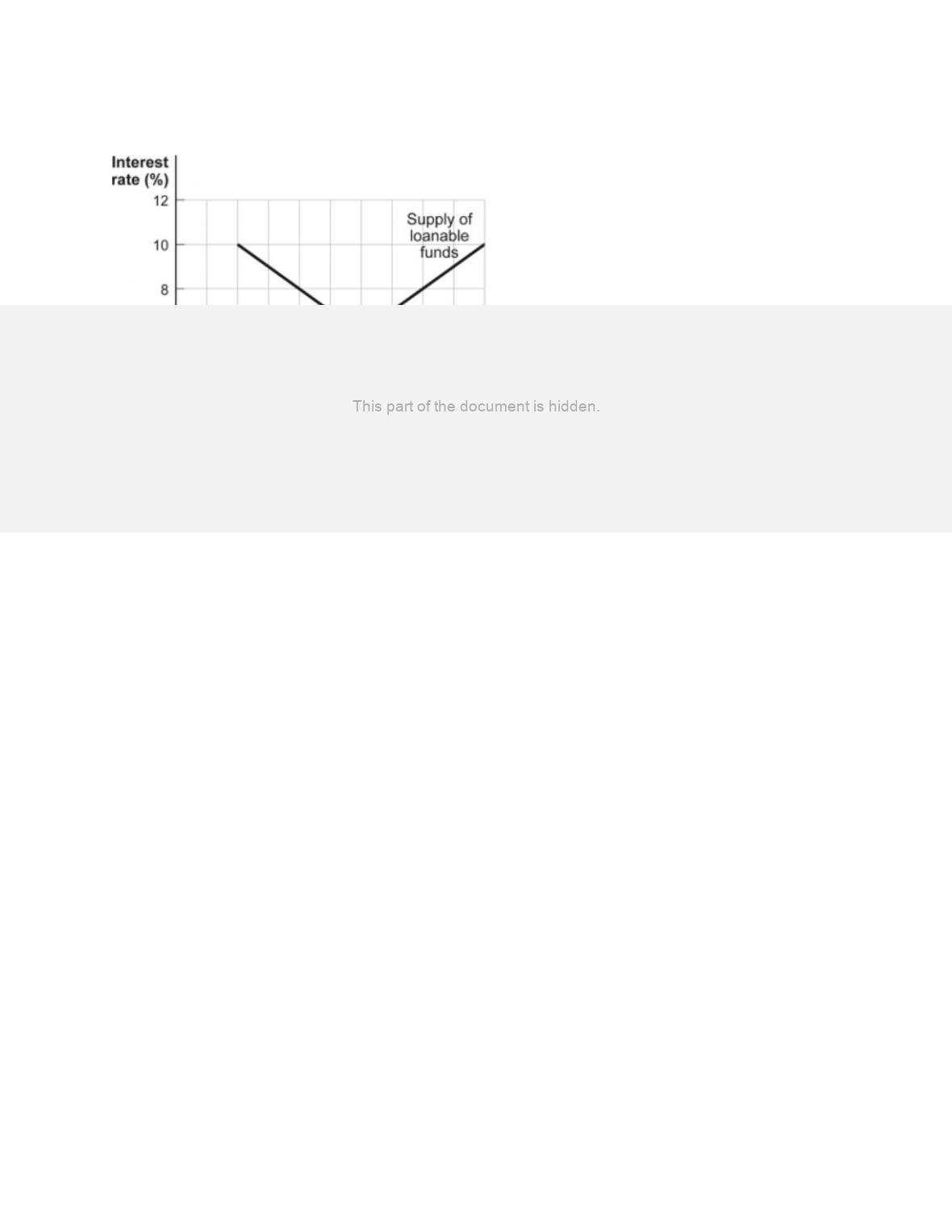
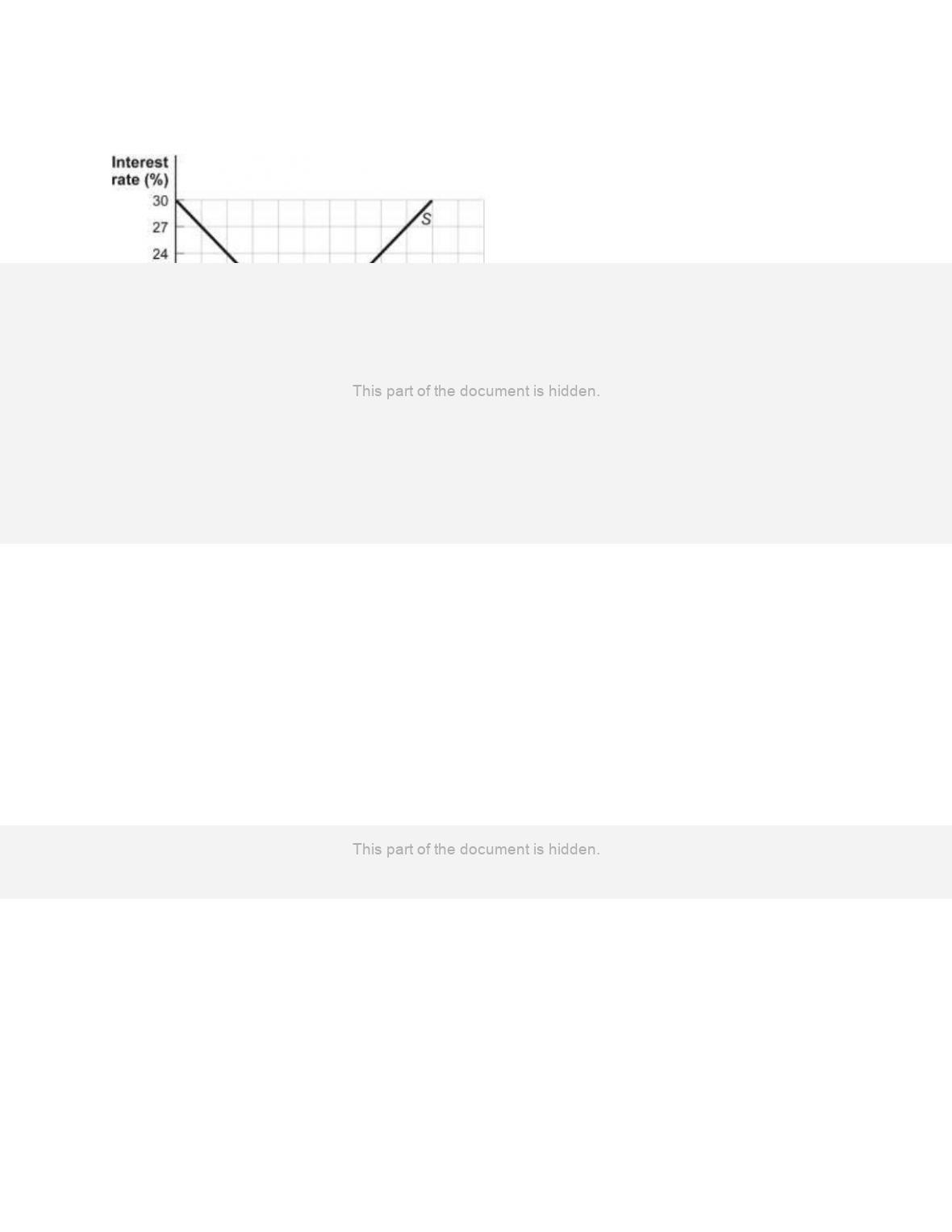
(Figure: Market for Loanable Funds I) Use Figure: Market for Loanable Funds I. The
equilibrium interest rate in the loanable funds market is _____%.
A)
2
B)
4
C)
6
D)
8
95.
The loanable funds market maximizes the:
A)
interest rate to savers.
B)
rate of return from borrowers.
C)
gains from trade between lenders and borrowers.
D)
amount of investment spending in the economy.
96.
If in an open economy a country imports more than it exports and the government
budget deficit increases, interest rates will _____ and the amount of borrowing will
_____.
A)
increase; increase
B)
decrease; increase
C)
increase; change unpredictably
D)
change unpredictably; increase
Page 22
97.
The price in the loanable funds market is the:
A)
rate of return of a project.
B)
price level.
C)
interest rate.
D)
consumer price index.
98.
The price determined in the market for loanable funds is the:
A)
margin call.
B)
profit rate.
C)
transaction fee.
D)
interest rate.
99.
If the interest rate in the market for loanable funds is above the equilibrium rate:
A)
there is a shortage of loanable funds.
B)
savings exceed investment spending.
C)
the quantity demanded of loanable funds exceeds the quantity supplied.
D)
consumption is smaller than savings.
Use the following to answer question 100:

Page 23
100.
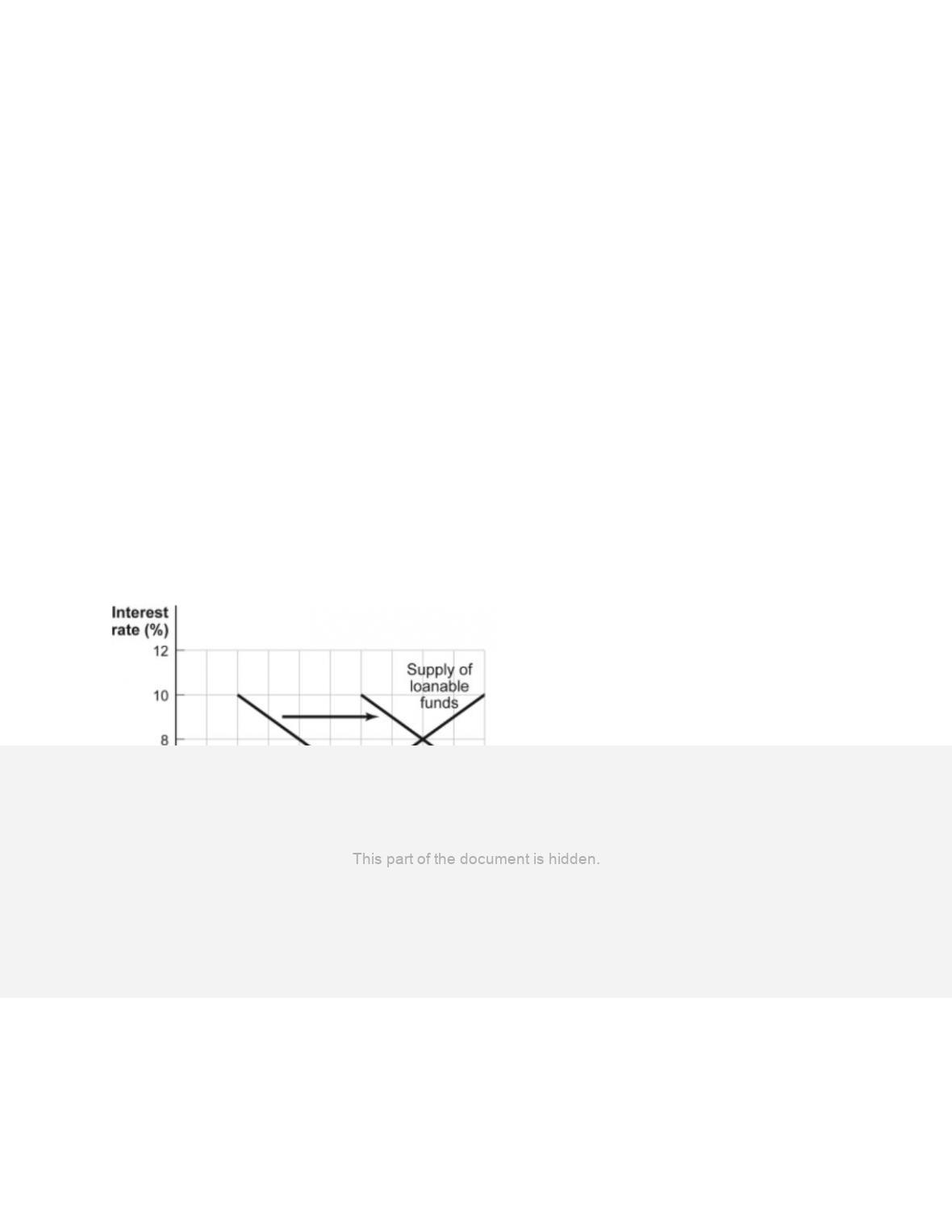
(Figure: The Market for Loanable Funds with Government Borrowing) Use Figure: The
Market for Loanable Funds with Government Borrowing. After an increase in
government borrowing, the new equilibrium interest rate will rise from 6% to _____%
and the amount of private savings will _____.
A)
10; stay the same
B)
8; rise
C)
8; fall
D)
10; be indeterminate
101.
A shift away from taxing asset income and toward taxing consumption would lead to a:
A)
larger demand for loanable funds, a higher interest rate, and more investment
spending.
B)
larger supply of loanable funds, a lower interest rate, and more investment
spending.
C)
larger government budget deficit and more investment spending.
D)
smaller supply of loanable funds, a higher interest rate, and more investment
spending.
102.
If the government increases its borrowing, then at every interest rate there is a(n) _____
funds.
A)
additional supply of
B)
additional demand for
C)
decrease in the supply of
D)
increase in the supply of
103.
Which statement is the MOST accurate?
A)
Deficits increase economic growth.
B)
Deficits decrease economic growth.
C)
Deficits do not affect economic growth.
D)
We cannot unambiguously say whether government spending that increases
deficits lowers or increases economic growth.
104.
Crowding out hampers the economy by:
A)
decreasing government borrowing.
B)
decreasing consumption.
C)
increasing private borrowing.
D)
reducing private investment spending on physical capital.
Page 24
Use the following to answer questions 105-114:
105.
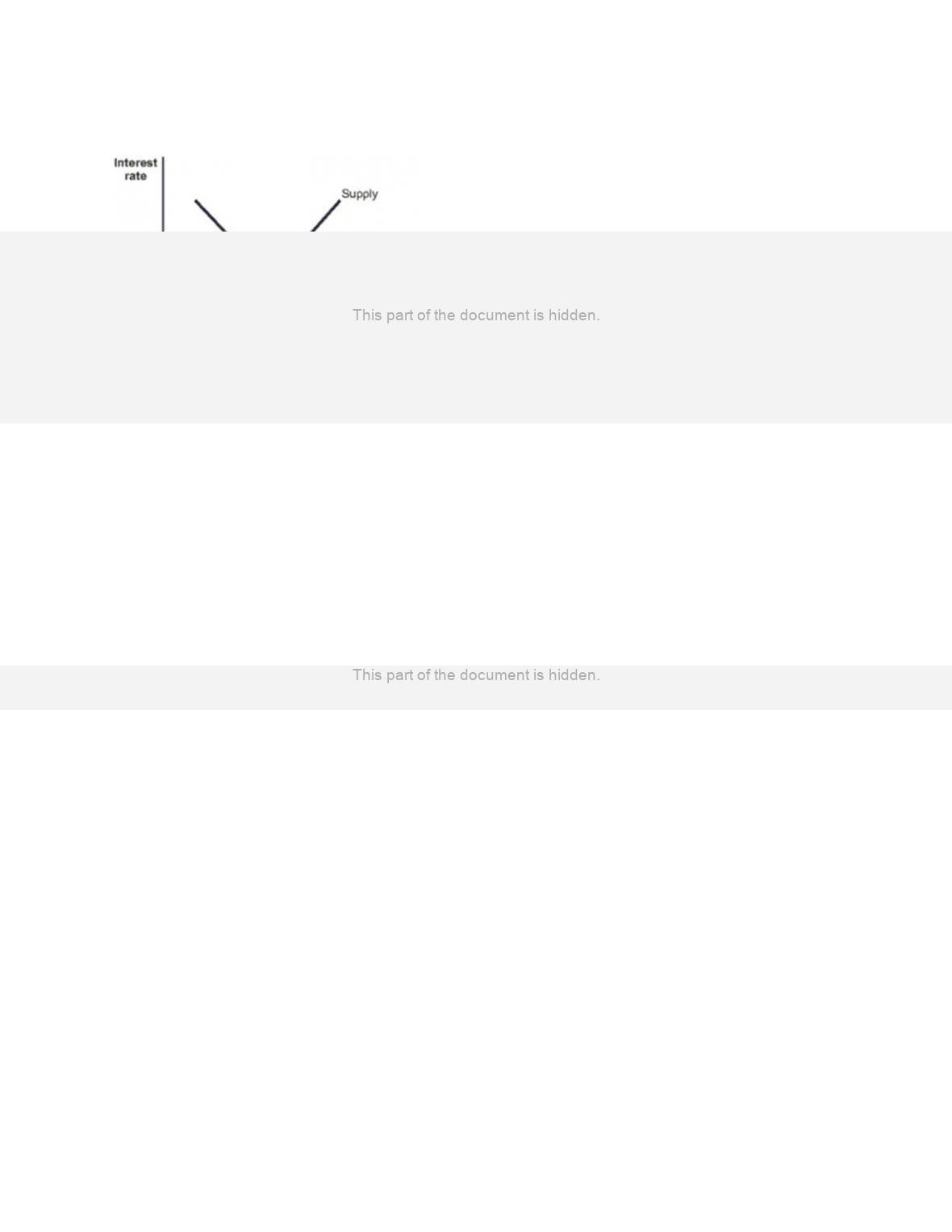
(Figure: The Market for Loanable Funds II) Use Figure: The Market for Loanable Funds
II. If the interest rate is higher than _____%, the quantity supplied of loanable funds will
be the quantity of loanable funds demanded.
A)
8; greater than
B)
8; less than
C)
8; equal to
D)
10; less than
106.
(Figure: The Market for Loanable Funds II) Use Figure: The Market for Loanable Funds
II. If the interest rate is lower than 8%, the quantity supplied of loanable funds will be
_____ the quantity of loanable funds demanded.
A)
greater than
B)
less than
C)
equal to
D)
The quantity supplied of loanable funds cannot be determined from the information
provided.
107.
(Figure: The Market for Loanable Funds II) Use Figure: The Market for Loanable Funds
II. An increase in government borrowing will shift the demand for loanable funds to the
_____ and _____ the interest rate.
A)
left; increase
B)
left; decrease
C)
right; increase
D)
right; decrease

Page 25
108.
(Figure: The Market for Loanable Funds II) Use Figure: The Market for Loanable Funds
II. A decrease in government borrowing will shift the demand for loanable funds to the
_____ and _____ the interest rate.
A)
left; increase
B)
right; decrease
C)
right; increase
D)
left; decrease
109.
(Figure: The Market for Loanable Funds II) Use Figure: The Market for Loanable Funds
II. A decrease in savings by the private sector will shift the supply of loanable funds to
the _____ and _____ the interest rate.
A)
left; increase
B)
right; decrease
C)
right; increase
D)
left; decrease
110.
(Figure: The Market for Loanable Funds II) Use Figure: The Market for Loanable Funds
II. An increase in savings by the private sector will shift the supply of loanable funds to
the_____ and _____ the interest rate.
A)
left; increase
B)
right; decrease
C)
right; increase
D)
left; decrease
111.
(Figure: The Market for Loanable Funds II) Use Figure: The Market for Loanable Funds
II. Other things being equal, if there is an increase in the interest rate above 8%, _____
quantity of loanable funds will be demanded.
A)
the same
B)
a larger
C)
a smaller
D)
at first a smaller and then a larger
112.
(Figure: The Market for Loanable Funds II) Use Figure: The Market for Loanable Funds
II. Other things being equal, if there is a decrease in the interest rate below 8%, _____
quantity of loanable funds will be demanded.
A)
the same
B)
a larger
C)
a smaller
D)
at first a smaller and then a larger
Page 26
113.
(Figure: The Market for Loanable Funds II) Use Figure: The Market for Loanable Funds
II. Other things being equal, an increase in taxes on savings and investment income will
shift _____ to the _____ and _____ the interest rate.
A)
demand; right; increase
B)
demand; left; decrease
C)
supply; right; decrease
D)
supply; left; increase
114.
(Figure: The Market for Loanable Funds II) Use Figure: The Market for Loanable Funds
II. Other things being equal, a decrease in taxes on savings and investment income will
shift _____ to the _____ and _____ the interest rate.
A)
demand; right; increase
B)
demand; left; decrease
C)
supply; right; decrease
D)
supply; left; increase
Use the following to answer questions 115-122:
115.
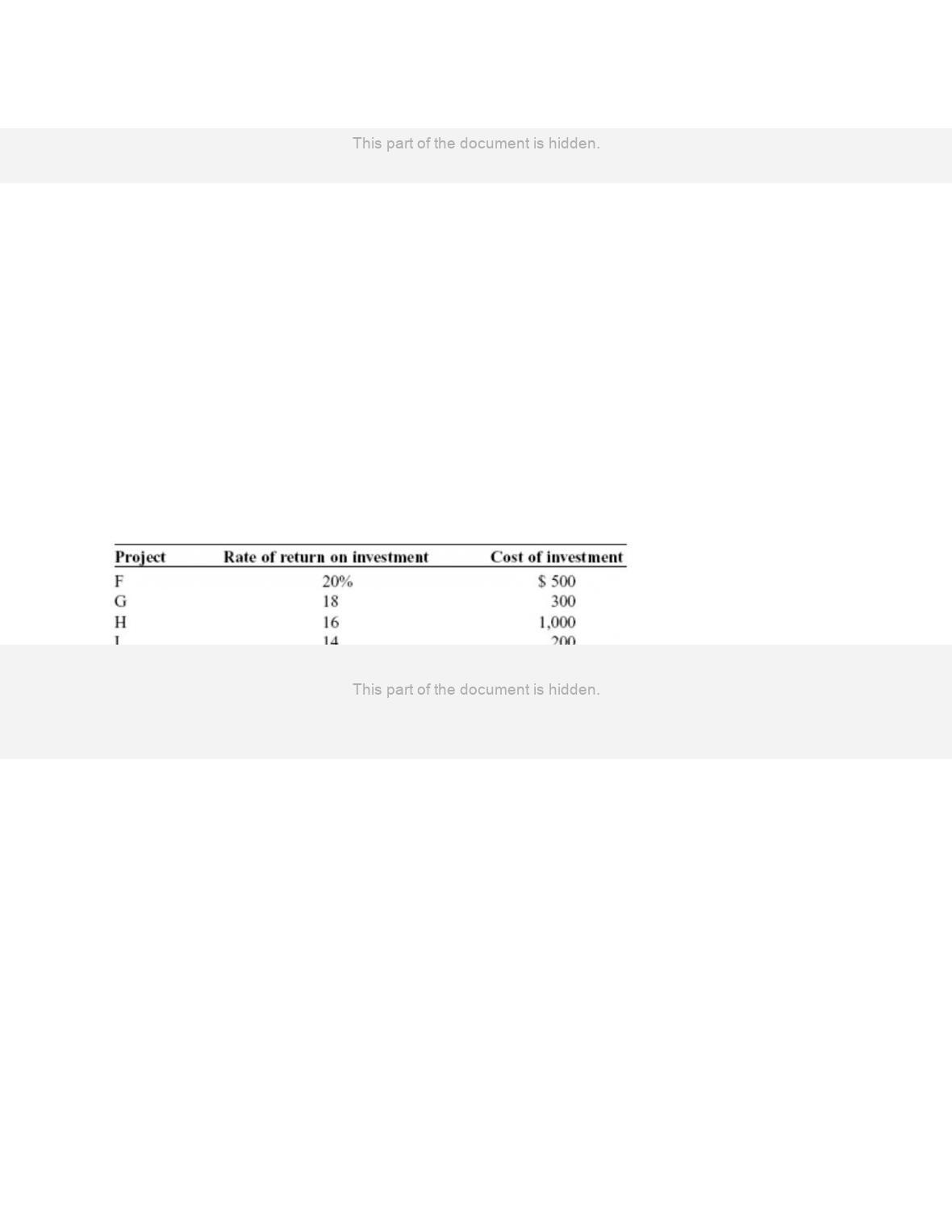
(Table: Investment Projects) Use Table: Investment Projects. If the market interest rate
is 15%, the last project undertaken is:
A)
F.
B)
G.
C)
H.
D)
I.
116.
(Table: Investment Projects) Use Table: Investment Projects. If the market interest rate
is 11%, the last project undertaken is:
A)
G.
B)
H.
C)
I.
D)
J.
Page 27
117.
(Table: Investment Projects) Use Table: Investment Projects. If the market interest rate
is 13%, the amount of planned investment spending is:
A)
$200.
B)
$800.
C)
$1,000.
D)
$2,000.
118.
(Table: Investment Projects) Use Table: Investment Projects. If the market interest rate
is 9%, the amount of planned investment spending is:
A)
$1,800.
B)
$2,000.
C)
$4,000.
D)
$5,500.
119.
(Table: Investment Projects) Use Table: Investment Projects. If the market interest rate
is 17%, the amount of investment demanded is:
A)
$200.
B)
$800.
C)
$1,000.
D)
$2,000.
120.
(Table: Investment Projects) Use Table: Investment Projects. If the market interest rate
is 11%, the amount of investment demanded is:
A)
$800.
B)
$1,000.
C)
$2,000.
D)
$4,000.
121.
(Table: Investment Projects) Use Table: Investment Projects. If the market interest rate
declines from 15% to 11%, then the amount of investment demanded will increase by:
A)
$200.
B)
$1,000.
C)
$2,000.
D)
$2,200.
Page 28
122.
(Table: Investment Projects) Use Table: Investment Projects. If the market interest rate
declines from 15% to 13%, then the amount of investment demanded will increase by:
A)
$200.
B)
$1,000.
C)
$2,000.
D)
$2,200.
123.
Higher rates of interest tend to _____ the quantity of loanable funds demanded, and
lower rates of interest tend to _____ it.
A)
increase; reduce
B)
reduce; reduce
C)
increase; increase
D)
reduce; increase
124.
There is a _____ relationship between the amount of loanable funds demanded and the
rate of interest.
A)
positive
B)
direct
C)
negative
D)
weak
125.
An expectation that perceived business opportunities will increase will generally cause
a(n) _____ for loanable funds.
A)
shift to the left in the demand curve
B)
movement along the demand curve
C)
increase in the demand
D)
decrease in the demand
126.
An increase in the level of business opportunity will generally _____ the loanable funds
demand curve.
A)
not change
B)
left-shift
C)
cause a movement along
D)
right-shift
Page 29
127.
A decrease in the level of business opportunity will generally _____ the loanable funds
demand curve.
A)
not change
B)
left-shift
C)
cause a movement along
D)
right-shift
128.
A decrease in the demand for loanable funds would MOST likely be caused by a(n):
A)
decrease in the market interest rate.
B)
decrease in corporate income tax rates.
C)
increase in expected business opportunities.
D)
decrease in expected business opportunities.
129.
An increase in the demand for loanable funds would MOST likely be caused by a(n):
A)
increase in the market interest rate.
B)
increase in business tax rates.
C)
increase in expected business opportunities.
D)
decrease in expected business opportunities.
130.
A decrease in the demand for loanable funds would MOST likely be caused by a(n):
A)
decrease in the inflation rate.
B)
increase in the budget deficit.
C)
decrease in expected business opportunities.
D)
increase in expected business opportunities.
131.
All other things unchanged, a general increase in government borrowing will typically:
A)
shift the loanable funds demand curve to the left and decrease interest rates.
B)
shift the loanable funds demand curve to the right and increase interest rates.
C)
have no effect on the loanable funds demand curve.
D)
have no effect on the demand for loanable funds.
132.
All other things unchanged, a general decrease in the amount of government borrowing
will typically:
A)
have no effect on the demand for loanable funds.
B)
increase interest rates.
C)
shift the loanable funds demand curve to the left.
D)
raise the level of demand for loanable funds.
Page 30
133.
All other things unchanged, an increase in demand for loanable funds would MOST
likely be caused by a(n):
A)
decrease in expected business opportunities.
B)
increase in the market interest rate.
C)
increase in corporate income tax rates.
D)
increase in government borrowing.
134.
All other things unchanged, an increase in demand for loanable funds would MOST
likely be caused by a(n):
A)
important forecast predicting solid economic growth.
B)
important forecast predicting a recession.
C)
increase in the market interest rate.
D)
increase in the cost of new capital goods.
135.
Which statement is FALSE?
A)
When there is an increase in the government budget deficit, the total amount of
borrowing falls.
B)
When there is an increase in private savings, the interest rate decreases.
C)
When there is an increase in the government budget deficit, private investment is
crowded out.
D)
When there is an increase in private savings, the total amount of borrowing
increases.
136.
A business will be likely to borrow to fund projects if the:
A)
rate of return on the project is less than the interest rate on the loan.
B)
project will produce a good or service that is in high demand.
C)
rate of return on the project is at least as high as the interest rate on the loan.
D)
minimum efficient scale will be attained.
137.
The rate of return on a business project equals:
A)
(Cost of project / revenue from project) * 100.
B)
(Revenue from project / cost of project) * 100.
C)
(Revenue from project * cost of project) * 100.
D)
(Revenue from project – cost of project) / (Cost of project) * 100.
Page 31
138.
Crowding out is a phenomenon in which:
A)
an increase in the government’s budget surplus decreases overall investment
spending.
B)
overproduction in the goods market leads to a sharp drop in the aggregate price
level.
C)
an increase in the government’s budget deficit reduces overall investment spending.
D)
an increase in imports reduces overall domestic production.
Use the following to answer questions 139-142:
139.
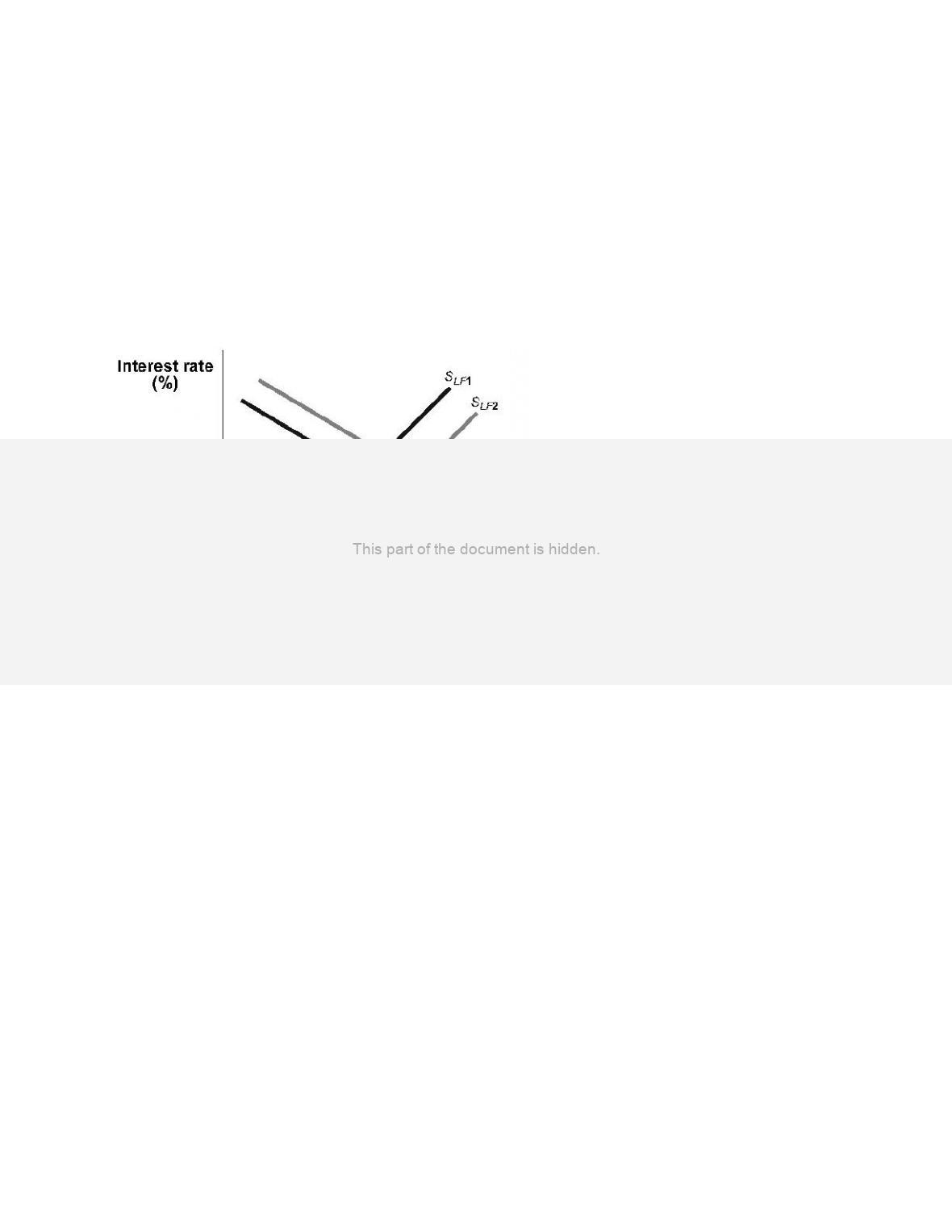
(Figure: Crowding Out) Use Figure: Crowding Out. The demand for loanable funds
curve DLF1 will shift to DLF2 when there is a(n):
A)
decrease in the government budget deficit.
B)
increase in the government budget deficit.
C)
increase in private savings.
D)
decrease in private savings.
140.
(Figure: Crowding Out) Use Figure: Crowding Out. If the demand for loanable funds
curve shifts to the right, the result will be a(n) _____ in the interest rate and a(n) _____
in the total amount of borrowing in the funds market.
A)
increase; increase
B)
increase; decrease
C)
decrease; decrease
D)
decrease; increase
Page 32
141.
(Figure: Crowding Out) Use Figure: Crowding Out. The supply of loanable funds curve
SLF1 shifts to SLF2. This shift implies that:
A)
private savings has increased.
B)
national investment has decreased.
C)
private savings has decreased.
D)
national savings has decreased.
142.
(Figure: Crowding Out) Use Figure: Crowding Out. If the supply of loanable funds
curve shifts to the right, the result will be a(n) _____ in the total amount of borrowing
and a(n) _____ in the interest rate.
A)
increase; increase
B)
decrease; decrease
C)
increase; decrease
D)
decrease; increase
143.
Crowding out means that:
A)
private savings decreases when the government borrows money.
B)
private investment decreases when the government borrows money.
C)
there are too many players in the financial markets.
D)
some bondholders will be squeezed out of the market.
144.
The government’s budget deficit increases, and at the same time the trade deficit grows.
This will lead to a(n) _____ in the demand and a(n) _____ in the supply of loanable
funds in domestic markets.
A)
increase; decrease
B)
decrease; decrease
C)
increase; increase
D)
decrease; increase
Page 33
Use the following to answer questions 145-148:
145.
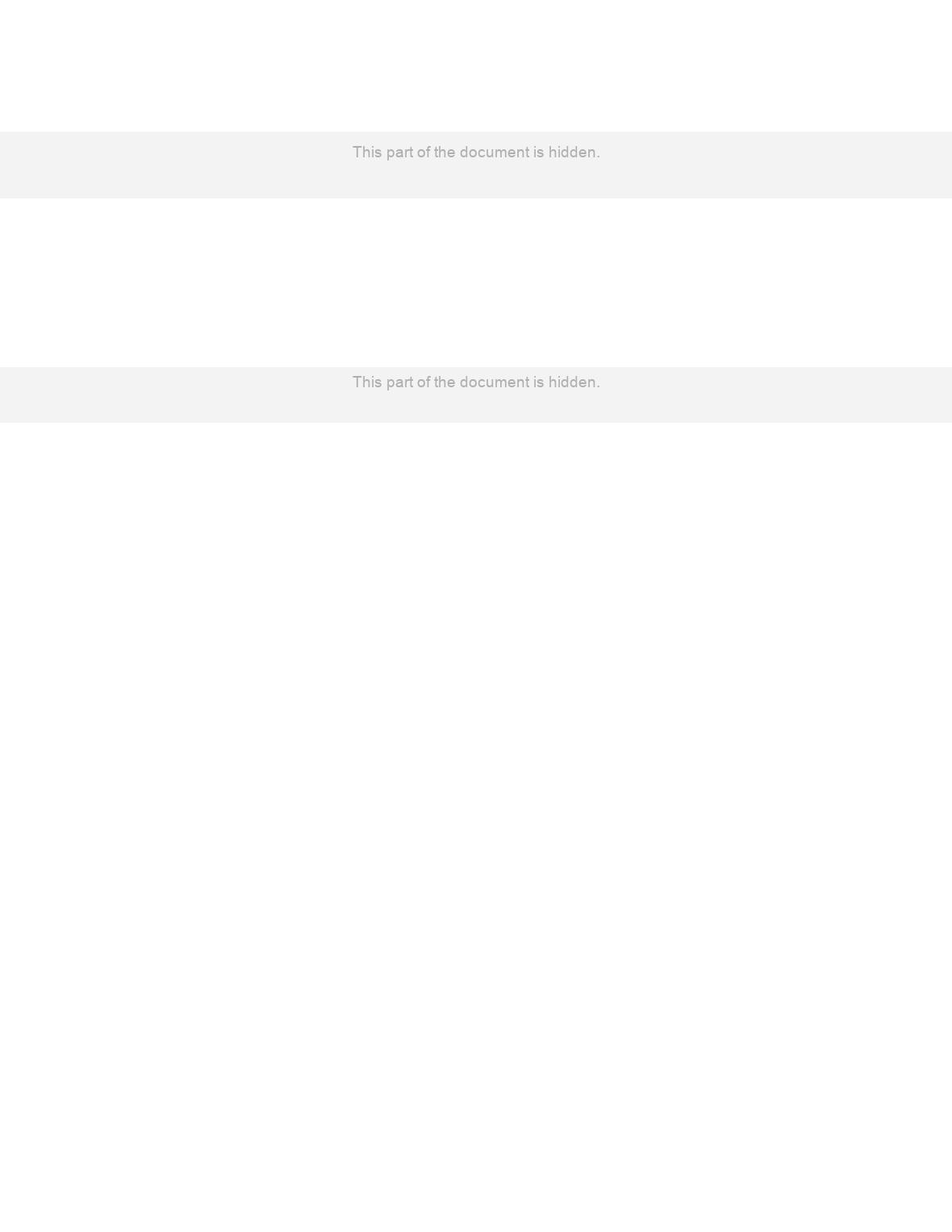
(Figure: The Market for Loanable Funds III) Use Figure: The Market for Loanable
Funds III. If the government in a closed economy is running a budget balance of zero
when it decides to increase defense spending by $200 billion and then finances the
spending by selling bonds, the equilibrium interest rate will:
A)
fall to 12%.
B)
rise to 16.5%.
C)
rise to 18%.
D)
rise to 21%.
146.
(Figure: The Market for Loanable Funds III) Use Figure: The Market for Loanable
Funds III. If the government in a closed economy is running a budget balance of zero
when it decides to increase defense spending by $200 billion and then finances the
spending by selling bonds, the government will crowd out a maximum of _____ in
private investment spending.
A)
$200 billion
B)
$100 billion
C)
$50 billion
D)
$10 billion
Page 34
147.
(Figure: The Market for Loanable Funds III) Use Figure: The Market for Loanable
Funds III. If the government in a closed economy finances deficits by selling bonds and
it decides to decrease defense spending by $200 billion, the equilibrium interest rate
will:
A)
rise to 18%.
B)
not change.
C)
fall to 13.5%.
D)
fall to 12%.
148.
(Figure: The Market for Loanable Funds III) Use Figure: The Market for Loanable
Funds III. If the government in a closed economy finances deficits by selling bonds and
it decides to decrease defense spending by $200 billion, the decrease in government
spending will encourage _____ in additional private investment spending.
A)
$400 billion
B)
$200 billion
C)
$100 billion
D)
$10 billion
149.
Governments can save when:
A)
taxes are less than expenditures.
B)
taxes are greater than expenditures.
C)
the government borrows to finance its expenditures.
D)
the president insists that Congress balance the budget.
150.
The Fisher effect states that the:
A)
nominal rate of interest is unaffected by the change in expected inflation.
B)
nominal rate of interest is unaffected by the change in unexpected inflation.
C)
expected real rate of interest is unaffected by the change in expected inflation.
D)
expected real rate of interest increases by one percentage point for each percentage
change in expected inflation.
151.
Suppose that a lender expects a real interest rate of 6% and the inflation rate is expected
to be 3%. In this case, the nominal interest rate equals _____%.
A)
3
B)
9
C)
12
D)
6
Page 35
152.
Samantha asks her employer for a 5% raise for the coming year. If the inflation rate
during the next year is 5.5%, then her real wage will:
A)
increase by 5%.
B)
decrease by 0.5%.
C)
decrease by 5%.
D)
increase by 0.5%.
153.
Suppose that Maria wins a $7 million lottery and is trying to decide whether to take $2
million all at once or $7 million over 20 years. One bit of information Maria would need
to know is what the prevailing _____ will be over the next 20 years.
A)
unemployment rate
B)
interest rate
C)
deflation rate
D)
standard of living
154.
You receive an email from a firm proposing the following business deal. The firm will
send you $1,000 now, and in exchange you will send it $1,100 in one year. You will just
break-even if the annual interest rate is _____%.
A)
12
B)
4
C)
6
D)
10
155.
Your textbook costs $90, and you can resell it in one year for $45. If the annual interest
rate is 10%, then the present value of the textbook’s resale value (to the nearest dollar)
is:
A)
$90.
B)
$41.
C)
$45.
D)
$37.
156.
You have an opportunity to pay $1,000 today and receive $1,200 a year from now. If the
annual interest rate is 20%, the difference between the present value of the benefit and
your investment is:
A)
$440.
B)
$200.
C)
$166.
D)
0.
Page 36
157.
The _____ money paid back after borrowing money, the _____ the interest rate.
A)
more; higher
B)
less; higher
C)
more; lower
D)
There is not enough information to determine the answer.
158.
If you are paid $10,500 in one year on a $10,000 loan made today, then your annual
interest rate is _____%.
A)
0.5
B)
5
C)
10
D)
10.5
159.
If Mega Corp. borrows $9,000 and agrees to pay the lender $10,000 in one year, the
annual interest rate on the loan is approximately _____%.
A)
9.0
B)
10.0
C)
11.1
D)
0.9
160.
Someone who has to decide whether to receive $100 now or $100 one year from now
will probably choose _____ since there is a(n) _____ in waiting to use the money.
A)
one year from now; benefit
B)
now; opportunity cost
C)
one year from now; opportunity cost
D)
now; benefit
161.
Assuming a positive interest rate, the dollar amount of a future payment is _____ its
present value.
A)
exactly the same as
B)
approximately the same as
C)
less than
D)
more than
162.
Assuming a positive interest rate, the present value of a future payment is _____ its
future dollar amount.
A)
exactly the same as
B)
approximately the same as
C)
less than
D)
more than

163.
An amount that would equal a particular future value if deposited today at the prevailing
interest rate is the:
A)
present value.
B)
inflation rate.
C)
discount premium.
D)
market index.
164.
The present value of future payments depends on:
A)
whether the payment is interest or dividends.
B)
the marginal propensity to save.
C)
the interest rate.
D)
sunk costs.
165.
Given an annual interest rate of 3%, the present value of a future payment of $2,080 to
be paid in one year is:
A)
$1,904.76.
B)
$2,000.00.
C)
$2,019.42.
D)
$2,080.00.
166.
The present value of $1 realized one year from now equals:
A)
$1 / (1 + r).
B)
$1 * (1 + r).
C)
1 + r.
D)
1 / r.
167.
You have purchased a new mattress for $2,000, and the store has given you a “12
months, same as cash” deal. This means that you do not actually have to pay for the
mattress for another year. One year from now, you will have to give the store the full
price of $2,000. If the annual interest rate is 10%, how much money do you need today
to ensure that you will have $2,000 one year from today?
A)
$1,980
B)
$1,818
C)
$2,200
D)
$20,000
Page 38
168.
You are given the choice of receiving $100 today or $115 one year from today. What
annual interest rate will make you indifferent between these two choices?
A)
5%
B)
10%
C)
15%
D)
20%
169.
If you are paid $5,500 in one year on a $5,000 loan made today, then your annual
interest rate is _____%.
A)
0.5
B)
10
C)
1
D)
5
170.
Assuming a positive interest rate, the dollar amount of a future payment is:
A)
exactly the same as its present value.
B)
approximately the same as its present value.
C)
less than its present value.
D)
more than its present value.
171.
An amount that would equal a particular future value if deposited today at a specific
interest rate is the:
A)
present value.
B)
inflation rate.
C)
discount premium.
D)
market index.
172.
The present value of a future payment _____ if the _____.
A)
decreases; interest rate increases
B)
increases; future payment decreases
C)
decreases; interest rate decreases
D)
increases; stock market falls
173.
If Mega Corp. borrows $8,000 and agrees to pay the lender $9,000 in one year, the
annual interest rate on the loan is approximately _____%.
A)
9.0
B)
10.5
C)
12.5
D)
11.8
Page 39
174.
If Mega Corp. borrows $9,000 and agrees to pay the lender $10,500 in one year, the
annual interest rate on this loan is approximately _____%.
A)
8.6
B)
14.3
C)
16.7
D)
15
175.
The present value of a $110 payment in one year, given an annual 10% interest rate, is:
A)
$10.
B)
$11.
C)
$100.
D)
$110.
176.
Given an annual interest rate of 2%, the present value of a future payment of $1,500 to
be paid in one year is:
A)
$1,250.55.
B)
$1,470.59.
C)
$1,530.
D)
$1,500.
177.
Interest rates:
A)
were very high in the 1970s and decreased in the 1980s.
B)
were very low in the 1970s and increased in the 1980s.
C)
steadily increased from 1960 through 2016.
D)
steadily decreased from 1960 through 2016.
178.
Inflation:
A)
was very low in the 1970s and increased in the 1980s.
B)
was very high in the 1970s and decreased in the 1980s.
C)
steadily increased from 1960 through 2016.
D)
steadily decreased from 1960 through 2016.
179.
Interest rates were high during the 1970s and decreased during the 1980s because
expected inflation was:
A)
high during both decades.
B)
low during both decades.
C)
high during the 1970s and decreased during the 1980s.
D)
low during the 1970s and increased during the 1980s.
Page 40
180.
Interest rates were high during the middle years of the period from 2002 to 2016 and
then decreased primarily because the:
A)
supply of loanable funds steadily increased.
B)
supply of loanable funds steadily decreased.
C)
demand for loanable funds decreased and then increased because of conditions in
the housing market.
D)
demand for loanable funds increased and then decreased because of conditions in
the housing market.
181.
From the standpoint of economic growth, banks are important to:
A)
fight inflation.
B)
keep interest rates low.
C)
channel savings into investment.
D)
channel investment into savings.
182.
Which item qualifies as an asset from the viewpoint of a household?
A)
a house
B)
a mortgage
C)
credit card debt
D)
a car loan
183.
The value of all accumulated savings of a household is called:
A)
wealth.
B)
income.
C)
debt.
D)
wages.
184.
The main role of financial systems is to:
A)
make the capitalist class richer.
B)
provide credit cards to as many people as possible.
C)
channel goods and services to the people willing to pay for them.
D)
channel funds from savers into investments.
185.
A household’s wealth is:
A)
what it earns each period.
B)
what it saves each period.
C)
the value of its accumulated savings.
D)
the value of its financial assets.