Page 39
154.
(Figure: MSB and MSC of Pollution) Use Figure: MSB and MSC of Pollution. Assume
that firms are the only beneficiaries of pollution and that costs are borne solely by others
in the society. What level of pollution represents the socially optimal level?
A)
Q1
B)
Q2
C)
Q3
D)
Q4
155.
(Figure: MSB and MSC of Pollution) Use Figure: MSB and MSC of Pollution. Assume
that firms are the only beneficiaries of pollution and that costs are borne solely by others
in the society. If the current level of pollution is at Q1, _____ pollution is being emitted
because _____.
A)
not enough; MSB > MSC
B)
not enough; MSB < MSC
C)
too much; MSB > MSC
D)
the socially optimal amount of; MSB = MSC
156.
(Figure: MSB and MSC of Pollution) Use Figure: MSB and MSC of Pollution. Assume
that firms are the only beneficiaries of pollution and that costs are borne solely by others
in the society. Suppose pollution is unregulated. What level of emissions tax would
move the level of pollution to the socially optimal level?
A)
$100 per ton
B)
$800 per ton
C)
$500 per ton
D)
$300 per ton
Page 40
Use the following to answer questions 157-160:
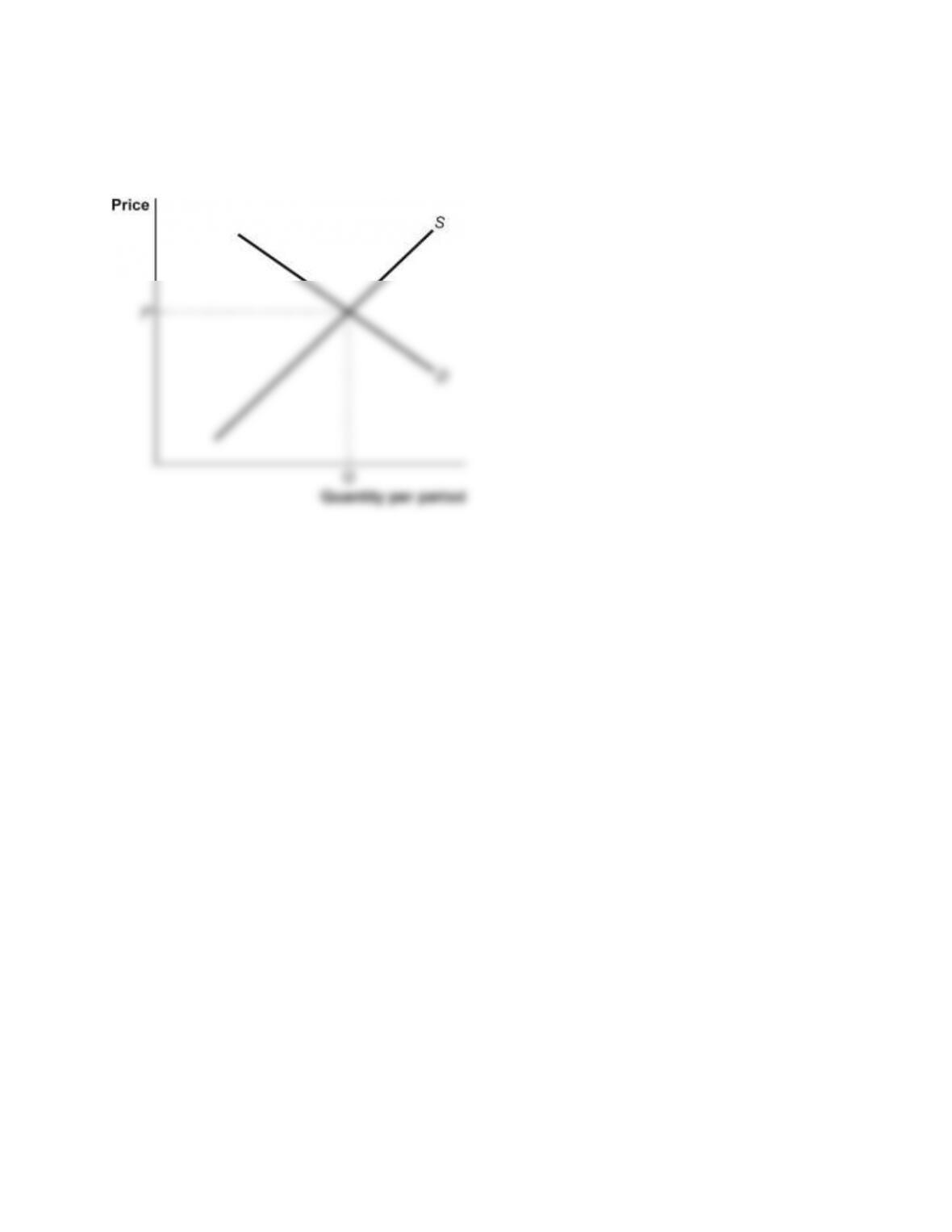
Figure: Model of a Competitive Market
157.
(Figure: Model of a Competitive Market) Use Figure: Model of a Competitive Market.
Given the figure, if there are no external benefits or costs, the output at Q will be:
A)
larger than is socially desirable.
B)
smaller than is socially desirable.
C)
efficient.
D)
inefficient.
158.
(Figure: Model of a Competitive Market) Use Figure: Model of a Competitive Market.
Given the figure, if there are external costs:
A)
resources will be underallocated to the production of the good.
B)
resources will be overallocated to the production of the good.
C)
resources will be efficiently allocated to the production of the good.
D)
the price at P will be higher than if there were no external costs.
159.
(Figure: Model of a Competitive Market) Use Figure: Model of a Competitive Market.
Given the figure, if there are external costs, a tax imposed on sellers will:
A)
decrease the equilibrium quantity.
B)
increase the equilibrium quantity.
C)
have no effect on the equilibrium price.
D)
decrease the equilibrium price.
Page 41
160.
(Figure: Model of a Competitive Market) Use Figure: Model of a Competitive Market.
Given the figure, if a tax is imposed on sellers, the equilibrium price will _____ and the
equilibrium quantity will _____.
A)
increase; decrease
B)
remain the same; increase
C)
remain the same; decrease
D)
increase; increase
161.
A principal cause of market failure is actions generating side effects on nonmarket
participants that are not properly taken into account by the market.
A)
True
B)
False
162.
The total external cost of air pollution in Tennessee affects the final price of goods in
Tennessee, assuming that the government does not intervene in the marketplace.
A)
True
B)
False
163.
Externalities exist when individuals impose costs or confer benefits on others but don’t
have an incentive to take those costs or benefits into account.
A)
True
B)
False
164.
The marginal social benefit of pollution is always zero.
A)
True
B)
False
165.
Economists and environmentalists agree that pollution is undesirable and that
government policy should aim to achieve a zero-pollution society.
A)
True
B)
False
166.
If at the current amount of pollution its marginal social benefit is greater than its
marginal social cost, then there is too little pollution.
A)
True
B)
False
Page 42
167.
The economically efficient level of an externality is zero.
A)
True
B)
False
168.
According to the Coase theorem, only when transaction costs are extremely high can
two parties internalize a negative externality.
A)
True
B)
False
169.
According to the Coase theorem, the inefficiencies caused by externalities can be
removed by the private sector if individuals enter into appropriately structured deals,
provided that the transaction costs of such deals are sufficiently low.
A)
True
B)
False
170.
If externalities are fully internalized, an outcome is efficient, even without government
intervention.
A)
True
B)
False
171.
Environmental standards ensure that the marginal benefit of pollution is equal for all
sources of pollution.
A)
True
B)
False
172.
The most economically efficient way to reduce pollution is to impose strict
environmental standards on all polluters.
A)
True
B)
False
173.
Since texting while driving generates a negative externality, banning texting while
driving would necessarily be economically efficient.
A)
True
B)
False
Page 43
174.
Taxes on sulfur dioxide emissions, excise taxes on gas, and sales taxes are all examples
of Pigouvian taxes.
A)
True
B)
False
175.
The optimal Pigouvian tax is equal to the marginal social cost of pollution at the socially
optimal quantity of pollution (assuming there are no private costs from pollution to the
polluter).
A)
True
B)
False
176.
Emissions taxes and tradable emissions permits both ensure that any given reduction in
total pollution is achieved at the lowest possible cost. This is not the case for
environmental standards since they fail to ensure that those who can reduce pollution
most cheaply are in fact the ones to do so.
A)
True
B)
False
177.
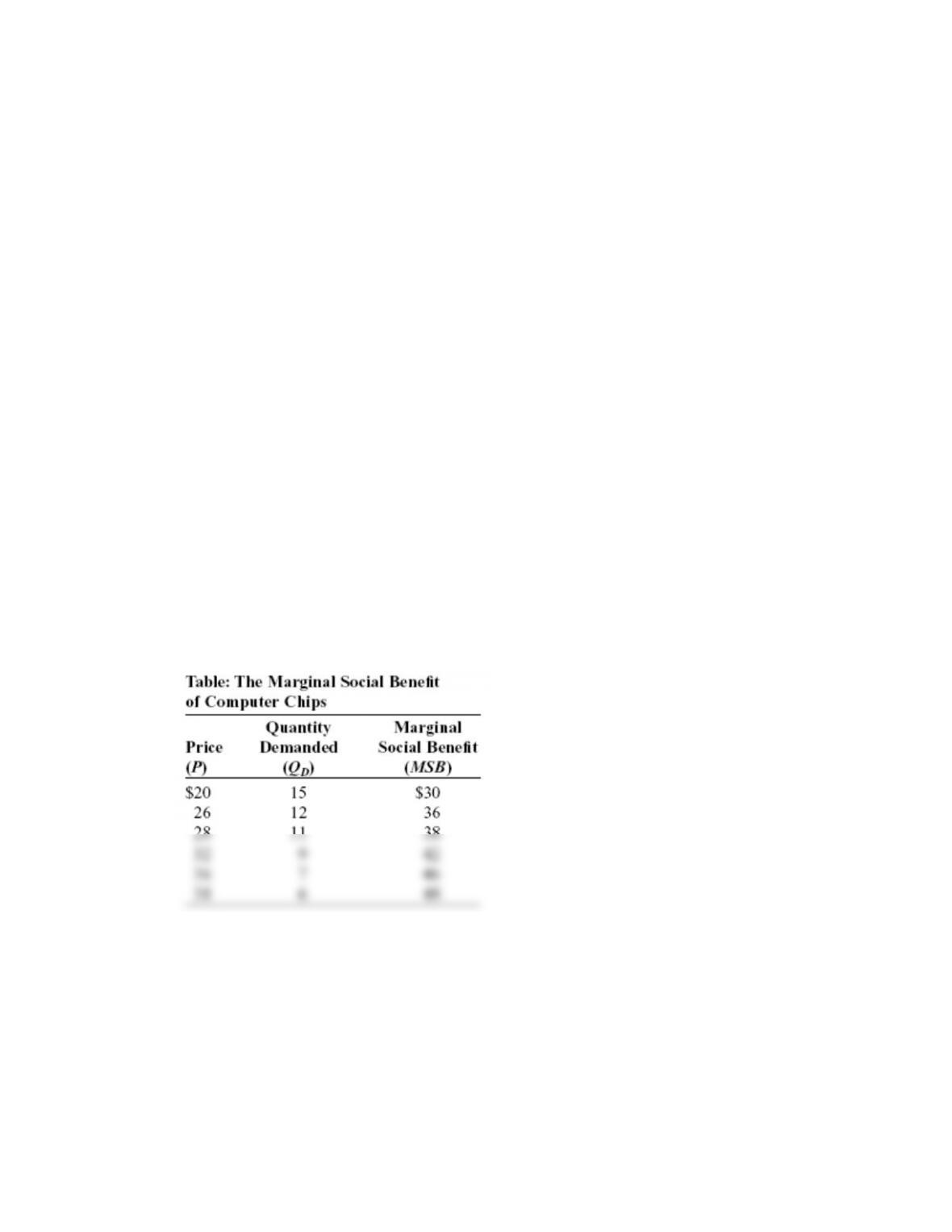
(Table: The Marginal Social Benefit of Computer Chips) Use Table: The Marginal
Social Benefit of Computer Chips. The production of computer chips generates an
external benefit in the form of a technology spillover. If the marginal social benefit is
indicated by MSB, the optimal Pigouvian subsidy is equal to $10.
A)
True
B)
False
178.
What is meant by a negative externality? Use an example in your explanation.
179.
What is meant by a positive externality? Use an example to assist your explanation.
180.
If pollution is such a bad thing, why do economists argue that the optimal amount of
pollution is greater than zero?
181.
Brad and Angelina are neighbors. Brad never mows his yard, rakes his leaves, or trims
his hedges. His overgrown yard not only is an eyesore, it is pulling down the value of
Angelina’s house. How could the Coase theorem be used to remedy this negative
externality? Does it matter whether Brad has the right to ignore his yard or Angelina has
the right to force him to clean it up?
182.
Industrial production of goods causes pollution that damages the environment. Suppose
that polluting does not cost the polluters anything but that the marginal social cost of
pollution can be represented by the function MSC = 2T, where T represents tons of
pollution. Suppose that the marginal social benefit of pollution (accruing entirely to the
polluters) can be represented by the function MSB = 1,000 – 2T.
A) In an unregulated market, how many tons of pollution will be emitted?
B) Solve for the socially optimal amount of pollution.
C) What level of Pigouvian tax will reduce pollution to the optimal level?
183.
In an unregulated market, how much pollution will be emitted as goods and services are
produced? Why is this market outcome inefficient?
184.
Why do economists argue that an emissions tax is a more efficient way to reduce
pollution than is an environmental standard?
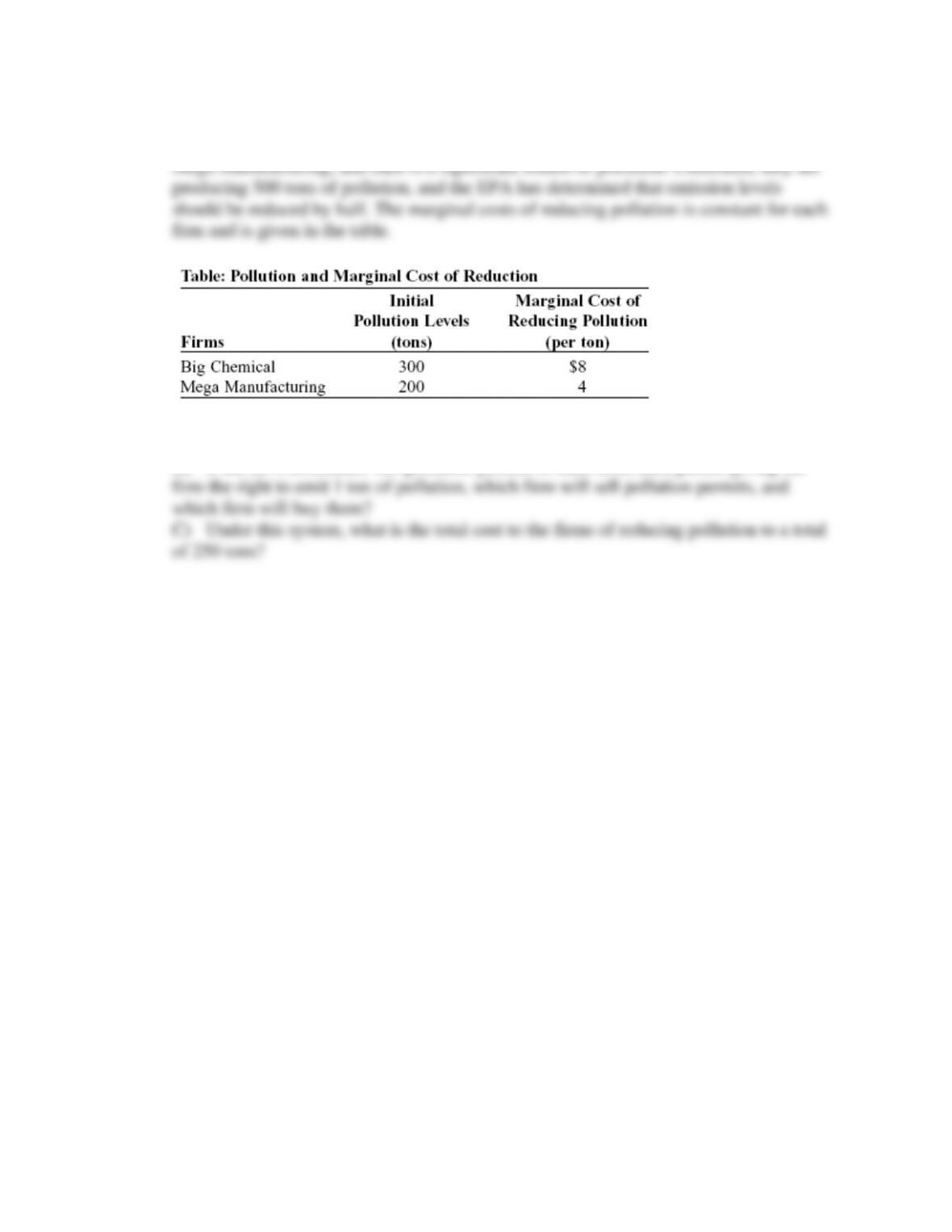
185.
(Table: Pollution and Marginal Cost of Reduction) Use Table: Pollution and Marginal
Cost of Reduction. There are two large firms in your community, Big Chemical and
Mega Manufacturing, and each is a significant source of pollution. Combined, they are
producing 500 tons of pollution, and the EPA has determined that emission levels
should be reduced by half. The marginal costs of reducing pollution is constant for each
firm and is given in the table.
A) If the EPA dictated that each firm must emit only 125 tons of pollution, how much
total cost would the firms incur to meet this environmental standard?
B) If the EPA distributes 125 pollution permits to each firm, each permit giving the
firm the right to emit 1 ton of pollution, which firm will sell pollution permits, and
which firm will buy them?
C) Under this system, what is the total cost to the firms of reducing pollution to a total
of 250 tons?
186.
Economists say that, when an activity provides a positive externality to the community,
the market does not produce enough of that activity. Why?
187.
More and more firms are developing cars that are powered by electricity, rather than
gasoline. How does the absence of a network externality hinder the widespread adoption
of these vehicles?
188.
The marginal social cost of a unit of pollution:
A)
is the additional cost imposed on society by that unit.
B)
is easy to calculate since pollution produces costs.
C)
is often overestimated.
189.
The marginal social benefit of pollution:
A)
increases as more pollution is emitted.
B)
equals zero when the social optimal quantity of pollution is produced.
C)
equals the marginal social cost of pollution in all markets at equilibrium.
D)
is the benefit to society of one more unit of pollution.
Page 46
Use the following to answer questions 190-192:
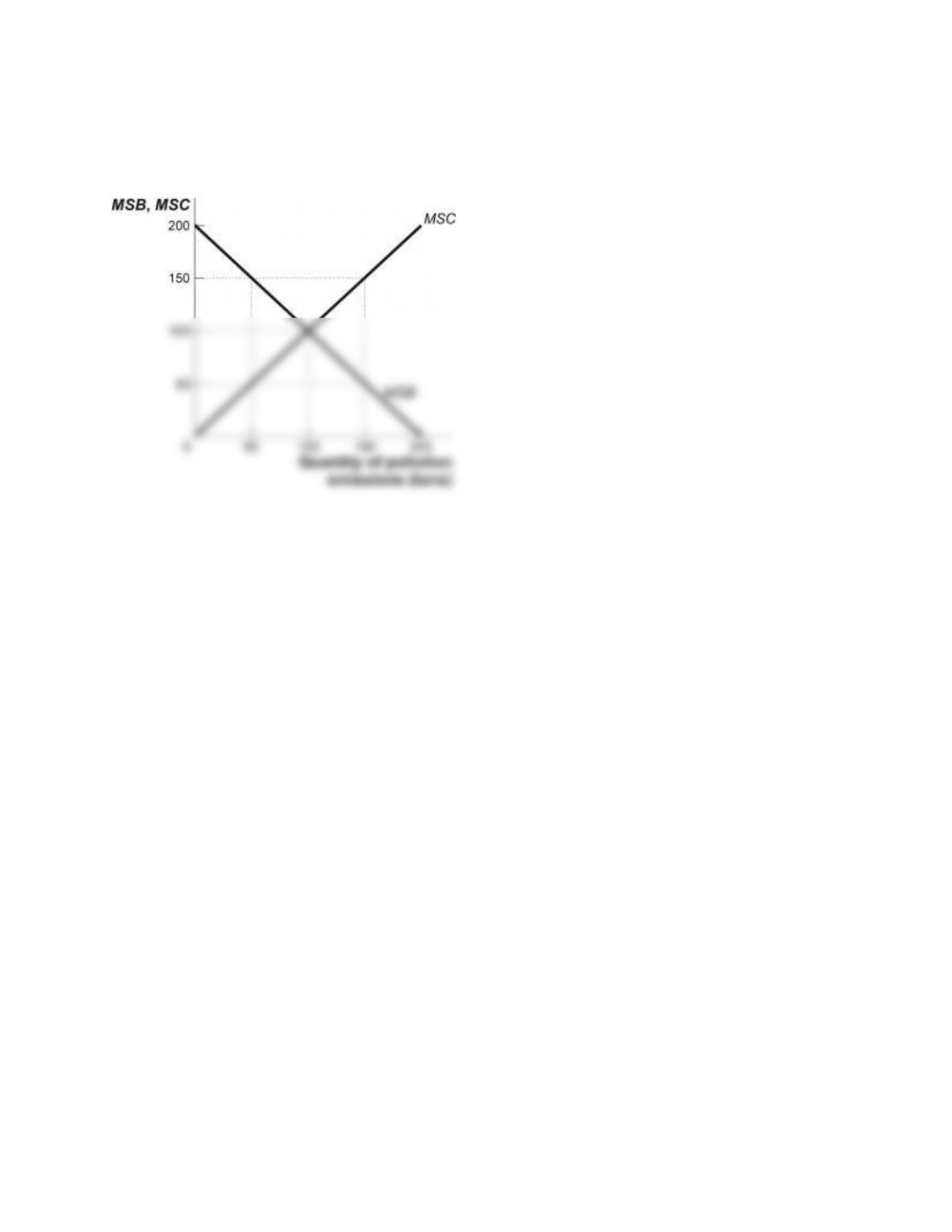
Figure: The Quantity of Pollution
190.
(Figure: The Quantity of Pollution) Use Figure: The Quantity of Pollution. If the amount
of pollution emitted is 150:
A)
this economy would benefit by increasing production of this good.
B)
the marginal social benefit is greater than the marginal social cost of pollution.
C)
the production of pollution is not socially optimal.
D)
this economy is producing at the socially optimal level of pollution.
191.
(Figure: The Quantity of Pollution) Use Figure: The Quantity of Pollution. The socially
optimal level of pollution emissions for this economy is:
A)
0.
B)
50.
C)
100.
D)
150.
192.
(Figure: The Quantity of Pollution) Use Figure: The Quantity of Pollution. When this
economy produces 50 tons of emissions, it:
A)
is producing below its socially optimal level of production.
B)
finds that the marginal social cost is greater than the marginal social benefit.
C)
is not recognizing the marginal private benefits or costs.
D)
is producing at its socially optimal level of production.
Page 47
193.
An emissions tax will:
A)
ensure that the marginal benefit of pollution is equal for all sources of pollution.
B)
set standards to which all producers must adhere, regardless of their production
costs.
C)
cause all polluters to reduce emissions by the same amount.
D)
increase pollution, but not in the most efficient cost-saving way.
194.
Firm A and firm B both produce a good whose manufacture causes pollution, but the
firms differ in their marginal benefit from pollution. In this case, an emissions standard
would:
A)
reduce pollution in the most effective manner.
B)
lead to an unequal reduction in pollution for both firms.
C)
not be efficient since it does not take into account differences in marginal benefits
from polluting.
D)
be preferred to an emissions tax since it takes into account differences in marginal
benefits.
195.
Pigouvian taxes:
A)
tax the profits of polluting firms.
B)
are designed to reduce external costs.
C)
are essentially the same as emissions standards.
D)
are tradable emissions permits.
196.
Markets for the right to pollute are:
A)
established by individual firms when they reduce emissions.
B)
established by government when it issues tradable pollution permits.
C)
likely to result in fewer incentives to develop and implement technology that
reduces pollution.
D)
a means by which more pollution is encouraged.
197.
Both emissions taxes and tradable emissions permits:
A)
are efficient cost-minimizing methods of pollution reduction.
B)
work only if they are coupled with environmental standards.
C)
encourage more pollution.
D)
are usually less effective than are environmental standards.
Page 48
198.
Positive externalities:
A)
are similar to negative externalities in their ease of measuring marginal benefits.
B)
are likely to be solved with the use of a Pigouvian tax.
C)
are difficult to measure since marginal social benefits are hard to observe.
D)
result from greater than optimal production of a good.
199.
Flu vaccines often provide both private benefits to individuals and positive external
benefits to other members of society. As a result, without government intervention, one
would find:
A)
too many doses of flu vaccine being produced since external benefits would not be
considered.
B)
too few doses of flu vaccine being produced since external benefits would not be
considered.
C)
the optimal amount of doses of flu vaccines being produced since external benefits
would not be considered.
D)
a shortage of doses of flu vaccine because their marginal social benefit is
overestimated.
200.
Suppose that each person in a community had to pay for his or her own education from
kindergarten through high school. One would expect that:
A)
less education would be acquired than at present since an individual may not
consider the positive external benefits of education to society.
B)
more education would be acquired than at present since an individual may not
consider the positive external benefits of education to society.
C)
the optimal amount of education would be acquired by community members since
they each paid for the amount of education they wanted.
D)
a Pigouvian tax would ensure the optimal amount of education.
201.
To encourage consumption of a good that generates positive externalities, the BEST
option for policymakers would be to:
A)
impose a tax on the amount consumed to achieve the socially optimal level.
B)
mandate consumption of the good at the socially optimal level.
C)
provide a subsidy per unit of the good consumed to achieve the socially optimal
level.
D)
do nothing since the market will achieve the socially optimal level without
government intervention.
Page 49
202.
A good is subject to a network externality when:
A)
the value of the good to an individual is less when a large number of other people
also use the good.
B)
the value of the good is determined only by marginal private benefits.
C)
an increase in the number of other people using the good increases its value to an
individual.
D)
a good yields negative externalities.
203.
Network externalities are often:
A)
separate from positive feedback.
B)
a reason for natural monopolies.
C)
less likely to occur in the communications or technology industries than they are in
other industries.
D)
not likely to move toward market domination.
204.
(Scenario: Private and External Benefits) Use Scenario: Private and External Benefits.
How many hours of lawn upkeep will occur in this community, and what will be the
marginal private benefit of such upkeep?
Scenario: Private and External Benefits
A small community finds that tidy lawns and neighborhoods provide both private and
external benefits. They determine that the marginal private benefit (MPB) of lawns can
be represented by the equation MPB = 50 – 0.5Q, where Q is the number of hours spent
on keeping lawns tidy. The marginal private cost (MPC) of such lawn upkeep is
represented by the equation MPC = 0.5Q, where Q is again the number of hours
engaged in lawn upkeep.
A)
50 hours and $50
B)
45 hours and $20
C)
50 hours and $25
D)
100 hours and $50
Page 50
205.
(Scenario: Private and External Benefits) Use Scenario: Private and External Benefits.
The community estimates the marginal benefit to external parties from lawn upkeep to
be $15. Given this information, what is the socially optimal amount of lawn upkeep for
this community?
Scenario: Private and External Benefits
A small community finds that tidy lawns and neighborhoods provide both private and
external benefits. They determine that the marginal private benefit (MPB) of lawns can
be represented by the equation MPB = 50 – 0.5Q, where Q is the number of hours spent
on keeping lawns tidy. The marginal private cost (MPC) of such lawn upkeep is
represented by the equation MPC = 0.5Q, where Q is again the number of hours
engaged in lawn upkeep.
A)
0 hours
B)
45 hours
C)
50 hours
D)
65 hours
206.
(Scenario: Private and External Benefits) Use Scenario: Private and External Benefits.
The community decides that the marginal benefit to external parties from lawn upkeep
is $15 and that it is important to maintain the socially optimal number of lawn upkeep
hours. To achieve this goal, the community will:
Scenario: Private and External Benefits
A small community finds that tidy lawns and neighborhoods provide both private and
external benefits. They determine that the marginal private benefit (MPB) of lawns can
be represented by the equation MPB = 50 – 0.5Q, where Q is the number of hours spent
on keeping lawns tidy. The marginal private cost (MPC) of such lawn upkeep is
represented by the equation MPC = 0.5Q, where Q is again the number of hours
engaged in lawn upkeep.
A)
require community lawn service of 45 hours.
B)
subsidize everyone who contributes to lawn upkeep with a payment of $15.
C)
implement a Pigouvian lawn tax of $65.
D)
provide no additional funds to lawn upkeep.
Page 51
Use the following to answer questions 207-209:
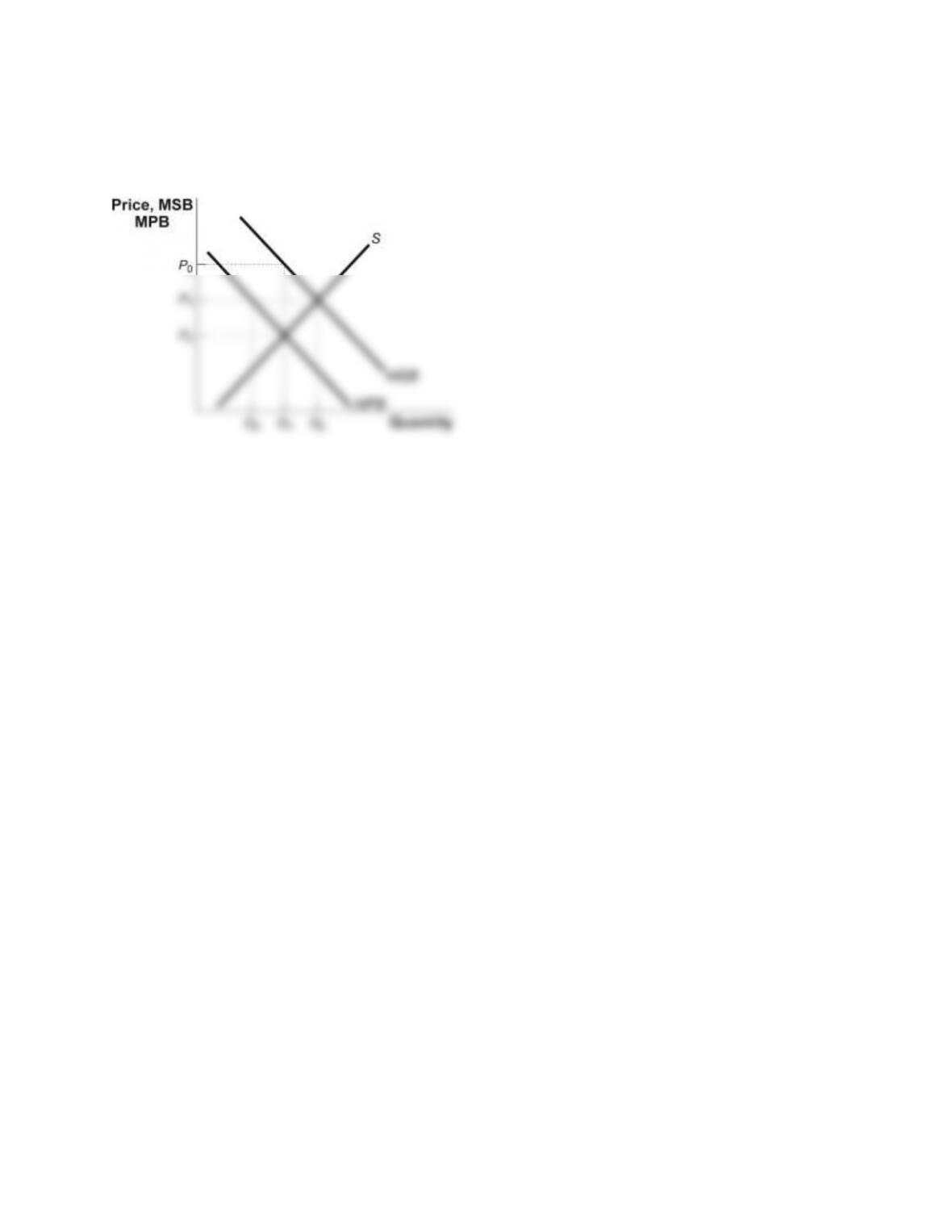
Figure: Marginal Private Benefits and Marginal Social Benefits
207.
(Figure: Marginal Private Benefits and Marginal Social Benefits) Use Figure: Marginal
Private Benefits and Marginal Social Benefits. Without government intervention, this
market will produce _____ units at a price of _____.
A)
Q0; P0
B)
Q1; P0
C)
Q1; P2
D)
Q2; P1
208.
(Figure: Marginal Private Benefits and Marginal Social Benefits) Use Figure: Marginal
Private Benefits and Marginal Social Benefits. If government does intervene and
encourages the market to produce and price at the socially optimal level, what will be
the output and price?
A)
Q0 and P0
B)
Q1 and P0
C)
Q1 and P2
D)
Q2 and P1
209.
(Figure: Marginal Private Benefits and Marginal Social Benefits) Use Figure: Marginal
Private Benefits and Marginal Social Benefits. One way for the government to achieve
this socially optimal level is by:
A)
imposing a per-unit tax equal to P1 – P2.
B)
providing a per-unit subsidy of P0 – P2.
C)
providing a per-unit subsidy of P1 – P2.
D)
leaving the quantity at the initial private market-clearing quantity and price.
Page 52
Answer Key
1.
B
2.
C
3.
D
4.
B
5.
A
6.
B
7.
A
8.
C
9.
B
10.
D
11.
C
12.
C
13.
B
14.
C
15.
B
16.
B
17.
C
18.
A
19.
B
20.
B
21.
A
22.
B
23.
A
24.
D
25.
C
26.
D
27.
C
28.
A
29.
B
30.
D
31.
B
32.
A
33.
B
34.
C
35.
B
36.
D
37.
C
38.
D
39.
B
40.
A
41.
B
42.
A
43.
B
44.
C
Page 53
45.
A
46.
A
47.
B
48.
B
49.
B
50.
D
51.
A
52.
D
53.
D
54.
B
55.
D
56.
A
57.
C
58.
B
59.
C
60.
B
61.
D
62.
A
63.
D
64.
D
65.
A
66.
B
67.
D
68.
A
69.
A
70.
C
71.
C
72.
B
73.
C
74.
C
75.
D
76.
B
77.
A
78.
A
79.
D
80.
B
81.
B
82.
A
83.
C
84.
A
85.
A
86.
A
87.
C
88.
A
89.
C
90.
D
Page 54
91.
C
92.
C
93.
B
94.
D
95.
B
96.
A
97.
C
98.
D
99.
C
100.
C
101.
C
102.
B
103.
C
104.
D
105.
C
106.
B
107.
C
108.
D
109.
C
110.
C
111.
D
112.
B
113.
A
114.
A
115.
C
116.
B
117.
D
118.
D
119.
D
120.
C
121.
C
122.
C
123.
B
124.
B
125.
C
126.
C
127.
C
128.
C
129.
A
130.
A
131.
D
132.
C
133.
B
134.
B
135.
C
136.
C
Page 55
137.
C
138.
D
139.
A
140.
A
141.
D
142.
A
143.
D
144.
A
145.
D
146.
C
147.
A
148.
B
149.
A
150.
B
151.
C
152.
A
153.
D
154.
B
155.
A
156.
C
157.
C
158.
B
159.
A
160.
A
161.
A
162.
B
163.
A
164.
B
165.
B
166.
A
167.
B
168.
B
169.
A
170.
A
171.
B
172.
B
173.
B
174.
B
175.
A
176.
A
177.
A
178.
179.
180.
181.
182.
Page 56
183.
184.
185.
186.
187.
188.
A
189.
D
190.
C
191.
C
192.
A
193.
A
194.
C
195.
B
196.
B
197.
A
198.
C
199.
B
200.
A
201.
C
202.
C
203.
B
204.
C
205.
D
206.
B
207.
C
208.
D
209.
B