Page 61
292.
(Table: Real and Nominal Output) Use Table: Real and Nominal Output. The price
index in year 1, using year 3 as the base period, is:
A)
25.
B)
50.
C)
100.
D)
150.
293.
(Table: Real and Nominal Output) Use Table: Real and Nominal Output. The price
index in year 1, using year 4 as the base period, is:
A)
25.
B)
50.
C)
100.
D)
150.
294.
(Table: Real and Nominal Output) Use Table: Real and Nominal Output. In which year
is all of the increase in nominal output due to an increase in real output?
A)
2
B)
3
C)
5
D)
6
295.
(Table: Real and Nominal Output) Use Table: Real and Nominal Output. Nominal
output in year 3 is:
A)
$20.
B)
$50.
C)
$100.
D)
$1,500.
296.
(Table: Real and Nominal Output) Use Table: Real and Nominal Output. Nominal
output in year 4 is:
A)
$70.
B)
$120.
C)
$140.
D)
$280.
Page 62
297.
(Table: Real and Nominal Output) Use Table: Real and Nominal Output. The change in
nominal output between years 3 and 4 is an increase of:
A)
64%.
B)
100%.
C)
180%.
D)
280%.
298.
(Table: Real and Nominal Output) Use Table: Real and Nominal Output. Assuming year
3 is the base year, real output in year 3 is:
A)
$100.
B)
$120.
C)
$140.
D)
$200.
299.
(Table: Real and Nominal Output) Use Table: Real and Nominal Output. Assuming year
3 is the base year, real output in year 4 is:
A)
$100.
B)
$120.
C)
$140.
D)
$200.
300.
(Table: Real and Nominal Output) Use Table: Real and Nominal Output. Assuming year
3 is the base year, the change in real output between years 3 and 4 is an increase of:
A)
40%.
B)
100%.
C)
140%.
D)
200%.
301.
The circular-flow diagram illustrates the growth of income inequality in the United
States.
A)
True
B)
False
302.
Flows of money, goods and services, and factors of production through the economy are
all shown in the circular-flow diagram.
A)
True
B)
False
Page 63
303.
The underlying principle of the circular-flow diagram is that the flows of money into
each sector or market in the economy are greater than those coming out of the sector or
market.
A)
True
B)
False
304.
The underlying principle of the circular-flow diagram is that the flows of money into
each sector or market in the economy are equal to those coming out of the sector or
market.
A)
True
B)
False
305.
A firm is an organization that produces goods and/or services for sale.
A)
True
B)
False
306.
A firm is an organization that buys goods and/or services and produces resources.
A)
True
B)
False
307.
A household is a person or group of people who share an income.
A)
True
B)
False
308.
A household is a person or group of people who buy resources and produce goods and
services.
A)
True
B)
False
309.
Households demand goods and services in the product markets.
A)
True
B)
False
310.
Households supply goods and services in the product markets.
A)
True
B)
False

Page 64
311.
Households demand resources in the factor markets.
A)
True
B)
False
312.
Households supply resources in the factor markets.
A)
True
B)
False
313.
Firms demand goods and services in the product markets.
A)
True
B)
False
314.
Firms supply goods and services in the product markets.
A)
True
B)
False
315.
Firms demand resources in the factor markets.
A)
True
B)
False
316.
Firms supply resources in the factor markets.
A)
True
B)
False
317.
The government returns part of the money it raises from taxes in the form of
government transfers.
A)
True
B)
False
318.
For measuring GDP as spending on domestically produced final goods and services,
spending on inputs like steel for manufacturing a car is counted in GDP, but spending
on a new factory in which the cars are produced is NOT counted in GDP.
A)
True
B)
False
Page 65
319.
Final goods and services are sold to the final or end user.
A)
True
B)
False
320.
When Disney builds a new amusement park in the United States, it is counted as part of
GDP.
A)
True
B)
False
321.
Most of the value added included in GDP in the United States is added by businesses,
rather than by consumers.
A)
True
B)
False
322.
The largest spending category in GDP is consumption.
A)
True
B)
False
323.
If the United States exports $500 of goods and services and imports $700 of goods and
services, net exports are $1,200.
A)
True
B)
False
324.
Steel manufactured to make a car is not counted in aggregate output, but the car that
results is counted.
A)
True
B)
False
325.
Doublecounting in the GDP can be avoided by including both final and intermediate
production.
A)
True
B)
False
326.
Renting a car to go on a vacation will result in more GDP than it will if you use your
own car.
A)
True
B)
False

Page 66
327.
The most important use of GDP is to measure of the size of the economy, which can be
used to compare economic performance over time or between countries.
A)
True
B)
False
328.
If nominal GDP increases from $10 trillion to $12 trillion in a year, it can only mean
that aggregate output grew by 20%.
A)
True
B)
False
329.
If nominal GDP increases from $10 trillion to $12 trillion in a year, it could mean that
aggregate output grew by 20%, that prices increased 20%, or that prices and aggregate
output both increased.
A)
True
B)
False
330.
Nominal GDP in the United States was $5,803 billion in 1994 and $11,734 billion in
2008, so we can conclude that aggregate output roughly doubled over the 14-year period
in the United States.
A)
True
B)
False
331.
Aggregate output is the sum of consumer spending on goods and services and
investment spending by firms.
A)
True
B)
False
332.
Aggregate output is the total quantity of intermediate goods and services produced in a
year.
A)
True
B)
False
333.
Aggregate output is the total quantity of final goods and services produced.
A)
True
B)
False
Page 67
334.
If real GDP falls when nominal GDP increases, then prices have fallen.
A)
True
B)
False
335.
If real GDP falls when nominal GDP increases, then prices have increased.
A)
True
B)
False
336.
If the dollar amount of nominal GDP decreases, then aggregate output is definitely
decreasing.
A)
True
B)
False
337.
The total value of all final goods and services produced in the economy in a given year,
calculated with the prices current in the year in which the output is produced, is nominal
GDP.
A)
True
B)
False
338.
The total value of all final goods and services produced in the economy in a given year,
calculated with the prices current in the year in which the output is produced, is real
GDP.
A)
True
B)
False
339.
Real GDP will increase if aggregate output increases.
A)
True
B)
False
340.
Chain linking is the method of calculating changes in real GDP using averages between
an early base year and a late base year.
A)
True
B)
False
341.
Chain linking is a method used to measure the change in real GDP.
A)
True
B)
False
Page 68
342.
GDP per capita measures the value of all intermediate goods and services produced in
the economy.
A)
True
B)
False
343.
Between 2013 and 2015, the nominal GDP of Venezuela grew by 29% annually because
prices in Venezuela decreased rapidly during the period.
A)
True
B)
False
344.
The aggregate price level is the average of stock prices on the New York Stock
Exchange.
A)
True
B)
False
345.
The aggregate price level is a measure of the overall level of prices in the economy.
A)
True
B)
False
346.
Economists include the prices of only the most important consumer goods, such as food
and energy, in the aggregate price level.
A)
True
B)
False
347.
A market basket used to measure the aggregate price level is a group of stocks that the
wealthiest investors own.
A)
True
B)
False
348.
A market basket is a hypothetical set of consumer purchases of goods and services.
A)
True
B)
False
349.
The price index in the current year is the cost of the market basket in the base year
divided by the cost of the market basket in the current year.
A)
True
B)
False
Page 69
350.
The price index in the current year is the cost of the market basket in the current year
divided by the cost of the market basket in the base year.
A)
True
B)
False
351.
If the cost of the market basket in the base year is $1,000 and the cost of the market
basket in 2013 is $1,080, the price index for 2013 is 80.
A)
True
B)
False
352.
If the cost of the market basket in the base year is $5,000 and the cost of the market
basket in the current year is $5,100, the price index for the current year is 102.
A)
True
B)
False
353.
The price index in the base year is normalized so that it equals 100 in the base year.
A)
True
B)
False
354.
If the price index in year 1 is 110 and the price index in year 2 is 115, then the inflation
rate is exactly 5% from year 1 to year 2.
A)
True
B)
False
355.
The inflation rate is measured as the percentage change per year in a price index.
A)
True
B)
False
356.
If the consumer price index increases from 125 to 130 in one year, the rate of inflation is
5%.
A)
True
B)
False
357.
The consumer price index is intended to measure the cost of all goods purchased in the
economy over time.
A)
True
B)
False
Page 70
358.
The consumer price index measures the cost of the consumption of a family of four
living below the poverty line.
A)
True
B)
False
359.
The consumer price index measures the cost of the consumption of a family of four
living in a typical U.S. city.
A)
True
B)
False
360.
The base period for the consumer price index is 1941 to 1945.
A)
True
B)
False
361.
The base period for the consumer price index is 1982 to 1984.
A)
True
B)
False
362.
The consumer price index is calculated by the Congressional Budget Office.
A)
True
B)
False
363.
The consumer price index is calculated by the Bureau of Labor Statistics.
A)
True
B)
False
364.
Spending on medical care is the largest portion of the consumer price index.
A)
True
B)
False
365.
Spending on housing is the largest portion of the consumer price index.
A)
True
B)
False
Page 71
366.
The GDP deflator measures changes in the cost of a market basket of raw commodities,
such as steel, electricity, and coal.
A)
True
B)
False
367.
The producer price index measures changes in the cost of a market basket of raw
commodities, such as steel, electricity, and coal.
A)
True
B)
False
368.
The producer price index is also known as the wholesale price index.
A)
True
B)
False
369.
The Dow Jones Industrial Average is likely to respond more quickly to price changes
than are the other indexes, so it is regarded as a warning sign of inflation.
A)
True
B)
False
370.
The producer price index is likely to respond more quickly to price changes than are the
other indexes, so it is regarded as a warning sign of inflation.
A)
True
B)
False
371.
The GDP deflator for a given year is equal to 100 times nominal GDP for that year
minus real GDP for that year.
A)
True
B)
False
372.
The GDP deflator for a given year is equal to 100 times nominal GDP for that year
divided by real GDP for that year expressed in prices of a selected base year.
A)
True
B)
False
373.
The PPI and the consumer price index are both price indexes.
A)
True
B)
False
Page 72
374.
The producer price index usually responds to price changes more quickly than the
consumer price index.
A)
True
B)
False
375.
The GDP deflator is another name for the consumer price index.
A)
True
B)
False
376.
Income tax brackets are indexed to the consumer price index.
A)
True
B)
False
377.
The GDP deflator is used to calculate the official estimate of inflation that is used to
index Social Security payments.
A)
True
B)
False
378.
The consumer price index is used to index income tax brackets.
A)
True
B)
False
379.
Explain why each of the following transactions would or would not be counted in the
GDP of the United States.
a. Japanese auto producer Honda builds a factory in Indiana.
b. You buy a new pair of pants produced at a factory in Honduras.
c. You mow your uncle’s yard and he gives you $10 for a job well done.
380.
Explain why each of the following transactions would or would not be counted in the
GDP of the United States.
a. American auto producer Ford builds a factory in Canada.
b. You buy a blueberry muffin at a coffee shop.
c. A Ford dealership in Ohio has 15 unsold new cars at the end of 2011.
Page 73
381.
A single woman attorney hires a local firm to mow the grass, rake the leaves, and trim
the rose bushes. After several years, she and the owner of the lawn service fall madly in
love and get married. After the honeymoon, her new husband takes care of the yard
maintenance, and she no longer pays his company the monthly fee. What has happened
to GDP, holding everything else constant?
382.
Why do economists bother to compute real GDP? Why can’t we just compare nominal
GDP from one year to the next?
Use the following to answer questions 383-384:
383.
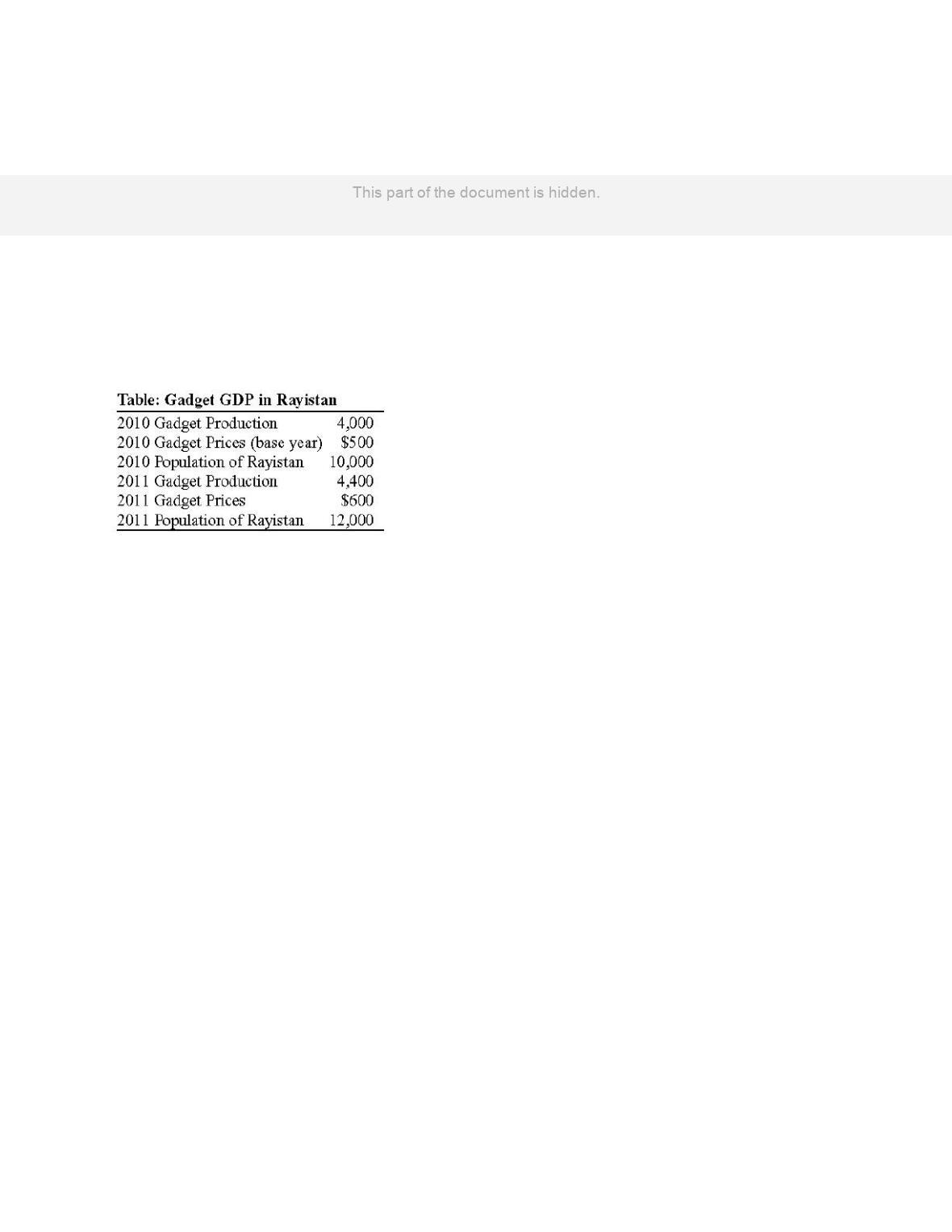
(Table: Gadget GDP in Rayistan) Use Table: Gadget GDP in Rayistan. Why is real
GDP per capita used as a measure of a country’s standard of living? What are some of
the limitations of using real GDP as the only measure of a country’s quality of life?
384.
(Table: Gadget GDP in Rayistan) Use Table: Gadget GDP in Rayistan. Rayistan is a
small nation that produces only one good, the gadget. The table shows production and
prices of gadgets for two consecutive years, as well as the population of Rayistan.
a. Compute nominal GDP in 2010 and 2011.
b. Compute real GDP in 2010 and 2011.
c. Has Rayistan’s standard of living, as measured by real GDP per capita, increased,
decreased, or stayed the same?
385.
Suppose Elmer Brown is campaigning for reelection as governor of his state. He claims
that during his first term the state’s citizens are 50% better off, since GDP has increased
from $10 billion to $15 billion. Why might his claim be misguided?
386.
Suppose the consumer price index was 180.5 last year and this year is 202.2. What is the
rate of inflation between last year and this year? What is the rate of inflation between
the base year and this year?
Use the following to answer questions 387-388:
387.
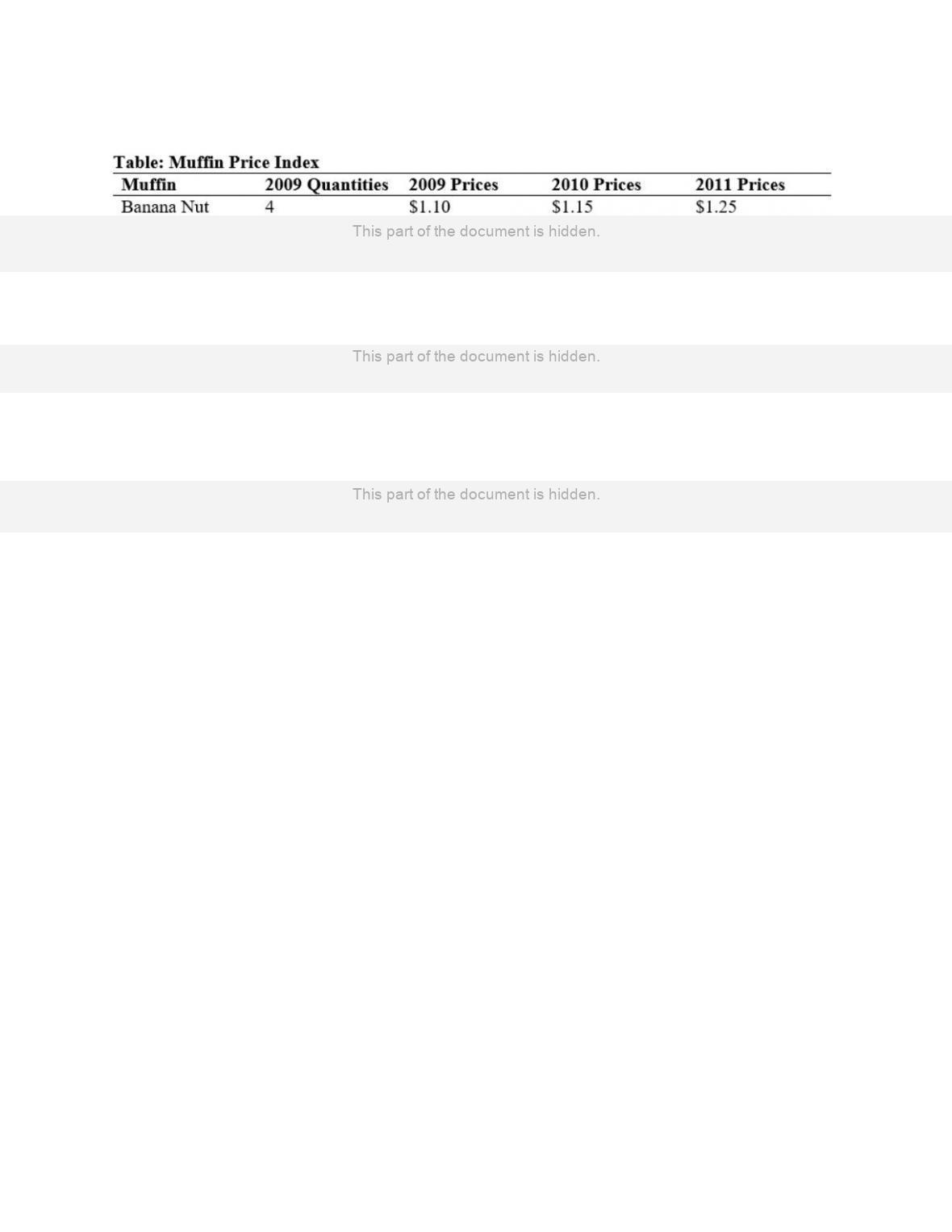
(Table: Muffin Price Index) Use Table: Muffin Price Index. A college town has many
small coffee shops, and they all sell muffins. As an economics project you have been
assigned to compile a muffin price index (MPI). The base year is 2009. Use these data
to compute the MPI for each year.
388.
(Table: Muffin Price Index) Use Table: Muffin Price Index. A college town has many
small coffee shops, and they all sell muffins. As an economics project you have been
assigned to compile a muffin price index (MPI). The base year is 2009. Use these data
to compute the rate of inflation in the MPI between:
a. 2009 and 2010.
b. 2010 and 2011.
389.
Explain the difference between the consumer price index and the producer price index.
Which is likely to be the first to indicate inflation?
390.
In the circular-flow diagram, government purchases of goods and services are financed
by:
A)
tax revenues.
B)
tax revenues net of transfer payments.
C)
tax revenues net of transfer payments plus government borrowing from financial
markets.
D)
tax revenues plus government borrowing from financial markets.
391.
The instrument by which a household makes a loan to a firm and the firm pays interest
to the household is known as:
A)
a stock.
B)
a bond.
C)
a transfer payment.
D)
disposable income.

Page 75
392.
Households indirectly own the physical capital used by firms through:
A)
stocks.
B)
bonds.
C)
transfer payments.
D)
private debt.
393.
Private saving by households is:
A)
the portion of disposable income not spent on goods and services.
B)
the portion of income coming from transfer payments.
C)
often larger than consumption spending.
D)
not related to consumption spending.
394.
Investment spending refers to the:
A)
accumulation of financial stock by an individual firm.
B)
addition to the economy’s supply of productive physical capital.
C)
total net value of assets sold to foreigners.
D)
total spending by households.
395.
The construction of new housing is considered part of:
A)
investment spending.
B)
consumption.
C)
government purchases of goods and services.
D)
private saving.
396.
Flows into financial markets are equal to the sum of:
A)
all foreign lending.
B)
foreign lending and purchases of stock plus private saving.
C)
borrowing and stock issues plus foreign borrowing and sales of stock.
D)
private saving.
397.
A decrease in inventories is:
A)
a fall in investment spending.
B)
an increase in investment spending that will lead to an increase in sales.
C)
thought to have no impact on investment since it is not part of investment
spending.
D)
part of government spending.