Page 21
96.
Enchanté Inc., a designer clothing company, buys $400 worth of silk and $30 worth of
accessories to produce each dress. If the value added by Enchanté is equal to $200, then
according to the value-added approach, the price of the designer dress should be:
A)
$630.
B)
$230.
C)
$200.
D)
$830.
97.
Boeing buys $3 million worth of steel, $2.5 million worth of computer hardware and
software, and $1 million worth of mechanical tools to manufacture a certain model of
aircraft. Boeing sells this particular model at $10 million. The value added by Boeing is
equal to:
A)
$3.5 million.
B)
$16.5 million.
C)
$13 million.
D)
$15.5 million.
98.
Which equation is CORRECT?
A)
GDP = C + I + G + IM – X.
B)
GDP = C + I + G + X – IM.
C)
GDP = C + I + G + X + IM.
D)
GDP = C + I + G – T + TR.
99.
Don is a builder and in his free time he has built an addition to his own house. This
transaction will:
A)
not be included in GDP because it is not produced for the marketplace.
B)
be included in GDP because Don is a professional builder.
C)
not be included in GDP because it is an intermediate good.
D)
be included in GDP because building is Don’s hobby.
100.
Which transaction will be included in the official measurement of GDP?
A)
Stan sold his 2015 Honda to his sister.
B)
Monica illegally downloaded movies to her laptop.
C)
Ben bought a textbook from his friend who took the class last semester. .
D)
Sean bought a new truck.
Page 22
101.
An example of an intermediate good is:
A)
wages paid to an employee.
B)
steel purchased by aircraft manufacturers.
C)
vegetables purchased for your dinner.
D)
electric bills for your house.
102.
Which item would NOT be included in this year’s GDP?
A)
the production of a television show
B)
the purchase of a new work truck
C)
the hiring of a new police officer
D)
your purchase of your neighbor’s 2001 Toyota
103.
Which equation is the BEST one for GDP?
A)
GDP = C+ I + G – X + IM
B)
GDP = C + I + G + X – IM
C)
GDP = C + I + G + taxes – value added
D)
GDP = C + I + G + taxes + X + IM
104.
Which item would NOT be included in GDP?
A)
the dollar value of a repair job done by your cousin on her own car
B)
the dollar value of a lawyer’s service
C)
new car sales by a local dealer
D)
production of new cars that were not sold in the current year
105.
Goods that are produced in a particular period but NOT sold in that period:
A)
count as consumption in the next year.
B)
are included in investment.
C)
are treated like exports.
D)
are classified as purely financial transactions.
106.
A country’s exports minus its imports during a period are:
A)
net exports.
B)
gross exports.
C)
net imports.
D)
gross imports.
Page 23
107.
Net exports are calculated by subtracting:
A)
imports from exports.
B)
exports from imports.
C)
out all intermediate goods.
D)
I, G, and value added from GDP.
108.
A nation’s exports minus its imports:
A)
equals its private investment.
B)
is net exports.
C)
is always a positive number.
D)
is equal to net transfer payments.
109.
Which item would NOT be a part of GDP?
A)
used car sales
B)
new residential construction
C)
a new truck purchased by a building contractor
D)
cable TV service purchased for a home
110.
The total volume of business sales in the economy is much larger than GDP because:
A)
GDP understates the value of total output.
B)
the output approach to measuring GDP excludes intermediate transactions.
C)
GDP includes transfer payments.
D)
GDP excludes exports.
111.
Which item would NOT be included in this year’s GDP?
A)
the production of a television show
B)
the purchase of a new hybrid truck
C)
the hiring of a new schoolteacher
D)
the purchase of your neighbor’s house, which was built in 1994
112.
Purchases of _____ are included in GDP.
A)
used goods
B)
newly issued stocks
C)
new foreign-produced investment goods
D)
new capital goods
Page 24
113.
GDP counts the dollar value of only final goods and services because:
A)
we can measure only the value of final goods and services, not the value of inputs.
B)
if we counted the value of all goods, we would count inputs, such as the value of
steel in a new automobile, more than once.
C)
intermediate goods reduce GDP.
D)
only final goods and services matter for the economy.
114.
The calculation of GDP does NOT include the value of:
A)
Firestone tires sold at your local garage.
B)
Bridgestone tires purchased by Ford Motor Co.
C)
Goodyear tires purchased by the United States Secret Service.
D)
Michelin tires purchased by Canadian car collectors.
Use the following to answer question 115:
115.
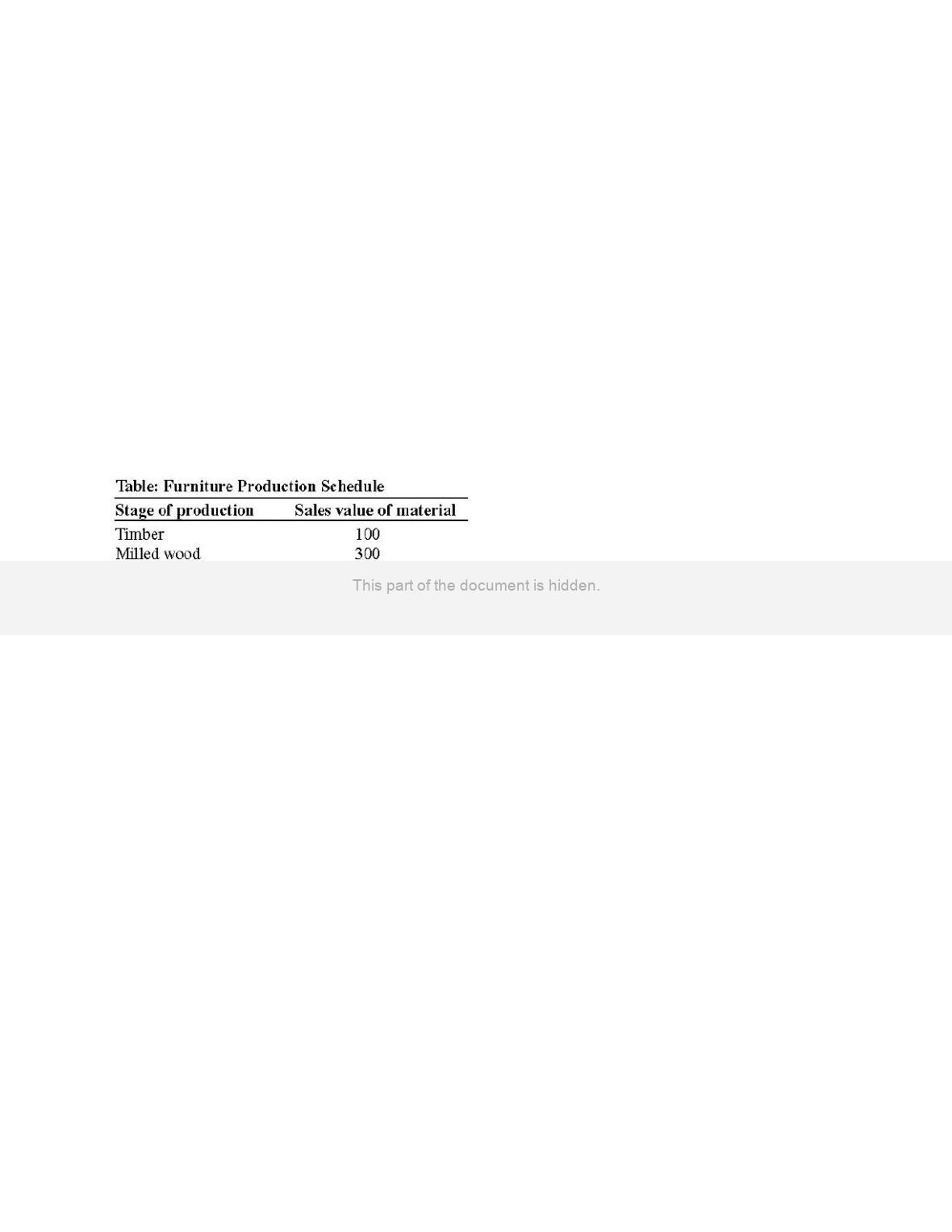
(Table: Furniture Production Schedule) Use Table: Furniture Production Schedule.
What is the total value added of all stages of production of the furniture?
A)
$800
B)
$1,200
C)
$1,800
D)
$2,000
116.
Suppose that Mr. Green Jeans sells $5,000 of wheat to Big Ben Bakery. Big Ben uses
the wheat to make flour and then hamburger buns, which it sells to Hamburger Heaven
for $11,000. Hamburger Heaven also buys $20,000 of beef from a rancher. Hamburger
Heaven uses the beef and buns to make 10,000 hamburgers, which are sold for $5 each.
How much do these transactions add to GDP?
A)
$86,000
B)
$36,000
C)
$31,000
D)
$50,000
Page 25
117.
Value added in national income accounts refers to the:
A)
value added by labor to the production process.
B)
difference between the price and the value of inputs purchased.
C)
difference in profits at various stages of production.
D)
value of all inputs used by the final producer.
118.
Which item is included in GDP?
A)
the purchase of 100 shares of Microsoft stock
B)
the purchase of a 1965 Ford Mustang
C)
Social Security payments from the U.S. government to retired people
D)
the purchase of a ticket to a Lady Gaga concert
119.
GDP does NOT exclude:
A)
the value of leisure.
B)
damage to the environment.
C)
the value of housework.
D)
the value of owner-occupied housing.
120.
Which item is included in the calculation of GDP?
A)
expenditure on new construction
B)
a retiree’s monthly Social Security check
C)
buying a house built 10 years ago
D)
buying shares of Home Depot stock
121.
Included in GDP is the dollar value of:
A)
a used car sold during the period.
B)
a new car imported during the period.
C)
a new car exported during the period.
D)
100 shares of General Motors stock bought by a retiree.
122.
The value of _____ is counted in GDP.
A)
glass for windshields purchased by a car manufacturer
B)
a new car sold by a dealer
C)
a used car sold by a dealer
D)
a share of stock in a car manufacturer

Page 26
123.
Which transaction is included in the nation’s gross domestic product?
A)
A college student buys a used textbook from his roommate.
B)
A construction company purchases lumber to build a new house.
C)
A college student buys a pizza and has it delivered to her dorm room.
D)
A group of college students volunteer to rake leaves at an assisted living facility for
senior citizens.
124.
If, during 2010, the Republic of Sildavia recorded investment spending of $3 billion,
government purchases of $3 billion, consumer spending of $7 billion, imports of $5
billion, government transfers of $1 billion, and exports of $3 billion, Sildavia’s GDP in
2010 was:
A)
$11 billion.
B)
$12 billion.
C)
$13 billion.
D)
$14 billion.
125.
Suppose a consumer buys a Perfect Pizza frozen cheese pizza at the grocery store for
$10. Perfect Pizza purchased the dough and tomato sauce from a food-processing
company for $2 and bought the cheese for $1. It sold the pizza to the store for $5. How
much has GDP increased?
A)
$2
B)
$5
C)
$10
D)
$18
126.
Which transaction would NOT be counted in GDP?
A)
Nike builds a retail store.
B)
Your mother buys a pound of Washington-grown apples.
C)
Your mother buys 100 shares of Nike stock.
D)
The Indiana state government pays for repair of a damaged bridge over the Wabash
River.
127.
GDP may be calculated as the sum of:
A)
consumer spending, investment spending, government purchases of goods and
services, and exports minus imports.
B)
consumer spending, investment spending, government transfer payments, and
exports minus imports.
C)
consumer spending, investment spending, government purchases of goods and
services, and exports.
D)
exports and imports only.
Page 27
Use the following to answer question 128:
128.
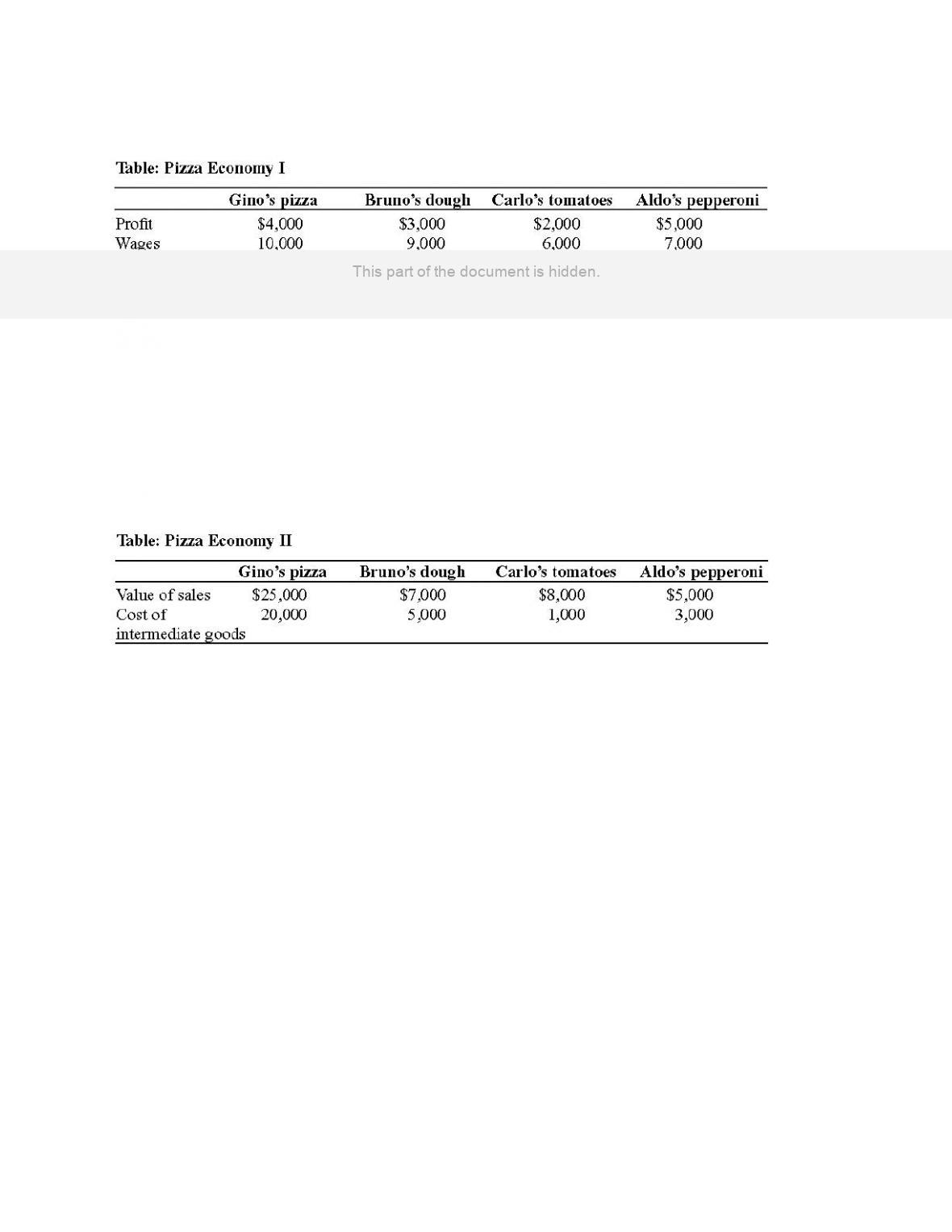
(Table: Pizza Economy I) Use Table: Pizza Economy I. GDP in this economy is:
A)
$73,000.
B)
$65,000.
C)
$57,000.
D)
$51,000.
Use the following to answer question 129:
129.
(Table: Pizza Economy II) Use Table: Pizza Economy II. GDP in this economy is:
A)
$74,000.
B)
$5,000.
C)
$29,000.
D)
$16,000.
130.
If, during 2011, the Republic of Sildavia recorded a value added of $78 billion, wages of
$40 billion, profits of $8 billion, and total sales of all goods and services $90 billion, the
value of intermediate goods purchased during 2011 in Sildavia was:
A)
$42 billion.
B)
$30 billion.
C)
$12 billion.
D)
$4 billion.
Page 28
131.
If, during 2011, the Republic of Sildavia recorded a GDP of $65 billion, interest
payments of $15 billion, imports of $13 billion, profits of $7 billion, exports of $15
billion, and rent of $7 billion, wages during 2011 in Sildavia were:
A)
$36 billion.
B)
$38 billion.
C)
$51 billion.
D)
$64 billion.
132.
In the United States, consumer spending accounts for approximately _____% of GDP.
A)
50
B)
60
C)
70
D)
80
133.
The LARGEST component of U.S. GDP is value added in:
A)
household production.
B)
business production.
C)
government production.
D)
production of goods sold overseas.
134.
In the United States, investment spending accounts for approximately _____% of GDP.
A)
6
B)
16
C)
24
D)
33
135.
In the United States, government spending accounts for approximately_____% of GDP.
A)
5
B)
10
C)
20
D)
30
136.
Historically, _____ spending was the LARGEST component of U.S. GDP, at
approximately 70% of aggregate spending.
A)
government
B)
consumer
C)
investment
D)
net export
Page 29
137.
The calculation of aggregate output does NOT include the value of:
A)
Firestone tires sold at your local auto shop.
B)
a new shower installed in a 1920s house.
C)
the six-CD player replacing the factory-mounted radio-cassette player in your car.
D)
the tires on brand-new Volvo station wagons.
138.
In the United States:
A)
GNP is about twice GDP.
B)
GDP is about twice GNP.
C)
GDP exceeds GNP by depreciation plus indirect business taxes.
D)
GNP and GDP are about equal.
139.
A country’s GNP:
A)
must be larger than its GDP.
B)
is the total factor income earned by residents of a country.
C)
includes factor income earned by foreigners.
D)
excludes factor income earned abroad by Americans.
140.
The MOST important use of GDP is as a measure of:
A)
the size of the economy.
B)
the level of unemployment.
C)
changes in the price level.
D)
rates of return in financial markets.
141.
The scale MOST often used to compare economic performance in other years is:
A)
the circular-flow diagram.
B)
real GDP.
C)
the business cycle.
D)
fiscal policy.
142.
An increase in the value of nominal GDP over time:
A)
is always due to an increase in prices.
B)
is always due to an increase in the production of goods and services.
C)
may be due to an increase in prices, in the production of goods and services, or
both.
D)
may be due to a decrease in prices, in the production of goods and services, or
both.
Page 30
143.
The Venezuela example illustrates:
A)
that the difference between nominal and real GDP is negligible in most cases.
B)
that there is no difference between nominal and real GDP in the real world.
C)
the importance of distinguishing between nominal and real GDP.
D)
that GNP, rather than GDP, is a better measure of a country’s economic activity.
Use the following to answer questions 144-147:
144.
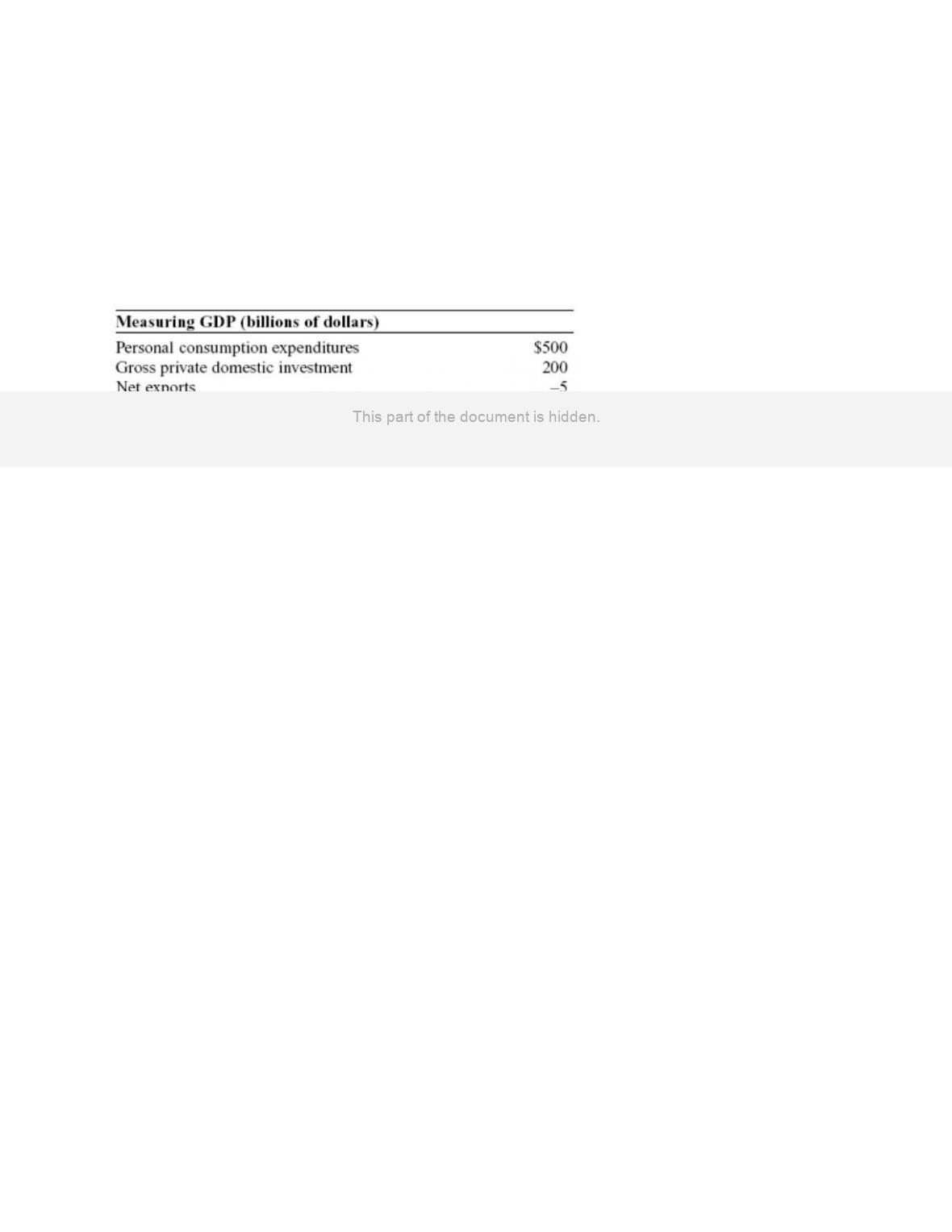
(Table: Measuring GDP) Use Table: Measuring GDP. GDP is equal to:
A)
$500 billion.
B)
$850 billion.
C)
$995 billion.
D)
$1,000 billion.
145.
(Table: Measuring GDP) Use Table: Measuring GDP. Total expenditures on GDP by
the household sector are:
A)
$100 billion.
B)
$150 billion.
C)
$200 billion.
D)
$500 billion.
146.
(Table: Measuring GDP) Use Table: Measuring GDP. Government purchases of goods
and services are:
A)
$50 billion.
B)
$100 billion.
C)
$200 billion.
D)
$300 billion.
Page 31
147.
(Table: Measuring GDP) Use Table: Measuring GDP. Exports are:
A)
–$5 billion.
B)
zero.
C)
$5 billion.
D)
$10 billion.
148.
The inflation-adjusted measure of aggregate output typically used by economists is
called:
A)
aggregate output.
B)
nominal gross national product.
C)
net domestic product.
D)
real gross domestic product.
149.
Real GDP is nominal GDP adjusted for:
A)
double counting.
B)
changes in prices.
C)
population.
D)
imports.
150.
If real GDP rises while nominal GDP falls, then prices on average have:
A)
risen.
B)
fallen.
C)
stayed the same.
D)
decreased and then been offset by an equal increase.
151.
Aggregate output is:
A)
equal to consumer spending on goods and services.
B)
the value of new construction, changes in inventories, and the purchase of physical
capital by businesses.
C)
the total quantity of intermediate goods produced by an economy.
D)
the total quantity of final goods and services produced by an economy.
152.
If real GDP falls while nominal GDP rises, then prices on average have:
A)
risen.
B)
fallen.
C)
stayed the same.
D)
Real GDP cannot rise when nominal GDP falls.
Page 32
153.
The total value of all final goods and services produced in a given year, calculated with
the prices current in the year in which the output is produced, is:
A)
real GDP.
B)
nominal GDP.
C)
net exports.
D)
consumption spending.
154.
The total value of all final goods and services produced in a given year, calculated using
the prices of a selected base year, is:
A)
real GDP.
B)
nominal GDP.
C)
net exports.
D)
consumption spending.
Use the following to answer questions 155-164:
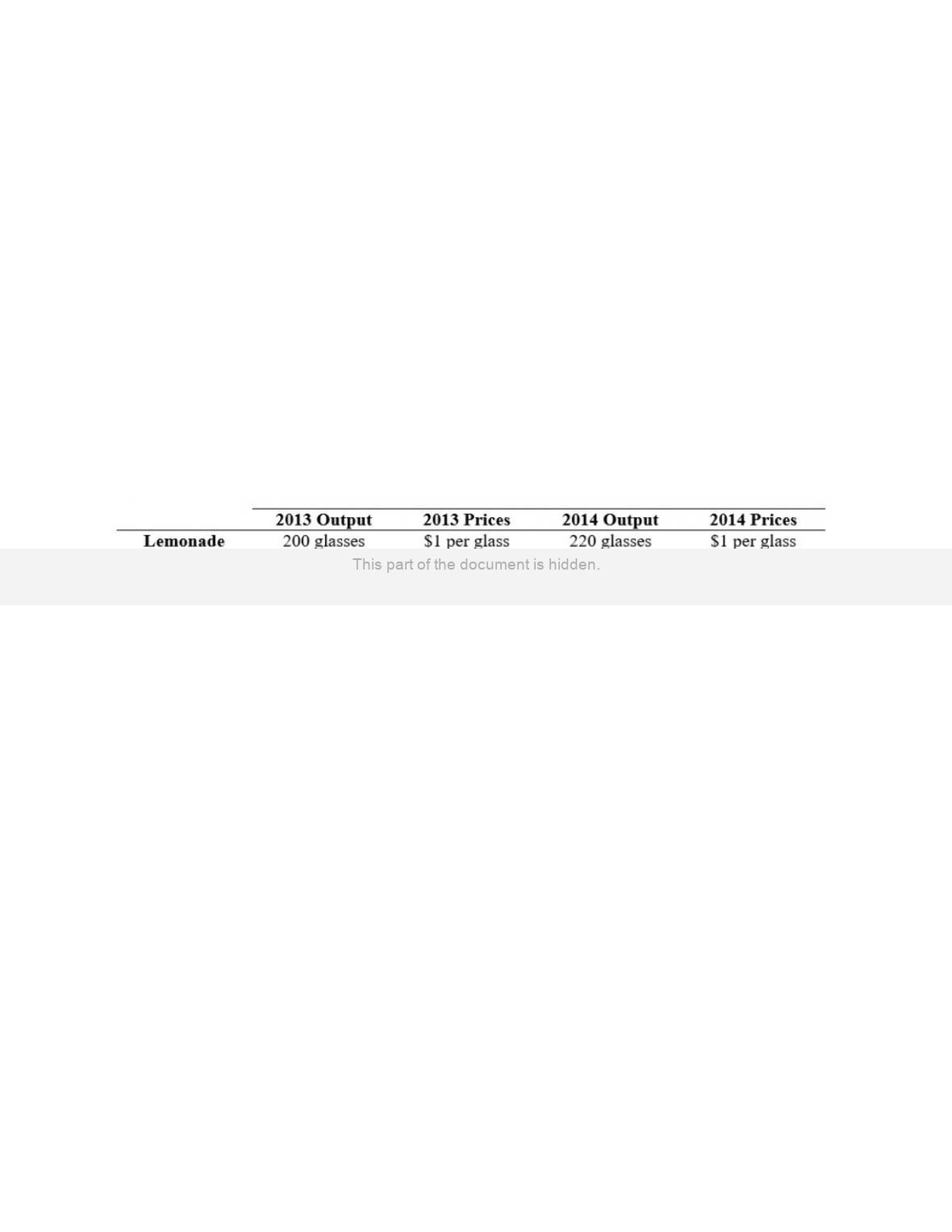
155.
(Table: Lemonade and Cookies) Use Table: Lemonade and Cookies. Assume that an
economy produces only lemonade and cookies. Nominal GDP in 2013 was:
A)
$400.
B)
$420.
C)
$445.
D)
$820.
156.
(Table: Lemonade and Cookies) Use Table: Lemonade and Cookies. Assume that an
economy produces only lemonade and cookies. Nominal GDP in 2014 was:
A)
$400.
B)
$420.
C)
$445.
D)
$820.

Page 33
157.
(Table: Lemonade and Cookies) Use Table: Lemonade and Cookies. Assume that an
economy produces only lemonade and cookies. The growth rate of nominal GDP from
2013 to 2014 was _____%.
A)
5
B)
10
C)
11.25
D)
45
158.
(Table: Lemonade and Cookies) Use Table: Lemonade and Cookies. Assume that an
economy produces only lemonade and cookies. If 2013 is the base year, real GDP in
2013 was:
A)
$400.
B)
$420.
C)
$425.
D)
$445.
159.
(Table: Lemonade and Cookies) Use Table: Lemonade and Cookies. Assume that an
economy produces only lemonade and cookies. If 2013 is the base year, real GDP in
2014 was:
A)
$400.
B)
$420.
C)
$425.
D)
$445.
160.
(Table: Lemonade and Cookies) Use Table: Lemonade and Cookies. Assume that an
economy produces only lemonade and cookies. Assuming 2013 was the base year, the
growth rate of real GDP from 2013 to 2014 was _____%.
A)
5
B)
10
C)
11.25
D)
20
161.
(Table: Lemonade and Cookies) Use Table: Lemonade and Cookies. Assume that an
economy produces only lemonade and cookies. The growth of nominal GDP from 2013
to 2014 was due to approximately a _____% increase in prices and approximately a
_____% increase in aggregate output.
A)
11.25; 0
B)
0; 45
C)
5; 11.25
D)
6.25; 5

Page 34
162.
(Table: Lemonade and Cookies) Use Table: Lemonade and Cookies. Assume that an
economy produces only lemonade and cookies. If 2014 is the base year, real GDP in
2014 was:
A)
$400.
B)
$420.
C)
$425.
D)
$445.
163.
(Table: Lemonade and Cookies) Use Table: Lemonade and Cookies. Assume that an
economy produces only lemonade and cookies. If 2014 is the base year, real GDP in
2013 was:
A)
$400.
B)
$420.
C)
$425.
D)
$445.
164.
(Table: Lemonade and Cookies) Use Table: Lemonade and Cookies. Assume that an
economy produces only lemonade and cookies. Assuming that 2014 was the base year,
the growth rate of real GDP from 2013 to 2014 was:
A)
–5%.
B)
4.7%.
C)
11.25%.
D)
20%.
165.
Consider an economy that produces only DVDs and DVD players. If 10 DVDs are sold
at $20 each and 5 DVD players are sold at $100 each, then nominal GDP is:
A)
$100.
B)
$700.
C)
$1,100.
D)
$900.
166.
Consider an economy that produces only DVDs and DVD players. Last year, 10 DVDs
were sold at $20 each and 5 DVD players were sold at $100 each, while this year 15
DVDs were sold at $10 each and 10 DVD players were sold at $50 each. Nominal GDP
this year is:
A)
$100.
B)
$650.
C)
$700.
D)
$500.
Page 35
167.
Consider an economy that produces only DVDs and DVD players. Last year, 10 DVDs
were sold at $20 each and 5 DVD players were sold at $100 each, while this year 15
DVDs were sold at $10 each and 10 DVD players were sold at $50 each. Real GDP this
year using last year as the base year is:
A)
$100.
B)
$700.
C)
$1,300.
D)
$300
168.
Suppose that nominal GDP is $1,000 in 2009 and $1,500 in 2010. If the overall price
level increased by _____% between 2009 and 2010, we could say that real GDP _____.
A)
50; stayed constant
B)
less than 50; decreased
C)
more than 50; increased
D)
50; increased
Use the following to answer questions 169-173:
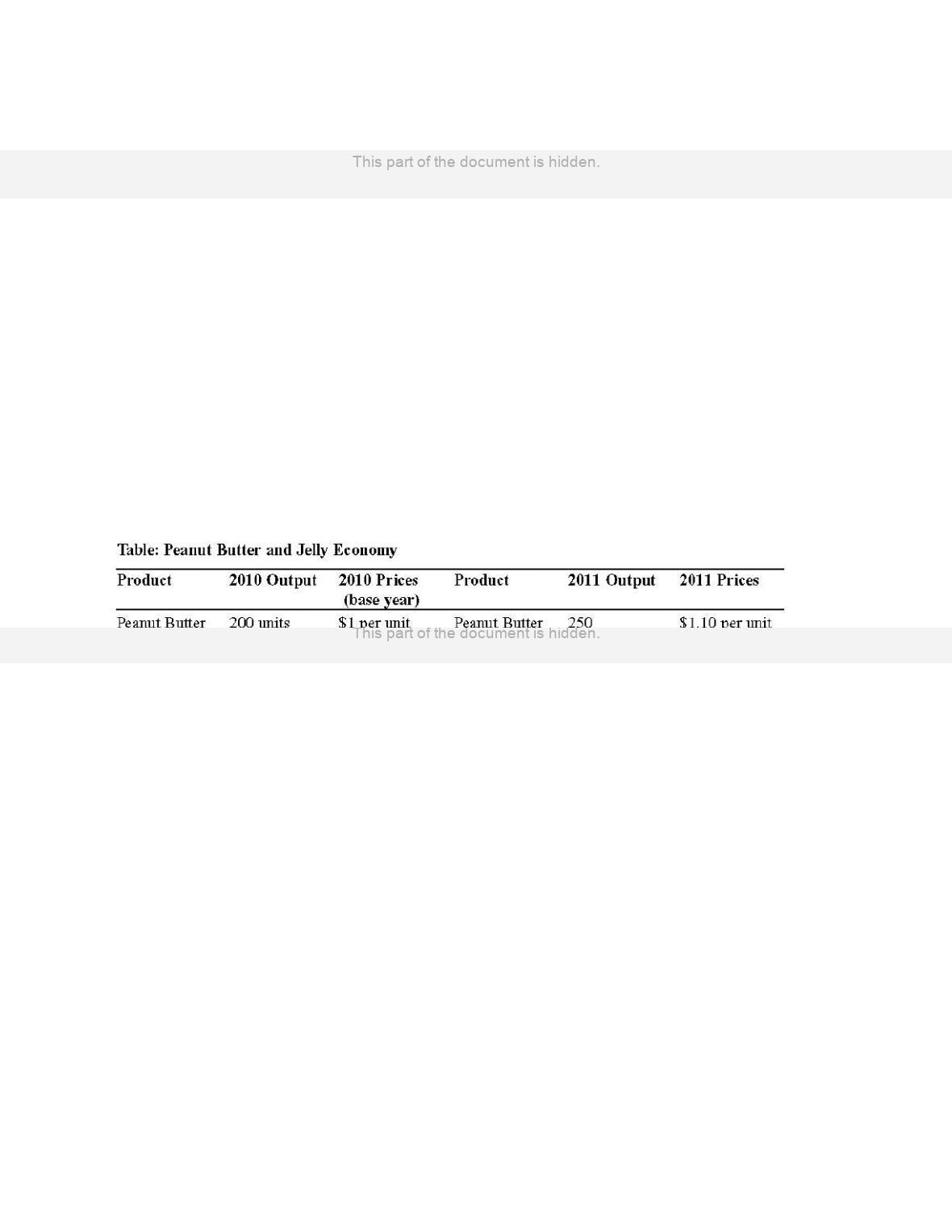
169.
(Table: Peanut Butter and Jelly Economy) Use Table: Peanut Butter and Jelly Economy.
In 2011, nominal GDP was _____ and real GDP was _____.
A)
$450; $400
B)
$525; $450
C)
$525; $400
D)
$450; $575
170.
(Table: Peanut Butter and Jelly Economy) Use Table: Peanut Butter and Jelly Economy.
From 2010 to 2011 real GDP _____ by _____%.
A)
increased; 12.5
B)
decreased; 50
C)
increased; 43.75
D)
decreased; 12.5
Page 36
171.
(Table: Peanut Butter and Jelly Economy) Use Table: Peanut Butter and Jelly Economy.
Nominal GDP in 2010 was:
A)
$200.
B)
$400.
C)
$450.
D)
$525.
172.
(Table: Peanut Butter and Jelly Economy) Use Table: Peanut Butter and Jelly Economy.
Between 2010 and 2011, nominal GDP _____ by _____%.
A)
increased; 12.5
B)
decreased; 12.5
C)
increased; 16.67
D)
increased; 31.25
173.
(Table: Peanut Butter and Jelly Economy) Use Table: Peanut Butter and Jelly Economy.
How much of the increase in nominal GDP between 2010 and 2011 was due to
inflation?
A)
31.25%
B)
18.75%
C)
12.5%
D)
4%
174.
Chained dollars is:
A)
money that banks are required to keep in their vaults to back deposits.
B)
the measure of the value of intermediate goods.
C)
a method for calculating changes in real GDP using an early base year and a late
base year.
D)
a method used to convert real to nominal GDP.
175.
Real GDP is:
A)
the value of the production of all final goods and services measured in current
prices.
B)
the value of the production of all final goods and services adjusted for price
changes.
C)
the projected future value of GDP.
D)
calculated by adding up only the real number of all items sold in the United States,
regardless of their prices.
Page 37
176.
Suppose that, in year 1, an economy produces 100 golf balls that sell for $3 each and 75
pizzas that sell for $8 each. The next year, the economy produces 110 golf balls that sell
for $3.25 each and 80 pizzas that sell for $9 each. The value of nominal GDP in years 1
and 2, respectively, is:
A)
$900 and $1,077.50.
B)
$900 and $990.
C)
$180,000 and $257,400.
D)
$1,000 and $1,005.
177.
Suppose that, in year 1, an economy produces 100 golf balls that sell for $3 each and 75
pizzas that sell for $8 each. The next year, the economy produces 110 golf balls that sell
for $3.25 each and 80 pizzas that sell for $9 each. Using year 1 as the base year, real
GDP in year 2 is:
A)
$900.
B)
$970.
C)
$1,000.
D)
$1,077.50.
178.
Suppose that, in year 1, an economy produces 100 golf balls that sell for $3 each and 75
pizzas that sell for $8 each. The next year, the economy produces 110 golf balls that sell
for $3.25 each and 80 pizzas that sell for $9 each. The growth rate of nominal GDP
from year 1 to year 2 is _____%.
A)
10
B)
7.8
C)
19.7
D)
8.8
179.
Suppose that, in year 1, an economy produces 100 golf balls that sell for $3 each and 75
pizzas that sell for $8 each. The next year, the economy produces 110 golf balls that sell
for $3.25 each and 80 pizzas that sell for $9 each. Using year 1 as the base year, the
growth rate of real GDP from year 1 to year 2 is _____%.
A)
10
B)
7.8
C)
19.7
D)
8.8
180.
Nominal GDP:
A)
has not been adjusted for changes in prices over time.
B)
has been adjusted for changes in prices over time.
C)
is a small or nominal amount of output.
D)
excludes the international sector.
Page 38
181.
If both aggregate output and the aggregate price level increase:
A)
real GDP will increase faster than nominal GDP will.
B)
nominal GDP will increase faster than real GDP will.
C)
it makes no difference to real or nominal GDP.
D)
real GDP and nominal GDP will increase faster than the price level will.
182.
If nominal GDP increases from one year to the next, _____ must have risen.
A)
prices
B)
real GDP
C)
prices and real GDP
D)
real GDP or prices or both
183.
If nominal GDP decreases from one year to the next, _____ must have fallen.
A)
prices
B)
real GDP
C)
prices and real GDP
D)
Real GDP or prices or both
184.
If the price level and nominal GDP both doubled, then real GDP would:
A)
also double.
B)
increase by half.
C)
remain unchanged.
D)
decrease by half.
185.
Real GDP is the same as _____ GDP.
A)
current-dollar
B)
inflation-adjusted
C)
nominal
D)
value-added
186.
Nominal GDP is:
A)
inflation-adjusted GDP.
B)
real GDP minus depreciation.
C)
current-dollar GDP.
D)
constant-dollar GDP.
Page 39
187.
Government economists have adopted the _____ method of calculating the change in
real GDP, which averages the GDP growth rate according to both an early base year and
a late base year.
A)
cost indexation
B)
straight-line depreciation
C)
chain-linking
D)
fixed base year
188.
Assume that, in the base year (2011), a country’s nominal GDP is $10,000 billion. The
country has had 5% inflation each year since 2006. Real GDP of 2011 is equal to:
A)
$10,500 billion.
B)
$11,025 billion.
C)
$10,000 billion.
D)
$9,500 billion.
189.
Real GDP tends to understate our economic well-being because it:
A)
includes the value of services produced in the home.
B)
excludes the value of leisure.
C)
includes expenditures on crime prevention equipment.
D)
includes health care costs related to the consumption of cigarettes.
190.
Choose the best answer. Real GDP tends to overstate our economic well-being by
including:
A)
expenditures on crime prevention.
B)
payments for cleaning up the environment.
C)
repairs to structures destroyed by storms.
D)
expenditures on crime prevention, payments for cleaning up the environment, and
repairs to structures destroyed by storms.
191.
A country’s living standard is BEST measured by:
A)
per capita nominal GDP.
B)
real GDP.
C)
nominal GDP.
D)
per capita real GDP.
192.
Economists frequently use GDP per capita to reflect:
A)
the impact of prices on GDP.
B)
differences in living standards across countries.
C)
people who are employed.
D)
both people who are employed and those who are unemployed.
Page 40
193.
Real GDP per capita is:
A)
a perfect measure of a country’s standard of living.
B)
the only way to measure living standards among different countries.
C)
an incomplete measure of a country’s standard of living.
D)
used only by the United Nations to compare nations based on measures of welfare.
194.
The BEST available common measure of a nation’s standard of living is:
A)
nominal GDP.
B)
market GDP.
C)
real GDP per capita.
D)
nominal GDP per capita.
195.
Dividing real GDP by the population:
A)
results in consumption per capita.
B)
results in nominal GDP per capita.
C)
results in real GDP per capita.
D)
results in a measure of happiness.
196.
Assume that the real GDP of the United States is approximately $12 trillion and the
population of the United States is approximately 300 million. What is per capita real
GDP?
A)
$4,000
B)
$36,000
C)
$40,000
D)
Real per capita GDP can’t be determined without more information.
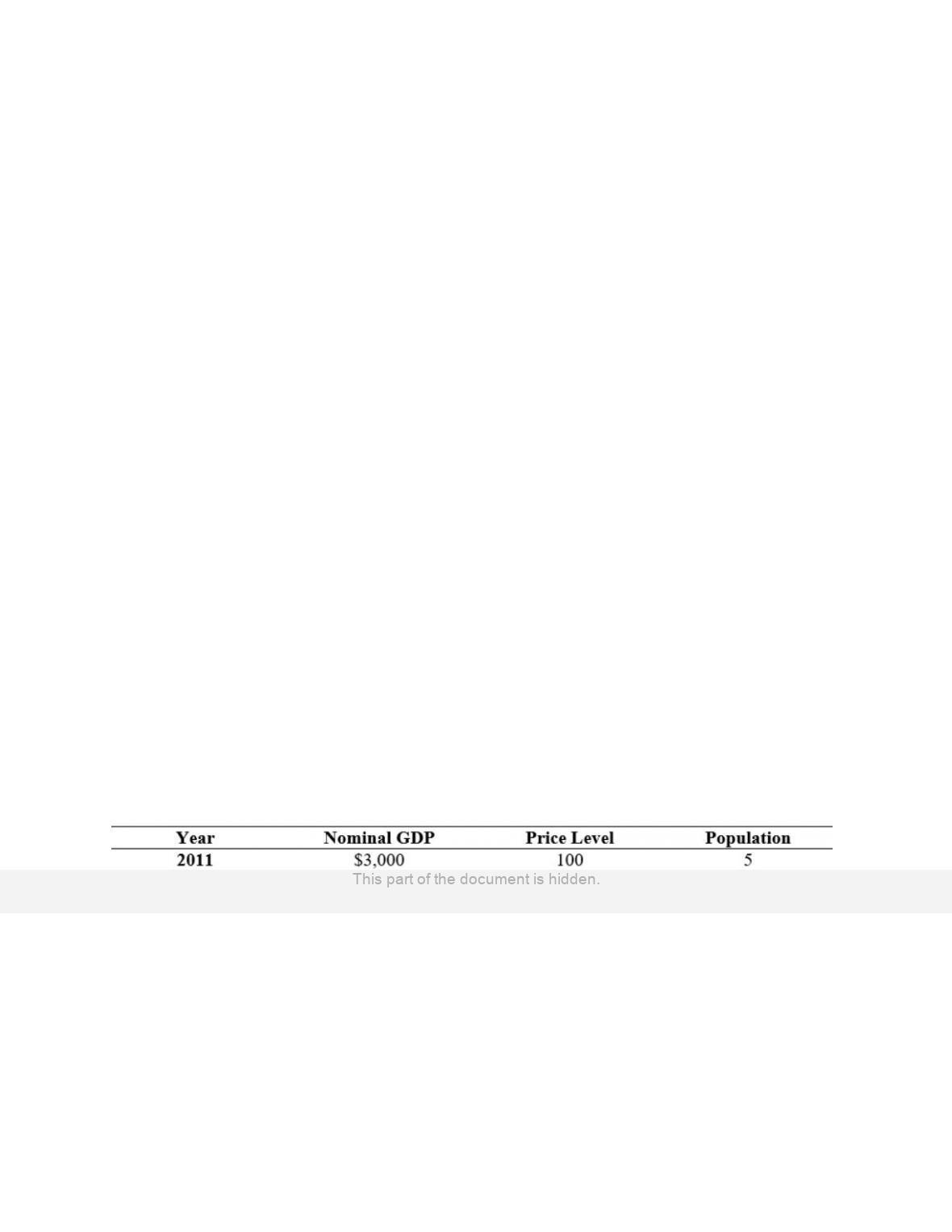
Use the following to answer questions 197-206:
197.
(Table: Per Capita GDP) Use Table: Per Capita GDP. The growth rate of nominal GDP
from 2011 to 2014 was _____%.
A)
37.5
B)
60
C)
62.5
D)
166.7