Page 1
Name: __________________________ Date: _____________
1.
Choose the best answer. The topics studied in macroeconomics include:
A)
inflation.
B)
unemployment.
C)
economic growth.
D)
inflation, unemployment, and economic growth.
2.
The topics studied in macroeconomics include:
A)
inflation.
B)
monopolies.
C)
spillovers, such as pollution.
D)
mergers.
3.
Macroeconomics entails the study of the:
A)
overall behavior of the economy.
B)
individual decision makers.
C)
market structures.
D)
cost and production decisions by firms.
4.
Macroeconomics focuses on:
A)
the economy as a whole.
B)
individual decisions.
C)
wages.
D)
the allocation of scarce resources.
5.
The topics studied in macroeconomics include:
A)
the price of a motorcycle.
B)
the wages of engineers.
C)
the general price level in the economy.
D)
how much ice cream consumers buy.
6.
Which is MOST likely a macroeconomic, not microeconomic, question?
A)
Is the national unemployment rate rising or falling?
B)
Are consumers buying more bottled water and less fruit juice?
C)
Are salaries for nurses rising or falling?
D)
Should a tax be levied on each ton of carbon dioxide a factory emits?
Page 2
7.
Which is a microeconomic question, rather than a macroeconomic question?
A)
Will a decrease in the income tax rate lift the nation out of a recession?
B)
Will an increase in consumer spending cause inflation?
C)
Will a decrease in the income tax rate lead to a government budget deficit?
D)
Will an increase in the cigarette tax reduce the number of packs sold?
8.
How the actions of individuals and firms interact to produce a particular economy-wide
level of performance is the focus of:
A)
macroeconomics.
B)
fiscal policy.
C)
monetary policy.
D)
microeconomics.
9.
Which would most likely be a MICROECONOMIC question?
A)
Should I go to business school or take a job?
B)
What determines the overall salary levels paid to workers in a given year?
C)
What government policies should be adopted to promote full employment and
growth?
D)
What determines the level of output for the economy as whole?
10.
Which would NOT be classified as a MACROECONOMIC question?
A)
How many people are employed in the economy as a whole?
B)
What determines the overall level of prices?
C)
What determines the overall trade in goods, services, and financial assets between
the United States and the rest of the world?
D)
What determines a university’s cost of offering a new course?
11.
Which question is the MOST appropriate to the study of MICROECONOMICS?
A)
How does the aggregate price level affect consumer spending?
B)
How does the level of interest rates affect investment spending?
C)
How much will Sony charge for the new game system to be introduced later this
year?
D)
How does the GDP affect overall government spending?
12.
Which question is the MOST appropriate to the study of MACROECONOMICS?
A)
How does the aggregate price level affect overall consumer spending?
B)
How does the level of interest rates affect Delta’s decision to buy a new airplane?
C)
How much will Sony charge for the new game system to be introduced later this
year?
D)
What determines whether Wachovia opens a new office in Beijing?
Page 3
13.
Promotion of employment and growth in the economy as a whole is the focus of:
A)
macroeconomics.
B)
fiscal policy.
C)
monetary policy.
D)
microeconomics.
14.
If all of the households and businesses start saving more during economic hard times,
then aggregate income will fall, hurting everyone in the economy. This is known as the:
A)
quantity theory.
B)
crowding-out theory.
C)
paradox of thrift.
D)
permanent income hypothesis.
15.
The concept that the whole is greater than the sum of its parts best characterizes:
A)
microeconomics.
B)
supply and demand.
C)
macroeconomics.
D)
business forecasting.
16.
A key insight into macroeconomics is that in the short run the combined effect of
individual decisions:
A)
is always the same as what one individual intended.
B)
may be very different from what any one individual intended.
C)
is always beneficial to the economy as a whole.
D)
is always detrimental to the economy as a whole.
17.
A rubber-necking traffic jam an example of:
A)
microeconomics in action.
B)
individual behavior that has a large aggregate impact.
C)
the paradox of thrift.
D)
an outcome smaller than the sum of its parts.
18.
What do a rubber-necking traffic jam and the paradox of thrift have in common?
A)
Individual behavior has large negative consequences for the whole of society.
B)
Seemingly bad behavior ends up harming everyone.
C)
Seemingly careless behavior leads to good times for all.
D)
Government intervention can only make matters worse.
Page 4
19.
In the paradox of thrift:
A)
firms that are pessimistic about the future lay off the most saving-conscientious
workers.
B)
when families and business are feeling pessimistic about the future, they spend
more.
C)
increased saving by individuals increases their chances of becoming unemployed.
D)
risky behavior during economic tough times has large negative consequences for
society.
20.
In contrast to the conclusions drawn from microeconomics, many economists argue that
in macroeconomics, government:
A)
control of rent prices increases overall economic activity.
B)
intervention in markets usually leaves society as a whole worse off.
C)
taxation of goods and services does not cause a deadweight loss of economic
welfare.
D)
intervention in markets can prevent or reduce the effects of adverse events on the
macroeconomy.
21.
The view that the government should take an active role in the macroeconomy dates to:
A)
the Civil War.
B)
World War I.
C)
the Great Depression.
D)
the Vietnam War.
22.
Changing the level of government spending is an example of _____ policy.
A)
fiscal
B)
interest rate
C)
monetary
D)
exchange rate
23.
The modern macroeconomic tools used by the government are _____ policy and _____
policy.
A)
tax; antitrust
B)
fiscal; monetary
C)
monetary; exchange rate
D)
capital; labor
Page 5
24.
Changing interest rates is an example of _____ policy.
A)
fiscal
B)
tax
C)
monetary
D)
exchange rate
25.
Fiscal policy refers to changes in _____ to affect overall spending in the economy:
A)
interest rates
B)
government spending and taxation
C)
the quantity of money
D)
interest rates and of government spending
26.
The economist whose writings in the 1930s argued that the cause of an economic
depression is inadequate spending was:
A)
Herbert Hoover.
B)
John Maynard Keynes.
C)
Andrew Mellon.
D)
Joseph Schumpeter.
27.
One role of government policy is to:
A)
provide insurance to cover damages from macroeconomic fluctuations.
B)
attempt to manage short-run macroeconomic fluctuations.
C)
subsidize private insurance for businesses to cover harm from macroeconomic
fluctuations.
D)
avoid Keynesian economics.
28.
Among the tools available to macroeconomic policy makers is:
A)
fiscal policy, for use in manipulating government spending and taxation.
B)
antitrust policy, to break up monopolies.
C)
environmental policy, to clean up the economy.
D)
improving standards for food and drugs.
29.
In 1936 economic theory changed dramatically with the publication of:
A)
The General Theory of Employment, Interest, and Money, by John Maynard
Keynes.
B)
The Wealth of Nations, by Adam Smith.
C)
The Road to Serfdom, by F. A. Hayek.
D)
Principles of Economics, by Paul Samuelson.
Page 6
30.
The central mission of modern macroeconomics is to prevent:
A)
shortages.
B)
surpluses.
C)
high gas prices.
D)
a deep recession like the Great Depression.
31.
Which two types of policy are considered to be macroeconomic?
A)
monetary and fiscal policy
B)
monetary and regulation policy
C)
fiscal and regulation policy
D)
fiscal policy and price controls
32.
Fiscal policy attempts to affect the level of overall spending by making changes in:
A)
the interest rate.
B)
the money supply.
C)
banking regulations.
D)
taxes and spending.
33.
Monetary policy attempts to affect the overall level of spending by making changes in:
A)
taxes.
B)
taxes and spending.
C)
taxes and interest rates.
D)
interest rates and the quantity of money.
34.
Monetary policy attempts to affect the overall level of spending through:
A)
changes in the inflation rate.
B)
changes in the quantity of money and the interest rate.
C)
changes in tax policy or government spending.
D)
discretionary regulation of profits and wages.
35.
Fiscal policy attempts to affect the overall level of spending through:
A)
changes in the inflation rate.
B)
changes in the quantity of money or the interest rate.
C)
changes in tax policy or government spending.
D)
discretionary regulation of profits and wages.
Page 7
36.
If macroeconomic policy has been successful over time, it is likely that the economy has
NOT seen:
A)
any inflation.
B)
any severe recessions.
C)
any unemployment.
D)
a business cycle.
37.
Use of monetary policy entails changes in:
A)
government spending.
B)
tax receipts.
C)
the quantity of money.
D)
tax rates.
38.
Use of fiscal policy involves changes in:
A)
interest rates.
B)
government spending.
C)
the quantity of money.
D)
the quantity of money and interest rates.
39.
When the Great Depression reached its trough in 1933, the unemployment rate was
approximately _____%.
A)
5
B)
10
C)
25
D)
50
40.
The onset of the Great Depression:
A)
was not a shock to anyone, since most economists predicted the Roaring Twenties
were bound to end in disaster.
B)
caused a disagreement between the Hoover administration and conventional
economists because Hoover wanted the government to intervene much more
quickly than most others.
C)
came as a considerable shock to the conventional wisdom of economics at that time
and opened the door for critiques of mainstream thought by economists like John
Maynard Keynes.
D)
was in 1918 at the end of World War I.
Page 8
41.
The General Theory of Employment, Interest, and Money, written by _____ and
published in _____, transformed the way economists thought about macroeconomics.
A)
Milton Friedman; 1946
B)
Paul Samuelson; 1940
C)
John Maynard Keynes; 1936
D)
Paul Lucas; 1966
42.
The General Theory of Employment, Interest, and Money was written by:
A)
Robert Lucas.
B)
David Ricardo.
C)
John Maynard Keynes.
D)
Thomas Malthus.
43.
Keynesian economics stressed:
A)
the importance of total spending.
B)
the self-correcting power of free markets.
C)
the long run.
D)
that the Depression should run its course to bring down the high cost of living.
44.
In recent times, the U.S. government has been trying to help the economy through one
of the worst economic slumps ever. The policies used are based on _____ theory.
A)
Keynesian
B)
classical
C)
supply-side
D)
trickle-down
45.
Keynesian economics promotes ideas that:
A)
government intervention can be destabilizing.
B)
the government can help a depressed economy via fiscal and monetary policies.
C)
the private sector is perfectly capable of regulating itself.
D)
the free market system will always prevail.
46.
A change in the level of overall spending in the economy due to a change in the interest
rate, brought about by a change in the quantity of money, is an example of _____
policy.
A)
monetary
B)
fiscal
C)
free-market
D)
trickle-down
Page 9
47.
Changing government spending and taxes to affect overall spending is use of _____
policy.
A)
tax-and-spend
B)
monetary
C)
fiscal
D)
free-trade
48.
John Maynard Keynes believed that the government should:
A)
actively try to mitigate the effects of recessions by using fiscal and monetary
policies.
B)
not interfere with the economy but let the economy self-correct.
C)
intervene only when there is a boom but let the recession run its course.
D)
not use fiscal and monetary policies, as these policies have long-term adverse
effects.
49.
Periods in which output and employment are falling in many industries are called:
A)
recessions.
B)
booms.
C)
expansions.
D)
deflations.
50.
An expansion is a period in which:
A)
output declines.
B)
the price level falls.
C)
output rises.
D)
deflation occurs.
51.
Recessions are periods when:
A)
output rises.
B)
the aggregate price level rises.
C)
the unemployment rate is falling.
D)
output and employment are falling in many industries.
52.
The short-run alternation between economic downturns and recessions, then economic
upturns and expansions is known as the _____ cycle.
A)
business
B)
contractionary
C)
expansionary
D)
disequilibrium
Page 10
53.
If during several quarters, the economy is simultaneously increasing its levels of
output and employment, then the economy is in a(n):
A)
depression.
B)
expansion.
C)
recession.
D)
turning point between a recovery and a downturn.
54.
A business cycle is a:
A)
very deep and prolonged economic downturn.
B)
period in which output and employment are rising.
C)
period in which output and employment are falling.
D)
short-run shift between economic upturns and downturns.
55.
The switching between recessions and expansions is known as the:
A)
unemployment rate.
B)
long-run economic growth.
C)
business cycle.
D)
macroeconomy.
56.
In a typical business cycle, the trough is immediately followed by the:
A)
peak.
B)
recession.
C)
depression.
D)
expansion.
57.
In a typical business cycle, the peak is immediately followed by the:
A)
recession.
B)
trough.
C)
expansion.
D)
depression.
58.
An economic expansion in the United States is typically associated with a(n):
A)
falling inflation rate.
B)
increase in the poverty rate.
C)
increase in output.
D)
decrease in corporate profits.
Page 11
59.
Economists have identified several consecutive quarters of falling employment, and
forecasts for the next few months suggest more of the same. The economy is at the
_____ stage of the business cycle.
A)
recession
B)
expansion
C)
peak
D)
trough
60.
For the past several months, per capita output has increased at a slower and slower rate.
Over the same period, the unemployment rate has been falling, but it appears that both
have leveled off. Where in the business cycle is the economy?
A)
peak
B)
recession
C)
trough
D)
expansion
61.
The point at which a recession ends and the expansion begins is called the:
A)
trough.
B)
downturn.
C)
peak.
D)
lag.
62.
The trough of the business cycle:
A)
comes right after the expansion phase.
B)
comes before the recession phase.
C)
is a temporary maximum level of real GDP.
D)
is a temporary minimum level of real GDP.
63.
A period of rising real GDP is a(n)_______in the business cycle:
A)
peak.
B)
trough.
C)
expansion.
D)
recession.
64.
A period of falling real GDP is a(n)________ in the business cycle:
A)
peak.
B)
trough.
C)
expansion.
D)
recession.
Page 12
65.
A pattern of expansion, then recession, then expansion again is a(n):
A)
annual trend.
B)
secular trend.
C)
business cycle.
D)
consumer cycle.
66.
The point on a business cycle when real GDP stops rising and begins falling is a(n):
A)
peak.
B)
trough.
C)
expansion.
D)
recession.
67.
The point on a business cycle when real GDP stops falling and begins rising is a(n):
A)
peak.
B)
expansion.
C)
trough.
D)
recession.
68.
The sequence of business cycle phases is:
A)
peak, trough, expansion, recession.
B)
peak, expansion, trough, recession.
C)
peak, recession, trough, expansion.
D)
peak, expansion, recession, trough.
69.
Rising total output accompanied by increasing employment is generally known as a(n):
A)
stagflation.
B)
recession.
C)
inflation.
D)
expansion.
70.
A country’s real gross domestic product (GDP), undergoes periodic fluctuations called
a(n):
A)
recession.
B)
business cycle.
C)
expansion.
D)
trough.
Page 13
Use the following to answer questions 71-72:
71.
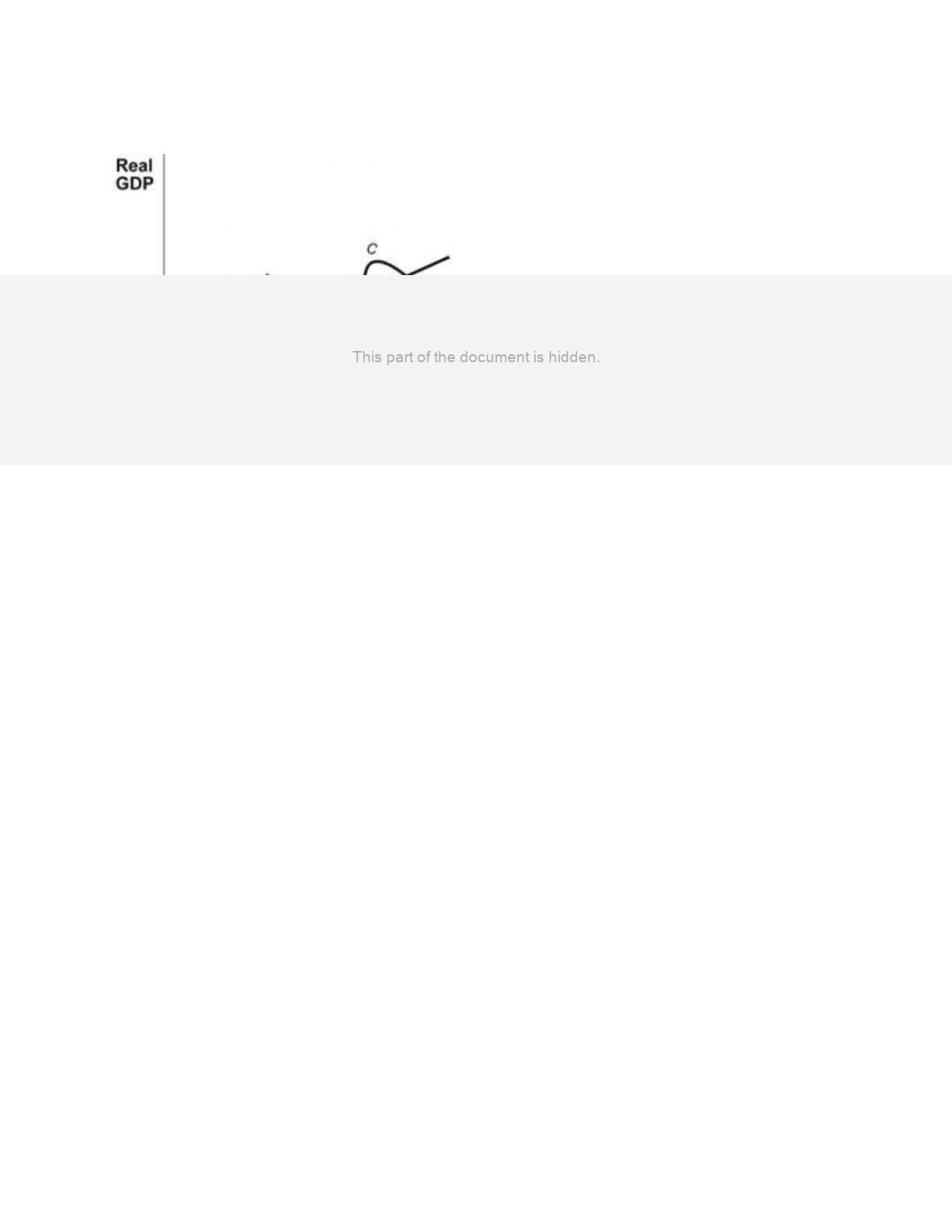
(Figure: The Business Cycle)
Point B on this graph shows a(n):
A)
peak.
B)
trough.
C)
expansion.
D)
recession.
72.
(Figure: The Business Cycle)
The movement from point B to C is called a(n):
A)
trough.
B)
expansion.
C)
depression.
D)
peak.
73.
A recession does NOT lead to:
A)
higher unemployment.
B)
reduced output.
C)
reduced income and living standards.
D)
higher employment.
74.
In the United States, recessions are typically associated with a(n):
A)
falling unemployment rate.
B)
decrease in the number of people living in poverty.
C)
decrease in the percentage of Americans with health insurance.
D)
increase in corporate profits.

Page 14
75.
The most painful effect of a recession is:
A)
inflation.
B)
unemployment.
C)
money neutrality.
D)
liquidity trap.
76.
The most painful consequence of a recession is:
A)
rising unemployment.
B)
increasing inflation.
C)
increasing aggregate output.
D)
higher interest rates.
77.
In many countries, economists adopt the rule that a recession is a period of at least
_____ during which aggregate output falls.
A)
one quarter
B)
two consecutive quarters
C)
three consecutive quarters
D)
a full year
78.
The most widely used indicator of the conditions in the labor market is the:
A)
unemployment rate.
B)
population growth rate.
C)
inflation rate.
D)
trade deficit.
79.
An independent panel of economic experts at the _____ analyzes the macroeconomy
and determines when recessions begin and end.
A)
Bureau of the Census
B)
President’s Council of Economic Advisers
C)
Treasury Department
D)
National Bureau of Economic Research
80.
Choose the best answer. The purpose of macroeconomic policy is to:
A)
bring unemployment closer to the natural rate.
B)
reduce the severity of recessions.
C)
rein in excessively strong expansions.
D)
bring unemployment closer to the natural rate, rein in excessively strong
expansions, and reduce the severity of recessions.
Page 15
81.
According to official statistics for the United States, since the Great Depression:
A)
economists are confident that the business cycle has been tamed.
B)
the economy has constantly had positive real GDP growth rates.
C)
the economy had longer recessions than expansions only during the 1960s and
1990s.
D)
the economy has not had another severe and prolonged economic downturn
comparable to it.
82.
A depression occurs when:
A)
both output and employment increase.
B)
the economic downturn becomes extremely deep and prolonged.
C)
both price level and unemployment increase.
D)
output rises but employment remains unchanged.
83.
Long-run growth is the sustained upward trend in:
A)
aggregate output per person over several decades.
B)
the unemployment rate over time.
C)
interest rates over time.
D)
aggregate output per person over the business cycle.
84.
Long-run growth is the:
A)
sustained upward trend in aggregate output per person over several decades.
B)
expansion phase of business cycles.
C)
downturn phase of business cycles.
D)
sustained downward trend in the employment rate over several decades.
85.
Long-run growth is a(n):
A)
sustained upward trend in the economy’s overall output per person, which
generates higher incomes and a higher standard of living for its members.
B)
increase in the rate of inflation across time, which reduces real salaries.
C)
increase in the overall output of the economy over a three- or four-year period.
D)
reduction in the price level over decades.
86.
Historical evidence shows that for determining a country’s living standards, over:
A)
an extended period, long-run growth is just as important as the business cycle.
B)
short periods, long-run growth is less important than the business cycle.
C)
an extended period, long-run growth is much more important than the business
cycle.
D)
long periods, it is difficult to determine whether the business cycle or long-run
growth is more important.