
Page 21
100.
If aggregate consumption equals $100 million + 0.75* YD, then the marginal propensity
to consume is:
A)
0.75.
B)
0.25.
C)
$75 million.
D)
$100 million.
101.
If aggregate consumption equals $100 million + 0.75* YD, then the marginal propensity
to save is:
A)
0.75.
B)
0.25.
C)
–$75 million.
D)
–$100 million.
102.
If the aggregate consumption equals $100 million + 0.75* YD, then autonomous
consumption is:
A)
0.75.
B)
0.25.
C)
$75 million.
D)
$100 million.
103.
The aggregate consumption function:
A)
relates household consumption to interest rates.
B)
describes what people would like to buy.
C)
describes the relationship of spending to family wealth.
D)
relates disposable income to total consumer spending.
104.
In the equation C = A + MPC* YD, _____ represents autonomous consumption.
A)
C
B)
A
C)
MPC
D)
YD
105.
David receives a tax refund of $800. He spends $600 and saves $200. David’s marginal
propensity to consume is:
A)
0.6.
B)
0.75.
C)
0.25.
D)
0.20.

Page 22
106.
If the marginal propensity to consume is greater than zero but less than one, when
disposable income rises by $1, consumption will:
A)
not be affected.
B)
rise by more than $1.
C)
rise by less than $1.
D)
rise by exactly $1.
107.
If the consumption function is plotted on the vertical axis of a graph with disposable
income on the horizontal axis:
A)
the slope of the line will be negative and determined by the marginal propensity to
save.
B)
the horizontal axis intercept will be determined by the level of autonomous
consumption.
C)
the slope of the line will be positive and determined by the marginal propensity to
consume.
D)
the vertical axis intercept will be determined by the marginal propensity to save.
108.
The marginal propensity to consume equals:
A)
consumption divided by disposable income.
B)
a change in consumption divided by a change in disposable income.
C)
income divided by consumption.
D)
a change in income divided by a change in consumption.
109.
If the marginal propensity to save decreases from 0.6 to 0.5:
A)
the slope of the consumption function increases from 0.4 to 0.5.
B)
the vertical axis intercept of the consumption function changes from 0.6 to 0.5.
C)
the slope of the consumption function decreases from 0.6 to 0.5.
D)
the horizontal axis intercept of the consumption function changes from 0.4 to 0.5.
110.
Consider the simple economy of Behr, whose government does not tax its citizens. The
consumption function of Behr is given by C = 500 + 0.80Y, where Y is income. The
autonomous consumer spending in this economy is:
A)
1,000.
B)
800.
C)
500.
D)
not possible to calculate.
Page 23
111.
Consider the simple economy of Behr, whose government does not tax its citizens. The
consumption function of Behr is given by C = 500 + 0.80Y, where Y is income. The
marginal propensity to consume in Behr is:
A)
0.75.
B)
500.
C)
0.80.
D)
1.
112.
If disposable income increases:
A)
the consumption function will shift upward.
B)
there will be a rightward movement along the consumption function.
C)
there will be a leftward movement along the consumption function.
D)
the consumption function will shift downward.
113.
If disposable income increases by $1,000 and consumer spending increases by $800,
then the marginal propensity to consume is:
A)
0.8.
B)
1.
C)
1.25.
D)
0.75.
114.
If the marginal propensity to consume is 0.75, then the marginal propensity to save is:
A)
1.75.
B)
0.25.
C)
–0.25.
D)
1.25.
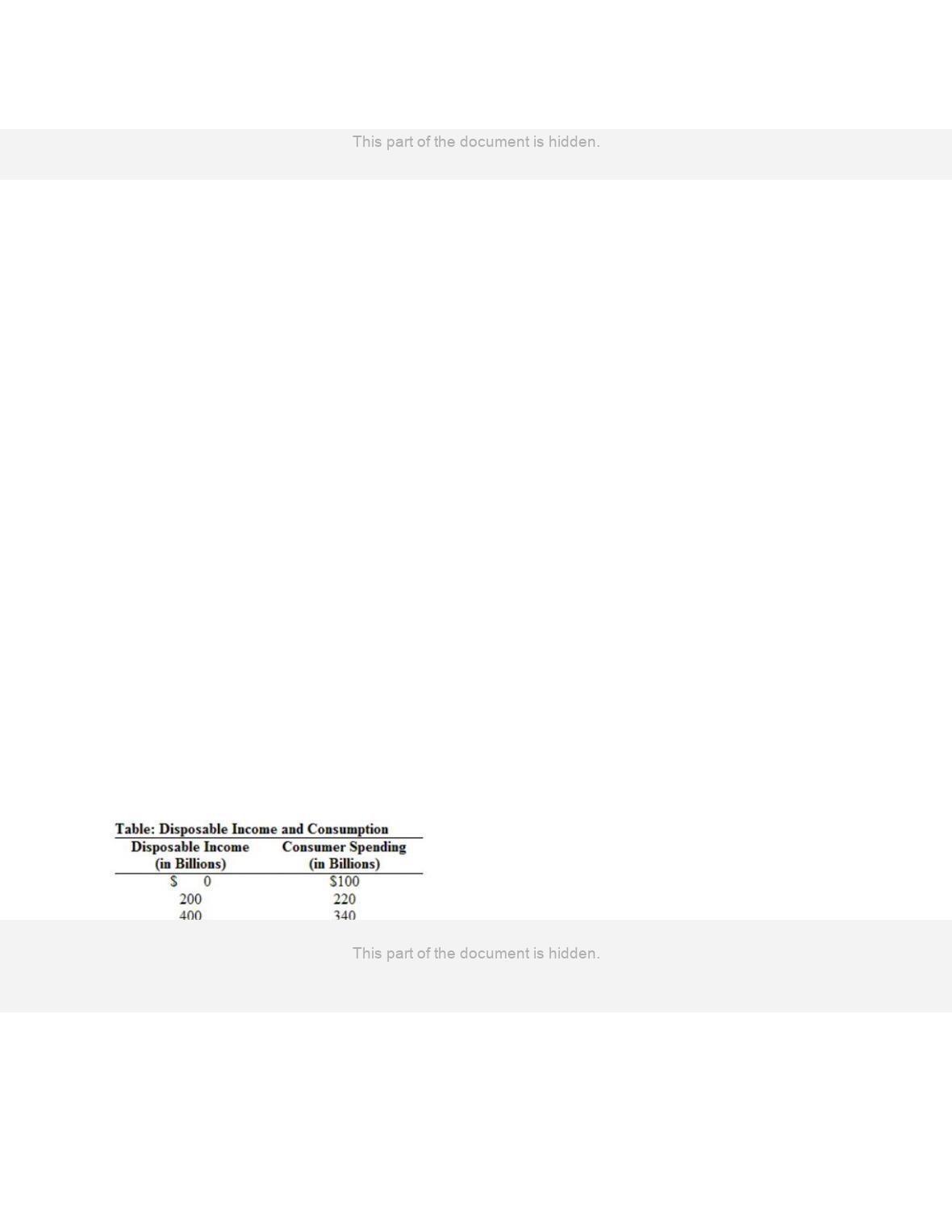
Use the following to answer questions 115-116:

Page 24
115.
(Table: Disposable Income and Consumption) Use Table: Disposable Income and
Consumption. Autonomous consumer spending is:
A)
$200.
B)
$100.
C)
$120.
D)
$0.
116.
(Table: Disposable Income and Consumption) Use Table: Disposable Income and
Consumption. The marginal propensity to consume equals:
A)
0.8.
B)
2.
C)
1.2.
D)
0.6.
117.
Consider a simple economy: MPC = 0.75, income = $400 billion, and aggregate
consumption spending = $400 billion. Autonomous consumption is:
A)
0.
B)
$100 billion.
C)
$300 billion.
D)
$200 billion.
118.
The consumption function will shift up if:
A)
households expect an increase in the minimum wage.
B)
households expect a decrease in the minimum wage.
C)
the marginal propensity to consume decreases.
D)
the marginal propensity to save increases.
119.
If other things are equal, expectations of lower disposable income would _____ and
shift the consumption function _____.
A)
increase autonomous consumption; up
B)
decrease the marginal propensity to consume; down
C)
decrease autonomous consumption; down
D)
increase the marginal propensity to consume; up
Page 25
120.
The marginal propensity to consume is 0.5, aggregate autonomous consumption is
$10,000, and aggregate disposable income is $40,000. If disposable income is expected
to increase, the aggregate consumption function might take the form of:
A)
C = 10,000 + (40,000* 0.5).
B)
C = 12,000 + (40,000* 0.5).
C)
C = 10,000 + (40,000* 0.7).
D)
C = 10,000 + (42,000* 0.5).
121.
When future disposable income rises, current consumption:
A)
falls.
B)
rises.
C)
is unaffected.
D)
is autonomous.
122.
Which factor will shift the aggregate consumption function UPWARD?
A)
Disposable income rises.
B)
Consumer expectations turn more pessimistic.
C)
The stock market is strong and wealth is rising.
D)
Disposable income falls.
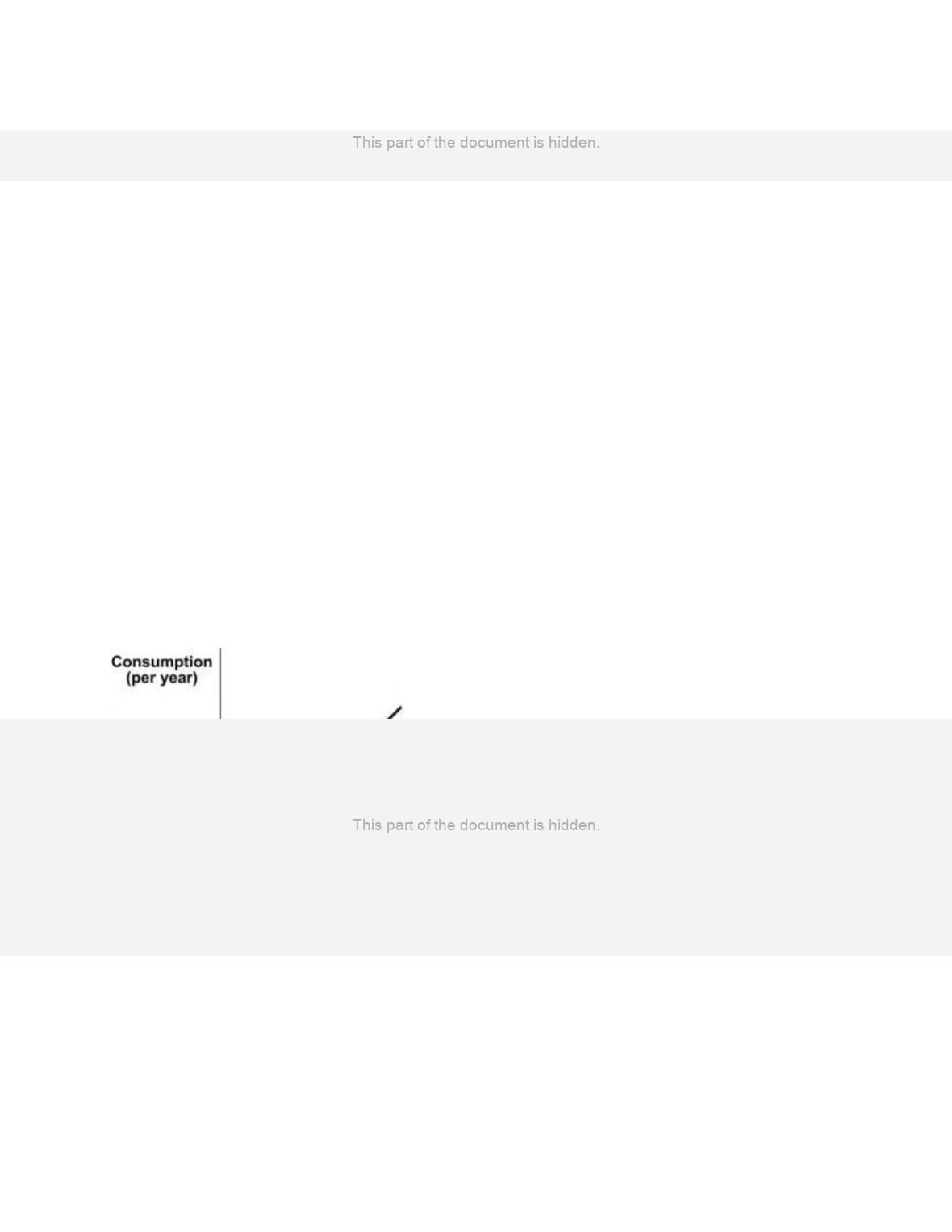
Use the following to answer questions 123-124:
Page 26
123.
(Figure: Consumption Functions) Use Figure: Consumption Functions. An economy’s
consumption function would shift from curve C to curve C when there is a(n):
A)
decrease in wealth.
B)
decrease in the price level.
C)
increase in expected disposable income.
D)
increase in wealth.
124.
(Figure: Consumption Functions) Use Figure: Consumption Functions. An economy’s
consumption function would shift from curve C to curve C
when there is a(n):
A)
increase in expected disposable income.
B)
decrease in expected GDP growth estimates.
C)
drop in wealth.
D)
increase in the unemployment rate.
125.
An increase in the wealth of households, all other things unchanged, will result in _____
the aggregate consumption function.
A)
no effect on
B)
an upward shift in
C)
a downward shift of
D)
a movement to the right along
126.
An upward shift in the aggregate consumption function can be caused by:
A)
expectations of higher incomes.
B)
expectations of less income.
C)
a stock market crash.
D)
a reduction in the wealth of households.
127.
A downward shift in the consumption function can be caused by:
A)
expectations of higher incomes.
B)
an increase in the marginal propensity to consume.
C)
a decline in consumer wealth.
D)
an increase in the wealth of households.
128.
An upward shift in the consumption function can be caused by:
A)
an increase in consumer wealth.
B)
a drop in consumer wealth.
C)
pessimistic expectations.
D)
an increase in disposable personal income.
Page 27
129.
A downward shift in the consumption function can be caused by:
A)
a decrease in disposable income.
B)
an increase in disposable income.
C)
expectations of higher permanent income.
D)
a decrease in wealth.
130.
If the stock market crashes:
A)
the aggregate consumption function will shift up.
B)
the aggregate consumption function will shift down.
C)
unplanned inventory investment will be negative.
D)
GDP will increase.
131.
Which factor is NOT a determinant of consumer spending?
A)
disposable income
B)
expected disposable income
C)
wealth
D)
investment spending
132.
If other things are equal, an increase in aggregate wealth will _____ and shift the
consumption function _____.
A)
increase autonomous consumption; up
B)
decrease the marginal propensity to consume; down
C)
decrease autonomous consumption; down
D)
increase the marginal propensity to consume; up
133.
The aggregate consumption function depends on:
A)
disposable income.
B)
expected disposable income.
C)
wealth.
D)
disposable income, expected disposable income, and wealth.
134.
According to the life-cycle hypothesis, wealth affects consumer spending because:
A)
wealthier people have higher incomes.
B)
wealthier people have better connections to buy in-demand goods.
C)
people try to smooth their consumption over the course of their lives.
D)
people try to consume as early in their lives as they can.
Page 28
135.
An increase in aggregate wealth:
A)
increases consumption by each individual.
B)
increases the aggregate consumption function.
C)
decreases consumption by each individual.
D)
decreases the aggregate consumption function.
136.
The life-cycle hypothesis of consumer spending says that consumers plan their
spending:
A)
based only on current disposable income.
B)
based on interest rates.
C)
over their lifetime.
D)
according to fluctuations in the stock market.
137.
The consumption function shifts when:
A)
disposable income changes.
B)
expected disposable income changes.
C)
people receive a pay raise.
D)
disposable income goes down.
138.
The life-cycle hypothesis suggests that consumers:
A)
spend in response to current income.
B)
plan spending over their lifetime.
C)
always spend more when income rises.
D)
always save more when incomes rise.
139.
People are likely to save the MOST _____ according to the life-cycle hypothesis.
A)
as they get closer to retirement
B)
in their peak earnings years
C)
the older they get
D)
in their old age
140.
A(n) _____ will increase the aggregate consumption function.
A)
increase in aggregate wealth
B)
increase in aggregate disposable income
C)
decrease in aggregate wealth
D)
decrease in expected disposable income

Page 29
141.
Suppose that the aggregate consumption function is given by the equation C = 200 +
0.8YD, where C represents consumption and YD represents disposable income. If
disposable income is $500, autonomous consumption is:
A)
$0.
B)
$200.
C)
$400.
D)
$600.
142.
Suppose that the aggregate consumption function is given by the equation C = 200 +
0.8YD, where C represents consumption and YD represents disposable income. If
disposable income is $500, aggregate consumption is:
A)
$0.
B)
$200.
C)
$400.
D)
$600.
143.
Suppose that the aggregate consumption function is given by the equation C = 200 +
0.8YD, where C represents consumption and YD represents disposable income. If
disposable income increases from $500 to $800, autonomous consumption is:
A)
$0.
B)
$200.
C)
$240.
D)
$440.
144.
Suppose that the aggregate consumption function is given by the equation C = 200 +
0.8YD, where C represents consumption and YD represents disposable income. If
disposable income increases from $500 to $800, aggregate consumption is:
A)
$840.
B)
$440.
C)
$240.
D)
$200.
145.
Suppose that the aggregate consumption function is given by the equation C = 200 +
0.8YD, where C represents consumption and YD represents disposable income. If
disposable income increases from $500 to $800, aggregate consumption will increase
by:
A)
$0.
B)
$200.
C)
$240.
D)
$440.

Page 30
146.
Suppose that the aggregate consumption function is given by the equation C = 200 +
0.8YD, where C represents consumption and YD represents disposable income. If all
employers announce in September that they guarantee to give all employees a large
bonus in December, which equation could represent the new aggregate consumption
function?
A)
C = 100 + 0.8YD
B)
C = 250 + 0.8YD
C)
C = 200 + 0.9YD
D)
C = 200 + 0.7YD
147.
Suppose that the aggregate consumption function is given by the equation C = 200 +
0.8YD, where C represents consumption and YD represents disposable income. If the
stock market crashes suddenly, which equation could represent the new aggregate
consumption function?
A)
C = 100 + 0.8YD
B)
C = 250 + 0.8YD
C)
C = 200 + 0.9YD
D)
C = 200 + 0.7YD
148.
Suppose that the aggregate consumption function is given by the equation C = 200 +
0.8YD, where C represents consumption and YD represents disposable income. If
housing prices throughout the United States decrease rapidly because of an increase in
mortgage foreclosures, which equation could represent the new aggregate consumption
function?
A)
C = 100 + 0.8YD
B)
C = 250 + 0.8YD
C)
C = 200 + 0.9YD
D)
C = 200 + 0.7YD
149.
Planned investment spending does NOT depend on:
A)
the rate of interest.
B)
the expected level of real GDP.
C)
the productive capacity of the economy.
D)
real GDP.
150.
The _____ is NOT one of the three principal factors upon which planned investment
spending depends.
A)
interest rate
B)
expected level of real GDP
C)
current level of production capacity
D)
current level of aggregate wealth
Page 31
151.
The factors that determine planned investment spending do NOT include:
A)
expected real GDP.
B)
expectations about disposable income.
C)
the market interest rate.
D)
production capacity.
152.
Planned investment spending for a given period is:
A)
actual investment.
B)
investment spending minus depreciation.
C)
investment spending that businesses plan to undertake.
D)
always equal to savings.
153.
Planned investment spending depends on:
A)
the market interest rate.
B)
wealth.
C)
expected disposable income.
D)
the life-cycle hypothesis.
154.
Most recessions originate from a(n):
A)
increase in investment spending.
B)
decrease in investment spending.
C)
increase in aggregate supply.
D)
decrease in aggregate supply.
155.
Investment spending:
A)
fluctuates more than consumption.
B)
fluctuates less than consumption.
C)
fluctuates by the same amount as consumption.
D)
is less volatile than consumption.
156.
An important factor determining planned investment spending is:
A)
company profits.
B)
the prices of final products.
C)
expected spending.
D)
expected real GDP.
Page 32
157.
If the Federal Reserve increases interest rates to reduce inflation and all other things
remain constant:
A)
planned investment spending is most likely to increase.
B)
planned investment spending is most likely to decrease.
C)
planned investment spending is most likely to remain the same.
D)
unplanned investment in inventories is likely to be negative.
158.
Which statement is TRUE?
A)
Borrowing money will always be more expensive than using retained earnings.
B)
The cost of retained earnings is unrelated to the cost of borrowing money.
C)
The tradeoff a firm faces whether using retained earnings or borrowed funds is the
same.
D)
Using retained earnings has a higher opportunity cost than does using borrowed
money because retained earnings come from past profits.
159.
A fall in the market interest rate makes any investment project:
A)
less profitable if the funds were borrowed and more profitable if it came from
retained earnings.
B)
less profitable whether the funds were borrowed or came from retained earnings.
C)
more profitable whether the funds were borrowed or came from retained earnings.
D)
more profitable only if the funds were borrowed.
160.
Planned investment spending _____ the interest rate.
A)
is positively related to
B)
is negatively related to
C)
is independent of
D)
moves in the same direction as
161.
Planned investment spending is _____ related to the interest rate because a _____ in the
market interest rate _____.
A)
positively; fall; decreases the supply of loanable funds
B)
negatively; rise; makes any given investment project less profitable
C)
positively; fall; decreases the opportunity cost of investing
D)
negatively; rise; causes consumption to crowd out investment
162.
Retained earnings are earnings that firms:
A)
keep to pay taxes.
B)
keep to pay dividends.
C)
keep to finance investments.
D)
do not pay taxes on.
Page 33
163.
If the interest rate rises:
A)
planned investment spending rises.
B)
more investment projects have a rate of return above that of the interest rate.
C)
the opportunity cost of investment is greater.
D)
excess capacity will increase.
164.
If a firm pays for investment spending out of retained earnings:
A)
the interest rate is irrelevant.
B)
past profits are adjusted downward.
C)
current profits are adjusted downward.
D)
the firm forgoes interest it could have received.
165.
Planned investment spending will decrease if:
A)
the interest rate rises.
B)
firms expect the growth of real GDP to increase.
C)
firms are producing near full capacity.
D)
consumer expectations about wealth grow more optimistic.
166.
The accelerator principle states that planned investment spending by firms is:
A)
positively related to the expected growth of real GDP.
B)
negatively related to the expected growth of real GDP.
C)
negatively related to the current level of real GDP.
D)
positively related to the current level of real GDP.
167.
The level of productive capacity _____ planned investment spending.
A)
has no effect on
B)
is positively related to
C)
is negatively related to
D)
varies directly with
168.
Other things being equal, investment spending _____ when _____.
A)
decreases; firms expect sales to fall
B)
increases; firms have excessive production capacity
C)
increases; the rate of growth of real GDP is low
D)
decreases; the obsolete or worn out physical capital increases
Page 34
169.
Other things being equal, planned investment spending _____ as long as _____.
A)
decreases; technological innovation develops faster than technological
obsolescence
B)
increases; sales exceed the existing production capacity
C)
increases; the rate of growth of real GDP is lower than the marginal propensity to
save
D)
decreases; the rate of growth of physical capital is positive
170.
The higher the production capacity of the economy:
A)
the higher is planned investment spending.
B)
the lower is planned investment spending.
C)
the higher is actual production.
D)
the lower is current production.
171.
According to the accelerator principle:
A)
a higher growth rate of real GDP leads to higher planned investment spending.
B)
a higher growth rate of real GDP increases immigration.
C)
higher budget deficits lead to even larger deficits.
D)
the more money people make, the faster they spend it.
172.
According to the accelerator principle, a _____ rate of growth in real GDP leads to
_____.
A)
lower; lower unplanned inventory investment
B)
higher; higher inventory investment
C)
higher; higher planned investment spending
D)
lower; higher inventory investment
173.
According to the _____, there is a positive relationship between planned investment
spending and the expected growth rate of real GDP.
A)
paradox of thrift
B)
life-cycle hypothesis
C)
multiplier effect
D)
accelerator principle
174.
According to the accelerator principle there is a _____ relationship between _____ and
planned investment spending.
A)
positive; expected growth
B)
negative; expected growth
C)
positive; unplanned inventory investment
D)
positive; the interest rate
Page 35
175.
Actual investment equals planned investment:
A)
plus unplanned investment.
B)
minus unplanned investment.
C)
plus unplanned investment plus inventory investment.
D)
times unplanned investment minus inventory investment.
176.
Inventory investment is:
A)
a part of planned investment spending and is always positive.
B)
a part of unplanned investment spending and may either be positive or negative.
C)
not a part of investment spending, as it can’t be properly planned.
D)
a part of consumption spending, as these are unsold goods.
177.
If a store has 10,000 CDs at the start of the period and 15,000 CDs at the end, then its
inventory investment during the period was _____ CDs.
A)
–5,000
B)
0.67
C)
1.5
D)
5,000
178.
Positive unplanned inventory investment occurs when actual:
A)
depreciation is less than expected.
B)
sales are less than expected.
C)
depreciation is more than expected.
D)
sales are higher than expected.
179.
If planned investment spending is $2 trillion and inventories decrease by $0.5 trillion,
actual investment spending is:
A)
$2.5 trillion.
B)
$1.5 trillion.
C)
$2 trillion.
D)
$1 trillion.
180.
Inventory investment can be:
A)
negative only.
B)
zero only.
C)
positive only.
D)
negative, zero, or positive.
Page 36
181.
Actual investment spending equals:
A)
planned investment plus unplanned investment.
B)
planned investment minus unplanned investment.
C)
unplanned investment, even if there is a positive amount of planned investment.
D)
unplanned investment minus planned investment.
182.
Rising inventories typically indicate _____ unplanned inventory investment and a _____
economy.
A)
positive; slowing
B)
negative; slowing
C)
positive; expanding
D)
negative; expanding
183.
In 2005, Airbus Co. purchased raw materials worth $400 million to manufacture
airplanes for a total value of $900 million. In that year, Airbus Co. sold airplanes for a
total value of $800 million. During 2005, Airbus Co. registered inventory investment of:
A)
$900 million.
B)
$500 million.
C)
$400 million.
D)
$100 million.
184.
Actual investment spending equals:
A)
the difference between unplanned investment spending and planned investment
spending.
B)
the difference between planned investment spending and unplanned investment
spending.
C)
the sum of planned investment spending and unplanned investment spending.
D)
the ratio of planned investment spending to unplanned investment spending.
185.
If overall inventories rise in a month because of unplanned inventory investment,
MOST likely:
A)
the economy is slowing down.
B)
sales were above forecasts.
C)
inventory investment is negative.
D)
the accelerator principle was contradicted.
Page 37
186.
When planned investment is less than actual investment, there must be:
A)
unplanned inventory investment.
B)
unplanned inventory disinvestments.
C)
unplanned depreciation.
D)
unplanned technological progress.
187.
Which factor will cause a decrease in unplanned inventory investment?
A)
an increase in interest rates
B)
an unexpected increase in consumer spending
C)
an increase in the growth rate of real GDP
D)
a sudden decrease in consumer wealth
188.
Actual investment equals:
A)
planned investment plus unplanned investment.
B)
planned investment minus unplanned investment.
C)
unplanned investment minus planned investment.
D)
planned investment in a free market economy.
189.
Negative inventory investment occurs when companies _____ their inventories _____.
A)
add to; because sales fall
B)
add to; by increasing production
C)
reduce; by decreasing production
D)
reduce; because sales increase.
190.
Rising inventories usually indicate an:
A)
economy that grows unexpectedly.
B)
economy that slows unexpectedly.
C)
unexpected spurt in sales.
D)
inflationary cycle.
191.
Falling inventories indicate _____ unplanned inventory investment and a _____
economy.
A)
positive; growing
B)
positive; slowing
C)
negative; slowing
D)
negative; growing
Page 38
192.
Planned investment spending is _____ related to the interest rate and _____.
A)
positively; existing productive capacity
B)
negatively; existing productive capacity
C)
positively; expected GDP
D)
negatively; expected GDP
193.
The initial impact of an unexpected decrease in consumer spending will be a change in:
A)
planned investment spending.
B)
unplanned investment spending.
C)
both planned and unplanned investment spending.
D)
neither planned nor unplanned investment spending.
194.
The initial impact of an unexpected decrease in consumer spending will be a(n) _____
investment spending.
A)
decrease in planned
B)
decrease in unplanned
C)
increase in planned
D)
increase in unplanned
195.
An increase in interest rates on business loans will change _____ investment spending.
A)
planned
B)
unplanned
C)
both planned and unplanned
D)
neither planned nor unplanned
196.
An increase in interest rates on business loans will _____ investment spending.
A)
decrease planned
B)
decrease unplanned
C)
increase planned
D)
increase unplanned
197.
The initial impact of a sudden decrease in the expected growth rate of GDP will MOST
likely be a change in _____ investment spending.
A)
planned
B)
unplanned
C)
both planned and unplanned
D)
neither planned nor unplanned

Page 39
198.
The initial impact of a sudden decrease in the expected growth rate of GDP will MOST
likely be a(n) _____ in _____ investment spending.
A)
decrease; planned
B)
decrease; unplanned
C)
increase; planned
D)
increase; unplanned
199.
In an economy with no international trade, no government expenditure, no transfers, and
no taxes, planned aggregate spending equals _____ plus planned investment spending.
A)
GDP minus disposable income
B)
consumption
C)
disposable income
D)
GDP minus consumption
200.
In an economy with no international trade, no government expenditure, no transfers, and
no taxes, disposable income equals GDP. Therefore, it follows that:
A)
as GDP increases, planned aggregate spending decreases.
B)
consumption equals investment spending.
C)
as GDP decreases, planned aggregate spending decreases.
D)
investment spending equals disposable income.
201.
Planned aggregate expenditures are represented by a line that is:
A)
upward sloping.
B)
downward sloping.
C)
vertical.
D)
horizontal.
202.
The slope of the planned aggregate spending line is determined by the:
A)
marginal propensity to consume.
B)
level of unplanned investment spending.
C)
level of planned investment spending.
D)
level of autonomous consumption.
203.
If planned investment spending increases, the planned aggregate spending line:
A)
becomes flatter.
B)
shifts down.
C)
becomes steeper.
D)
shifts up.

Page 40
204.
An increase in the expected disposable income of households _____ the planned
aggregate spending line.
A)
shifts down
B)
increases the slope of
C)
decreases the slope of
D)
shifts up
205.
Aggregate spending increases when:
A)
unplanned investment spending decreases.
B)
planned investment spending decreases.
C)
unplanned investment spending increases.
D)
planned investment spending increases.
206.
In an economy without government purchases, government transfers, or taxes, aggregate
autonomous consumer spending is $250 billion, planned investment spending is $100
billion, and the marginal propensity to consume is 0.6. What is the expression for
planned aggregate spending?
A)
AEPlanned = $100 + 0.6* YD
B)
AEPlanned = $250 + 0.4* YD
C)
AEPlanned = $350 + 0.6* YD
D)
AEPlanned = $150 + 0.4* YD
207.
In an economy without government purchases, government transfers, or taxes, aggregate
autonomous consumer spending is $750 billion, planned investment spending is $300
billion, and the marginal propensity to consume is 0.75. What is the expression for
planned aggregate spending?
A)
AEPlanned = $1,050 + 0.75* YD
B)
AEPlanned = $300 + 0.25* YD
C)
AEPlanned = $750 + 0.75* YD
D)
AEPlanned = $500 + 0.25* YD
208.
The planned aggregate spending line has a slope:
A)
greater than 1.
B)
less than 1.
C)
equal to 1.
D)
less than 0.