
Page 1
Name: __________________________ Date: _____________
1.
Amazon’s primary type of investment spending is the purchase of:
A)
server farms, or arrays of linked computers.
B)
health care for its employees.
C)
stock in Yahoo and Google.
D)
U.S. Treasury securities.
2.
Which source(s) provide(s) funds for Amazon’s investment spending?
I. investors who purchase shares of stock in the company
II. borrowing from savers
A)
I only
B)
II only
C)
both I and II
D)
neither I nor II
3.
MOST human capital is provided by:
I. governments through public education.
II. investment spending by private sector firms.
A)
I only
B)
II only
C)
both I and II
D)
neither I nor II
4.
MOST physical capital, except for infrastructure, is provided by:
I. governments through public education.
II. investment spending by private sector firms.
A)
I only
B)
II only
C)
both I and II
D)
neither I nor II
5.
Which source(s) provide(s) funding for private investment spending?
I. savings of the owners of a family business
II. profits of a large corporation
III. borrowing
A)
I only
B)
II only
C)
III only
D)
I, II, and III

Page 2
6.
Which statement is considered investment spending in macroeconomics?
A)
GM builds a new plant.
B)
Ryan Jones buys GM stock.
C)
Ryan Jones buys GM bonds.
D)
Ryan Jones buys GM stock and bonds.
7.
Economists view _____ as investment spending.
A)
stocks
B)
bonds
C)
spending on physical capital
D)
mutual fund investing
8.
Investment spending in macroeconomics refers to:
A)
buying stocks.
B)
buying newly issued shares of stock.
C)
adding to physical capital.
D)
adding to one’s retirement account.
9.
Which example is considered to be investing in a physical asset?
A)
purchasing stock in IBM
B)
selling stock in IBM
C)
buying a bond issued by IBM
D)
buying a new factory that produces IBM handheld devices
10.
Which statement is an example of investment spending in macroeconomics?
A)
The owner of a Domino’s Pizza store has employed two students to deliver pizzas.
B)
The manager of a Domino’s Pizza store has deposited cash in the bank.
C)
A Domino’s Pizza store has purchased a new pizza oven.
D)
The owner of the Domino’s Pizza store has bought stock in Domino’s.
11.
Which statement describes an advantage to the recipient of foreign investment?
A)
Foreigners are content to receive lower profits and interest rates than are domestic
investors.
B)
Foreigners don’t expect to receive profits and interest as often as do domestic
investors.
C)
Domestic firms with foreign investors are exempt from domestic income taxes on a
portion of their net income.
D)
Foreign companies often bring new technology to the recipient country, which
increases productivity.

Page 3
12.
Physical capital is purchased through investment spending, which in turn is MOSTLY
financed out of:
A)
taxes.
B)
savings.
C)
import tariffs.
D)
consumption expenditure.
13.
Private savings equals:
A)
income after taxes minus consumption.
B)
taxes minus government spending on goods and services.
C)
the total amount of savings accounts plus stocks plus bonds owned by households.
D)
income plus investment.
14.
GDP is $12 trillion this year in a closed economy. Consumption is $8 trillion and
government spending is $2 trillion. Taxes are $0.5 trillion. How much is private saving?
A)
$4 trillion
B)
$2.5 trillion
C)
$3.5 trillion
D)
–$0.5 trillion
15.
GDP is $12 trillion this year in a closed economy. Consumption is $8 trillion and
government spending is $2 trillion. Taxes are $0.5 trillion. What is the government
budget balance?
A)
a surplus of $1.5 trillion
B)
a deficit of $1.5 trillion
C)
a surplus of $0.5 trillion
D)
a deficit of $0.5 trillion
16.
GDP is $12 trillion this year in a closed economy. Consumption is $8 trillion and
government spending is $2 trillion. Taxes are $0.5 trillion. How much is national
saving?
A)
$3.5 trillion
B)
$3 trillion
C)
$2.5 trillion
D)
$2 trillion
Page 4
17.
GDP is $12 trillion this year in a closed economy. Consumption is $8 trillion and
government spending is $2 trillion. Taxes are $0.5 trillion. How much is investment
spending?
A)
$3.5 trillion
B)
$3 trillion
C)
$2.5 trillion
D)
$2 trillion
18.
In a simple closed economy, all investment spending must come from:
A)
savings.
B)
money creation.
C)
debt issuance.
D)
foreign borrowing.
19.
The budget balance equals:
A)
taxes plus government spending.
B)
taxes minus government spending.
C)
consumption plus investment.
D)
imports minus exports.
20.
A budget surplus exists when:
A)
taxes are greater than government spending.
B)
taxes are less than government spending.
C)
taxes are less than government spending plus investment.
D)
investment is less than government spending less taxes.
21.
National savings is the sum of private savings and:
A)
private consumption.
B)
government tax revenue.
C)
the budget balance.
D)
trade surplus.
22.
In a closed economy, all investment spending must come from:
A)
government.
B)
national savings.
C)
foreign savings.
D)
government, domestic savings, and foreign savings.

Page 5
23.
The savings–investment spending identity says that:
A)
each person in the economy must invest as much as he or she saves.
B)
savings and investment spending are always equal for the economy as a whole.
C)
savings must equal government investment for the economy as a whole.
D)
each person in the economy must save as much as he or she invests.
24.
In a closed economy, investment spending, I, must equal:
A)
GDP – C – G.
B)
GDP – C.
C)
GDP – C – G – X.
D)
GDP – [C * G].
25.
The government saves when it:
A)
has a balanced budget.
B)
has a budget deficit.
C)
has a budget surplus.
D)
borrows by selling bonds.
26.
The government saves when tax revenue:
A)
is less than government spending.
B)
is more than government spending.
C)
equals government spending.
D)
is positive.
27.
National savings in a closed economy is NOT:
A)
the sum of private savings plus the government budget balance.
B)
the total savings in the economy.
C)
GDP – C – G.
D)
government spending minus consumption.
28.
One difference between a closed and an open economy is that:
A)
in the latter, foreign savings complement domestic savings in financing investment
spending.
B)
in the latter, the government is more open to the idea of financing investment
spending than in the former.
C)
in the former, foreign savings complement domestic savings in financing
investment spending.
D)
in the former, foreign savings finance more investment spending than in the latter.
Page 6
29.
The savings–investment spending identity says that savings and investment spending
are:
A)
always equal because private savings match government savings.
B)
equal as long as there is no trade surplus or deficit.
C)
always equal for the economy as a whole.
D)
equal as long as there is no government budget deficit or surplus.
30.
In a closed economy, the savings–investment spending identity is:
A)
I = GDP – C – G + (IM – NX).
B)
NS = GDP + I.
C)
NS = GDP + (C – T + TR) + (T – TR – G).
D)
I = GDP – C – G.
31.
In a closed economy government spending was $30 billion, consumption was $70
billion, taxes were $20 billion, and GDP was $110 billion this year. Investment
spending was $10 billion. As a result:
A)
private savings were $10 billion.
B)
the government’s budget balance was a surplus of $10 billion.
C)
there was no net savings.
D)
private savings were $20 billion.
32.
To help increase investment spending, the government can:
A)
lower taxes on consumption so that disposable income rises.
B)
lower taxes on the returns from savings so that total savings increase and the
interest rate falls.
C)
raise taxes on the returns from bonds while lowering taxes on stock dividends.
D)
lower taxes on investment spending while raising taxes on savings so that total tax
revenue remains constant.
33.
According to the savings–investment spending identity:
A)
savings equals investment spending.
B)
government spending equals tax receipts.
C)
total income equals consumption spending plus savings.
D)
savings equals investment spending plus consumption spending.
34.
In a closed economy, national savings equals private savings:
A)
minus consumption spending.
B)
plus the budget balance.
C)
minus investment spending.
D)
minus tax receipts.

Page 7
35.
In a closed economy, national savings equals:
A)
(disposable income minus consumption spending) minus (tax receipts minus
government spending).
B)
(disposable income minus consumption spending) plus (government spending
minus tax receipts).
C)
(disposable income minus consumption spending) plus (tax receipts minus
government spending).
D)
(consumption spending minus disposable income) plus (government spending
minus tax receipts).
36.
In an open economy, total investment equals:
A)
national savings plus capital inflow.
B)
private savings plus national savings plus capital inflow.
C)
private savings plus capital inflow.
D)
national savings minus private savings minus capital inflow.
37.
In an open economy, GDP is $12 trillion this year. Consumption is $8 trillion, and
government spending is $2 trillion. Taxes are $0.5 trillion. Exports are $1 trillion, and
imports are $3 trillion. How much is private saving?
A)
$4 trillion
B)
$2.5 trillion
C)
$3.5 trillion
D)
$1.5 trillion
38.
In an open economy, GDP is $12 trillion this year. Consumption is $8 trillion, and
government spending is $2 trillion. Taxes are $0.5 trillion. Exports are $1 trillion, and
imports are $3 trillion. What is the government budget balance?
A)
a surplus of $1.5 trillion
B)
a deficit of $1.5 trillion
C)
a deficit of $0.5 trillion
D)
a surplus of $3.5 trillion
39.
In an open economy, GDP is $12 trillion this year. Consumption is $8 trillion, and
government spending is $2 trillion. Taxes are $0.5 trillion. Exports are $1 trillion, and
imports are $3 trillion. How much is national saving?
A)
$4 trillion
B)
$3.5 trillion
C)
$2 trillion
D)
$5.5 trillion
Page 8
40.
In an open economy, GDP is $12 trillion this year. Consumption is $8 trillion, and
government spending is $2 trillion. Taxes are $0.5 trillion. Exports are $1 trillion, and
imports are $3 trillion. How much is the net capital inflow?
A)
$1 trillion
B)
$2 trillion
C)
$3 trillion
D)
$4 trillion
41.
In an open economy, GDP is $12 trillion this year. Consumption is $8 trillion, and
government spending is $2 trillion. Taxes are $0.5 trillion. Exports are $1 trillion, and
imports are $3 trillion. How much is investment spending?
A)
$2 trillion
B)
$3 trillion
C)
$3.5 trillion
D)
$4 trillion
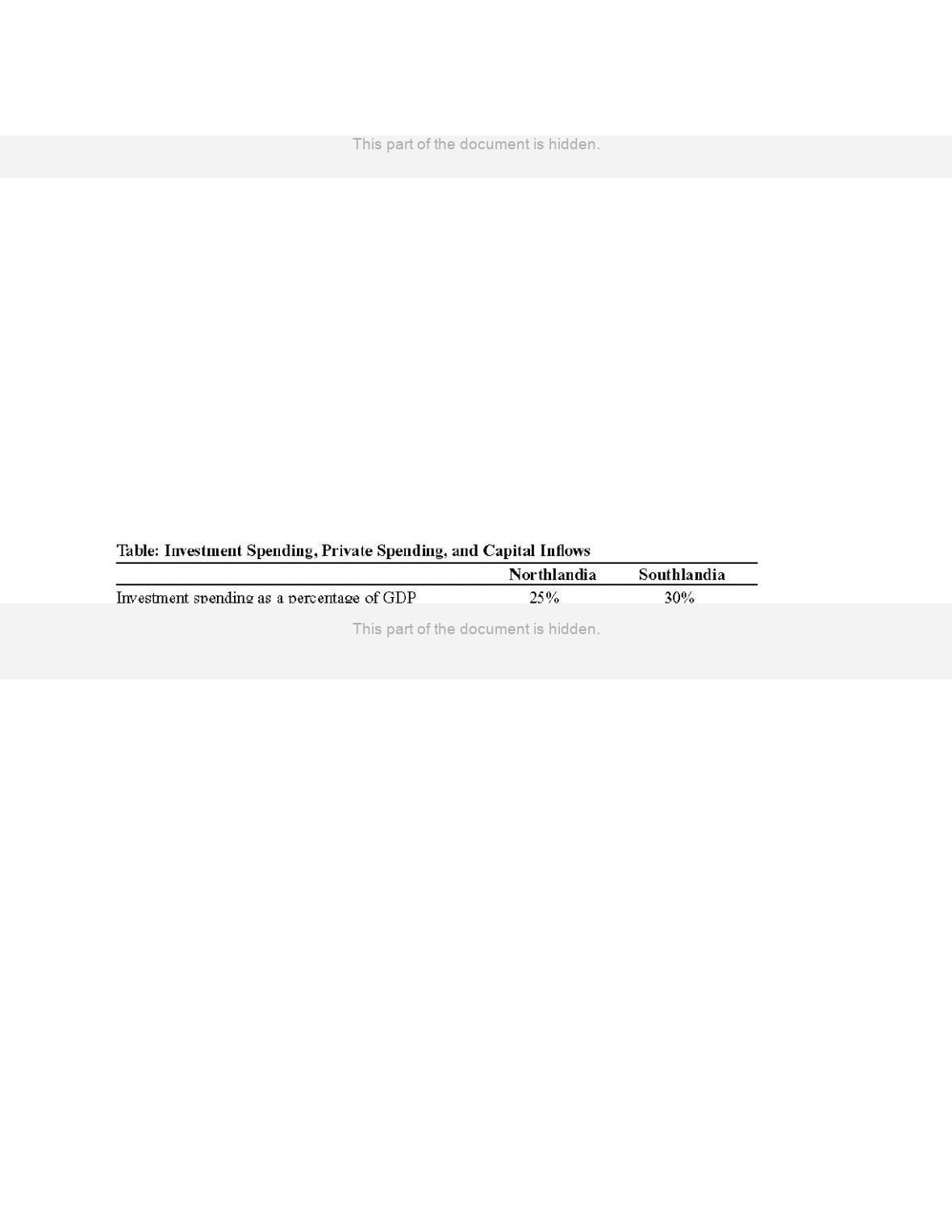
Use the following to answer questions 42-44:
42.
(Table: Investment Spending, Private Spending, and Capital Inflows) Use Table:
Investment Spending, Private Spending, and Capital Inflows. What is the budget
balance as a percentage of GDP in Northlandia?
A)
–10%
B)
0%
C)
10%
D)
20%
43.
(Table: Investment Spending, Private Spending, and Capital Inflows) Use Table:
Investment Spending, Private Spending, and Capital Inflows. What is the budget
balance as a percentage of GDP in Southlandia?
A)
–10%
B)
0%
C)
10%
D)
20%

Page 9
44.
(Table: Investment Spending, Private Spending, and Capital Inflows) Use Table:
Investment Spending, Private Spending, and Capital Inflows. Northlandia has a _____,
while Southlandia has a _____.
A)
balanced budget; budget deficit
B)
budget deficit; balanced budget
C)
budget surplus; balanced budget
D)
balanced budget; balanced budget
45.
Suppose that there is no trade and no government in a small economy. GDP is $25
trillion, and consumption spending is $18 trillion this year. What is the level of private
saving?
A)
$7 trillion
B)
$18 trillion
C)
$43 trillion
D)
–$7 trillion
46.
Suppose that there is no trade and no government in a small economy. GDP is $25
trillion, and consumption spending is $18 trillion this year. What is the level of
investment spending?
A)
$18 trillion
B)
$7 trillion
C)
$25 trillion
D)
–$7 trillion
47.
Suppose that there is no trade and no government in a small economy. GDP is $25
trillion, and consumption spending is $18 trillion this year. There is a new government,
and it imposes taxes on its citizens to spend on infrastructure. Taxes and government
spending are both $2 trillion. What is the level of private saving now?
A)
$11 trillion
B)
$7 trillion
C)
$5 trillion
D)
$18 trillion
48.
Suppose that there is no trade and no government in a small economy. GDP is $25
trillion, and consumption spending is $18 trillion this year. There is a new government
and it imposes taxes on its citizens to spend on infrastructure. Taxes and government
spending are both $2 trillion. What is the level of investment spending now?
A)
$7 trillion
B)
$5 trillion
C)
$18 trillion
D)
–$4 trillion
Page 10
49.
The budget balance equals:
A)
taxes minus government spending.
B)
transfers minus government spending.
C)
taxes plus government spending.
D)
savings plus taxes.
50.
National savings equals:
A)
private savings plus consumption spending.
B)
trade balance plus the budget balance.
C)
private savings plus the budget balance.
D)
government spending plus taxes.
51.
Capital inflow equals:
A)
GDP plus exports minus imports.
B)
the growth in capital stock minus investment spending.
C)
foreign direct investment.
D)
the total inflow of foreign funds minus the total outflow of domestic funds.
52.
Taxes equal:
A)
government spending plus private savings.
B)
total spending minus consumption minus investment minus private savings.
C)
total income minus consumption minus private savings.
D)
consumption plus private savings plus total income.
53.
Which statement is CORRECT?
A)
The budget deficit equals tax revenues plus transfer payments.
B)
Government spending equals private savings plus the budget deficit.
C)
Tax revenues equal national savings plus the budget deficit.
D)
The budget deficit equals government spending minus tax revenues.
54.
Capital inflow is:
A)
the net inflow of funds into a country.
B)
the net outflow of funds from a country.
C)
the amount by which domestic savings exceeds foreign savings.
D)
physical capital exported minus physical capital imported.

Page 11
55.
Assume that I = SPrivate + SGovernment + (IM – X). Furthermore, let’s say that imports are
equal to exports. In this case, private savings:
A)
plus government savings exceed investment.
B)
exceed investment.
C)
plus government savings are less than investment.
D)
plus government savings are equal to investment.
56.
Net capital inflow equals:
A)
national savings.
B)
imports minus exports.
C)
consumption.
D)
consumption plus government spending.
57.
In an open economy, government spending was $30 billion, consumption was $70
billion, taxes were $20 billion, GDP was $100 billion, and investment spending was $10
billion. As a result, there was:
A)
a net capital inflow of $10 billion.
B)
capital inflows of $10 billion and capital outflows of $20 billion.
C)
a trade surplus of $20 billion and a financial deficit of $20 billion.
D)
a net capital outflow of $10 billion.
58.
If a country has a trade surplus, we can conclude that it also has a:
A)
budget surplus.
B)
net capital outflow.
C)
net capital inflow.
D)
budget deficit.
59.
In an open economy, savings CANNOT come from:
A)
domestic sources.
B)
foreign sources.
C)
government sources.
D)
consumption.
60.
Capital inflow into a country is associated with:
A)
imports exceeding exports.
B)
a small amount of funds available for domestic investment.
C)
imports equaling exports.
D)
exports exceeding imports.
Page 12
61.
A relatively low saving rate affects productivity growth by:
A)
causing a shortage of funds for investment in physical capital.
B)
decreasing consumption spending and increasing investment in human capital.
C)
reducing the tax base and preventing the government from providing public goods.
D)
stimulating imports and increasing the trade deficit.
62.
The sources of financing of physical capital include:
A)
domestic consumption.
B)
foreign borrowing from the home country.
C)
foreign investment in the home country.
D)
foreign consumption.
63.
The government can increase savings by:
A)
taxing more than it spends.
B)
spending more than it taxes.
C)
increasing inflation.
D)
increasing the deficit.
64.
The United States is a net recipient of foreign savings.
A)
This has never happened before.
B)
This is bad because we are borrowing money from overseas.
C)
This is bad because we are losing control over our own destiny.
D)
This has been true throughout much of our history.
65.
According to the savings–investment spending identity:
A)
savings and investment spending are always equal for the economy as a whole.
B)
for long-run economic growth, savings must be more than investment spending.
C)
for long-run economic growth, savings must be less than investment spending.
D)
the identity of savers and investors is important for encouraging long-run economic
growth.
66.
GDP is the value of consumption spending _____ investment spending _____
government purchases _____ the value of exports _____ spending on imports.
A)
plus; plus; plus; plus
B)
plus; plus; plus; minus
C)
plus; minus; minus; plus
D)
minus; minus; plus; plus
Page 13
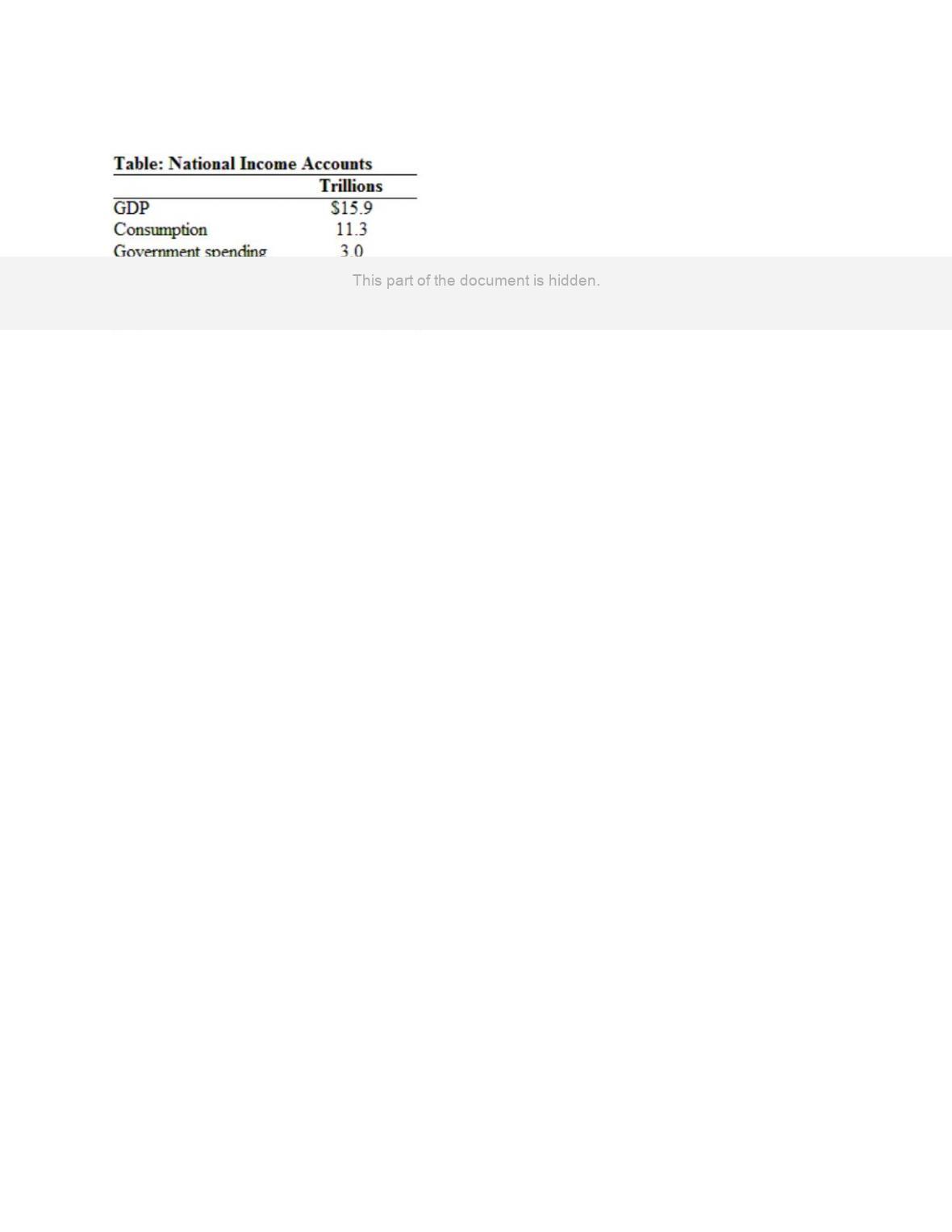
Use the following to answer questions 67-71:
67.
(Table: National Income Accounts) Use Table: National Income Accounts. The value of
investment spending is:
A)
$15.9 trillion.
B)
$4.9 trillion.
C)
$2.1 trillion.
D)
–$0.5 trillion.
68.
(Table: National Income Accounts) Use Table: National Income Accounts. The value of
national savings is:
A)
$15.9 trillion.
B)
$4.9 trillion.
C)
$2.1 trillion.
D)
$1.6 trillion.
69.
(Table: National Income Accounts) Use Table: National Income Accounts. The value of
tax revenue is:
A)
$1.8 trillion.
B)
$4.9 trillion.
C)
$2.1 trillion.
D)
$1.6 trillion.
70.
(Table: National Income Accounts) Use Table: National Income Accounts. The value of
net capital inflow is:
A)
$1.8 trillion.
B)
$0.5 trillion.
C)
$4.9 trillion.
D)
$1.6 trillion.
Page 14
71.
(Table: National Income Accounts) Use Table: National Income Accounts. The value of
private savings is:
A)
$1.8 trillion.
B)
$0.5 trillion.
C)
$2.8 trillion.
D)
$1.6 trillion.
72.
If there is an increase in the government budget deficit, the _____ loanable funds will
_____, interest rates will _____, and the amount of borrowing will _____.
A)
demand for; increase; increase; increase
B)
demand for; decrease; decrease; decrease
C)
supply of; increase; decrease; increase
D)
supply of; decrease; increase; decrease
73.
If private savings increase, the _____ loanable funds will _____, interest rates will
_____, and the amount of borrowing will _____.
A)
demand for; increase; increase; increase
B)
demand for; decrease; decrease; decrease
C)
supply of; increase; decrease; increase
D)
supply of; decrease; increase; decrease
74.
A business will want to borrow to undertake an investment project when the rate of
return on that project is _____ rate.
A)
lower than the interest
B)
higher than the interest
C)
higher than the exchange
D)
equal to the inflation
75.
Economists use _____ as a model to explain how savers and borrowers come together to
determine the equilibrium rate of interest.
A)
the money market
B)
the market for loanable funds
C)
aggregate demand and aggregate supply
D)
the financial system
Page 15
76.
The demand for loanable funds is _____ sloping because _____ respond to lower
interest rates by _____ their quantity demanded of loanable funds.
A)
downward; investors; increasing
B)
downward; savers; increasing
C)
upward; investors; decreasing
D)
upward; savers; decreasing
77.
The supply of loanable funds is _____ sloping because _____ respond to lower interest
rates by _____ their quantity supplied of loanable funds.
A)
upward; savers; increasing
B)
upward; investors; decreasing
C)
upward; savers; decreasing
D)
downward; investors; increasing
78.
The interest rate is 5% in the market for loanable funds. Investors wish to borrow $100
million and savers wish to save $125 million at this interest rate. We would expect the
interest rate to _____, as there is a _____ of loanable funds.
A)
fall; shortage
B)
rise; surplus
C)
rise; shortage
D)
fall; surplus
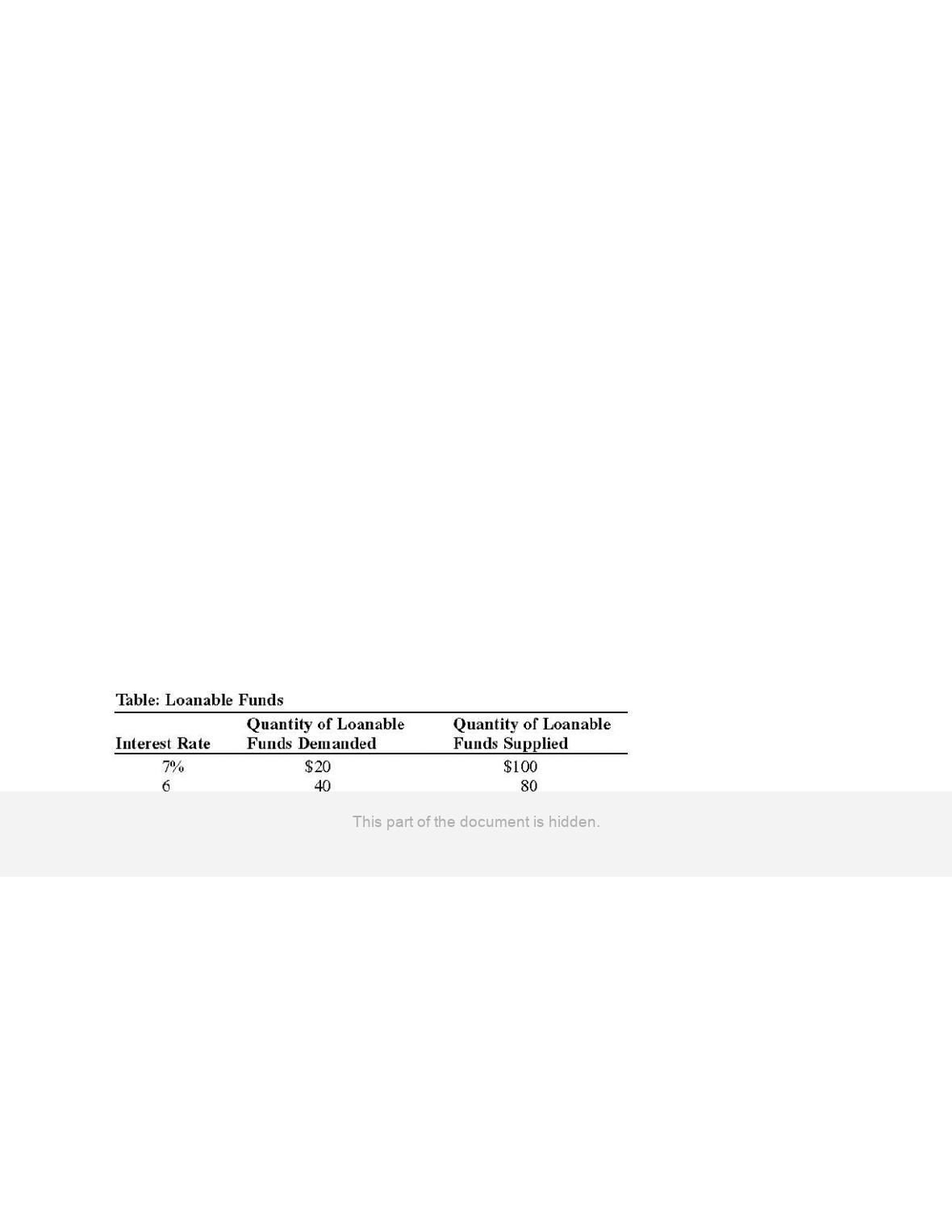
Use the following to answer question 79:
79.
(Table: Loanable Funds) Use Table: Loanable Funds. At what interest rate will the
market for loanable funds be in equilibrium?
A)
7%
B)
6%
C)
5%
D)
4%
Page 16
Use the following to answer questions 80-83:
80.
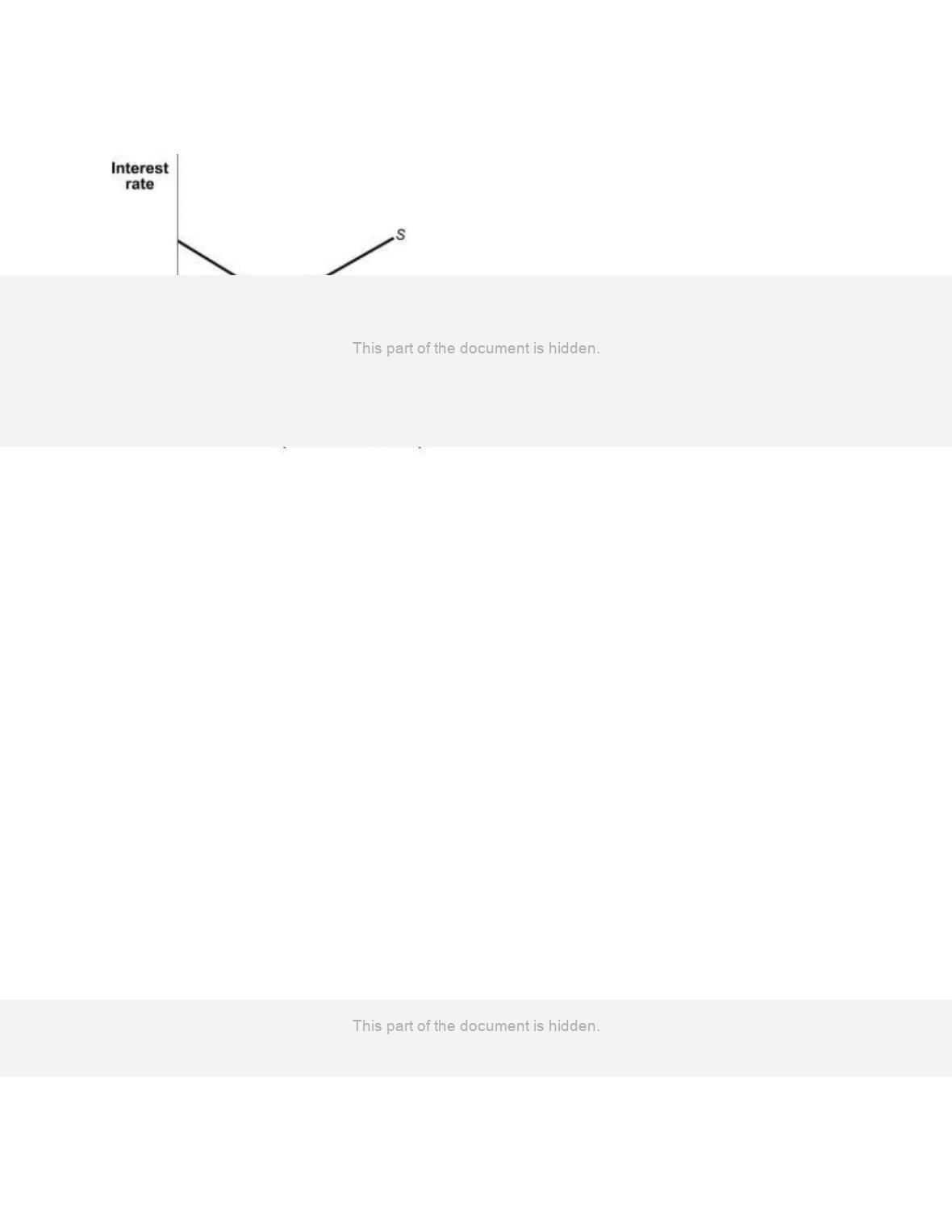
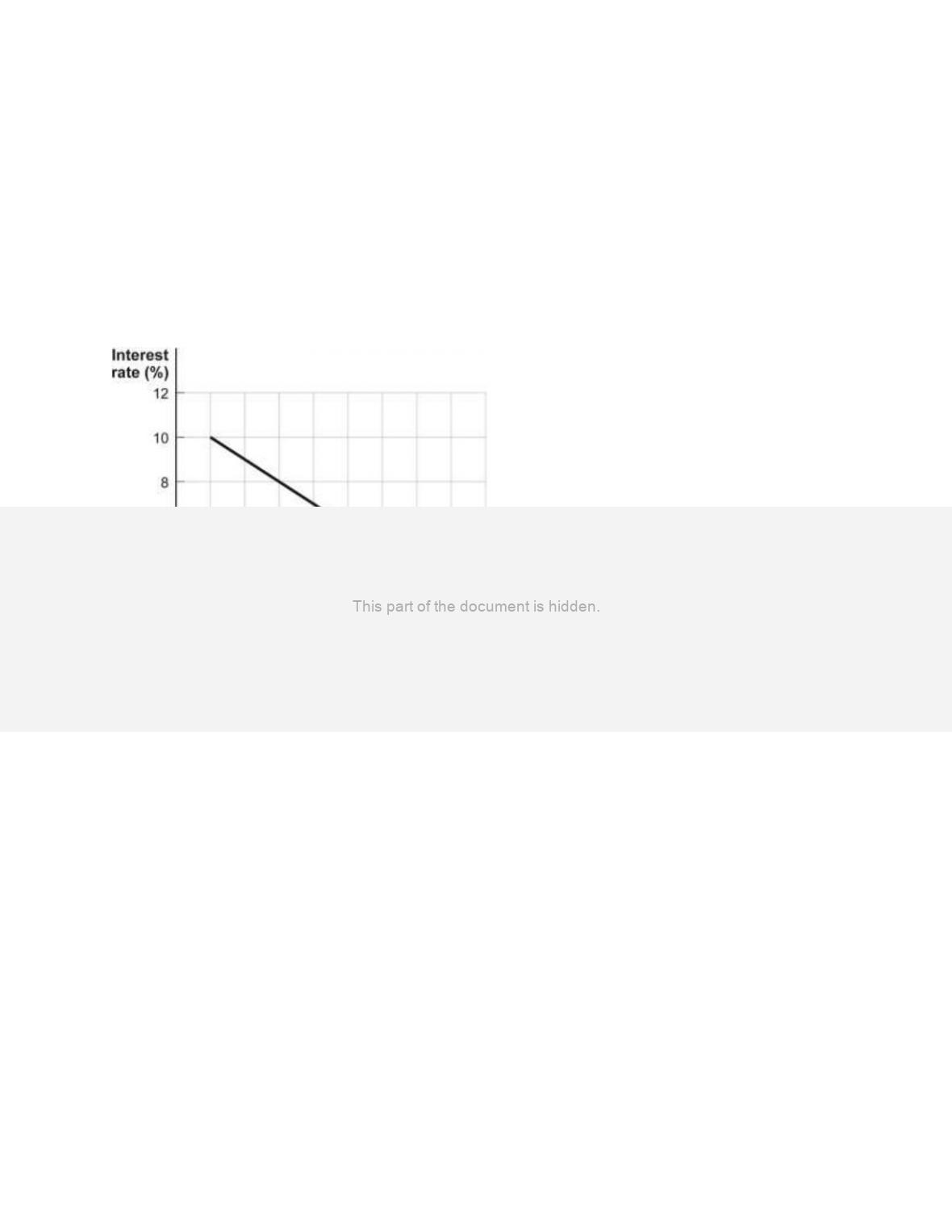
(Figure: Loanable Funds) Use Figure: Loanable Funds. Which scenario might produce a
new equilibrium interest rate of 8% and a new equilibrium quantity of loanable funds of
$150 billion?
A)
Consumption as a fraction of disposable income increases.
B)
Businesses become more optimistic about the return on investment spending.
C)
The federal government has a budget surplus, rather than a budget deficit.
D)
There is an increase in capital inflows from other nations.
81.
(Figure: Loanable Funds) Use Figure: Loanable Funds. Which scenario might produce a
new equilibrium interest rate of 5% and a new equilibrium quantity of loanable funds of
$150 billion?
A)
Consumption as a fraction of disposable income increases.
B)
Businesses become more optimistic about the return on investment spending.
C)
The federal government has a budget surplus, rather than a budget deficit.
D)
There is an increase in capital inflows from other nations.
82.
(Figure: Loanable Funds) Use Figure: Loanable Funds. Which scenario might produce a
new equilibrium interest rate of 8% and a new equilibrium quantity of loanable funds of
$75 billion?
A)
Capital inflows from foreign citizens decline.
B)
The federal government runs a budget deficit, rather than a surplus.
C)
Profit expectations for business investments become less optimistic.
D)
The government eliminates taxes on income from interest earned.
Page 17
83.
(Figure: Loanable Funds) Use Figure: Loanable Funds. Which scenario might produce a
new equilibrium interest rate of 4% and a new equilibrium quantity of loanable funds of
$75 billion?
A)
Profit expectations for business investments become less optimistic.
B)
Capital inflows from foreign citizens decline.
C)
The federal government runs a budget deficit, rather than a surplus.
D)
The government eliminates taxes on income from interest earned.
Use the following to answer question 84:
84.
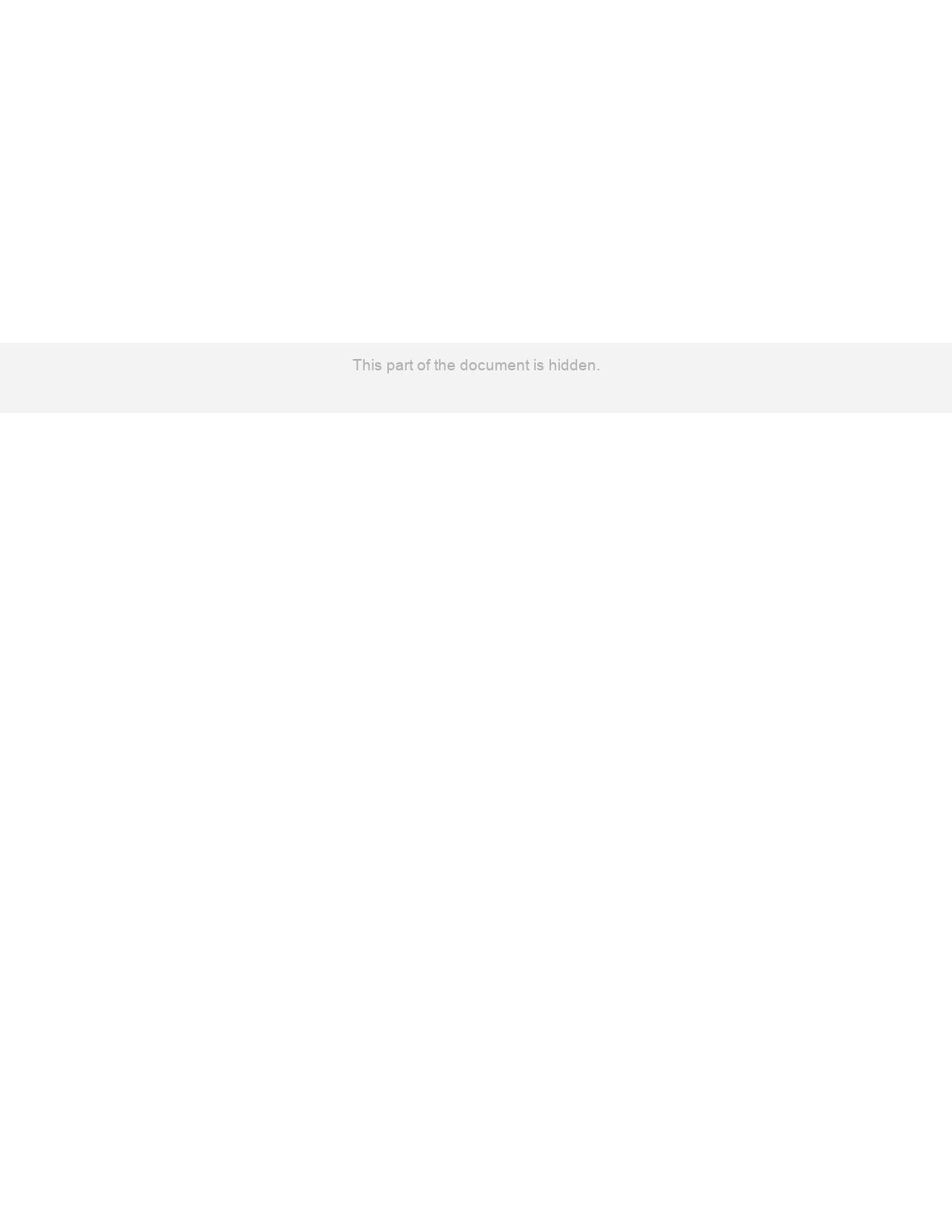
(Figure: Demand for Loanable Funds) Use Figure: Demand for Loanable Funds. When
the interest rate is 6%, the quantity demanded of loanable funds will equal:
A)
$30 billion.
B)
$40 billion.
C)
$50 billion.
D)
$60 billion.
85.
A firm does NOT want to borrow money for a project when the:
A)
interest rate is higher than the rate of return on the project.
B)
interest rate is lower than the rate of return on the project.
C)
interest rate is positive.
D)
rate of return on the project is positive.
Page 18
86.
If a one-year project costs $100,000 and is expected to return the firm $105,000, the rate
of return of the project is:
A)
4.8%.
B)
5%.
C)
$5,000.
D)
$105,000.
87.
A business will want a loan when:
A)
interest rate < (return on project – cost of project) / cost of project * 100.
B)
rate of return < interest rate.
C)
rate of return – interest rate < 0.
D)
rate of return > (cost of project – interest rate) / interest rate * 100.
88.
Which scenario is NOT associated with government budget deficits?
A)
The government becomes a borrower in the market for loanable funds.
B)
The interest rate rises.
C)
The total amount of borrowing decreases.
D)
Private investment spending is crowded out.
89.
The demand curve for loanable funds slopes:
A)
upward since it takes a higher rate of return to get more funds.
B)
downward because more potential projects yield 10% than yield 5%.
C)
upward because higher rates of return are necessary to cover higher costs.
D)
downward because quantity demanded is lower when the price to borrow money is
higher.
Page 19
Use the following to answer questions 90-92:
90.
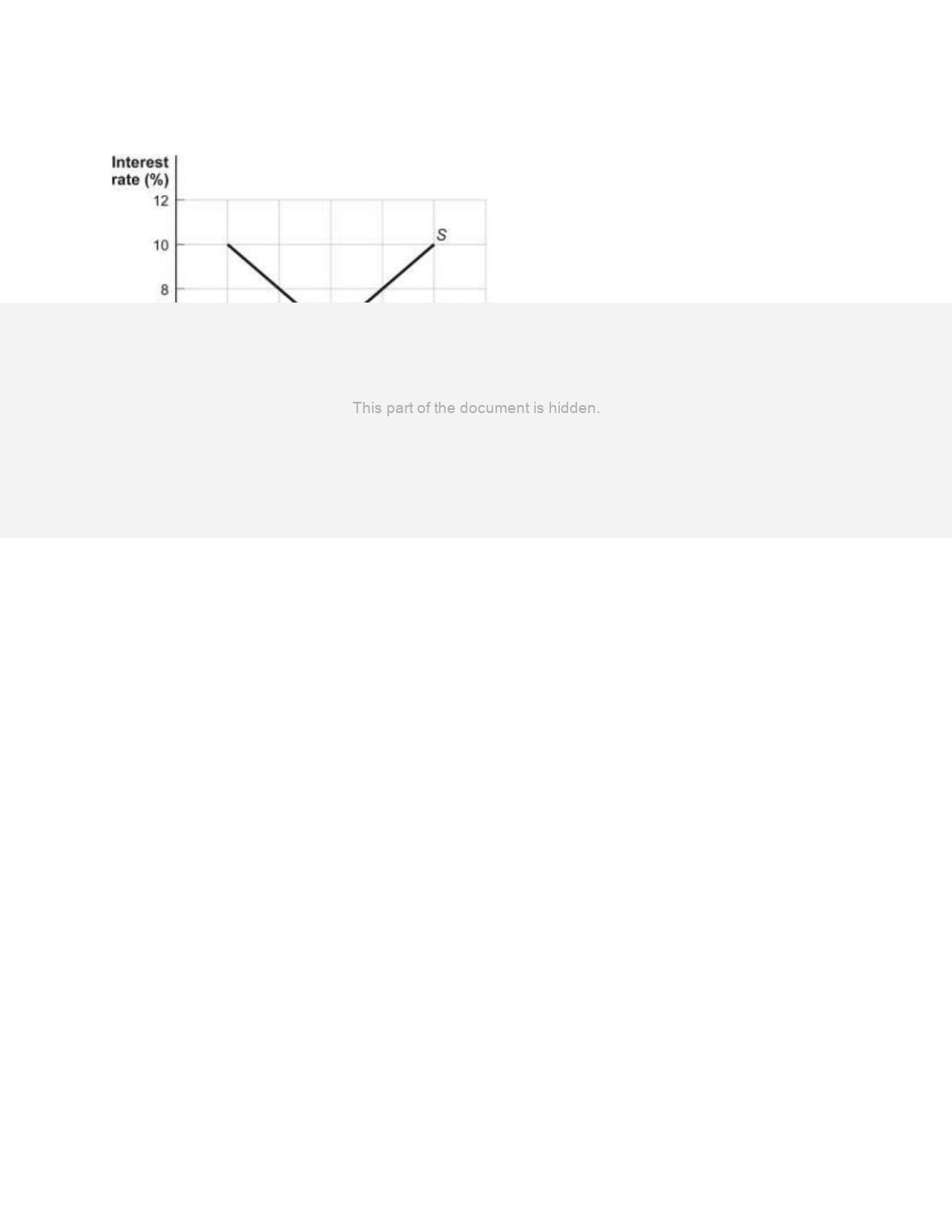
(Figure: Loanable Funds Market) Use Figure: Loanable Funds Market. If the interest
rate is 8%, businesses will want to borrow approximately:
A)
$3 trillion.
B)
$2 trillion.
C)
$4 trillion.
D)
$1 trillion.
91.
(Figure: Loanable Funds Market) Use Figure: Loanable Funds Market. If the interest
rate is 8%, people will want to save approximately:
A)
$3 trillion.
B)
$2 trillion.
C)
$4 trillion.
D)
$1 trillion.
92.
(Figure: Loanable Funds Market) Use Figure: Loanable Funds Market. The equilibrium
interest rate and total quantity of lending are:
A)
8% and $2 trillion.
B)
2% and $5 trillion.
C)
10% and $1 trillion.
D)
6% and $3 trillion.
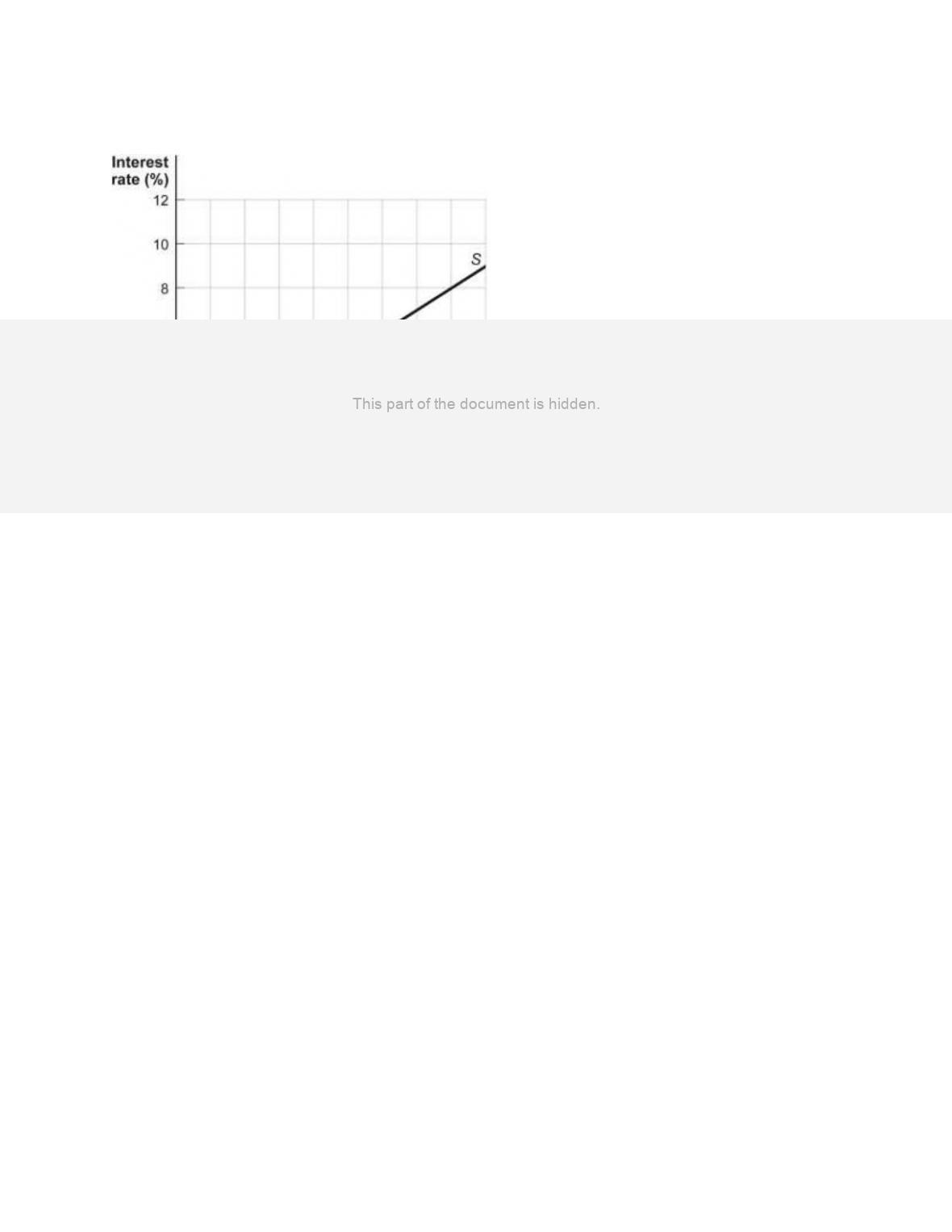
Page 20
Use the following to answer question 93:
93.
(Figure: Supply of Loanable Funds) Use Figure: Supply of Loanable Funds. When the
interest rate rises from 6% to 8%, the:
A)
supply of loanable funds rises by $20 billion.
B)
quantity supplied of loanable funds rises by $20 billion.
C)
supply of loanable funds falls by $10 billion.
D)
quantity supplied of loanable funds falls by $20 billion.