
Page 1
Name: __________________________ Date: _____________
1.
Market structures are categorized by:
A)
the number and size of the firms.
B)
whether products are differentiated and the extent of advertising.
C)
the number of firms and whether products are differentiated.
D)
the size of the firms and the extent of advertising.
2.
Which statement about the differences between monopoly and perfect competition is
INCORRECT?
A)
A monopolist has market power, while a perfect competitor does not.
B)
Unlike a perfectly competitive firm, a monopoly can make positive economic
profits in the long run.
C)
A monopoly will charge a higher price and produce a smaller quantity than will a
competitive market with the same demand and cost structure.
D)
Monopoly profits can continue in the long run because the monopoly produces
more and charges a higher price than does a comparable perfectly competitive
industry.
3.
Which statement concerning monopoly is TRUE?
A)
Monopoly firms are always larger than are perfectly competitive firms.
B)
A monopoly has no rivals.
C)
Barriers to entry do not prevent other firms from entering a monopolized industry.
D)
Monopolists produce more output than does a competitive market with the same
demand and cost structure.
4.
_____ firms have the MOST market power.
A)
Monopoly
B)
Duopoly
C)
Oligopoly
D)
Monopolistic competition
5.
An industry with a single producer that sells a single product with no substitutes is a:
A)
perfectly competitive industry.
B)
monopoly.
C)
oligopoly.
D)
monopolistically competitive industry.
Page 2
6.
An industry with a firm that is the only producer of a good or service for which there are
no close substitutes and for which entry by potential rivals is prohibitively difficult is:
A)
a duopoly.
B)
a monopoly.
C)
an oligopoly.
D)
perfect competition.
7.
A monopoly is a market characterized by a:
A)
single seller.
B)
product with many close substitutes.
C)
large number of small firms.
D)
small number of large firms.
8.
A monopoly:
A)
produces a product with no close substitutes.
B)
is composed of a single buyer and several sellers.
C)
is composed of a large number of small firms.
D)
is composed of a small number of large firms.
9.
Diamond rings are relatively scarce because:
A)
according to geologists, diamonds are less common than is any other gem-quality
stone.
B)
the demand for diamonds is so high.
C)
diamond producers limit the quantity supplied to the market.
D)
of monopolistic competition.
10.
De Beers became a monopoly by:
A)
establishing control over diamond mines.
B)
use of economies of scale.
C)
use of technological superiority.
D)
ownership of a patent.
11.
A monopolist is likely to produce _____ and charge _____ than is a comparable
perfectly competitive firm.
A)
more; more
B)
less; more
C)
more; less
D)
less; less
Page 3
12.
In contrast with perfect competition, a monopolist:
A)
produces more at a lower price.
B)
produces where MR > MC, and a perfectly competitively firm produces where P =
MC.
C)
may have economic profits in the long run.
D)
earns zero economic profits in the long run.
13.
Because of monopoly, consumers experience _____ than they do with perfect
competition.
A)
more choices
B)
larger quantities
C)
higher quality
D)
higher prices
14.
The ability of a monopolist to raise the price of a product above the competitive level by
reducing the output is known as:
A)
product differentiation.
B)
barrier to entry.
C)
market power.
D)
patents and copyrights.
15.
Most electric, gas, and water companies are examples of _____ monopolies.
A)
unregulated
B)
natural
C)
restricted-input
D)
sunk-cost
16.
Suppose that you build a high-speed, magnetically powered transportation system from
New York to Los Angeles, and you are the only firm providing this service. High fixed
costs resulting from the enormous quantity of capital used in this system enable
decreasing average cost for any conceivable level of demand. Your monopoly is the
result of your:
A)
control of a scarce resource or input.
B)
technological superiority.
C)
increasing returns to scale.
D)
use of government-set barriers.
Page 4
17.
If your farm had the only known source of a rare cocoa bean needed to make
chocolate-covered peanuts, your monopoly would result from:
A)
control of a scarce resource or input.
B)
technological superiority.
C)
increasing returns to scale.
D)
government-set barriers.
18.
If you had an official license for the exclusive right to sell breakfast bagels in your
community, your monopoly would result from:
A)
control of a scarce resource or input.
B)
technological superiority.
C)
increasing returns to scale.
D)
government-set barriers.
19.
The De Beers company is described as a monopolist in the production of:
A)
diamonds.
B)
software.
C)
oil.
D)
beer.
20.
You own a lemonade stand in a competitive market, and as such, you are a price-taking
firm. Which event would MOST likely increase your market power?
A)
The government abolishes the system of patents and copyrights.
B)
A booming economy increases the demand for lemonade and attracts entry into the
market.
C)
The average total cost curve for firms in the industry becomes horizontal.
D)
You acquire exclusive rights to harvest lemons from all domestic citrus orchards.
21.
Conditions that keep new firms out of a monopoly market are:
A)
barriers to entry.
B)
terms of sale.
C)
labor market stipulations.
D)
production controls.

Page 5
22.
A natural monopoly exists whenever a single firm:
A)
is owned and operated by the government.
B)
is investor owned but has been granted the exclusive right by the government to
operate in a market.
C)
has economies of scale over the entire range of production that is relevant to its
market.
D)
has gained control over a strategic input of an important production process.
23.
Natural monopolies are NOT likely to include:
A)
a diamond-mining company.
B)
a gas company.
C)
an electricity company.
D)
railways.
24.
Suppose that you build a new jumbo jet that can carry five times more passengers than
can any other competitor. You have high fixed costs due to the quantity of capital used
to build the jets, and average cost is decreasing for all levels of demand. In this case,
your monopoly would result from:
A)
sunk costs.
B)
location.
C)
economies of scale.
D)
government restrictions.
25.
A firm that has economies of scale:
A)
at low output and diseconomies of scale at high output is a natural monopoly.
B)
over the entire range of output demanded is a natural monopoly.
C)
at any particular level of output is a natural monopoly.
D)
has a continually rising long-run average cost curve.
26.
The land you own has the only known source of aloe needed to make anti-itch lotion. In
this case, your monopoly results from:
A)
government restrictions.
B)
location.
C)
sunk costs.
D)
ownership of scarce inputs.
Page 6
27.
If the state government gave you the exclusive right to sell cement to municipalities,
your monopoly would result from:
A)
sunk costs.
B)
government restrictions to entry.
C)
economies of scale.
D)
location.
28.
A monopoly is MOST likely to be temporary if the monopoly power is derived from:
A)
high barriers to entry.
B)
a fundamental lack of substitutes for the monopolist’s product.
C)
economies of scale.
D)
technological change.
29.
If a product’s usefulness increases with the number of users, it:
A)
has network externalities.
B)
is a monopoly.
C)
is a conglomerate.
D)
has an exclusive franchise.
30.
Which factor is NOT a barrier to entry?
A)
control of scarce resources
B)
economies of scale
C)
patents and copyrights
D)
diseconomies of scale
31.
Critics of the National Collegiate Athletic Association (NCAA) argue that the NCAA
monopolizes college athletics and prevents student athletes from earning money while
in college. If this is true, what type of entry barrier does the NCAA have?
A)
a patent
B)
a copyright
C)
control of a scarce resource or input
D)
economies of scale
32.
Lenoia runs a natural monopoly producing electricity for a small mountain village. The
barrier preventing other firms from competing with her is:
A)
her control of scarce natural resources.
B)
the existence of economies of scale.
C)
her technological superiority.
D)
a government-set barrier.
Page 7
33.
Which factor is NOT a barrier to entry?
A)
control of an input essential for production
B)
government-set barriers such as patents
C)
a ban on certain kinds of advertising
D)
the existence of significant economies of scale
34.
Microsoft and its operating system are often cited as an example of a company that grew
into a monopolist through:
A)
ownership of a resource.
B)
patents.
C)
network externalities.
D)
large economies of scale.
35.
Network externalities exist when a good’s value to the consumer rises as:
A)
the number of people who use the good increases.
B)
the number of people who use the good decreases.
C)
the number of people who use the good remains constant.
D)
technology improves.
36.
A monopoly is an industry structure characterized by:
A)
a single buyer and several sellers.
B)
a product with many close substitutes.
C)
a large number of small firms.
D)
barriers to entry and exit.
37.
Large barriers to entry are one reason that a monopoly:
A)
earns an economic profit in the long run.
B)
produces at the minimum average total cost in the long run.
C)
produces with no fixed costs in the long run.
D)
maximizes its profits by producing where P = MC.
38.
The demand curve facing a monopolist is:
A)
horizontal, the same as that facing a perfectly competitive firm.
B)
downward sloping, the same as that facing a perfectly competitive firm.
C)
upward sloping, the same as that facing a perfectly competitive firm.
D)
downward sloping, unlike the horizontal demand curve facing a perfectly
competitive firm.
Page 8
39.
Which statement is TRUE?
A)
A monopoly firm is a price taker.
B)
MR > P if the demand curve is downward sloping.
C)
MR = MC is a profit-maximizing rule for any firm.
D)
In monopoly, P = MC when profits are maximized.
40.
The demand curve for a monopoly is:
A)
the sum of the supply curves of all of the firms in the monopoly’s industry.
B)
the industry demand curve.
C)
horizontal because no one can enter.
D)
perfectly elastic.
41.
A firm that faces a downward-sloping demand curve is a:
A)
price setter.
B)
quantity minimizer.
C)
quantity taker.
D)
price taker.
42.
Because monopoly firms are price setters, they:
A)
can sell more only by lowering the price.
B)
sell more at higher prices than at lower prices.
C)
take the market-determined price as given and sell all they can at that price.
D)
charge the highest possible price.
43.
Wendy has a monopoly in the retailing of motor homes. She can sell five per week at
$21,000 each. If she wants to sell six, she can charge only $20,000 each. The quantity
effect of selling the sixth motor home is:
A)
$20,000.
B)
$10,000.
C)
$15,000.
D)
$21,000.
44.
Wendy has a monopoly in the retailing of motor homes. She can sell five per week at
$21,000 each. If she wants to sell six, she can only charge $20,000 each. The price
effect of selling the sixth motor home is:
A)
$20,000.
B)
–$15,000.
C)
–$5,000.
D)
$25,000.
Page 9
45.
After the first unit sold, the marginal revenue a monopolist receives from selling one
more unit of a good is less than the price of that unit because of:
A)
diminishing marginal returns.
B)
increasing marginal cost.
C)
a downward-sloping demand curve.
D)
declining average fixed cost.
46.
Mr. Porter sells 10 bottles of champagne per week at $50 per bottle. He can sell 11
bottles per week if he lowers the price to $45 per bottle. The quantity and the price
effects on total revenue would be, respectively, an increase of _____ and a decrease of
_____.
A)
$450; $500
B)
$495; $550
C)
$45; $5
D)
$45; $50
47.
One of the major differences between a monopolist and a purely competitive firm is that
the monopolist has a _____ demand curve, while the purely competitive firm has a
_____ demand curve.
A)
downward-sloping; perfectly elastic
B)
perfectly inelastic; perfectly elastic
C)
downward-sloping; perfectly inelastic
D)
perfectly elastic; downward-sloping
48.
The demand curve for a monopoly is:
A)
the MR curve above the AVC curve.
B)
the MR curve above the horizontal axis.
C)
the entire MR curve.
D)
above the MR curve.
49.
Suppose that a monopoly computer chip maker increases production from 10
microchips to 11 microchips. If the market price declines from $30 per unit to $29 per
unit, marginal revenue for the eleventh unit is:
A)
$1.
B)
$9.
C)
$19.
D)
$29.
Page 10
50.
Marginal revenue for a monopolist is:
A)
equal to price.
B)
greater than price.
C)
less than price.
D)
equal to average revenue.
51.
A downward-sloping demand curve will ensure that _____ is TRUE for a monopoly.
A)
P = MR
B)
P > MR
C)
P < MR
D)
P = MC
52.
Which statement is TRUE?
A)
Instead of applying the marginal decision rule, monopoly firms just set the price as
high as possible.
B)
If demand is downward sloping, P = MR.
C)
If demand is downward sloping, P = ATC.
D)
If demand is downward sloping, P > MR.
53.
The demand curve for a monopoly is:
A)
above the marginal revenue curve.
B)
below the marginal revenue curve.
C)
horizontal because of economies of scale.
D)
infinitely elastic.
54.
The demand curve facing a monopolist is:
A)
downward sloping.
B)
vertical.
C)
horizontal.
D)
upward sloping.
55.
The demand curve facing a monopolist is always:
A)
the same as the industry’s demand curve.
B)
perfectly elastic.
C)
unit-elastic.
D)
perfectly inelastic.
Page 11
56.
The demand curve facing a monopolist is:
A)
vertical, the same as that facing a perfectly competitive firm.
B)
perfectly inelastic, the same as that facing a perfectly competitive firm.
C)
upward sloping, the same as that facing a perfectly competitive firm.
D)
downward sloping, like the industry demand curve in perfect competition.
57.
The demand curve for a monopoly is:
A)
the MC curve above the AVC curve.
B)
the MR curve above the horizontal axis.
C)
identical to the MR curve.
D)
also the industry demand curve.
58.
Marginal revenue for a monopolist is:
A)
equal to price.
B)
greater than price.
C)
less than price.
D)
the change in total revenue plus the change in output.
59.
If a firm faces a downward-sloping demand curve, it will ensure that:
A)
P = ATC.
B)
P > MR.
C)
P < MC.
D)
P = MC.
60.
A monopolist’s marginal cost curve shifts up, but the firm’s demand curve remains the
same and the firm does not shut down. Compared with the condition before the increase
in marginal costs, the monopolist will _____ its price and _____ its level of production.
A)
raise; decrease
B)
not change; decrease
C)
raise; increase
D)
lower; increase
61.
Suppose a monopoly is producing output so that marginal revenue equals marginal cost.
If the monopolist reduces output, it:
A)
can charge a higher price.
B)
will increase profits.
C)
will decrease marginal revenue.
D)
can’t change the price because it is a price taker.
Page 12
62.
At a monopoly’s profit-maximizing level of output:
A)
marginal revenue equals marginal cost.
B)
marginal revenue is greater than marginal cost.
C)
marginal revenue is less than marginal cost.
D)
price is less than marginal cost.
63.
A monopoly is producing output so that average total cost is $30, marginal revenue is
$40, and the price is $50. If ATC is at its minimum level and the ATC curve is U-shaped,
to maximize profits, this firm should:
A)
increase output.
B)
reduce output.
C)
do nothing; it is already maximizing profits.
D)
shut down.
64.
If a monopolist is producing a quantity where MC = P, then profit:
A)
is maximized.
B)
is maximized only if MR = P.
C)
can be increased by increasing production.
D)
can be increased by decreasing production.
65.
If a monopolist is producing a quantity where MC > MR, then profit:
A)
is maximized.
B)
is maximized only if MC = P.
C)
can be increased by increasing production.
D)
can be increased by decreasing production.
66.
Which statement is TRUE?
A)
Profit-maximizing behavior occurs only in perfectly competitive markets.
B)
Additional units of a good should be produced as long as MR < MC.
C)
The profit-maximizing solution occurs where MR = MC.
D)
The profit-maximizing solution occurs where MR > MC.
67.
A monopolist responds to an increase in demand by _____ price and _____ output.
A)
increasing; decreasing
B)
increasing; increasing
C)
decreasing; increasing
D)
decreasing; decreasing
Page 13
68.
A monopolist responds to a decrease in demand by _____ price and _____ output.
A)
increasing; decreasing
B)
increasing; increasing
C)
decreasing, increasing
D)
decreasing; decreasing
69.
A monopolist responds to an increase in marginal cost by _____ price and _____ output.
A)
increasing; decreasing
B)
increasing; increasing
C)
decreasing; increasing
D)
decreasing; decreasing
70.
A monopoly responds to a decrease in marginal cost by _____ price and _____ output.
A)
increasing; decreasing
B)
increasing; increasing
C)
decreasing; increasing
D)
decreasing; decreasing
71.
The GoSports Company is a profit-maximizing firm with a monopoly in the production
of school team pennants. The firm sells its pennants for $10 each. We can conclude that
GoSports is producing a level of output at which:
A)
average total cost equals $10.
B)
average total cost is greater than $10.
C)
marginal revenue equals $10.
D)
marginal cost equals marginal revenue.
72.
Suppose that a profit-maximizing monopoly firm undergoes a substantial technological
change that reduces its marginal and average total costs by $40. If in response to its
reduction in cost the firm changes its price in a profit-maximizing way, then we can
predict that its total economic profit will:
A)
fall.
B)
remain unchanged.
C)
rise.
D)
It is not possible to make a determination from the information given.
Page 14
73.
Suppose that a profit-maximizing monopoly firm undergoes a substantial technological
change that reduces its marginal and average total costs by $40. If in response to its
reduction in cost the firm changes its price in a profit-maximizing way, then we can
predict that its total output will:
A)
rise.
B)
fall.
C)
remain unchanged.
D)
It is not possible to make a determination from the information given.
74.
Suppose that a monopoly firm is required to pay a new annual license fee to do business
in its city and that the fee is somewhat less than the economic profit the firm is now
earning. In response to the increase in fees, the firm will:
A)
raise its price by less than the amount of the license fee.
B)
raise its price by the amount of the license fee.
C)
raise its price by somewhat more than amount of the license fee.
D)
not change its price.
75.
An increase in the fixed costs of a monopoly firm would _____ price and _____
quantity in the short run.
A)
increase; decrease
B)
increase; increase
C)
not change; not change
D)
decrease; decrease
76.
If a monopolist is producing a quantity that generates MC > MR, then profit:
A)
is maximized.
B)
is maximized only if MC = P.
C)
can be increased by increasing price.
D)
can be increased by decreasing price.
77.
If a monopolist is producing a quantity that generates MC < MR, then profit:
A)
is maximized.
B)
is maximized only if MC = P.
C)
can be increased by increasing production.
D)
can be increased by decreasing production.
Page 15
78.
If a monopolist is producing a quantity that generates MC = MR, then profit:
A)
is maximized.
B)
is maximized only if MC = P.
C)
can be increased by increasing production.
D)
can be increased by decreasing production.
79.
Suppose that the Yankee Cap Company is a profit-maximizing firm with a monopoly in
the production of baseball caps. The firm sells its baseball caps for $25 each. From this
information, we can assume that the Yankee Cap Company is producing a level of
output at which:
A)
marginal revenue equals $25.
B)
marginal cost is less than $25.
C)
average total cost equals $25.
D)
average total cost is greater than $25.
Use the following to answer questions 80-83:
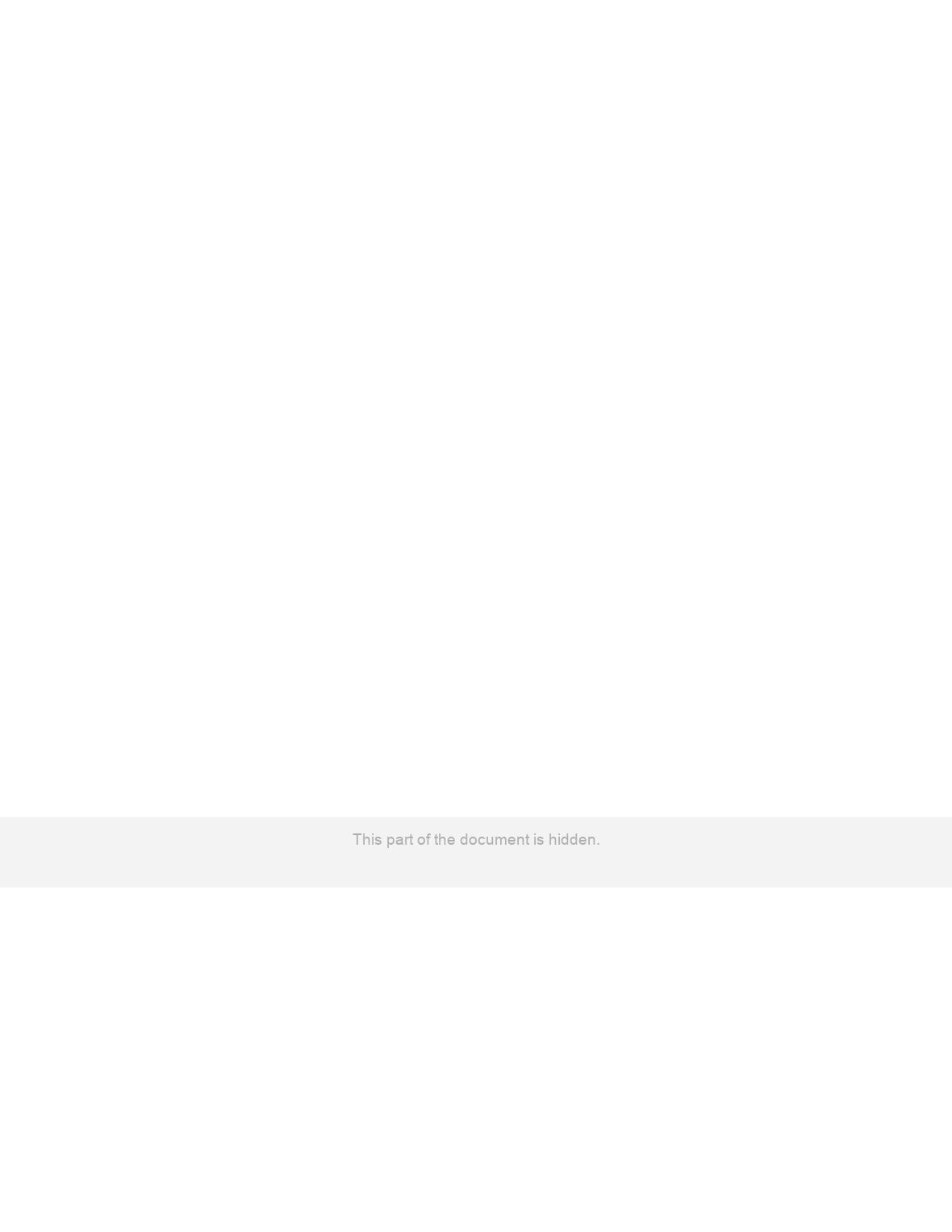
Figure: Short-Run Monopoly
Page 16
80.
(Figure: Short-Run Monopoly) Use Figure: Short-Run Monopoly. The
profit-maximizing rule is satisfied by the intersection at point:
A)
G.
B)
H.
C)
J.
D)
L.
81.
(Figure: Short-Run Monopoly) Use Figure: Short-Run Monopoly. The
profit-maximizing quantity of output is quantity:
A)
Q.
B)
R.
C)
S.
D)
T.
82.
(Figure: Short-Run Monopoly) Use Figure: Short-Run Monopoly. The
profit-maximizing price is price:
A)
N.
B)
O.
C)
P.
D)
Q.
83.
(Figure: Short-Run Monopoly) Use Figure: Short-Run Monopoly. The marginal cost of
producing the profit-maximizing quantity is cost:
A)
N.
B)
O.
C)
P.
D)
Q.
84.
The monopoly firm’s profit-maximizing price is:
A)
given by the point on the ATC curve for the profit-maximizing quantity.
B)
given by the point on the demand curve for the profit-maximizing quantity.
C)
determined for the quantity of output at which MR > MC by the greatest amount.
D)
found where MR > MC at the monopolist’s profit-maximizing quantity of output.
85.
A monopolist generally _____ than does a perfectly competitive industry with the same
market demand.
A)
produces a larger quantity
B)
charges a higher price
C)
charges a lower price
D)
earns less profit in the long run
Page 17
86.
Bob owns a trout farm with monopoly power in North Carolina. Bob’s optimal output
occurs where marginal revenue _____ marginal cost. Because of monopoly power,
Bob’s supply curve _____.
A)
equals; does not exist
B)
exceeds; does not exist
C)
equals; is upward sloping
D)
exceeds; is perfectly inelastic
87.
Which statement about monopoly equilibrium and perfectly competitive equilibrium is
INCORRECT?
A)
Price is greater than marginal cost in monopoly, and price equals marginal cost in
perfect competition.
B)
When a monopoly exists, the consumer surplus from the market is less than it
would be if the same market were perfectly competitive.
C)
Monopoly output will be less than will the output of a comparable perfectly
competitive industry.
D)
In the long run, economic profits are driven to zero in both a monopoly and a
perfectly competitive market.
88.
Which statement BEST reflects an evaluation of monopoly firms?
A)
They are economically inefficient.
B)
They have little or no market power.
C)
Consumers are given more choices, lower costs, and higher quality.
D)
Competition should replace all monopolies.
89.
In perfect competition, the firm produces the output such that _____, and in monopoly,
the firm produces the output such that _____.
A)
P > MR = MC; P = MR = MC
B)
P = MR = MC; P < MR = MC
C)
P = MR = MC; P > MR = MC
D)
P = MR = MC; P = MR = MC
90.
Which statement is TRUE?
A)
A monopoly firm is a price maker.
B)
MR = P if the demand curve is downward sloping.
C)
MR = MC is a profit-maximizing rule for firms in perfect competition only.
D)
Monopolies tend to charge lower prices than do perfectly competitive firms.
Page 18
91.
The profit-maximizing rule MR = MC is:
A)
followed by a monopoly but not by a perfectly competitive firm.
B)
followed by a perfectly competitive firm but not by a monopoly.
C)
followed by all types of firms.
D)
not followed by a monopoly because it would reduce economic profit to zero.
92.
Assume that a monopoly is currently earning economic profits. If a permanent change in
fixed cost raises average total cost above the demand curve:
A)
price and output will increase.
B)
more monopolies will enter.
C)
the monopoly will go out of business.
D)
marginal cost will be greater than marginal revenue.
Use the following to answer questions 93-96:
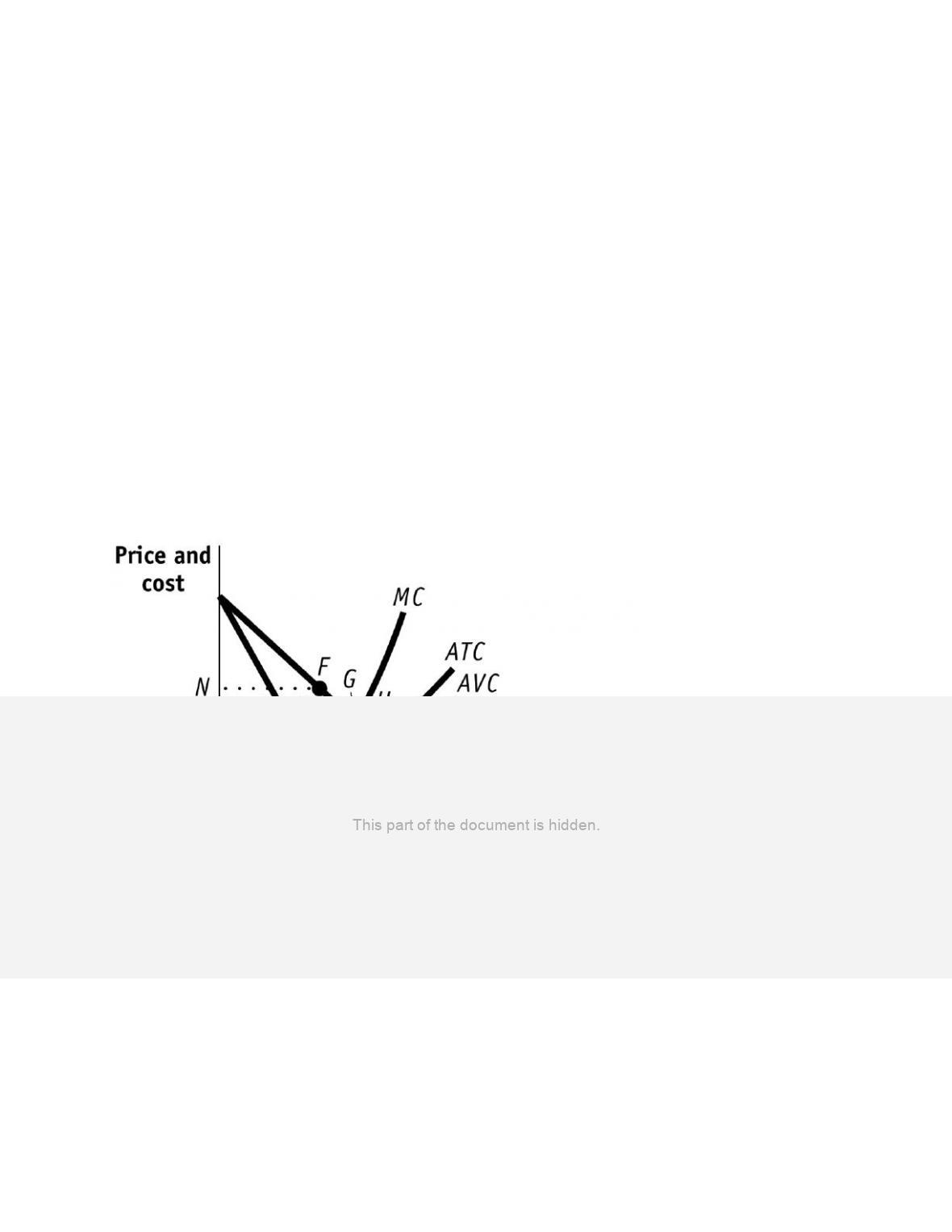
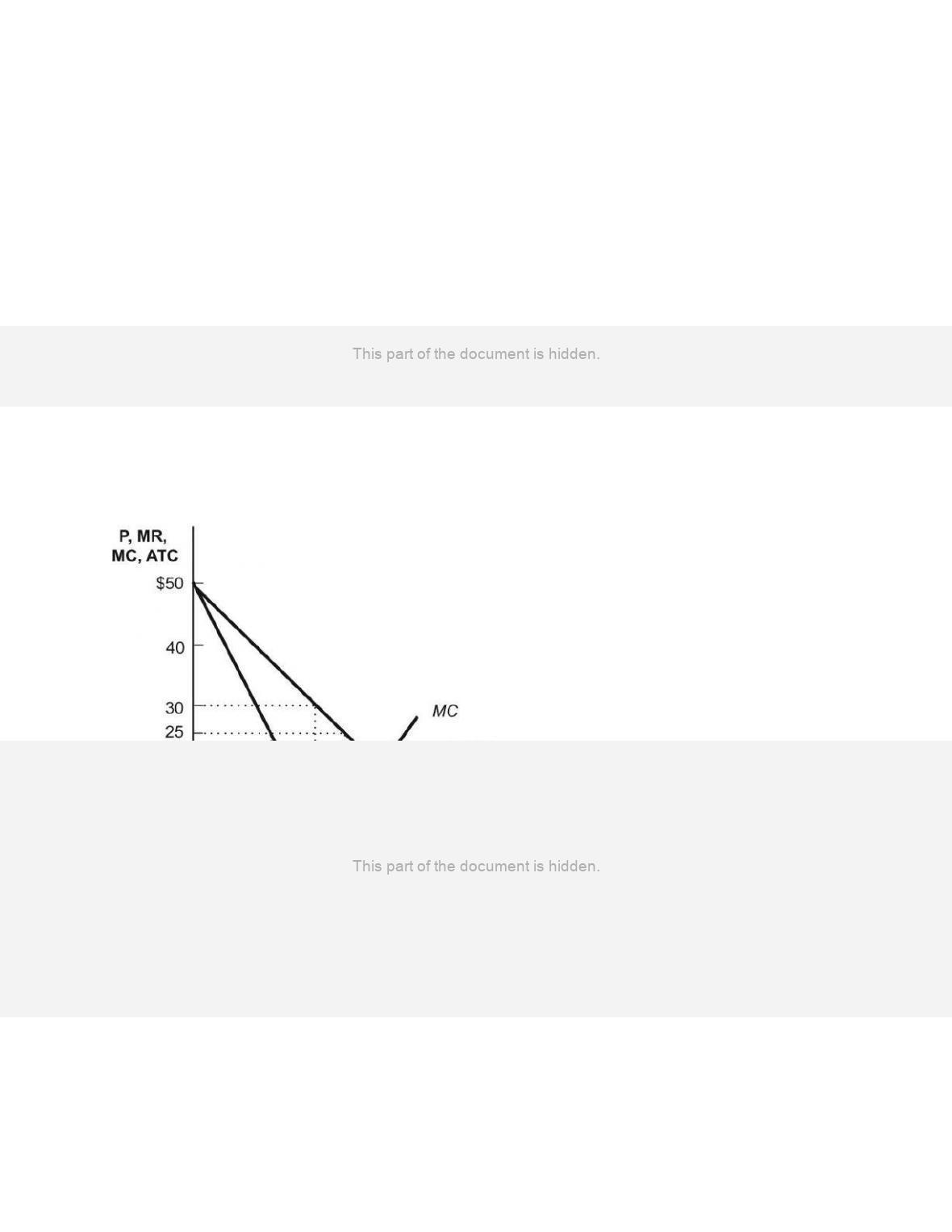
Figure: A Profit-Maximizing Monopoly Firm
Page 19
93.
(Figure: A Profit-Maximizing Monopoly Firm) Use Figure: A Profit-Maximizing
Monopoly Firm. The firm in this figure will produce _____ units of output per week.
A)
150
B)
200
C)
250
D)
300
94.
(Figure: A Profit-Maximizing Monopoly Firm) Use Figure: A Profit-Maximizing
Monopoly Firm. This firm’s cost per unit at its profit-maximizing quantity is:
A)
$8.
B)
$15.
C)
$18.
D)
$20.
95.
(Figure: A Profit-Maximizing Monopoly Firm) Use Figure: A Profit-Maximizing
Monopoly Firm. This firm’s price per unit is:
A)
$20.
B)
$25.
C)
$30.
D)
$35.
96.
(Figure: A Profit-Maximizing Monopoly Firm) Use Figure: A Profit-Maximizing
Monopoly Firm. This firm’s profit per unit is:
A)
$5.
B)
$12.
C)
$15.
D)
$20.
97.
In the short run, a monopoly will stop producing if:
A)
P < ATC.
B)
P < AVC.
C)
P > MR.
D)
P > ATC.
98.
In a monopoly in the long run:
A)
economic profits will be eliminated by the entry of rival firms.
B)
economic profits will be reduced but not eliminated by the entry of rival firms.
C)
entry by other firms will not occur.
D)
the price will be the same as if the market were perfectly competitive.
Page 20
Use the following to answer questions 99-103:
99.
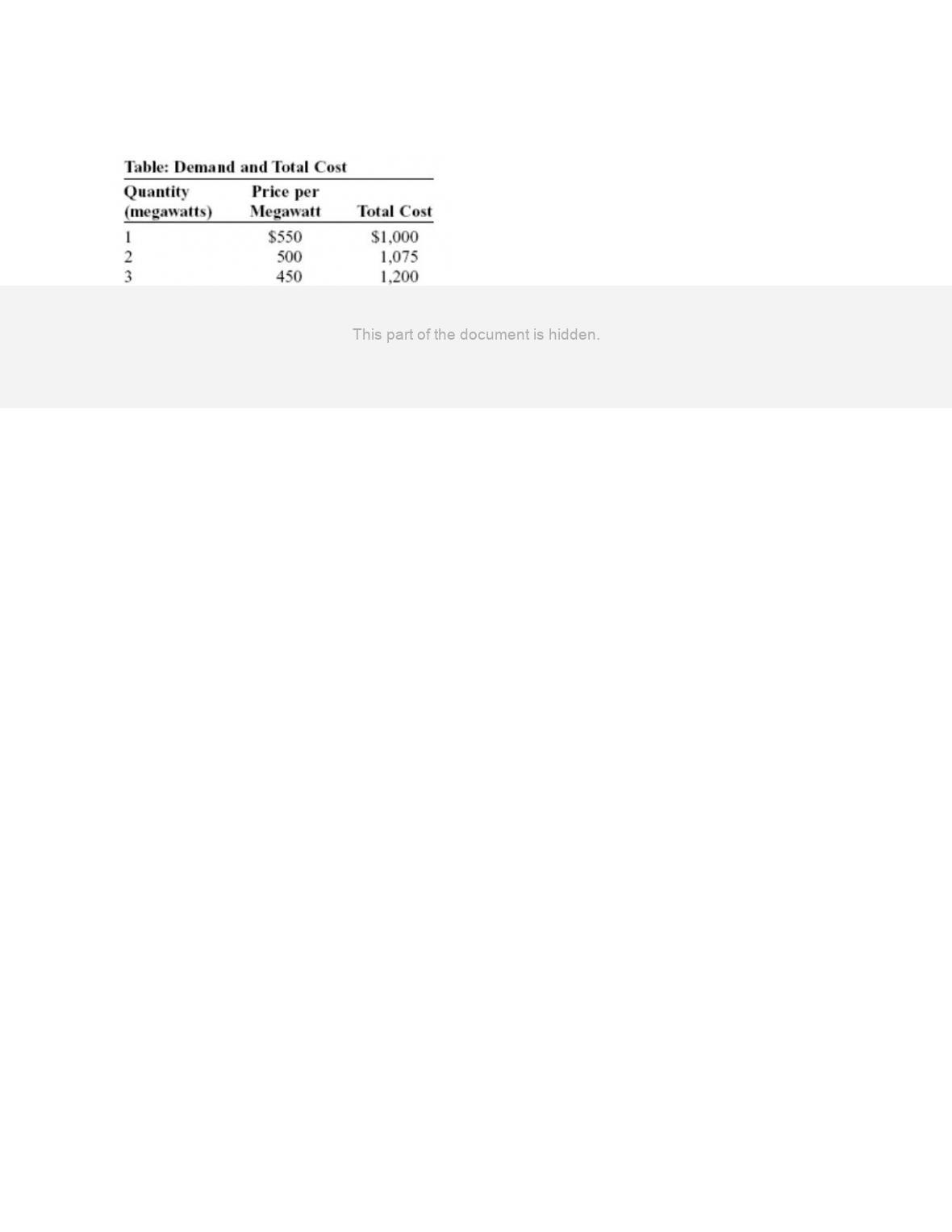
(Table: Demand and Total Cost) Use Table: Demand and Total Cost. Lenoia runs a
natural monopoly firm producing electricity for a small mountain village. The table
shows Lenoia’s demand and total cost of producing electricity. The price effect of
increasing production from 3 megawatts to 4 megawatts is:
A)
–$150.
B)
$500.
C)
$450.
D)
–$50.
100.
(Table: Demand and Total Cost) Use Table: Demand and Total Cost. Lenoia runs a
natural monopoly firm producing electricity for a small mountain village. The table
shows Lenoia’s demand and total cost of producing electricity. To maximize profits,
Lenoia should charge a price of:
A)
$350.
B)
$400.
C)
$450.
D)
$500.
101.
(Table: Demand and Total Cost) Use Table: Demand and Total Cost. Lenoia runs a
natural monopoly firm producing electricity for a small mountain village. The table
shows Lenoia’s demand and total cost of producing electricity. The marginal revenue of
the fourth unit of production is:
A)
$200.
B)
$250.
C)
$450.
D)
$500.