Page 52
232.
A monopolistically competitive firm is operating in the short run at the optimal level of
output and is earning positive economic profits. Describe how this industry will adjust
in the long run.
233.
A monopolistically competitive firm is operating in the short run at the optimal level of
output and earns negative economic profits. Describe how this industry will adjust in the
long run.
234.
Your friend Angelina is the owner of a boutique clothing store in a monopolistically
competitive clothing market. The market is in long-run equilibrium. Over coffee,
Angelina tells you that she is considering raising the price of her clothing to increase her
profits. What is your advice?
235.
Consider the demand curve for a firm in perfect competition, a firm in monopolistic
competition, and a monopolist. Which is likely to be the least elastic, and which is likely
to be the most elastic? Explain.
236.
Which industry type, perfect competition or monopolistic competition, produces less
deadweight loss? Which industry type is preferred by society? Explain.
237.
Do economists consider advertising to be an economically productive activity? Explain.
238.
Why are some rational consumers willing to pay more for a bottle of Advil than for a
bottle of generic ibuprofen tablets, when ibuprofen is the active ingredient in Advil?
239.
Industries that are made up of many competing producers, each selling a differentiated
product, and whose firms earn zero economic profits in the long run are:
A)
perfectly competitive.
B)
monopolies.
C)
oligopolies.
D)
monopolistically competitive.
240.
Monopolistic competitors:
A)
have some ability to set price.
B)
must accept the price as given and therefore are price takers.
C)
produce goods that are standardized and hard to differentiate.
D)
eventually produce at their minimum ATC at the profit-maximizing level.
Page 53
241.
Monopolistic competitors sell products that are _____ substitutes, and as a result, each
firm has a _____ demand curve.
A)
imperfect; downward-sloping
B)
perfect; horizontal
C)
imperfect; horizontal
D)
perfect; downward-sloping
Use the following to answer question 242:
Figure: Monopolistic Competitor
242.
(Figure: Monopolistic Competitor) Use Figure: Monopolistic Competitor. If the firm
shown in the figure maximizes its returns, it will:
A)
earn a positive economic profit.
B)
break even.
C)
incur a loss.
D)
incur a loss equal to its MR.
243.
Consumers’ differing tastes are one reason monopolistic:
A)
firms encounter large barriers to entry.
B)
competitors earn a positive economic profit in the long run.
C)
competitors set price at MC.
D)
competitors are similar to monopolists.
Page 54
244.
In the long run, monopolistic competitors will:
A)
earn zero economic profits.
B)
produce at the minimum of their ATC curves.
C)
set price where MC = MR.
D)
collude with other firms.
245.
(Scenario: Monopolistically Competitive Firm) Use Scenario: Monopolistically
Competitive Firm. Given the information in the scenario, what is the fixed cost for this
firm?
Scenario: Monopolistically Competitive Firm
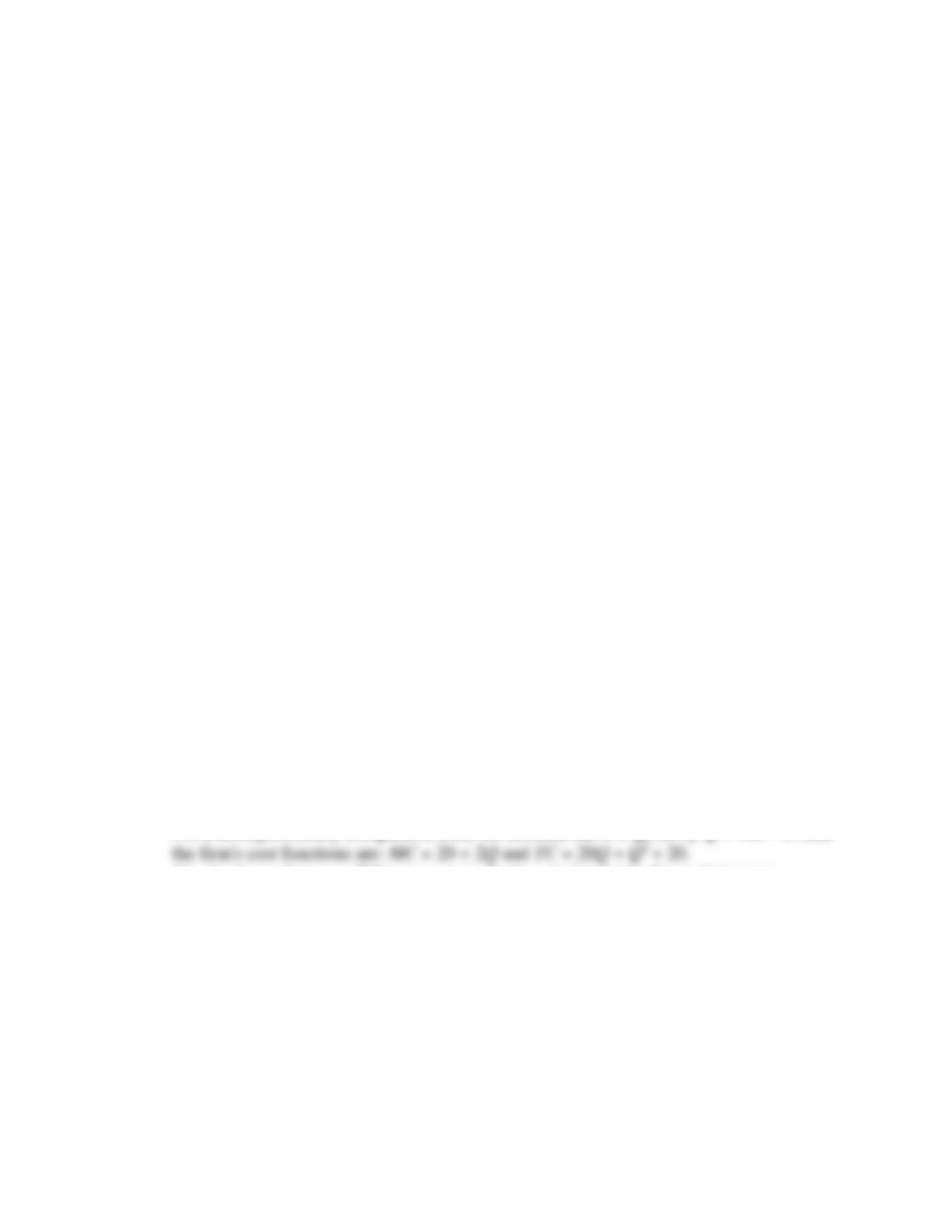
For a monopolistically competitive firm, the demand curve is given by Q = 160 – P, and
the firm’s cost functions are: MC = 20 + 2Q and TC = 20Q + Q2 + 20.
A)
There is none since this is the long run.
B)
Fixed costs equal $160.
C)
Fixed costs equal $20.
D)
Fixed costs equal $180.
246.
(Scenario: Monopolistically Competitive Firm) Use Scenario: Monopolistically
Competitive Firm. Given the information in the scenario, what is the profit-maximizing
level of output for this firm in the short run?
Scenario: Monopolistically Competitive Firm
For a monopolistically competitive firm, the demand curve is given by Q = 160 – P, and
the firm’s cost functions are: MC = 20 + 2Q and TC = 20Q + Q2 + 20.
A)
160 units
B)
20 units
C)
35 units
D)
180 units
Page 55
247.
(Scenario: Monopolistically Competitive Firm) Use Scenario: Monopolistically
Competitive Firm. Given the information in the scenario, what is the profit-maximizing
price for this firm in the short run?
Scenario: Monopolistically Competitive Firm
For a monopolistically competitive firm, the demand curve is given by Q = 160 – P, and
the firm’s cost functions are: MC = 20 + 2Q and TC = 20Q + Q2 + 20.
A)
$160
B)
$125
C)
$40
D)
$180
248.
(Scenario: Monopolistically Competitive Firm) Use Scenario: Monopolistically
Competitive Firm. Given the information in the scenario, in the short run, this firm:
Scenario: Monopolistically Competitive Firm
For a monopolistically competitive firm, the demand curve is given by Q = 160 – P, and
the firm’s cost functions are: MC = 20 + 2Q and TC = 20Q + Q2 + 20.
A)
earns profits of $2,430.
B)
incurs losses of $2,450.
C)
earns no profit.
D)
incurs losses of $20.
249.
(Scenario: Monopolistically Competitive Firm) Use Scenario: Monopolistically
Competitive Firm. Given the information in the scenario, in the long run, this firm can
expect that:
Scenario: Monopolistically Competitive Firm
For a monopolistically competitive firm, the demand curve is given by Q = 160 – P, and
the firm’s cost functions are: MC = 20 + 2Q and TC = 20Q + Q2 + 20.
A)
its demand curve will become more elastic as it dominates the market more.
B)
its economic profits will decrease to zero.
C)
its losses will fall and eventually become a positive economic profit.
D)
other firms will not enter or exit the industry.
Page 56
250.
Monopolistically competitive firms:
A)
engage in collusive activity to maximize profit.
B)
are very similar to perfect competitors in producing at the minimum ATC.
C)
earn a positive economic profit if price is greater than ATC.
D)
will set price where MC > MR.
251.
In the long run, perfect competitors and monopolistic competitors are similar in that
they:
A)
set price where MR < MC.
B)
produce an output level at which P = ATC.
C)
produce a product that is standardized and hard to differentiate.
D)
earn a positive economic profit.
252.
Both monopolists and monopolistic competitors:
A)
make positive economic profits in the long run.
B)
have high barriers to entry.
C)
charge a price that is greater than the marginal cost of production.
D)
produce a product for which there are no substitutes.
253.
Perfect competitors and monopolistic competitors both earn _____ economic profit in
the long run, but perfect competitors produce at the _____ of the ATC curve, while
monopolistic competitors produce _____ of the ATC curve.
A)
zero; minimum point; on the downward-sloping portion
B)
positive; minimum point; on the upward-sloping portion
C)
negative; minimum point; at the minimum point
D)
zero; downward-sloping portion; at the minimum point
254.
A monopolistic competitor will advertise to:
A)
reduce excess capacity.
B)
increase demand for its product.
C)
collude more effectively with other firms.
D)
produce on the upward-sloping portion of its ATC curve.
Page 57
Use the following to answer questions 255-256:
Figure: Monopolistic Competitor
255.
(Figure: Monopolistic Competitor) Use Figure: Monopolistic Competitor. The firm
shown in the figure may engage in advertising because:
A)
it does not know any better.
B)
its price is greater than its MC.
C)
its profits are negative.
D)
this will decrease its excess capacity levels.
256.
(Figure: Monopolistic Competitor) Use Figure: Monopolistic Competitor. If the firm
shown in the figure produces at its profit-maximizing level, it will produce:
A)
with excess capacity since its P is greater than MR.
B)
without excess capacity since P is greater than ATC.
C)
with excess capacity since that output level is on the downward-sloping portion of
the ATC curve.
D)
without excess capacity since that output level is on the downward-sloping portion
of the MR curve.
Answer Key
Page 59
45.
C
46.
A
47.
D
48.
C
49.
A
50.
A
51.
C
52.
C
53.
B
54.
D
55.
A
56.
C
57.
C
58.
A
59.
C
60.
B
61.
C
62.
B
63.
A
64.
A
65.
A
66.
C
67.
B
68.
A
69.
C
70.
C
71.
C
72.
B
73.
B
74.
A
75.
C
76.
C
77.
A
78.
B
79.
D
80.
A
81.
D
82.
A
83.
A
84.
C
85.
B
86.
D
87.
B
88.
A
89.
C
90.
A
Page 60
91.
C
92.
B
93.
C
94.
C
95.
D
96.
B
97.
D
98.
A
99.
C
100.
D
101.
C
102.
A
103.
B
104.
B
105.
C
106.
D
107.
D
108.
B
109.
B
110.
B
111.
C
112.
A
113.
B
114.
B
115.
C
116.
B
117.
A
118.
B
119.
A
120.
C
121.
C
122.
D
123.
A
124.
B
125.
A
126.
D
127.
C
128.
B
129.
C
130.
D
131.
B
132.
A
133.
C
134.
A
135.
A
136.
B
Page 61
137.
C
138.
B
139.
C
140.
D
141.
A
142.
B
143.
A
144.
A
145.
D
146.
B
147.
C
148.
B
149.
B
150.
B
151.
C
152.
B
153.
C
154.
A
155.
A
156.
B
157.
C
158.
B
159.
D
160.
A
161.
D
162.
B
163.
D
164.
C
165.
D
166.
B
167.
A
168.
B
169.
C
170.
C
171.
A
172.
C
173.
B
174.
B
175.
C
176.
C
177.
B
178.
A
179.
C
180.
B
181.
C
182.
A
Page 62
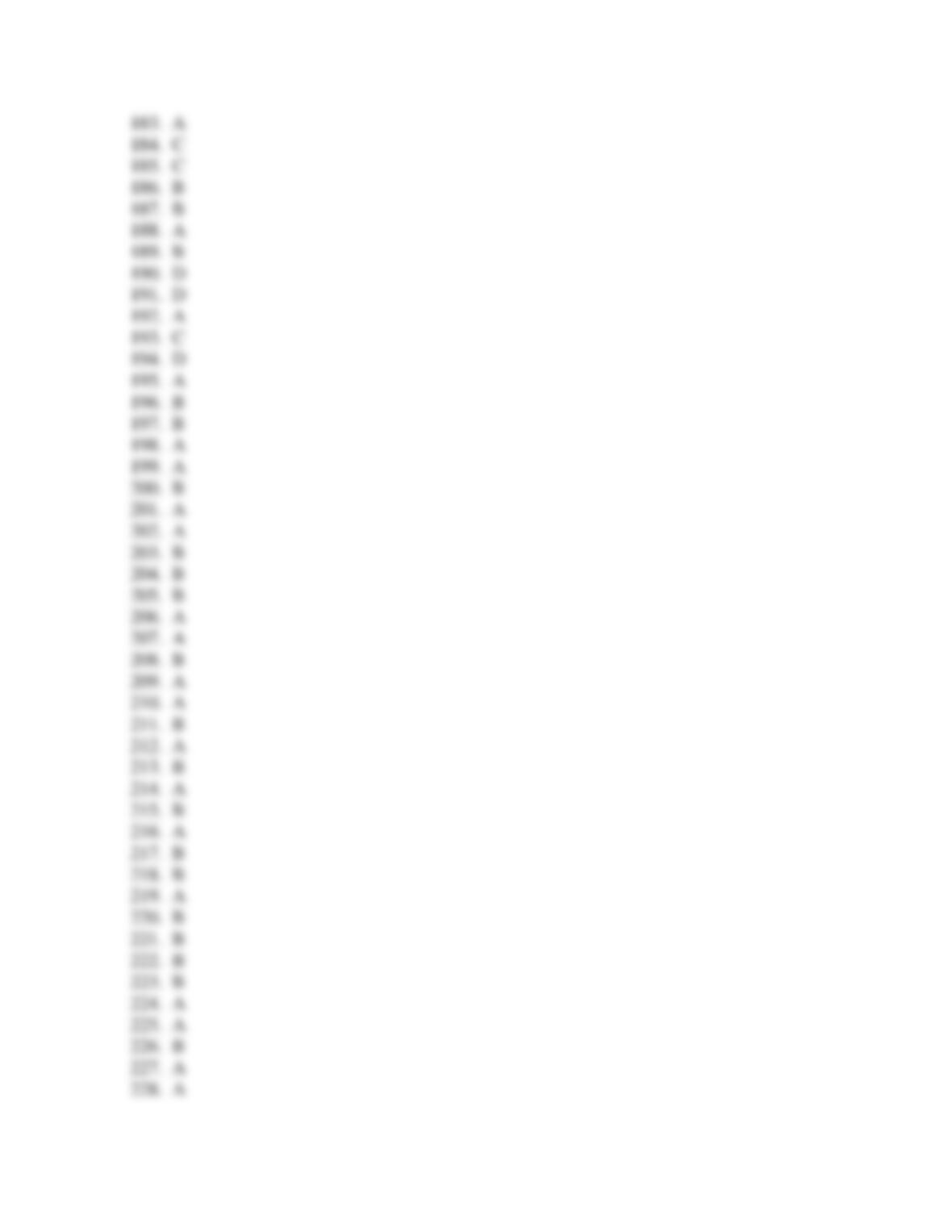
183.
A
184.
C
185.
C
186.
B
187.
B
188.
A
189.
B
190.
D
191.
D
192.
A
193.
C
194.
D
195.
A
196.
B
197.
B
198.
A
199.
A
200.
B
201.
A
202.
A
203.
B
204.
B
205.
B
206.
A
207.
A
208.
B
209.
A
210.
A
211.
B
212.
A
213.
B
214.
A
215.
B
216.
A
217.
B
218.
B
219.
A
220.
B
221.
B
222.
B
223.
B
224.
A
225.
A
226.
B
227.
A
228.
A
Page 63
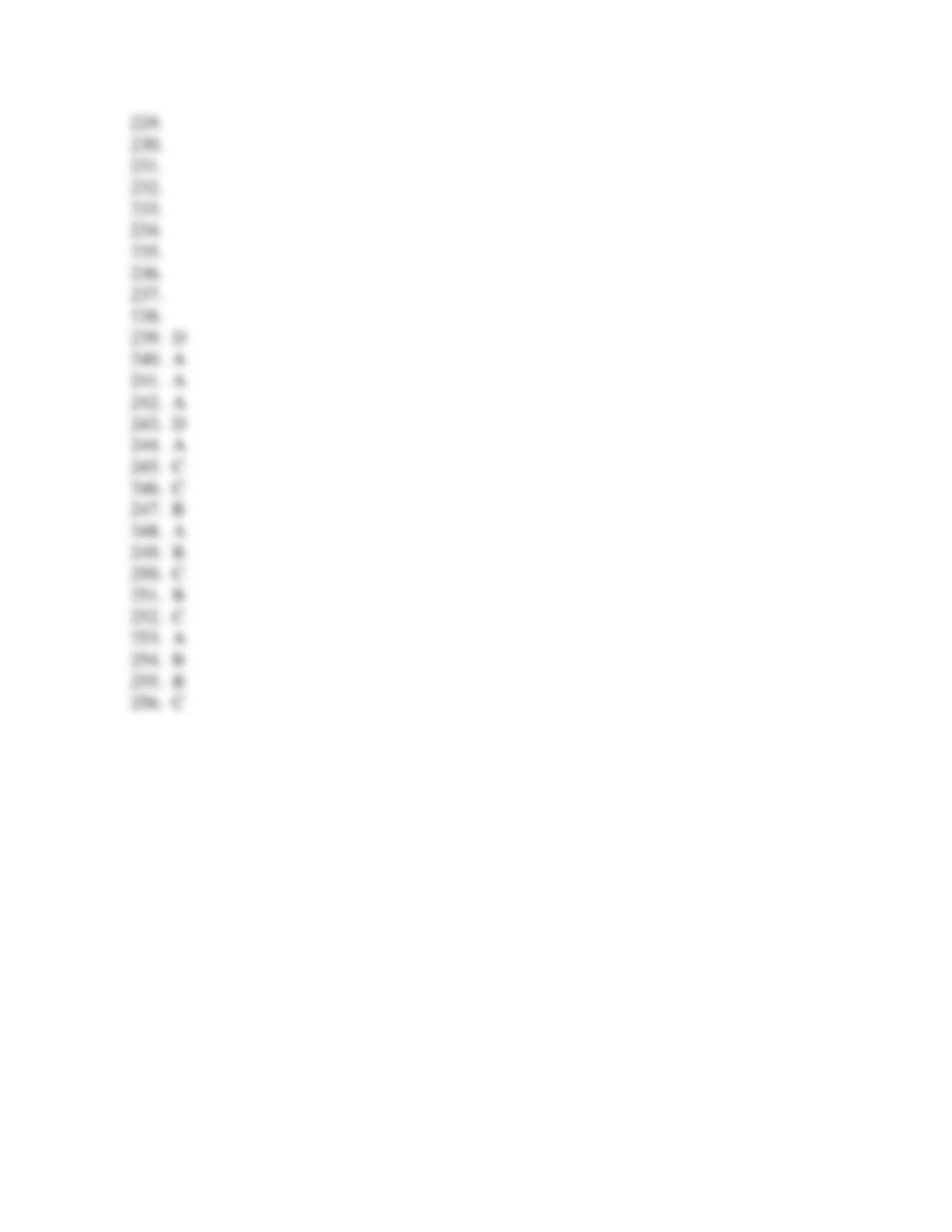
229.
230.
231.
232.
233.
234.
235.
236.
237.
238.
239.
D
240.
A
241.
A
242.
A
243.
D
244.
A
245.
C
246.
C
247.
B
248.
A
249.
B
250.
C
251.
B
252.
C
253.
A
254.
B
255.
B
256.
C