Page 1
Name: __________________________ Date: _____________
1.
Which industry is MOST likely to be monopolistically competitive?
A)
automobile production
B)
fresh bagel shops
C)
corn farming
D)
electric utility production
2.
A monopolistically competitive industry, such as corn snack chips, and a perfectly
competitive industry, like wheat farming, are alike in that:
A)
firms in both types of industries produce identical products.
B)
firms in both types of industries produce similar but not identical products.
C)
barriers to entry in both industries are large.
D)
there are many firms in each industry.
3.
Monopolistic competition is characterized by:
A)
free entry and exit in the long run.
B)
each firm producing a standardized product.
C)
few producers.
D)
barriers to entry.
4.
In monopolistic competition, each firm:
A)
is a price taker.
B)
has some ability to set the price of its differentiated good.
C)
will set price equal to marginal cost.
D)
has marginal revenue that is greater than price.
5.
The wedding dress industry is monopolistically competitive. As a result:
A)
thousands of dress suppliers all sell identical products.
B)
dresses tend to be differentiated among the many sellers serving this market.
C)
it has freedom of entry but not exit.
D)
prices tend to be lower than if the dress industry approximated perfect competition.
6.
Monopolistic competition is similar to perfect competition because firms in both market
structures:
A)
are price takers.
B)
produce goods that are perfect substitutes.
C)
find it beneficial to advertise.
D)
do not face any barriers to entry to the industry in the long run.
Page 2
7.
In monopolistic competition:
A)
firms earn zero economic profits in the long run.
B)
each firm produces a product identical to that of every other firm in the industry.
C)
firms are aware of their strategic interdependence.
D)
firms earn large economic profits in the long run.
8.
For the monopolistically competitive wild-caught seafood market, the demand curve for
any individual firm is _____, and there are _____ producers of seafood.
A)
downward sloping; few
B)
upward sloping; many
C)
vertical; few
D)
downward sloping; many
9.
The downward-sloping demand curve for a monopolistically competitive firm:
A)
reflects product differentiation.
B)
eventually will become perfectly elastic as more firms enter.
C)
indicates collusion among firms in the industry.
D)
ensures that the firm will produce at minimum average cost in the long run.
10.
An industry characterized by many firms producing similar but differentiated products
in a market with easy entry and exit is called:
A)
perfectly competitive.
B)
monopolistic.
C)
monopolistically competitive.
D)
oligopolistic.
11.
An example of monopolistic competition is the _____ industry.
A)
restaurant
B)
soft-drink
C)
automobile
D)
airline
12.
A(n) _____ market has a single firm and _____, whereas a(n) _____ market has _____
firm(s) and _____.
A)
oligopolistic; no barriers to entry; monopolistic; many; easy entry and exit
B)
monopolistic; barriers to entry; monopolistically competitive; many; easy entry and
exit
C)
monopolistic; barriers to entry; oligopolistic; few; no barriers to entry
D)
monopolistically competitive; barriers to entry; monopolistic; one; barriers to entry
Page 3
13.
In large shopping malls, the retail clothing market is MOST illustrative of:
A)
monopolistic competition.
B)
monopoly.
C)
perfect competition.
D)
perfect oligopoly.
14.
An industry with a large number of relatively small firms producing differentiated
products in a market with easy entry and exit of firms is:
A)
a monopoly.
B)
a duopoly.
C)
an oligopoly.
D)
monopolistically competitive.
15.
A monopolistically competitive industry is characterized by a _____ number of firms
producing _____ products with _____ entry.
A)
small; identical; barriers to
B)
small; similar; relatively easy
C)
large; similar; relatively easy
D)
large; identical; relatively easy
16.
Monopolistic competition is an industry structure characterized by:
A)
a product with no close substitutes.
B)
a horizontal demand curve.
C)
a large number of firms.
D)
barriers to entry and exit.
17.
Because most communities have a large number of similar but not identical substitutes,
the market for chiropractors is BEST considered to be:
A)
an oligopoly.
B)
perfect competition.
C)
monopolistically competitive.
D)
a monopoly.
18.
Because most communities have a large number of similar but not identical substitutes,
the market for financial planners is BEST considered to be:
A)
a monopoly.
B)
an oligopoly.
C)
perfect competition.
D)
monopolistically competitive.
Page 4
19.
A feature of monopolistic competition that makes it different from monopoly is the:
A)
fact that firms in monopolistically competitive industries follow the marginal
decision rule, while monopolies do not.
B)
downward-sloping demand curve.
C)
downward-sloping marginal revenue curve.
D)
number of firms in the industry.
20.
An industry characterized by many competitors, each producing identical products, with
free entry and exit, is described as:
A)
monopolistically competitive.
B)
oligopolistic.
C)
perfectly competitive.
D)
monopolistic.
21.
Which characteristic is NOT indicative of monopolistic competition?
A)
product differentiation
B)
a lack of barriers to entry and exit in the long run
C)
many competing producers
D)
tacit collusion
22.
Which feature is shared by monopolistic competition and perfect competition?
A)
few firms in the industry
B)
no barriers to entry or exit in the long run
C)
absolute market power
D)
standardized products
23.
A common example of monopolistic competition is the market for:
A)
mandarin oranges.
B)
cable TV service.
C)
automobiles.
D)
gasoline for cars.
24.
An industry with a large number of relatively small firms producing _____ products in a
market with easy entry and exit is a(n) _____.
A)
similar; monopoly
B)
identical; monopolistic competition
C)
differentiated; oligopoly
D)
differentiated; monopolistic competition
Page 5
25.
Monopolistic competition describes an industry characterized by a _____ number of
firms producing _____ products with _____ entry.
A)
small; identical; barriers to
B)
small; similar; relatively easy
C)
large; similar; relatively easy
D)
large; identical; relatively easy
26.
The market for dentists in most communities can be considered _____ because the
market has a large number of similar but not identical dental services.
A)
monopolistic competition
B)
a monopoly
C)
perfect competition
D)
an oligopoly
27.
Monopolistic competition describes an industry characterized by:
A)
a product with many close substitutes.
B)
a horizontal demand curve.
C)
a small number of firms.
D)
barriers to entry and exit.
28.
Monopolistic competition is different from monopoly because firms:
A)
have some power to set prices.
B)
have a downward-sloping demand curve.
C)
face some competition.
D)
have a downward-sloping marginal revenue curve.
29.
Because most communities have a large number of similar but not identical substitutes,
the market for florists is BEST considered to be:
A)
a monopoly.
B)
an oligopoly.
C)
monopolistically competitive.
D)
perfectly competitive.
30.
Monopolistic competition describes an industry characterized by:
A)
a product with no close substitutes.
B)
many firms, each with some market power.
C)
a small number of firms.
D)
barriers to entry and exit.
Page 6
31.
An industry with easy entry and exit of a large number of small firms producing a
standardized product is:
A)
in perfect competition.
B)
in monopolistic competition.
C)
an oligopoly.
D)
a monopoly.
32.
Because of the lack of substitutes, the market for a newly developed and freshly
patented prescription drug is BEST considered to be:
A)
in perfect competition.
B)
in monopolistic competition.
C)
an oligopoly.
D)
a monopoly.
33.
An industry with a few interdependent firms is BEST described as being:
A)
in perfect competition.
B)
in monopolistic competition.
C)
an oligopoly.
D)
a monopoly.
34.
The market for grade A large eggs in California is BEST considered to be an example
of:
A)
perfect competition.
B)
monopolistic competition.
C)
oligopoly.
D)
monopoly.
35.
An industry with a single firm producing a product for which there are no close
substitutes and that is protected by barriers to entry is an example of:
A)
perfect competition.
B)
monopolistic competition.
C)
oligopoly.
D)
monopoly.
36.
The market for soft drinks, which is dominated by Coca Cola and Pepsi, is BEST
considered to be an example of:
A)
perfect competition.
B)
monopolistic competition.
C)
oligopoly.
D)
monopoly.
Page 7
37.
If the toothpaste market is monopolistically competitive, product differentiation would
NOT take the form of:
A)
production of many varieties of toothpaste, including those with whitening agents.
B)
differentiation in the locations where certain toothpastes are available.
C)
quality differences among the various brands.
D)
setting the price of the product well below the price charged by the rivals.
38.
In many cities you, can stay at a Holiday Inn in the downtown area, in a suburban
community, or near the airport. These Holiday Inn establishments are examples of
product differentiation by:
A)
type.
B)
location.
C)
quality.
D)
style.
39.
Many customers will walk right past a diner that serves coffee and go to Starbucks,
where they pay more for a cup of java. For these customers, coffee is differentiated by:
A)
style.
B)
location.
C)
quality.
D)
type.
40.
The sources of product differentiation do NOT include:
A)
differences in location.
B)
differences in quality.
C)
the perception by consumers that products are different, even if they are physically
identical.
D)
consumers’ dislike of having options.
41.
Which factor is NOT a source of product differentiation?
A)
price
B)
location
C)
style
D)
quality
Page 8
42.
Firms in monopolistic competition can acquire some market power by:
A)
product differentiation.
B)
engaging in tacit collusion.
C)
producing where MR > MC.
D)
increasing their output to the perfectly competitive level.
43.
When a monopolistically competitive industry earns economic profit, the result of
competition among sellers is usually that:
A)
the price of the product increases to monopoly level.
B)
the price of the product quickly reaches the perfectly competitive level.
C)
firms in the industry gain market share.
D)
firms in the industry lose market share.
44.
Since a monopolistically competitive firm faces a downward-sloping demand curve, its
price will be _____ revenue.
A)
equal to marginal
B)
less than marginal
C)
greater than marginal
D)
equal to total
45.
The demand curve for a firm operating in a monopolistically competitive industry is:
A)
U-shaped.
B)
upward sloping.
C)
downward sloping.
D)
vertical.
46.
The demand curve for a firm in monopolistic competition is _____ facing a perfectly
competitive firm.
A)
downward sloping, unlike the horizontal demand curve
B)
horizontal, unlike the downward-sloping demand curve
C)
horizontal, the same as that
D)
downward sloping, the same as that
47.
The profit-maximizing rule MC = MR is followed by firms operating in:
A)
monopolistic competition but not perfect competition.
B)
perfect competition but not monopolistic competition.
C)
either monopolistic competition or perfect competition, depending on the costs of
production.
D)
both monopolistic competition and perfect competition.
Page 9
48.
Product differentiation under monopolistic competition means that each firm:
A)
charges the same price.
B)
maximizes profit where MC = P.
C)
faces a downward-sloping demand curve.
D)
always receives economic profits.
49.
Product differentiation under monopolistic competition means that each firm:
A)
charges a slightly different price.
B)
has a pure monopoly.
C)
maximizes profit where MC = P.
D)
faces a horizontal demand curve.
50.
In a monopolistically competitive industry:
A)
a firm maximizes profits when MR = MC yet P > MC.
B)
people would be better off if output were reduced.
C)
output could be increased without an increase in total cost.
D)
to maximize profits, firms set MR = MC, and people would be better off if output
were reduced.
51.
A monopolistically competitive firm has a downward-sloping demand curve for its
product, primarily because:
A)
there are no barriers to entry or exit in the long run.
B)
there are many sellers in the industry.
C)
its product is differentiated.
D)
the price is greater than the marginal revenue.
52.
The demand curve for a firm operating in a monopolistically competitive market is
BEST described as:
A)
U-shaped.
B)
upward sloping.
C)
downward sloping.
D)
horizontal.
53.
The _____ demand curve for a firm operating in a monopolistically competitive market
_____ facing a perfectly competitive firm.
A)
downward-sloping; is the same as the demand curve
B)
downward-sloping; differs from the horizontal demand curve
C)
horizontal; differs from the downward-sloping demand curve
D)
horizontal; is the same as the demand curve

Page 10
54.
If a monopolistically competitive firm is producing the profit-maximizing level of
output and is earning an economic profit in the short run:
A)
price is less than average total costs.
B)
price is less than marginal cost.
C)
marginal revenue is less than marginal cost.
D)
marginal revenue equals marginal cost.
55.
Suppose a monopolistically competitive firm is making a profit, but it can increase its
profits by increasing output. At the current level of output:
A)
marginal revenue is greater than marginal cost.
B)
price is less than marginal cost.
C)
price is less than average total cost.
D)
marginal revenue is less than marginal cost.
56.
Suppose Susan owns a business that operates in a market characterized by monopolistic
competition. Susan’s profit-maximizing price is $12, her profit-maximizing output is
900 units per week, and her profits are $1,800 per week. Susan decides that she needs
more profits and therefore raises her price to $15. At the new price of $15:
A)
profits will increase.
B)
profits will remain at $1,800.
C)
marginal revenue will be greater than marginal cost.
D)
marginal revenue will be less than marginal cost.
57.
Suppose a monopolistically competitive firm can increase its profits by decreasing its
output. At the current output:
A)
marginal revenue is less than zero.
B)
price is less than marginal revenue.
C)
marginal revenue is less than marginal cost.
D)
price is less than average total cost.
58.
To maximize profit, a monopolistically competitive firm should produce the level of
output at which:
A)
marginal revenue equals marginal cost.
B)
price equals marginal cost.
C)
price equals total cost.
D)
marginal revenue equals price.

Page 11
59.
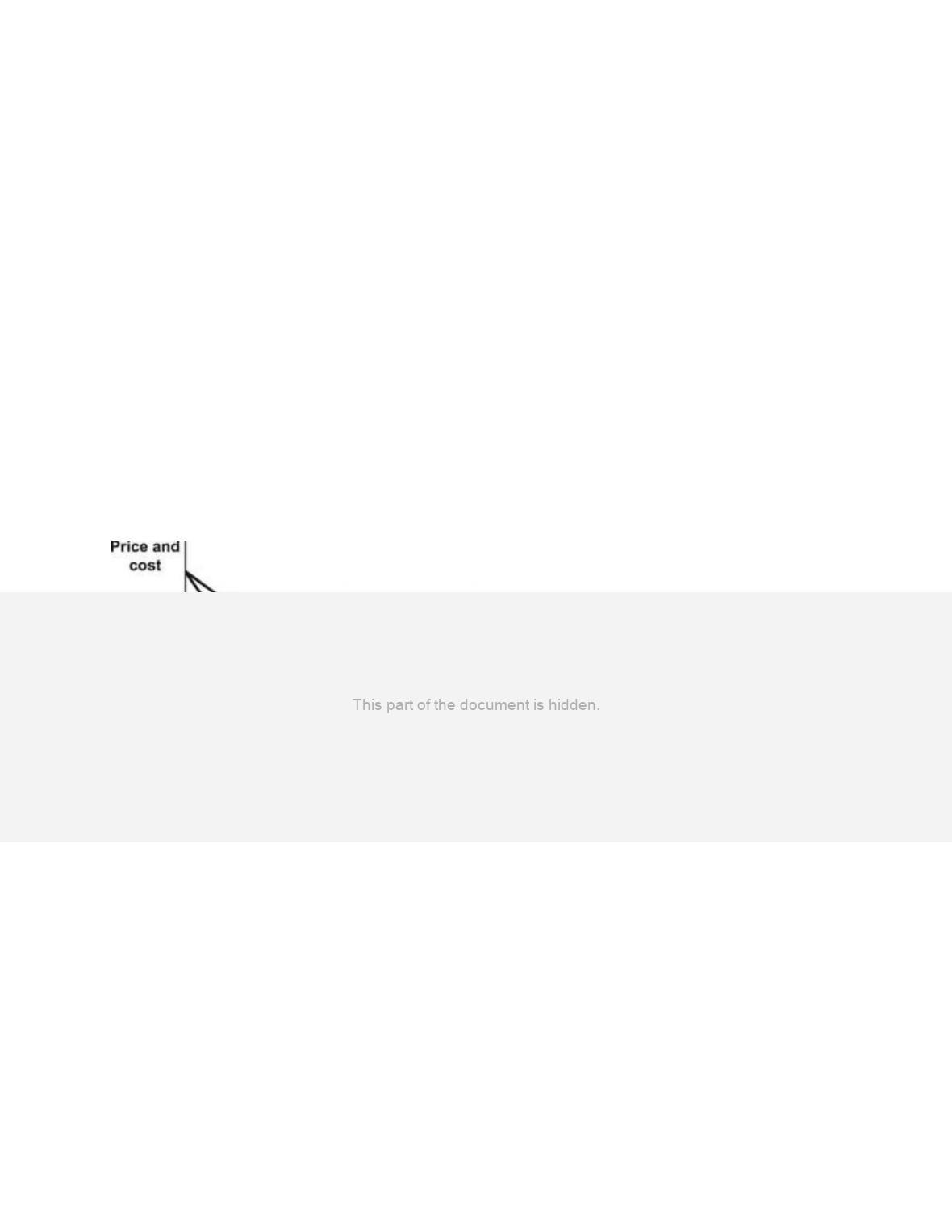
(Figure: Monopolistic Competition) Use Figure: Monopolistic Competition. The firm in
the figure is producing at the output level that maximizes profits (minimizes losses). The
shaded rectangle depicts the level of:
Figure: Monopolistic Competition
A)
profit.
B)
loss.
C)
fixed cost.
D)
variable cost.
60.
The price for a firm under monopolistic competition is _____ revenue.
A)
equal to marginal
B)
greater than marginal
C)
less than marginal
D)
greater than total
61.
A firm in monopolistic competition maximizes its profit by producing at a quantity
where:
A)
MC = ATC.
B)
MC = AR.
C)
MC = MR.
D)
MC = P.
62.
If a firm operating in monopolistic competition is producing a quantity that generates
MC > MR, then the marginal decision rule tells us that profit:
A)
can be increased by increasing production.
B)
can be increased by decreasing production.
C)
can be increased by decreasing the price.
D)
is maximized only if MC = P.
Page 12
63.
If a firm operating in monopolistic competition is producing a quantity that generates
MC < MR, then the marginal decision rule tells us that profit:
A)
can be increased by increasing production.
B)
can be increased by decreasing production.
C)
can be increased by increasing the price.
D)
is maximized only if MC = P.
64.
If a firm operating in monopolistic competition is producing a quantity that generates
MC = MR, then the marginal decision rule tells us that profit:
A)
is maximized.
B)
can be increased by decreasing production.
C)
can be increased by decreasing the price.
D)
is maximized only if MC = P.
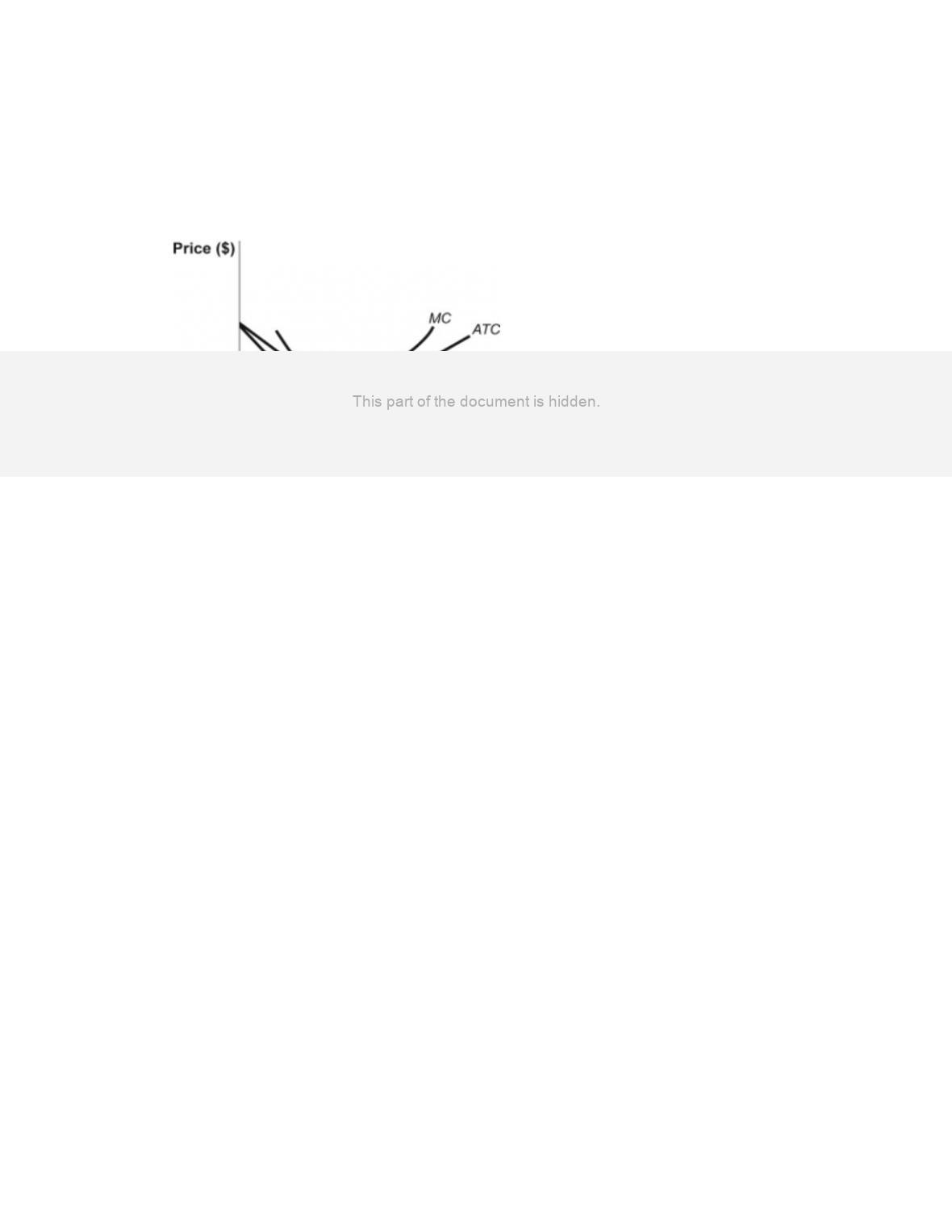
Use the following to answer questions 65-66:
Figure: Profit Maximization for a Firm in Monopolistic Competition
65.
(Figure: Profit Maximization for a Firm in Monopolistic Competition) Use Figure:
Profit Maximization for a Firm in Monopolistic Competition. Suppose that an
innovation reduces a firm’s costs from ATC to ATC. Before the innovation reduced the
cost, the firm’s economic profit at the profit-maximizing quantity was:
A)
$0.
B)
$30.
C)
$750.
D)
$4,500.

Page 13
66.
(Figure: Profit Maximization for a Firm in Monopolistic Competition) Use Figure:
Profit Maximization for a Firm in Monopolistic Competition. Suppose that an
innovation reduces a firm’s costs from ATC to ATC. After the innovation reduces the
cost, the firm’s economic profit at the new profit-maximizing quantity is:
A)
$0.
B)
$30.
C)
$1,500.
D)
$3,000.
67.
In the short run, a monopolistically competitive firm produces at the optimal level of
output and is earning positive economic profits. Which expression must be TRUE for
this firm?
A)
MR = MC and P = ATC.
B)
MR = MC and P > ATC.
C)
MR > MC and P = ATC.
D)
P = MR = MC > ATC.
68.
A monopolistically competitive firm is operating in the short run at the optimal level of
output and is earning negative economic profits. Which expression must be TRUE for
this firm?
A)
ATC > P > MR = MC.
B)
ATC = P > MR = MC.
C)
ATC > P = MR = MC.
D)
ATC > P > MR > MC.
69.
A gas station operates in a monopolistically competitive market and is in short-run
equilibrium. Suppose that a fixed cost for this firm decreases. As a result, the firm’s
price will _____, the firm’s output will _____, and the firm’s economic profit will
_____.
A)
increase; increase; increase
B)
increase; increase; decrease
C)
stay the same; stay the same; increase
D)
decrease; stay the same; increase
70.
To maximize profits, a firm in monopolistic competition should produce such that
marginal cost:
A)
equals average total cost.
B)
is greater than marginal revenue.
C)
equals marginal revenue.
D)
equals price.
Page 14
71.
If a firm operating in monopolistic competition is producing a quantity at which _____,
then the marginal decision rule tells us that profit _____.
A)
MC > MR; can be increased by increasing production
B)
MC < MR; can be increased by decreasing production
C)
MC < MR; can be increased by increasing production
D)
MC > MR; is maximized
72.
If a firm operating in monopolistic competition is producing a quantity at which MC <
MR, then profit can be _____ by _____.
A)
increased; decreasing production
B)
increased; increasing production
C)
increased; increasing the price
D)
maximized; decreasing production
73.
A firm operating in a monopolistically competitive market is producing a quantity at
which MC = MR. Profit:
A)
can be increased by increasing production.
B)
is maximized.
C)
can be increased by decreasing the price.
D)
is maximized only if MC = P.
74.
If a monopolistically competitive firm is in long-run equilibrium, price:
A)
equals average total cost.
B)
equals marginal cost.
C)
equals marginal revenue.
D)
is greater than average total cost.
75.
In the long run, monopolistically competitive firms:
A)
produce at the level that minimizes average total cost.
B)
set marginal revenue equal to price.
C)
cannot earn an economic profit.
D)
produce such that marginal cost equals price.
76.
Monopolistically competitive firms have zero economic profits in the long run because
of:
A)
excess capacity.
B)
price wars among firms.
C)
easy entry and exit.
D)
excessive advertising.
Page 15
77.
Toby operates a small deli downtown. The deli industry is monopolistically competitive.
In the long run, Toby will produce where:
A)
marginal revenue equals marginal cost.
B)
price equals minimum average total cost.
C)
price equals marginal cost.
D)
price equals marginal revenue.
78.
Suppose the dry-cleaning market is monopolistically competitive and economically
profitable this year. In the long run, the demand for any one firm’s dry-cleaning services
will _____ as more firms enter the industry, causing economic profits to _____.
A)
decrease; become economic losses
B)
decrease; fall to zero
C)
not change; fall
D)
increase; increase
79.
If monopolistically competitive firms are earning positive economic profits in the short
run, then in the long run:
A)
firms will leave the industry.
B)
the demand curves faced by existing firms will move to the right.
C)
economic profits will increase.
D)
economic profits will be reduced to zero.
80.
When a monopolistically competitive firm is making zero economic profits, it is
producing so that the average total cost curve is tangent to the demand curve. At this
output:
A)
the firm is maximizing profits, and marginal cost must equal marginal revenue.
B)
the firm is not maximizing profits, and a slight increase or decrease in output will
lead to positive profits.
C)
since economic profits are zero, the condition that marginal revenue equals
marginal cost is irrelevant.
D)
the condition that marginal revenue equals marginal cost continues to be relevant,
but the marginal revenue and marginal cost curves need not intersect directly below
the point of tangency between the average total cost curve and the demand curve.
81.
Toby operates a small deli downtown. The deli industry is monopolistically competitive.
If some delis leave the industry, Toby’s _____ curve will shift to the _____.
A)
marginal cost; left
B)
marginal cost; right
C)
demand; left
D)
demand; right

Page 16
82.
In monopolistic competition:
A)
firms may advertise to increase demand for their product.
B)
entry of new firms shifts the demand curve for existing firms to the right.
C)
when some firms exit, the demand curve for the firms that remain in the industry
shifts to the left.
D)
firms earn large economic profits in the long run.
83.
The model of monopolistic competition characterizes the market for plumbing services
in a city. Suppose that the market is in long-run equilibrium. For a typical plumbing
firm, price:
A)
equals average total cost.
B)
exceeds average total cost.
C)
is less than average total cost.
D)
is greater than the average for all other firms in the market.
84.
The model of monopolistic competition characterizes the market for plumbing services
in a city. This market is initially in long-run equilibrium, but then there is an increase in
market demand for plumbing services. We expect that in the long run:
A)
firms will leave the plumbing market.
B)
there will be a short-run increase in the number of firms, but then the number will
return to the original level.
C)
new firms will enter the plumbing market.
D)
firms will shut down, but they will not leave the industry.
85.
In the long run, monopolistically competitive firms tend to have:
A)
high economic profits.
B)
zero economic profits.
C)
negative economic profits.
D)
substantial economic losses.
86.
In the long run, if a monopolistically competitive firm produces the optimal level of
output:
A)
P = ATC = MR = MC.
B)
P > ATC > MR = MC.
C)
P = ATC > MR > MC.
D)
P = ATC > MR = MC.
Page 17
87.
(Figure: Possible Long-Run Outcome) Use Figure: Possible Long-Run Outcome. In the
figure, which price and quantity refer to a potential long-run profit maximizing outcome
for a firm producing in a monopolistically competitive market?
Figure: Possible Long-Run Outcome
A)
P1 and Q3
B)
P1 and Q1
C)
P2 and Q2
D)
P1 and Q4
88.
In the short run, a monopolistically competitive firm produces at the optimal level of
output and is earning positive economic profits. In the long run, the _____ of firms
shifts the firm’s demand and marginal revenue curves _____, which _____ the firm’s
level of output and _____ the price it can charge until price equals average total cost.
A)
entry; leftward, decreases; decreases
B)
entry; leftward, decreases; increases
C)
entry; downward, decreases; decreases
D)
exit; rightward, increases; increases
89.
In a long-run equilibrium, firms in a monopolistically competitive industry sell at a
price:
A)
equal to marginal cost.
B)
less than marginal cost.
C)
greater than marginal cost.
D)
less than marginal revenue.
Page 18
90.
General Snacks is a typical firm in monopolistic competition. If the market is in
long-run equilibrium, then the price General Snacks charges for its snack goods:
A)
equals average total cost.
B)
exceeds average total cost.
C)
is less than average total cost.
D)
is more than the average for all other firms in the market.
91.
General Snacks is a typical firm in monopolistic competition. Initially, the market is in
long-run equilibrium, and then there is an increase in the market demand for snacks. In
the long run, the economic profits of typical firms in the industry will be:
A)
typical of those earned by monopoly firms.
B)
positive but less than the level typically earned by monopoly firms.
C)
zero.
D)
negative.
92.
In the long run, monopolistically competitive firms:
A)
always earn high economic profits.
B)
tend to earn zero economic profits.
C)
usually incur negative economic profits.
D)
usually incur substantial economic losses.
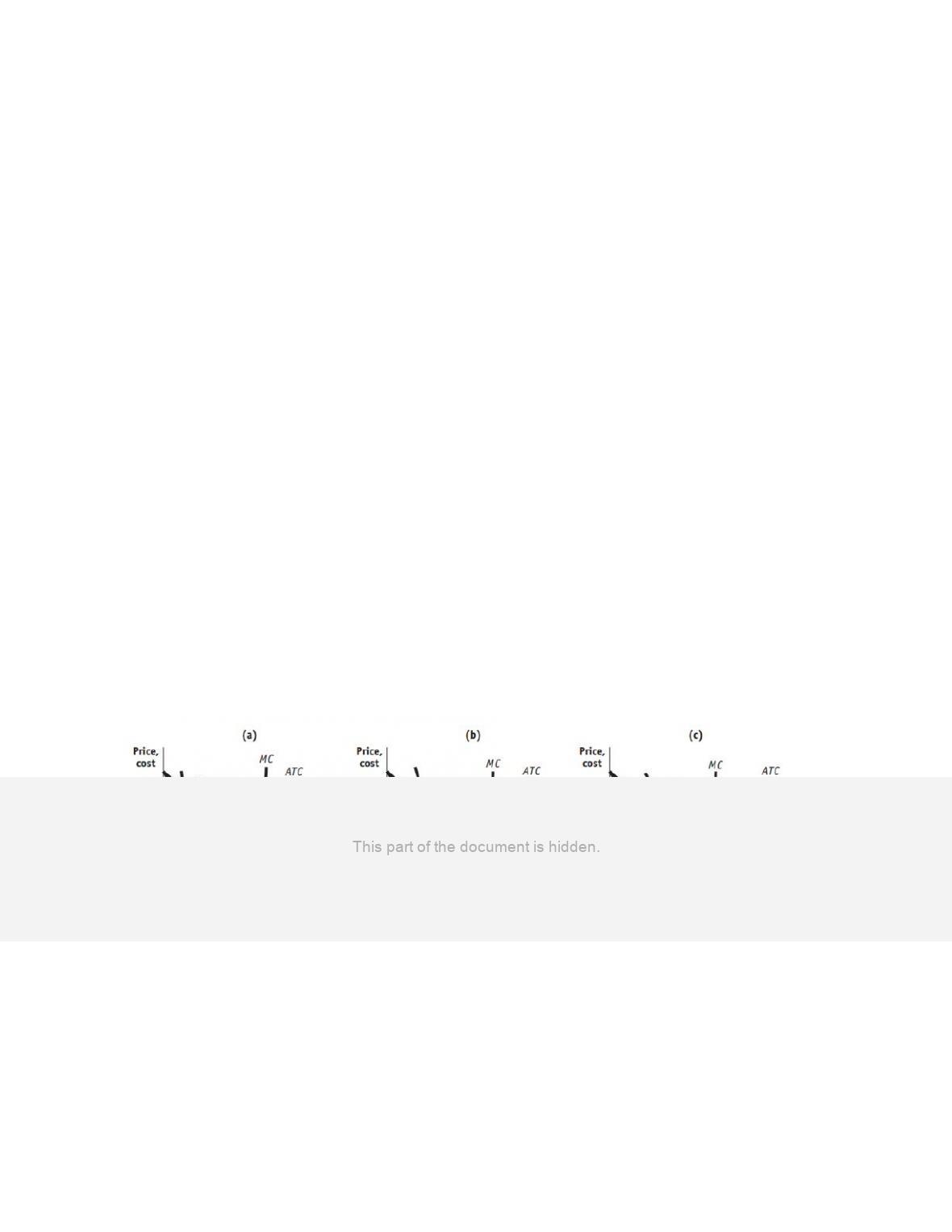
Use the following to answer questions 93-101:
Figure: Firms in Monopolistic Competition
Page 19
93.
(Figure: Firms in Monopolistic Competition) Use Figure: Firms in Monopolistic
Competition. In panel (A) of the figure, the profit-maximizing quantity of output is
determined by the intersection at point:
A)
K.
B)
P.
C)
N.
D)
O.
94.
(Figure: Firms in Monopolistic Competition) Use Figure: Firms in Monopolistic
Competition. In panel (B) of the figure, the profit-maximizing quantity of output is
determined by the intersection at point:
A)
Q.
B)
R.
C)
S.
D)
T.
95.
(Figure: Firms in Monopolistic Competition) Use Figure: Firms in Monopolistic
Competition. In panel (C) of the figure, the profit-maximizing quantity of output is
determined by the intersection at point:
A)
U.
B)
V.
C)
W.
D)
X.
96.
(Figure: Firms in Monopolistic Competition) Use Figure: Firms in Monopolistic
Competition. In panel (A) of the figure, economic profit per unit is the vertical distance
between points:
A)
K and L.
B)
L and O.
C)
M and N.
D)
N and O.
97.
(Figure: Firms in Monopolistic Competition) Use Figure: Firms in Monopolistic
Competition. In panel (C) of the figure, economic loss per unit is the vertical distance
between points:
A)
X and T.
B)
U and W.
C)
V and W.
D)
V and T.
Page 20
98.
(Figure: Firms in Monopolistic Competition) Use Figure: Firms in Monopolistic
Competition. A positive economic profit will be earned if the profit-maximizing price is
_____ in panel _____.
A)
F; (A)
B)
G; (A)
C)
H; (B)
D)
I; (C)
99.
(Figure: Firms in Monopolistic Competition) Use Figure: Firms in Monopolistic
Competition. Zero economic profit will be earned if the profit-maximizing price is
_____ in panel _____.
A)
F; (A)
B)
G; (A)
C)
H; (B)
D)
I; (C)
100.
(Figure: Firms in Monopolistic Competition) Use Figure: Firms in Monopolistic
Competition. There will be a negative economic profit (or an economic loss) earned at
the profit-maximizing price _____ in panel _____.
A)
G; (A)
B)
H; (B)
C)
I; (C)
D)
J; (C)
101.
(Figure: Firms in Monopolistic Competition) Use Figure: Firms in Monopolistic
Competition. A long-run equilibrium is illustrated at the profit-maximizing price _____
in panel _____.
A)
F; (A)
B)
G; (A)
C)
H; (B)
D)
I; (C)