Page 16
87.
An increase in the nation’s _____ is generally accepted as a long-run indicator of a
rising standard of living.
A)
output per person
B)
unemployment rate
C)
inflation rate
D)
trade deficit
88.
Long-run economic growth is best measured by:
A)
a sustained rise in the production of goods and services.
B)
the growth of the money supply.
C)
trade surpluses in the long run.
D)
the rate of private saving.
89.
Which one of the following measures long-run economic growth?
A)
a rise in employment
B)
an increase in the money supply
C)
a sustained increase in the production of goods and services
D)
an increase in the labor force
90.
Economists use the term long-term growth to indicate:
A)
the expansion phase of the business cycle.
B)
growth of the economy over several decades.
C)
growth of the economy over one to five years.
D)
long-run growth of the value of a company.
91.
Per capita economic growth is:
A)
growth per unit of capital.
B)
growth per person.
C)
always accelerated during a business cycle.
D)
a sustained increase in interest rates.
Page 17
92.
Which statement about the U.S. economy is FALSE?
A)
Since the Second World War, aggregate output has grown more slowly than the
population.
B)
Since the Second World War, aggregate output has grown more rapidly than the
population.
C)
Since the Second World War, macroeconomic policy has helped make the
economy more stable.
D)
Long-run growth per capita is the key to higher wages and a rising standard of
living.
93.
Which statement is TRUE?
A)
In the past century, the population of the United States has grown faster than
output.
B)
Long-run growth models and business cycle models are the same.
C)
Since World War II, the economy of Argentina has grown faster than the economy
of Canada.
D)
The level of saving is important for long-run growth.
94.
Which statement is TRUE?
A)
Inflation means an increase in the overall level of prices.
B)
Deflation refers to a decrease in prices only in the energy and transportation
sectors.
C)
During inflation most people enjoy an increase in their standard of living even if
their wages don’t increase.
D)
Inflation was a problem for the first time in the recession of 1929–1933.
95.
Inflation:
A)
is a movement of the economy toward economic growth.
B)
can be thought of as an increase in a nation’s standard of living.
C)
is a sustained fall in the overall level of prices.
D)
is an increase in the overall level of prices.
96.
If the economy grew at 3% this year and average prices increased _____, people would
be better off this year than last year.
A)
by 3%
B)
faster than 3%
C)
less than 3%
D)
faster than 10%
Page 18
97.
If wages grew at 5% last year and average prices grew at 3%, then the average worker:
A)
is better off.
B)
is worse off.
C)
has lost purchasing power.
D)
is unaffected.
98.
If workers’ nominal wages have risen by 50% over 10 years and prices have increased
by 40% in that same period, then we can safely conclude that the amount of goods and
services workers can buy has:
A)
fallen.
B)
increased.
C)
not changed.
D)
decreased in quality.
99.
An increase in the nation’s overall price level is:
A)
long-term economic growth.
B)
unemployment.
C)
inflation.
D)
deflation.
100.
During inflation the _____ price level _____.
A)
average; falls
B)
average; increases
C)
average; remains constant
D)
real; falls
101.
The annual percentage change in the aggregate price level is negative when there is:
A)
deflation.
B)
disinflation.
C)
inflation.
D)
spiraling inflation.
102.
With inflation:
A)
overall prices are increasing, although some may be decreasing.
B)
all prices must be increasing.
C)
the economy must be contracting.
D)
the economy must be producing at full employment.
Page 19
103.
Inflation:
A)
raises the cost of making purchases.
B)
can result in a decrease in barter transactions.
C)
encourages people to hold cash.
D)
makes borrowers worse off.
104.
Deflation:
A)
raises the cost of making purchases.
B)
makes borrowers better off.
C)
encourages people to hold cash rather than invest.
D)
is caused only by changes in interest rates.
105.
With regard to the aggregate price level, economists generally believe that:
A)
price stability is desirable.
B)
inflation is worse than deflation.
C)
deflation is worse than inflation.
D)
inflation benefits most retired people.
106.
Which statement is TRUE about inflation and deflation?
A)
Both are good for the economy.
B)
Inflation is always good for the economy and deflation is always bad for the
economy.
C)
Inflation is always bad for the economy and deflation is always good for the
economy.
D)
Both inflation and deflation can pose problems for the economy.
107.
Inflation affects people adversely because:
A)
nominal income falls.
B)
purchasing power tends to increase.
C)
the budget deficit increases.
D)
it causes money to lose its value over time.
108.
Which statement is CORRECT?
A)
Supply and demand cannot explain why a particular good or service becomes more
expensive relative to other goods and services.
B)
Inflation affects only the more advanced countries, whereas less advanced
countries face deflation.
C)
Employment levels remained stable during the Great Depression.
D)
When the economy is in recession and jobs are hard to find, inflation tends to fall.
Page 20
109.
Price stability occurs when:
A)
the overall price level is zero.
B)
the economy is at full employment.
C)
the overall cost of living is changing very slowly.
D)
food prices have remained the same.
110.
If a country sells more goods and services to the rest of the world than it purchases from
the other countries, then the country has a:
A)
trade deficit.
B)
budget deficit.
C)
trade surplus.
D)
budget surplus.
111.
If a country has a trade deficit, does it indicate that the country has a serious problem?
A)
No. Trade deficits occur when a country’s investment spending is higher than its
level of saving.
B)
Yes. Trade deficits occur when a country has low productivity.
C)
Yes. Trade deficits occur when a country does not have a comparative advantage in
production.
D)
Yes. Trade deficits occur when a country has a high budget surplus.
112.
Goods and services that are produced in a foreign country but consumed domestically
are called:
A)
exports.
B)
imports.
C)
investment goods.
D)
consumer durables.
113.
An open economy:
A)
trades goods and services with other countries.
B)
does not regulate its industries.
C)
does not impose taxes on its citizens.
D)
allows free practice of speech and religion.
114.
A nation whose value of imports exceeds its value of exports is said to have:
A)
hyperinflation.
B)
a trade deficit.
C)
price stability.
D)
a trade surplus.
Page 21
115.
An open economy:
A)
trades only with its neighbors.
B)
trades goods but not services or assets with other countries.
C)
does not trade goods, services, or assets with other countries.
D)
trades goods and services with other countries.
116.
In an open economy:
A)
the exchange rate is determined by the government.
B)
specialization in activities with a comparative advantage is not possible.
C)
trade is beneficial only to the larger economy.
D)
there is trade in goods, services, and/or assets with other countries.
117.
The trade balance is the difference between the value of:
A)
the trade deficit and the budget deficit.
B)
exports and imports.
C)
the exchange rates of two countries that are engaged in international trade.
D)
the national debt and the foreign debt.
118.
The additional profit earned by Microsoft Corporation by marketing and using a
proprietary method of coding software is a microeconomic issue.
A)
True
B)
False
119.
Fiscal policy entails changes in the quantity of money or the interest rate.
A)
True
B)
False
120.
Monetary and fiscal policy are tools to reduce the severity of recessions.
A)
True
B)
False
121.
One type of macroeconomic policy is antitrust enforcement.
A)
True
B)
False
122.
Fiscal policy can be used to reduce the severity of recessions.
A)
True
B)
False
Page 22
123.
The business cycle is the long-run alternation between downturns and upturns.
A)
True
B)
False
124.
Expansions are periods when real GDP and employment are growing.
A)
True
B)
False
125.
Recessions are periods in which output and employment are falling.
A)
True
B)
False
126.
Business cycles are defined by the expansion, contraction, then expansion again of
nominal GDP.
A)
True
B)
False
127.
Following a trough, real GDP increases.
A)
True
B)
False
128.
The peak of the business cycle provides evidence that the recession is over.
A)
True
B)
False
129.
Between 1980 and 2017, inflation wiped out most of the wage gains of the typical
worker.
A)
True
B)
False
130.
A newspaper article documents the closing of a factory and the many jobs that are lost.
A separate article describes the rising U.S. unemployment rate. Why is the first article a
microeconomic issue and the second article a macroeconomic issue?
Page 23
131.
The economy is in a recession and Congress passes legislation to reduce income taxes.
Tom, seeing an increase in his take-home pay, goes to Best Buy and purchases a new
television. Why is the tax cut a macroeconomic issue, while Tom’s new TV is a
microeconomic issue?
132.
Explain what is meant by the paradox of thrift.
133.
What are Keynesian policies?
134.
Suppose the business cycle is expanding. Predict how the economic indicators of real
gross domestic product, the unemployment rate, and the inflation rate are moving.
135.
You read a newspaper article that says the unemployment rate rose this month. Are we
in a recession? Explain.
136.
What is long-run economic growth, and why is it so important for a nation’s economy?
137.
Your boss is impressed with your performance over the past year and has decided to
give you a 5% increase in your salary. Are you clearly better off with your increased
salary? What factors must be considered?
138.
In a typical business cycle recession, the unemployment rate rises and the inflation rate
falls. Explain these two trends.
139.
The United States imports coffee from Brazil and exports cars to Brazil. Is this a
macroeconomic or microeconomic issue?
140.
One of the issues of importance to macroeconomists is:
A)
the behavior of individuals and their allocation of income.
B)
how firms determine the profit-maximizing level of output.
C)
understanding how living standards change over time.
D)
the behavior of individual markets.
Page 24
141.
In macroeconomics:
A)
aggregate data such as real GDP, the price level, and unemployment are analyzed.
B)
individual and firm decisions regarding utility and profit maximization are studied.
C)
long-term growth is not considered to be important.
D)
market intervention from the government is not considered important.
142.
The paradox of thrift highlights:
A)
the role of investment in the macroeconomy.
B)
how individual decisions to save more may worsen a recession.
C)
how an increase in spending occurs during recessions.
D)
irrational behavior on the part of households.
143.
Fiscal and monetary policies:
A)
have no role in macroeconomic policies.
B)
have been used by the government for over 250 years.
C)
are most effective in microeconomic settings.
D)
are used to correct for short-term economic fluctuations.
144.
Fiscal policy entails:
A)
setting the money supply.
B)
setting levels of taxation and/or government spending.
C)
setting interest rates in specific markets.
D)
correcting only recessionary problems.
145.
Keynesians argue that low levels of spending:
A)
are irrelevant.
B)
can lead to prolonged recessions.
C)
are not helped by monetary or fiscal policy efforts.
D)
are evident only during expansions.
146.
Setting interest rates and the money supply in an effort to change overall spending in is
use of:
A)
fiscal policy.
B)
monetary policy.
C)
investment.
D)
the stock market.
Page 25
147.
Setting government spending and taxes in an effort to change overall spending in an
economy is use of:
A)
fiscal policy.
B)
monetary policy.
C)
investment.
D)
the stock market.
148.
During the Great Depression, unemployment rates reached as high as _____%.
A)
25
B)
50
C)
10
D)
60
149.
Recessions tend to be _____, and expansions tend to be _____.
A)
short; short
B)
long; long
C)
short; long
D)
long; short
150.
During a recession, one will often observe:
A)
rising aggregate output.
B)
rising unemployment rates and falling aggregate output.
C)
rising employment rates.
D)
zero unemployment rates.
151.
When economists measure economic growth, they often use:
A)
the inflation rate.
B)
the unemployment rate.
C)
nominal GDP.
D)
real GDP.
152.
One normally expects that unemployment increases while aggregate output and
aggregate incomes decrease during:
A)
an expansion.
B)
government intervention.
C)
a recession.
D)
the peak of the business cycle.
Page 26
153.
A contraction in the business cycle is:
A)
the long run.
B)
a recession.
C)
accompanied by an increase in employment.
D)
viewed as a rarity.
154.
When an economy is operating between a trough and a peak of the business cycle, it is
in:
A)
an expansion.
B)
a contraction.
C)
a short-run condition.
D)
the beginning of a fall in aggregate spending.
155.
An economic recovery does NOT encompass:
A)
sustained economic growth.
B)
a short-run increase in aggregate production.
C)
a time of increasing employment.
D)
the end of the business cycle.
156.
When an economy is expanding, unemployment tends to _____ and overall prices tend
to _____.
A)
fall; rise
B)
fall; fall
C)
rise; fall
D)
rise; rise
157.
When an economy’s overall production grows faster than its population, it is
undergoing:
A)
long-run growth per capita.
B)
an increase in nominal GDP.
C)
deflation.
D)
the paradox of thrift.
158.
An overall decrease in the price level is called:
A)
inflation.
B)
deflation.
C)
long-run growth.
D)
the result of an increase in economic production.
Page 27
159.
When overall price levels rise over time, it is referred to as:
A)
deflation.
B)
inflation.
C)
an increase in purchasing power.
D)
the consumer price index.
160.
If an economy is open:
A)
anyone can immigrate to the country.
B)
trading with other countries makes up a portion of its economy.
C)
it does not trade with other countries.
D)
its real GDP will drop.
161.
A trade surplus occurs:
A)
during economic contractions only.
B)
when the value of imports exceeds the value of exports.
C)
when the value of imports is less than the value exports.
D)
when unemployment is rising.
162.
If the value of a country’s exports is GREATER than the value of its imports, it is:
A)
running a trade surplus.
B)
running a trade deficit.
C)
in an economic contraction.
D)
likely to find its investment spending greater than its level of saving.
163.
If a country runs a trade deficit, its investment spending is probably:
A)
above its level of saving.
B)
less than its level of saving.
C)
equal to its level of saving.
D)
equal to zero.
164.
The relation between a country’s level of saving and investment:
A)
affects its trade balances.
B)
does not affect an open economy.
C)
has often been used to correct a trade deficit but not a trade surplus.
D)
pertains to trade surpluses only.
Answer Key
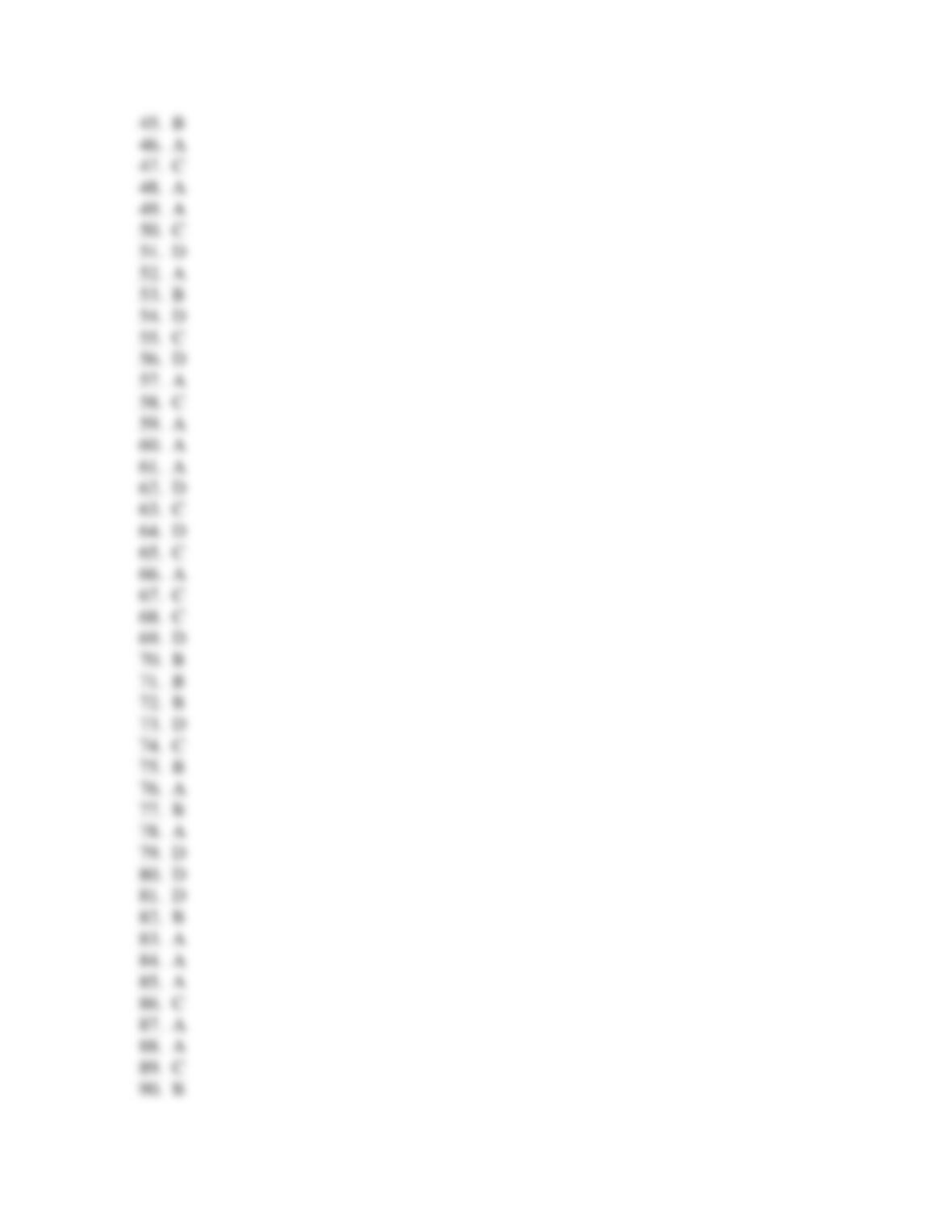
Page 29
45.
B
46.
A
47.
C
48.
A
49.
A
50.
C
51.
D
52.
A
53.
B
54.
D
55.
C
56.
D
57.
A
58.
C
59.
A
60.
A
61.
A
62.
D
63.
C
64.
D
65.
C
66.
A
67.
C
68.
C
69.
D
70.
B
71.
B
72.
B
73.
D
74.
C
75.
B
76.
A
77.
B
78.
A
79.
D
80.
D
81.
D
82.
B
83.
A
84.
A
85.
A
86.
C
87.
A
88.
A
89.
C
90.
B
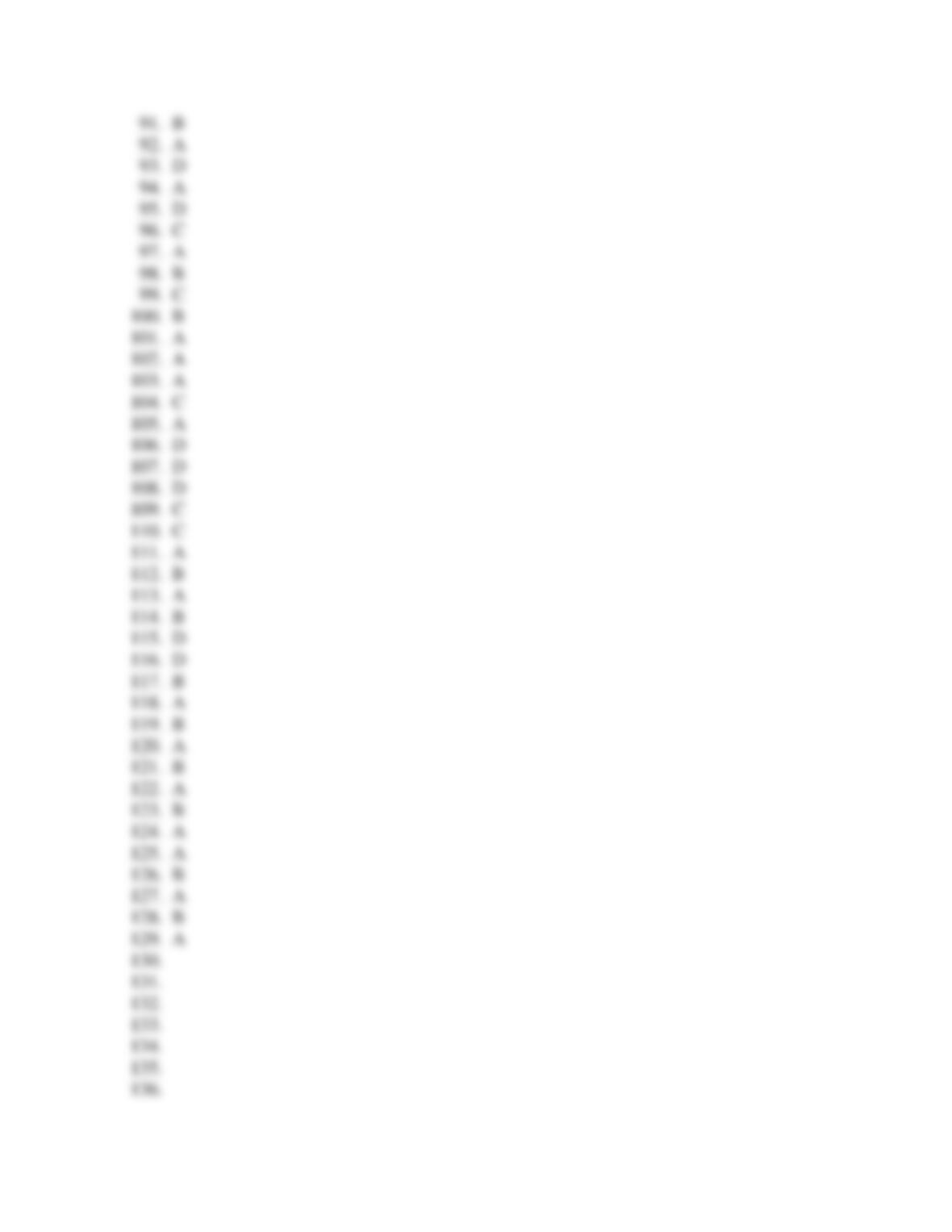
Page 30
91.
B
92.
A
93.
D
94.
A
95.
D
96.
C
97.
A
98.
B
99.
C
100.
B
101.
A
102.
A
103.
A
104.
C
105.
A
106.
D
107.
D
108.
D
109.
C
110.
C
111.
A
112.
B
113.
A
114.
B
115.
D
116.
D
117.
B
118.
A
119.
B
120.
A
121.
B
122.
A
123.
B
124.
A
125.
A
126.
B
127.
A
128.
B
129.
A
130.
131.
132.
133.
134.
135.
136.
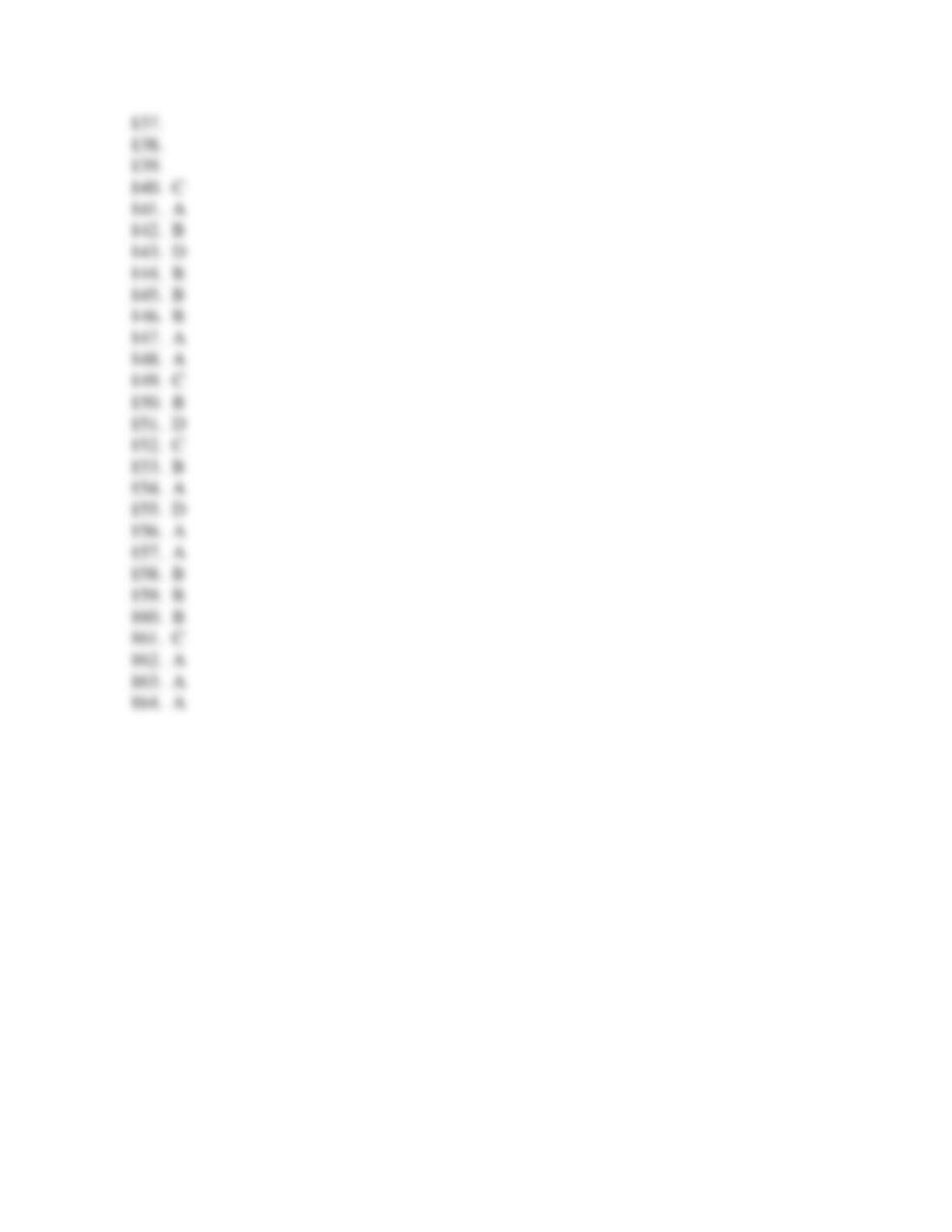
Page 31
137.
138.
139.
140.
C
141.
A
142.
B
143.
D
144.
B
145.
B
146.
B
147.
A
148.
A
149.
C
150.
B
151.
D
152.
C
153.
B
154.
A
155.
D
156.
A
157.
A
158.
B
159.
B
160.
B
161.
C
162.
A
163.
A
164.
A