Page 1
Name: __________________________ Date: _____________
1.
Employment is the total:
A)
labor force.
B)
population of working age.
C)
number of people actively working, either full time or part time.
D)
number of people not unemployed.
2.
The labor force is the total:
A)
number of people employed.
B)
population.
C)
number of people in the population of working age.
D)
number of people who are employed or unemployed.
3.
The unemployment rate is the:
A)
percent of the labor force that is unemployed.
B)
number of people unemployed.
C)
the labor force minus the number of people unemployed.
D)
average length of time someone is unemployed.
4.
To be counted as unemployed, one must:
A)
have had a job previously.
B)
be out of work and be actively looking for a job during the past four weeks.
C)
have had a job before and be actively looking for work.
D)
be actively looking for a job and have at least a high-school diploma or its
equivalent.
5.
The unemployment rate is the ratio of all of the people:
A)
out of work to the total population.
B)
out of work to those over age 16.
C)
unemployed to those looking for work.
D)
unemployed to those in the labor force.
Page 2
6.
If a country has a working-age population of 200 million, 135 million people with jobs,
and 15 million people unemployed and seeking employment, then its unemployment
rate is:
A)
4%.
B)
7.5%.
C)
10%.
D)
67.5%.
7.
If a country has a working-age population of 200 million, 120 million people with jobs,
and 30 million people unemployed and seeking employment, then its unemployment
rate is:
A)
5%.
B)
7.5%.
C)
15%.
D)
20%.
8.
If a country has a working-age population of 200 million, 135 million people with jobs,
and 15 million people unemployed and seeking employment, then its labor force is:
A)
335 million.
B)
200 million.
C)
155 million.
D)
150 million.
9.
The labor force is equal to the:
A)
sum of the number of those employed and unemployed.
B)
population minus the number of employed.
C)
sum of the number of those employed and the underemployed.
D)
number of people working.
10.
Which statement is TRUE?
A)
The number of people not working but who have looked for work in the past year
is equal to the number of unemployed people.
B)
The labor force is the total number of people working plus those who are
unemployed.
C)
The unemployment rate is the number of people unemployed expressed as a
percentage of the population.
D)
The labor force is the same as the population.
Page 3
11.
A person who is NOT working or looking for work is:
A)
included in the unemployment rate.
B)
underemployed.
C)
a member of the labor force who is not working.
D)
not counted in the unemployment rate.
12.
The labor force is considered to be:
A)
everyone who is employed.
B)
everyone who is employed plus everyone who is unemployed.
C)
the population of the nation.
D)
those not frictionally unemployed plus all others who are employed.
13.
The statistics and data on unemployment are gathered and reported:
A)
daily.
B)
weekly.
C)
monthly.
D)
yearly.
14.
You are a college student and NOT working or looking for work. You are:
A)
unemployed.
B)
in the labor force but not employed.
C)
not part of the labor force.
D)
counted in the labor force as underemployed.
15.
The percentage of the labor force that is unemployed is the:
A)
labor force participation rate.
B)
employment ratio.
C)
unemployment rate.
D)
natural employment rate.
16.
A person without a job who is actively seeking and available for work is considered:
A)
employed.
B)
unemployed.
C)
underemployed.
D)
marginally attached.
Page 4
17.
Choose the best answer. A person who has no job but is looking for one is:
A)
unemployed.
B)
a discouraged worker.
C)
part of the labor force.
D)
unemployed and part of the labor force.
18.
To be officially unemployed, a person must:
A)
not have a job and must have looked for work in the past four weeks.
B)
be under 55 years old.
C)
be working fewer than 30 hours per week.
D)
be working fewer than 20 hours per week.
19.
The rate of unemployment is found by dividing the:
A)
number of people looking for work by the population.
B)
number of people not working but looking for work by the sum of the number of
people not working but looking for work and the number of people employed.
C)
labor force by the number of people looking for work.
D)
unemployed and discouraged workers by the labor force.
20.
A survey reveals that, on a small island, 40 people have jobs, 10 people are not working
but are looking for jobs, and 30 people are neither working nor looking for work. The
unemployment rate on the island is _____%.
A)
12.5
B)
20
C)
25
D)
50
21.
A survey reveals that, on a small island, initially 40 people have jobs, 10 people are not
working but are looking for jobs, and 30 people are neither working nor looking for
work. Suppose that 10 of the 30 people who weren’t working or looking for work now
begin looking for work. There are now 20 people without jobs but looking for work and
40 people working. The unemployment rate:
A)
rises to 33.3%.
B)
rises to 50%.
C)
falls to 25%.
D)
Nothing happens to the unemployment rate because these people weren’t working
before and they aren’t working now.

Page 5
22.
A survey reveals that, on a small island, 100 people have jobs, 25 people are not
working but are looking for jobs, and 45 people are neither working nor looking for
work. The unemployment rate on the island is:
A)
12.5%.
B)
20%.
C)
25%.
D)
50%.
23.
A survey reveals that, on a small island, initially 100 people have jobs, 25 people don’t
have jobs but are looking for jobs, and 45 people are neither working nor looking for
work. Suppose that 15 of the 45 people who weren’t looking for work now begin
looking for work. There are now 40 people looking for work and 100 people working.
The unemployment rate:
A)
falls to 20%.
B)
rises to 28.6%.
C)
rises to 50%.
D)
Nothing happens to the unemployment rate because these people weren’t working
before and they aren’t working now.
24.
A survey reveals that, on a small island, 1,000 people have jobs, 250 people are
unemployed and looking for jobs, and 450 people are neither working nor looking for
work. The unemployment rate on the island is _____%.
A)
20
B)
25
C)
45
D)
15.6
25.
A survey reveals that, on a small island, initially 1,000 people have jobs, 250 people are
not working but are looking for jobs, and 450 people are neither working nor looking for
work. Suppose that 150 of the 450 people who weren’t looking for work now begin
looking for work. There are now 400 people looking for work and 1,000 people
working. The unemployment rate:
A)
falls to 20%.
B)
rises to 28.6%.
C)
rises to 50%.
D)
Nothing happens to the unemployment rate because these people weren’t working
before and they aren’t working now.

Page 6
26.
A survey reveals that, on a small island, 1,000 people have jobs, 200 people don’t have
jobs but are looking for jobs, and 200 people are neither working nor looking for work.
The unemployment rate on the island is _____%.
A)
12.5
B)
16.7
C)
20
D)
30
27.
A survey reveals that, on a small island, initially 1,000 people have jobs, 200 people are
unemployed but are looking for jobs, and 200 people are neither working nor looking
for work. Suppose that 100 of the 200 people who weren’t looking for work now begin
looking for work and that half of the new entrants find a job. The unemployment rate:
A)
rises to 19.2%.
B)
rises to 21.4%.
C)
rises to 28.6%.
D)
Nothing happens to the unemployment rate.
28.
Suppose that there are 70 million people in the labor force, of whom 60 million are
employed. The unemployment rate is:
A)
7%.
B)
10%.
C)
14.29%.
D)
4.2%.
29.
The unemployment rate equals the number _____ divided by the number _____ times
100.
A)
unemployed; employed
B)
unemployed; in the population
C)
employed; in the labor force
D)
unemployed; in the labor force
30.
In 2017, 10 million people did not have a job but were actively looking for employment,
and 85 million people had either a full-time or a part-time job. The unemployment rate
in 2017 was _____%.
A)
10
B)
9.5
C)
10.5
D)
8.5

Page 7
31.
The Republic of Livonia has an adult population of 100 million; 60% of Livonia’s
population is employed, and 10% of the people are unemployed. The labor force
participation rate in Livonia is _____%.
A)
70
B)
60
C)
7
D)
10
32.
If the labor force totals 100 million workers and 90 million are working, then the
unemployment rate is _____%.
A)
1
B)
5
C)
10
D)
90
33.
If the labor force includes 100 million workers and 5 million people are unemployed but
actively seeking work, then the unemployment rate is _____%.
A)
1
B)
5
C)
10
D)
95
34.
If 99 million people are working and 1 million are unemployed but actively seeking
work, then the unemployment rate is _____%.
A)
1
B)
5
C)
10
D)
100
35.
If the population of the United States is 260 million, the labor force is 130 million, and
120 million workers are employed, the rate of unemployment is _____%.
A)
7.7
B)
8.3
C)
50
D)
92
Page 8
36.
If the rate of unemployment is 10% and the labor force is 130 million, the number of
unemployed workers is _____million.
A)
1.3
B)
13
C)
10
D)
8
37.
If there are 100 million people in the total population, a labor force of 50 million, and 47
million employed workers, the unemployment rate is _____%.
A)
3
B)
6
C)
8
D)
10
38.
Which expression MOST accurately describes how to calculate the unemployment rate?
A)
(Unemployed / Population) * 100
B)
(Unemployed / Employed) * 100
C)
(Unemployed / Labor force) * 100
D)
[(Unemployed – Employed) / Labor force] * 100
Use the following to answer questions 39-41:
39.
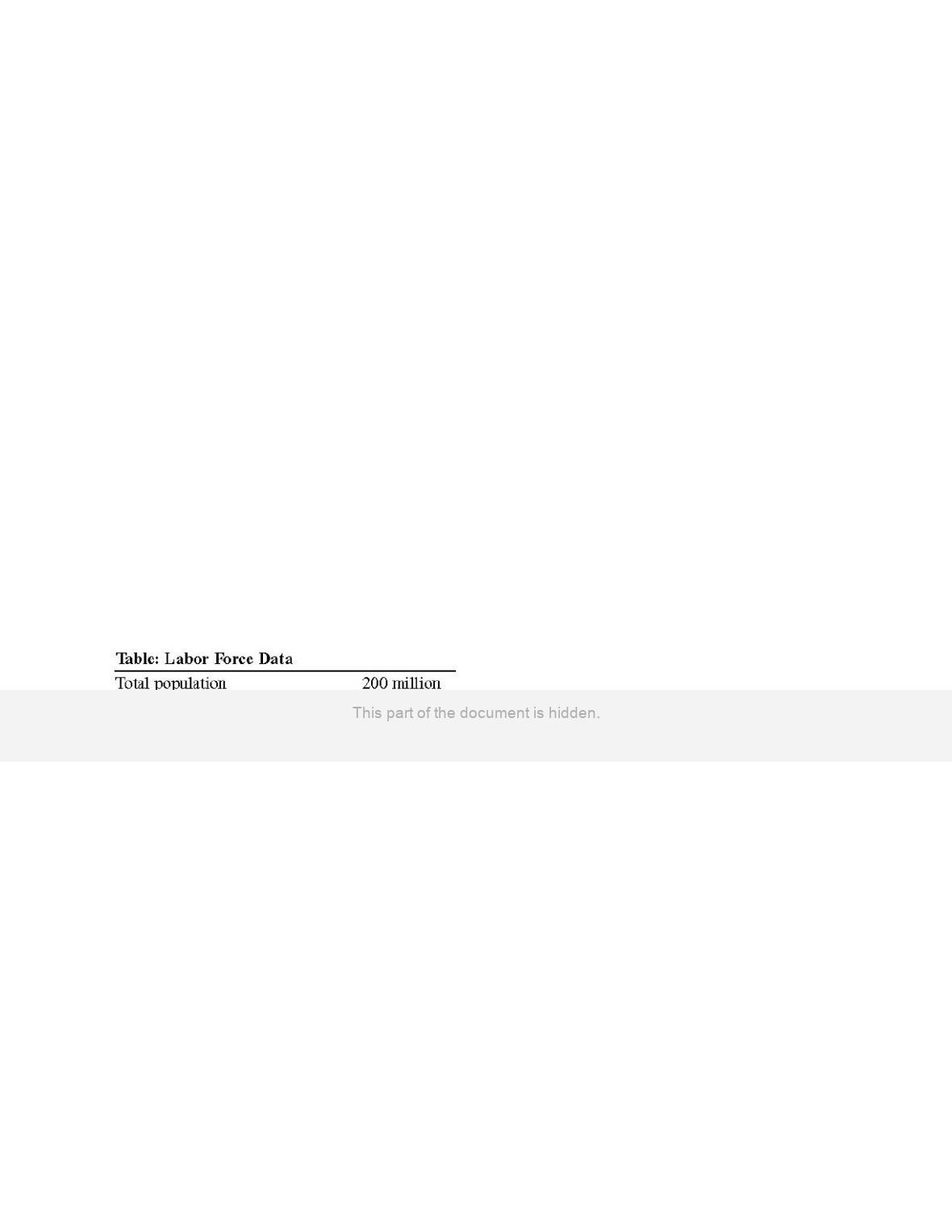
(Table: Labor Force Data) Use Table: Labor Force Data. Suppose the labor force
participation rate is 70%. The labor force is equal to _____ million.
A)
1,200
B)
50
C)
105
D)
400
40.
(Table: Labor Force Data) Use Table: Labor Force Data. Suppose the labor force
participation rate is 70%. The number of unemployed adults is _____ million.
A)
8
B)
53
C)
103
D)
50

Page 9
41.
(Table: Labor Force Data) Use Table: Labor Force Data. If the labor force participation
rate is 70%, the unemployment rate is _____%.
A)
7.6
B)
5
C)
4
D)
3
Use the following to answer questions 42-43:
42.
(Table: Labor Force Distribution) Use Table: Labor Force Distribution. The total
population is _____ million.
A)
486
B)
253
C)
278
D)
283
43.
(Table: Labor Force Data) Use Table: Labor Force Distribution. The unemployment rate
is _____%.
A)
3.85
B)
10
C)
4.55
D)
6.75
44.
If a country has a working-age population of 200 million, 135 million people with jobs,
10 million people who were looking for a job but have given up, and 5 million people
who are unemployed and seeking employment, then its labor force is _____ million.
A)
150
B)
145
C)
140
D)
135
Page 10
45.
If a country has a working-age population of 200 million, 135 million people with jobs,
10 million people who were looking for a job but have given up, and 5 million people
who are unemployed and seeking employment, then the number of discouraged workers
is _____ million.
A)
25
B)
15
C)
10
D)
5
46.
The Bureau of Labor Statistics calls a person who is out of work, would like to work,
but has given up looking for work:
A)
unemployed.
B)
employed.
C)
a discouraged worker.
D)
lazy.
47.
Suppose that roughly 8 million people in the United States were actively seeking jobs
but had not found them this month, the same number as last month. Suppose that 2
million of the people who were unemployed last month gave up their search this month
and stopped looking for work. What will happen to the official unemployment rate this
month, all other things unchanged?
A)
It will rise because 2 million people are not in the labor force this month and are
not counted as unemployed.
B)
It will fall because 2 million people are not in the labor force this month and are
not counted as unemployed.
C)
It will be unaffected because the same number of people is unemployed.
D)
The unemployment rate will decrease by 25%.
48.
The Bureau of Labor Services calculates U-6. This statistic measures the:
A)
underuse of labor that includes discouraged workers, marginally attached workers,
and underemployed workers.
B)
use of labor based on various demographics.
C)
labor force participation rate in a comprehensive way.
D)
rate of overuse of labor when workers hold multiple jobs.
49.
The official unemployment rate reported by the government may tend to understate the
amount of unemployment because it:
A)
includes discouraged workers.
B)
excludes discouraged workers.
C)
includes people over 65 who aren’t retired.
D)
excludes teenagers.
Page 11
50.
Discouraged workers:
A)
are getting paid too little.
B)
do not like their job.
C)
are working part-time but are looking for a full-time job.
D)
have given up looking for a job.
51.
According to official statistics, discouraged workers are:
A)
included in the employment statistics.
B)
included in the labor force.
C)
not included in the labor force.
D)
treated just like the underemployed.
52.
The official unemployment rate ignores:
A)
people with professional jobs.
B)
people who work on commission.
C)
discouraged workers.
D)
people with professional jobs, people who work on commission, and discouraged
workers.
53.
Which situation is likely to lead to an INCREASE in discouraged workers?
A)
The economy is expanding.
B)
The availability of jobs falls.
C)
The economy is undergoing inflation.
D)
The economy is undergoing deflation.
54.
An INCREASE in the number of discouraged workers in the economy tends to:
A)
raise the official unemployment rate.
B)
lower the official unemployment rate.
C)
lower the number of people who are frictionally unemployed.
D)
increase the number of people who are structurally unemployed.
55.
Donna was laid off at the beginning of 2017. She looked for a job for three months but
could not find anything suitable. She then decided to volunteer for a soup kitchen and
stopped looking for a job. Donna is considered to be:
A)
unemployed.
B)
underemployed.
C)
a discouraged worker.
D)
a part-time worker.

Page 12
56.
Economists claim that the unemployment rate can understate the true level of
unemployment because the ONLY group that is included is:
A)
discouraged workers.
B)
marginally attached workers.
C)
underemployed workers.
D)
workers without jobs who have looked for work in the past four weeks.
57.
Jim has a part-time job. He would prefer to have a full-time job but has been unable to
find one. Jim is classified as:
A)
a discouraged worker.
B)
underemployed.
C)
unemployed.
D)
out of the labor force.
58.
Which federal agency calculates and reports the official unemployment rate?
A)
Federal Reserve Bank
B)
Treasury Department
C)
Department of Health and Human Services
D)
Bureau of Labor Statistics
59.
Suppose that Allison has an accounting degree, but she lost her job two months ago
when her company merged with another firm. Allison hasn’t been able to find another
accounting job, so she has taken a part-time job as a sales clerk at a clothing store. The
Bureau of Labor Statistics classifies Allison as:
A)
a marginally attached worker.
B)
a discouraged worker.
C)
underemployed.
D)
unemployed.
60.
Suppose that Allison has an accounting degree, but she lost her job two months ago
when her company merged with another firm. Allison hasn’t been able to find another
accounting job, so she has taken a part-time job as a sales clerk at a clothing store. As a
result, the official unemployment rate will:
A)
not change.
B)
increase.
C)
decrease.
D)
increase temporarily, then fall back to its original level.
Page 13
61.
Unemployment rates are usually HIGHEST for:
A)
white teenagers.
B)
African American teenagers.
C)
male workers aged 25 to 54.
D)
female workers aged 25 to 54.
62.
Which statement about unemployment is FALSE?
A)
Unemployment always falls during recessions.
B)
Unemployment always falls during expansions.
C)
There is a strong negative relation between growth in real GDP and changes in
unemployment.
D)
In general, there is a trade-off between inflation and unemployment in the short
run.
63.
If the growth rate of GDP is above its historical average, then there is a tendency for the
unemployment rate to:
A)
fall to zero.
B)
rise.
C)
fall.
D)
stabilize.
64.
During a recession:
A)
unemployment and the growth rate of real GDP both decrease.
B)
unemployment decreases and the growth rate of real GDP increases.
C)
unemployment increases and the growth rate of real GDP decreases.
D)
there is no relation between unemployment and the growth rate of real GDP.
65.
In general, for the U.S. economy, the relation between unemployment and economic
growth is:
A)
positive.
B)
direct.
C)
neutral.
D)
negative.
66.
According to historical economic data for the United States from 1949 to 2016, the
unemployment rate is MOST likely to rise:
A)
whenever the economy grows at a rate below 3.20%.
B)
only when there is no economic growth.
C)
only when there is positive economic growth.
D)
whenever the economy grows at a rate between 4% and 4.8%.
Page 14
67.
For most of U.S. modern economic history, when the unemployment rate is _____, real
GDP is _____.
A)
falling; rising
B)
falling; falling
C)
rising; unchanged
D)
rising; rising
68.
In general, expansions are characterized by:
A)
increasing unemployment.
B)
falling unemployment.
C)
decreasing employment.
D)
constant employment.
69.
Periods of recession are likely to be marked by:
A)
rising unemployment.
B)
constant unemployment.
C)
increasing employment.
D)
constant employment.
70.
People who are counted as unemployed by the Bureau of Labor Statistics are:
A)
people without a job who are actively seeking a job.
B)
discouraged workers.
C)
workers who are underemployed.
D)
people without a job who are actively seeking a job, discouraged workers, and
workers who are underemployed.
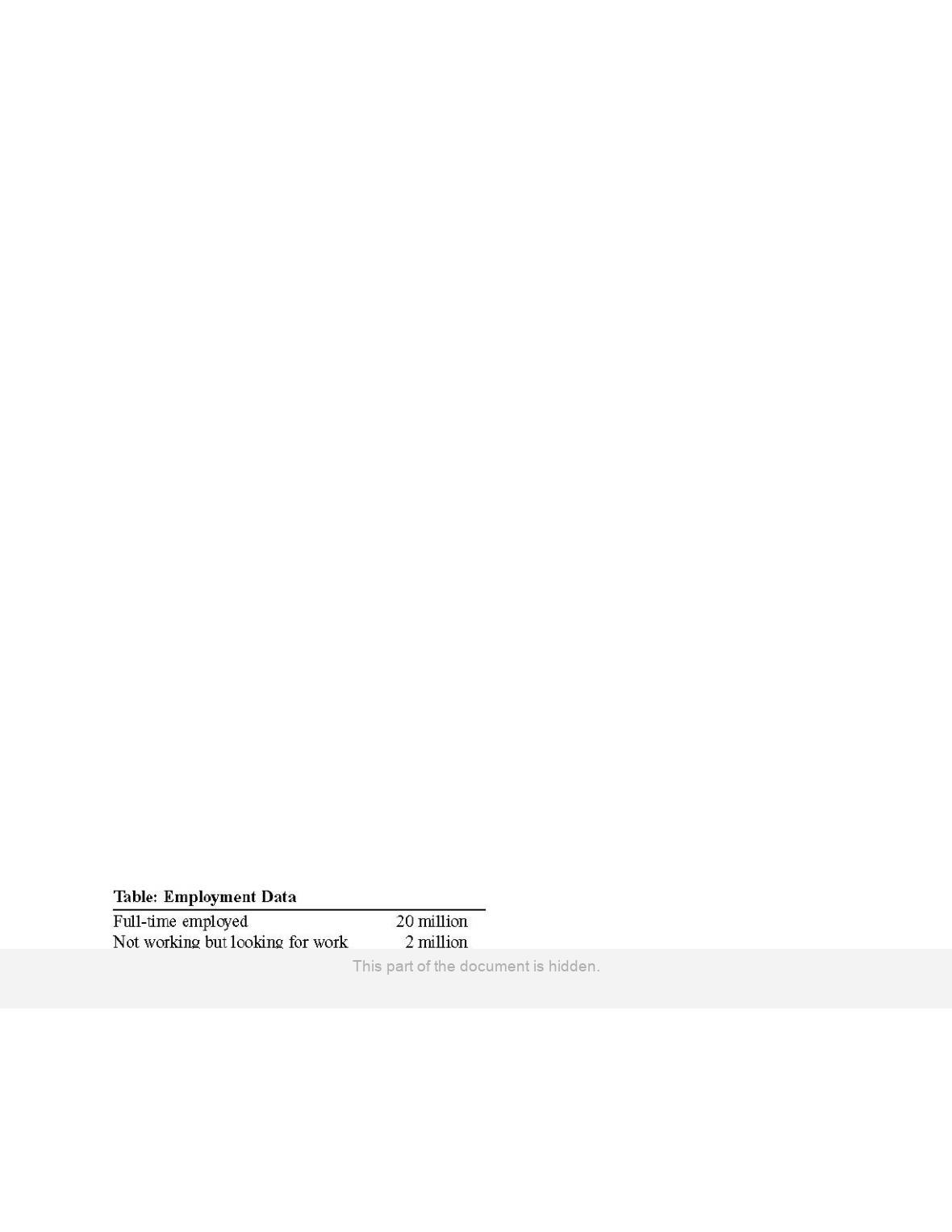
Use the following to answer questions 71-74:
Page 15
71.
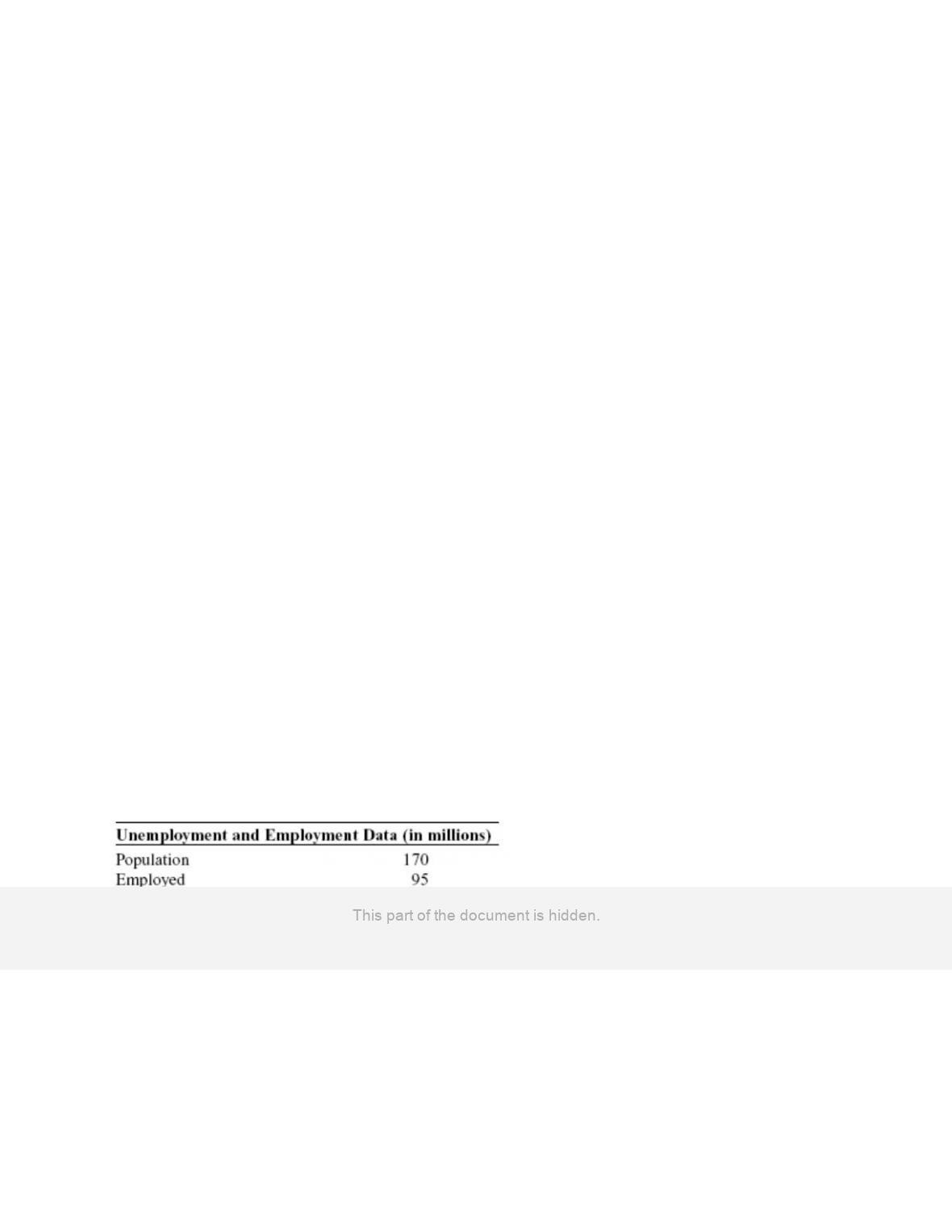
(Table: Unemployment and Employment Data) Use Table: Unemployment and
Employment Data. The unemployment rate for this economy is _____%.
A)
2.9
B)
4.8
C)
5
D)
5.3
72.
(Table: Unemployment and Employment Data) Use Table: Unemployment and
Employment Data. The labor force in this economy is _____ million.
A)
170
B)
140
C)
100
D)
98
73.
(Table: Unemployment and Employment Data) Use Table: Unemployment and
Employment Data. If marginally attached workers are included, the labor force in this
economy is _____ million.
A)
170
B)
103
C)
100
D)
98
74.
(Table: Unemployment and Employment Data) Use Table: Unemployment and
Employment Data. If marginally attached workers are included in the labor force and in
the unemployment rate, the unemployment rate in this economy is _____%.
A)
8.4
B)
7.8
C)
5
D)
3
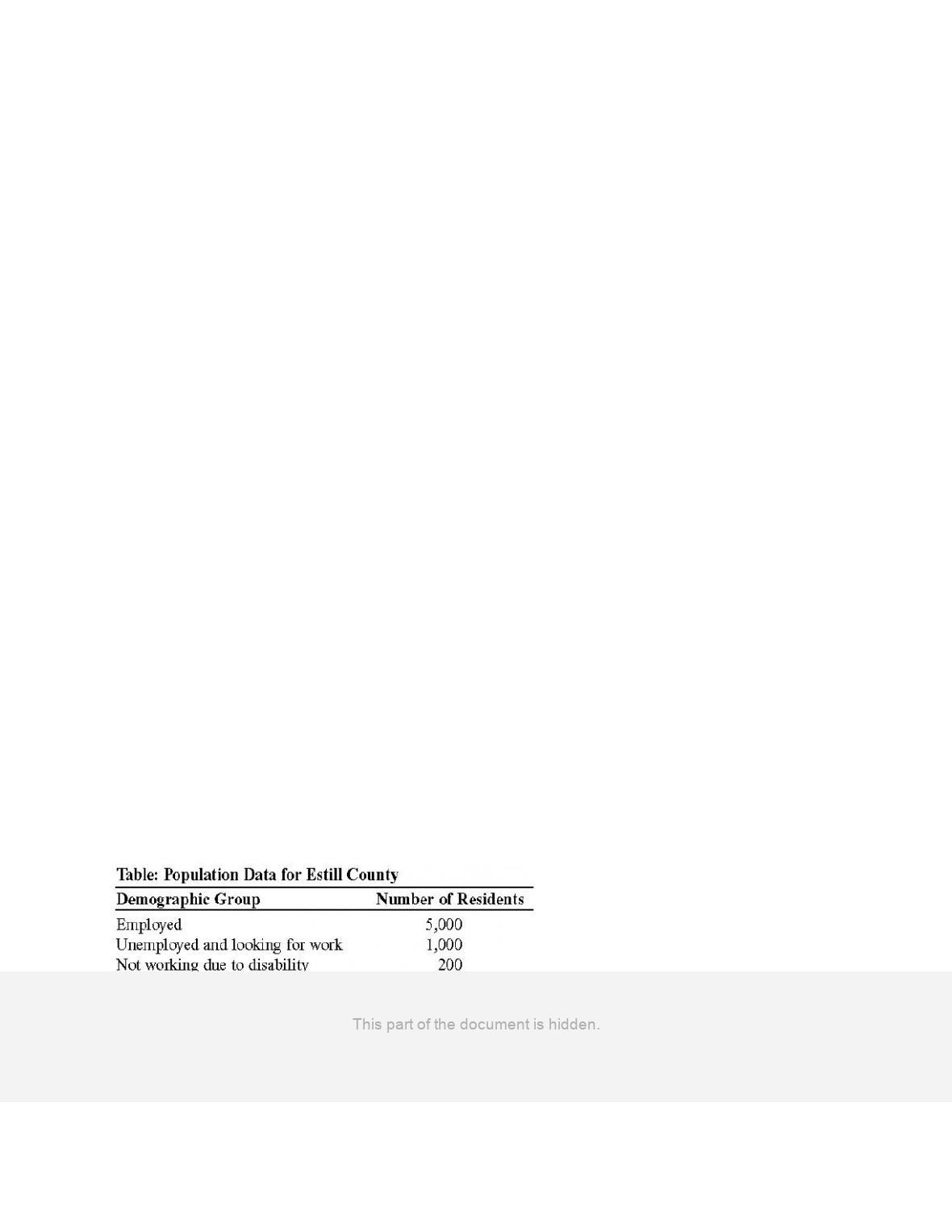
Use the following to answer questions 75-78:
Page 16
75.
(Table: Employment Data) Use Table: Employment Data. The unemployment rate is
_____%.
A)
6.25
B)
6.45
C)
9.09
D)
9.37
76.
(Table: Employment Data) Use Table: Employment Data. The labor force is
_____million.
A)
33
B)
32
C)
31
D)
22
77.
(Table: Employment Data) Use Table: Employment Data. If marginally attached
workers are included in the labor force, the labor force is _____ million.
A)
1
B)
11
C)
32
D)
33
78.
(Table: Employment Data) Use Table: Employment Data. If marginally attached
workers are included in the labor force and in the unemployment rate, the
unemployment rate is _____%.
A)
39.4
B)
30.3
C)
9.1
D)
6.25
Use the following to answer questions 79-83:
Page 17
79.
(Table: Population Data for Estill County) Use Table: Population Data for Estill County.
How many people are in the labor force?
A)
6,000
B)
9,400
C)
7,400
D)
6,500
80.
(Table: Population Data for Estill County) Use Table: Population Data for Estill County.
What is the labor force participation rate?
A)
64%
B)
81%
C)
17%
D)
79%
81.
(Table: Population Data for Estill County) Use Table: Population Data for Estill County.
What is the unemployment rate?
A)
64%
B)
48%
C)
17%
D)
6%
82.
(Table: Population Data for Estill County) Use Table: Population Data for Estill County.
If marginally attached workers are included, the labor force in Estill County is:
A)
7,400.
B)
6,500.
C)
6,000.
D)
5,500.
83.
(Table: Population Data for Estill County)Use Table: Population Data for Estill County.
If marginally attached workers are included in the labor force and in the unemployment
rate, the unemployment rate in this economy is _____%.
A)
10.6
B)
15.4
C)
23.1
D)
33.2
Page 18
84.
Anna recently moved to Boston with her husband Joe, who has a new job as an
economics professor at Harvard. Anna is an experienced surgeon who is interviewing
with several hospitals in Boston. Anna is:
A)
frictionally unemployed.
B)
structurally unemployed.
C)
cyclically unemployed.
D)
counted as employed since she is likely to receive a job offer soon.
85.
Unemployment that is due to the time workers spend in job search is _____
unemployment.
A)
frictional
B)
structural
C)
cyclical
D)
natural
86.
Last week, Stephanie quit her job as a copywriter at an advertising agency. She has
spent the past few days browsing the help wanted ads but hasn’t found anything that
matches her skills. Stephanie is BEST classified as:
A)
structurally unemployed.
B)
frictionally unemployed.
C)
a discouraged worker.
D)
out of the labor force.
87.
Unemployment that occurs because it takes workers and employees time to find each
other is _____ unemployment.
A)
cyclical
B)
structural
C)
frictional
D)
discouraged
88.
People who are changing jobs are counted in _____ unemployment.
A)
frictional
B)
involuntary
C)
structural
D)
cyclical
Page 19
89.
A recent college graduate with a major in economics attends a job fair but has not yet
found a job. This graduate is counted as a _____ unemployed worker.
A)
structurally
B)
seasonally
C)
cyclically
D)
frictionally
90.
When the unemployment rate is very low, most of it tends to be:
A)
cyclical.
B)
frictional.
C)
seasonal.
D)
structural.
91.
A person who spends time looking for work is:
A)
engaged in job search.
B)
usually counted as a marginally attached worker.
C)
counted as out of the labor force.
D)
usually counted as a discouraged worker.
92.
A reason that does NOT explain why frictional unemployment exists is:
A)
that new jobs are continually being created.
B)
that some old jobs are always being destroyed.
C)
that new workers are always entering the labor market.
D)
the minimum wage.
93.
An example of the frictionally unemployed is a(n):
A)
autoworker who is temporarily laid off because of a decline in sales.
B)
geologist who is permanently laid off from an oil company because of a
technological advance.
C)
worker at a fast-food restaurant who quits work and attends college.
D)
real estate agent who leaves a job in Texas and searches for a similar,
higher-paying job in California.
94.
A worker classified as frictionally unemployed is one who is:
A)
laid off during a recession.
B)
discouraged and has dropped out of the labor force.
C)
unemployed while looking for a job that demands his or her skills.
D)
working part time but would prefer to work full time.
Page 20
95.
Ron quit his job in retail management and moved to Florida with his wife, a physician
who opened a new practice there. He was not successful in his job search for the next
four months. Ron’s unemployment is:
A)
structural.
B)
cyclical.
C)
frictional.
D)
seasonal.
96.
Internet employment agencies have simplified the job search for the applicants. They
have also led to a(n) _____ unemployment.
A)
increase in frictional
B)
increase in cyclical
C)
decrease in frictional
D)
decrease in structural
97.
Economists generally agree that sufficiently high minimum wage laws:
A)
cause unemployment.
B)
help lower the structural unemployment rate.
C)
decrease the labor force participation rate.
D)
make an opportunity for discouraged workers.
98.
Structural unemployment consists of people who are unemployed because of:
A)
temporary changes in jobs.
B)
there being more labor demanded than there is labor supplied.
C)
the time it takes for employers and workers to find each other.
D)
there being more job hunters than there are jobs.
99.
An example of structural unemployment is a(n):
A)
autoworker who is temporarily laid off because of a decline in sales.
B)
geologist who is permanently laid off because of an increase in wages won by labor
unions.
C)
worker at a fast-food restaurant who quits work and attends college.
D)
real estate agent who leaves a job in Texas and searches for a similar,
higher-paying job in California.