Page 1
Name: __________________________ Date: _____________
1.
A market economy will produce _____ without any government regulation.
A)
too little pollution
B)
too much pollution
C)
the socially optimal amount of pollution
D)
the amount of pollution that maximizes total surplus
2.
A negative externality:
A)
is any cost above the economic cost.
B)
equals the social cost plus the firm’s private cost.
C)
is an uncompensated cost imposed by an individual or firm on others.
D)
equals the opportunity cost minus the social costs.
3.
Which activity does NOT generate a negative externality?
A)
Bob’s Service Station dumps used oil in the river.
B)
Bob renovates a run-down house in the neighborhood.
C)
Bob occasionally drives while drunk.
D)
Bob’s Service Station donates a car to charity.
4.
Which activity generates a negative externality?
A)
You buy a new car, then discover it needs a new transmission.
B)
Your next-door neighbor mows the lawn at 6 A.M.
C)
The only two coffee shops in town conspire to raise prices.
D)
After Jane buys health insurance, she begins racing motorcycles on the weekends.
5.
If drivers decide to make phone calls without considering the costs imposed on others,
the:
A)
number of phone calls made while driving will be more than the socially optimal
quantity.
B)
number of phone calls made while driving will be fewer than the socially optimal
quantity.
C)
marginal social cost curve will lie below the marginal cost of production curve.
D)
marginal social benefit curve will lie below the marginal social cost curve.
Page 2
6.
Which example illustrates a negative externality?
A)
high prices for necessities such as drinking water in the aftermath of a natural
disaster
B)
the risks to nonsmokers from second-hand smoke
C)
the increased risk of a traffic accident to an individual who uses a cell phone while
driving
D)
unemployment in the steel industry caused by low prices of imported (external)
steel
7.
An externality is said to exist when:
A)
individuals impose costs or benefits on others but have no incentive to take these
costs and benefits into account.
B)
individuals impose costs or benefits on others, and the market provides incentives
to take these costs and benefits into account.
C)
individual actions are affected by external forces like the loss of U.S. jobs because
of competition from abroad.
D)
individual actions are affected by government policies (such as taxes) that are
externally imposed on the market.
8.
If an activity generates external costs, the decision makers generating the activity will:
A)
be faced with its full costs.
B)
be faced with no costs.
C)
not be faced with its full costs.
D)
be faced with excessive costs.
9.
A coal-powered electrical generator that discharges smoke into the air and causes
uncompensated costs and discomfort to residents of a town has a(n):
A)
quasi-public good.
B)
external cost.
C)
external benefit.
D)
specific tax.
10.
Whenever human activity generates a concentration of a substance in the environment
sufficient to cause harm to living things, it is called:
A)
a free good.
B)
an external shock.
C)
a result of human greed.
D)
pollution.
Page 3
11.
Damage to the environment occurs because:
A)
no one involved in markets cares about the environment.
B)
a nonzero amount of pollution is never socially optimal.
C)
pollution results from production of goods and services.
D)
pollution reduces the social cost of production.
12.
Activities that generate external costs will likely be carried out at levels that _____ those
that would be efficient.
A)
are equal to
B)
are less than
C)
exceed
D)
compete with
13.
An example that does NOT illustrate an external cost is:
A)
the smoke nuisance of a factory.
B)
zoning restrictions on your property.
C)
land defilement from strip mining.
D)
a spreading patch of weeds on your next-door neighbor’s lawn.
14.
An industry with production that generates external costs produces a quantity of output
that is:
A)
socially optimal.
B)
smaller than the socially optimal quantity.
C)
larger than the socially optimal quantity.
D)
socially optimal if a specific subsidy is given to buyers.
15.
Which statement BEST describes a negative externality?
A)
Your neighbor loves to bake bread and always brings you a loaf fresh and hot from
the oven.
B)
Your neighbor has an ornamental pond that breeds mosquitoes.
C)
Your neighbor has invested in beautiful landscaping, increasing the value of all of
the houses on the block.
D)
Your neighbor has a pool and has given you an open invitation to come over and
swim.
Page 4
16.
A plastics manufacturing plant dumps pollution into the Big River. This pollution leads
to higher costs and disruption for fishermen on the river, for which they are not
compensated. In this situation:
A)
too few of society’s resources are being used to produce plastic.
B)
too many of society’s resources are being used to produce plastic.
C)
the ideal amount of society’s resources are being used to produce plastic.
D)
there is an external benefit to society from plastic production.
17.
Given the general agreement that pollution is undesirable and social welfare is increased
by reducing pollution, the optimal level of pollution in a society is:
A)
zero.
B)
the level that reduces the marginal social costs of pollution to zero.
C)
the level at which the marginal social cost is equal to the marginal social benefit.
D)
the level that minimizes the average total cost of producing the product that
generates the pollution.
18.
The socially optimal amount of pollution occurs where the marginal social benefit of
pollution is _____ the marginal social cost of pollution.
A)
equal to
B)
greater than
C)
less than
D)
There is no socially optimal amount of pollution.
19.
The marginal social benefit of pollution:
A)
is zero since pollution is not beneficial.
B)
can be measured as the additional gain to society from one additional unit of
pollution.
C)
is easy to estimate since polluters are required to file this information in their tax
returns.
D)
is equal to the marginal social cost of pollution since benefits to producers are
equal to costs to consumers.
20.
Pollution has _____ and _____.
A)
no benefits; only costs
B)
benefits; costs
C)
no opposition; only advocates
D)
short-term effects; very few long-term effects
Page 5
21.
There are benefits resulting indirectly from pollution because:
A)
we obtain goods and services that we enjoy, even though we pollute in the process.
B)
firms pollute the environment only if it allows them to increase the price they can
charge consumers.
C)
businesses and consumers receive a perverse satisfaction from polluting.
D)
it can often be beneficial to wildlife.
22.
The additional cost imposed on society as a whole by an additional unit of pollution is:
A)
the marginal social benefit of pollution.
B)
the marginal social cost of pollution.
C)
the optimal Pigouvian tax.
D)
a technology spillover.
23.
The efficient level of pollution is the quantity at which:
A)
its total benefits exceed its total costs to society by the greatest possible amount.
B)
its total benefits to society equal its total costs to society.
C)
the marginal social benefit of an additional unit of pollution is greater than the
marginal social cost of the additional unit.
D)
the marginal social benefit of an additional unit of pollution is less than the
marginal social cost of the additional unit.
24.
The efficient quantity of pollution emissions occurs where:
A)
there is absolutely no damage done to a pristine environment.
B)
government forces zero pollution to occur, no matter what the cost.
C)
the marginal social benefits of pollution exceed the marginal social costs of
pollution.
D)
the marginal social benefit of pollution is equal to the marginal social cost of
pollution.
25.
As the quantity of pollution rises, its marginal social cost:
A)
remains constant.
B)
falls.
C)
rises.
D)
rises at first but eventually falls.
26.
The socially optimal quantity of pollution is:
A)
zero.
B)
the quantity at which marginal social cost is equal to zero.
C)
the quantity at which marginal social benefit is equal to zero.
D)
the quantity at which marginal social cost is equal to the marginal social benefit.
Page 6
27.
The marginal social cost of pollution rises as the quantity of pollution emissions:
A)
remains constant.
B)
falls.
C)
rises.
D)
rises but subsequently gradually falls.
28.
The marginal benefit of pollution emissions _____ as the quantity of pollution emissions
_____.
A)
decreases; increases
B)
increases; increases
C)
decreases; decreases
D)
remains unchanged; goes up or down
29.
The marginal social benefit from pollution _____ as the quantity of pollution emissions
_____.
A)
remains constant; increases
B)
increases; decreases
C)
increases; increases
D)
remains constant; decreases
30.
The efficient rate of emissions occurs when:
A)
there is absolutely no damage done to a pristine environment.
B)
government forbid
s all pollution, no matter what the cost.
C)
the marginal social benefits of pollution exceed the marginal social costs of
pollution.
D)
the change in social benefits and the change in social costs from an additional unit
of emissions are equal.
31.
The marginal social cost of pollution emissions _____ as the quantity of pollution
emissions _____.
A)
decreases; increases
B)
increases; increases
C)
increases; decreases
D)
remains constant; decreases
Page 7
32.
If, at the current amount of pollution, its marginal social benefit is greater than its
marginal social cost:
A)
there is too little pollution.
B)
there is too much pollution.
C)
society is achieving the optimal amount of pollution.
D)
the externality is minimized.
33.
A copper mining operation discharges waste products into a river and causes higher
costs and discomfort to downstream users of the water for which they are not
compensated. In this case:
A)
too little of society’s resources is being used to produce copper.
B)
too much of society’s resources is being used to produce copper.
C)
the optimal amount of society’s resources is being used to produce copper.
D)
there is an external benefit to society from copper production.
34.
If the marginal social benefit received from pollution is equal to its marginal social cost:
A)
society’s well-being can be improved if the quantity of pollution increases.
B)
society’s well-being can be improved if the quantity of pollution decreases.
C)
society has achieved its socially optimal level of pollution.
D)
the market is producing too much pollution.
35.
If the marginal social benefit received from pollution is less than its marginal social
cost:
A)
society’s well-being can be improved if the quantity of pollution increases.
B)
society’s well-being can be improved if the quantity of pollution decreases.
C)
society has achieved its socially optimal level of pollution.
D)
the market is producing too little pollution.
36.
The marginal social benefit received from pollution is equal to its marginal social cost in
the market for highly polished glass. In this situation:
A)
society’s well-being can be improved if the quantity of pollution decreases.
B)
firms in the market produce too much pollution.
C)
firms in the market produce too little pollution.
D)
firms in the market produce the socially optimal level of pollution.
Page 8
37.
The marginal social benefit received from pollution is less than its marginal social cost
in the market for highly polished glass. In this situation:
A)
firms in the market produce the socially optimal level of pollution.
B)
society’s well-being cannot be improved by changing the quantity of pollution.
C)
firms in the market produce too much pollution.
D)
firms in the market produce too little pollution.
38.
If the marginal social benefit received from pollution is greater than its marginal social
cost in a market:
A)
society’s well-being can be improved if the quantity of pollution decreases.
B)
firms in the market produce the socially optimal level of pollution.
C)
firms in the market produce too much pollution.
D)
firms in the market produce too little pollution.
39.
If a good that involves external costs is priced to take these costs into account, then its
price will likely:
A)
fall, and output will likely rise.
B)
rise, and output will likely fall.
C)
not change, but output will likely fall.
D)
rise, but output will likely stay the same.
40.
If external costs exist, the competitive free market:
A)
allocates resources inefficiently.
B)
allocates resources efficiently.
C)
automatically corrects an overallocation of resources.
D)
automatically corrects an underallocation of resources.
41.
When farmers raise hogs, there are a number of external costs. In particular, hogs
generate methane gas. Without government regulation:
A)
too few hogs will be raised.
B)
the price of hogs will be less than the marginal social cost of the last hog sold.
C)
the price of hogs will be less than the marginal benefit of the last hog sold.
D)
the price of hogs will be less than the marginal cost of the last hog sold to the hog
farmer who sold it.
Page 9
42.
When farmers raise hogs, there are a number of external costs. In particular, hogs
generate methane gas. If the marginal external cost is $100 per hog and the government
imposes a tax of $200 per hog, then at the equilibrium price and quantity of hogs:
A)
too few hogs will be raised.
B)
the price will be less than the marginal social cost.
C)
the price will be less than the marginal social benefit.
D)
the price will be less than the marginal cost to hog farmers.
43.
A familiar example of a negative externality is traffic congestion. In principle, it should
be possible to internalize this externality by permitting drivers to negotiate rights to
drive during particular times. The most likely reason that these negotiations do NOT
happen is that:
A)
most individuals are unfamiliar with the Coase theorem.
B)
the transaction costs associated with identifying and establishing communication
among the many interested parties would be prohibitive.
C)
agreements arising from such negotiations could not be enforced since the
Constitution guarantees all individuals freedom of access to all public roads.
D)
lawyers would find a way to prohibit such negotiations unless they were actively
involved, thus making transaction costs prohibitive.
44.
The Coase theorem states that, in the presence of externalities, a market economy will:
A)
always reach an efficient solution.
B)
never reach an efficient solution.
C)
reach an efficient solution if transaction costs are sufficiently low and property
rights are well-defined.
D)
reach an efficient solution only in the case of government regulation.
45.
An externality is said to be internalized:
A)
when individuals take external costs and benefits into account in their decision
making.
B)
when the Coase theorem is irrelevant or cannot be applied.
C)
when individuals successfully petition the government to ban or restrict activities
that generate negative externalities.
D)
when individuals learn to adapt to negative externalities through introspection or
internal acceptance of what are viewed as unchangeable facts of life.
Page 10
46.
The proposition that, if bargaining is costless and property rights are well-defined, the
market can achieve an efficient outcome is the:
A)
Coase theorem.
B)
property rights paradigm.
C)
market rights theorem.
D)
efficient environment paradigm.
47.
When individuals take external costs and benefits into account:
A)
there are no external costs.
B)
they internalize the externality.
C)
the government should intervene in the market.
D)
the market will not reach an efficient solution.
48.
According to the Coase theorem, when negative externalities are present, a market will:
A)
always reach an efficient solution.
B)
reach an efficient solution if transaction costs are low and property rights are
well-defined.
C)
reach an efficient solution only if the government intervenes in the market with a
tax.
D)
reach an efficient solution only if the negative externalities are offset by positive
externalities.
49.
A familiar example of a negative externality is loud music on a college campus. In
principle, it should be possible to internalize this externality by permitting students to
negotiate rights to play music during particular times. The most likely reason that these
negotiations do NOT happen is that:
A)
most students are unfamiliar with the Coase theorem.
B)
the transaction costs associated with identifying and establishing communication
with students would be high.
C)
music is an experience, not a good.
D)
some students don’t view loud music as a negative externality.
50.
The idea that even in the presence of externalities an economy can reach an efficient
solution as long as transaction costs of making a deal are low and property rights are
well-defined is known as:
A)
a Pigouvian tax.
B)
a network externality.
C)
a technology spillover.
D)
the Coase theorem.
Page 11
51.
The proposition that, if transaction costs are low enough and property rights are
well-defined, the private market can achieve an efficient outcome, regardless of which
of the affected parties hold the property rights, is known as the:
A)
Coase theorem.
B)
property rights paradigm.
C)
market rights theorem.
D)
green environment paradigm.
52.
According to the Coase theorem, the private market can achieve an efficient outcome:
A)
as long as the enforcement of property rights costs less than the marginal benefit of
emissions.
B)
only if the property right to clean air is assigned to the polluter.
C)
only if the property right to clean air is assigned to the party harmed by pollution.
D)
if bargaining costs are low and property rights are well-defined.
Use the following to answer questions 53-58:
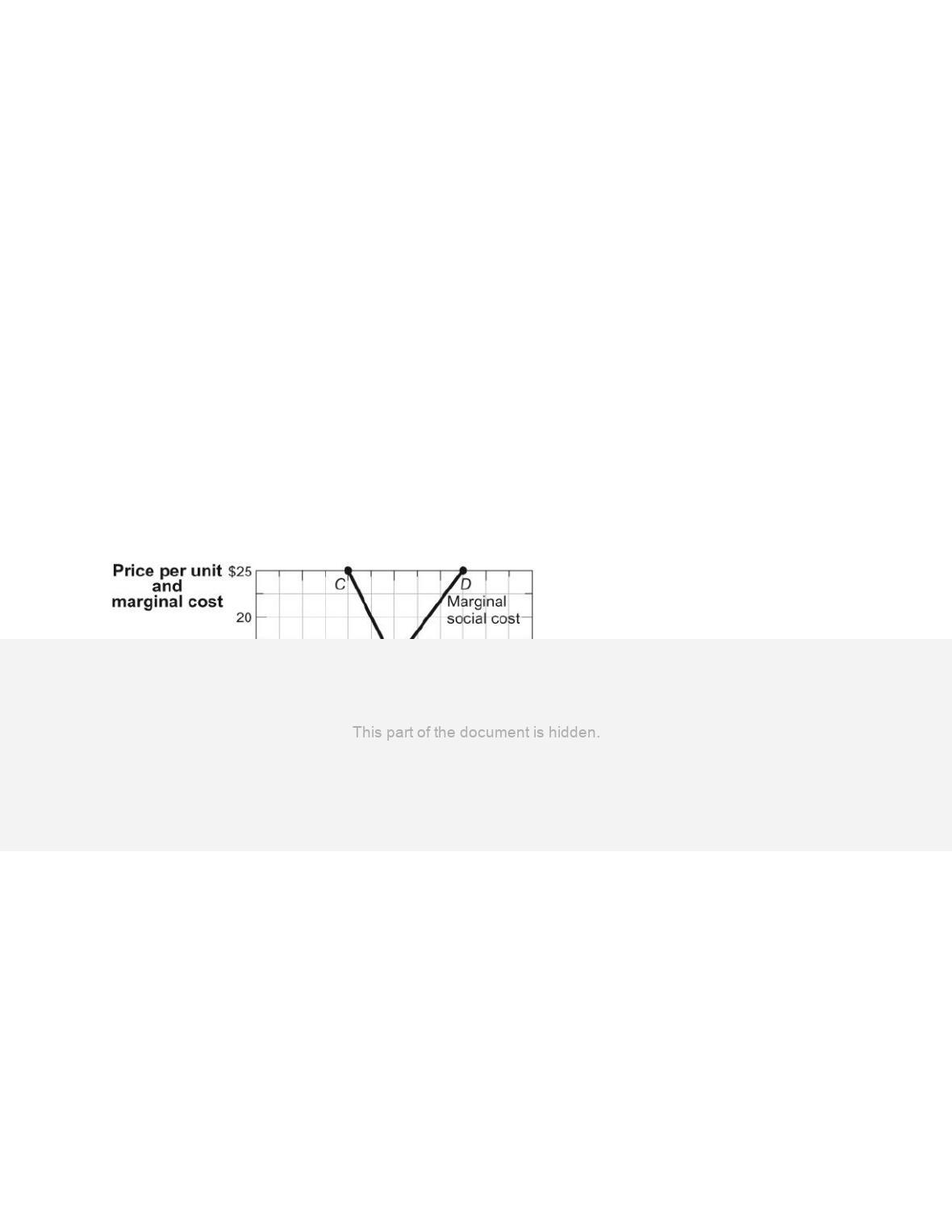
Figure: Pollution and Efficiency
53.
(Figure: Pollution and Efficiency) Use Figure: Pollution and Efficiency. Point _____ in
the figure represents an efficient solution in this market, where sulfur emissions are a
result of production.
A)
A
B)
B
C)
E
D)
F
Page 12
54.
(Figure: Pollution and Efficiency) Use Figure: Pollution and Efficiency. In this market,
whose sulfur emissions are a result of production, an efficient solution takes place at a
price of _____ and a quantity of _____.
A)
$5; 40
B)
$15; 30
C)
$25; 30
D)
$15; 15
55.
(Figure: Pollution and Efficiency) Use Figure: Pollution and Efficiency. In this market,
whose sulfur emissions are a result of production, an efficient solution is one in which:
A)
MSB < MSC.
B)
MSC < MSB.
C)
total cost = total benefit.
D)
MSC = MSB.
56.
(Figure: Pollution and Efficiency) Use Figure: Pollution and Efficiency. In this market,
in which sulfur emissions are a result of production, if _____ units of emissions are
produced, then _____.
A)
30; it would be efficient
B)
30; MSB > MSC
C)
45; total cost would equal total benefits
D)
45; MSC = 0
57.
(Figure: Pollution and Efficiency) Use Figure: Pollution and Efficiency. In this market,
in which sulfur emissions are a result of production, if _____ units of emissions are
produced, then _____.
A)
40; MSB = MSC
B)
30; MSB < MSC
C)
40; MSB < MSC
D)
30; MSC < MSB
58.
(Figure: Pollution and Efficiency) Use Figure: Pollution and Efficiency. In this market,
in which sulfur emissions are a result of production, too much pollution is found when
the price is _____ and the quantity is _____.
A)
$5; 15
B)
$5; 40
C)
$25; 20
D)
$5; 30
Page 13
Use the following to answer questions 59-71:
59.
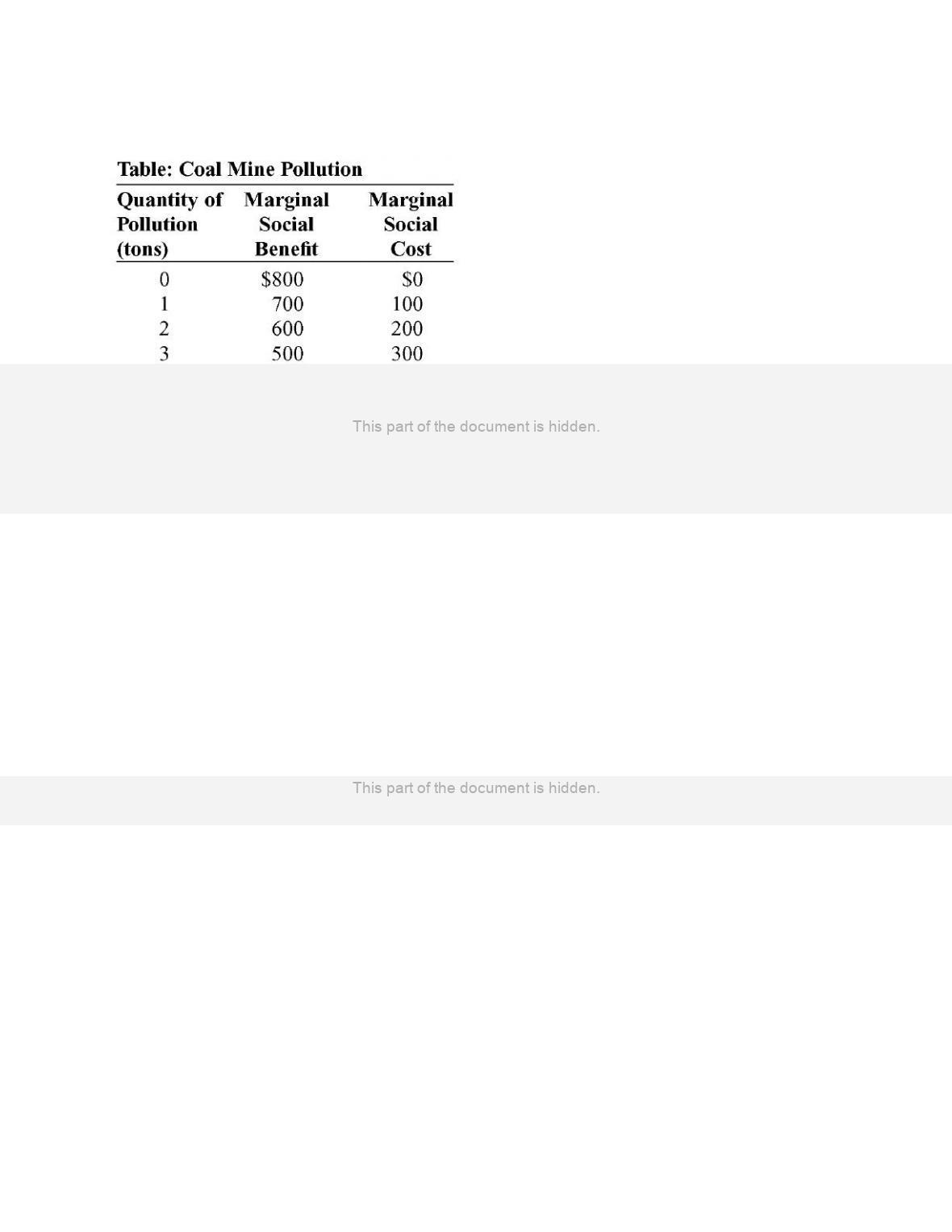
(Table: Coal Mine Pollution) Use Table: Coal Mine Pollution. The table shows the
marginal social benefit and cost of various amounts of pollution from a coal mine. The
efficient quantity of pollution is _____ tons.
A)
0
B)
2
C)
4
D)
8
60.
(Table: Coal Mine Pollution) Use Table: Coal Mine Pollution. The table shows the
marginal social benefit and cost of various amounts of pollution from a coal mine. At
the efficient quantity of pollution, the marginal social cost of pollution is _____ the
marginal social benefit of pollution.
A)
greater than
B)
equal to
C)
less than
D)
unrelated to

Page 14
61.
(Table: Coal Mine Pollution) Use Table: Coal Mine Pollution. The table shows the
marginal social benefit and cost of various amounts of pollution from a coal mine. At
the efficient quantity of pollution, the marginal social cost of pollution is:
A)
$0.
B)
$100.
C)
$200.
D)
$400.
62.
(Table: Coal Mine Pollution) Use Table: Coal Mine Pollution. The table shows the
marginal social benefit and cost of various amounts of pollution from a coal mine. At
the efficient quantity of pollution, the marginal social benefit of pollution is:
A)
$400.
B)
$300.
C)
$200.
D)
$100.
63.
(Table: Coal Mine Pollution) Use Table: Coal Mine Pollution. The table shows the
marginal social benefit and cost of various amounts of pollution from a coal mine.
Suppose that the marginal cost from the production process itself (to the producer) is 0.
The market-determined quantity of pollution is _____ tons.
A)
0
B)
2
C)
4
D)
8
64.
(Table: Coal Mine Pollution) Use Table: Coal Mine Pollution. The table shows the
marginal social benefit and cost of various amounts of pollution from a coal mine.
Suppose that the marginal cost from the production process itself (to the producer) is 0.
At the market-determined quantity of pollution, the marginal social benefit of pollution
is:
A)
$800.
B)
$400.
C)
$200.
D)
$0.
Page 15
65.
(Table: Coal Mine Pollution) Use Table: Coal Mine Pollution. The table shows the
marginal social benefit and cost of various amounts of pollution from a coal mine.
Suppose that the marginal cost from the production process itself (to the producer) is 0.
At the market-determined quantity of pollution, the marginal social cost of pollution is:
A)
$800.
B)
$400.
C)
$200.
D)
$0.
66.
(Table: Coal Mine Pollution) Use Table: Coal Mine Pollution. The table shows the
marginal social benefit and cost of various amounts of pollution from a coal mine. If 5
tons of pollution is produced, the marginal social benefit is _____, and the marginal
social cost is _____.
A)
$0; $800
B)
$300; $500
C)
$400; $400
D)
$800; $0
67.
(Table: Coal Mine Pollution) Use Table: Coal Mine Pollution. The table shows the
marginal social benefit and cost of various amounts of pollution from a coal mine. If 5
tons of pollution is produced, the outcome is _____ because _____.
A)
efficient; MSB = MSC
B)
efficient; MSB > MSC
C)
inefficient; MSB > MSC
D)
inefficient; MSB < MSC
68.
(Table: Coal Mine Pollution) Use Table: Coal Mine Pollution. The table shows the
marginal social benefit and cost of various amounts of pollution from a coal mine. If 5
tons of pollution is produced:
A)
too much pollution is produced.
B)
the efficient amount of pollution is produced.
C)
not enough pollution is produced.
D)
the socially optimum amount of pollution is produced.
Page 16
69.
(Table: Coal Mine Pollution) Use Table: Coal Mine Pollution. The table shows the
marginal social benefit and cost of various amounts of pollution from a coal mine. If 2
tons of pollution is produced, the marginal social benefit is _____, and the marginal
social cost is _____.
A)
$600; $200
B)
$500; $300
C)
$400; $400
D)
$800; $0
70.
(Table: Coal Mine Pollution) Use Table: Coal Mine Pollution. The table shows the
marginal social benefit and cost of various amounts of pollution from a coal mine. If 2
tons of pollution is produced, the outcome is _____ because _____.
A)
efficient; MSB = MSC
B)
efficient; MSB > MSC
C)
inefficient; MSB > MSC
D)
inefficient; MSB < MSC
71.
(Table: Coal Mine Pollution) Use Table: Coal Mine Pollution. The table shows the
marginal social benefit and cost of various amounts of pollution from a coal mine. From
the perspective of efficiency, 2 tons of pollution is:
A)
too much.
B)
the efficient amount.
C)
not enough.
D)
the socially optimum amount.
72.
According to many economists, the government should:
A)
reduce the level of carbon emissions as far as possible.
B)
use policies to achieve the optimal level of carbon-emissions reduction in the least
costly way.
C)
set policy to achieve the efficient level of pollution by reducing the costs of
pollution, which will always increase the benefits to society.
D)
reduce carbon emissions whenever the marginal cost exceeds a predetermined level
set by the courts.
73.
The principal government agency in the United States responsible for enforcing national
environmental policies is the:
A)
Department of Agriculture.
B)
Department of the Interior.
C)
Environmental Protection Agency.
D)
Department of Justice.
Page 17
74.
Which factor is an environmental standard?
A)
tradable pollution permits
B)
taxes on the level of pollution
C)
legal limits on sulfur dioxide emissions
D)
production subsidies
75.
Laws that require vehicles to have catalytic converters or that restrict or prohibit leaf
burning are:
A)
Pigouvian taxes.
B)
internalization of externalities.
C)
transaction costs.
D)
environmental standards.
76.
Many economists believe that there are more efficient ways to deal with pollution than
with environmental standards because these standards do NOT:
A)
reduce pollution enough.
B)
allow reductions in pollution to be achieved at minimum cost.
C)
specify the behavior that needs to be changed.
D)
target behaviors in a way that can be enforced.
77.
When the government attempts to reduce the noise from airplanes by restricting the
noise level from a jet engine to less than 50 decibels, it is using a(n):
A)
environmental standard.
B)
emissions tax.
C)
Pigouvian tax.
D)
tradable emissions permit.
78.
When the government attempts to reduce climate change by establishing a minimum
level of fuel efficiency on new cars, it is using a(n):
A)
environmental standard.
B)
emissions tax.
C)
Pigouvian tax.
D)
tradable emissions permit.
79.
Your community requires the sewage-treatment plant to process raw sewage so that it is
safe to return the water to the environment. This example illustrates:
A)
an emissions tax.
B)
the Coase theorem.
C)
a tradable emissions permit.
D)
an environmental standard.
Page 18
80.
Automobile emissions generate pollution, have health costs for pedestrians, and cause
discomfort to residents of a city. In this case:
A)
too little of society’s resources are being used to operate automobiles.
B)
the externality can be internalized by imposing a specific tax on drivers.
C)
there is an external benefit to society from operating automobiles.
D)
the externality can be internalized by granting a specific subsidy to drivers.
81.
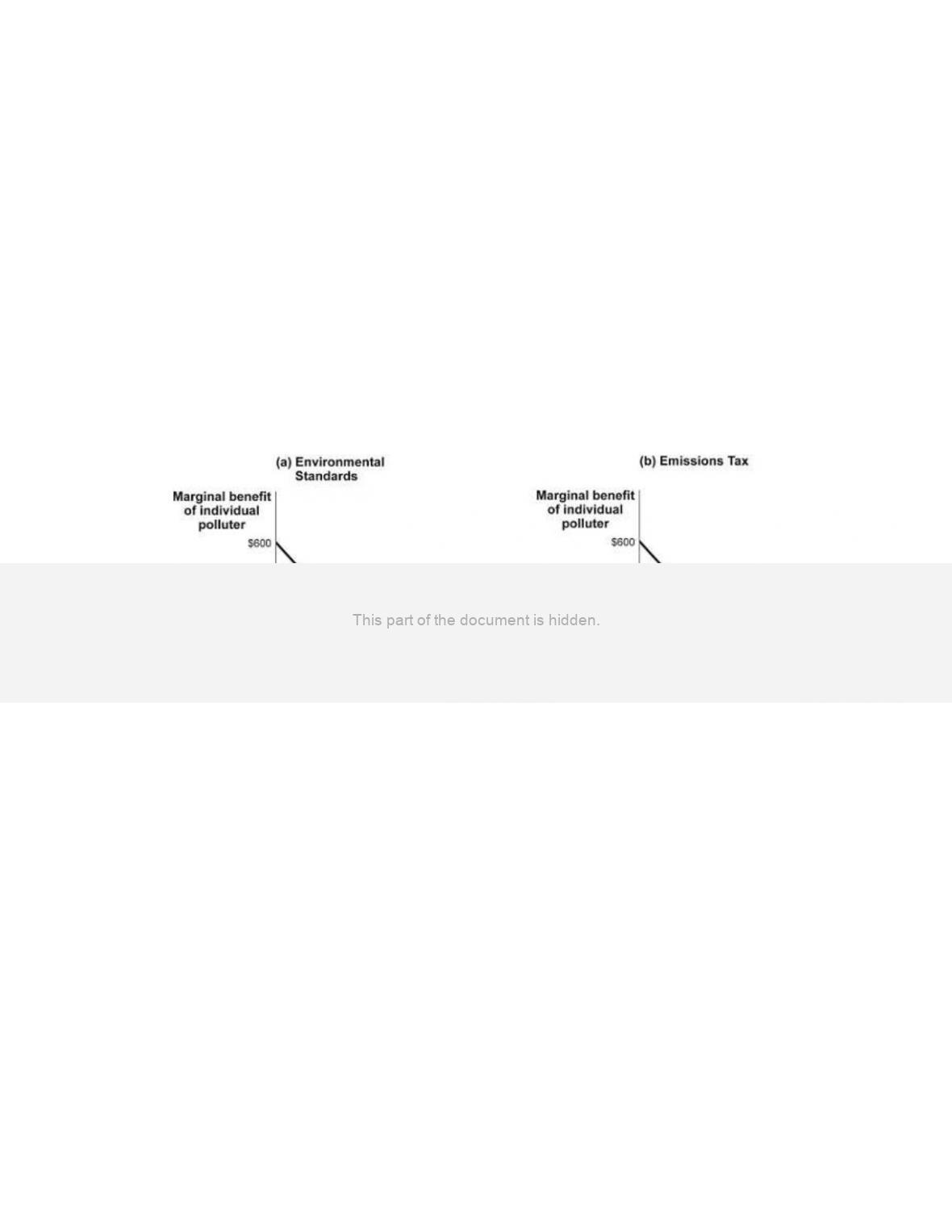
(Figure: Environmental Standards versus Emissions Taxes) Use Figure: Environmental
Standards versus Emissions Taxes. In the figure, if the goal is to limit the total
emissions of the two firms, A and B, to 600 tons, the MOST efficient solution is an
_____, and total pollution would be _____ tons.
Figure: Environmental Standards versus Emissions Taxes
A)
environmental standard; 300
B)
emissions tax; 600
C)
environmental standard; 600
D)
emissions tax; 200
82.
Suppose that government officials have set an emissions tax to reduce pollution.
Assume that the optimal tax would be $1,500, but government officials have set the tax
at $500. At the equilibrium with the $500 tax:
A)
there will be too much pollution.
B)
the marginal social cost of pollution will be less than $500.
C)
the marginal social benefit of pollution will be less than $500.
D)
the marginal social benefit of pollution will be more than $500.

Page 19
83.
Suppose that government officials have set an emissions tax to reduce pollution.
Assume that the optimal tax would be $500, but government officials have set the tax at
$900. At the equilibrium with the $900 tax:
A)
there will be too much pollution.
B)
the marginal social cost of pollution will be less than $900.
C)
the marginal social benefit of pollution will be $900.
D)
the marginal social benefit of pollution will be more than $900.
84.
If government officials set an emissions tax too high:
A)
there will be too little pollution.
B)
there will be too much pollution.
C)
the marginal social cost of pollution will exceed the marginal social benefit of
pollution.
D)
pollution will be unabated.
85.
Suppose that government officials have set an emissions tax to reduce pollution. Further
suppose that, with the emissions tax, the marginal social cost of pollution exceeds the
marginal social benefit of pollution. The emissions tax is:
A)
too low.
B)
too high.
C)
optimal.
D)
efficient.
86.
Which statement is CORRECT?
A)
An emissions tax is a more efficient way to reduce pollution than is an
environmental standard because an emissions tax equalizes the marginal benefit of
pollution from all sources.
B)
An environmental standard is a more efficient way to reduce pollution than is an
emissions tax because an environmental standard can be structured to equalize the
reduction in pollution from all sources.
C)
If an emissions tax and environmental standards lead to the same total reduction in
pollution, then they will also lead to the same reduction in pollution by individual
polluters.
D)
It is easy to set emissions taxes at the “correct” level since the relationship between
emissions taxes and the reduction in emissions that they induce has been
extensively studied and is well known.
Page 20
87.
Suppose an emissions tax is imposed on all dairy farms in Wisconsin. This tax would:
A)
encourage the dairy farmers to lower prices.
B)
increase the level of emissions.
C)
reduce the supply of milk in Wisconsin.
D)
increase the supply of milk in Wisconsin.
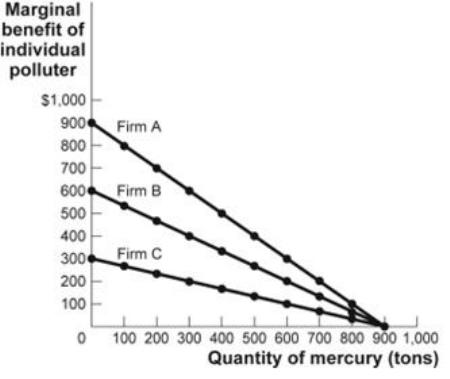
Use the following to answer questions 88-90:
Figure: Three Firms That Pollute
88.
(Figure: Three Firms that Pollute) Use Figure: Three Firms That Pollute. If each
company is allowed to emit only 300 tons of pollution per day, which company will be
MOST adversely affected?
A)
firm A
B)
firm B
C)
firm C
D)
They are equally affected.
89.
(Figure: Three Firms that Pollute) Use Figure: Three Firms That Pollute. If the city
imposes a tax of $400 per ton of pollution, firm B will produce _____ tons of mercury,
and firm A will produce _____ tons of mercury than will firm C.
A)
600; 200 fewer
B)
700; 200 fewer
C)
300; 500 more
D)
300; 200 fewer