Page 21
79.
(Table: Demand for Crude Oil) Use Table: Demand for Crude Oil. Assume that the
crude oil industry is a duopoly and the marginal cost and fixed cost of producing crude
oil equals zero. Suppose that the two firms are maximizing industry profit and splitting
the profit evenly. If firm 1 decides to cheat and increase production by 10 more barrels
and firm 2 continues to produce 40 barrels, firm 2 will earn profits of:
A)
$6,400.
B)
$6,300.
C)
$3,500.
D)
$2,800.
80.
(Table: Demand for Crude Oil) Use Table: Demand for Crude Oil. Assume that the
crude oil industry is a duopoly and the marginal cost and fixed cost of producing crude
oil equal zero. Suppose that the two firms are maximizing industry profit and splitting
the profit evenly. If both firms decide to cheat and produce 10 more barrels each,
industry output will be _____ barrels.
A)
100
B)
120
C)
110
D)
160
81.
(Table: Demand for Crude Oil) Use Table: Demand for Crude Oil. Assume that the
crude oil industry is a duopoly and the marginal cost and fixed cost of producing crude
oil equal zero. Suppose that the two firms are maximizing industry profit and splitting
the profit evenly. If both firms decide to cheat and produce 10 more barrels each, the
price of crude oil will be:
A)
$160.
B)
$80.
C)
$70.
D)
$60.
82.
(Table: Demand for Crude Oil) Use Table: Demand for Crude Oil. Assume that the
crude oil industry is a duopoly and the marginal and fixed cost of producing crude oil
equals zero. Suppose that the two firms are maximizing industry profit and splitting the
profit evenly. If both firms decide to cheat and produce 10 more barrels each, firm 1’s
profit will be _____, and firm 2’s profit will be _____.
A)
$3,200; $3,200
B)
$3,200; $3,000
C)
$3,000; $3,200
D)
$3,000; $3,000

Page 22
83.
(Table: Demand for Crude Oil) Use Table: Demand for Crude Oil. Assume that the
crude oil industry is a duopoly and the marginal and fixed costs of producing crude oil
equal zero. Suppose that the two firms are maximizing industry profit and splitting the
profit evenly. If both firms engage in noncooperative behavior, the industry output will
be _____ barrels, and the price of crude oil will be _____.
A)
0; $160
B)
80; $80
C)
100; $60
D)
160; $0
84.
Game theory is commonly used to explain behavior in oligopolies because oligopolies
are characterized by:
A)
large profits in the long run.
B)
either homogeneous or heterogeneous products.
C)
interdependence.
D)
imperfect competition.
85.
An analytical approach through which strategic choices can be assessed is called:
A)
cost-benefit analysis.
B)
econometric theory.
C)
game theory.
D)
monopolistic competition.
86.
One framework used to analyze strategic choices is:
A)
the tacit supply curve model.
B)
game theory.
C)
perfect competition.
D)
risk assessment.
87.
The study of behavior in situations of interdependence is known as:
A)
dominant strategies.
B)
game theory.
C)
the Nash equilibrium.
D)
tacit collusion.
Page 23
88.
In the classic prisoners’ dilemma with two accomplices in crime, the dominant strategy
for each individual is to:
A)
not confess.
B)
confess.
C)
confess only if the other confesses.
D)
This game does not have a dominant strategy.
89.
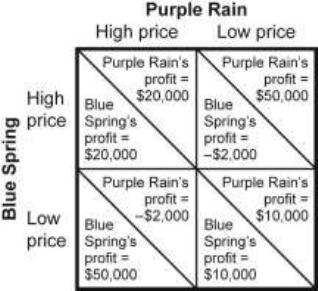
In the classic prisoners’ dilemma with two accomplices in crime, the Nash equilibrium is
for:
A)
neither to confess.
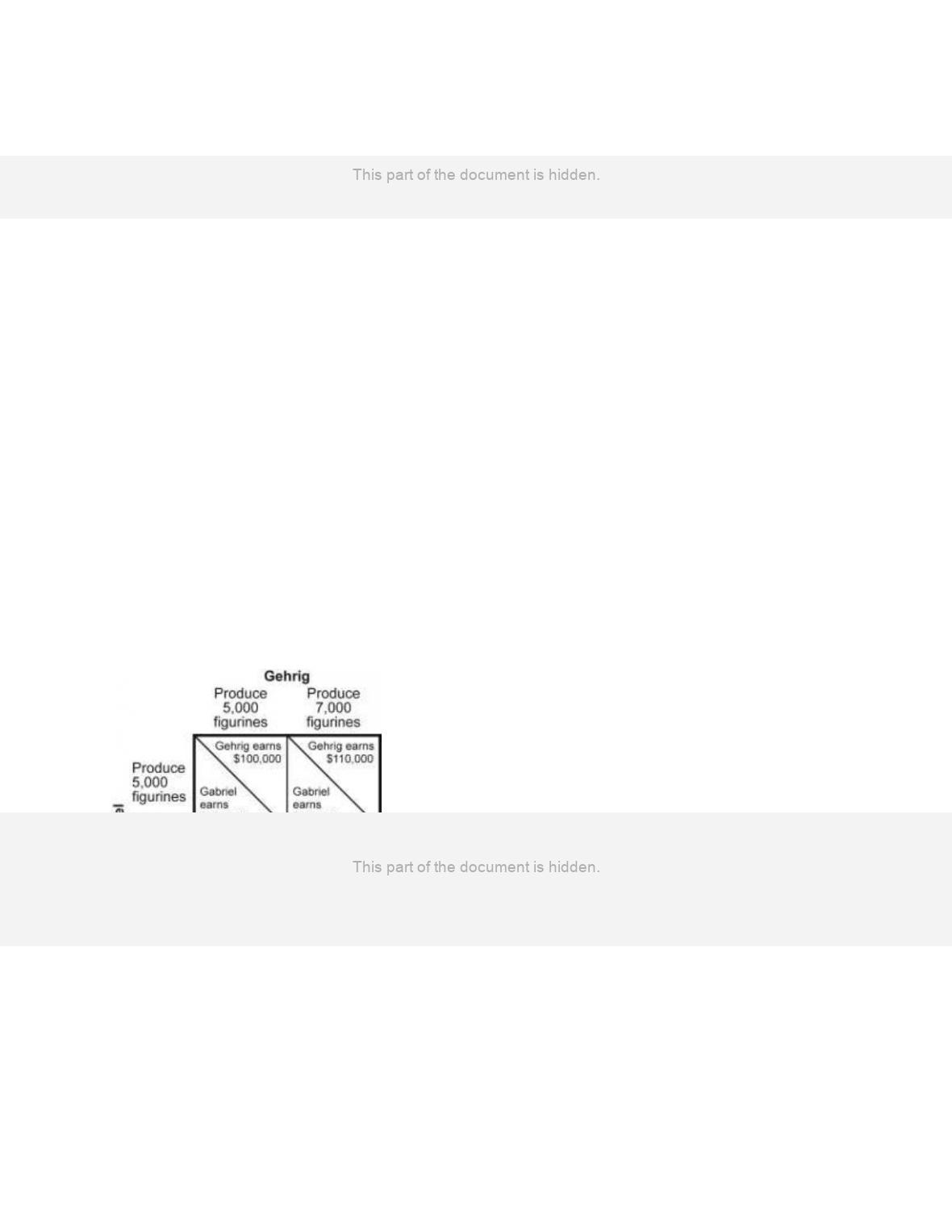
B)
both to confess.
C)
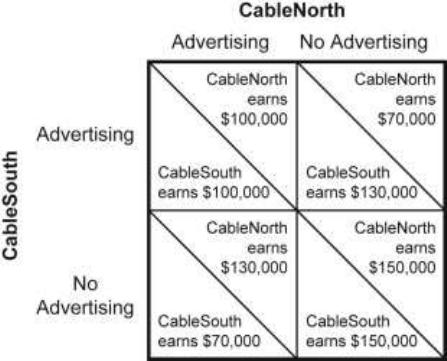
one to confess and the other not to confess.
D)
This game does not have a Nash equilibrium.
90.
Gary’s Gas and Frank’s Fuel are the only two providers of gasoline in their town. Gary
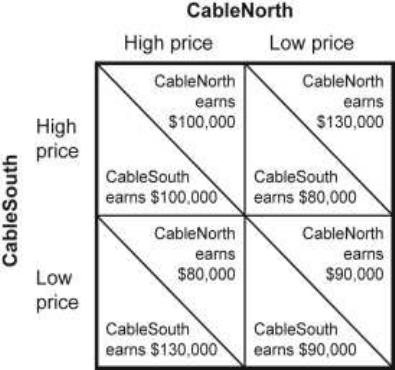
and Frank decide to form a cartel. Later, Gary summarizes his pricing strategy as, “I’ll
cheat on the cartel because, regardless of what Frank does, cheating gives me the best
payoff.” This is an example of:
A)
a dominant strategy.
B)
a tit-for-tat strategy.
C)
an irrational strategy.
D)
product differentiation.
91.
An action is a dominant strategy when it is a player’s best action:
A)
regardless of the actions by other players.
B)
given certain profit-maximizing actions of other players.
C)
assuming the other players do not correctly anticipate the action.
D)
if there is only one other competitor.
Page 24
92.
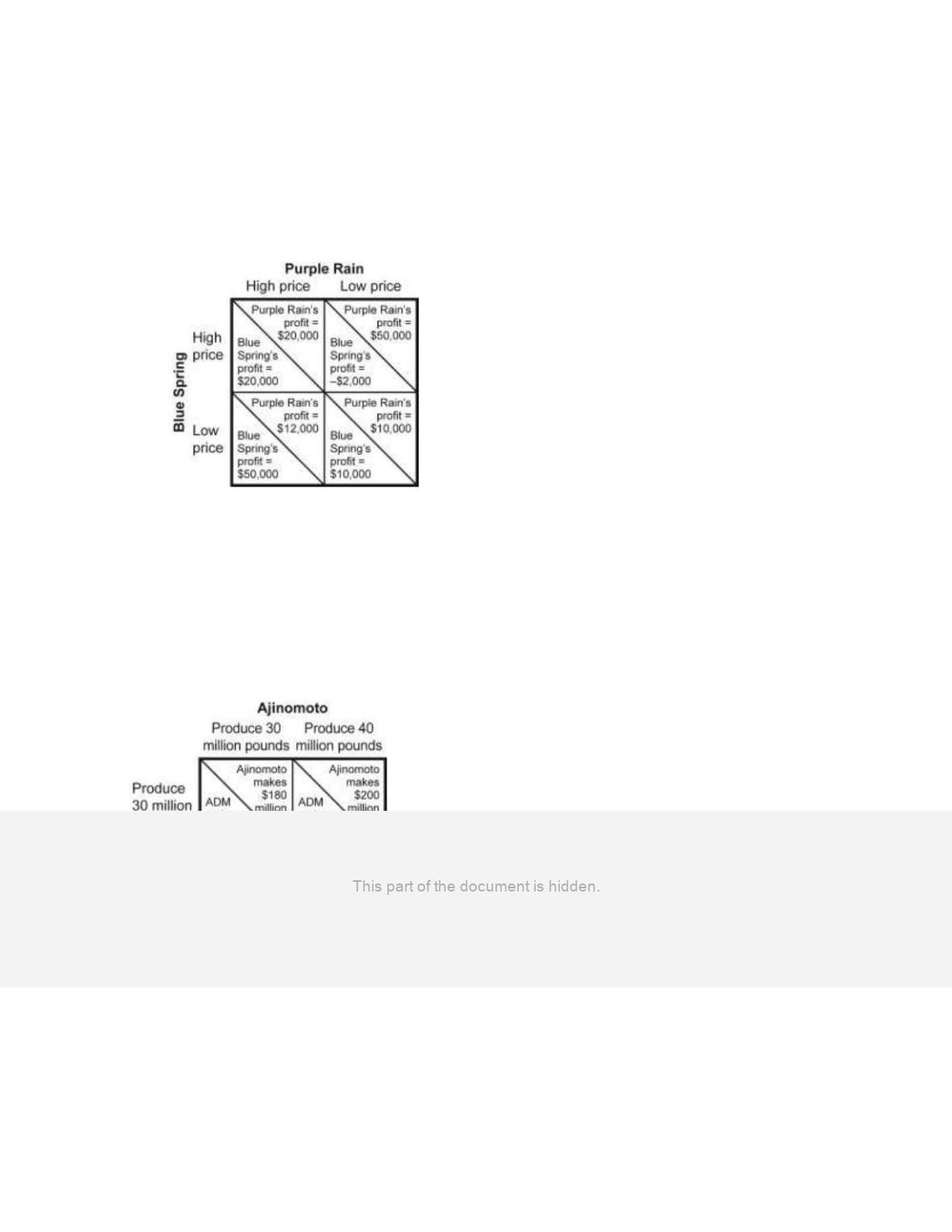
(Figure: Payoff Matrix I for Blue Spring and Purple Rain) Use Figure: Payoff Matrix I
for Blue Spring and Purple Rain. The figure refers to two producers of bottled water.
Each has two strategies available to it: a high price and a low price. The dominant
strategy for Purple Rain is to:
Figure: Payoff Matrix I for Blue Spring and Purple Rain
A)
charge a low price.
B)
charge a high price.
C)
adopt the same strategy as Blue Spring.
D)
Purple Rain does not have a dominant strategy.
Use the following to answer questions 93-94:
Figure: Payoff Matrix for Ajinomoto and ADM
Page 25
93.
(Figure: Payoff Matrix for Ajinomoto and ADM) Use Figure: Payoff Matrix for
Ajinomoto and ADM. The optimal combination for maximum combined profit occurs
when ADM produces _____ million pounds and Ajinomoto produces _____ million
pounds.
A)
30; 30
B)
40; 40
C)
30; 40
D)
40; 30
94.
(Figure: Payoff Matrix for Ajinomoto and ADM) Use Figure: Payoff Matrix for
Ajinomoto and ADM. The Nash equilibrium combination occurs when ADM produces
_____ million pounds and Ajinomoto produces _____ million pounds.
A)
30; 30
B)
40; 40
C)
30; 40
D)
40; 30
Use the following to answer questions 95-96:
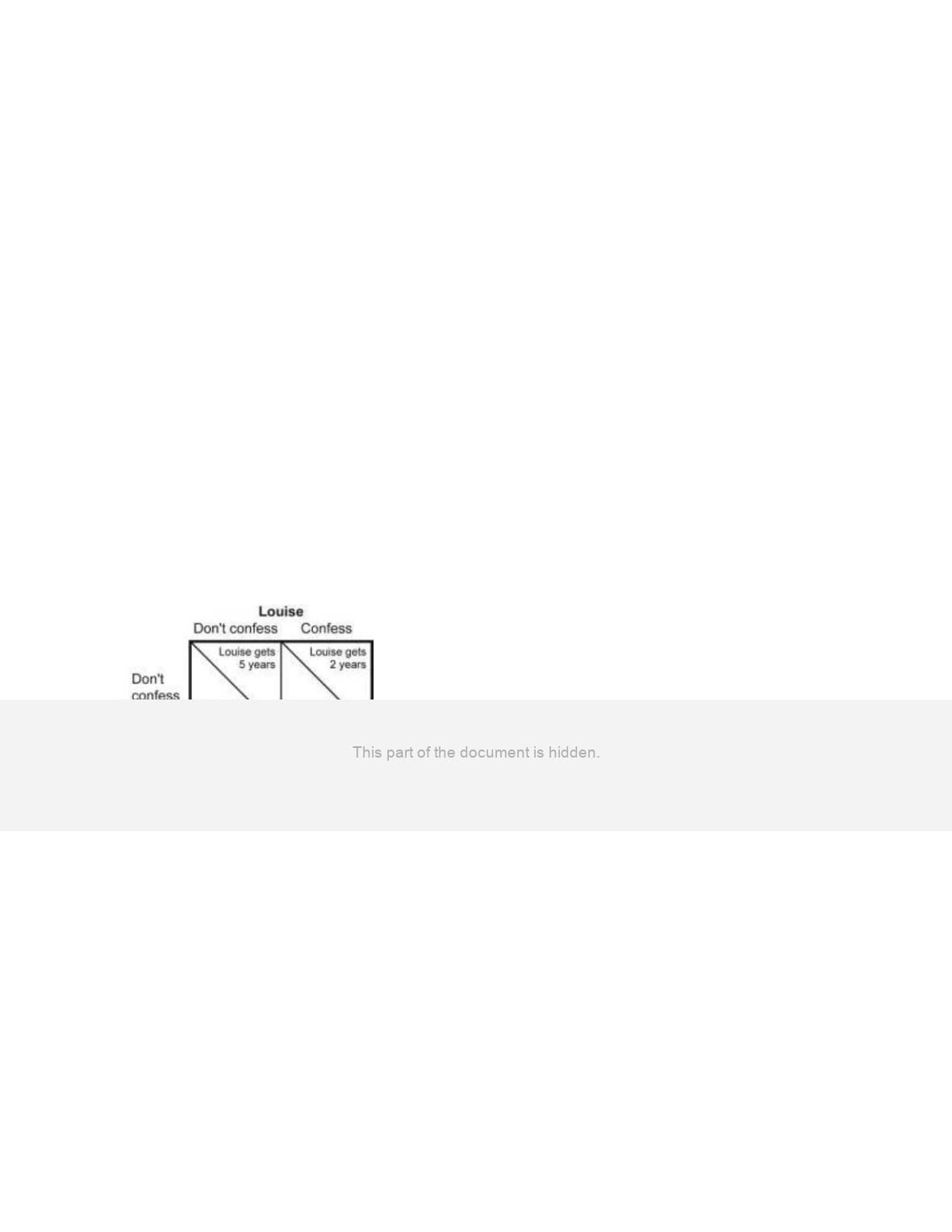
Figure: Prisoners’ Dilemma for Thelma and Louise
95.
(Figure: Prisoners’ Dilemma for Thelma and Louise) Use Figure: Prisoners’ Dilemma
for Thelma and Louise. Thelma and Louise are arrested and jailed for murder. Given the
payoff matrix in the figure, the optimal behavior for Thelma and Louise to minimize
their joint sentence is for Thelma _____ and for Louise ____.
A)
to confess; not to confess.
B)
to confess; to confess.
C)
not to confess; to confess
D)
not to confess; not to confess
Page 26
96.
(Figure: Prisoners’ Dilemma for Thelma and Louise) Use Figure: Prisoners’ Dilemma
for Thelma and Louise. Thelma and Louise are arrested and jailed for murder. Given the
payoff matrix in the figure, the Nash equilibrium behavior is for Thelma _____ and
Louise _____.
A)
to confess; not to confess
B)
to confess; to confess
C)
not to confess; to confess
D)
not to confess; not to confess
Use the following to answer questions 97-98:
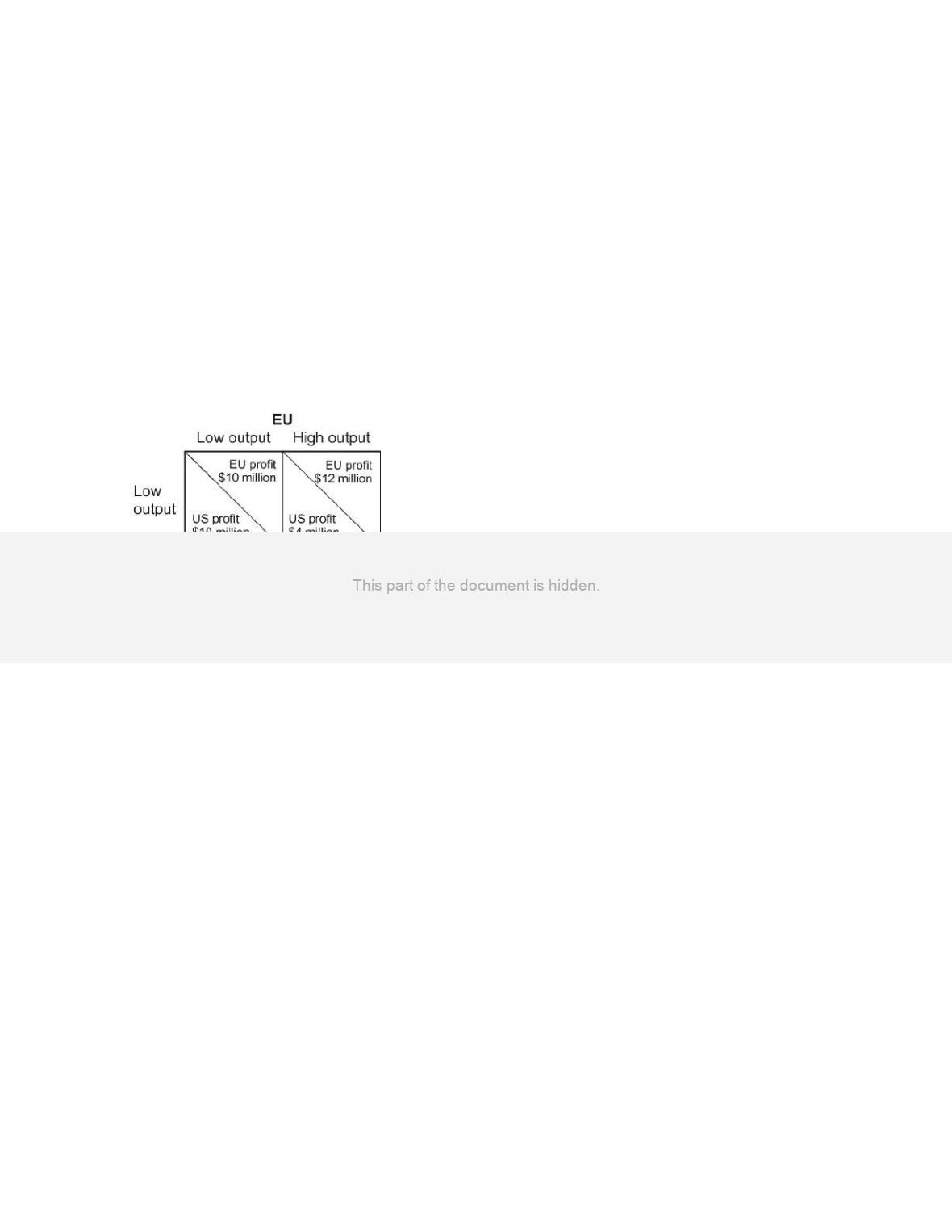
Figure: Payoff Matrix for the United States and the European Union
97.
(Figure: Payoff Matrix for the United States and the European Union) Use Figure:
Payoff Matrix for the United States and the European Union. Suppose that the United
States and the European Union both produce corn, and each region can make more
profit if output is limited and the price of corn is high. The joint profit-maximizing
combination is for the United States to produce a _____ output and the European Union
to produce a _____ output.
A)
high; high
B)
high; low
C)
low; low
D)
low; high
98.
(Figure: Payoff Matrix for the United States and the European Union) Use Figure:
Payoff Matrix for the United States and the European Union. Suppose that the United
States and the European Union both produce corn, and each region can make more
profit if output is limited and the price of corn is high. The Nash equilibrium
combination is for the United States to produce a _____ output and the European Union
to produce a _____ output.
A)
high; high
B)
high; low
C)
low; low
D)
low; high
99.
The outcome of a strategic choice is called a:
A)
payoff.
B)
game.
C)
product.
D)
dilemma.
100.
Suppose that each of two prisoners has the independent choice of confessing to a crime
or not confessing to a crime they were both alleged to commit. If neither confesses, both
spend two years in prison; if both confess, both spend three years in prison. If one
confesses and the other does not, the confessor gets off with one year but the other gets
six years. According to game theory, the MOST likely strategy of the prisoners is that:
A)
both will confess.
B)
neither will confess.
C)
one will confess and the other will not.
D)
both may or may not confess.
101.
Suppose that each of the two firms in a duopoly has the independent choice of
advertising or not advertising. If neither advertises, each gets $10 million in profit; if
both advertise, their profits will be $5 million each; and if one advertises while the other
does not, the advertiser gets profit of $15 million and the other gets profit of $2 million.
According to game theory, the Nash equilibrium is that:
A)
both may or may not advertise.
B)
one will advertise and the other will not.
C)
both will advertise.
D)
neither will advertise.
Page 28
102.
Suppose that each of the two firms in a duopoly has the independent choice of
advertising or not advertising. If neither advertises, each gets $10 million in profit; if
both advertise, their profits will be $5 million each; and if one advertises while the other
does not, the advertiser gets profit of $15 million and the other gets profit of $2 million.
According to game theory, if the firms collude to maximize joint profits:
A)
both may or may not advertise.
B)
one will advertise and the other will not.
C)
both will advertise.
D)
neither will advertise.
103.
A strategy that is the same, regardless of the action of the other player in a game, is a
_____ strategy.
A)
competitive
B)
trigger
C)
dominant
D)
tit-for-tat
104.
A dominant-strategy equilibrium occurs when:
A)
a player has no choice.
B)
all players’ action of choice is always best for them, regardless of the action of the
other players.
C)
each player makes the best choice given the choice of the other player.
D)
no player is able to dictate the actions of any other player.
Use the following to answer questions 105-106:

Page 29
105.
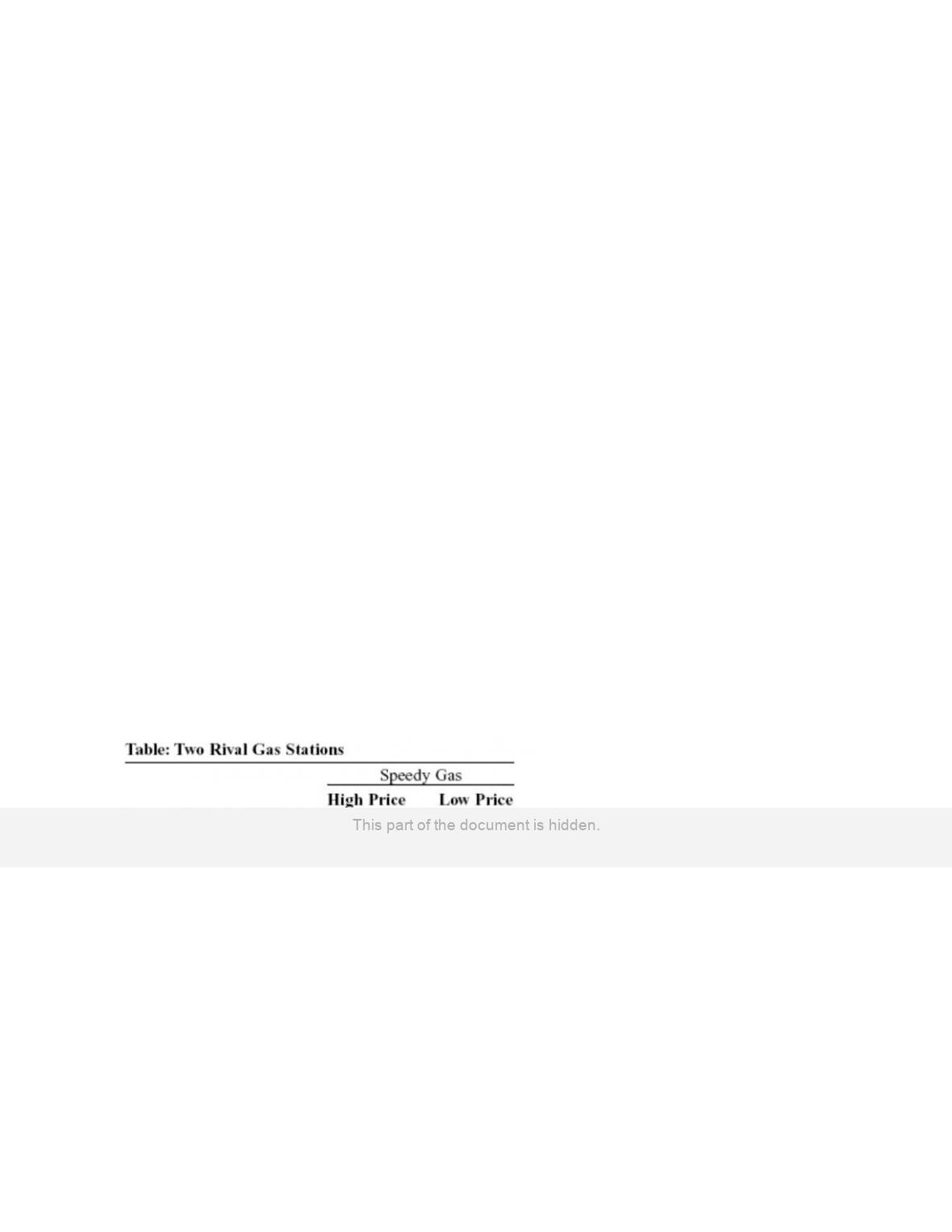
(Table: Two Rival Gas Stations) Use Table: Two Rival Gas Stations. The table shows a
payoff matrix for two gas stations in a small town. Each firm can set either a high price
or a low price, and customers view these two firms as nearly perfect substitutes. Profits
in each cell of the payoff matrix are given as (Swifty’s profit, Speedy’s profit). If each
firm sets the price independently, the Nash equilibrium outcome will be:
A)
$100, $100.
B)
$150, $25.
C)
$25, $150.
D)
$50, $50.
106.
(Table: Two Rival Gas Stations) Use Table: Two Rival Gas Stations. The table shows a
payoff matrix for two gas stations in a small town. Each firm can set either a high price
or a low price, and customers view these two firms as nearly perfect substitutes. Profits
in each cell of the payoff matrix are given as (Swifty’s profit, Speedy’s profit). Which
statement describes a dominant strategy?
A)
Swifty will always set a low price, no matter Speedy’s choice.
B)
Swifty will always set a high price, no matter Speedy’s choice.
C)
Swifty will set a low price when Speedy sets a high price, but Swifty will set a high
price when Speedy sets a low price.
D)
Swifty will set a high price when Speedy sets a high price, but Swifty will set a low
price when Speedy sets a low price.
107.
In game theory, when a player has an action that is always best for that player,
regardless of the action taken by the other player(s) in a game, we say this player has a
_____ strategy.
A)
competitive
B)
trigger
C)
dominant
D)
tit-for-tat
108.
A dominant-strategy equilibrium exists in a game when:
A)
no player has a choice.
B)
every player has a clear best action that does not depend on the action of the other
players.
C)
each player’s choices are dependent on the actions of other players.
D)
no player is able to dictate or predict the actions of any other player.
Page 30
109.
Gary’s Gas and Frank’s Fuel are the only two providers of gasoline in their small town.
Gary summarizes his pricing strategy as, “I’ll do to Frank (price-wise) what Frank did to
me last time.” This is an example of:
A)
a dominant strategy.
B)
a tit-for-tat strategy.
C)
an irrational strategy.
D)
product differentiation.
110.
If rival solar roof panel manufacturers in Reno limit production and _____ prices in a
way that increases their profits without meeting with one another in a formal way, they
are engaging in _____ collusion.
A)
lower; tacit
B)
raise; tacit
C)
lower; explicit
D)
raise; explicit
111.
Tacit collusion is difficult to achieve in practice:
A)
the larger the number of firms in the industry.
B)
the fewer the number of products being sold.
C)
the more similar the marginal costs of each firm.
D)
if customers have little or no bargaining power.
112.
When a firm responds to a rival’s cheating by cheating and to a rival’s cooperation by
cooperating, that firm is practicing a _____ strategy.
A)
dominant
B)
trigger
C)
conclusive
D)
tit-for-tat
113.
Unwritten or unspoken understandings through which firms restrict competition are
called:
A)
cartel agreements.
B)
oligopoly agreements.
C)
overt collusion.
D)
tacit collusion.
Page 31
114.
Which statement is TRUE?
A)
Once an industry has achieved tacit collusion, producers have an incentive to raise
prices.
B)
Tacit collusion is legal in the United States.
C)
The fact that one firm changes its price shortly after another firm does is proof of
tacit collusion.
D)
It is difficult to determine how much tacit collusion exists in a particular industry;
hence, tacit collusion remains hard to prosecute in the United States.
115.
An unwritten, unspoken agreement through which firms limit competition among
themselves is called:
A)
satisfying.
B)
tacit collusion.
C)
overt collusion.
D)
a cartel.
116.
When firms in a particular industry informally agree to charge the same price as the
largest firm in that industry, it is called:
A)
satisfying.
B)
price extortion.
C)
overt collusion.
D)
tacit collusion.
117.
Which statement is NOT true about OPEC?
A)
OPEC is the Organization of Petroleum Exporting Countries.
B)
OPEC is an international cartel made up of oil-producing countries.
C)
OPEC is the cartel that was responsible for the large increases in crude oil prices in
the 1970s.
D)
OPEC operates in a perfectly competitive market.
118.
A well-known example of an international cartel is:
A)
Japan.
B)
OPEC.
C)
Exxon.
D)
General Motors.
Page 32
119.
Tacit collusion in an industry is limited by:
A)
a small number of firms.
B)
simple products and pricing.
C)
monopoly power.
D)
a large number of firms and the bargaining power of buyers.
120.
Which statement does NOT describe OPEC?
A)
OPEC is the Organization of Petroleum Exporting Countries.
B)
OPEC is an international cartel made up of 12 oil-producing countries and two
unofficial members.
C)
OPEC is the cartel that was responsible for the large increases in crude oil prices in
the 1970s.
D)
OPEC is the name of the free-trade zone encompassing the Middle East and other
oil-producing nations.
121.
OPEC is a(n) _____ cartel that includes _____ national governments.
A)
illegal; 12
B)
legal; 12
C)
illegal; 11
D)
legal; 8
122.
_____ is the unwritten or unspoken agreement through which firms limit _____.
A)
A satisfying agreement; price increases
B)
Tacit collusion; competition among themselves
C)
Overt collusion; competition among rivals
D)
A cartel; price changes
123.
Which type of strategy is intended to influence the future actions of other players?
A)
dormant
B)
trigger
C)
conclusive
D)
tit-for-tat
Page 33
Use the following to answer questions 124-125:
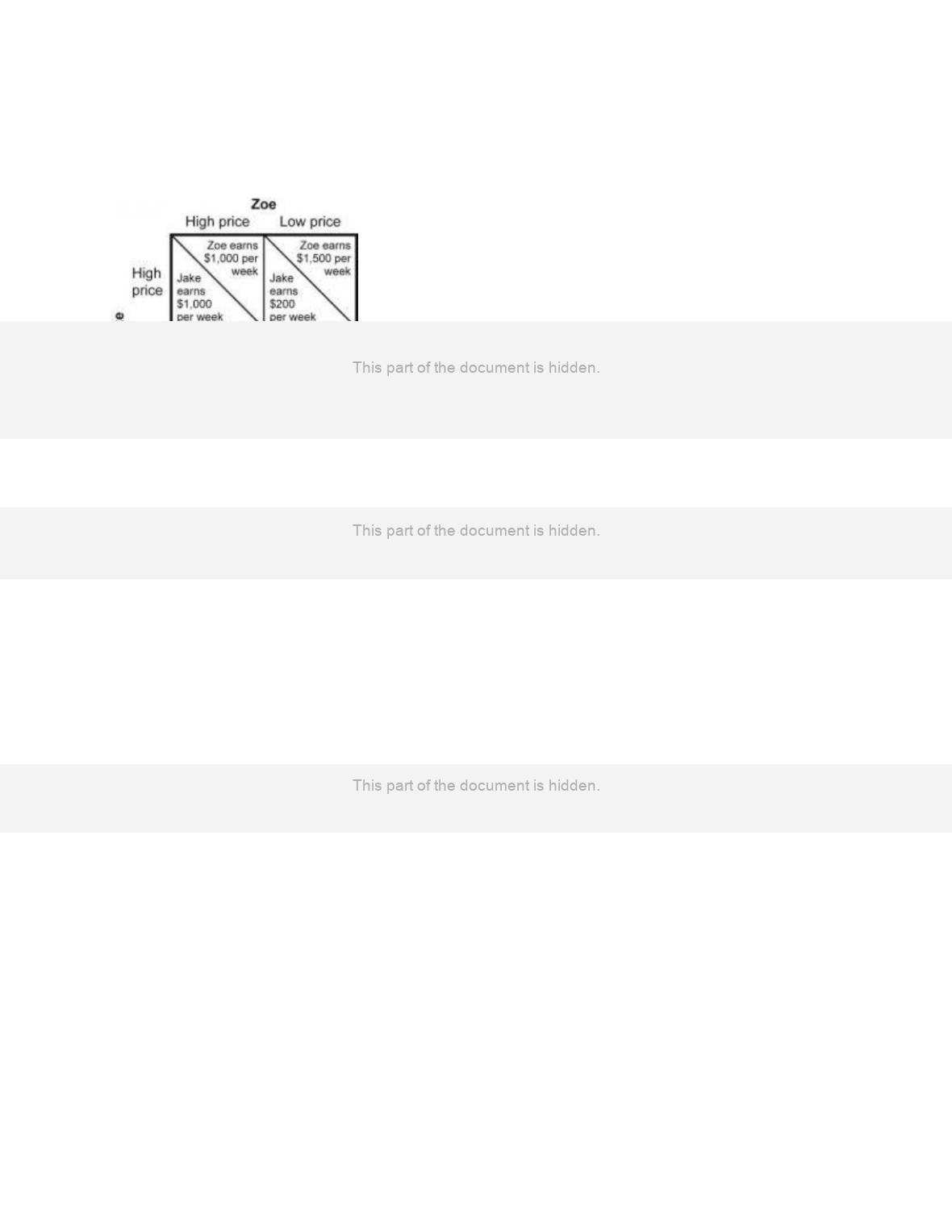
Figure: Payoff Matrix for Jake and Zoe
124.
(Figure: Payoff Matrix for Jake and Zoe) Use Figure: Payoff Matrix for Jake and Zoe.
Jake and Zoe are the only producers of slushies in their tourist town. Every week, each
decides whether to price high or price low for the following week. The figure shows the
profit per week earned by their two firms. According to the Nash equilibrium, Jake
prices _____ and Zoe prices _____.
A)
high; high
B)
high; low
C)
low; high
D)
low; low
125.
(Figure: Payoff Matrix for Jake and Zoe) Use Figure: Payoff Matrix for Jake and Zoe.
Jake and Zoe are the only producers of slushies in their tourist town. Every week, each
decides whether to price high or price low for the following week. The figure shows the
profit per week earned by their two firms. Suppose the firms each decide to price high
initially and adopt a tit-for-tat strategy for the following weeks. After a few weeks,
Jake’s weekly profit would be _____ and Zoe’s weekly profit would be _____.
A)
$800; $800
B)
$1,000; $1,000
C)
$1,500; $200
D)
$200; $1,500
Page 34
Use the following to answer questions 126-129:
Figure: Payoff Matrix II for Blue Spring and Purple Rain
126.
(Figure: Payoff Matrix II for Blue Spring and Purple Rain) Use Figure: Payoff Matrix II
for Blue Spring and Purple Rain. The figure describes two producers of bottled water.
The Nash equilibrium in the figure is reached when Blue Spring charges a _____ price
and Purple Rain charges a _____ price.
A)
high; high
B)
low; low
C)
high; low
D)
low; high
127.
(Figure: Payoff Matrix II for Blue Spring and Purple Rain) Use Figure: Payoff Matrix II
for Blue Spring and Purple Rain. The figure describes two producers of bottled water.
Each has two strategies available to it: a high price and a low price. The dominant
strategy for Purple Rain is to:
A)
charge a low price.
B)
charge a high price.
C)
adopt the same strategy as Blue Spring.
D)
Purple Rain does not have a dominant strategy.
Page 35
128.
(Figure: Payoff Matrix II for Blue Spring and Purple Rain) Use Figure: Payoff Matrix II
for Blue Spring and Purple Rain. The figure describes two producers of bottled water.
Suppose Blue Spring charges a high price and Purple Rain does the same. In the next
period, Blue Spring charges a low price and Purple Rain incurs a loss. If Purple Rain
responds with a tit-for-tat strategy, it will:
A)
always charge a low price—the same as its dominant strategy.
B)
make random changes in its price so that Blue Spring is left with no systematic
strategy.
C)
charge a low price in the next period and thereafter charge the same price that Blue
Spring charged in the previous period.
D)
always charge a high price.
129.
(Figure: Payoff Matrix II for Blue Spring and Purple Rain) Use Figure: Payoff Matrix II
for Blue Spring and Purple Rain. The figure describes two producers of bottled water. If
both firms follow a tit-for-tat strategy, then:
A)
both firms will charge a high price.
B)
both firms will charge a low price.
C)
Blue Spring will charge a high price, and Purple Rain will charge a low price.
D)
Purple Rain will charge a high price, and Blue Spring will charge a low price.
Use the following to answer questions 130-132:
Figure: Payoff Matrix for Gehrig and Gabriel

Page 36
130.
(Figure: Payoff Matrix for Gehrig and Gabriel) Use Figure: Payoff Matrix for Gehrig
and Gabriel. The figure describes two people who sell handmade Davy Crockett
figurines in San Antonio. Both Gehrig and Gabriel have two strategies available to
them: to produce 5,000 figurines each month or to produce 7,000 figurines each month.
The combined profits of the two are maximized if Gehrig produces _____ figurines and
Gabriel produces _____ figurines.
A)
5,000; 5,000
B)
7,000; 7,000
C)
7,000; 5,000
D)
5,000; 7,000
131.
(Figure: Payoff Matrix for Gehrig and Gabriel) Use Figure: Payoff Matrix for Gehrig
and Gabriel. The figure describes two people who sell handmade Davy Crockett
figurines in San Antonio. Both Gehrig and Gabriel have two strategies available to
them: to produce 5,000 figurines each month or to produce 7,000 figurines each month.
For both Gehrig and Gabriel, the dominant strategy is to:
A)
produce 5,000 figurines.
B)
produce 7,000 figurines.
C)
produce between 5,000 and 7,000 figurines.
D)
collude and increase production to more than 14,000 figurines.
132.
(Figure: Payoff Matrix for Gehrig and Gabriel) Use Figure: Payoff Matrix for Gehrig
and Gabriel. The figure describes two people who sell handmade Davy Crockett
figurines in San Antonio. Both Gehrig and Gabriel have two strategies available to
them: to produce 5,000 figurines each month or to produce 7,000 figurines each month.
If both follow a tit-for-tat strategy, equilibrium will be reached when Gehrig produces
_____ figurines and Gabriel produces _____ figurines.
A)
5,000; 5,000
B)
7,000; 7,000
C)
7,000; 5,000
D)
5,000; 7,000
Page 37
Use the following to answer questions 133-137:
Figure: Pricing Strategy in Cable TV Market I
133.
(Figure: Pricing Strategy in Cable TV Market I) Use Figure: Pricing Strategy in Cable
TV Market I. In the figure, the dominant strategy for CableNorth:
A)
is to advertise.
B)
is not to advertise.
C)
is to do whatever CableSouth does.
D)
does not exist.
134.
(Figure: Pricing Strategy in Cable TV Market I) Use Figure: Pricing Strategy in Cable
TV Market I. In the figure, the dominant strategy for CableSouth:
A)
is to advertise.
B)
is not to advertise.
C)
is to do whatever CableNorth does.
D)
does not exist.
135.
(Figure: Pricing Strategy in Cable TV Market I) Use Figure: Pricing Strategy in Cable
TV Market I. If both CableNorth and CableSouth advertise, then without any collusion:
A)
CableNorth will stop advertising to maximize profits.
B)
CableSouth will stop advertising to maximize profits.
C)
there will be no incentive for either CableNorth or CableSouth to stop advertising.
D)
there is an incentive for both CableNorth and CableSouth to stop advertising.
Page 38
136.
(Figure: Pricing Strategy in Cable TV Market I) Use Figure: Pricing Strategy in Cable
TV Market I. If neither CableNorth nor CableSouth advertises, then without any
collusion:
A)
CableNorth will begin advertising to maximize profits.
B)
CableSouth will begin advertising to maximize profits.
C)
there will be no incentive for either CableNorth or CableSouth to begin advertising.
D)
there is an incentive for both CableNorth and CableSouth to begin advertising.
137.
(Figure: Pricing Strategy in Cable TV Market I) Use Figure: Pricing Strategy in Cable
TV Market I. If the two firms in the cable TV market collude:
A)
both firms advertise, and each earns $100,000.
B)
neither firm advertises, and each earns $150,000.
C)
CableNorth advertises and earns $130,000, while CableSouth does not advertise
and earns $70,000.
D)
both firms advertise and each earns $130,000.
Use the following to answer questions 138-144:
Figure: Pricing Strategy in Cable TV Market II
138.
(Figure: Pricing Strategy in Cable TV Market II) Use Figure: Pricing Strategy in Cable
TV Market II. The dominant strategy for CableNorth:
A)
is to charge a high price.
B)
is to charge a low price.
C)
is to charge what CableSouth does.
D)
does not exist.
Page 39
139.
(Figure: Pricing Strategy in Cable TV Market II) Use Figure: Pricing Strategy in Cable
TV Market II. The dominant strategy for CableSouth:
A)
is to charge a high price.
B)
is to charge a low price.
C)
is to charge what CableNorth does.
D)
does not exist.
140.
(Figure: Pricing Strategy in Cable TV Market II) Use Figure: Pricing Strategy in Cable
TV Market II. The Nash equilibrium in the cable TV market occurs when:
A)
both firms set a low price and each earns $90,000.
B)
both firms set a high price and each earns $100,000.
C)
CableNorth sets a high price and earns $80,000, and CableSouth sets a low price
and earns $130,000.
D)
CableNorth sets a low price and earns $130,000, and CableSouth sets a high price
and earns $80,000.
141.
(Figure: Pricing Strategy in Cable TV Market II) Use Figure: Pricing Strategy in Cable
TV Market II. The noncooperative equilibrium in the cable TV market occurs when:
A)
CableNorth sets a high price and earns $80,000, and CableSouth sets a low price
and earns $130,000.
B)
CableNorth sets a low price and earns $130,000, and CableSouth sets a high price
and earns $80,000.
C)
both firms set a low price and each earns $90,000.
D)
both firms set a high price and each earns $100,000.
142.
(Figure: Pricing Strategy in Cable TV Market II) Use Figure: Pricing Strategy in Cable
TV Market II. If the two firms in the cable TV market collude:
A)
CableNorth will set a high price and earn $80,000, and CableSouth will set a low
price and earn $130,000.
B)
CableNorth will set a low price and earn $130,000, and CableSouth will set a high
price and earn $80,000.
C)
both firms will set a low price and each will earn $90,000.
D)
both firms will set a high price and each will earn $100,000.
143.
(Figure: Pricing Strategy in Cable TV Market II) Use Figure: Pricing Strategy in Cable
TV Market II. If CableNorth followed a high-price strategy one period but found that
CableSouth followed a noncooperative low-price strategy, and CableNorth decided to
lower prices for the next month, we would say that CableNorth is following a:
A)
kinked demand model.
B)
dominant strategy.
C)
tit-for-tat strategy.
D)
collusive strategy.
144.
(Figure: Pricing Strategy in Cable TV Market II) Use Figure: Pricing Strategy in Cable
TV Market II. Suppose that, after one month, the cable providers follow a tit-for-tat
strategy. Eventually, they will achieve a tacit collusive equilibrium at which:
A)
both firms set a low price and each earns $90,000.
B)
both firms set a high price and each earns $100,000.
C)
CableNorth sets a high price and earns $80,000, and CableSouth sets a low price
and earns $130,000.
D)
CableNorth sets a low price and earns $130,000, and CableSouth sets a high price
and earns $80,000.
Use the following to answer questions 145-146:
145.
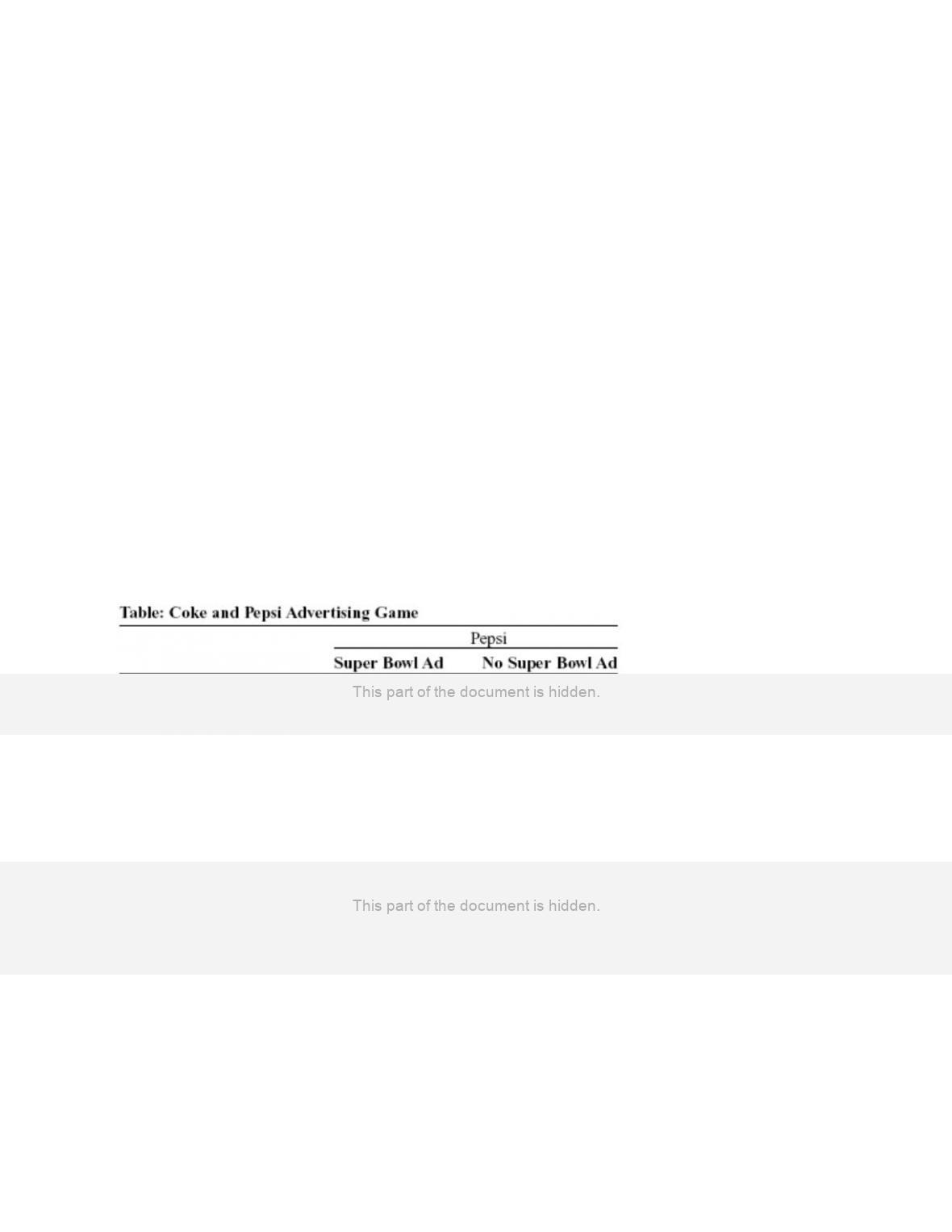
(Table: Coke and Pepsi Advertising Game) Use Table: Coke and Pepsi Advertising
Game. The soft-drink industry is dominated by Coke and Pepsi, and each firm spends a
lot of money on advertising. Suppose each firm is considering a costly television
commercial during halftime of the Super Bowl. The table shows the payoff matrix of
profits that each firm would receive from its advertising decision, given the advertising
decision of their rival. Profits in each cell of the payoff matrix are given as (Coke,
Pepsi). If each firm makes the decision whether to advertise on the Super Bowl
independently, the Nash equilibrium is for Coke _____ and Pepsi _____ during the
Super Bowl.
A)
to advertise; to advertise
B)
not to advertise; not to advertise
C)
not to advertise; to advertise
D)
to advertise; not to advertise