Page 41
176.
Airplane seats are rival in consumption.
A)
True
B)
False
177.
A good is excludable if nonpayers can be prevented from consuming it.
A)
True
B)
False
178.
Goods are said to be rival in consumption because they are substitutes in consumption,
such as coffee and tea or road travel and air travel.
A)
True
B)
False
179.
Any road without a toll can be thought of as a common resource since it is
nonexcludable and rival in consumption.
A)
True
B)
False
180.
In a market economy, goods that are nonexcludable and nonrival will be produced at
inefficiently low levels (if they are produced at all), and goods that are excludable but
nonrival in consumption will be produced at inefficiently low consumption levels.
A)
True
B)
False
181.
In a market economy, goods that are nonrival in consumption are subject to inefficiently
low production.
A)
True
B)
False
182.
A public good is one that is generally available for consumption by the public; that is, a
person does not have to be a member of a special group or a club to be able to consume
it. A good example would be milk for sale in a grocery store that is open to the public.
A)
True
B)
False
Page 42
183.
For a public good, the marginal social benefit will be higher than any individual’s
marginal benefit of consumption.
A)
True
B)
False
184.
The efficient level of provision of a public good is the level at which its marginal social
benefit is equal to the marginal social cost of its production.
A)
True
B)
False
185.
The problem with public goods is similar to the problem with positive externalities: the
marginal social benefit exceeds any individual’s marginal benefit.
A)
True
B)
False
186.
For a public good, the marginal social benefit is the horizontal summation of each
individual’s marginal benefit curve.
A)
True
B)
False
187.
A low voter turnout can be explained by noting that political engagement and action is
arguably a kind of public good in that people who don’t engage or vote can free-ride on
those who do.
A)
True
B)
False
188.
A city government engages in cost-benefit analysis when it estimates the social costs
and social benefits of providing trash-collection services.
A)
True
B)
False
189.
Since individuals ignore the effect of their use on the amount of a resource remaining
for others, common resources are subject to overuse when left to the private market.
A)
True
B)
False
Page 43
190.
To ensure efficient use of a common resource, the government could assign property
rights.
A)
True
B)
False
191.
Artificially scarce goods are inefficiently consumed because the market price is zero.
A)
True
B)
False
192.
Pay-per-view movies are an example of a common resource.
A)
True
B)
False
193.
The efficient price for a good that is nonrival in consumption is necessarily greater than
zero.
A)
True
B)
False
194.
When a good is nonrival in consumption, it means that the marginal cost of any
individual’s consumption is zero.
A)
True
B)
False
195.
A movie on a Blu-ray disc is a private good, but a pay-per-view movie from your cable
company is considered an artificially scarce good. How are they similar, and what
makes them different?
196.
The fish in the local river are considered a common resource, but the city’s sanitation
work, which keeps the river clean enough for people to fish and keep their catch, is
considered a public good. How are they similar, and what makes them different?
197.
The federal government provides national defense. Why would it be unlikely for
national defense to be provided by a private entrepreneur?
Page 44
198.
Suppose that you live in a community that relies on clean drinking water from a nearby
lake. Lately, you have noticed that the quality of the water has deteriorated as pollution
washed into the lake. An editorial in the local newspaper suggests that all residents
donate money to clean up the lake. Why would this suggestion be unlikely to succeed?
199.
Colleges and universities solicit their alumni for donations that go toward the operation
and advancement of the college. How does this present a potential free-rider problem?
How can colleges and universities attempt to lessen the free-rider problem and increase
alumni contributions?
200.
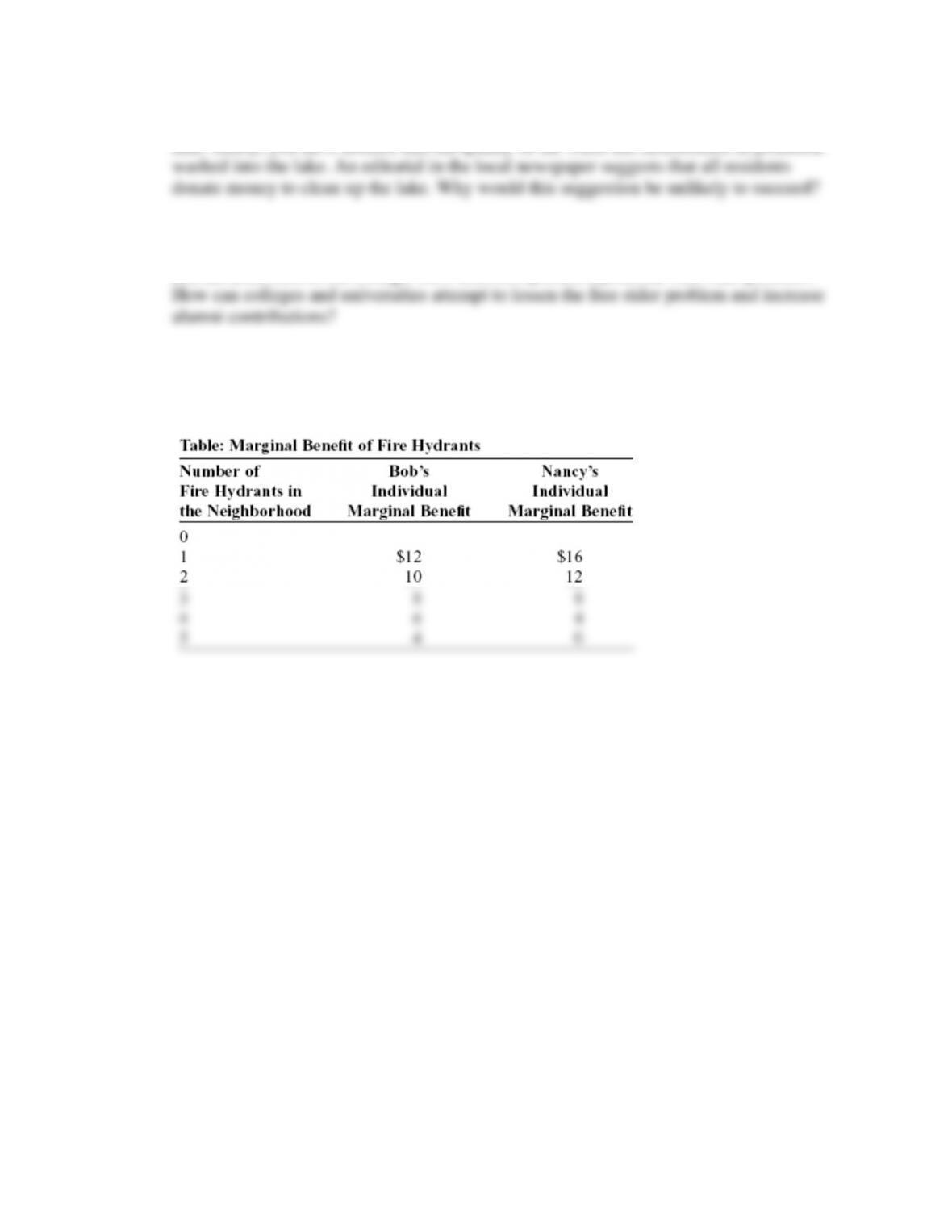
(Table: Marginal Benefit of Fire Hydrants) Use Table: Marginal Benefit of Fire
Hydrants. Suppose that the marginal cost of installing a hydrant is $10.
A) What is the most that Nancy would be willing to pay to have one hydrant installed
in the neighborhood?
B) If Nancy had to pay for fire hydrants on her own, how many hydrants would there
be?
C) What is the optimal number of fire hydrants in the neighborhood?
201.
The North Woods is a public area supporting such a large moose population that the
government sees no reason to regulate or limit the harvest of the moose.
A) From an economic point of view, how might this situation eventually lead to
market failure?
B) You are appointed by the governor to regulate the harvest of moose from the North
Woods. How could you use the three tools described in the text to maintain the efficient
level of moose harvest?
202.
Many cities have tollbooths on busy highways as a way to reduce congestion. To drive
on this toll road, the driver must pay a price at the booth before proceeding. From an
economist’s point of view, why would a toll road be part of the solution to the problem
of traffic congestion?
Page 45
203.
More and more consumers are watching their favorite network television programs from
their computer. Suppose that a network or cable company begins to charge a small fee to
access and download an episode of a popular program. For a supplier of television
programming, the marginal cost of supplying the episode to one more customer is zero.
A) What type of good is this Internet television episode download? Explain.
B) Will the efficient quantity of television downloads be provided? Explain.
204.
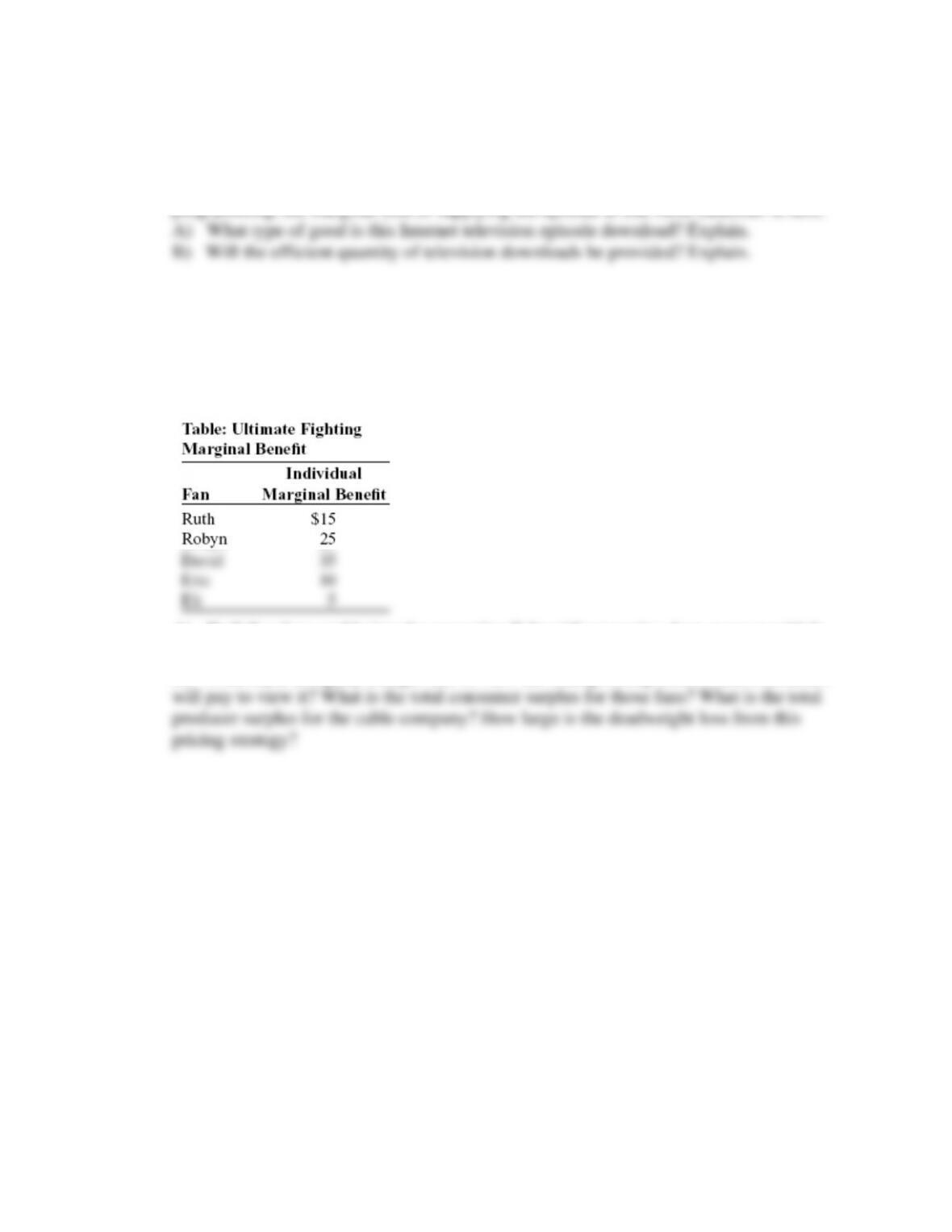
(Table: Ultimate Fighting Marginal Benefit) Use Table: Ultimate Fighting Marginal
Benefit. Most ultimate-fighting bouts are available on a pay-per-view basis from cable
companies. The marginal cost of making the bout available to one additional consumer
is zero.
A) If all five fans could view the upcoming fight without paying, how many would do
so, and what would be the total consumer surplus to those consumers?
B) If the cable company charges $20 to view the championship bout, which consumers
will pay to view it? What is the total consumer surplus for those fans? What is the total
producer surplus for the cable company? How large is the deadweight loss from this
pricing strategy?
205.
Goods that are nonrival in consumption and nonexcludable are _____ goods.
A)
common resource
B)
private
C)
public
D)
normal
206.
A good that is nonexcludable but rival in consumption is a _____ good.
A)
common resource
B)
private
C)
public
D)
normal
Page 46
207.
_____ are a good that is rival in consumption and nonexcludable.
A)
Public parks
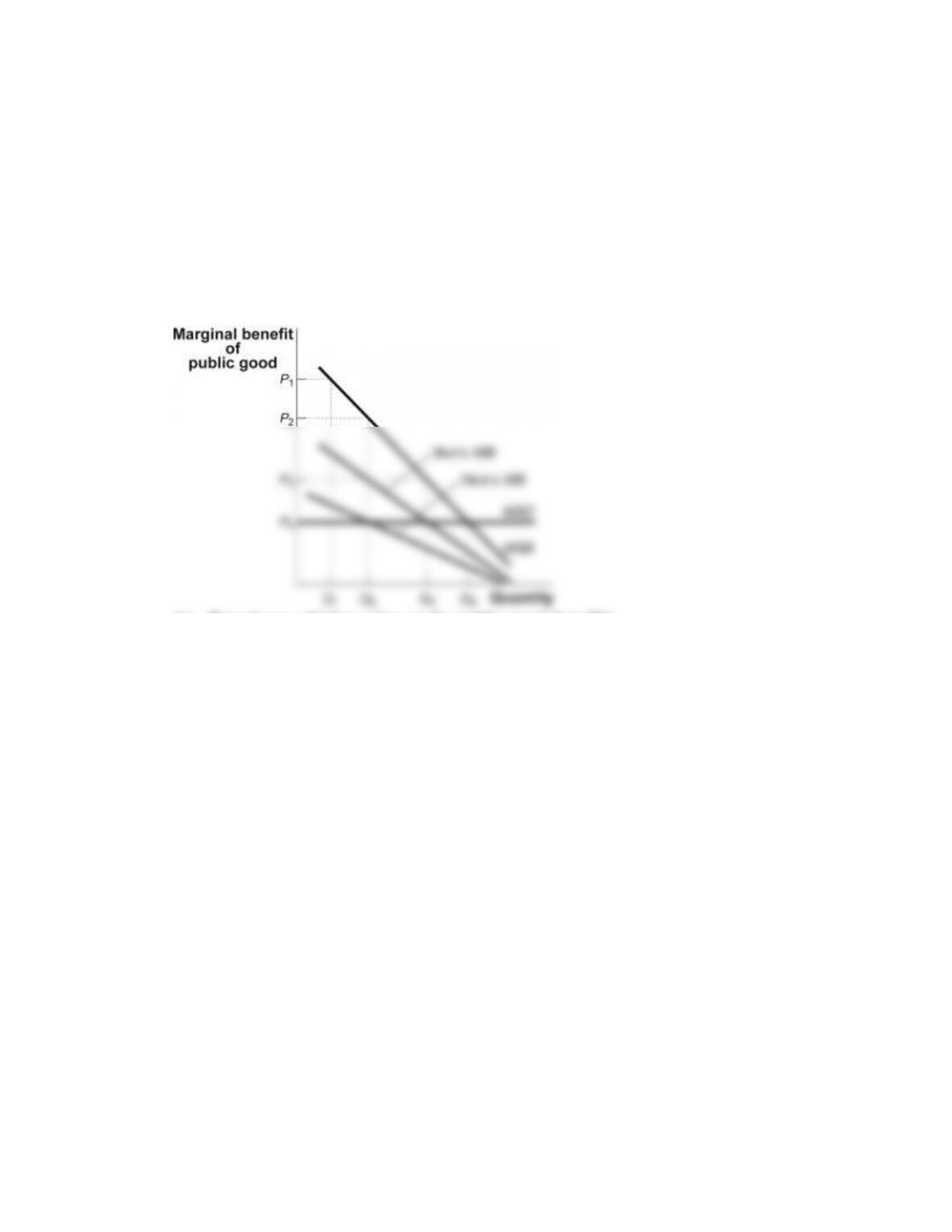
B)
Public policy, such as national economic policy
C)
Private beaches
D)
National defense
208.
Economic policymaking is _____ in consumption and _____.
A)
rival; nonexcludable
B)
nonrival; nonexcludable
C)
nonrival; excludable
D)
rival; excludable
209.
On hot summer days, beach parking lots are usually full by early morning, even though
one must pay to park there. Parking at such lots is _____ in consumption and _____.
A)
rival; nonexcludable
B)
rival; excludable
C)
nonrival; nonexcludable
D)
nonrival; excludable
210.
A small public park in a large town with many other parks often has very few visitors
because of its size. There is no fee to enter the park, but few people visit it since other
parks have more amenities. This park is _____ in consumption and _____.
A)
rival; excludable
B)
nonrival; excludable
C)
nonrival; nonexcludable
D)
rival; nonexcludable
211.
A market produces too much of a good when the price of the good is:
A)
greater than the marginal social cost of providing it.
B)
equal to the marginal social cost of providing it.
C)
less than the marginal social cost of providing it.
D)
equal to 1.
212.
When goods are rival in consumption and excludable, perfectly competitive markets:
A)
will consistently produce more than the efficient quantity of the good.
B)
will produce an efficient quantity of the good.
C)
will consistently produce less than the efficient quantity of the good.
D)
will find that consumers are unwilling to purchase the good.
Page 47
213.
Encouragement of voluntary contributions to the provision of public goods:
A)
will always lead to the socially optimal provision of public goods.
B)
may lead to the provision of public goods.
C)
will result in too much of the public good being provided.
D)
is required to provide private goods.
214.
Nikos and Camila are working on a team project for a course. They will receive the
same grade for the project. They have done a great job, but they have not kept track of
their bibliography sources very well, although they both have all of the information.
Camila knows that Nikos will eventually do the bibliography since Nikos does not like
to turn in incomplete work. As a result:
A)
Camila will free-ride on Nikos’s labor.
B)
Nikos will free-ride on Camila’s labor.
C)
neither will free-ride since they both earn the same grade.
D)
free-riding is not relevant to this issue since no money is involved.
215.
Every few months, public radio announces a call for pledge support. During this time, it
asks listeners to contribute to their local public radio station. Although they raise money
during this time, it often falls short of the amount they wish to raise because:
A)
they do not make the pledge period long enough.
B)
listeners know they will be able to hear public radio, even if they don’t contribute.
C)
public radio free-rides on the listeners.
D)
the marginal social cost equals the marginal social benefit of public radio listening.
216.
When a good is nonexcludable:
A)
consumers will pay the market price for it.
B)
producers will produce too much of it.
C)
a free-rider problem can arise.
D)
production will be efficient.
217.
When a good is nonrival in consumption, its MOST efficient price is:
A)
zero.
B)
determined by producers.
C)
greater than zero.
D)
equal to the market price of a similar rival good.
Page 48
218.
If a good is nonrival in consumption and a positive price is charged by the supplier:
A)
more people want to use this good at the supplier’s price than at the efficient price.
B)
consumption of it is inefficiently low.
C)
free-riding occurs.
D)
there is a socially optimal level of consumption.
219.
(Scenario: Alexander and Vanessa) Use Scenario: Alexander and Vanessa. If Alexander
and Vanessa are the only two individuals in a society, which equation CORRECTLY
represents the marginal social benefit (MSB) of scientific research?
Scenario: Alexander and Vanessa
Alexander and Vanessa benefit from scientific research. Alexander’s marginal private
benefit from such research is given by the equation MPB = 200 – Q, where Q refers to
the amount of research undertaken and MPB captures the marginal private benefit
Alexander gets from different marginal quantities. Meanwhile, Vanessa’s marginal
private benefit from such research is given by the equation MPB = 100 – Q. The
marginal social cost of such research is constant at $100.
A)
MSB = 300 – 2Q.
B)
MSB = 100 – Q.
C)
MSB = 200 – Q.
D)
MSB = 100.
220.
(Scenario: Alexander and Vanessa) Use Scenario: Alexander and Vanessa. What is the
socially optimal amount of scientific research for this economy?
Scenario: Alexander and Vanessa
Alexander and Vanessa benefit from scientific research. Alexander’s marginal private
benefit from such research is given by the equation MPB = 200 – Q, where Q refers to
the amount of research undertaken and MPB captures the marginal private benefit
Alexander gets from different marginal quantities. Meanwhile, Vanessa’s marginal
private benefit from such research is given by the equation MPB = 100 – Q. The
marginal social cost of such research is constant at $100.
A)
60 units
B)
300 units
C)
100 units
D)
200 units
Page 49
221.
(Scenario: Alexander and Vanessa) Use Scenario: Alexander and Vanessa. If the
socially optimal level of scientific research is produced and if both Vanessa and
Alexander are truthful in disclosing the marginal private benefits they expect to receive
from this research, what is the price per unit of research that Vanessa is willing to pay at
the social optimum?
Scenario: Alexander and Vanessa
Alexander and Vanessa benefit from scientific research. Alexander’s marginal private
benefit from such research is given by the equation MPB = 200 – Q, where Q refers to
the amount of research undertaken and MPB captures the marginal private benefit
Alexander gets from different marginal quantities. Meanwhile, Vanessa’s marginal
private benefit from such research is given by the equation MPB = 100 – Q. The
marginal social cost of such research is constant at $100.
A)
$0
B)
$50
C)
$100
D)
$300
Page 50
222.
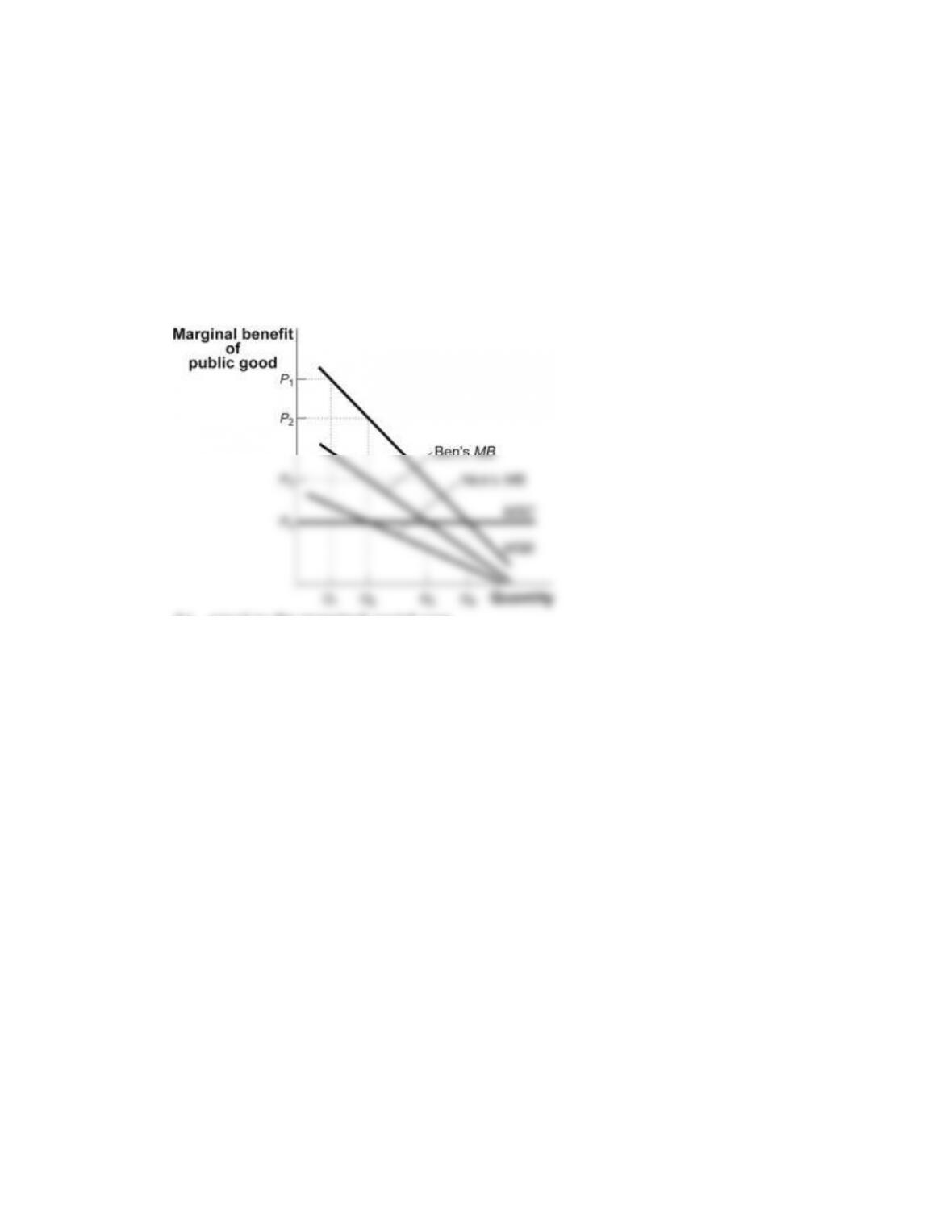
(Scenario: Ben and Nik) Use Scenario: Ben and Nik. At Q2 in the figure, the marginal
social benefit from the last unit of the public good is:
Scenario: Ben and Nik
Ben and Nik are the only members of a community. They have revealed the marginal
private benefits they each receive from a public good whose marginal social benefit is
known. In addition, the marginal social cost (MSC) of the public good is known and is
constant.
A)
equal to the marginal social cost.
B)
equal to P4 + P3.
C)
the optimal level of provision of the public good.
D)
zero for Nik.
Page 51
223.
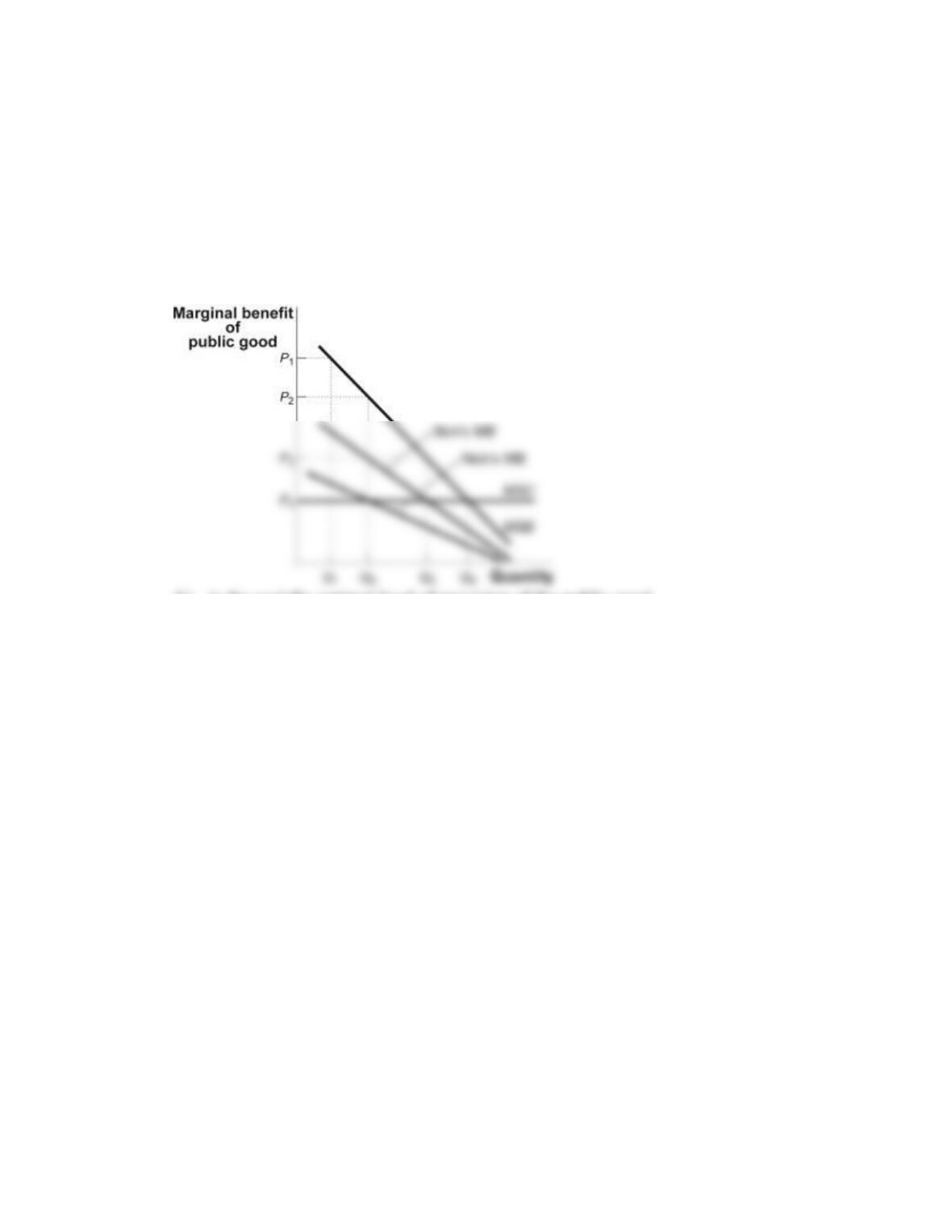
(Scenario: Ben and Nik) Use Scenario: Ben and Nik. In the figure, Q4:
Scenario: Ben and Nik
Ben and Nik are the only members of a community. They have revealed the marginal
private benefits they each receive from a public good whose marginal social benefit is
known. In addition, the marginal social cost (MSC) of the public good is known and is
constant.
A)
is the socially optimal level of provision of the public good.
B)
is equal to P4 + P3 in marginal social benefits.
C)
represents an amount at which the MSB is greater than the MSC.
D)
will not be produced since neither Ben nor Nik finds any benefit in it at this level.
Page 52
224.
(Scenario: Ben and Nik) Use Scenario: Ben and Nik. At all levels of provision of the
public good:
Scenario: Ben and Nik
Ben and Nik are the only members of a community. They have revealed the marginal
private benefits they each receive from a public good whose marginal social benefit is
known. In addition, the marginal social cost (MSC) of the public good is known and is
constant.
A)
Ben places a higher value on the public good than Nik.
B)
the MSC is less than the MSB.
C)
the optimal level is not attained.
D)
the private marginal benefits cannot be determined.
225.
If at the quantity determined by private costs and benefits, the marginal social benefit of
a public good is greater than the marginal social cost of providing the good:
A)
the private market will best determine how much of the good will be provided and
to whom.
B)
a community would be better off if provision of the good were to increase.
C)
the community will not provide the good.
D)
free riding will not occur, so the private market will provide the socially optimal
amount.
226.
A common resource is _____ in consumption.
A)
excludable and rival
B)
nonexcludable and rival
C)
excludable and nonrival
D)
nonexcludable and nonrival
Page 53
227.
An example of a common resource is:
A)
coffee sold in coffee shops.
B)
any type of public good.
C)
any private good that is monopolized.
D)
fishing in the ocean.
228.
The private market will lead to _____ of clean air because _____.
A)
too little consumption; it is nonexcludable but rival in consumption
B)
too much consumption; it is nonexcludable but rival in consumption
C)
production of the socially optimal amount; the marginal cost is zero
D)
government provision; it is a public good
229.
Common resource goods are similar to:
A)
public goods because they are both nonexcludable and nonrival in consumption.
B)
goods with negative externalities because not all users take into account the
external costs imposed on society.
C)
private goods because they are both excludable and rival.
D)
artificially scarce goods because they are both are excludable and nonrival in
consumption.
230.
After many years, a small community builds a toll road but discovers that it is not used
very much. If it wishes for the road to be used at the socially optimal level, the
community should:
A)
set the toll higher.
B)
set the toll equal to $1.
C)
set the toll lower.
D)
build another toll road.
231.
Assigning property rights helps correct the problems associated with common resources:
A)
because it allows property owners to exclude users and to manage the resource
more efficiently.
B)
because it allows the government to determine the amount that would lead to the
socially optimal outcome.
C)
because it makes the good nonrival in consumption.
D)
and therefore allows the market to better assess the marginal social benefits.
Page 54
232.
Imposing a Pigouvian tax on a good, establishing a system of tradable licenses, and
assigning property rights are methods to alleviate the problems associated with:
A)
private goods.
B)
positive externalities.
C)
public goods.
D)
common resources.

Answer Key
Page 56
45.
B
46.
A
47.
B
48.
D
49.
D
50.
A
51.
B
52.
C
53.
D
54.
A
55.
B
56.
D
57.
C
58.
C
59.
B
60.
D
61.
A
62.
B
63.
A
64.
D
65.
D
66.
D
67.
C
68.
B
69.
B
70.
A
71.
C
72.
B
73.
B
74.
A
75.
C
76.
C
77.
C
78.
B
79.
C
80.
D
81.
C
82.
A
83.
B
84.
C
85.
D
86.
C
87.
A
88.
C
89.
C
90.
A
Page 57
91.
D
92.
C
93.
A
94.
D
95.
C
96.
A
97.
B
98.
D
99.
C
100.
D
101.
D
102.
A
103.
C
104.
C
105.
B
106.
C
107.
A
108.
C
109.
C
110.
C
111.
B
112.
A
113.
D
114.
B
115.
A
116.
C
117.
C
118.
C
119.
B
120.
C
121.
A
122.
A
123.
C
124.
D
125.
C
126.
B
127.
B
128.
B
129.
B
130.
D
131.
D
132.
A
133.
B
134.
B
135.
B
136.
C
Page 58
137.
C
138.
C
139.
B
140.
A
141.
B
142.
D
143.
A
144.
A
145.
B
146.
B
147.
D
148.
C
149.
C
150.
A
151.
D
152.
D
153.
D
154.
D
155.
C
156.
C
157.
A
158.
A
159.
D
160.
C
161.
B
162.
C
163.
D
164.
D
165.
C
166.
C
167.
A
168.
D
169.
C
170.
C
171.
D
172.
A
173.
B
174.
D
175.
A
176.
A
177.
A
178.
B
179.
A
180.
A
181.
A
182.
B
Page 59
183.
A
184.
A
185.
A
186.
B
187.
A
188.
A
189.
A
190.
A
191.
B
192.
B
193.
B
194.
A
195.
196.
197.
198.
199.
200.
201.
202.
203.
204.
205.
C
206.
A
207.
A
208.
B
209.
B
210.
C
211.
C
212.
B
213.
B
214.
A
215.
B
216.
C
217.
A
218.
B
219.
A
220.
C
221.
A
222.
B
223.
A
224.
A
225.
B
226.
B
227.
D
228.
B

Page 60
229.
B
230.
C
231.
A
232.
D