Page 1
Name: __________________________ Date: _____________
1.
G. Reecy’s Hamburger Joint is a fast-food restaurant. Which factor is associated with
production?
A)
the raw meat used for the hamburgers
B)
the hamburger buns
C)
the cook
D)
the concentrate that is diluted to make the soft drinks
2.
Human capital:
A)
consists of man-made resources such as buildings and machines.
B)
is the improvement in labor produced by education and knowledge that is
embodied in the workforce.
C)
has become less important because of the progress in technology.
D)
is the improvement in labor produced by education, which has become less
important because of the progress in technology.
3.
Which factor is NOT associated with production at a college?
A)
the faculty
B)
classroom buildings
C)
electricity
D)
the computer labs
4.
Which factor is associated with production at a college?
A)
the faculty
B)
lab concentrations to use in experiments
C)
electricity
D)
Scantron sheets
5.
Which factor is an input in the production of croissants?
A)
ovens
B)
pastry chefs
C)
flour
D)
dough mixers

Page 2
6.
The key distinction between a factor of production and an input is that:
A)
an input is an enduring source of income, but a factor of production is used up in
production.
B)
a factor of production earns income from selling its services over and over again,
but an input does not.
C)
an input earns income from selling its services over and over again, but a factor of
production does not.
D)
a factor of production has limited earning potential.
7.
Human capital is the improvement in _____ produced by _____.
A)
physical capital; technology
B)
labor; education and knowledge
C)
labor; physical capital
D)
labor; management
8.
Manufactured resources such as equipment, buildings, and tools are also known as:
A)
human capital.
B)
labor.
C)
physical capital.
D)
natural resources.
9.
Now that Naila has her bachelor’s degree, she has decided to pursue her master’s degree.
Naila’s choice of additional education is called an investment in:
A)
natural resources.
B)
human capital.
C)
physical capital.
D)
labor.
10.
When the demand for automobiles is high, the demand for workers who build
automobiles is high. This relation between the market for automobiles and the market
for the labor that builds automobiles is why demand in a factor market is called:
A)
the marginal productivity theory of income distribution.
B)
a compensating differential.
C)
the factor distribution of income.
D)
a derived demand.

Page 3
11.
The demand for factors of production is called a derived demand because it is:
A)
derived from the demand for the outputs that are produced by the factors of
production.
B)
derived from the available supply of factors, such as land, that can be
overexploited.
C)
not easy to determine and must be derived by a technical (and often complicated)
process.
D)
derived on the basis of questions posed to residents during the census.
12.
The demand for a factor of production is a(n) _____ demand.
A)
derived
B)
implicit
C)
direct
D)
distributional
13.
Factor demand is called derived demand because it:
A)
requires the use of other factors.
B)
depends on demand for the product that the factor produces.
C)
has a downward-sloping demand curve.
D)
has a constant marginal factor cost.
14.
The category “compensation of employees”:
A)
includes the earnings of proprietors.
B)
doesn’t include benefits such as health insurance.
C)
refers in large part to the return on human capital.
D)
includes payments in kind that are common in rural areas.
15.
The category “compensation of employees” doesn’t capture the full income of labor
because:
A)
it doesn’t include the earnings of proprietors.
B)
it doesn’t include benefits such as health insurance.
C)
a sizable fraction of it can be attributed to the return on human capital.
D)
it excludes payments in kind that are common in rural areas.
16.
In the United States in 2015, approximately _____% of total income in the economy
took the form of compensation of employees.
A)
40
B)
9
C)
90
D)
70
Page 4
17.
The LARGEST component of the factor distribution of income in the United States is:
A)
interest and rents.
B)
taxes.
C)
corporate profits.
D)
compensation of employees.
18.
In terms of contribution to total income in the United States, the single MOST important
factor of production is:
A)
capital.
B)
labor.
C)
land.
D)
entrepreneurship.
19.
Which statement is NOT true about the factor distribution of income?
A)
It is the division of total income among labor, land, and capital.
B)
Labor receives the bulk of the income in the modern U.S. economy.
C)
The returns to human capital are easily measured.
D)
A part of the proprietor’s income should be considered wages that the business
owners pay themselves.
20.
In the United States in 2015, approximately 70% of total income, by far the largest
share, took the form of:
A)
compensation of employees.
B)
corporate profits.
C)
interest income.
D)
rental income.
21.
In terms of contribution to total U.S. income, the factor of production that receives the
SMALLEST share is:
A)
capital.
B)
labor.
C)
land.
D)
entrepreneurship.
Page 5
22.
When labor is hired in a competitive market, the value of the marginal product of labor
is computed by:
A)
multiplying the price of the output by the marginal product of labor.
B)
multiplying the price of the output by the wage paid to labor.
C)
multiplying the wage paid to labor by the marginal product of labor.
D)
dividing the marginal product of labor by the price of the output.
23.
Liyun owns a small flower shop, and the industry is perfectly competitive. She is
considering whether to hire an additional worker. The wage rate for the worker is $500
per week; the marginal product of the additional worker would be 100 units per week;
and the price of the units is $10 each. Liyun should:
A)
hire the additional worker.
B)
not hire the additional worker.
C)
raise the price of the flower arrangements that she sells.
D)
Not enough information is given to answer the question.
24.
As a rule, a profit-maximizing restaurant owner employs each factor of production up to
the point at which the value of the marginal product of the _____ unit of the factor
employed is _____ that factor’s price.
A)
first; greater than
B)
last; equal to
C)
first; equal to
D)
last; less than
25.
Using standard economic theory, a firm should continue hiring workers until:
A)
the marginal product of labor times price equals demand.
B)
the quantity of labor supplied equals the quantity of labor demanded.
C)
the marginal product of labor times price equals the workers’ wage.
D)
the marginal product of labor times the workers’ wage wage equals price.
26.
The value of the marginal product is equal to:
A)
marginal product times the wage rate.
B)
average product times the wage rate.
C)
marginal product times the price per unit of output.
D)
average product times the price per unit of output.
Page 6
27.
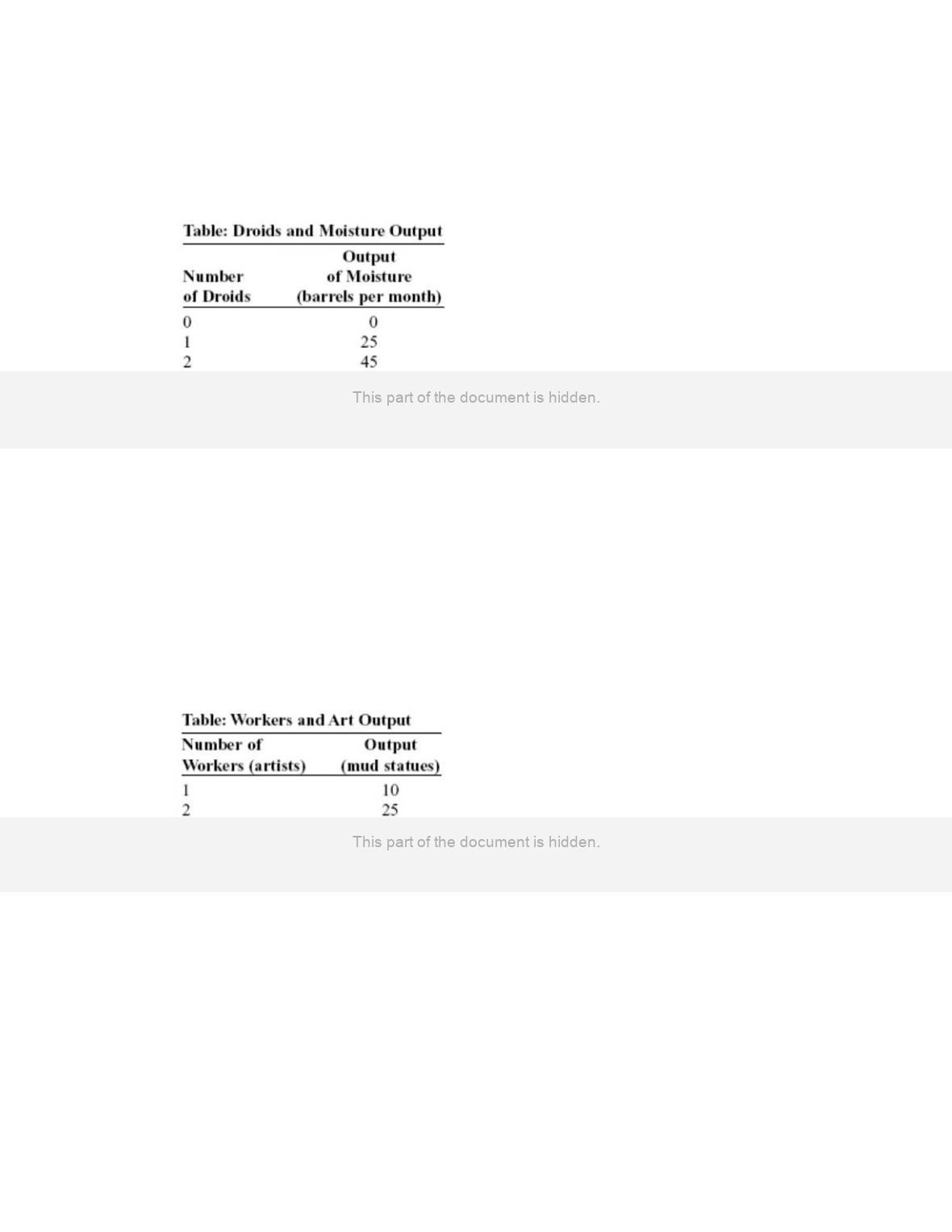
(Table: Droids and Moisture Output) Use Table: Droids and Moisture Output. Luke
Skywalker uses droids to operate a moisture farm in a perfectly competitive market on
the planet Tatooine. A barrel of moisture sells for 50 republic credits. A droid costs 675
republic credits per month to rent. How many droids should Luke rent?
A)
one
B)
two
C)
three
D)
four
28.
(Table: Workers and Art Output) Use Table: Workers and Art Output. Suppose that you
achieve your dream of opening an art studio specializing in selling mud statues. You
pay $10 in fixed costs for equipment and $9 per day to each of your workers who make
the mud statues. The industry is perfectly competitive, with a current market price of $1.
How many statues should you produce?
A)
25
B)
35
C)
43
D)
3

Page 7
29.
The amount by which the use of an additional unit of a factor of production increases a
firm’s total revenue during a period is called the:
A)
value of the marginal product.
B)
average product.
C)
marginal factor cost.
D)
marginal physical product.
30.
The value of the marginal product is the:
A)
change in total output resulting from a unit change in the quantity of a factor.
B)
change in total revenue resulting from a unit change in the quantity of a factor.
C)
change in total cost resulting from a unit change in the quantity of a factor.
D)
ratio of total revenue to the quantity of a factor employed.
31.
If the extra output that is produced by hiring one more unit of labor adds more to _____
than to _____, the firm will increase its profit by increasing the use of labor.
A)
total cost; total revenue
B)
total revenue; total cost
C)
marginal cost; marginal revenue
D)
marginal product; marginal cost
32.
The Bountiful Bakery is considering hiring another pastry chef. The bakery knows the
average product of its chefs currently is 15 dozen croissants per day. It also believes that
the next chef hired will produce an extra 12 dozen croissants per day. A dozen
croissants sell for $30. The bakery should hire another worker:
A)
only if the new chef’s marginal product is 12 dozen or more.
B)
only if the new chef’s daily wage is $450 or less.
C)
only if the new chef’s daily wage is $360 or less.
D)
because the marginal product is below the average product.
33.
The amount by which an additional unit of a factor increases a firm’s total _____ during
a period is the _____.
A)
revenue; value of the marginal product
B)
revenue; marginal factor cost
C)
cost; value of marginal product
D)
cost; marginal product

Page 8
34.
Which expression BEST describes the value of the marginal product?
A)
the change in total output generated by a unit change in the quantity of a factor
B)
the change in total revenue generated by a unit change in the quantity of a factor
C)
the change in marginal cost generated by a unit change in the quantity of a factor
D)
the ratio of total revenue to the quantity of a factor employed
35.
The value of the marginal product is calculated as:
A)
MP / MR.
B)
MP / P.
C)
MP × P.
D)
MR / MP.
36.
The amount that an additional unit of a factor adds to a firm’s total revenue is called the:
A)
marginal revenue.
B)
marginal cost.
C)
additional revenue product.
D)
value of the marginal product.
37.
The marginal product times product price equals the:
A)
marginal revenue.
B)
value of the marginal product.
C)
additional revenue product.
D)
marginal cost.
38.
Which formula is CORRECT?
A)
VMPL = MC × P.
B)
VMPL = MPL × P.
C)
MPL = VMPL × P.
D)
VMPL / MC = TR.
39.
Which statement is TRUE?
A)
The marginal product is the change in total revenue divided by a one-unit change in
a factor.
B)
The marginal revenue is the change in total output divided by the change in output.
C)
The value of the marginal product is the marginal product times the price.
D)
The marginal cost is equal to the average total cost.

Page 9
40.
Which statement is TRUE?
A)
The value of the marginal product of labor equals the marginal product of labor
times price.
B)
The value of the marginal product of labor equals a one-unit change in a factor
divided by the change in total revenue.
C)
Marginal cost equals change in total revenue divided by the one-unit change in a
factor.
D)
The value of the marginal product of labor equals the change in the quantity of a
factor times the price of the factor.
41.
A profit-maximizing firm will base its decision to hire workers on the additional costs
and benefits of each worker. If the extra output that is produced by hiring one more unit
of labor adds more to _____ than to _____, the firm will increase its profit by increasing
the use of labor.
A)
total cost; total revenue
B)
total revenue; total cost
C)
marginal cost; marginal revenue
D)
marginal cost; total cost
42.
A firm has hired the profit-maximizing number of workers when the wage is:
A)
less than the price of the product.
B)
greater than the average product of the last worker hired.
C)
equal to the average product of the last worker hired.
D)
equal to the value of the marginal product of labor of the last worker hired.
43.
Suppose that Billy Bud’s Bucking Broncos employs 20 workers at a daily wage of $60
each. The average product of labor is 30 bucking broncos per day; the marginal product
of the last worker is 12 bucking broncos per day; and total fixed cost is $3,600 for
equipment. What is the marginal cost of the last bucking bronco produced?
A)
$0.20
B)
$5.00
C)
$240.00
D)
$720.00
44.
To maximize profits, a firm will employ workers until for the last worker employed:
A)
marginal product of labor is equal to the nominal wage rate.
B)
the value of the marginal product of labor is equal to the wage rate.
C)
the value of the marginal product of labor is equal to the price per unit of output.
D)
the value of the marginal product of labor is as high as possible.

Page 10
45.
Maria operates a persimmon orchard in southeastern Oklahoma. She pays her workers
$248 per week to pick and process persimmons, and she sells her persimmons for $6 per
bushel. If she adds one more worker and that worker can pick and process 44 bushels
per week, what will be the profit for Maria from hiring that worker?
A)
$0
B)
$16
C)
$264
D)
$544
46.
For the Tampa Bay Rays baseball team, the value of the marginal product curve is the
team’s labor _____ curve. This means the marginal product curve has a _____ slope.
A)
demand; positive
B)
supply; positive
C)
demand; negative
D)
supply; negative
47.
José, a corn farmer operating in a perfectly competitive market, pays his workers $8 an
hour. At his current level of labor use, the marginal product of an additional hour of
labor is three bushels of corn. The market price of corn is $2.75. To maximize his
profits, Jose should:
A)
hire more labor.
B)
hire less labor.
C)
not change the amount of labor.
D)
This question cannot be answered without knowing the average product of labor.
48.
Barry’s Brewpub is considering hiring more brewmasters. The market wage for a
brewmaster is $120 per day. The average brewmaster produces 40 pints of beer per day,
but Barry expects the next brewmaster to produce only 20 pints per day. Assuming the
market for beer is perfectly competitive, Barry’s Brewpub will hire another brewmaster
only if:
A)
a pint of brew sells for $3.
B)
the new brewmaster can produce 40 pints.
C)
a pint of brew sells for $2.
D)
a pint of brew sells for $6 or more.

Page 11
49.
Barry’s Brewpub is considering hiring more brewmasters. A pint of brew sells for $3.
The market wage of a brewmaster is $150 per day. Assuming that the market for beer is
perfectly competitive, Barry’s Brewpub will hire another brewmaster only if Barry
believes the new brewmaster will:
A)
produce the same number of pints per day as the last brewmaster hired.
B)
produce 50 or more pints per day.
C)
raise average production to 50 or more pints per day.
D)
increase the marginal product by $150 per day.
50.
Mary is considering hiring another worker in an assembly line for Bluetooth speakers.
Mary knows the average product of labor is 15 speakers per day. She also believes that
the next worker hired will produce an extra 12 speakers per day. A speaker sells for $10.
Assuming that the market for speakers is perfectly competitive, Mary should hire
another worker:
A)
only if the new worker’s marginal product is 12 or more.
B)
only if the new worker’s daily wage is $150 or less.
C)
only if the new worker’s daily wage is $120 or less.
D)
since the marginal product is below the average product.
51.
The individual producer’s labor demand curve is the:
A)
marginal product of labor curve.
B)
value of the average product of labor curve.
C)
average product curve.
D)
value of the marginal product of labor curve.
52.
All perfectly competitive fast-food firms are hiring the profit-maximizing quantity of
labor and are paying their workers $7 per hour. If the government raises the minimum
wage to $8 per hour:
A)
the value of the marginal product will exceed the wage, and firms will hire more
workers.
B)
the value of the marginal product will be less than the wage, and firms will lay off
some workers.
C)
firms will increase their prices to keep the value of the marginal product equal to
the wage.
D)
firms will have to exit the industry since the value of the marginal product is
always less than the wage.
Page 12
53.
As the _____ of labor used in production increases, ceteris paribus, eventually the
_____ of labor will _____.
A)
price; supply; increase
B)
quantity; marginal product; fall
C)
quantity; marginal product; rise
D)
quantity; value of the marginal product; rise
54.
When a firm is a perfect competitor in the product market, its demand curve for labor
will _____ because the _____ product declines as additional workers are hired.
A)
slope downward; marginal
B)
be horizontal; average
C)
slope upward; marginal
D)
slope downward; average
55.
A firm’s demand curve for labor is:
A)
the upward-sloping portion of its value of the marginal product curve.
B)
the downward-sloping portion of its marginal product curve.
C)
the downward-sloping portion of its value of the marginal product curve.
D)
horizontal for the firm in perfect competition.
56.
The quantity demanded of labor will decrease if:
A)
the price of the product that the labor produces increases.
B)
the productivity of labor increases.
C)
the price of labor rises.
D)
there is an increase in the supply of a factor labor uses.
57.
Suppose there are diminishing returns to labor. If the _____ of labor hired by a firm
increases, holding everything else constant, the _____ labor will _____.
A)
price; demand for; increase
B)
quantity; marginal product of; fall
C)
quantity; marginal product of; rise
D)
quantity; value of the marginal product of; rise
58.
If the marginal product is _____, the value of marginal product must be _____.
A)
rising; falling
B)
falling; falling
C)
falling; rising
D)
rising; zero
Page 13
59.
A firm’s demand curve for labor is:
A)
its marginal cost curve.
B)
its marginal product curve.
C)
its value of the marginal product of labor curve.
D)
horizontal if it is in perfect competition.
60.
A profit-maximizing firm will hire workers up to the quantity of labor where:
A)
VMPL > W.
B)
VMPL = W.
C)
VMPL < W.
D)
MP × MR = VMPL.
61.
If a firm hires labor such that W > VMPL, then profit:
A)
is maximized.
B)
can be increased by hiring less labor.
C)
can be increased by hiring more labor.
D)
can be increased by decreasing the price of the output.
62.
If a firm hires labor such that W < VMPL, then profit:
A)
is maximized.
B)
can be increased by hiring less labor.
C)
can be increased by hiring more labor.
D)
can be increased by increasing the wage.
63.
If a firm hires labor and with its current employees W = VMPL, then profit:
A)
is maximized.
B)
can be increased by hiring less labor.
C)
can be increased by hiring more labor.
D)
can be increased by increasing the wage rate.
64.
Which statement is TRUE?
A)
If W < VMPL, the firm should hire more labor.
B)
If W > VMPL, the firm should hire more labor.
C)
If W = VMPL, the firm should hire more labor.
D)
If W > 0, the firm should shut down.

Page 14
65.
A firm’s demand curve for labor in a perfectly competitive market is the
downward-sloping portion of its _____ curve.
A)
marginal revenue
B)
average total cost
C)
value of the marginal product of labor
D)
total revenue
66.
If the wage rate rises, firms will find that:
A)
their labor demand curve shifts leftward.
B)
their labor demand curve shifts rightward.
C)
they move upward and to the left along the labor demand curve.
D)
they move downward and to the right along the labor demand curve.
67.
Suppose the labor market for plumbers is in equilibrium. Which occurrence might
DECREASE the wage for plumbers?
A)
An economic boom increases the demand for new homes.
B)
The plumbers union establishes a rigorous certification test that is difficult for
aspiring plumbers to pass.
C)
Unemployed manufacturing workers attend technical schools to learn the plumbing
trade.
D)
A minimum wage is imposed in the market for plumbers.
68.
An increase in the market demand for electricians in the factor market might occur if
the:
A)
price of electrical repair and installation services rises.
B)
demand for new houses falls.
C)
price of copper electrical wiring increases.
D)
wage for electricians falls.
69.
Benny employs people to sell candy bars at intersections. Assume that Benny can obtain
candy bars to sell for no cost. The marginal product of the last worker Benny hired is 20
candy bars per hour. Benny pays $7 per worker per hour and sells the candy bars for $1
each. If the price of candy bars rises to $2, then the:
A)
demand for labor increases.
B)
demand for labor decreases.
C)
quantity demanded of labor increases, but the demand for labor curve does not
shift.
D)
quantity demanded of labor decreases, but the demand for labor curve does not
shift.
Page 15
70.
Phil’s Copy Studio pays its workers $60 per day and sells poster-size copies for $10 per
print. If the market wage rises to $70, then the:
A)
demand for labor increases.
B)
demand for labor decreases.
C)
quantity demanded of labor increases, but the demand for labor curve does not
shift.
D)
quantity demanded of labor decreases, but the demand for labor curve does not
shift.
71.
Phil’s Copy Studio pays its workers $60 per day and sells poster-size copies for $10 per
print. Now suppose that, during the holiday season, the price of poster-size copies
increases to $12. What happens?
A)
The demand for labor increases.
B)
The demand for labor decreases.
C)
The quantity demanded of labor increases, but the demand for labor curve does not
shift.
D)
The quantity demanded of labor decreases, but the demand for labor curve does not
shift.
72.
The government increases the sales tax on all goods but does not change the tax on
income earned from labor. What happens?
A)
The quantity of labor demanded decreases, but the demand for labor does not shift.
B)
The demand for labor decreases.
C)
The supply of labor increases.
D)
There is no change in the labor market.
73.
Over the past several years, the demand for phone operators has fallen dramatically.
Which factor would account for this development?
A)
an increase in the number of automated answering services
B)
a decrease in the quality of the technology associated with phone equipment
C)
an increase in the supply of phone operators
D)
higher prices for long-distance service
Page 16
74.
Labor with a particular skill level and training is used in only two industries: grape
cultivation and cranberry cultivation. Which occurrence is likely to cause an
INCREASE in the demand for this type of labor?
A)
improved technology that leads to more efficient machines for grape picking
B)
publication of a report asserting that drinking two glasses of grape or cranberry
juice every day improves digestion and heart health
C)
a report by the USDA that an increasing proportion of grapes are contaminated
with unacceptable pesticides
D)
a decrease in the acreage of cranberry bogs
75.
A factor demand curve will shift because:
A)
of a change in the price of the good the factor produces.
B)
the elasticity of demand for the final product is high.
C)
of a change in the proportion of the factor’s cost relative to total cost.
D)
the slope of the MP curve is negative.
76.
There will be an increase in factor demand because of a(n) _____ in the price of the
_____.
A)
increase; factor
B)
increase; good the factor produces
C)
decrease; factor
D)
decrease; good the factor produces
77.
A factor demand curve will shift to the left because of a(n) _____ in the price of the
_____.
A)
increase; factor
B)
increase; good the factor produces
C)
decrease; factor
D)
decrease; good the factor produces
78.
An increase in the demand for autoworkers may come about because of a(n):
A)
decrease in the price of cars.
B)
decrease in the productivity of autoworkers.
C)
decrease in the supply of other factors that autoworkers use in production.
D)
increase in the price of cars.
Page 17
79.
An increase in the demand for autoworkers would NOT come about because of a(n):
A)
increase in the price of cars.
B)
decrease in the market wage rate.
C)
increase in the productivity of autoworkers.
D)
increase in the supply of other factors that autoworkers use in production.
80.
A decrease in the demand for pastry chefs may come about because of an increase in
the:
A)
concern for healthy living.
B)
market wage rate for pastry chefs.
C)
productivity of pastry chefs.
D)
supply of other factors that pastry chefs use.
81.
An increase in the demand for construction workers may come about because of a(n):
A)
increase in the demand for new housing.
B)
decrease in the market wage rate for construction workers.
C)
decrease in the productivity of construction workers.
D)
decrease in the supply of other factors that construction workers use.
82.
A shift in demand for a given factor of production will NOT occur if:
A)
the price of that factor falls.
B)
the productivity of that factor increases.
C)
the productivity of that factor decreases.
D)
there is a decrease in the price of a substitute factor.
83.
A firm’s demand curve for labor will shift because of:
A)
a decrease in the wage rate.
B)
an increase in the wage rate.
C)
changes in preferences and the cultural norms that define how much we work.
D)
a change in the product’s price.
84.
According to the _____, in a perfectly competitive economy each factor of production is
paid its equilibrium value of the marginal product.
A)
theory of labor supply
B)
efficiency-wage model
C)
theory of compensating differentials
D)
marginal productivity theory of income distribution
Page 18
85.
Oscar’s Flower Shop maximizes profits by hiring four workers in a perfectly
competitive labor market. The workers and their value of the marginal product of labor
are Noe, $40; Barbara, $35; Calvin, $27; and Diana, $15. According to the marginal
productivity theory of income distribution, which statement is TRUE?
A)
In equilibrium, each worker is paid his or her value of the marginal product of
labor.
B)
Each worker is paid a wage equal to the highest value of the marginal product of
labor (i.e., $40).
C)
Each worker is paid $15.
D)
We need to know the product price before we can figure out the wage rate.
86.
An important assumption underlying the marginal productivity theory of income
distribution is that:
A)
product markets are monopolistically competitive.
B)
factor markets are perfectly competitive.
C)
the relevant value of the marginal product is not the equilibrium value.
D)
the firm does not own any land or physical capital.
87.
The marginal productivity theory of income distribution says that:
A)
each factor is paid the equilibrium value of the output generated by the last unit of
that factor employed in the factor market as a whole.
B)
each factor is paid an amount greater than the value of the output generated by the
last unit of that factor employed in the factor market as a whole.
C)
each factor is paid an amount less than the value of the output generated by the last
unit of that factor employed in the factor market as a whole.
D)
the payment to each factor does not correspond to the marginal product of the
factor.
88.
The labor demand curve in a perfectly competitive factor market is the horizontal sum
of all firms’ _____ product of labor curves.
A)
marginal
B)
value of the marginal
C)
marginal physical
D)
average physical

Page 19
Use the following to answer questions 89-91:
Figure: Equilibrium in the Labor Market
89.
(Figure: Equilibrium in the Labor Market) Use Figure: Equilibrium in the Labor Market.
In the figure, an increase in the productivity of labor, when everything else stays the
same, will lead to a(n) _____ in the equilibrium quantity of labor and a(n) _____ in the
equilibrium price of labor.
A)
decrease; increase
B)
increase; decrease
C)
decrease; decrease
D)
increase; increase
90.
(Figure: Equilibrium in the Labor Market) Use Figure: Equilibrium in the Labor Market.
In the figure, a decrease in the price of the good produced, when everything else stays
the same, will lead to a(n) _____ in the equilibrium quantity of labor and a(n) _____ in
the equilibrium price of labor.
A)
increase; increase
B)
decrease; increase
C)
increase; decrease
D)
decrease; decrease
91.
(Figure: Equilibrium in the Labor Market) Use Figure: Equilibrium in the Labor Market.
In the figure, a decrease in population that decreases the number of workers, when
everything else stays the same, will lead to a(n) _____ in the equilibrium quantity of
labor and a(n) _____ in the equilibrium price of labor.
A)
increase; increase
B)
decrease; increase
C)
increase; decrease
D)
decrease; decrease

Page 20
92.
According to the marginal productivity theory of income distribution, every factor of
production is paid _____ the equilibrium value of its _____ product.
A)
exactly; marginal
B)
more than; marginal
C)
less than; marginal
D)
exactly; average
93.
The marginal productivity theory of income distribution assumes that factor markets
are:
A)
monopolies.
B)
oligopolies.
C)
perfectly competitive.
D)
allowed to pay only the wages that government approves.
94.
The equilibrium value of the marginal product of a factor is the additional value
produced by the _____ unit of that factor employed in the factor market as a whole.
A)
first
B)
last
C)
most productive
D)
least productive
95.
According to the marginal productivity theory of income distribution, if a unit of labor
is paid more than a unit of capital, it is because, at the equilibrium quantity of each
factor, the value of the _____ product of labor is _____ product of capital.
A)
marginal; greater than the marginal
B)
marginal; less than the marginal
C)
average; greater than the average
D)
average; less than the average
96.
At Hamill Manufacturing of Pennsylvania, highly skilled senior machinists are paid
$70,000, excluding benefits, but the average skilled machinist generates approximately
$137,000 in value added. This difference is due to the fact that the:
A)
marginal productivity theory of income distribution does not apply in this case.
B)
value of the marginal product of the last machinist hired is less than the average of
all machinists employed.
C)
value of the marginal product of the last machinist hired is greater than the average
of all machinists employed.
D)
value of the marginal product of the last machinist hired is equal to the average of
all machinists employed.