Page 21
97.
At Hamill Manufacturing of Pennsylvania, highly skilled senior machinists are paid
$70,000, excluding benefits, but the average skilled machinist generates approximately
$137,000 in value added. This difference is due to the fact that the:
A)
marginal productivity theory of income distribution does not apply in this case.
B)
equilibrium wage rate includes other costs, such as employee benefits, that have to
be subtracted from the $70,000 salary.
C)
equilibrium wage rate includes other costs, such as employee benefits, that have to
be added to the $70,000 salary.
D)
value of the marginal product of the last machinist hired is equal to the average of
all machinists employed.
Use the following to answer questions 98-101:
98.
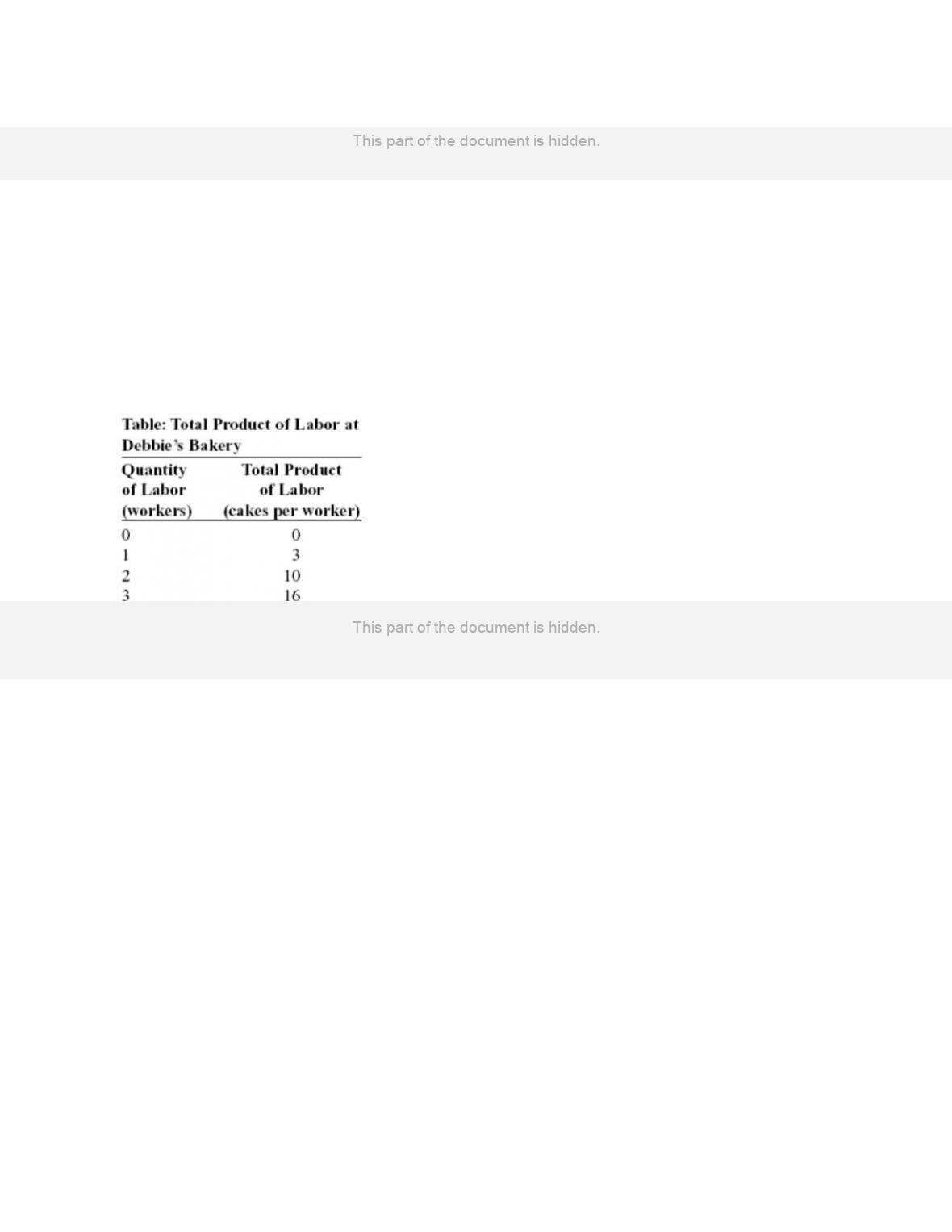
(Table: Total Product of Labor at Debbie’s Bakery) Use Table: Total Product of Labor
at Debbie’s Bakery. Debbie can sell cakes at $10 each. What is the value of the marginal
product for the fourth worker?
A)
5 cakes
B)
$50
C)
$210
D)
21 cakes
99.
(Table: Total Product of Labor at Debbie’s Bakery) Use Table: Total Product of Labor
at Debbie’s Bakery. Debbie can sell cakes at $10 each. If Debbie must pay each worker
$40 per day, how many workers will she hire to maximize profit?
A)
3
B)
4
C)
5
D)
6
Page 22
100.
(Table: Total Product of Labor at Debbie’s Bakery) Use Table: Total Product of Labor
at Debbie’s Bakery. Debbie can sell cakes at $8 each. Debbie must pay each worker $45
per day. How many workers will she hire to maximize profit?
A)
2
B)
3
C)
4
D)
5
101.
(Table: Total Product of Labor at Debbie’s Bakery) Use Table: Total Product of Labor
at Debbie’s Bakery. Debbie can sell cakes at $10 each. Debbie must pay each worker
$30 per day. Now suppose the government imposes a minimum wage law that all
bakeries must pay no less than $50 per day. Debbie _____ employment from _____
workers to _____ worker(s).
A)
reduces; 6; 1
B)
reduces; 6; 5
C)
reduces; 6; 4
D)
increases; 1; 4
Use the following to answer questions 102-106:
102.
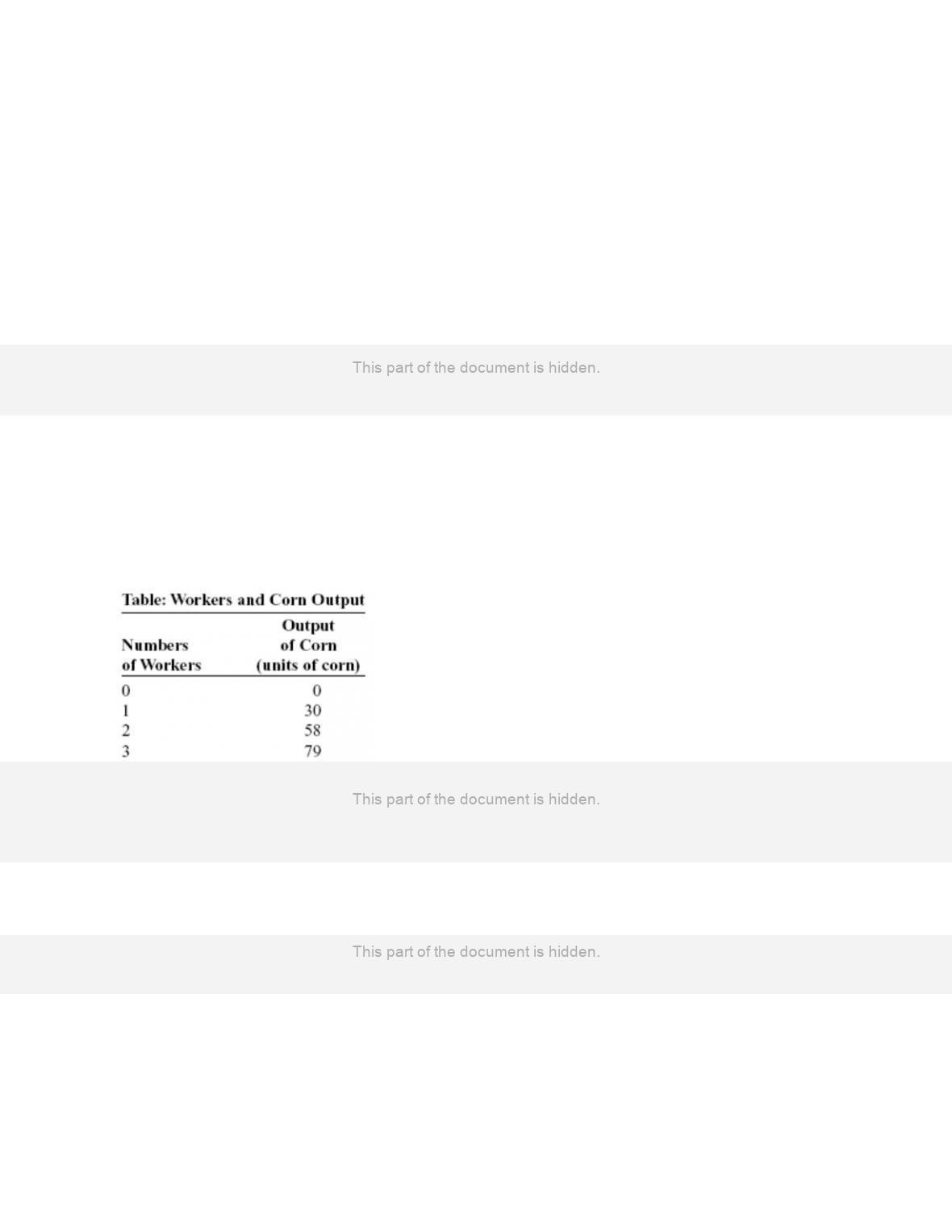
(Table: Workers and Corn Output) Use Table: Workers and Corn Output. Laura is a
price-taking farmer who produces corn. Assume that the wage rate for workers is $130
and the price per bushel of corn is $10. Suppose that Laura is employing 2 workers. If
she adds the third worker, her profits will:
A)
increase by $79.
B)
decrease by $51.
C)
decrease by $19.
D)
increase by $80.

Page 23
103.
(Table: Workers and Corn Output) Use Table: Workers and Corn Output. Laura is a
price-taking farmer who produces corn. Assume that the wage rate for workers is $125
and the price per bushel of corn is $10. To maximize profits, Laura should employ
_____ workers.
A)
2
B)
3
C)
4
D)
6
104.
(Table: Workers and Corn Output) Use Table: Workers and Corn Output. Laura is a
price-taking farmer who produces corn. Assume that the wage rate for workers is $125
and the price per bushel of corn is $10. Suppose that Laura is employing 7 workers. If
she reduces employment to 6 workers, her profits will:
A)
increase by $20.
B)
decrease by $970.
C)
increase by $105.
D)
increase by $90.
105.
(Table: Workers and Corn Output) Use Table: Workers and Corn Output. Laura is a
price-taking farmer who produces corn. Assume that the wage rate for workers is $250
and the price per bushel of corn is $20. Laura should hire _____ workers to maximize
profits.
A)
1
B)
2
C)
4
D)
7
106.
(Table: Workers and Corn Output) Use Table: Workers and Corn Output. Laura is a
price-taking farmer who produces corn. Assume that the wage rate for workers is $130
and the price per bushel of corn is $10. Suppose that Laura acquires more land and as a
result the output that can be produced by any given number of workers doubles. Laura
should hire _____ workers to maximize profits.
A)
4
B)
5
C)
6
D)
7

Page 24
Use the following to answer questions 107-110:
107.
(Table: Employment and Output) Use Table: Employment and Output. In the table, if
the price of a bushel of wheat is $10, then the value of the marginal product of the third
worker is:
A)
$15.
B)
$150.
C)
$170.
D)
$510.
108.
(Table: Employment and Output) Use Table: Employment and Output. In the table, if
the price of a bushel of wheat is $10, then the value of the marginal product of the fifth
worker is:
A)
$11.
B)
$110.
C)
$90.
D)
$750.
Page 25
109.
(Table: Employment and Output) Use Table: Employment and Output. In the table, if
the price of a bushel of wheat is $5 and the price of labor (wage) is $40, then the
profit-maximizing quantity of labor is:
A)
1.
B)
3.
C)
6.
D)
8.
110.
(Table: Employment and Output) Use Table: Employment and Output. In the table, if
the price of a bushel of wheat is $10 and the price of labor (wage) is $120, then the
profit-maximizing quantity of labor is:
A)
1.
B)
3.
C)
4.
D)
6.
Use the following to answer questions 111-114:
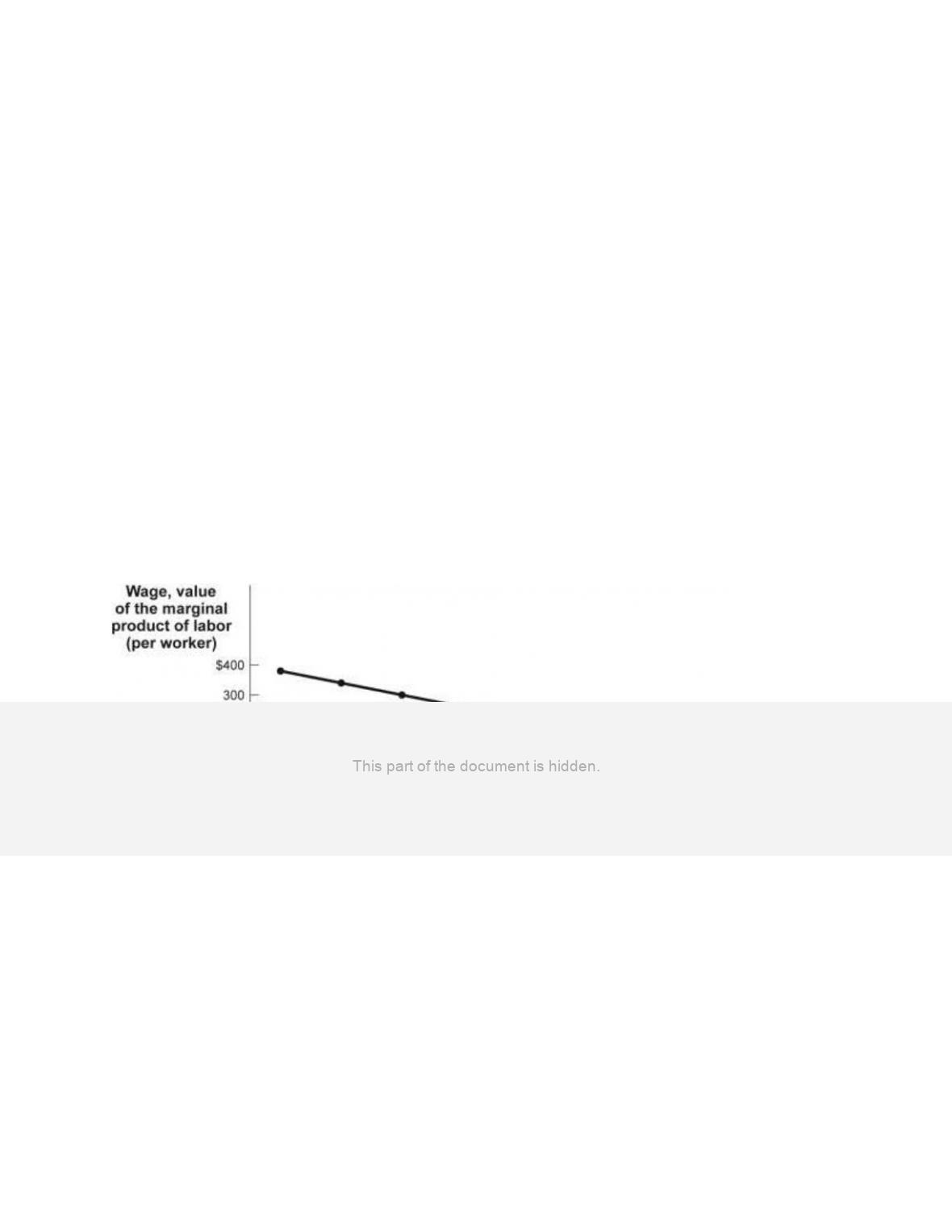
Figure: The Value of the Marginal Product Curve
111.
(Figure: The Value of the Marginal Product Curve) Use Figure: The Value of the
Marginal Product Curve. In the figure, if the market wage rate increases, then the:
A)
VMPL curve will shift to the right.
B)
profit-maximizing quantity of labor will increase.
C)
VMPL curve will shift to the left.
D)
profit-maximizing quantity of labor will decrease.

Page 26
112.
(Figure: The Value of the Marginal Product Curve) Use Figure: The Value of the
Marginal Product Curve. In the figure, the VMPL curve will shift to the right if:
A)
the wage rate increases.
B)
a technological advance makes labor more productive.
C)
the price of the good that the labor produces decreases.
D)
the wage rate decreases.
113.
(Figure: The Value of the Marginal Product Curve) Use Figure: The Value of the
Marginal Product Curve. In the figure, if a technological advance makes labor more
productive and everything else stays the same, then the profit-maximizing quantity of
labor:
\\
A)
will increase.
B)
will decrease.
C)
will stay the same.
D)
cannot be determined.
114.
(Figure: The Value of the Marginal Product Curve) Use Figure: The Value of the
Marginal Product Curve. In the figure, if the price of the good increases and everything
else stays the same, then the profit-maximizing quantity of labor:
A)
will increase.
B)
will decrease.
C)
will stay the same.
D)
cannot be determined.
Use the following to answer questions 115-125:

115.
(Table: Value of the Marginal Product of Labor and Demand) Use Table: Value of the
Marginal Product of Labor and Demand. In the table, the total product of labor is shown
for the hourly production of power cords. Assume that the market for power cords is
perfectly competitive. If the price of a power cord is $2, the value of the marginal
product for the fifth worker is:
A)
$0.
B)
$20.
C)
$40.
D)
$60.
116.
(Table: Value of the Marginal Product of Labor and Demand) Use Table: Value of the
Marginal Product of Labor and Demand. In the table, the total product of labor is shown
for the hourly production of power cords. Assume that the market for power cords is
perfectly competitive. If the price of a power cord is $2, the value of the marginal
product for the third worker is:
A)
$2.
B)
$10.
C)
$60.
D)
$80.
117.
(Table: Value of the Marginal Product of Labor and Demand) Use Table: Value of the
Marginal Product of Labor and Demand. In the table, the total product of labor is shown
for the hourly production of power cords. Assume that the market for power cords is
perfectly competitive. If the price of a power cord is $2 and the market wage rate is $20
per hour, the profit-maximizing quantity of labor is _____ workers.
A)
2
B)
4
C)
6
D)
8
118.
(Table: Value of the Marginal Product of Labor and Demand) Use Table: Value of the
Marginal Product of Labor and Demand. In the table, the total product of labor is shown
for the hourly production of power cords. Assume that the market for power cords is
perfectly competitive. If the price of a power cord is $2 and the market wage rate is $60
per hour, the profit-maximizing quantity of labor is _____ workers.
A)
0
B)
2
C)
4
D)
6

Page 28
119.
(Table: Value of the Marginal Product of Labor and Demand) Use Table: Value of the
Marginal Product of Labor and Demand. In the table, the total product of labor is shown
for the hourly production of power cords. Assume that the market for power cords is
perfectly competitive. If the price of a power cord is $2 and the market wage rate is
$100 per hour, the profit-maximizing quantity of labor is _____ workers.
A)
0
B)
2
C)
4
D)
6
120.
(Table: Value of the Marginal Product of Labor and Demand) Use Table: Value of the
Marginal Product of Labor and Demand. In the table, the total product of labor is shown
for the hourly production of power cords. Assume that the market for power cords is
perfectly competitive. If the price of a power cord is $4 and the market wage rate is $80
per hour, the profit-maximizing quantity of labor is _____ worker(s).
A)
1
B)
3
C)
5
D)
7
121.
(Table: Value of the Marginal Product of Labor and Demand) Use Table: Value of the
Marginal Product of Labor and Demand. In the table, the total product of labor is shown
for the hourly production of power cords. Assume that the market for power cords is
perfectly competitive. If the price of a power cord is $4 and the market wage rate is
$120 per hour, the profit-maximizing quantity of labor is _____ workers.
A)
0
B)
2
C)
3
D)
4
122.
(Table: Value of the Marginal Product of Labor and Demand) Use Table: Value of the
Marginal Product of Labor and Demand. In the table, the total product of labor is shown
for the hourly production of power cords. Assume that the market for power cords is
perfectly competitive. The price of a power cord is $2, the market wage rate is $40 per
hour, and 8 workers are hired. Profit can be maximized by hiring _____ worker(s).
A)
1 more
B)
2 more
C)
1 fewer
D)
3 fewer
Page 29
123.
(Table: Value of the Marginal Product of Labor and Demand) Use Table: Value of the
Marginal Product of Labor and Demand. In the table, the total product of labor is shown
for the hourly production of power cords. Assume that the market for power cords is
perfectly competitive. The price of a power cord is $2, the market wage rate is $40 per
hour, and 4 workers are hired. Profit can be maximized by hiring _____ worker(s).
A)
1 more
B)
2 more
C)
1 fewer
D)
2 fewer
124.
(Table: Value of the Marginal Product of Labor and Demand) Use Table: Value of the
Marginal Product of Labor and Demand. In the table, the total product of labor is shown
for the hourly production of power cords. Assume that the market for power cords is
perfectly competitive. The price of a power cord is $2, the market wage rate is $20 per
hour, and 8 workers are hired. Profit can be maximized by hiring _____ worker(s).
A)
1 more
B)
2 more
C)
1 fewer
D)
2 fewer
125.
(Table: Value of the Marginal Product of Labor and Demand) Use Table: Value of the
Marginal Product of Labor and Demand. In the table, the total product of labor is shown
for the hourly production of power cords. Assume that the market for power cords is
perfectly competitive. If the price of a power cord is $2 and the wage rate is $90 per
hour, the profit-maximizing quantity of labor is _____ workers.
A)
0
B)
2
C)
4
D)
6

Page 30
Use the following to answer questions 126-138:
Figure: The Demand for Bricklayers
126.
(Figure: The Demand for Bricklayers) Use Figure: The Demand for Bricklayers. If the
equilibrium market wage for bricklayers is $100 per day, _____ bricklayers will be
hired by this masonry firm.
A)
4
B)
5
C)
6
D)
There is insufficient information to make this decision.
127.
(Figure: The Demand for Bricklayers) Use Figure: The Demand for Bricklayers. The
equilibrium market wage for bricklayers is determined by:
A)
the firm hiring the bricklayers.
B)
demand and supply in the market for bricklayers.
C)
the government.
D)
where VMPLbricklayers = MPbricklayers × P of output.

Page 31
128.
(Figure: The Demand for Bricklayers) Use Figure: The Demand for Bricklayers. The
equilibrium market wage for bricklayers is $100. For a profit-maximizing firm at the
equilibrium level of output, the VMPLbricklayers:
A)
is $200.
B)
is equal to the market wage rate.
C)
is irrelevant since the firm is a price taker.
D)
cannot be determined from the information provided.
129.
(Figure: The Demand for Bricklayers) Use Figure: The Demand for Bricklayers. The
equilibrium market wage for bricklayers is $100 a day, but a minimum wage of $130 a
day for bricklayers is set by the government. As a result:
A)
6 workers will now be hired by the firm.
B)
three workers who would have been employed at the previous $100 market wage
are now unemployed.
C)
all bricklayers are better off.
D)
construction firms will shut down.
130.
(Figure: The Demand for Bricklayers) Use Figure: The Demand for Bricklayers. Which
statement is TRUE?
A)
Bricklayers should be hired whenever the value of the marginal product of
bricklayers is greater than or equal to the market wage rate of bricklayers.
B)
The profit-maximizing condition for firms hiring bricklayers is where
VMPLbricklayers is less than the market wage rate.
C)
The profit-maximizing condition for firms hiring bricklayers is where MPbricklayers
equals the market wage rate.
D)
Bricklayers should be hired whenever the market wage rate of bricklayers is greater
than the value of the marginal product of bricklayers.
131.
(Figure: The Demand for Bricklayers) Use Figure: The Demand for Bricklayers. If the
price for bricks laid in the wall is $0.10 a brick, the marginal product of the second
bricklayer is _____ bricks.
A)
1,500
B)
1,400
C)
1,300
D)
1,200
Page 32
132.
(Figure: The Demand for Bricklayers) Use Figure: The Demand for Bricklayers. If the
price for bricks laid in the wall is $0.10 a brick, the total production of bricks by the first
three bricklayers is _____ bricks.
A)
1,500
B)
2,900
C)
4,200
D)
5,400
133.
(Figure: The Demand for Bricklayers) Use Figure: The Demand for Bricklayers. If the
equilibrium market wage rate for bricklayers rises from $80 to $100, the _____
bricklayers will _____.
A)
demand for; rise
B)
quantity demanded of; rise
C)
demand for; fall
D)
quantity demanded of; fall
134.
(Figure: The Demand for Bricklayers) Use Figure: The Demand for Bricklayers. If the
equilibrium market wage for bricklayers falls from $110 to $100, the _____ bricklayers
will _____.
A)
demand for; rise
B)
quantity demanded of; rise
C)
demand for; fall
D)
quantity demanded of; fall
135.
(Figure: The Demand for Bricklayers) Use Figure: The Demand for Bricklayers. If there
is an increase in technology that increases the productivity of bricklayers, then the value
of the marginal product of the sixth bricklayer will be _____ than _____.
A)
less; $80
B)
greater; $100
C)
less; $60
D)
greater; $110
136.
(Figure: The Demand for Bricklayers) Use Figure: The Demand for Bricklayers. If a
shortage in the market for mortar lowers bricklayers’ productivity, then the value of the
marginal product of the eighth bricklayer will be:
A)
less than $80.
B)
greater than $100.
C)
equal to $100.
D)
greater than $80.

Page 33
137.
(Figure: The Demand for Bricklayers) Use Figure: The Demand for Bricklayers. If the
equilibrium market wage for bricklayers is $80 per day, then this masonry firm will hire
_____ bricklayers.
A)
4
B)
6
C)
5
D)
8
138.
(Figure: The Demand for Bricklayers) Use Figure: The Demand for Bricklayers. The
equilibrium market wage for bricklayers is $100 a day, but there is a new minimum
wage of $120. Therefore:
A)
3 workers who otherwise would have been employed by this firm are now
unemployed.
B)
4 workers will now be hired by this firm.
C)
all bricklayers are better off.
D)
this firm will shut down.
139.
Which group had the HIGHEST median earnings in the U.S. labor market in 2015?
A)
White men
B)
women, regardless of ethnicity
C)
African-Americans
D)
Hispanics
140.
Which group had the LOWEST median earnings in the U.S. labor market in 2015?
A)
White men
B)
women, regardless of ethnicity
C)
African-Americans
D)
Hispanics
141.
In 2015, women, regardless of ethnicity, earned:
A)
the same as White men.
B)
about twice as much as White men.
C)
about 75% of the earnings for White men.
D)
about 25% of the earnings for White men.
Page 34
142.
Wage differences across jobs that reflect the fact that some jobs are less pleasant than
others are called:
A)
efficiency wages.
B)
market power.
C)
compensating differentials.
D)
discrimination.
143.
Which example illustrates wage disparity due to compensating differentials?
A)
The median earnings of White men are more than are the median earnings of
African-Americans.
B)
People with graduate degrees usually have higher earnings than do people who did
not graduate from high school.
C)
Nick Saban, the football coach at the University of Alabama, earns more than does
an economics professor.
D)
Crab fishermen on the Bering Sea earn more than do clerks who sell goldfish at a
pet store.
144.
Sam and Bob have the same educational background. Both have been policemen in
Memphis for 10 years. Sam works from 11 P.M. until 7 A.M., and Bob works from 7
A.M. until 3 P.M. Sam’s salary is $800 per month higher than Bob’s salary. This
example illustrates a wage disparity due to:
A)
efficiency wages.
B)
market power.
C)
compensating differentials.
D)
discrimination.
145.
Which statement is MOST likely an example of wage disparity due to differences in
talent and ability?
A)
The median earnings of White men are more than are the median earnings of
African-Americans.
B)
Clerks at a Gap in New York City earn more than do clerks at a Gap in Topeka,
Kansas.
C)
Nick Saban, the football coach at the University of Alabama, earns more than does
the local high school football coach.
D)
Crab fishermen on the Bering Sea earn more than do clerks who sell goldfish at a
pet store.
Page 35
146.
Which statement is MOST likely an example of wage disparity due to differences in
human capital?
A)
The median earnings of White men are more than are the median earnings of
African-Americans.
B)
People with graduate degrees usually have higher earnings than do people who did
not graduate from high school.
C)
Nick Saban, the football coach at the University of Alabama, earns more than does
an economics professor.
D)
Crab fishermen on the Bering Sea earn more than do clerks who sell goldfish at a
pet store.
147.
Actual wage differentials can be partially explained by which factor(s)?
I. differences in talent
II. different amounts of human capital
III. compensating differentials
A)
I only
B)
I and II only
C)
III only
D)
I, II, and III
148.
Which statement describes a compensating differential?
A)
Tiger Woods gets paid more than does a college professor.
B)
A window washer working in a suburban residential subdivision gets paid less than
does one who is washing windows on the outside of a skyscraper.
C)
A nuclear scientist gets paid more than does a janitor working in the same building.
D)
On average, White men get paid more than do women of all ethnicities.
149.
A new teacher often makes less than a teacher with 20 years’ experience because of:
A)
discrimination.
B)
differences in human capital.
C)
efficiency wages.
D)
differences in physical capital.
150.
Which factor does NOT partially explain wage differentials?
A)
different amounts of human capital
B)
compensating differentials
C)
differences in talent
D)
differences in capital

Page 36
151.
A nurse willing to work the midnight to 8 A.M. shift may make more than one who
works 8 A.M. to 4 P.M. because of:
A)
discrimination.
B)
market power.
C)
compensating differentials.
D)
efficiency wages.
152.
A small college employs two economists. Rob has been employed by the college for 15
years, and Nasrin has been employed for 1 year. Rob’s salary is significantly higher than
is Nasrin’s, although both have their doctoral degrees in economics. Each professor
averages one publication per year, and both are excellent teachers. Given this
information, the wage difference is BEST explained by:
A)
compensating differentials.
B)
differences in human capital.
C)
discrimination.
D)
differences in talent.
153.
Employers can sometimes organize to pay lower wages when:
A)
efficiency wages are used to drive down morale and break up a labor union.
B)
health maintenance organizations (HMOs) organize to get groups of doctors to
work together at lower wages than they would earn on their own.
C)
labor unions are not allowed to engage in collective bargaining.
D)
corporations force the minimum wage down.
154.
In 2015, unions represent approximately _____% of employees of private businesses.
A)
1
B)
7
C)
19
D)
29
155.
Which statement about unions is TRUE?
A)
Laws allow unions to discriminate on the basis of gender and ethnicity.
B)
Unions bargain for better working conditions at the cost of higher wages.
C)
Unions cause a surplus of labor by bargaining for wages that are higher than the
value of the marginal product of labor.
D)
Unions cause compensating differentials.
Page 37
156.
In the past 30 years, the ability of unions to increase wages and improve working
conditions for their members has:
A)
increased.
B)
decreased.
C)
remained constant.
D)
proved the marginal productivity theory of income distribution to be false.
157.
Above-equilibrium wages paid by some employers as an incentive for better
performance are called:
A)
efficiency wages.
B)
market power wages.
C)
compensating differentials.
D)
discrimination.
158.
Because the efficiency wage is _____ the equilibrium wage, it may lead to a _____ of
labor.
A)
below; shortage
B)
below; surplus
C)
above; shortage
D)
above; surplus
159.
An efficiency wage is:
A)
above the equilibrium wage and is paid to provide workers with an incentive to
increase productivity.
B)
efficient because it is exactly equal to the wage rate implied by the marginal
productivity theory.
C)
determined by collective bargaining between unions and management.
D)
equal to the value of the marginal product of labor adjusted so as to make the
structure of compensation more equitable.
160.
According to the efficiency wage model, efficiency wages do NOT:
A)
reduce unemployment.
B)
represent a response to a type of market failure.
C)
get set above the equilibrium wage.
D)
reduce worker turnover.
Page 38
161.
Suppose that Mike wants to pay efficiency wages to help in the construction of his
beach home. If the prevailing wage rate for electricians is $22 per hour in his area, one
possible efficiency wage he could pay would be:
A)
$22.
B)
$26.
C)
$18.
D)
the minimum wage.
162.
According to the _____, workers may earn a wage rate higher than the value of their
marginal product because it provides an incentive to perform efficiently.
A)
marginal productivity of income distribution theory
B)
efficiency-wage model
C)
diminishing-returns theory
D)
increasing-returns model
163.
One reason that wage discrimination based on gender or ethnicity can continue is:
A)
market interference or market failure associated with above-equilibrium wages.
B)
market competition making it profitable to engage in discrimination.
C)
it is justified by the marginal productivity theory of income distribution.
D)
because, as the South African experience with apartheid showed, discrimination
leads to more rapid economic growth.
164.
Scott’s wage is $25 per hour and he works 50 hours a week, which is his optimal labor
supply at that wage. His marginal utility of one hour of leisure is equal to the:
A)
marginal utility he gets from $25 worth of goods.
B)
marginal utility he gets from more than $25 worth of goods.
C)
marginal utility he gets from less than $25 worth of goods.
D)
substitution effect.
165.
The more work people do, all other things unchanged, the:
A)
more their free time.
B)
greater their nonmarket use of time.
C)
less income they have.
D)
less leisure they have.
166.
The price of an extra hour of leisure is:
A)
$1.
B)
the hourly wage rate.
C)
the same as the price of money.
D)
the total utility of labor.

167.
The opportunity cost of an extra hour of leisure is:
A)
$1.
B)
the hourly wage rate.
C)
the same as the price of money.
D)
always less than the value of the marginal product of labor.
168.
A _____ wage will _____ the _____ leisure.
A)
lower; increase; opportunity cost of
B)
higher; always decrease; amount of time spent on
C)
higher; increase; opportunity cost of
D)
lower; not affect; amount of time spent on
169.
Gabriella often faces a trade-off between time at the beach and time working as a model.
She earns $40 per hour as a model and values going to the beach at the same price.
When explaining this to her parents, she says, “The marginal utility per hour working is
the same as the marginal utility per hour of going to the beach.” This example
illustrates:
A)
indifference curves.
B)
the substitution effect.
C)
the income effect.
D)
optimal time allocation.
170.
The opportunity cost of an hour of leisure:
A)
is always assumed to be equal to the minimum wage.
B)
is the hourly wage rate.
C)
increases if the hour of leisure time is spent in an unproductive activity.
D)
decreases if the hour of leisure is spent in a productive activity.
171.
John is an entrepreneur who owns an auto body repair shop. John’s business is booming,
and his salary is rising. John’s labor supply curve will be _____ if the substitution effect
is _____ the income effect.
A)
upward sloping; smaller than
B)
downward sloping; smaller than
C)
horizontal; equal to
D)
vertical; greater than
Page 40
172.
Suppose that Professor Jones receives a promotion and an increase in her annual salary.
Her labor supply curve will be _____ if the substitution effect is _____ than the income
effect.
A)
upward sloping; greater
B)
upward sloping; smaller
C)
downward sloping; greater
D)
vertical; greater
173.
Suppose that the government increases the child tax credit, which increases the after-tax
income of families with children. How will this decision affect the amount of labor
supplied by parents, assuming that leisure is a normal good?
A)
Since the income and substitution effects move in the same direction, the amount
of labor supplied will increase.
B)
Since the income effect will dominate the substitution effect, the amount of labor
supplied will decrease.
C)
We don’t know what will happen to the quantity of labor supplied, since we don’t
know whether the income effect or substitution effect will dominate.
D)
The labor supply curve will shift right, so the quantity of labor will also increase.
174.
André has asked his boss for a pay raise. His boss is concerned that, if he increases
André’s wage, André might work less. In other words, André‘s boss is concerned that
leisure is a normal good for André and that his:
A)
income and substitution effects might move in the same direction.
B)
income effect might be greater than his substitution effect.
C)
substitution effect might be greater than his income effect.
D)
income and substitution effects might cancel out to zero.
175.
Tim works 51 hours per week, and his wage is $35 per hour. If his wage increases to
$70 per hour:
A)
the substitution effect implies that he will work less.
B)
if leisure is a normal good, the income effect implies that he will work more.
C)
if leisure is a normal good, the income effect will reinforce the substitution effect
and he will work more.
D)
the substitution effect implies that he will work more.
176.
Lisa works 46 hours a week at $10 an hour. If her wage increases to $16.50:
A)
the substitution effect implies that she will work less.
B)
if leisure is a normal good, the income effect implies that she will work less.
C)
if leisure is a normal good, the income effect will reinforce the substitution effect
and she will work less.
D)
Lisa’s marginal product of labor has decreased.